Running an e-commerce business in Ireland provides exciting opportunities, but it also presents distinct bookkeeping challenges. For financial clarity and compliance, it is imperative to maintain effective bookkeeping in light of online sales, inventory management, and fluctuating cash flow. In this guide we will go over the basics of e commerce business bookkeeping, discussing procedures, typical mistakes, and recommended strategies. Additionally, discover how FORTI can assist with your e-commerce bookkeeping needs, allowing you to concentrate on expansion as we handle the details.
Why Bookkeeping Matters for E-Commerce Businesses
Bookkeeping is not merely a compliance obligation for e-commerce enterprises; it is a strategic asset. Here’s why it’s important:
1. Inventory Management
Accurate inventory tracking is essential for comprehending profit margins, guaranteeing appropriate stock levels, and preventing costly write-offs.
2. VAT Compliance
VAT on sales must be collected by Irish e-commerce companies. Maintaining accurate records helps you avoid fines by making sure you report and pay VAT accurately.
3. Cash Flow Management
Maintaining a healthy cash flow and reinvesting in growth requires accurate tracking of income and expenses when transaction volumes are high.
4. Financial Clarity for Decision-Making
Strategic decisions are aided by the insights that detailed records offer into profitable products, seasonal trends, and consumer purchasing patterns.
Key Bookkeeping Steps for E-Commerce Businesses
Here’s how to simplify your e-commerce bookkeeping step-by-step:
1. Set Up a Dedicated Business Bank Account
It’s essential to have a dedicated business bank account for all your e-commerce transactions to maintain a distinction between your business finances and make tracking easier while also complying with Irish tax laws.
2. Track All Sales and Income Sources
Ensure to keep track of all earnings received from sources such as sales from your website through third-party marketplaces, as well as other revenue streams. It’s important to monitor not only the income but also consider any fees and shipping costs to better understand the overall profitability of your business. Make sure you don’t just focus on how much you earn but also take into account any charges and shipping expenses to get a picture of how profitable your business is.
3. Record Cost of Goods Sold (COGS)
The expenses linked to creating or acquiring the goods you sell are reflected in your COGS (Cost of Goods Sold). It’s important to keep your COGS up to date to ensure the profitability and inventory valuation are accurate; this includes costs related to manufacturing processes such as shipping and warehousing expenses.
4. Manage Inventory Effectively
In the world of businesses, like e commerce stores and shops selling goods over the internet or other electronic platforms, inventories are a significant asset to manage well and keep track of properly to run a successful operation smoothly and effectively which includes maintaining precise records of available stock levels monitoring expenses and updating data for any inventory losses or reductions due to theft damage or other factors that may affect the overall inventory quantity The use of specialised software for inventory management can make this entire process easier by seamlessly connecting with your accounting system, allowing for better organisation and control over your business operations.
5. Record Expenses and Overheads
Remember to keep track of all your business costs, such as advertising expenses and hosting fees, along with shipping and software subscriptions, in order to maximise your deductions and lower your income effectively.
6. Track VAT on Sales and Purchases
Irish online businesses are required to apply VAT on transactions within the EU and ensure reporting of it by maintaining records of VAT on sales as well as purchases and expenses. Utilise accounting tools to streamline VAT calculations and schedule reminders for submitting VAT returns.
7. Reconcile Payment Gateway Fees
Make sure to factor in the transaction fees charged by payment gateways such as PayPal, Stripe, or credit card processors when reconciling the income with the sales figures.
8. Monitor Accounts Receivable and Payable
It’s crucial, for businesses that offer credit or have vendor accounts to keep an eye, on money owed and money coming due to ensure cash flow and prevent penalties for late payments.
9. Generate Monthly Financial Reports
Regular monthly reports that consist of profit and loss statements along, with balance sheets and cash flow statements offer insights, into the well being of your business entity.Use these reports to assess profitability and make informed business choices.
Common errors in e-commerce bookkeeping
1. Not Tracking Inventory Changes Accurately
Profit calculations may become erroneous if stock level fluctuations are ignored. Utilise software to keep tabs on inventory and make necessary record adjustments.
2. Failing to Reconcile Payment Gateway Fees
Payment gateway fees mount up. Ignoring the need to reconcile these fees may lead to unexpected discrepancies and inaccurate revenue tracking. If you dont record the expenses, you end up paying additional taxes.
3. Overlooking VAT Compliance
Inaccurately recording VAT on both domestic and EU sales can result in expensive fines and problems with Revenue compliance.
4. Not Separating Income Sources
Revenue can be easily misclassified when there are several sales channels. Better financial analysis and tax accuracy are made possible by tracking each source independently.
5. Inconsistent COGS Recording
Inaccurate profit margins and skewed financial statements are the results of inconsistent cost tracking. Update COGS monthly for accuracy on regular basis. Keep your books clean and health.
6. Neglecting to Record Small Expenses
Running a store involves minor costs, like packaging materials and software subscriptions that should be accurately tracked to gauge the actual profitability of the business.
Best Practices for Efficient E-Commerce Bookkeeping
Use E-Commerce Accounting Software
Accounting software tailored for e-commerce businesses, such as QuickBooks Commerce or Xero, allows seamless integration with sales platforms to automate inventory tracking and manage VAT and expenses efficiently without the need for data entry. Reducing errors significantly.
Implement Inventory Management Tools
Tools such as TradeGecko or the inventory management features integrated into Shopify assist in monitoring stock quantities and replenishment requirements while also managing costs of goods sold (COGS). This efficient system saves time. Effectively mitigates problems related to insufficient stock levels.
Schedule Monthly Financial Reviews
Regularly checking your statements every month enables you to identify patterns and manage your funds effectively while also making changes in a timely manner. Moreover, reviewing your finances on a regular basis ensures that you are well prepared for tax season with records that adhere to regulations.
Plan for VAT and Tax Payments
Online retail companies should remember to submit VAT returns on a basis and allocate funds each month to account for VAT and taxes so that they are ready when its time to make payments.
Work with a Bookkeeper Experienced in E-Commerce
Managing finances for e-commerce comes with its own set of hurdles to overcome—an accountant well acquainted with digital enterprises can navigate VAT issues and monitor inventory while assisting in optimising tax benefits.
Monthly Bookkeeping Checklist for E-Commerce Businesses
Your bookkeeping procedure can be streamlined and you can avoid missing any important steps by using a monthly checklist:
| Task | Frequency | Completed (Y/N) |
| Record all sales and income sources | Weekly | |
| Update inventory and COGS | Weekly | |
| Record expenses and overheads | Weekly | |
| Reconcile bank and payment gateway fees | Monthly | |
| Track VAT on sales and purchases | Monthly | |
| Generate profit and loss statement | Monthly | |
| Review cash flow and inventory levels | Monthly | |
| Prepare VAT return (if applicable) | Quarterly |
Monthly and Annual Bookkeeping and Tax Compliance Activities
Monthly Bookkeeping Activities:
- Sales Invoices and Revenue Recording
- Purchase Invoices and Expense Tracking
- Bank Account Reconciliation
- Creditors Reconciliation (Supplier Balances)
- Debtors Reconciliation (Customer Balances)
- Payroll and PAYE Reconciliation
- Loan Account Reconciliation
- Other Reconciliation Tasks (e.g., Petty Cash, Intercompany Accounts)
Bi-Monthly and Year-End Tax & Compliance Activities:
- Bi-Monthly VAT Returns (Cash or Accrual Basis Reconciliation)
- Payroll Processing and Submissions
- Year-End Financial Reconciliations
- Preparation of Financial Statements
- CT1 Corporate Tax Filing
- B1 Annual Return Filing
- Personal Income Tax Returns (Self-Assessment)
How FORTI Can Help Your E-Commerce Business
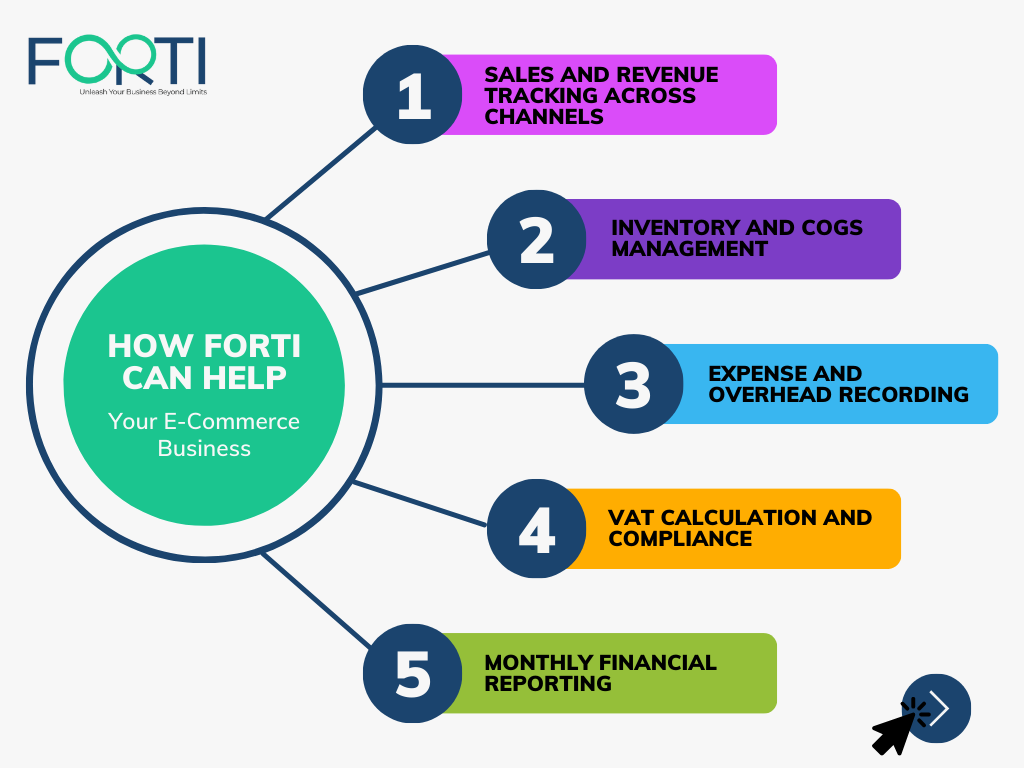
We recognise the requirements of online retail companies and offer tailored accounting solutions to simplify your financial processes and ensure precision and transparency for you to concentrate on expanding your enterprise.
Our Bookkeeping Services for E-Commerce Businesses Include:
- Sales and Revenue Tracking Across Channels
We keep a record of earnings from every sales source. Compare payment gateway charges to guarantee revenue calculations. - Inventory and COGS Management
We make sure to keep our inventory records up-to-date and accurately calculate the cost of goods sold (COGS) to reflect our profit margins. - Expense and Overhead Recording
We keep a record of every cost related to our business operations. From packaging expenses to marketing expenditures. To make sure that we cover all the expenses incurred. - VAT Calculation and Compliance
We handle VAT computations for your sales in Ireland and the EU to guarantee reporting and submission to prevent any penalties. - Monthly Financial Reporting
To help you understand the performance of your business, FORTI offers monthly balance sheets, cash flow reports, and profit and loss statements. - Document Management for Tax Compliance
We prepare you for audits and tax filings by organising and safely storing all supporting documentation, including invoices and receipts.
Ready to streamline your e-commerce bookkeeping?
FORTI can handle the complexities of your e-commerce accounting. With our tailored bookkeeping solutions, you can maintain VAT compliance, manage inventory, and make data-driven growth decisions.