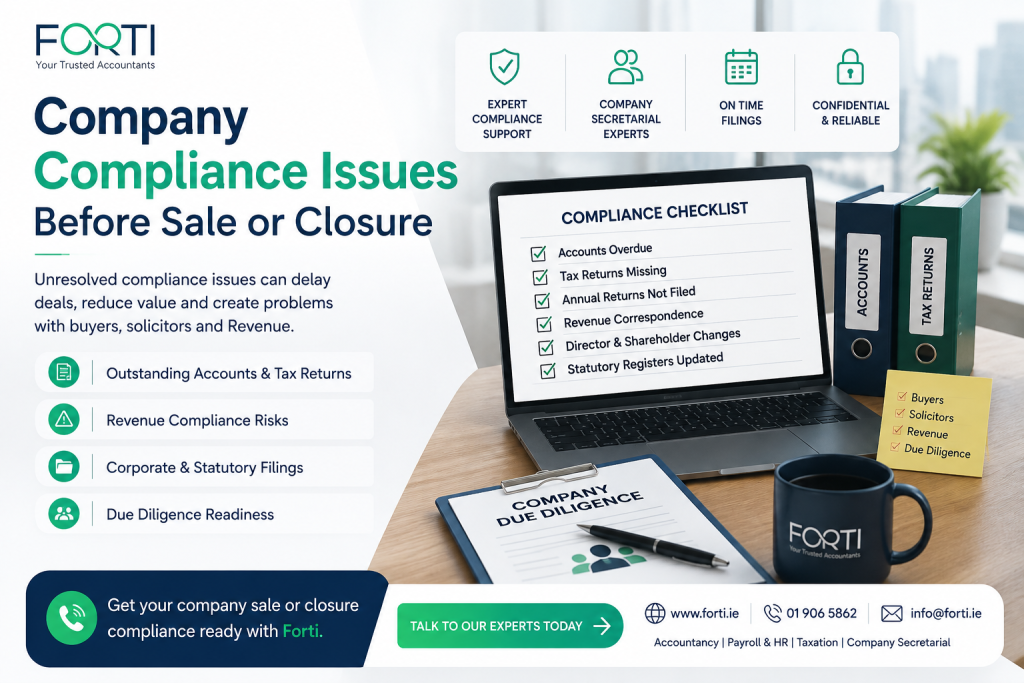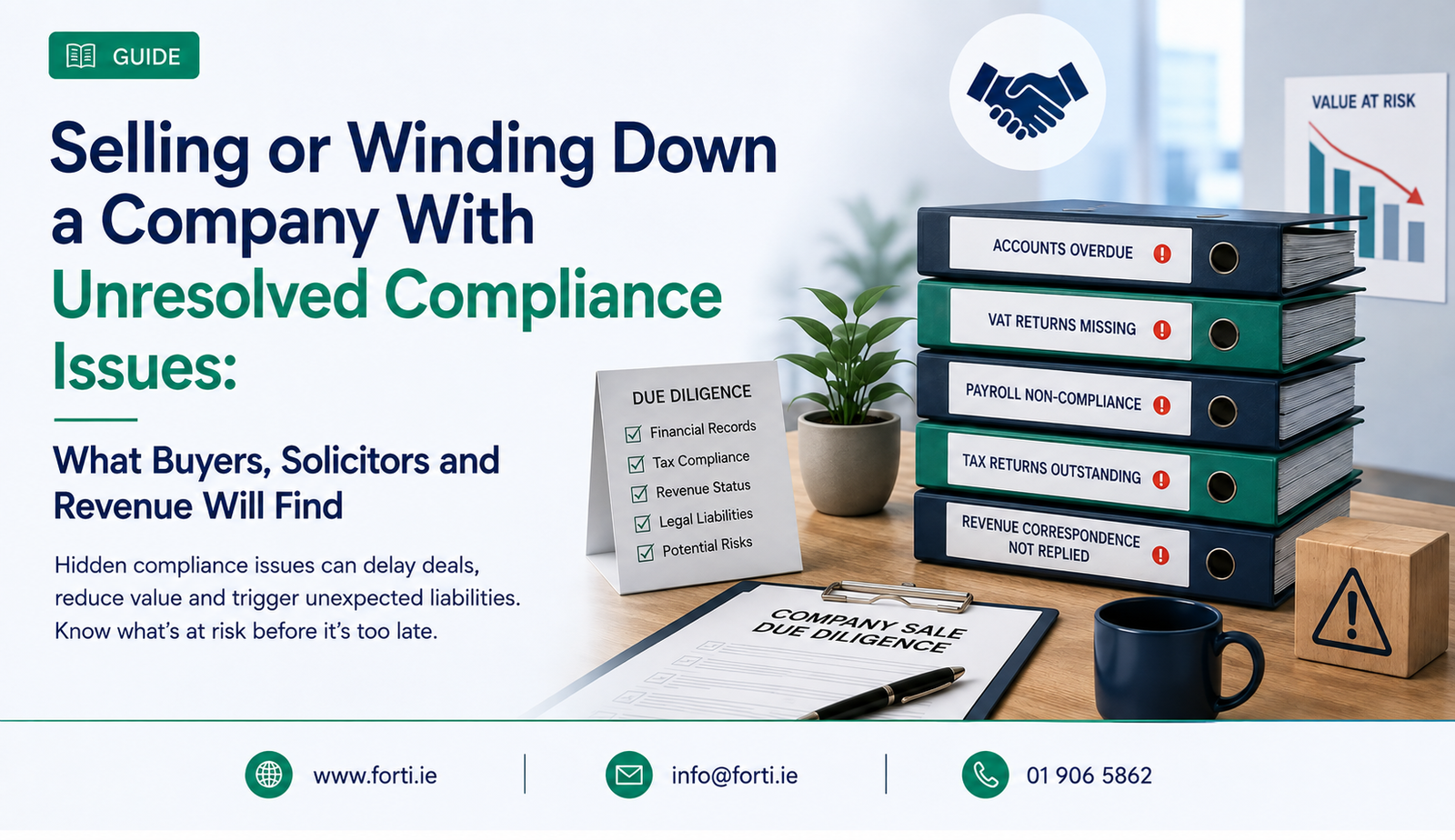
A missed annual return or an uncancelled VAT registration is one thing when nobody’s looking. It’s a different problem entirely when a buyer’s solicitor, an investor’s due diligence team, or Revenue’s own tax clearance system starts looking — which is exactly what happens the moment you try to sell, merge, or formally close a company.
Why Compliance History Becomes Visible at Exactly the Wrong Moment
Throughout this series we’ve looked at what happens when a business owner simply stops trading and leaves the paperwork unresolved. Selling a company, bringing in an investor, or even just formally winding it down properly surfaces every one of those gaps at once — because each process relies on independent, third-party verification of exactly the things that tend to get left until later: CRO filing history, Revenue’s tax clearance system, and the Register of Beneficial Ownership.
None of this is hidden. A company’s late filing history is publicly searchable on the CRO register, RBO discrepancies are checked as standard AML due diligence, and Revenue’s tax clearance status is verified electronically in real time. A buyer’s solicitor will find what’s there — the only question is whether it’s found before or after you’ve agreed a price.
Share Sale vs Asset Sale: Why Compliance History Matters Differently
Share Sale
When shares in the company are sold, the buyer acquires the company itself — its history, its liabilities, and its compliance record, warts and all. Every unresolved CRO filing, every unpaid Revenue liability, and every RBO discrepancy transfers with it unless specifically carved out. This is why share sale agreements lean so heavily on warranties and indemnities: the buyer is pricing in exactly this risk, and will expect the seller to stand behind it contractually.
Asset Sale
When the buyer instead purchases specific assets — a customer list, equipment, a brand, a lease — out of the company rather than the company itself, historic compliance issues are less likely to transfer directly. But the company itself still needs a clean compliance position to complete the sale in the first place: a Tax Clearance Certificate is often required to satisfy the buyer and their bank, and if the sale involves property, a CG50 clearance certificate is required under Section 980 of the Taxes Consolidation Act 1997 — without it, the purchaser is legally required to withhold part of the sale proceeds and remit them to Revenue.
What Due Diligence Actually Uncovers
- Late CRO filing history — publicly visible on the register and an immediate flag for any buyer’s solicitor running standard checks.
- Loss of audit exemption from a prior late filing — meaning historic accounts may need to be re-audited before a deal can close cleanly.
- An expired or refused Tax Clearance Certificate — Revenue’s electronic system checks compliance in real time and will not issue clearance while returns or liabilities remain outstanding.
- RBO mismatches — beneficial ownership details that don’t match the actual shareholding, a standard check under anti-money-laundering due diligence.
- Unresolved VAT, OSS, or foreign VAT registrations — particularly relevant for ecommerce or multi-country sellers, as covered in Part 3 of this series.
- A CG50 requirement the seller wasn’t aware applied — relevant wherever property or certain high-value assets form part of what’s being sold.
Preparing a Company for Sale or Formal Closure
- Bring every CRO annual return up to date well before entering negotiations — a clean filing history removes one of the most visible red flags in due diligence.
- Apply for a Tax Clearance Certificate early. The electronic system checks compliance automatically, and any gap will surface immediately rather than at the point you actually need it.
- Confirm the Register of Beneficial Ownership entry matches the current shareholding exactly, updating within 14 days of any change.
- Resolve any dormant, ceased-trading, or multi-country VAT ambiguity — as set out in Parts 1 through 3 of this series — so the buyer’s due diligence team isn’t the one working out what category the company actually falls into.
- If property or qualifying assets are involved, apply for CG50 clearance as soon as contracts are signed rather than waiting until closing, since Revenue can take up to several weeks to process it.
- Where the company won’t be sold at all but simply needs to close, follow the voluntary strike-off process from Part 2 rather than leaving it to lapse mid-negotiation.
What Happens If You Sell Anyway, Issues Unresolved
Deals don’t usually collapse outright over compliance gaps — they get renegotiated. A buyer who discovers late filings, a lapsed audit exemption, or an unresolved VAT position will typically respond in one of a few predictable ways: a reduction in price to reflect the cost of fixing it, a specific indemnity requiring the seller to cover any resulting liability after completion, or a delay to closing while the seller resolves the position. In each case, the seller ends up paying for the same fix they could have made earlier — just later, under time pressure, and with less negotiating leverage.
Case Studies
Case Study 1 — A Share Sale Delayed by an Expired Audit Exemption
A services company preparing to sell discovered during due diligence that a prior year’s late annual return had cost it audit exemption for two years — years for which the accounts had never actually been audited. Completion was delayed by several weeks while a retrospective audit was arranged, and the buyer negotiated a price reduction to reflect the delay and the risk.
Case Study 2 — A Missed CG50 Almost Cost the Seller Cash at Closing
A business owner selling a company that held a small commercial property assumed the sale would proceed like any other share transaction. Their solicitor identified that a CG50 clearance certificate was required under Section 980 given the property involved, and without it, the purchaser would have been legally required to withhold part of the proceeds. Applying as soon as contracts were signed avoided a hold-back at closing that would otherwise have tied up a meaningful portion of the sale price.
Case Study 3 — An RBO Mismatch That Slowed Down Investor Due Diligence
A founder seeking investment for an otherwise healthy business found the round delayed when the investor’s AML checks flagged a discrepancy between the Register of Beneficial Ownership and the company’s actual shareholding, following an earlier share transfer that had never been updated on the register. The correction itself was straightforward, but it added weeks to a process the founder had expected to close quickly.
(These case studies are illustrative composites reflecting patterns we see regularly among Irish business owners, not individual clients.)
Technical Appendix: Statutory Thresholds & Legal Mechanics
1. Capital Gains Tax Clearance (Section 980 & Form CG50A)
When an asset sale or a share sale involves specific Irish assets (such as land, buildings, goodwill, or unquoted shares deriving their value from Irish land), strict statutory thresholds apply under Section 980 of the Taxes Consolidation Act 1997:
- The Triggers: A Form CG50A clearance certificate is legally required if the disposal consideration exceeds:
- €500,000 for commercial property, land, business goodwill, or qualifying unquoted shares.
- €1,000,000 for residential property.
- The Withholding Penalty: If the seller fails to produce a valid CG50A certificate to the buyer prior to or at closing, the purchaser is legally mandated to withhold exactly 15% of the gross purchase price and remit it directly to Revenue within 30 days.
- Processing Timelines: Applications must be submitted electronically via the eCG50 facility on ROS (Revenue Online Service). Revenue standard processing times typically range from 3 to 4 weeks, meaning applications should ideally be initiated as soon as contracts are exchanged.
2. Companies Registration Office (CRO) & Audit Exemption Rules
Filing histories are scrutinized heavily during corporate transactions due to the severe downstream legal impacts of a missed deadline:
- Automatic Loss of Exemption: Under the Companies Act 2014, if a company files its annual return late by even one day, it automatically forfeits its right to claim an audit exemption for the financial year in question and the subsequent financial year.
- The Transaction Impact: If a company has traded through those years without an audit under the assumption it was exempt, it will be forced to commission a retrospective audit before a share sale can cleanly close. This frequently causes severe delays and triggers price chips from buyers.
3. Register of Beneficial Ownership (RBO) Compliance
- The 14-Day Rule: To comply with statutory Anti-Money Laundering (AML) frameworks, any internal corporate restructuring, share transfer, or allotment must be updated on the central Register of Beneficial Ownership within 14 days of the change.
- Due Diligence Friction: Discrepancies between the company’s internal stock transfer book and the public RBO register automatically flag during a buyer’s or investor’s standard AML checks, halting funds from being drawn down until rectified.
Key Action Checklist for Pre-Sale Due Diligence
| Compliance Area | Verification Action | Timing Requirement |
|---|---|---|
| 1.Tax Clearance Certificate (TCC) | Check ROS electronic status across all tax heads (VAT, Relevant Contracts Tax, Corporation Tax, PAYE/PRSI). | Run 6–8 weeks before negotiations to catch hidden flags. |
| 2.CG50 Clearance | File electronic application via eCG50 on ROS if transaction hits the €500k/€1m thresholds. | File immediately upon exchange of contracts. |
| 3.CRO History | Verify that no annual returns are pending and check for past late filings that might have triggered an audit requirement | Review before drafting the initial Heads of Terms. |
| 4.RBO Alignment | Cross-reference the central RBO register against the current register of members | Remediate any discrepancies at least 3 weeks prior to closing. |
Frequently Asked Questions
It’s frequently required by buyers, their banks, or as part of standard due diligence, even where not strictly a legal precondition of the sale itself. Applying early, since Revenue’s electronic system checks compliance automatically, avoids delay at the point you actually need it.
A Tax Clearance Certificate confirms your overall tax affairs are in order. A CG50 is a separate clearance specifically relevant where property or certain qualifying assets are part of the sale, confirming Revenue doesn’t require the purchaser to withhold part of the proceeds.
They rarely stop a sale outright, but they routinely delay it and give the buyer leverage to negotiate a lower price or demand a specific indemnity covering the risk.
Not entirely. While historic liabilities are less likely to transfer with specific assets rather than the company as a whole, the company itself typically still needs a Tax Clearance Certificate and, where property is involved, a CG50 to complete the transaction.
We prepare companies for sale or formal closure well before a buyer’s solicitor gets involved — bringing CRO filings current, securing tax clearance, correcting RBO entries, and resolving any dormant or ceased-trading ambiguity, so the compliance story is already clean by the time due diligence begins.
Preparing to Sell or Close? Talk to Forti Early
Monthly bookkeeping and management accounts from €195/month + VAT
Irish company formation, CRO fee included: €250
Tax clearance, RBO correction and pre-sale compliance clean-up available on request
If a sale, investment round, or formal closure is on the horizon, get in touch with the Forti team at forti.ie before a buyer’s due diligence team finds the gaps for you.