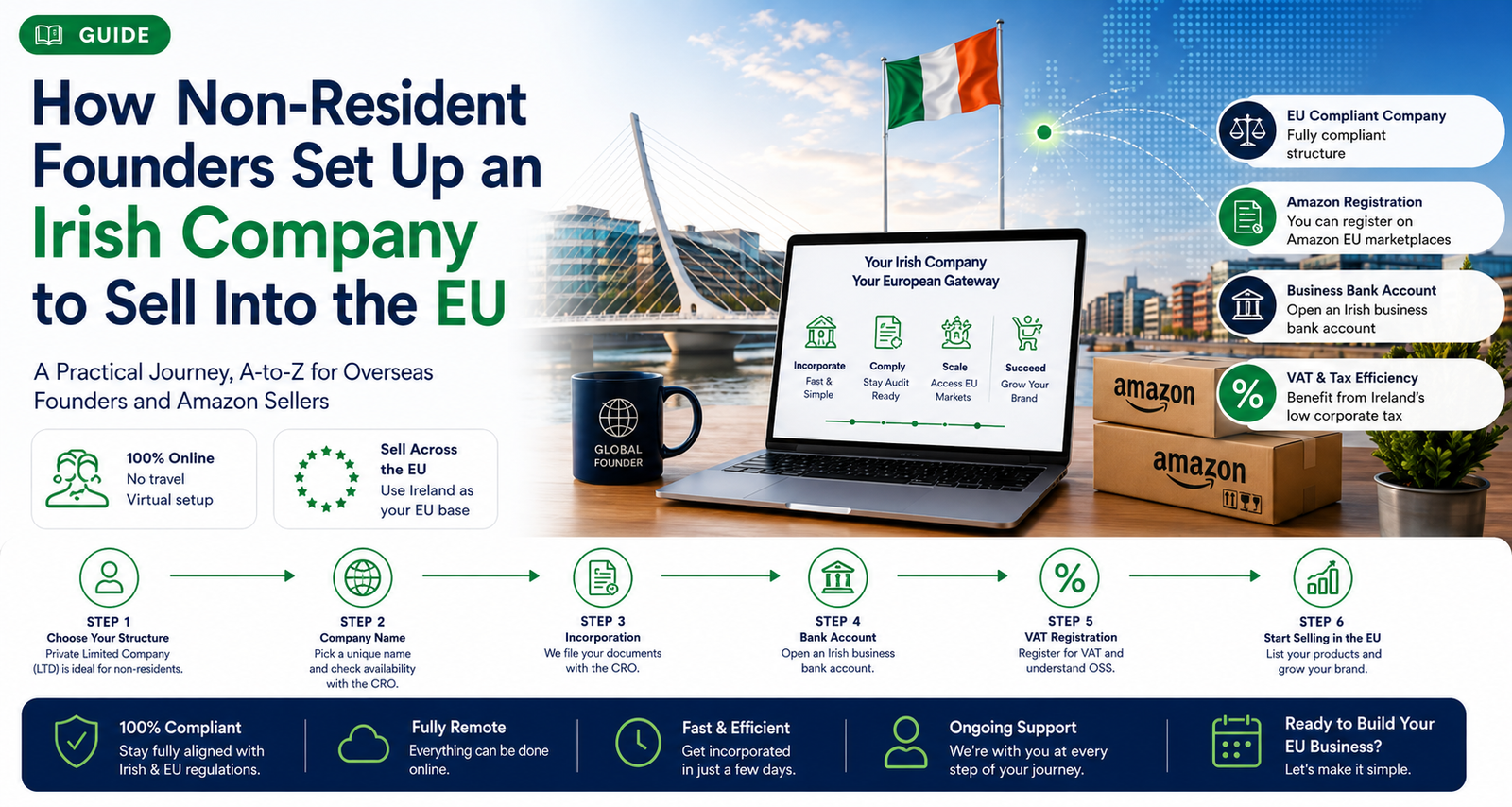
QUICK ANSWER
Non-resident e-commerce founders can set up an Irish company without living in Ireland or the EEA — but the journey has two separate compliance tracks running in parallel: getting the company itself legally formed (Section 137 Bond, identity verification, AML/KYC), and getting it ready to actually trade across the EU (VAT registration, OSS/IOSS, and — if using Amazon FBA — a VAT footprint that can expand fast). Missing either track causes real delays; missing both at once is how most non-resident e-commerce setups go wrong.
At a Glance
| Track One: Legal Formation | Track Two: Trading & Tax Readiness |
|---|---|
| 1. Identity verification (VIF/IPN) — often the real starting point | 1. Irish VAT registration (+ EORI if importing stock) |
| 2. Section 137 Bond arrangement | 2. OSS/IOSS setup for cross-border sales |
| 3. CRO incorporation & RBO filing | 3. Marketplace settlement reconciliation (A2X/Link My Books) |
| 4. Fintech or corporate banking setup | 4. Local VAT registration in each country if using Pan-EU FBA |
If you’re running an e-commerce business from the US, UK, UAE, or anywhere else outside the EEA and looking at Ireland as your EU entry point, you’re not alone — Ireland is a common choice for exactly this reason: English-speaking, EU/eurozone membership, and a well-understood company law framework. But non-resident founders setting up specifically to sell online run into two distinct sets of requirements that rarely get covered together: the rules around forming a company without an EEA-resident director, and the e-commerce-specific VAT obligations that kick in the moment you start trading. This guide walks through both, in the order you’ll actually hit them.
Why Overseas E-commerce Sellers Choose an Irish Company for EU Market Access
An Irish limited company gives a non-resident e-commerce founder a genuine EU legal entity — which matters for more than just optics. It means access to the EU’s VAT simplification schemes (OSS/IOSS) as an EU-established business rather than a non-EU one, straightforward eligibility for Amazon’s European marketplaces and fulfilment programmes, and a recognised EU corporate structure that EU-based suppliers, payment processors, and logistics partners are set up to work with by default.
None of that requires you to live in Ireland, or anywhere in the EEA. It does require getting two things right at the outset: how the company itself satisfies Irish director-residency law, and how it registers for VAT before its first sale.
Track One: Getting the Company Legally Formed
Identity Verification Usually Comes First
Almost no non-resident founder holds an Irish PPSN, which CRO filings require by default. The workaround is a Verification of Identity Form (VIF), which gets you an Identified Person Number (IPN) usable on all future CRO and RBO filings. This is worth starting immediately, not treating as a formality alongside everything else — for many non-resident founders, IPN approval is now the actual gating step on the whole incorporation timeline, since CRO processing depends on it being in place first. One detail that catches founders out: as of 30 April 2026, this form must be witnessed with the declarant and witness physically in the same room — a fully remote, video-witnessed process is no longer accepted, so this needs to be booked and planned for early rather than assumed to be a same-day online task.
This applies to beneficial owners too, not just directors. Anyone owning more than 25% of the company who lacks a PPSN also needs their own VIF-based IPN for the Register of Beneficial Owners (RBO) filing. The RBO filing deadline is five months from incorporation, but there’s no reason to wait — get the beneficial owner’s identity verification done in the same window as the director’s, using the same process, rather than treating it as a separate task to pick up later.
The EEA-Resident Director Requirement
Under Section 137 of the Companies Act 2014, every Irish company needs at least one director resident in the EEA (EU plus Iceland, Norway, and Liechtenstein) — residency, not nationality. If none of your founding team lives there, which is the normal situation for an overseas e-commerce founder, the standard route is a Section 137 Bond: a surety bond covering the company for €25,000, arranged at incorporation and renewed every two years. It’s the fastest option available to a brand-new company — the alternative (a Section 140 “real and continuous link” certificate) isn’t available until a company has an established Irish trading history, which obviously doesn’t exist yet at formation.
AML/KYC
Standard anti-money-laundering due diligence applies to all incoming officers and shareholders, non-resident or not — proof of identity, proof of address, and source-of-funds documentation, gathered as part of formation rather than as a separate step afterwards.
For the full breakdown of the bond, the identity verification process, common mistakes, and pricing, see “Setting Up an Irish Company Without an EEA-Resident Director.”
The Part Founders Don’t Expect: Opening a Bank Account
This is the step that surprises most non-resident founders. Traditional Irish banks can open corporate accounts for non-resident-owned companies, but a fully remote process is genuinely difficult — most traditional banks still expect some form of in-person or video verification and a clear business rationale for banking in Ireland specifically. In practice, many non-resident e-commerce founders start with an EU-facing fintech business account (providers like Wise Business or Revolut Business are commonly used for this) to get trading immediately, and either keep that as their primary account or move to a traditional bank later once the business has an established trading history. Either path is workable — the mistake is not planning for this step at all and assuming a bank account will be ready the moment the company is incorporated.
Track Two: Getting Ready to Actually Trade
Company formation and VAT registration are separate processes, and treating them as sequential rather than parallel is one of the most common causes of delay we see.
VAT Registration From Day One
Once incorporated, an Irish company selling to Irish or EU customers needs Irish VAT registration once it crosses €85,000 (goods) or €42,500 (services) — or can register voluntarily below that, useful if there are significant VAT-bearing setup costs to reclaim early. For sales into other EU countries, the One Stop Shop (OSS) scheme lets you report that cross-border VAT through a single Irish return once combined EU sales pass €10,000, rather than registering separately in every country you sell into.
Importing inventory into Ireland? If you’re shipping physical stock from outside the EU — Great Britain, the US, or China — into an Irish hub, you’ll also need an EORI number linked to your VAT profile. It’s worth setting up Postponed VAT Accounting (PVA) alongside your VAT registration at the same time: this lets you declare import VAT on your bi-monthly VAT3 return instead of paying it in cash at the border, which matters for cash flow if you’re importing stock regularly.
The Amazon-Specific Trap
If you’re planning to use Amazon’s Pan-European FBA programme, be aware before you opt in: the moment Amazon physically stores your stock in a country, you need a local VAT registration in that country — OSS does not cover this. As of January 2026, Amazon requires a minimum of five EU VAT registrations just to remain eligible for Pan-EU FBA. This is very commonly misunderstood by founders who assume OSS is a complete solution, and it’s worth deciding your fulfilment approach (Pan-EU FBA vs. the single-country European Fulfilment Network) before your VAT registrations are in place, not after stock has already started moving.
Planning to use Amazon Pan-EU FBA?
Don’t let inventory transfers freeze mid-launch because a VAT registration wasn’t in place before stock landed. Request a free e-commerce & non-resident formation review and Forti will map your required VAT footprint before you opt in.
For the full detail on OSS vs IOSS vs local VAT registration, the Pan-EU FBA VAT trap, the 2026 customs duty changes, and Extended Producer Responsibility (EPR/Repak) obligations for sellers of packaged goods, see “The Complete Guide to E-commerce Accounting for Shopify and Amazon FBA Sellers in Ireland.”
Ongoing Compliance
Once trading, a non-resident-owned Irish e-commerce company carries the same ongoing obligations as any Irish company — CRO annual returns, Corporation Tax (CT1), VAT3 filings, and Register of Beneficial Owners (RBO) filings, required within five months of incorporation and whenever ownership changes — on top of the e-commerce-specific bookkeeping challenge of reconciling Amazon and Shopify settlement reports (typically via A2X or Link My Books) across currencies and jurisdictions.
Choosing a Partner Who Understands Both Sides
This is the practical reason most non-resident e-commerce founders end up frustrated with their first advisor: a generalist formation agent understands the Section 137 Bond but not OSS/IOSS or the Pan-EU FBA VAT trap. An e-commerce-focused accountant understands VAT and marketplace reconciliation but may not have handled a non-resident director bond or VIF/IPN identity verification before. Getting both tracks right — the formation side and the trading side — usually means working with one partner who handles both, rather than coordinating a formation agent and a separate accountant who’ve never had to think about how the two interact.
Two Founders, Two Different Starting Points
These are composite, illustrative scenarios based on patterns we see across non-resident e-commerce clients — not specific named businesses.
The FBA seller who assumed OSS was enough
A US-based founder incorporated an Irish company, registered for Irish VAT and OSS, and started selling on Amazon — all correctly. Six months later, they opted into Pan-EU FBA to speed up EU delivery, assuming their existing OSS registration already covered it. It didn’t. Amazon began distributing stock into Germany, France, and Poland, and inventory transfers stalled while five local VAT registrations were arranged retroactively — during what should have been their busiest sales period.
The founder who left identity verification too late
A Dubai-based founder lined up their Section 137 Bond and company name in advance, expecting incorporation within days. They hadn’t accounted for the VIF process — booking an in-person notary appointment abroad took over two weeks, during which the CRO filing sat waiting on the IPN. The bond was never the bottleneck; the identity verification step was.
Both are avoidable with the same fix: treat both tracks as running from day one, not one after the other.
Frequently Asked Questions
Yes. There’s no requirement to live in Ireland or the EEA to form or own an Irish company. You do need to satisfy the EEA-resident director requirement, typically via a Section 137 Bond, and complete identity verification if you don’t hold an Irish PPSN.
You need Irish VAT registration once you exceed €85,000 (goods) or €42,500 (services) in turnover, though many non-resident founders register voluntarily from the outset. If you’re selling cross-border into the EU from day one, registering for OSS alongside your Irish VAT number is standard practice.
It’s difficult with traditional banks, which usually expect some in-person or video verification. Most non-resident founders start with an EU-facing fintech business account to begin trading, then reassess once the company has an established history.
They’re separate processes that can run in parallel, but they aren’t automatic — VAT registration has to be actively applied for once you know your trading plans, and it’s worth starting this alongside incorporation rather than waiting until the company is fully formed.
Both. Anyone who owns more than 25% of the company and lacks an Irish PPSN needs their own VIF-based IPN for the RBO filing, separate from any director’s IPN. It’s worth doing both at the same time rather than leaving the beneficial owner’s verification until closer to the five-month RBO deadline.
No — an EORI number is only required if you’re importing physical stock into Ireland from outside the EU. If you’re sourcing entirely from EU suppliers or drop-shipping, it doesn’t apply.
Assuming OSS covers all their EU VAT obligations. It doesn’t cover local VAT registration triggered by holding stock in a country — which is exactly what happens under Amazon’s Pan-EU FBA programme.
Get Your Non-Resident E-commerce Setup Right From Day One
Forming the company and getting it ready to trade are two different jobs — Forti handles both together, so your identity verification, Section 137 Bond, VAT/OSS registration, and ongoing bookkeeping are managed as one process rather than passed between separate providers.
Talk to Forti about setting up your Irish e-commerce company → forti.ie