
Forti's Approach
1.
Scoping the VAT position across three jurisdictions
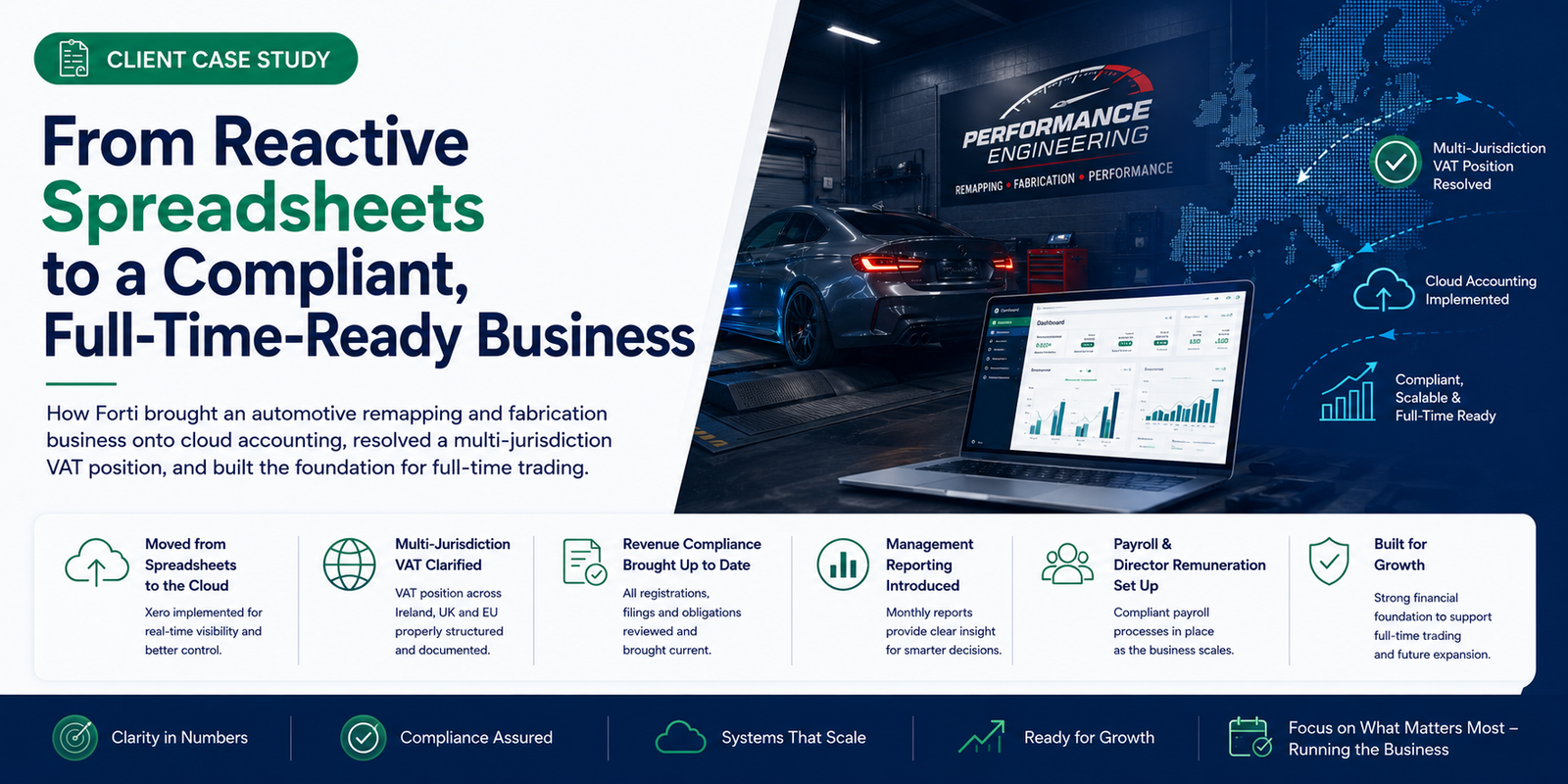
Before recommending registration, Forti reviewed the full shape of the client’s trading activity: digital tuning file imports from the UK (reverse charge on services), physical stock imports from the UK (branded exhaust systems and tracking hardware), and inbound components from China. This mixed profile — domestic sales only, but imports spanning both a post-Brexit jurisdiction and a non-EU supplier — needed a structure that would let the client recover import VAT on stock without over-complicating the registration.
Forti recommended Irish VAT registration together with Postponed VAT Accounting (PVA), which allows import VAT to be accounted for on the VAT return rather than paid upfront at the border — directly solving the cash-flow problem on stock imports. VIES registration was flagged as relevant once EU sourcing (Poland-based suppliers of fabrication components) came into the picture, and was added to the engagement when that need became concrete.
2.
Onboarding, AML/KYC and Revenue registration
Forti carried out standard AML/KYC onboarding (proof of identity, proof of address, company and ownership details, and professional clearance from the outgoing accountant), then requested ROS agent access to act on the client’s behalf with Revenue. VAT registration and PVA setup were submitted, followed shortly after by VIES once the EU purchasing need was confirmed.
3.
Moving off spreadsheets: Xero and Hubdoc migration
With a financial year-end approaching and the books not yet up to date, Forti scoped a nine-month historical bookkeeping catch-up to bring the accounts to a clean starting point, alongside a €195 per month all-inclusive retainer covering bookkeeping through to annual compliance going forward. The catch-up fee was split into equal monthly instalments to spread the cost for the client.
Xero and Hubdoc organisations were set up and access shared, moving the business fully off manual spreadsheets. Hubdoc was positioned specifically for day-to-day invoice capture going forward — not for the historical backlog, which Forti’s team processed directly from the bank statements and invoices already provided — keeping the transition simple and avoiding duplicated work on the client’s end.
4.
Building toward growth planning
The client’s underlying goal was to leave his day job once the numbers supported it. Forti scoped cash flow forecasting and business planning as a natural next step once the historical bookkeeping was complete and the records were live and current in Xero — ensuring any growth targets set would be based on accurate, real-time data rather than a spreadsheet snapshot.