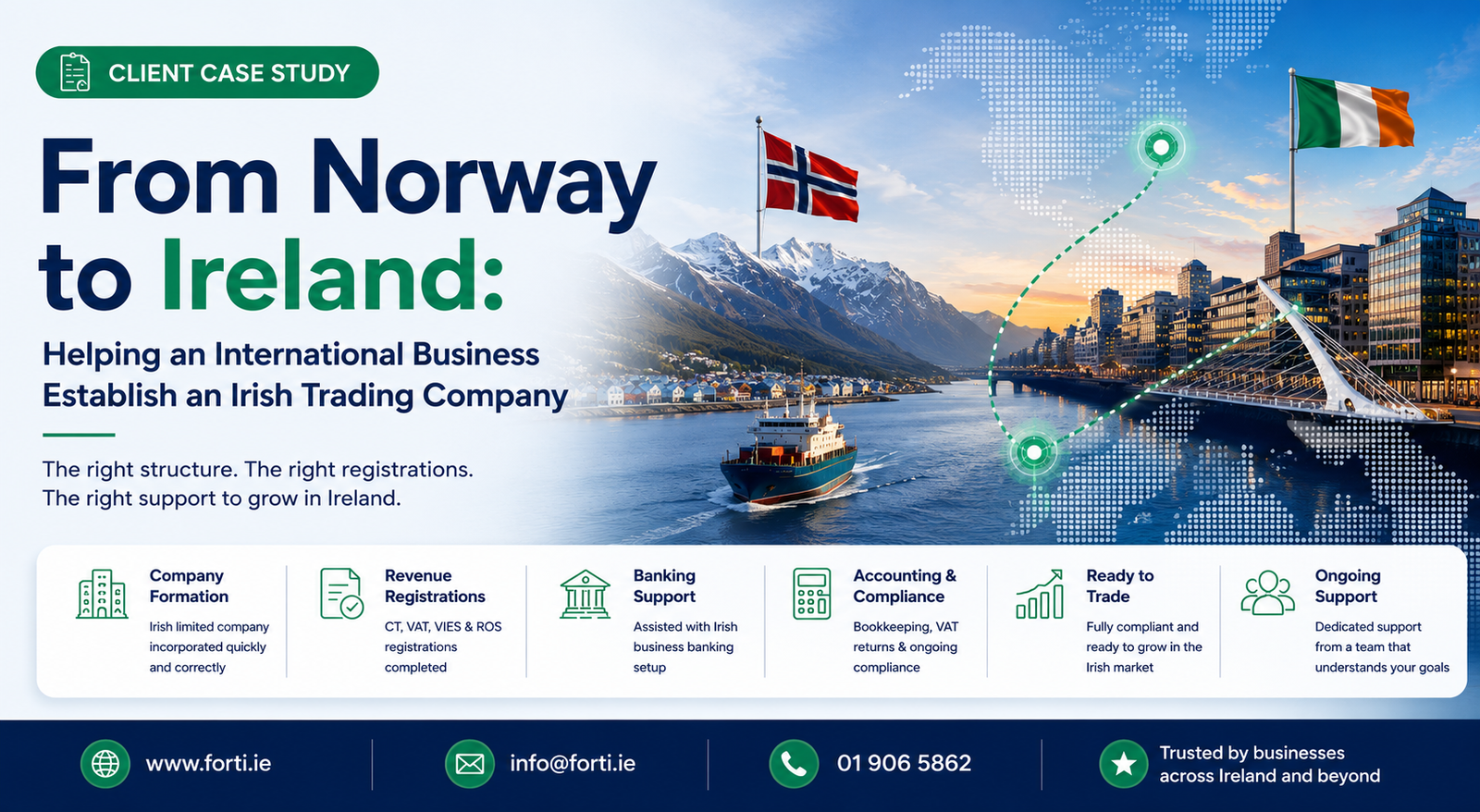
From Norway to Ireland: Helping an International Business Establish an Irish Trading Company

From Norway to Ireland: Helping an International Business Establish an Irish Trading Company

How Forti helped a South Africa-based Irish entrepreneur successfully relocate an established international business into Ireland - overcoming non-EEA director requirements, Revenue registrations, banking challenges, and ongoing compliance.

Client

Irish Trading Company

Challenge

Company director approached Forti to relocate an existing international audience measurement research business from Norway to Ireland while residing in South Africa. As a non-EEA resident director, she required a Section 137 Bond, an IPN application, Irish company incorporation, a registered office, Revenue registrations, business banking, and ongoing compliance support.

Forti's Approach

1.

Understanding the Client's Business and Recommending the Right Structure

Before recommending any services, Forti took the time to understand company director ‘s long-term business objectives.

Unlike many new company formations, this was not a start-up. company director was relocating an established audience measurement and media auditing business from Norway to Ireland while continuing to manage the company remotely from South Africa.

Following an initial consultation, we reviewed the proposed ownership structure, director residency, future trading activities, banking requirements and ongoing compliance obligations.
Based on these discussions, Forti recommended our Non-Resident Plus Package, specifically designed for international entrepreneurs who require an Irish company but do not have an EEA-resident director.

The package provided everything required to establish a fully operational Irish company, including company incorporation, Section 137 Bond, Registered Office, Company Secretarial services and ongoing compliance support, allowing company director to work with a single trusted advisor throughout the process.

2.

Managing the Section 137 Bond, IPN Application and Company Incorporation

As company director was resident outside the European Economic Area (EEA), Irish company law required additional steps before the company could be incorporated.

Forti coordinated every stage of this process, including:

  • arranging the mandatory Section 137 Non-EEA Resident Director Bond through an approved insurer
  • preparing and reviewing the Form VIF application for an Identified Person Number (IPN), as the director did not hold an Irish PPS Number
  • reviewing certified identity documents and proof of address
  • coordinating notarised documentation where required
  • preparing all incorporation documents for submission to the Companies Registration Office (CRO)

Throughout the engagement, our team ensured every document complied with CRO requirements, helping minimise delays and allowing the incorporation process to progress efficiently.

3.

Successfully Incorporating Irish Trading Company

During the incorporation process, the proposed company name required amendments before it satisfied the Companies Registration Office’s naming guidelines.

Rather than delaying the project, Forti worked closely with the client to identify an appropriate alternative while ensuring the new name accurately reflected the business’s international operations.

Once approved, Irish Trading Company was successfully incorporated as an Irish Private Company Limited by Shares (LTD).

The company was now legally established and able to enter contracts, trade internationally, open business bank accounts and fulfil its statutory obligations under Irish company law.

4.

Completing Revenue Registrations Before Trading Commenced

Company incorporation is only one part of establishing a business in Ireland.

Before the company could commence trading, it also needed to complete the relevant Revenue registrations.

Forti prepared and submitted the necessary applications to Revenue, ensuring the business was correctly registered before its first client engagement.

Depending on the business activities, these registrations included:

  • Corporation Tax
  • Value Added Tax (VAT)
  • Employer PAYE
  • Revenue Online Service (ROS)
  • Other Revenue registrations where applicable

By completing these registrations proactively, company director avoided unnecessary delays when securing her first clients and ensured the company met its Irish tax obligations from the outset.

5.

Supporting Business Banking and Residency Verification

Opening an Irish business bank account can often be one of the more challenging stages for overseas business owners.

During the Revolut Business application, additional verification was requested because of the company’s non-EEA director structure.

Forti liaised with both the client and the banking provider, supplying supporting documentation relating to the company’s incorporation, registered office and Section 137 Bond.

We also assisted the client in understanding the verification process and responding to requests promptly, helping ensure the banking application progressed smoothly and allowing the business to begin invoicing customers without unnecessary delay.

6.

Providing Ongoing Accounting, Tax and Company Secretarial Support

Unlike many company formation providers whose involvement ends after incorporation, Forti continues to support company director as the company’s long-term accounting and compliance partner.

Following incorporation and Revenue registrations, the client engaged Forti to manage the company’s ongoing statutory obligations, including:

  • Monthly bookkeeping
  • Bank reconciliations
  • Preparation of annual financial statements
  • Corporation Tax returns
  • CRO Annual Returns
  • Company Secretarial services
  • Revenue correspondence
  • General accounting and business advisory support

Having a single professional firm manage both the incorporation and ongoing compliance provides continuity, reduces administrative burden and gives international business owners confidence that all Irish filing deadlines are monitored and met.

Why this version is stronger

Why this version is stronger

The Outcome

Successfully incorporated Irish Trading Company

Following the successful completion of the incorporation process, Irish Trading Company became a fully registered Irish private limited company under the Companies Act 2014. The company can now legally trade, enter into contracts, employ staff, open business bank accounts, and operate throughout Ireland and internationally.

For overseas entrepreneurs, incorporating an Irish company provides access to one of Europe’s most attractive business environments, supported by a stable legal system, a competitive corporate tax regime for qualifying trading income, and full access to the EU Single Market.

Section 137 Non-EEA Resident Director Bond Successfully Arranged

As the company’s sole director resides outside the European Economic Area (EEA), Irish company law required a Section 137 Bond before incorporation could proceed.

Forti arranged the bond through an approved insurer, prepared the supporting documentation, and ensured it was correctly lodged with the Companies Registration Office (CRO).

Without this bond (or a valid exemption), the company could not have been incorporated under Irish legislation.

For many international entrepreneurs, understanding this requirement early helps avoid significant delays during the incorporation process.

IPN Application Successfully Completed

Because the director did not hold an Irish Personal Public Service Number (PPSN), Forti managed the application for an Identified Person Number (IPN) through the CRO’s identity verification process.

The IPN enables overseas directors to satisfy statutory identity verification requirements, allowing them to complete company incorporations and future CRO filings without first obtaining a PPS Number.

This is particularly valuable for entrepreneurs who intend to manage their Irish businesses entirely from overseas.

Registered Office Established in Dublin

Every Irish limited company must maintain a registered office within the Republic of Ireland.

Forti provided a professional Registered Office address in Dublin, ensuring the company could receive official correspondence from:

  • The Companies Registration Office (CRO)
  • Revenue Commissioners
  • Government departments
  • Statutory authorities

Using a professional Registered Office also gives overseas business owners peace of mind that important legal notices and compliance deadlines are monitored and managed correctly.

Revenue Registrations Completed Before Trading

Following incorporation, Forti completed all Revenue registrations required for the business to commence trading.

Depending on the company’s activities, this included registrations such as:

  • Corporation Tax
  • Value Added Tax (VAT)
  • Employer PAYE
  • Revenue Online Service (ROS)
  • Other Revenue registrations applicable to the business

Completing these registrations before trading meant the company could begin invoicing clients immediately while remaining fully compliant with Irish tax legislation.

Many overseas businesses underestimate the importance of timely Revenue registrations, which can lead to unnecessary delays, penalties, or missed tax obligations if left until after trading has commenced.

Business Banking Successfully Supported

Opening an Irish business bank account can often be one of the most challenging stages for international business owners.

Because the company’s director lived outside the EEA, additional due diligence and verification were required during the Revolut Business application.

Forti worked directly with the client and the banking provider, supplying supporting documentation regarding the company’s registered office, incorporation details, and Section 137 Bond, helping the application progress smoothly.

Having an Irish business bank account allows companies to receive customer payments, pay suppliers, manage operating expenses, and establish commercial credibility with clients and financial institutions.

Ongoing Bookkeeping and Annual Compliance Managed by Forti

Rather than concluding the relationship after incorporation, the client appointed Forti as its long-term accounting and compliance partner.

Today, Forti manages the company’s ongoing statutory obligations, including:

  • Monthly bookkeeping
  • Bank reconciliations
  • Annual financial statements
  • Corporation Tax returns
  • CRO Annual Return (Form B1)
  • Company Secretarial services
  • Revenue correspondence
  • General accounting and business support

This allows the directors to focus on growing their international business while knowing their Irish compliance obligations are being monitored and managed by experienced professionals.
For overseas business owners, having a single firm manage both incorporation and ongoing compliance significantly reduces administrative complexity and helps ensure deadlines are never missed.

Why this version performs better

This approach is much stronger for both Google and AI assistants because it:

Explains the purpose of each legal requirement instead of simply listing it.

Naturally includes high-intent search terms such as Section 137 Bond, IPN, Registered Office, Corporation Tax, VAT registration, ROS, Irish company, and non-EEA director.

Answers follow-up questions users are likely to ask, increasing its value as a standalone educational resource.

Demonstrates Forti’s expertise through practical explanations rather than promotional claims.

Client Feedback

“I intend to manage the company remotely from South Africa and will require a virtual registered office address in Dublin.”

— Company Director

Frequently Asked Questions

Yes. Irish citizenship does not prevent you from incorporating an Irish limited company if you live overseas. However, Irish company law looks at where a director is resident, not their nationality. If none of the directors are ordinarily resident in the European Economic Area (EEA), the company must either have a valid Section 137 Bond or qualify for a statutory exemption before incorporation can proceed.

Yes. This is one of the most common misconceptions.

The requirement is based on residency rather than citizenship. Even if you hold an Irish or other EEA passport, you will normally require a Section 137 Bond if you are resident outside the EEA and there is no other EEA-resident director on the board.

A Section 137 Bond is a two-year surety bond required under the Companies Act 2014 where an Irish company has no EEA-resident director. The bond provides cover of €25,000 for certain fines and penalties under Irish company and tax legislation. It enables a company to be incorporated without appointing an EEA-resident director.

Yes.

Many Irish companies are managed by directors living in countries such as South Africa, the United Kingdom, the United States, Canada, Australia and the Middle East.

Modern banking, cloud accounting and electronic filing mean the day-to-day management of an Irish company can be carried out remotely, provided the business complies with Irish company law and tax obligations.

Not necessarily.

If you do not have a Personal Public Service Number (PPSN), you may apply for an Identified Person Number (IPN) through the CRO’s identity verification process. The IPN allows directors without a PPSN to satisfy CRO filing requirements.

An IPN is a unique identification number issued by the Companies Registration Office (CRO) for directors and beneficial owners who do not have an Irish PPS Number.

It allows individuals living overseas to complete company incorporations and future statutory filings with the CRO.

In most cases, incorporation takes between 5 and 10 working days once all documentation has been received.

Additional registrations, such as VAT, Corporation Tax or the IPN application, may take longer depending on Revenue and CRO processing times.

Yes.

Most international clients complete the entire incorporation process remotely.

Documentation can usually be signed electronically, while certain identity documents may require certification or notarisation depending on the circumstances.

Yes.

Every Irish limited company must maintain a registered office within the Republic of Ireland where statutory correspondence from the CRO, Revenue and other government bodies can be received.

Many overseas business owners use a professional registered office service rather than leasing physical premises.

The registrations depend on your business activities.

Common registrations include:

  • Corporation Tax
  • VAT
  • Employer PAYE
  • ROS (Revenue Online Service)
  • VIES
  • OSS (where applicable)

Not every business requires every registration. Choosing only those relevant to your activities helps avoid unnecessary administration.

Yes.

Forti manages the complete registration process with Revenue, including Corporation Tax, VAT, PAYE, ROS, VIES, OSS, Customs registrations and other specialist registrations where required.

Our aim is to ensure your business is ready to trade from day one.

Yes.

Many Irish banks and fintech providers offer business banking for non-resident directors, although additional verification is often required.

Depending on your circumstances, you may be asked to provide evidence of your registered office, company incorporation documents or information regarding your company’s ownership structure.

Generally, yes.

Once your company has been incorporated and a business bank account has been established, you can begin invoicing customers.

If your business requires VAT registration, you should ensure the correct VAT treatment is applied based on your registration status and the nature of your supplies.

Every Irish company has ongoing statutory obligations, which typically include:

  • Annual financial statements
  • Corporation Tax returns
  • CRO Annual Return
  • Bookkeeping
  • VAT returns (where applicable)
  • Payroll filings (where applicable)
  • Maintenance of statutory registers

Meeting these deadlines is essential to avoid penalties and maintain good standing with the CRO and Revenue.

Absolutely.

Many of our clients choose Forti as their long-term compliance partner.

We provide ongoing bookkeeping, VAT services, payroll, annual accounts, Corporation Tax returns, CRO filings, company secretarial services and day-to-day business support, allowing international business owners to focus on growing their companies while we manage the Irish compliance requirements.

Company director needed more than a company formation provider.

She required a partner capable of managing every stage of the journey—from obtaining a Section 137 Bond and completing the IPN application, to incorporating the company, securing Revenue registrations, assisting with business banking, and providing ongoing bookkeeping and compliance.

Today, Forti continues to support Irish Trading Company​, allowing the business to operate confidently from Ireland while being managed internationally.

Working With Forti

Brenda’s journey demonstrates that establishing an Irish company from overseas involves much more than simply completing incorporation documents. International entrepreneurs must navigate company law, Revenue registrations, identity verification, banking requirements, ongoing tax compliance and annual statutory obligations—all while managing their business from another country.

This is where working with an experienced Irish company formation and accounting firm makes a significant difference.

Rather than coordinating multiple providers for incorporation, registered office services, company secretarial support, Revenue registrations, bookkeeping and annual compliance, Brenda chose Forti as a single trusted partner throughout the entire lifecycle of her business.

Today, Forti continues to support Irish Trading Company by providing:

Monthly bookkeeping and financial reporting

Corporation Tax compliance

VAT compliance and Revenue support

Annual financial statements

CRO Annual Return preparation and filing

Company Secretarial services

Registered Office facilities

Ongoing business advisory support

Assistance with banking and regulatory matters as the business grows

This long-term relationship ensures that the company remains compliant with Irish company law and Revenue requirements, allowing Brenda to focus on serving clients and expanding the business internationally rather than worrying about statutory deadlines and regulatory obligations.

Whether you are an Irish citizen living overseas, an international entrepreneur establishing your first Irish company, or an existing overseas business looking to relocate part of your operations to Ireland, Forti provides end-to-end support—from the initial consultation and incorporation through to ongoing bookkeeping, tax compliance and strategic business advice.
Our goal is simple: to make doing business in Ireland straightforward, compliant and stress-free, regardless of where in the world you are based.

Why This Case Study Matters

Every international business has different objectives, ownership structures and compliance requirements. While the exact registrations and timelines may vary, Brenda’s experience demonstrates the typical journey many overseas entrepreneurs follow when establishing an Irish company.

By planning the structure correctly from the outset, completing the required registrations before trading, and putting robust compliance processes in place, businesses can avoid unnecessary delays, reduce regulatory risk and focus on sustainable growth.

If you’re considering establishing an Irish company and are unsure where to begin, speaking to an experienced company formation specialist early in the process can save considerable time, cost and complexity.

Still have questions? 

If you’re facing financial and tax challenges or need support with business closure, Forti Accountants is here to help! Contact us today to ensure your bookkeeping and compliance are in good hands.

Get Started

    Get Started