Are you considering establishing a limited company in Ireland? Discover the full journey – from formation and VAT registration to bookkeeping, annual returns, and corporation tax. This is a practical guide designed specifically for Irish SMEs.
Setting up a limited company in Ireland is a big step – and a very exciting one too. Whether you’re a first-time entrepreneur, moving your freelance business to a more formal structure or expanding from abroad, knowing what happens after incorporation is just as important as getting started.
In this guide, we’ll walk you through the full journey of an Irish limited company – from formation and early steps to ongoing responsibilities and annual compliance. We’ll keep it practical, clear, and honest. After all, no one likes surprises when it comes to Revenue or the CRO!
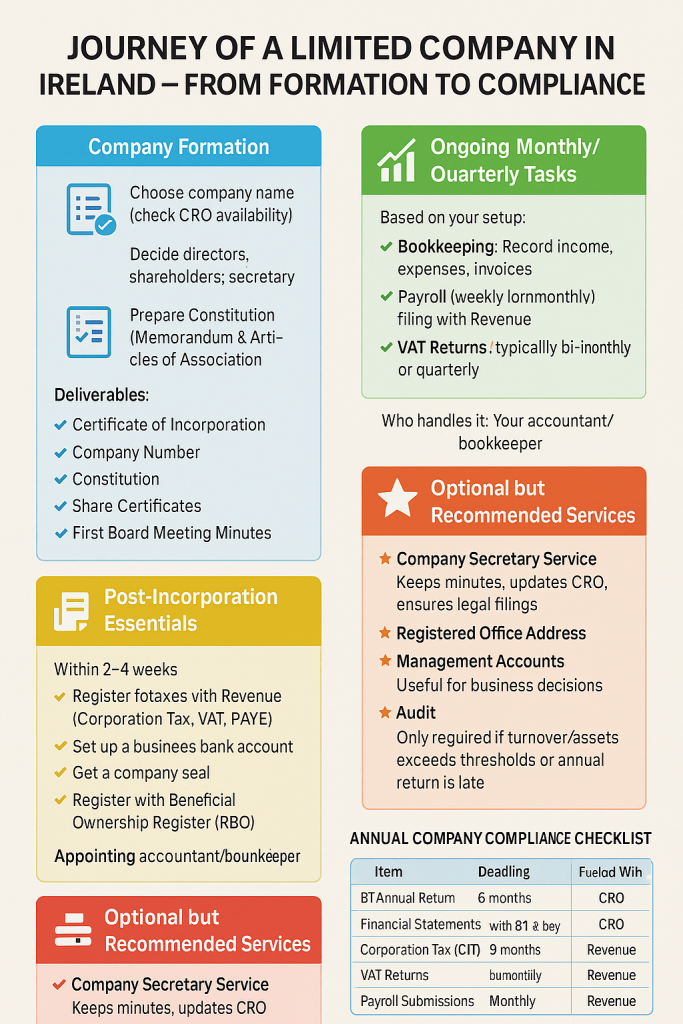
Step 1: Starting Out – Company Formation in Ireland
Let’s begin with the basics. Setting up a Private Company Limited by Shares (LTD) in Ireland is the most common route. It offers flexibility, limited liability, and is suitable for most businesses.
Here’s what you’ll need:
- A unique company name (CRO will need to approve it)
- Search the company name in just a few seconds: Click Here!
- At least one director (one must be EEA-resident unless bonded)
- One company secretary (can’t be the same person as the sole director)
- A registered office address in the Republic of Ireland
- Shareholders and details of share capital
- A company constitution (used to be called Memorandum & Articles)
Once you submit the Form A1 and supporting documents to the Companies Registration Office (CRO), you’ll receive:
- Certificate of Incorporation
- Company Number
- Constitution
- Share Certificates
- First Board Meeting Minutes
This stage is usually handled by an accountant or a company formation agent, and can be done within 5–10 working days.
✅ Do:
- Use a professional company formation agent or accountant to get it right first time.
- Double-check the company name with the CRO before finalising anything.
❌Don’t:
Assume the CRO will approve any name – many are rejected for being too similar to existing names.

Step 2: What Comes Next – Post-Incorporation Essentials
Now that your company is officially registered, there are a few important steps you’ll need to tick off:
- Register with Revenue – for Corporation Tax, VAT (if applicable), and PAYE (if you’ll have employees)
- Open a business bank account – make sure it’s in the company’s name
- Get a company seal – used for official documents
- Register with the RBO – the Beneficial Ownership Register
- Find a bookkeeper or accountant – trust us, you’ll thank yourself later
Pro Tip: If you’ve got a good accountant, they’ll guide you through all of this and make sure nothing’s missed.
✅ Do:
- Register for Corporation Tax within 30 days of trading.
- Make sure the RBO registration is done within 5 months – it’s mandatory.
❌ Don’t:
- Use your personal bank account for business – it’s not just unprofessional, it causes accounting headaches.
- Delay appointing a tax agent – you’ll risk missing deadlines later on.
Step 3: Day-to-Day Running – Bookkeeping, Payroll & VAT
As your business begins trading, there’s regular financial housekeeping to be done.
Here’s what that usually includes:
- Bookkeeping – tracking income, expenses, invoices, and receipts
- Payroll – processing salaries and filing with Revenue via ROS
- VAT Returns – filed bi-monthly or quarterly, depending on your setup
If you’re not comfortable managing all this yourself (and most business owners aren’t), outsourcing to a bookkeeper or accountant is a smart move. It’ll save you hours each month and ensure you stay on the right side of Revenue.
✅ Do:
- Keep digital copies of receipts – they’ll save your bacon at year-end.
- Use cloud accounting software (or a reliable bookkeeper) to stay organised.
❌ Don’t:
- Wait until the end of the year to sort your books – late filing leads to penalties.
- Miss payroll filings – Revenue are very strict about this.
Step 4: Staying Compliant – Annual Filing & Tax Returns
Once you’ve hit the six-month mark, it’s time to think about annual compliance. Here’s what’s involved:
- B1 Annual Return
- Your first B1 return is due 6 months after incorporation (no accounts required)
- Every year after, your B1 return must be filed with financial statements
- Financial Statements
- Includes profit & loss, balance sheet, and director’s report
- Must follow Irish GAAP or IFRS standards
- Corporation Tax Return (Form CT1)
- Due 9 months after your company’s year-end
- Submitted to Revenue with iXBRL-tagged accounts
- Income Tax Return (Form 11) for Directors
- Required if you’re a director and self-assessed for income tax
Miss a B1 deadline by even a single day and you’ll lose your audit exemption for two years – which means paying for a full audit even if you’re a small business.
✅ Do:
- Mark deadlines in your calendar and get professional help with returns.
- File the B1 on time every year to retain audit exemption.
❌ Don’t:
- Assume your accountant will file unless you ask – follow up regularly.
- Ignore iXBRL – it’s not optional for most companies.
Optional (But Highly Recommended) Services
Here are a few services that aren’t legally required but make life much easier:
📌 Company Secretary Service
- Handles statutory registers, board meeting minutes, CRO filings, and ensures you don’t miss key deadlines
📌 Registered Office Address
- Keeps your home address private
- Ensures important post from Revenue and CRO is handled properly
📌 Management Accounts
- Quarterly reports that show how your business is doing – especially useful if you’re applying for a loan or grant
📌 Audit
- Only required if you lose exemption or grow beyond certain thresholds
- Even if optional, it can boost credibility with investors or banks
✅ Do:
- Use a registered office address if you work from home – it looks more professional.
- Get quarterly management accounts to keep an eye on business health.
❌ Don’t:
- Rely on memory for deadlines – use a professional or set up reminders.
- Think audits are only for big companies – one late return and you’re in.
Quick Annual Compliance Checklist (for Irish Limited Companies)
| Task | Due | Who You File With |
|---|---|---|
| B1 Annual Return | 6 months after incorporation | CRO |
| Financial Statements | With second and future B1s | CRO |
| Corporation Tax (CT1) | 9 months after financial year-end | Revenue |
| VAT Returns | Every 2 or 3 months | Revenue |
| Payroll Submissions (RTD/P30) | Monthly | Revenue |
Smart Software = Less Admin Hassle
Accounting and compliance software significantly alleviates the burden on businesses today. Gone are the days of chasing receipts in shoeboxes or manually filing VAT returns. With the right tools in place, you can cut down your admin time significantly – and reduce the chances of errors.
Here’s what we typically use (or recommend) for Irish limited companies:
- Xero or QuickBooks Online – Both are cloud-based accounting platforms that make invoicing, bank reconciliation, expense tracking, and VAT reporting a breeze. You can access them anytime, anywhere – and they integrate beautifully with banks and payroll systems.
- Surf Accounts or Big Red Cloud – Also popular with Irish SMEs, especially for those who prefer a more localised interface or need simple bookkeeping features.
- BrightPay – Our go-to payroll software. It automates submissions to Revenue (via ROS), calculates tax, USC, and PRSI for each employee, and handles payslips and leave tracking too.
- Hubdoc AutoEntry or Dext (formerly Receipt Bank) – These tools let you scan receipts with your phone and automatically extract the data into your accounts. No more typing in totals or guessing VAT amounts — it’s all done for you.
- Google Drive /Dropbox – For securely storing all your company documents — everything from incorporation papers to tax returns.
The Result?
By combining the right software with professional support, we’ve helped clients reduce their manual admin by up to 90%. Things like:
- Automated bank feeds & reconciliations
- One-click VAT and payroll filings
- Real-time dashboards showing how your business is performing
- Fewer missed deadlines
- More time to actually run your business
“Since moving to Xero with Forti, I don’t touch the books anymore. I just upload my receipts and check the reports once a week – everything else is handled.”
– Cian, Retail Business Owner, Co. Kildare
FAQs About Running a Limited Company in Ireland
It usually takes around 5 to 10 working days once the documents are submitted to the Companies Registration Office (CRO). If everything’s in order, it can move quite quickly.
Not exactly — but you do need at least one director who is resident in the European Economic Area (EEA). If not, you’ll need to put a Section 137 bond in place to meet the CRO’s requirements.
If you miss the deadline, even by a day, you’ll lose your audit exemption for two years. You might also get hit with late filing penalties — so it’s one to stay on top of.
If your turnover is going to exceed €37,500 for services or €75,000 for goods, you’ll need to register. Even if you’re under the limit, some businesses choose to register early for credibility or to reclaim VAT.
You can, especially if things are simple early on. But unless you’re very confident with numbers, it’s usually best to bring in a professional bookkeeper or accountant. It saves time and reduces the risk of mistakes.
Yes — most directors in Ireland are self-assessed, which means you’ll need to file a Form 11 each year for your personal income.
Corporation Tax is paid by the company on its profits. Income Tax is what you pay personally on any income you take from the business (like salary or dividends).
Yes – if there’s only one director, you must appoint a separate company secretary. They help make sure your company stays compliant with the CRO.
It depends on what services you need, but for most small companies it’s somewhere between €2,500 and €4,000 per year. That would typically cover bookkeeping, tax returns, annual filings, and company secretarial work.
Absolutely. We look after everything from company formation and bookkeeping to tax filing, payroll, and compliance. Whether you’re just starting out or running a growing business, we’ll guide you through the whole journey.
Wrapping Up
Setting up a limited company in Ireland is a great way to build something lasting, but there’s more to it than just filling out a few forms. From day one, there are important responsibilities — bookkeeping, tax returns, VAT, payroll, and making sure you don’t miss key deadlines.
The good news? You don’t have to do it alone.
At Forti Ltd, we’ve helped multiple business owners across Ireland set up, stay compliant, and focus on growing their business. Whether you’re a start-up, a sole trader going limited, or expanding into Ireland from abroad — we’re here to help every step of the way.