Monthly Archives: July 2026

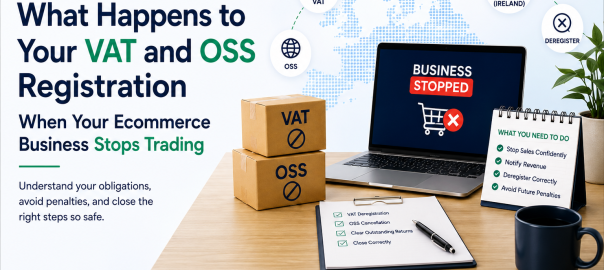
What Happens to Your VAT and OSS Registration

What Happens to Your VAT and OSS Registration When Your Ecommerce Business Stops Trading

Ecommerce sellers carry more moving parts than most business owners when they stop trading — an OSS registration, possibly a foreign VAT registration tied to stored stock, and a marketplace account that keeps running whether you’re paying attention to it or not. Here’s what needs to be closed down deliberately, and what happens if it isn’t.

Why Ecommerce Sellers Are a Special Case

Most of the compliance failures we’ve covered in this series apply to any Irish business. Ecommerce sellers carry extra exposure on top: a Union OSS registration reporting sales across every EU state you sell into, potentially a local VAT registration in any country where you’ve stored stock, and — if you sell through Amazon, eBay or Etsy — a marketplace account that continues taking orders, holding your inventory, and generating transactions long after you’ve mentally ‘stopped.’ None of these switch off on their own, and each has its own separate deregistration process.

Deregistering From OSS: The Steps That Actually Matter

1. Notify Revenue electronically, through the VAT OSS section in ROS, that you wish to deregister. This must be done at least 15 days before the end of the calendar quarter prior to the quarter in which you intend to stop using the scheme.

2. File your final OSS return covering the last quarter of use, and pay any VAT still due — deregistering doesn’t cancel liability for supplies already made under the scheme.

3. Keep OSS records for the full 10-year retention period required under EU rules, even after deregistration — Revenue and other member states can still request them.

4. If you’re stopping trading altogether rather than switching schemes, also cancel your underlying Irish VAT registration via TRCN1 once all final returns are filed.

Miss the 15-day notice window and simply stop filing instead, and you risk a different outcome entirely: exclusion from the scheme by Revenue for non-compliance, which triggers a quarantine period during which you cannot re-register for OSS even if you resume trading. A deliberate, on-time deregistration and an enforced exclusion are not the same thing on your compliance record.

The Stock Problem: What Happens to Inventory You Still Hold

If you’re deregistering with stock still on hand, Revenue treats the retention of that stock — for personal use, write-off, or simply because it wasn’t sold — as a deemed supply, meaning VAT still needs to be accounted for on it in your final return. This is one of the most commonly missed steps in a rushed closure: sellers cancel the registration and quietly dispose of remaining stock without accounting for the VAT position on it first.

The bigger risk sits with sellers using Amazon FBA or another pan-EU fulfilment model. OSS never covered the stock itself — only the sale to the end consumer. If stock is still sitting in a warehouse in Germany or Poland when you deregister from OSS and cancel your Irish VAT number, the local VAT registration in that country doesn’t disappear with it. It has to be separately closed, and any stock still physically there needs to be cleared, transferred, or accounted for under that country’s own rules first.

Marketplace Accounts Don’t Close Themselves Either

Closing an Amazon, eBay or Etsy seller account is a commercial step, not a tax one — but leaving it active after you’ve stopped trading creates exactly the kind of loose end that causes problems later. Outstanding orders, returns, and marketplace-collected VAT under the deemed supplier rules can continue generating activity on an account you’ve mentally already closed, and reconciling that activity months later, against tax registrations that have already been cancelled, is far harder than closing everything in the right order at the time.

A Sensible Closing Order

  • Stop taking new orders across every channel and let existing orders and returns run to completion.
  • Clear or transfer any stock held in foreign warehouses, and close the associated local VAT registration in that country.
  • Account for VAT on any stock you retain rather than sell, in your final return.
  • Submit your OSS deregistration at least 15 days before the end of the prior quarter, and file the final OSS return.
  • Cancel your underlying Irish VAT registration via TRCN1 once all final returns are filed and settled.
  • Close the marketplace seller accounts themselves once orders, returns and payouts have fully settled.
  • If the business traded through a limited company, follow the CRO closure steps covered in Part 2 of this series — dormancy, voluntary strike-off, or restoration, depending on where things stand.

Case Studies

Case Study 1 — A Clean OSS Deregistration

A Shopify-based homeware seller decided to close the business at the end of a calendar quarter. The deregistration notice was submitted to Revenue in good time, the final OSS return was filed and paid, and the underlying Irish VAT registration was cancelled once no further stock remained. No penalties, no quarantine period, and no loose ends.

Case Study 2 — Stranded Stock in a German Warehouse

An Amazon FBA seller cancelled their Irish VAT registration and OSS scheme without first arranging for stock still held in Amazon’s German fulfilment centre to be cleared. The German VAT registration tied to that stock remained technically open, and Amazon continued to report inventory movements against it. The position was only resolved once the stock was removed and the foreign registration formally closed — a step that should have preceded, not followed, the Irish deregistration.

Case Study 3 — Missing the Notice Window

A multi-channel seller simply stopped filing OSS returns after winding the business down informally, without submitting a deregistration notice. Revenue excluded the registration for non-compliance rather than processing a clean deregistration, which placed the business in a quarantine period before it could register for OSS again — relevant a year later when the same founder started a new ecommerce venture and found the scheme temporarily unavailable to them.

(These case studies are illustrative composites reflecting patterns we see regularly among Irish ecommerce clients, not individual businesses.)

Technical Appendix: Compliance Thresholds & Operational Mechanics

1. Capital Gains Tax Clearance

When an asset sale or a share sale involves specific Irish assets—such as land, buildings, business goodwill, or unquoted shares deriving their value from Irish land—specific financial thresholds apply:

  • The Triggers: A clearance certificate is required if the transaction value exceeds:
    • €500,000 for commercial property, land, business goodwill, or qualifying unquoted shares.
    • €1,000,000 for residential property.
  • The Withholding Penalty: If the seller fails to produce a valid clearance certificate to the buyer prior to or at closing, the purchaser is legally required to withhold exactly 15% of the gross purchase price and pay it directly to Revenue within 30 days.
  • Processing Timelines: Applications must be submitted electronically. Standard processing times typically range from 3 to 4 weeks, meaning applications should be initiated as soon as contracts are signed.

2. Company Registration History & Audit Exemption Rules

Filing histories are scrutinized heavily during corporate transactions due to the severe downstream impacts of a missed deadline:

  • Automatic Loss of Exemption: If a company files its annual return late by even a single day, it automatically loses its right to claim an audit exemption for that financial year and the subsequent financial year.
  • The Transaction Impact: If a company has traded through those years without an audit under the assumption it was exempt, it will be forced to commission a retrospective audit before a share sale can cleanly close. This causes severe transaction delays and often triggers price reductions from buyers.

3. Register of Beneficial Ownership (RBO) Compliance

  • The 14-Day Rule: Any internal corporate restructuring, share transfer, or new allotment must be updated on the central Register of Beneficial Ownership within 14 days of the change.
  • Due Diligence Friction: Discrepancies between the company’s internal share register and the public RBO register automatically flag during standard anti-money laundering checks, halting funds from being drawn down until corrected.

4. One Stop Shop (OSS) Timelines & Penalties

  • The Cut-off Logic: To stop using the Union OSS scheme, a business must notify Revenue by the 15th day of the final month of a calendar quarter (e.g., to exit from 1 October, notice must be submitted on or before 15 September). Missing this deadline locks the business into the scheme for the next full 3-month cycle.
  • The Quarantine Mechanic: A forced exclusion from the scheme due to persistent non-compliance (such as failing to file or pay for 3 consecutive quarters) results in an automatic 2-year suspension. During this time, the business cannot register for OSS in any EU Member State and must instead seek multiple local retail VAT registrations.
  • Data Retention Mandate: All records supporting OSS returns must be maintained digitally and made available upon request for exactly 10 years from the end of the year of the transaction.

5. Domestic VAT Cessation & Stock Asset Disposal

  • Deemed Supply Rule: Goods forming part of the assets of a business that ceases to trade are treated as sold by the business to itself.
  • Valuation: The VAT on unsold closing stock must be calculated based on the cost price (or purchase price) of the goods at the time of cessation, not the retail price.
  • Cancellation Mechanism: The domestic VAT cancellation is processed through an electronic registration facility once all final returns and liabilities hit zero.

6. Cross-Border Fulfillment & Marketplace Rules

  • Storage vs. Sale: Holding stock in a fulfillment center outside of Ireland immediately triggers a local VAT registration requirement in that host country. Canceling the Irish OSS scheme does not automatically close foreign VAT accounts.
  • Marketplace Rules: Digital platforms are responsible for collecting tax on certain transactions. However, if a merchant account is left active with automated returns or customer credits processing post-closure, the platform will continue to generate data entries that conflict with cancelled tax registrations.

Pre-Sale & Pre-Closure Sequence Checklist

Step Compliance Channel Metric / Deadline
1. Stock Liquidation Marketplace / Warehouse Clear, destroy, or legally transfer all foreign inventory out of non-Irish fulfillment hubs.
2. Foreign VAT Closure International Tax Authorities File final local returns and submit formal deregistration forms to every individual country where stock was stored.
3. Tax Clearance Certificate Electronic Revenue System Check status across all tax heads (VAT, Corporation Tax, PAYE/PRSI) 6–8 weeks before negotiations.
4. Deemed Supply Calculation Domestic VAT Return Value remaining Irish stock at cost price; include this figure on the final VAT return.
5. OSS Exit Notice Electronic OSS Portal Submit deregistration request 15 days or more before the quarter’s end.
6. Capital Gains Clearance Electronic Revenue System File clearance application if the transaction hits the €500k/€1m thresholds immediately upon exchange of contracts.
7. Domestic Cancellation Electronic Revenue System Submit formal cancellation for the underlying domestic VAT number once all liabilities are clear.
8. RBO Alignment Central Register Cross-reference the central RBO register against the current internal register of members at least 3 weeks prior to closing.

Frequently Asked Questions

1.Can I just stop filing OSS returns once I’ve stopped trading?

Ans: You can, but it’s the wrong way to close it. Simply stopping without notifying Revenue can result in exclusion from the scheme rather than a clean deregistration, which carries a quarantine period before you can register again.

2. Do I need to deregister OSS and Irish VAT at the same time?

Ans: Not necessarily at the same moment, but in the right order — OSS deregistration first (with its 15-day notice requirement), followed by cancellation of the underlying Irish VAT registration once all final returns are filed and settled.

3. What happens to VAT on stock I don’t sell before closing?

Ans: It’s treated as a deemed supply and needs to be accounted for in your final VAT return, whether you retain it, write it off, or dispose of it another way.

4. Does closing my Amazon or eBay seller account cancel my VAT obligations?

Ans: No. The marketplace account and your tax registrations are entirely separate. Closing one has no effect on the other, and outstanding marketplace activity can continue to affect a tax position you thought was already closed.

5. If stock is stored in another EU country, do I need to do anything before deregistering?

Ans: Yes. Clear or transfer the stock and close the local VAT registration in that country first — OSS and your Irish VAT registration never covered that separate obligation.

How Forti Helps

We handle the full sequence — OSS and VAT deregistration, foreign VAT closures tied to stored stock, and the underlying CRO position — so an ecommerce business closes cleanly across every channel, rather than leaving a registration open somewhere that resurfaces later.

Closing an Ecommerce Business? Talk to Forti First

Monthly bookkeeping and management accounts from €195/month + VAT

Irish company formation, CRO fee included: €250

OSS, VAT and multi-country deregistration support available for ecommerce sellers closing down
Already Stop Trading

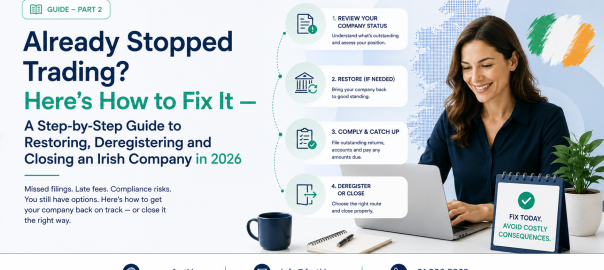
Already Stopped Trading? Here’s How to Fix It — A Step-by-Step Guide to Restoring, Deregistering and Closing an Irish Company in 2026

In Part 1, we looked at why ‘stopped trading’ isn’t the same as ‘closed down,’ and what it costs when business owners leave that gap unresolved. This follow-up is the practical playbook: the exact steps to restore a struck-off company, deregister properly with Revenue, close a company the right way, or keep a dormant one compliant — with the current CRO fees and timelines for each route.

Step One: Work Out Which Situation You’re Actually In

Before picking a fix, confirm the starting point. The route — and the cost — depends entirely on which of these applies to you right now.

  • Your company is still on the CRO register, but annual returns are overdue — you’re at risk, but not yet struck off.
  • Your company has already been struck off and dissolved — you need restoration if you want it back.
  • Your company is trading-inactive but compliant so far — you want to formally mark it dormant or close it properly before anything lapses.
  • You stopped self-employment as a sole trader — your fix runs through Revenue and, if you registered a business name, the CRO’s RBN3 form.

Search the CRO’s public register (cro.ie) for your company name or number — it will show your last filed annual return and current status, which tells you immediately which path below applies.

Path A: Restoring a Struck-Off Company

If it’s been less than 12 months since dissolution — Administrative Restoration

1. File Form H1 through the CRO’s CORE portal. The filing fee is €300, payable by bank draft, CRO deposit account, or online payment — cheques are no longer accepted.

2. File every outstanding annual return, each with its financial statements. Late filing penalties apply per return (€100 plus €3/day, capped at €1,200), though on a restoration the cumulative late-filing exposure across the last three returns is capped at €3,600.

3. If the company was struck off for Revenue non-compliance rather than CRO non-filing, you’ll also need written confirmation from Revenue that all outstanding statements have been delivered before the CRO will process restoration.

4. Confirm the company still meets the Section 137 requirement for an EEA-resident director (or holds the relevant bond), and that director/secretary details are up to date.

5. Once the Registrar is satisfied, the company is restored and treated, for continuity purposes, as if it had never been dissolved — though the gap in filings and the strike-off itself remain on the public record permanently.

If it’s been more than 12 months — Court Order Restoration

After the 12-month administrative window closes, restoration can only happen through the High Court, under Section 738 of the Companies Act 2014, provided fewer than 20 years have passed since dissolution.

This route requires a solicitor, a letter of no objection from the CRO’s Enforcement Section, confirmation from Revenue that all liabilities are discharged, and a court hearing before the order is filed with the CRO (a further €15 fee). It is slower, adds legal costs on top of the same outstanding CRO penalties and Revenue confirmations, and can take several months from start to finish — which is exactly why administrative restoration, actioned promptly, is the route worth protecting.

Path B: Closing a Company Properly (Voluntary Strike-Off)

If the company is solvent, has no outstanding creditors, and you genuinely want to close it rather than restore or reactivate it, voluntary strike-off is the cheapest and cleanest route — a fraction of the cost of letting the CRO strike it off involuntarily and dealing with the fallout later.

1. Confirm the company meets the Section 733 conditions: it has ceased trading (or never traded), has no assets or liabilities, and is not the subject of any court proceedings.

2. Ensure all Revenue tax registrations are cancelled and any final returns filed — the CRO’s H15 process assumes no outstanding Revenue position.

3. File Form H15 through CORE. The filing fee is €15.

4. Place a newspaper advertisement (published within 30 days of your CRO submission) announcing the intention to strike off, and submit the full page of that newspaper alongside the H15.

5. The CRO publishes a notice in the CRO Gazette. Any party has 90 days to object using Form H16; if no valid objection is received, the company is struck off and dissolved in an orderly, planned way — not an enforcement action against you.

Path C: Deregistering Correctly With Revenue

Whether you’re closing a company, pausing it as dormant with no further tax activity, or winding up a sole trade, Revenue registrations don’t cancel themselves — you have to tell them.

1. Submit a Tax Registration Cancellation Notification (Form TRCN1), or cancel online through ROS/myAccount where the facility is available, for each registration that no longer applies: VAT, employer PAYE, Corporation Tax, or Income Tax.

2. File all outstanding returns up to the date of cessation first. Cancelling the registration stops future obligations — it does not remove liability for periods before the cessation date.

3. Account for VAT on any assets or stock retained at the point of deregistration; Revenue treats this as a deemed supply in your final VAT return.

4. If you employed staff, complete final payroll submissions and issue final pay and tax details before cancelling your employer PAYE registration.

5. Keep the cancellation confirmation Revenue issues — you’ll need it if you later apply to have a company restored to the CRO register, since the CRO requires written confirmation that all Revenue statements were delivered.

Path D: Keeping a Dormant Company Properly Compliant

If the plan is to keep the company on the register — perhaps to protect a name, hold an asset, or pause before restarting

dormancy is a valid, low-cost status, but it still comes with a fixed annual routine.

  • Hold a directors’ meeting before the financial year end to formally record the decision that the company is dormant and will claim the dormant company audit exemption, minuted in accordance with Section 365.
  • File the CRO annual return (Form B1) every year, on time, with a balance sheet carrying the required dormant company exemption statement.
  • Submit a nil Corporation Tax return (CT1) to Revenue within nine months of the financial year end, every year, without exception.
  • Leave VAT and employer PAYE registrations cancelled unless there’s a specific reason to keep them live — an unused live VAT number is one of the most common sources of unexpected penalties.
  • Diarise the Annual Return Date itself; missing it even for a genuinely dormant company triggers the same late fees and, after repeated lapses, the same loss of audit exemption as an active company.

A Quick Reference: Fees at Each Stage

CRO Fees Table 2026
Action CRO fee (2026)
Annual return (Form B1), filed online €20
Late filing penalty per return €100 + €3/day, capped €1,200
Voluntary strike-off (Form H15) €15
Administrative restoration (Form H1) €300
Court order restoration lodgement €15 (plus legal costs)
Business name cessation (Form RBN3) No fee

These are the direct CRO fees only. Revenue penalties, interest, and any professional fees for preparing outstanding accounts or liaising with Revenue sit on top, and are almost always the larger part of the final bill for anyone recovering from a lapse rather than acting proactively.

Case Studies: Three Business Owners Who Fixed It

Case Study 1 — Restored Within the 12-Month Window

A Dublin design consultancy discovered, eight months after the fact, that its company had been struck off for missing two annual returns. Because it was still inside the 12-month administrative window, the director filed Form H1, submitted both outstanding annual returns with accounts, paid the capped late filing penalties, and had the company restored within several weeks — materially cheaper and faster than the court route it would have needed a few months later.

Case Study 2 — A Clean Voluntary Strike-Off

A part-time online retailer decided to close permanently after two years of declining sales. Before applying to the CRO, the director cancelled the VAT registration, filed a final VAT return accounting for the small amount of remaining stock, and confirmed no creditors were outstanding. The Form H15 application, newspaper notice, and 90-day objection period ran smoothly, and the company was dissolved in an orderly way with no penalties and no restoration ever required.

Case Study 3 — Reactivating a Dormant Company Instead of Starting Fresh

A founder who had paused a company for eighteen months while exploring a new venture wanted to start trading through it again rather than incorporate a new entity. Because the company had continued filing its annual return and nil CT1 every year while dormant, reactivation simply meant registering for VAT and employer PAYE again and updating Revenue on the resumption of trading — no restoration, no penalties, and no gap in the company’s history.

(These case studies are illustrative composites reflecting patterns we see regularly among Irish business owners, not individual clients.)

Frequently Asked Questions

How quickly should I act once I realise a company has been struck off?

Immediately. Administrative restoration is only available within 12 months of dissolution — after that, the only route is a High Court application, which costs significantly more and takes considerably longer.

Can I do the administrative restoration myself, or do I need a solicitor?

Form H1 can be filed directly through CORE without a solicitor, provided you can gather the outstanding returns, accounts, and any required Revenue confirmation yourself. Court restoration, by contrast, generally requires a solicitor to prepare the court application.

What happens to contracts or a bank account if the company is later restored?

Restoration is treated, for continuity purposes, as though the company had never been dissolved, which is what makes it possible to pick up existing arrangements. In practice, banks and counterparties may still ask questions about the gap, so it’s worth having the restoration paperwork ready to show.

Do I need to cancel VAT before I can voluntarily strike off a company?

Yes, in practice. The voluntary strike-off process assumes no outstanding Revenue position, and a live VAT registration with returns still due will hold up or invalidate the application.

Is it cheaper to restore an old company or just incorporate a new one?

It depends on the value tied up in the old entity — its trading history, contracts, VAT registration, or name. If none of that matters, incorporating fresh is often simpler. If the company has an established track record, restoring it within the 12-month window is usually the better value.

What if I genuinely can’t afford the restoration or penalty costs right now?

Speak to Revenue and, where relevant, the CRO before the relevant deadlines pass. Revenue operates phased payment arrangements for tax debts, and addressing the position early — even in instalments — is materially better than letting a strike-off or court restoration become the only remaining option.

How Forti Helps

We handle the practical side of every path above — restoration filings, voluntary strike-off applications, Revenue deregistration, and ongoing dormant company compliance — so the paperwork gets done correctly the first time, rather than compounding into a bigger bill later.

Get Back on Track With Forti

Monthly bookkeeping and management accounts from €195/month + VAT

Irish company formation, CRO fee included: €250

Company restoration, voluntary strike-off and dormant company filing support available on reques

Whether you’re inside the 12-month restoration window, ready to close a company for good, or need a dormant company kept compliant, get in touch with the Forti team at forti.ie — the earlier you act, the fewer of these fees actually apply to you.


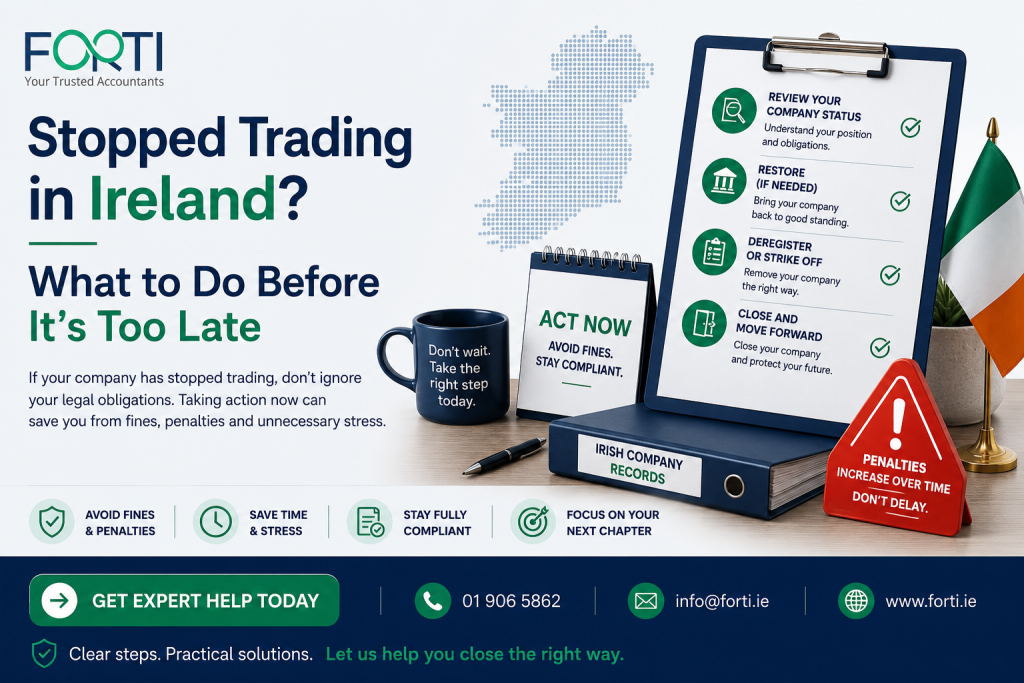
Stop Trading but Forgot to Close Properly

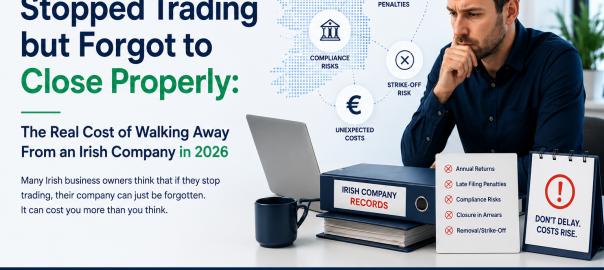
Stopped Trading but Forgot to Close Properly: The Real Cost of Walking Away From an Irish Company in 2026

Every year, Irish business owners quietly stop trading and assume that’s the end of it. It isn’t — and in 2026, with the CRO and Revenue both enforcing more actively than at any point in recent years, that assumption is proving very expensive.

The Misconception That Costs Thousands

Closing the laptop is not the same as closing the company. When a shop stops taking orders, a contractor stops invoicing, or a founder simply moves on to something else, the company or business name they used doesn’t disappear along with the activity. It stays on the register at the Companies Registration Office (CRO), and it stays live with Revenue, until someone formally deals with it.

Throughout 2026, both the CRO and Revenue have sharply increased enforcement. Following the Companies (Corporate Governance, Enforcement and Regulatory Provisions) Act 2024, the CRO has fully resumed involuntary strike-off action against non-filing companies, and Revenue continues to apply fixed penalties and daily interest on unresolved VAT and tax positions regardless of whether a business is actually trading. Directors who assume that silence equals closure are the ones most often caught out.

Five Ways a Business Can Be ‘Not Trading’ — and What Each One Requires

1. Dormant Company (Still Registered, No Activity)

Under Section 365 of the Companies Act 2014, a company is dormant if it has no significant accounting transactions during the financial year and its only assets or liabilities are permitted ones (such as amounts due to or from group companies). A dormant company can qualify for audit exemption regardless of its size — but it is not exempt from filing. It must still file an annual return (Form B1) with the CRO every year and submit a nil Corporation Tax return (CT1) to Revenue within nine months of its year end. The single most common mistake we see is a director assuming ‘dormant’ means ‘no filing needed.’ It doesn’t.

2. Ceased Trading, But the Company Is Still on the Register

This is the grey zone that catches most people out. The business has stopped operating, but the company was never formally struck off or dissolved. Every statutory obligation continues exactly as before: CRO annual returns, corporation tax returns, and — critically — VAT and payroll registrations, which don’t cancel themselves. If you were VAT registered and don’t tell Revenue you’ve stopped trading, Revenue’s systems will continue to expect returns and will issue estimated assessments and penalties when they don’t arrive.

3. Sole Trader Who Stopped Self-Employment

Sole traders have it slightly simpler but the obligations are just as real. You need to notify Revenue that you’ve ceased self-employment, cancel any VAT and employer PAYE registrations that no longer apply, and file a final Income Tax return covering the period up to cessation. If you traded under a registered business name, you’re also required to notify the CRO of the closure within three months.

4. Voluntary Strike-Off (Closing Down Properly)

This is the correct route for a solvent company with no outstanding creditors that genuinely wants to close. Directors apply to the CRO using Form H15, confirm the company has ceased trading and has no assets or liabilities, and place a newspaper advertisement confirming the intention to close. Done correctly, this results in an orderly, planned dissolution — the opposite of what happens when a company is simply abandoned.

5. Involuntary Strike-Off (What Happens When Nothing Is Done)

This is the default outcome of doing nothing. When annual returns go unfiled, the CRO issues a statutory notice, followed — if there’s no response — by a public notice in the CRO Gazette. If the company still doesn’t act, it is struck off and dissolved. From that date, the company ceases to exist as a legal entity, limited liability protection ends, and anyone continuing to trade through it is doing so in a personal capacity. The full process typically runs several months from the first missed deadline, but once the Gazette notice is published, the clock moves quickly.

The Revenue Side: Obligations That Don’t Switch Off on Their Own

Ceasing to trade doesn’t cancel your tax registrations — you have to do that deliberately. Revenue requires a formal cancellation request (Form TRCN1, or notification through ROS) for VAT, employer PAYE, and Corporation Tax registrations. Until that’s done, Revenue’s systems keep expecting returns.

  • VAT: a fixed penalty of €4,000 can apply for late or non-registration, non-submission of returns, or incomplete and incorrect returns — each treated as a separate default. Unpaid VAT accrues daily interest at approximately 0.0274% per day (roughly 10% annualised).
  • Income Tax, Corporation Tax and CGT: unpaid liabilities accrue daily interest at approximately 0.0219% per day.
  • Failure to pay or file outstanding returns after a registration is formally ceased can still result in penalties and interest for the periods up to the cessation date — cancelling the registration doesn’t erase what was already due.

These are not nominal late fees that fade away on their own. They compound the longer a business owner leaves the position unresolved, and Revenue’s enforcement has become considerably more systemised in the past year.

The CRO Side: The Filing Obligation That Survives Closure of the Business

Compliance Failure Table
Compliance failure Cost / consequence
Late annual return (Form B1) €100 + €3/day, capped at €1,200
Late filing (more than once in 5 years) Loss of audit exemption for 2 years
Forced statutory audit after losing exemption Approx. €2,000–€8,000 per year
Persistent non-filing Involuntary strike-off proceedings
Company struck off / dissolved Loss of limited liability protection

Beyond the direct fees, a strike-off record is permanent and public. It shows up in due diligence for future investment, financing, or directorships, and directors of dissolved companies can face disqualification proceedings brought by the Corporate Enforcement Authority in more serious cases. Restoring a struck-off company is possible — administrative restoration within twelve months of strike-off, or a High Court application after that — but both routes involve legal costs, accumulated penalties, and outstanding filings, all of which must be cleared before restoration is granted

Case Studies: Three Business Owners, Three Outcomes

Case Study 1 — The Ecommerce Founder Who Just Stopped

A Dublin-based Shopify seller closed their online shop after eighteen months, moved on to full-time employment, and assumed the company would ‘wind down on its own’ since there was no activity left. Two annual returns were missed. The CRO issued a statutory notice, then a Gazette notice, and the company was struck off and dissolved roughly five months later. The founder discovered this only when a supplier queried an old invoice — by then, restoring the company required a court application, accumulated late filing penalties, and legal fees that came to several times what a proper voluntary strike-off would have cost at the outset.

Case Study 2 — The Consultant Who Forgot to Deregister VAT

An IT contractor stopped trading through their limited company to take up a permanent role, but never submitted a VAT cancellation request. Revenue’s system continued to expect bi-monthly VAT returns. After several periods with no returns filed, fixed penalties and daily interest began accumulating on an account that had, in reality, no further business activity. The position was only resolved once the company engaged an accountant to formally cancel the VAT registration and negotiate the outstanding penalties — a process that took weeks and cost considerably more than the five-minute cancellation would have, had it been done at the time trading stopped.

Case Study 3 — The ‘Dormant’ Company That Wasn’t Filing

A holding company set up for a property investment sat dormant for three years while its director focused on other ventures, on the assumption that a dormant company had no filing obligations at all. In fact, the company had missed its CRO annual returns for two consecutive years. This triggered the loss of audit exemption for the following two years, meaning the eventual return to compliance required a full statutory audit of accounts that, in substance, contained almost no transactions — an audit bill running into thousands of euro for a company that had done, quite literally, nothing.

(These case studies are illustrative composites reflecting patterns we see regularly among Irish business owners, not individual clients.)

How to Close, Pause, or Keep a Company Compliant — Properly

Decide early whether you’re pausing (dormant) or ending (strike-off) — the obligations are different, and ‘I’ll figure it out later’ is how both get missed.

If dormant: hold a directors’ meeting to formally record the dormancy decision, and keep filing your annual return and nil CT1 every year without fail.

If ceasing trading permanently: cancel VAT, employer PAYE and any other Revenue registrations via TRCN1 or ROS, file final accounts and a final tax return, and settle any outstanding liabilities.

If closing the company entirely: use the voluntary strike-off process (Form H15) while the company is solvent and has no outstanding creditors — this is materially cheaper and faster than recovering from an involuntary strike-off later.

If you traded under a registered business name as a sole trader, notify the CRO of the closure within three months using Form RBN3.

Frequently Asked Questions

If my company isn’t trading, do I still need to file anything?

Yes. A dormant or non-trading company still must file its CRO annual return every year and submit a nil Corporation Tax return to Revenue. Only a company that has been properly struck off or dissolved has no further filing obligation.

Can I just let Revenue and the CRO strike the company off on their own?

You can, but it’s the most expensive way to close a business. Involuntary strike-off leaves accumulated penalties, a permanent public compliance record, and — if you need the company back — a restoration process that costs far more than a planned voluntary strike-off.

What happens to my personal liability if the company is struck off?

Limited liability protection ends on dissolution. If the business continues to operate in any form afterwards, it’s being carried on in a personal capacity, without the legal protection the company structure was providing.

I stopped trading as a sole trader — is there anything to file with the CRO?

Only if you registered a business name. In that case, you must notify the CRO of the closure within three months using Form RBN3. You’ll also need to notify Revenue and file a final Income Tax return.

Does cancelling my VAT registration clear penalties from before the cancellation?

No. Cancelling a registration stops future obligations; it doesn’t remove liability for returns or payments that were already due before the cessation date. Outstanding periods still need to be filed and settled.

Can a struck-off company be restored?

Usually yes. Administrative restoration is available within twelve months of strike-off provided all filings are brought up to date and penalties paid. After that window, restoration requires a High Court order, which involves legal costs and takes considerably longer.

What’s the cheapest way to avoid all of this?

Make the decision — dormant, wind down, or close — while the company is still in good standing, and act on it immediately rather than leaving it unresolved. Every one of the case studies above would have cost a fraction of the eventual bill if addressed in the first few months.

How Forti Helps

Whether a company is dormant, has stopped trading, or needs to be closed down properly, we handle the CRO filings and Revenue cancellations that keep the process clean — so it doesn’t turn into a strike-off, a forced audit, or a personal liability problem months down the line.

Talk to Forti Before You Walk AwayMonthly bookkeeping and management accounts from €195/month + VATIrish company formation, CRO fee included: €250Dormant company filings, VAT/PAYE deregistration and voluntary strike-off support available on request.

If you’re thinking about pausing, closing, or you’ve already stopped trading and aren’t sure what’s still outstanding, get in touch with the Forti team at forti.ie before the CRO or Revenue make the decision for you.


Irish Ecommerce VAT & OSS Compliance

Irish Ecommerce VAT & OSS Compliance: What Online Sellers Need to Get Right in 2026

For Irish-based online sellers shipping to customers across the EU, VAT is rarely simple — and getting it wrong is one of the most expensive mistakes a growing ecommerce business can make.

Why Ecommerce VAT Trips Up Even Careful Founders

Most Irish ecommerce founders start out registered for VAT in Ireland and assume that covers them. It doesn’t — not once sales cross into other EU member states. The rules that determine where VAT is due, at what rate, and under which scheme change the moment a business starts selling cross-border, and Revenue’s enforcement of these rules has tightened considerably as EU-wide reporting has become more joined up.

The good news is that the framework, once understood, is manageable. The two things that matter most are knowing your registration thresholds and knowing whether the One Stop Shop (OSS) scheme is right for your business — and both of those depend heavily on which platform, or mix of platforms, you’re actually selling through.

Step One: Categorise Your Sales Channels

Before any registration decision can be made, you need to know which category each of your sales channels falls into. VAT treatment is not the same across Shopify, Amazon, eBay and Etsy — the platform’s role in the transaction changes who is legally responsible for charging and remitting VAT.

Your Own Storefront: Shopify, WooCommerce, BigCommerce

On a self-hosted or owned storefront, you are the vendor of record for every sale. There is no intermediary collecting VAT on your behalf. This means your checkout needs to determine the customer’s location, apply the correct VAT rate, and your business needs to report that sale under either standard Irish VAT or the OSS scheme, depending on where the buyer is based. Full responsibility — and full liability if it’s done incorrectly — sits with you.

Online Marketplaces: Amazon, eBay, Etsy

Marketplaces are treated differently under EU ‘deemed supplier’ rules introduced in 2021. For certain transactions — mainly consignments valued under €150 imported from outside the EU, and sales by non-EU sellers to EU consumers — the marketplace itself is deemed to be the supplier for VAT purposes and collects and remits the VAT instead of you. Critically, this does not apply to every transaction: EU-based sellers shipping EU-held stock to EU consumers are generally still responsible for their own VAT, even when the sale happens through Amazon or eBay. Assuming the marketplace ‘has it covered’ across the board is one of the most common — and costly — misconceptions we see.

Multi-Channel and Hybrid Sellers

Most growing Irish ecommerce businesses end up selling through more than one channel — a Shopify store for brand and margin, plus Amazon or Etsy for reach. This is entirely normal, but it means your VAT reporting has to be built channel-by-channel: some sales collected and remitted by the marketplace, others fully your responsibility, all feeding into a single, reconciled VAT position. Trying to manage this with a single blended assumption across all channels is where errors creep in.

Irish VAT Registration Thresholds

Ireland applies two separate thresholds depending on what you’re selling. Once your turnover in any continuous 12-month period exceeds the relevant figure, VAT registration in Ireland becomes mandatory.

Registration trigger Irish threshold
Supply of services €42,500
Supply of goods €85,000

Many ecommerce sellers combine goods and services (for example, a product business that also sells digital add-ons or consulting), which is where the calculation gets more complex. It’s worth reviewing your revenue mix at least quarterly rather than waiting for a year-end surprise.

Which Registration Applies — and at What Revenue Level

Once you know your channel mix, the next question is which registration(s) you actually need. For most Irish ecommerce sellers, it isn’t one registration — it’s a combination that builds up as revenue and reach grow.

  • Irish domestic VAT registration — required once you cross €42,500 (services) or €85,000 (goods) in Irish-based turnover. This is your baseline registration regardless of where else you sell.
  • EU OSS (Union scheme) — required once your total cross-border B2C sales into other EU member states exceed €10,000 in a calendar year. Below that figure you may continue charging Irish VAT on those sales; above it, OSS (or local registration in each country) becomes necessary.
  • Import One-Stop Shop (IOSS) — relevant if you import and sell goods valued at €150 or less directly to EU consumers from outside the EU. IOSS lets you charge VAT at the point of sale and avoid customers being hit with surprise import VAT on delivery.
  • Local country VAT registration — triggered independently of OSS the moment you store stock in another EU country, most commonly through Amazon FBA or a pan-EU fulfilment network. OSS covers the sale; it does not cover the stock movement or the fact that you now have a taxable presence in that country.
  • Intrastat — a separate statistical filing once your intra-EU goods movements pass the relevant threshold, regardless of your VAT or OSS status (covered in more detail below).

The practical implication: a Shopify-only seller under €10,000 in EU sales might need nothing beyond standard Irish VAT. The same business, once it starts using Amazon FBA with stock held in Germany, could simultaneously need Irish VAT, OSS, a German VAT registration and Intrastat reporting — four obligations arising from one growth decision. This is precisely why channel and fulfilment choices should be reviewed with your accountant before scaling, not after.

The One Stop Shop (OSS) Scheme, Explained

The OSS scheme was introduced to simplify EU VAT for cross-border sellers, and for most Irish ecommerce businesses selling B2C into other member states, it’s the better option than registering for VAT in every country you sell into.

  • One registration, filed through Revenue in Ireland, covers your VAT obligations across all EU member states where you sell to consumers.
  • You charge the VAT rate of the customer’s country, not Ireland’s, on qualifying cross-border B2C sales.
  • Returns are filed quarterly, consolidating all EU sales into a single OSS return rather than dozens of local filings.
  • OSS applies once your total cross-border B2C sales into other EU states exceed €10,000 in a calendar year (a separate, EU-wide distance-selling threshold from the Irish domestic thresholds above).

The trade-off is that OSS requires precise record-keeping: you need to track the customer’s country for every sale, apply the correct local VAT rate, and reconcile it all at quarter-end. This is where a lot of founders — perfectly capable of running the commercial side of the business — start to lose time and accuracy.

Don’t Forget Intrastat

If your ecommerce business moves physical goods across EU borders (holding stock in an overseas fulfilment centre is a common trigger), you may also have an Intrastat reporting obligation, separate from your VAT return. Intrastat tracks the physical movement of goods between EU member states for statistical purposes, and thresholds and filing frequency depend on your volume of intra-EU trade. It’s a common blind spot for sellers using pan-EU fulfilment models, since the obligation exists independently of whether you’re OSS-registered.

The Most Common Compliance Mistakes We See

  • Registering for VAT in Ireland but continuing to charge Irish VAT on cross-border B2C sales that should carry the customer’s local rate under OSS.
  • Missing the €10,000 EU-wide distance-selling threshold because it’s tracked separately from the Irish domestic thresholds.
  • Treating marketplace sales (Amazon, Etsy, eBay) as fully compliant by default — deemed supplier rules mean the marketplace may account for VAT on your behalf, but only for certain transaction types.
  • Overlooking Intrastat obligations when stock is held or moved through overseas warehouses.
  • Reconciling VAT annually instead of monthly, which turns small errors into large, hard-to-unwind ones.

Case Studies: Three Irish Sellers, Three Different Paths

Case Study 1 — Emerald Home Goods (Shopify, direct-to-consumer)

Emerald Home Goods sells homeware exclusively through its own Shopify store, shipping from a single warehouse in Dublin. As an owned-storefront seller, Emerald is the vendor of record for every transaction. Once EU sales (outside Ireland) passed €10,000 in a calendar year, Emerald registered for OSS through Revenue, allowing it to charge the correct local VAT rate for each EU customer through a single quarterly return rather than registering separately in each country. Because all stock stays in Ireland, no Intrastat or additional local VAT registrations were triggered — OSS alone covered the cross-border position.

Case Study 2 — CelticTech Gadgets (Amazon FBA, pan-EU fulfilment)

CelticTech Gadgets sells electronics accessories through Amazon, using Amazon’s pan-EU fulfilment network to hold stock in Germany and Poland for faster delivery. Because Amazon is the marketplace for these sales, deemed supplier rules meant Amazon collected and remitted VAT on qualifying transactions. However, storing stock in Germany and Poland created a taxable presence in each country, independent of Amazon’s role — meaning CelticTech needed local VAT registration in both, alongside its existing Irish VAT registration, and a monthly Intrastat filing to report the stock movements. OSS was not sufficient on its own because it doesn’t cover the cross-border movement of a seller’s own stock.

Case Study 3 — Aisling Crafts (Etsy and eBay, hobby to business)

Aisling Crafts began as a part-time Etsy shop selling handmade candles and grew into a registered business within eighteen months. Early sales stayed under both the Irish threshold and the €10,000 EU OSS threshold, so no VAT registration was required. As UK and EU orders grew, Aisling crossed the OSS threshold first, followed by the Irish domestic threshold shortly after. Because the business tracked its channel-by-channel revenue from the outset, both registrations were completed proactively rather than in response to a compliance query from Revenue — avoiding any late-registration penalties or backdated VAT exposure.

(Emerald Home Goods, CelticTech Gadgets and Aisling Crafts are illustrative composites based on common patterns we see across Irish ecommerce clients, not individual businesses.)

Frequently Asked Questions

Do I need to register for VAT if I only sell within Ireland?

Only once your turnover exceeds the relevant Irish threshold — €42,500 for services or €85,000 for goods in any continuous 12-month period. Below that, registration is optional, though some businesses register voluntarily to reclaim VAT on costs.

If Amazon collects VAT on my sales, do I still need to register?

Possibly. Amazon’s deemed supplier rules only apply to specific transaction types — mainly low-value imports and non-EU seller sales. If you’re an Irish seller with EU-held stock, you very likely still carry the VAT obligation yourself, and may need OSS or local registration regardless of Amazon’s involvement.

Does OSS replace the need for Irish VAT registration?

No. OSS is an additional scheme for reporting cross-border B2C sales into other EU states. You still need standard Irish VAT registration once you exceed the domestic threshold, and OSS sits alongside it for EU sales beyond the €10,000 distance-selling threshold.

What happens if I store stock in another EU country?

Holding stock abroad — commonly through Amazon FBA or a European 3PL — generally creates a local VAT registration requirement in that country, along with an Intrastat obligation, regardless of your OSS status. This is one of the most frequently missed obligations for scaling sellers.

How often do OSS and Intrastat returns need to be filed?

OSS returns are filed quarterly. Intrastat filing frequency depends on your volume of intra-EU trade, but is typically monthly once the threshold is triggered.

What are the penalties for getting this wrong?

Penalties can include interest and fixed penalties on late or incorrect VAT, backdated liabilities if registration should have happened earlier, and in more serious cases, Revenue audit exposure. The cost of correcting a multi-country VAT position retrospectively is almost always higher than the cost of setting it up correctly from the start.

How Forti Helps Ecommerce Sellers Stay Compliant

This is exactly the kind of complexity we handle day-to-day for Irish ecommerce clients — from initial VAT and OSS registration through to ongoing monthly bookkeeping and quarterly OSS filings. We build the reporting so that country-by-country VAT is tracked correctly at the point of sale, not reconstructed under pressure at return time.

Work with Forti

Monthly bookkeeping and management accounts from €195/month + VAT

Irish company formation, CRO fee included: €250

VAT, OSS registration and Intrastat compliance built in for ecommerce clients