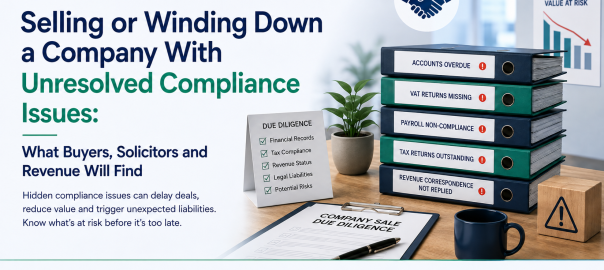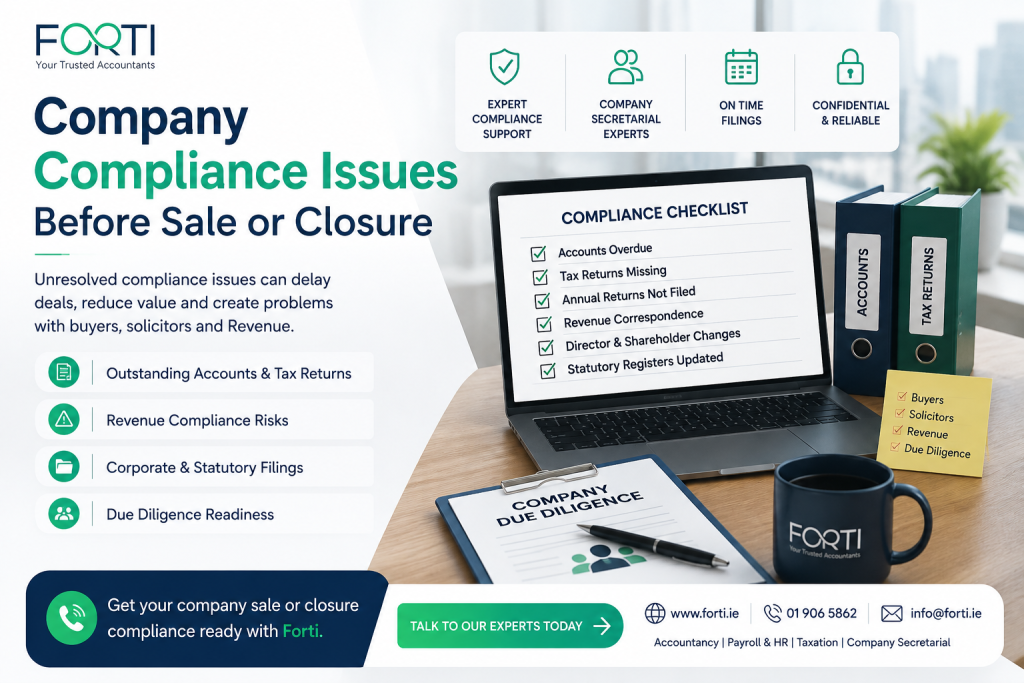
A missed annual return or an uncancelled VAT registration is one thing when nobody’s looking. It’s a different problem entirely when a buyer’s solicitor, an investor’s due diligence team, or Revenue’s own tax clearance system starts looking — which is exactly what happens the moment you try to sell, merge, or formally close a company.
Why Compliance History Becomes Visible at Exactly the Wrong Moment
Throughout this series we’ve looked at what happens when a business owner simply stops trading and leaves the paperwork unresolved. Selling a company, bringing in an investor, or even just formally winding it down properly surfaces every one of those gaps at once — because each process relies on independent, third-party verification of exactly the things that tend to get left until later: CRO filing history, Revenue’s tax clearance system, and the Register of Beneficial Ownership.
None of this is hidden. A company’s late filing history is publicly searchable on the CRO register, RBO discrepancies are checked as standard AML due diligence, and Revenue’s tax clearance status is verified electronically in real time. A buyer’s solicitor will find what’s there — the only question is whether it’s found before or after you’ve agreed a price.
Share Sale vs Asset Sale: Why Compliance History Matters Differently
Share Sale
When shares in the company are sold, the buyer acquires the company itself — its history, its liabilities, and its compliance record, warts and all. Every unresolved CRO filing, every unpaid Revenue liability, and every RBO discrepancy transfers with it unless specifically carved out. This is why share sale agreements lean so heavily on warranties and indemnities: the buyer is pricing in exactly this risk, and will expect the seller to stand behind it contractually.
Asset Sale
When the buyer instead purchases specific assets — a customer list, equipment, a brand, a lease — out of the company rather than the company itself, historic compliance issues are less likely to transfer directly. But the company itself still needs a clean compliance position to complete the sale in the first place: a Tax Clearance Certificate is often required to satisfy the buyer and their bank, and if the sale involves property, a CG50 clearance certificate is required under Section 980 of the Taxes Consolidation Act 1997 — without it, the purchaser is legally required to withhold part of the sale proceeds and remit them to Revenue.
What Due Diligence Actually Uncovers
Late CRO filing history — publicly visible on the register and an immediate flag for any buyer’s solicitor running standard checks.
Loss of audit exemption from a prior late filing — meaning historic accounts may need to be re-audited before a deal can close cleanly.
An expired or refused Tax Clearance Certificate — Revenue’s electronic system checks compliance in real time and will not issue clearance while returns or liabilities remain outstanding.
RBO mismatches — beneficial ownership details that don’t match the actual shareholding, a standard check under anti-money-laundering due diligence.
Unresolved VAT, OSS, or foreign VAT registrations — particularly relevant for ecommerce or multi-country sellers, as covered in Part 3 of this series.
A CG50 requirement the seller wasn’t aware applied — relevant wherever property or certain high-value assets form part of what’s being sold.
Preparing a Company for Sale or Formal Closure
Bring every CRO annual return up to date well before entering negotiations — a clean filing history removes one of the most visible red flags in due diligence.
Apply for a Tax Clearance Certificate early. The electronic system checks compliance automatically, and any gap will surface immediately rather than at the point you actually need it.
Confirm the Register of Beneficial Ownership entry matches the current shareholding exactly, updating within 14 days of any change.
Resolve any dormant, ceased-trading, or multi-country VAT ambiguity — as set out in Parts 1 through 3 of this series — so the buyer’s due diligence team isn’t the one working out what category the company actually falls into.
If property or qualifying assets are involved, apply for CG50 clearance as soon as contracts are signed rather than waiting until closing, since Revenue can take up to several weeks to process it.
Where the company won’t be sold at all but simply needs to close, follow the voluntary strike-off process from Part 2 rather than leaving it to lapse mid-negotiation.
What Happens If You Sell Anyway, Issues Unresolved
Deals don’t usually collapse outright over compliance gaps — they get renegotiated. A buyer who discovers late filings, a lapsed audit exemption, or an unresolved VAT position will typically respond in one of a few predictable ways: a reduction in price to reflect the cost of fixing it, a specific indemnity requiring the seller to cover any resulting liability after completion, or a delay to closing while the seller resolves the position. In each case, the seller ends up paying for the same fix they could have made earlier — just later, under time pressure, and with less negotiating leverage.
Case Studies
Case Study 1 — A Share Sale Delayed by an Expired Audit Exemption
A services company preparing to sell discovered during due diligence that a prior year’s late annual return had cost it audit exemption for two years — years for which the accounts had never actually been audited. Completion was delayed by several weeks while a retrospective audit was arranged, and the buyer negotiated a price reduction to reflect the delay and the risk.
Case Study 2 — A Missed CG50 Almost Cost the Seller Cash at Closing
A business owner selling a company that held a small commercial property assumed the sale would proceed like any other share transaction. Their solicitor identified that a CG50 clearance certificate was required under Section 980 given the property involved, and without it, the purchaser would have been legally required to withhold part of the proceeds. Applying as soon as contracts were signed avoided a hold-back at closing that would otherwise have tied up a meaningful portion of the sale price.
Case Study 3 — An RBO Mismatch That Slowed Down Investor Due Diligence
A founder seeking investment for an otherwise healthy business found the round delayed when the investor’s AML checks flagged a discrepancy between the Register of Beneficial Ownership and the company’s actual shareholding, following an earlier share transfer that had never been updated on the register. The correction itself was straightforward, but it added weeks to a process the founder had expected to close quickly.
(These case studies are illustrative composites reflecting patterns we see regularly among Irish business owners, not individual clients.)
1. Capital Gains Tax Clearance (Section 980 & Form CG50A)
When an asset sale or a share sale involves specific Irish assets (such as land, buildings, goodwill, or unquoted shares deriving their value from Irish land), strict statutory thresholds apply under Section 980 of the Taxes Consolidation Act 1997:
The Triggers: A Form CG50A clearance certificate is legally required if the disposal consideration exceeds:
€500,000 for commercial property, land, business goodwill, or qualifying unquoted shares.
€1,000,000 for residential property.
The Withholding Penalty: If the seller fails to produce a valid CG50A certificate to the buyer prior to or at closing, the purchaser is legally mandated to withhold exactly 15% of the gross purchase price and remit it directly to Revenue within 30 days.
Processing Timelines: Applications must be submitted electronically via the eCG50 facility on ROS (Revenue Online Service). Revenue standard processing times typically range from 3 to 4 weeks, meaning applications should ideally be initiated as soon as contracts are exchanged.
Filing histories are scrutinized heavily during corporate transactions due to the severe downstream legal impacts of a missed deadline:
Automatic Loss of Exemption: Under the Companies Act 2014, if a company files its annual return late by even one day, it automatically forfeits its right to claim an audit exemption for the financial year in question and the subsequent financial year.
The Transaction Impact: If a company has traded through those years without an audit under the assumption it was exempt, it will be forced to commission a retrospective audit before a share sale can cleanly close. This frequently causes severe delays and triggers price chips from buyers.
3. Register of Beneficial Ownership (RBO) Compliance
The 14-Day Rule: To comply with statutory Anti-Money Laundering (AML) frameworks, any internal corporate restructuring, share transfer, or allotment must be updated on the central Register of Beneficial Ownership within 14 days of the change.
Due Diligence Friction: Discrepancies between the company’s internal stock transfer book and the public RBO register automatically flag during a buyer’s or investor’s standard AML checks, halting funds from being drawn down until rectified.
Key Action Checklist for Pre-Sale Due Diligence
Compliance Area
Verification Action
Timing Requirement
1.Tax Clearance Certificate (TCC)
Check ROS electronic status across all tax heads (VAT, Relevant Contracts Tax, Corporation Tax, PAYE/PRSI).
Run 6–8 weeks before negotiations to catch hidden flags.
2.CG50 Clearance
File electronic application via eCG50 on ROS if transaction hits the €500k/€1m thresholds.
File immediately upon exchange of contracts.
3.CRO History
Verify that no annual returns are pending and check for past late filings that might have triggered an audit requirement
Review before drafting the initial Heads of Terms.
4.RBO Alignment
Cross-reference the central RBO register against the current register of members
Remediate any discrepancies at least 3 weeks prior to closing.
Frequently Asked Questions
Do I need a Tax Clearance Certificate to sell my company?
It’s frequently required by buyers, their banks, or as part of standard due diligence, even where not strictly a legal precondition of the sale itself. Applying early, since Revenue’s electronic system checks compliance automatically, avoids delay at the point you actually need it.
What’s the difference between a Tax Clearance Certificate and a CG50?
A Tax Clearance Certificate confirms your overall tax affairs are in order. A CG50 is a separate clearance specifically relevant where property or certain qualifying assets are part of the sale, confirming Revenue doesn’t require the purchaser to withhold part of the proceeds.
Can late CRO filings actually stop a sale from completing?
They rarely stop a sale outright, but they routinely delay it and give the buyer leverage to negotiate a lower price or demand a specific indemnity covering the risk.
Does an asset sale avoid all these compliance issues?
Not entirely. While historic liabilities are less likely to transfer with specific assets rather than the company as a whole, the company itself typically still needs a Tax Clearance Certificate and, where property is involved, a CG50 to complete the transaction.
How long does it take to fix these issues once discovered mid-deal?
We prepare companies for sale or formal closure well before a buyer’s solicitor gets involved — bringing CRO filings current, securing tax clearance, correcting RBO entries, and resolving any dormant or ceased-trading ambiguity, so the compliance story is already clean by the time due diligence begins.
Preparing to Sell or Close? Talk to Forti Early
Monthly bookkeeping and management accounts from€195/month + VAT
Tax clearance, RBO correction and pre-sale compliance clean-up available on request
If a sale, investment round, or formal closure is on the horizon, get in touch with the Forti team at forti.ie before a buyer’s due diligence team finds the gaps for you.
In Part 1, we looked at why ‘stopped trading’ isn’t the same as ‘closed down,’ and what it costs when business owners leave that gap unresolved. This follow-up is the practical playbook: the exact steps to restore a struck-off company, deregister properly with Revenue, close a company the right way, or keep a dormant one compliant — with the current CRO fees and timelines for each route.
Step One: Work Out Which Situation You’re Actually In
Before picking a fix, confirm the starting point. The route — and the cost — depends entirely on which of these applies to you right now.
Your company is still on the CRO register, but annual returns are overdue — you’re at risk, but not yet struck off.
Your company has already been struck off and dissolved — you need restoration if you want it back.
Your company is trading-inactive but compliant so far — you want to formally mark it dormant or close it properly before anything lapses.
You stopped self-employment as a sole trader — your fix runs through Revenue and, if you registered a business name, the CRO’s RBN3 form.
Search the CRO’s public register (cro.ie) for your company name or number — it will show your last filed annual return and current status, which tells you immediately which path below applies.
Path A: Restoring a Struck-Off Company
If it’s been less than 12 months since dissolution — Administrative Restoration
1. File Form H1 through the CRO’s CORE portal. The filing fee is €300, payable by bank draft, CRO deposit account, or online payment — cheques are no longer accepted.
2. File every outstanding annual return, each with its financial statements. Late filing penalties apply per return (€100 plus €3/day, capped at €1,200), though on a restoration the cumulative late-filing exposure across the last three returns is capped at €3,600.
3. If the company was struck off for Revenue non-compliance rather than CRO non-filing, you’ll also need written confirmation from Revenue that all outstanding statements have been delivered before the CRO will process restoration.
4. Confirm the company still meets the Section 137 requirement for an EEA-resident director (or holds the relevant bond), and that director/secretary details are up to date.
5. Once the Registrar is satisfied, the company is restored and treated, for continuity purposes, as if it had never been dissolved — though the gap in filings and the strike-off itself remain on the public record permanently.
If it’s been more than 12 months — Court Order Restoration
After the 12-month administrative window closes, restoration can only happen through the High Court, under Section 738 of the Companies Act 2014, provided fewer than 20 years have passed since dissolution.
This route requires a solicitor, a letter of no objection from the CRO’s Enforcement Section, confirmation from Revenue that all liabilities are discharged, and a court hearing before the order is filed with the CRO (a further €15 fee). It is slower, adds legal costs on top of the same outstanding CRO penalties and Revenue confirmations, and can take several months from start to finish — which is exactly why administrative restoration, actioned promptly, is the route worth protecting.
Path B: Closing a Company Properly (Voluntary Strike-Off)
If the company is solvent, has no outstanding creditors, and you genuinely want to close it rather than restore or reactivate it, voluntary strike-off is the cheapest and cleanest route — a fraction of the cost of letting the CRO strike it off involuntarily and dealing with the fallout later.
1. Confirm the company meets the Section 733 conditions: it has ceased trading (or never traded), has no assets or liabilities, and is not the subject of any court proceedings.
2. Ensure all Revenue tax registrations are cancelled and any final returns filed — the CRO’s H15 process assumes no outstanding Revenue position.
3. File Form H15 through CORE. The filing fee is €15.
4. Place a newspaper advertisement (published within 30 days of your CRO submission) announcing the intention to strike off, and submit the full page of that newspaper alongside the H15.
5. The CRO publishes a notice in the CRO Gazette. Any party has 90 days to object using Form H16; if no valid objection is received, the company is struck off and dissolved in an orderly, planned way — not an enforcement action against you.
Path C: Deregistering Correctly With Revenue
Whether you’re closing a company, pausing it as dormant with no further tax activity, or winding up a sole trade, Revenue registrations don’t cancel themselves — you have to tell them.
1. Submit a Tax Registration Cancellation Notification (Form TRCN1), or cancel online through ROS/myAccount where the facility is available, for each registration that no longer applies: VAT, employer PAYE, Corporation Tax, or Income Tax.
2. File all outstanding returns up to the date of cessation first. Cancelling the registration stops future obligations — it does not remove liability for periods before the cessation date.
3. Account for VAT on any assets or stock retained at the point of deregistration; Revenue treats this as a deemed supply in your final VAT return.
4. If you employed staff, complete final payroll submissions and issue final pay and tax details before cancelling your employer PAYE registration.
5. Keep the cancellation confirmation Revenue issues — you’ll need it if you later apply to have a company restored to the CRO register, since the CRO requires written confirmation that all Revenue statements were delivered.
Path D: Keeping a Dormant Company Properly Compliant
If the plan is to keep the company on the register — perhaps to protect a name, hold an asset, or pause before restarting
dormancy is a valid, low-cost status, but it still comes with a fixed annual routine.
Hold a directors’ meeting before the financial year end to formally record the decision that the company is dormant and will claim the dormant company audit exemption, minuted in accordance with Section 365.
File the CRO annual return (Form B1) every year, on time, with a balance sheet carrying the required dormant company exemption statement.
Submit a nil Corporation Tax return (CT1) to Revenue within nine months of the financial year end, every year, without exception.
Leave VAT and employer PAYE registrations cancelled unless there’s a specific reason to keep them live — an unused live VAT number is one of the most common sources of unexpected penalties.
Diarise the Annual Return Date itself; missing it even for a genuinely dormant company triggers the same late fees and, after repeated lapses, the same loss of audit exemption as an active company.
A Quick Reference: Fees at Each Stage
CRO Fees Table 2026
Action
CRO fee (2026)
Annual return (Form B1), filed online
€20
Late filing penalty per return
€100 + €3/day, capped €1,200
Voluntary strike-off (Form H15)
€15
Administrative restoration (Form H1)
€300
Court order restoration lodgement
€15 (plus legal costs)
Business name cessation (Form RBN3)
No fee
These are the direct CRO fees only. Revenue penalties, interest, and any professional fees for preparing outstanding accounts or liaising with Revenue sit on top, and are almost always the larger part of the final bill for anyone recovering from a lapse rather than acting proactively.
Case Studies: Three Business Owners Who Fixed It
Case Study 1 — Restored Within the 12-Month Window
A Dublin design consultancy discovered, eight months after the fact, that its company had been struck off for missing two annual returns. Because it was still inside the 12-month administrative window, the director filed Form H1, submitted both outstanding annual returns with accounts, paid the capped late filing penalties, and had the company restored within several weeks — materially cheaper and faster than the court route it would have needed a few months later.
Case Study 2 — A Clean Voluntary Strike-Off
A part-time online retailer decided to close permanently after two years of declining sales. Before applying to the CRO, the director cancelled the VAT registration, filed a final VAT return accounting for the small amount of remaining stock, and confirmed no creditors were outstanding. The Form H15 application, newspaper notice, and 90-day objection period ran smoothly, and the company was dissolved in an orderly way with no penalties and no restoration ever required.
Case Study 3 — Reactivating a Dormant Company Instead of Starting Fresh
A founder who had paused a company for eighteen months while exploring a new venture wanted to start trading through it again rather than incorporate a new entity. Because the company had continued filing its annual return and nil CT1 every year while dormant, reactivation simply meant registering for VAT and employer PAYE again and updating Revenue on the resumption of trading — no restoration, no penalties, and no gap in the company’s history.
(These case studies are illustrative composites reflecting patterns we see regularly among Irish business owners, not individual clients.)
Frequently Asked Questions
How quickly should I act once I realise a company has been struck off?
Immediately. Administrative restoration is only available within 12 months of dissolution — after that, the only route is a High Court application, which costs significantly more and takes considerably longer.
Can I do the administrative restoration myself, or do I need a solicitor?
Form H1 can be filed directly through CORE without a solicitor, provided you can gather the outstanding returns, accounts, and any required Revenue confirmation yourself. Court restoration, by contrast, generally requires a solicitor to prepare the court application.
What happens to contracts or a bank account if the company is later restored?
Restoration is treated, for continuity purposes, as though the company had never been dissolved, which is what makes it possible to pick up existing arrangements. In practice, banks and counterparties may still ask questions about the gap, so it’s worth having the restoration paperwork ready to show.
Do I need to cancel VAT before I can voluntarily strike off a company?
Yes, in practice. The voluntary strike-off process assumes no outstanding Revenue position, and a live VAT registration with returns still due will hold up or invalidate the application.
Is it cheaper to restore an old company or just incorporate a new one?
It depends on the value tied up in the old entity — its trading history, contracts, VAT registration, or name. If none of that matters, incorporating fresh is often simpler. If the company has an established track record, restoring it within the 12-month window is usually the better value.
What if I genuinely can’t afford the restoration or penalty costs right now?
Speak to Revenue and, where relevant, the CRO before the relevant deadlines pass. Revenue operates phased payment arrangements for tax debts, and addressing the position early — even in instalments — is materially better than letting a strike-off or court restoration become the only remaining option.
How Forti Helps
We handle the practical side of every path above — restoration filings, voluntary strike-off applications, Revenue deregistration, and ongoing dormant company compliance — so the paperwork gets done correctly the first time, rather than compounding into a bigger bill later.
Get Back on Track With Forti
Monthly bookkeeping and management accounts from €195/month + VAT
Irish company formation, CRO fee included: €250
Company restoration, voluntary strike-off and dormant company filing support available on reques
Whether you’re inside the 12-month restoration window, ready to close a company for good, or need a dormant company kept compliant, get in touch with the Forti team at forti.ie — the earlier you act, the fewer of these fees actually apply to you.
When you’re first getting a business off the ground in Ireland, your head is usually in a dozen places at once. You’re chasing the first big customer, haggling over a lease, or trying to get a website live. The “administrative” side of things—the paperwork and the legal filings—often feels like a job for “future you.”
However, every Irish company comes with a backpack of legal responsibilities from day one. At the heart of that is the Company Secretary.
Despite the name, this isn’t about typing memos or answering phones. Under the Companies Act 2014, the secretary is essentially your compliance anchor. They’re the person tasked with making sure the company stays on the right side of the law, keeping your records straight, and ensuring the Companies RegistrationOffice (CRO) doesn’t come knocking with a fine.
1. Decoding the Role: It’s More Than Just a Title
In the eyes of the Irish courts, the Company Secretary is a “high-ranking officer” of the company. That sounds a bit grand, doesn’t it? But it means they carry a specific weight of responsibility.
If the directors are the ones driving the car and making the big decisions, the company secretaryis the one checking the map, ensuring the road tax is paid, and keeping a log of every turn the car takes.
The Statutory “Must-Dos”
In a practical sense, the secretary handles the nitty-gritty that keeps a company legally healthy:
The Paper Trail: Keeping the official registers (directors, shareholders, and beneficial owners) accurate.
The Deadlines: Filing the Annual Returnon time (messing this up is the fastest way to lose your audit exemption).
The Formalities: Recording minutes of board meetings and making sure changes to the company—like a new office address or a change in shares—are reported to the CRO within the strict legal windows.
2. The Legal Landscape: The Companies Act 2014
To understand why this role is so vital, you have to look at the Companies Act 2014. This was a massive piece of legislation that simplified life for Irish businesses but also got very firm about “corporate governance.”
The Act states that every company must have a secretary. If you are a Single Director Company, you cannot be your own secretary. You need a second person or a professional firm to step in. This is a common stumbling block for solo entrepreneurs who think they can do it all themselves.
Even if you have two directors and one acts as the secretary, the law expects that person to have the “skills and resources” to do the job. You can’t just put a name on a form and hope for the best; the person needs to actually know what a B1 form is and when it’s due.
3. Deep Dive: The Statutory Registers
This is where many businesses fall down. Every company is required to keep a “Register Office” (usually your accountant’s office or your own business premises) where your statutory books are held. These aren’t just for show; they are the “DNA” of your company.
The Register of Members (Shareholders)
This is the most important document in your company. It is the prima facie evidence of who owns the business. If your name isn’t in this register, you technically don’t own the shares, regardless of what’s written on a napkin or an email. A good secretary ensures that every time a share changes hands, the register is updated immediately.
The Register of Directors and Secretaries
This tracks who is in charge. It includes their names, residential addresses (though you can apply for a service address for privacy in some cases), and their dates of birth.
The Register of Beneficial Ownership (RBO)
This is a relatively new and very “hot” topic in Irish compliance. Since 2019, you must report who actually controls the company to a central government database. The secretary handles this filing. If you ignore it, the fines can be eye-watering—up to €500,000 if it goes to court (though usually, it’s just a very stiff administrative fine).
4. The Annual Return (Form B1): The “Do Not Miss” Deadline
If there is one thing you take away from this guide, let it be this: Do not miss your Annual Return Date (ARD).
Every Irish company is assigned an ARD. This is the date by which you must tell the CRO that you’re still alive, who is running the show, and what your finances look like.
The Consequence of Being Late
In the old days, you might get a slap on the wrist. In 2026, the CRO is automated and unforgiving.
Late Filing Fees: These start at €100 the day after the deadline and tick up by €3 a day, capped at €1,200.
Loss of Audit Exemption: This is the real killer. Most small Irish companies don’t need an expensive audit. But if you’re late with your B1, you lose that right for the next two years. You’ll have to hire an auditor to go through your books, which could easily cost you €3,000 to €10,000 depending on your turnover.
Strike-Off: If you ignore it long enough, the CRO will simply strike your company off the register. This means you no longer exist, your bank accounts are frozen, and your assets technically belong to the State.
A professional company secretary lives and breathes these deadlines so you don’t have to.
5. Board Meetings and Minutes: Why Bother?
I often hear business owners say, “It’s just me and my co-founder, why do we need to write down minutes of our meetings? We talk every day over lunch!”
Legally, you are required to hold an Annual General Meeting (AGM) and keep minutes of board decisions.
The “Protection” Factor
Minutes aren’t just red tape; they are your protection. If there is ever a dispute between shareholders, or if the Revenue Commissioners ever audit your business, those minutes prove that the directors acted reasonably and followed the law.
A company secretary attends (or helps draft) these minutes to ensure the language is “legally sound.” They record who was there, what was decided, and any “disclosures of interest” (e.g., if a director is buying a car from their own company).
6. Corporate Changes: Navigating the CRO
Business is fluid. You’ll eventually want to change things. Each change requires a specific form and a specific timeframe (usually 14 to 28 days).
Change of Registered Office: Form B2.
Appointing/Resigning a Director: Form B10.
Issuing New Shares: Form B5.
Changing the Constitution: This requires a “Special Resolution” and a filing with the CRO.
If you don’t file these on time, your public record becomes “stale.” This becomes a massive headache when you try to open a new bank account or apply for a grant from Enterprise Ireland, as they will check the CRO first.
7. The Single Director Dilemma
Ireland is a great place for solo entrepreneurs, but the “Single Director” rule catches people out. Because a single director cannot be the secretary, you have a few choices:
The “Family” Option: Appointing a spouse or parent. This is free, but are they going to remember to file the RBO returns? Probably not.
The “Accountant” Option: Many accountants offer this, but it’s often a secondary service for them.
The “Professional” Option: Hiring a dedicated Company Secretarial firm.
In my experience, the third option is the safest for a growing business. It keeps your personal relationships and your business compliance separate.
8. Outsourcing vs. In-House: The Pros and Cons
As your company grows, you might wonder if you should hire a full-time secretary.
In-House
Pros: They are in the office, they know the business inside out, and they can handle other admin.
Cons: Expensive (salary, PRSI, pension) and they might not be a “specialist” in the latest company law changes.
Outsourced (Professional Service)
Pros: Cost-effective (a few hundred Euro vs. a salary), they have “bulk” experience with the CRO, and they use specialized software to track deadlines.
Cons: They aren’t in your office daily, so you have to be proactive about telling them when something changes.
9. What Does “Good” Look Like? (Costs and Expectations)
You shouldn’t be paying thousands for basic secretarial support. For a standard SME, the annual fee is usually €300 to €800.
What should be included for that price?
Acting as the named Company Secretary.
Annual Return filing (Form B1).
Maintenance of the Statutory Registers.
Reminders for all key deadlines.
Basic advice on governance.
If you’re doing a “Share Buyback” or a “Group Reorganisation,” expect to pay an extra project fee. These are complex legal maneuvers that require a specialist’s touch.
10. The International Perspective
If you’re a US or UK company setting up an Irish subsidiary, the Company Secretary is your local eyes and ears.
Ireland has strict “Section 137” rules where at least one director must be resident in the EEA (European Economic Area). If you don’t have a resident director, you have to take out a Section 137 Bond. A professional secretary will manage this bond and ensure that the Irish subsidiary stays compliant with local laws that might differ wildly from your home country.
11. Common Mistakes to Avoid
In my years advising Irish firms, I’ve seen it all. Here are the “Big Three” errors:
The “Residential Address” Slip: Directors often forget to update the CRO when they move house. This is technically a breach of the Act.
The “Lost” Minute Book: Keeping minutes in a random Word document on a laptop that eventually breaks. You need a centralized, secure “Minute Book.”
Incorrect Share Allocations: Issuing shares without checking if you have enough “Authorised Share Capital” left. This can be a nightmare to fix retrospectively.
12. Why It Matters for the Future (The “Exit” Strategy)
You might not be thinking about selling your company today, but you should be. When a big company or a VC firm looks to buy you, they perform Due Diligence.
They will send a team of lawyers to look at your secretarial records. If they find missing minutes, unfiled share transfers, or messy registers, they see risk. It can delay a deal by months or even cause the buyer to knock €50,000 off the price because they have to “clean up” your mess.
Good secretarial work is like keeping a clean engine; it makes the car much easier to sell when the time comes.
13. Summary: The Quiet Foundation
The company secretary isn’t the “star” of the show. They don’t bring in the sales or design the products. But they are the foundation.Without a solid secretary, your company is built on sand. One missed deadline or one messy shareholder dispute can bring the whole thing crashing down. By investing a small amount in professional services, you’re buying yourself the freedom to focus on growth, knowing that the “back office” is bulletproof.
Frequently Asked Questions (FAQs)
1. Does the Company Secretary have to live in Ireland?
Not necessarily. Unlike the requirement for at least one director to be resident in the EEA (European Economic Area), a company secretary can technically live anywhere. However, they need to be reachable and capable of filing Irish documents. Most people choose a local professional because they understand the specific quirks of the Irish CRO and the 2014 Act.
2. Can my accountant also be my Company Secretary?
Yes, many accounting firms offer this. It’s a handy “all-in-one” solution. Just ensure they are actually doing the secretarial work and not just filing the accounts. Some firms treat it as an afterthought, but as we’ve discussed, the legal registers are just as important as the profit and loss statement.
3. What happens if I just don’t appoint a secretary?
If you try to register a company without one, the CRO will simply reject the application. If your secretary resigns and you don’t replace them, your company is in breach of the Companies Act. This can lead to the company being struck off the register, which is a legal nightmare to fix.
4. Is the Company Secretary liable for the company’s debts?
Generally, no. Like directors, secretaries have “limited liability.” However, they can be held personally liable—or face fines and prosecution—if they are found to be complicit in fraud or if they consistently fail in their statutory duties (like failing to keep proper books).
5. We’re a tiny “husband and wife” team. Do we really need to hold an AGM?
Legally, yes. However, the 2014 Act allows private companies with two or more directors to “dispense” with holding a physical AGM if all the members sign a written resolution. It saves you sitting in the kitchen pretending to be at a formal meeting, but you still have to do the paperwork to make it official.
6. Can a “Body Corporate” (another company) be a secretary?
Yes. This is very common. Instead of naming an individual, you can hire a professional secretarial company. They act as the “Corporate Secretary.” This is often more stable because a company doesn’t go on holiday or get sick in the middle of a filing deadline.
7. Does the Secretary have a vote on the Board?
Only if they are also a Director. If they are just the secretary, they attend board meetings to take minutes and provide advice on procedure, but they don’t get a vote on business decisions like hiring, firing, or spending money
8. My company is currently “dormant” (not trading). Do I still need a secretary?
Yes. Even if your company doesn’t have a single Euro in its bank account and hasn’t sold a thing, it is still a legal entity. You still have to file an Annual Return and you still must have a secretary on record.
9. Can I change my Company Secretary at any time?
Absolutely. If you’re unhappy with your current provider or if your internal secretary leaves, you just need to file a Form B10 with the CRO within 14 days of the change. It’s a straightforward process.
10. What is the difference between a “Registered Office” and a “Business Address”?
The Registered Office is the official “legal” address where the CRO and Revenue send formal notices. This is where your secretary usually keeps the statutory registers. Your Business Address is where you actually do your day-to-day work. They can be the same, but many
A simple habit that keeps your business steady, confident, and in control
Most founders don’t avoid their numbers because they don’t care — they avoid them because they feel overwhelming, unclear, or always slightly out of date. And by the time you do look, it’s usually because something feels off.
The truth is, you don’t need hours of reports to stay on top of your finances. You just need a simple rhythm. A short monthly check-in with your bookkeeper can give you a clear picture of where you stand, what needs attention, and what you can confidently ignore.
This 15-minute ritual isn’t about accounting — it’s about peace of mind. It’s about replacing guesswork with clarity and making sure there are no surprises waiting around the corner.
Why This Matters More Than You Think
Running a business is busy, and finance often slips down the priority list until a deadline or cash worry pushes it back up. But the businesses that feel calm around money aren’t necessarily the most profitable — they’re the ones with visibility.
A short monthly conversation keeps you connected to the reality of the business. It helps you spot small issues early, make decisions with confidence, and sleep a little better knowing there’s nothing lurking in the background. Over time, this habit builds trust in your numbers and confidence in your direction.
When to Do It — Before the 10th Each Month
There’s something powerful about having a fixed point in the month when you pause and look at the financial picture. Doing this before the 10th works well because most of the previous month’s activity is settled, but you still have time to act if something needs attention.
Once it becomes routine, it stops feeling like a meeting and starts feeling like a reset. You know it’s coming, your bookkeeper knows it’s coming, and the conversation becomes easier every month. That consistency is what turns finance from reactive to proactive.
Phase 1: A Quick Reality Check (3 Minutes)
Before diving into performance, it’s worth making sure the numbers you’re looking at actually reflect reality. There’s no value in analysing reports if the basics aren’t right.
This quick check builds trust. When you know the data is clean and complete, the rest of the conversation becomes far more useful. It removes doubt and allows you to focus on what matters — understanding the story behind the numbers rather than questioning them.
Are All Accounts Reconciled?
This simply means every transaction showing in the bank is recorded correctly in your accounts. It sounds small, but it’s the difference between clarity and confusion.
When payment platforms like Stripe or Revolut are included, you get a full picture of your cash rather than just part of it. Keeping this tidy each month prevents bigger tidy-ups later and ensures you’re always looking at a reliable position.
Is Anything Sitting in “Uncategorised”?
Every business ends up with a few transactions that don’t quite have a home yet. Left alone, they quietly build up and make reports harder to trust.
Clearing them monthly keeps things clean and often highlights where processes could be smoother — maybe receipts aren’t being uploaded quickly, or suppliers need clearer references. It’s a small step that keeps everything running more smoothly.
Are Any Important Invoices Missing?
This is mostly about making sure you’re not leaving money behind, especially when it comes to VAT reclaims. If a high-value purchase isn’t documented properly, it can delay claims and create unnecessary back-and-forth later.
Checking this regularly encourages good habits across the business. Documentation becomes part of the process rather than an afterthought, and year-end becomes far less stressful.
Here is the quick checklist:
Bank Reconciliation
Ask: Are all accounts reconciled to month-end?
This includes:
Current accounts
Savings accounts
Stripe / PayPal
Revolut or payment processors
If accounts aren’t reconciled, the rest of the discussion is guesswork.
The “Suspense” or Uncategorised Review
Ask: Is anything sitting in Suspense or Uncategorised?
These usually indicate:
Missing receipts
Unknown transactions
Incorrect postings
Clearing them ensures your reports reflect reality, not placeholders.
The Receipt Gap Check
Ask: Are any high-value purchase invoices missing?
Outcome of Phase 1: You now know the numbers are reliable.
Phase 2: The Numbers That Actually Matter (7 Minutes)
You don’t need to review dozens of reports to understand your business — just a handful of meaningful numbers. These metrics give you a quick snapshot of health, momentum, and risk.
Over time, you start to develop an instinct for them. You’ll notice trends sooner, ask better questions, and feel far more connected to how the business is performing beyond just “busy” or “quiet.”
What’s Your Real Cash Position?
Your bank balance alone doesn’t tell the full story because some of that money already belongs to Revenue. When you subtract upcoming tax liabilities, you see what’s truly available.
This number removes false comfort and replaces it with clarity. It helps you make confident decisions about spending, investing, or holding back — all based on reality rather than assumptions.
Who Still Owes You Money?
Late payments are one of the biggest sources of unnecessary stress in any business. A quick look at who’s overdue keeps collections proactive rather than awkward or last-minute.
When customers know you review this regularly, payment behaviour naturally improves. It’s less about chasing and more about keeping expectations clear.
Has Your Margin Shifted?
Margins tell you how efficiently your business is operating. A small movement can signal supplier changes, pricing issues, or shifts in what you’re selling.
Spotting these early gives you options — renegotiate, adjust pricing, or rethink discounts. It’s far easier to correct course now than months down the line.
How Long Would Cash Last?
This is one of the most reassuring numbers you can know. Instead of worrying vaguely about the future, you have a clear timeline.
Knowing your runway helps you plan with confidence — whether that’s hiring, investing, or simply deciding to hold steady. It replaces uncertainty with perspective.
Are You Growing, Flat, or Slowing?
Looking at revenue compared to last month keeps you grounded in trajectory rather than isolated results. Even small changes can tell you a lot about demand or momentum.
It’s not about reacting emotionally to every fluctuation, but about staying aware of direction so you can respond thoughtfully.
Are Costs Quietly Creeping Up?
Subscriptions, small tools, and operational tweaks can gradually increase your monthly spend without you noticing. A quick scan keeps this in check.
This habit encourages intentional spending and makes it easier to decide what’s genuinely adding value and what might be trimmed.
Profit vs Cash — Do They Tell the Same Story?
Sometimes the business looks profitable but still feels tight on cash. Understanding why helps avoid confusion and unnecessary worry.
This perspective ensures you’re balancing growth with liquidity and not mistaking accounting profit for available funds.
Here is the quick checklist:
This is where insight happens. These are the seven numbers every founder should understand — not just accountants.
Why it matters: Your bank balance is not your spending power. This figure shows what you actually have available.
Debtors Deep Dive
Ask: Who are the top 3 customers over 60 days?
Then decide:
Who calls them
When payment is expected
Cash flow problems are often collection problems in disguise.
Gross Margin Health
Ask: Did margin move by more than 2%?
If yes, investigate:
Supplier price increases
Discounting
Product mix changes
Margins rarely collapse overnight — but they erode quietly.
Cash Runway
Ask: If we make no new sales, what exact date does cash run out?
This single metric reduces anxiety and improves planning. It turns vague worry into a clear timeline.
Revenue Trend vs Last Month
Is revenue:
Growing
Flat
Declining
Even a quick comparison highlights momentum early.
Cost Creep Check
Have any recurring costs increased? Software subscriptions and small expenses quietly add up.
Profit vs Cash Reality
Are you profitable but still cash-tight? That’s usually due to debtors, stock, or tax timing.
Outcome of Phase 2: You understand performance, risk, and momentum.
Phase 3: Staying on the Right Side of Compliance (5 Minutes)
Compliance doesn’t need to feel heavy or intimidating when it’s handled little and often. A quick monthly check keeps everything visible and manageable.
Rather than scrambling at year-end, you’re simply confirming that things are ticking along as they should. It’s a calm, steady approach that reduces risk without adding stress.
Have Expenses and Benefits Been Reported?
With real-time reporting becoming more common, it’s helpful to confirm everything has been logged correctly before payments go through.
This keeps you aligned with Revenue expectations and ensures there’s no backlog building quietly in the background.
Is the Director’s Loan Moving?
Director’s loans can creep up without much notice, so a quick monthly glance keeps things transparent.
It’s less about restriction and more about awareness — making sure personal and business finances stay balanced and predictable.
Is Payroll Fully Up to Date?
Payroll touches both compliance and team trust, so it’s worth confirming everything is accurate.
A regular check reduces the risk of surprises and reassures you that contributions and filings are exactly where they should be.
With auto-enrolment changes, monthly checks reduce risk significantly.
Outcome of Phase 3: Your compliance risk is under control.
Ending With Three Clear Actions
The real value of this ritual is what you do afterwards. Agreeing on just three actions keeps things focused and manageable.
It ensures the conversation leads to progress rather than simply awareness. Small, consistent actions each month create momentum and prevent issues from lingering.
When Numbers Aren’t Ready — It’s Usually a Process Issue
If the data isn’t ready by the time you meet, it’s rarely because reporting is slow. More often, it’s because receipts, invoices, or systems aren’t flowing smoothly.
Fixing how information is captured — through automation or clearer processes — transforms the whole experience. The conversation shifts from searching for documents to making decisions.
What Changes When This Becomes a Habit
Founders who adopt this ritual often describe a noticeable shift — less anxiety, clearer thinking, and more confidence in planning.
It doesn’t change the business overnight, but it changes how you feel running it. And that clarity compounds over time, making growth feel far more manageable.
The Implementation Tool: The RAG Action List
The ritual only works if it leads to action.
At the end of the 15 minutes, agree on exactly three actions using a traffic-light system.
This keeps the meeting focused and prevents “analysis paralysis.”
Real-World Scenario: How a 15-Minute Ritual Changed a Founder’s Cash Flow
The Situation A Dublin-based service business with a team of six was growing steadily, but the founder constantly felt short on cash. Sales were strong, yet there was always pressure before VAT deadlines. The feeling was familiar — “We’re busy, so why does it always feel tight?”
What We Found After introducing the monthly 15-minute check-in, two patterns became obvious within the first month:
Over €38,000 sitting in invoices older than 60 days
A VAT liability that wasn’t being factored into “available cash”
The business wasn’t struggling — it simply didn’t have visibility.
Founder reported feeling “back in control” of decisions
The key takeaway: nothing dramatic changed operationally — just awareness and timing.
Quick Summary: The 15-Minute Ritual in Plain English
If you remember nothing else, remember this:
1️⃣ Make sure the numbers are accurate 2️⃣ Check the few metrics that really matter 3️⃣ Confirm nothing risky is slipping through compliance 4️⃣ Leave with three clear actions
That’s it. No complicated dashboards. No finance jargon. Just a simple monthly reset that keeps your business grounded.
Frequently Asked Questions
Reports are useful, but conversations create clarity. This ritual turns information into decisions.
1. Is 15 minutes really enough?
Yes — the goal isn’t deep analysis, it’s awareness. If something needs more time, it becomes an action item rather than dragging out the meeting.
2. Do I need accounting software for this?
You don’t need anything fancy, but cloud software makes the process faster and more accurate.
3. What if my business is very small?
This ritual is arguably even more valuable for small businesses because cash visibility is critical.
4. Should this replace management accounts?
No — think of it as a monthly pulse check, while management accounts provide deeper quarterly insight.
5. What if my bookkeeper already sends reports?
Reports are useful, but conversations create clarity. This ritual turns information into decisions.
6. How does this help with cash flow?
It highlights overdue invoices, upcoming taxes, and spending trends early — before they become pressure points.
7. Who should attend the meeting?
Usually just the founder and bookkeeper. It works best when it stays simple and focused.
8. Can this help with growth planning?
Absolutely — knowing your runway and margins gives you confidence to invest at the right time.
9. What’s the biggest mistake founders make?
Looking at their bank balance without considering tax liabilities.
10. How long before I see results?
Most businesses feel the difference within 1–2 months because visibility improves immediately. If you’re running a business and your finances only get attention at year-end or tax deadlines, this small monthly habit can genuinely change how in control you feel. Start simple: 📅 Book a 15-minute check-in before the 10th of next month 📊 Review the key metrics ✅ Agree on three actions Consistency beats complexity every time. 👉 If you’d like a simple checklist or want help setting up a monthly financial rhythm, our team is always happy to point you in the right direction.
This is one of the most common — and most misunderstood — questions we hear from Irish company directors:
“Sure isn’t that what the accountant is for?”
It’s a fair question. You pay professional fees, you provide the information, and you expect filings to be done properly. But when it comes to Irish tax law, the line between who does the work and who carries the responsibility is very clear.
And it often only becomes clear when something goes wrong.
This article explains, in plain English, who is legally responsible for tax compliance in Ireland, what directors are personally accountable for, and where accountants actually fit into the picture.
The Short Answer (Up Front)
The director is legally responsible for tax compliance
The accountant supports compliance — but does not carry the liability
That applies whether your business is large or small, profitable or struggling, fully outsourced or managed internally.
Understanding this distinction can save directors from penalties, audits, and personal exposure later on.
What “Tax Compliance” Actually Means in Ireland
Tax compliance is not one single task. It covers a range of ongoing obligations, including:
The legal responsibility remains with the director.
This is why many directors engage Director Advisory Services — not just to “file returns”, but to understand risk, obligations, and decision-making clearly.
So What Is the Accountant Responsible For?
Accountants play a vital role — but it’s important to be clear on what that role actually is.
An accountant is responsible for:
Preparing returns based on the information provided
Advising on tax treatment and compliance
Filing returns where authorised
Flagging issues or risks when they arise
What they are not responsible for:
Business decisions made by directors
Incomplete or incorrect information supplied
Missed deadlines due to delayed inputs
Ongoing compliance failures where warnings were ignored
In other words, accountants support compliance, but they do not replace director accountability.
That’s why good tax compliance support works best when there is clarity and communication on both sides.
Where Directors Get Caught Out (Common Scenarios)
“I Thought the Accountant Was Handling It”
This is by far the most common issue.
A filing is missed, a penalty arrives, or Revenue raises a query — and the director assumes it’s an accountant error. In reality, the deadline may have passed because:
Information was provided late
Approvals were delayed
Decisions weren’t made in time
From Revenue’s perspective, that distinction doesn’t matter. The company — and the director — remain responsible.
“The Company Isn’t Making Money”
Lack of profit does not remove compliance obligations.
This is why ongoing Annual Compliance is about much more than year-end accounts — it’s about staying on the right side of the system all year round.
“The Bookkeeper Does That”
Bookkeepers are essential for day-to-day accuracy, but bookkeeping alone does not equal compliance.
Without proper oversight, review, and filing:
Errors can go unnoticed
VAT issues can build up
PAYE problems can escalate
That’s where structured Bookkeeping Services , aligned with tax and compliance oversight, make a real difference.
What Happens When Compliance Breaks Down?
When tax compliance issues arise, the consequences can include:
Interest and penalties
Revenue audits
Restriction on directors
Cashflow pressure
Reputational damage
In serious cases, directors may face personal exposure, particularly where there is repeated non-compliance or failure to engage.
This is why clarity around responsibility matters before there’s a problem — not after.
How Good Directors Actually Manage Compliance
In well-run Irish companies, the approach is usually simple and effective:
Directors own the responsibility
Advisors own the execution and advice
Deadlines are planned, not chased
Issues are flagged early
Decisions are documented
This is the difference between reactive compliance and controlled compliance.
A Practical Way to Think About It
A useful rule of thumb:
If Revenue has a question, they will look to the director first — not the accountant.
That doesn’t mean you should manage everything yourself. It means you should:
Understand what’s being filed
Know when it’s due
Know where the risks are
Have proper tax compliance support in place
Questions Directors Ask Us All the Time
Q1. If my accountant files everything, am I still responsible?
Yes — and this is where many directors get caught out. Even if your accountant prepares and submits the returns, the responsibility still sits with you as the director. From Revenue’s point of view, the company (and its directors) are accountable, not the adviser. That doesn’t mean your accountant isn’t doing their job — it just means the responsibility doesn’t transfer.
Q2. Can I personally get into trouble if something goes wrong?
In some situations, yes. Most issues start with penalties and interest. But if problems are repeated, ignored, or allowed to drag on, directors can face much more serious consequences. That’s why it’s better to deal with issues early, before they escalate.
Q3. What if the information I gave the accountant was late or incomplete?
This happens more often than people like to admit. If information is delayed, missing, or unclear, deadlines can slip. When that happens, the responsibility doesn’t move to the accountant — it stays with the director. That’s why timing and communication matter just as much as the filing itself.
Q4. Does this really apply to small companies and startups?
Yes, it does. The rules don’t change just because a business is small or new. Startups, one-person companies, and family businesses all have the same basic obligations. The difference is usually not the rules — it’s how closely compliance is monitored.
Q5. What if the company didn’t make any money?
This is another common misunderstanding. Even if a company makes no profit, returns still need to be filed. CRO filings, corporation tax returns, and VAT (where relevant) don’t stop just because trading was quiet. Revenue and the CRO don’t look at intent — they look at whether filings were done.
Q6. Isn’t this what my bookkeeper is for?
Bookkeepers are vital, but their role is different. They keep the records up to date. They don’t make decisions, assess risk, or deal with deadlines in the same way an accountant or adviser does. Without oversight, small issues can build up quietly and only come to light when Revenue gets involved.
Q6. Isn’t this what my bookkeeper is for?
Bookkeepers are vital, but their role is different. They keep the records up to date. They don’t make decisions, assess risk, or deal with deadlines in the same way an accountant or adviser does. Without oversight, small issues can build up quietly and only come to light when Revenue gets involved.
Q7. I’ve missed deadlines before — is it too late to fix things?
In most cases, no. Many past issues can be corrected, especially if you deal with them before Revenue raises questions. The longer problems are left, though, the harder (and more expensive) they become. Early action nearly always leads to a better outcome.
Q8. How often should I, as a director, be checking this stuff?
You don’t need to be looking at it every week, but you shouldn’t be relying on a once-a-year conversation either. Most directors benefit from having visibility at least every few months — knowing what’s due, what’s been filed, and whether anything needs attention.
Q9. Can accountants ever be held responsible?
Only in very limited situations. In day-to-day compliance, the responsibility sits with the director. Accountants advise, prepare, and file — but they don’t take on legal responsibility for the business.
Q10. What’s the safest way to manage all this without it taking over my life?
Clarity and structure. Knowing what’s due, when it’s due, and who’s doing what removes most of the stress. Problems usually arise when things are assumed rather than checked.
Real Situations We See with Irish Businesses
Case Study 1: “I Thought It Was All Being Handled”
A professional services firm had been trading for years without any major issues. The directors assumed compliance was under control because they sent everything to their accountant.
Over time, deadlines slipped during busy periods. VAT returns were filed late, and a Revenue query followed.
From the directors’ point of view, it felt unfair — they hadn’t ignored anything on purpose. But Revenue looked at it simply: filings were late, and the company was responsible.
The issue was resolved, but it came with penalties, interest, and a lot of unnecessary stress.
What they learned: Sending information over isn’t the same as actively managing compliance.
Case Study 2: “We’re Small — It Can’t Be That Serious”
A small owner-managed company assumed the rules were more relaxed because turnover was modest.
Returns were filed late more than once, and CRO deadlines were missed. Eventually, audit exemption was flagged as being at risk.
What started as a few missed dates turned into a much bigger problem than the director expected — both in cost and in time spent fixing it.
What they learned: The size of the business doesn’t change the rules.
Case Study 3: Bookkeeping Without Oversight
A growing business relied heavily on an internal bookkeeper and felt confident everything was under control.
Over time, VAT figures drifted, payroll issues went unnoticed, and no one stepped back to review the bigger picture.
When Revenue raised questions, the director had to deal with corrections, explanations, and penalties — all while trying to keep the business running.
What they learned: Good records are important, but oversight is what keeps things safe.
A Final Word for Directors
Most compliance problems don’t come from bad decisions. They come from assumptions.
Assuming:
Someone else is watching the deadlines
It’s probably fine this year
Issues will be flagged before they become serious
In reality, compliance works best when directors have clear visibility, even if they’re not involved day to day.
Final Thought: Responsibility Doesn’t Mean Doing Everything Yourself
Being responsible doesn’t mean being buried in paperwork.
It means:
Knowing where you stand
Having the right advice
Putting structure around compliance
That’s exactly where experienced Director Advisory Services and ongoing tax compliance support add real value — not just at filing time, but throughout the year.
If you’re not 100% clear on:
What you’re personally responsible for
Whether your company is fully compliant
Where your risks actually sit
👉 Now is a good time to get clarity.
A short compliance review can confirm:
Whether filings are on track
Whether any issues are building quietly
Whether your current setup is protecting you — or exposing you
Getting clarity early is far easier (and cheaper) than dealing with Revenue questions later.
As 2025 draws to a close, Irish business owners are double-checking their books, making sure nothing slips through the cracks before the new year begins. Whether you’re a sole trader, company director, or small-business owner, there’s still time to make practical tax-saving moves that could reduce what you owe and improve your 2026 cash flow.
At FORTI — Your Trusted Accountant, we work with businesses across Ireland to keep their finances compliant, efficient, and stress-free. Here are five simple but powerful steps you can take before 31 December 2025.
Quick Summary
In a hurry? Here’s what you can do before 31 December:
Maximise your allowable business expenses.
Make or top-up pension contributions.
Claim capital allowances on qualifying assets.
Review your director salary-dividend mix.
Use staff and charitable benefits wisely.
Each of these can help you lower your taxable income and start 2026 on the right financial footing.
Maximise Your Allowable Business Expenses (Process-First, No Paper Chaos)
Quick Answer: You can claim any expense that is “wholly and exclusively” for business use. Use cloud tools (Xero + Hubdoc/Dext/AutoEntry) to capture and categorise everything in real time so you don’t miss legitimate deductions.
Sarah — Graphic Designer in Cork: Sarah runs a small graphic-design studio in Cork.
Throughout the year, she paid for:
Adobe Creative Cloud – €65/month
Laptop upgrade – €1,200
Client coffee meetings – €20 each, twice a month
Canva Pro – €13/month
Broadband (used 70 % for business) – €600 annually
Here’s what should be captured and correctly coded:
Expense
Annual Cost
Allowable %
Deductible Amount
Adobe Creative Cloud
€780
100%
€780
Laptop (capital asset*)
€1,200
100%
€1,200†
Client meetings (coffee, light)
€480
100%
€480
Canva Pro
€156
100%
€156
Broadband (business use)
€600
70%
€420
Total 2025 deductions
€3,036
The laptop is an asset. Typically you claim via capital allowances (e.g., 12.5% per year).
† If your policy is to capitalise laptops, your 2025 deduction for the laptop would be €150 (12.5% of €1,200) and the remainder spread over future years. Either way, the value isn’t lost — it’s timed differently.
Tax impact (illustrative at 20% rate): €3,036 × 20% = €607 in tax saved for 2025 (plus future relief from capital allowances if the laptop is capitalised).
What changed?
Before cloud Sarah only claimed the laptop and Adobe. With automated capture and proper coding, she also claimed client meetings, Canva, and a fair split of broadband — without keeping a single paper receipt.
F. Quick Monthly Checklist (Copy/Paste into Xero Tasks)
Forward every supplier invoice to Hubdoc/Dext inbox
Snap every physical receipt in the app before you leave the shop
Reconcile bank feed weekly; attach missing docs
Review subscriptions and annual renewals
Record mileage and apportion home-office/phone
Forti month-end review: exceptions, duplicates, miscodings
G. Forti Can Help (Cloud First)
Our Bookkeeping Services are fully cloud-integrated. We’ll set up Xero + Hubdoc (or Dext/AutoEntry/QBO Capture), create your chart-of-accounts rules, and run month-end checks so every legitimate expense becomes a clean, auditable deduction — without paper.
Action Step: Ask Forti to migrate you to cloud capture before 31 December so 2026 starts with accurate, automated books.
Boost Your Pension and Lower Your Tax Bill
Quick Answer: Pension contributions made before 31 December can directly reduce this year’s taxable income. They’re one of the few legal ways to keep more of what you earn while investing in your future.
A. Why It Matters
Most Irish business owners think of pensions as “long-term savings.” In reality, they’re also an immediate tax-planning tool. When you or your company pay into a pension, that contribution is treated as an allowable expense—reducing the profit or income used to calculate tax. So you’re not just saving for retirement—you’re also saving on tax today.
B. Who Gets Relief and How
Category
How the Relief Works
Where the Deduction Appears
Company Director (Ltd)
Employer pension contributions are deductible against company profits.
Profit & Loss → reduces Corporation Tax.
Employee / Director via Payroll
Personal contributions get relief through PAYE; pension deduction reduces taxable pay.
Payroll system → reduces PAYE/USC.
Sole Trader / Partnership
Personal contributions qualify for income-tax relief up to Revenue limits.
Form 11 → reduces Total Income.
Revenue relief limits (2025 guide):
Age
% of Earnings Eligible for Relief
Under 30
15 %
30 – 39
20 %
40 – 49
25 %
50 – 54
30 %
55 – 59
35 %
60 +
40 %
(Capped at €115,000 of earnings per person.)
C. When to Pay
To count for the 2025 tax year:
Companies must make employer contributions by 31 December 2025.
Sole traders can pay after year-end but before filing their 2025 Form 11 (typically by 31 October 2026) and still backdate it to 2025.
D. The Accounting Process (How We Do It at Forti)
Plan: We project your profit and expected Corporation Tax / income tax.
Model: We test different contribution levels to see the tax saving at 12.5 % (Corporation Tax) or 20–40 % (Income Tax).
Record: In Xero, the payment posts to Pension Contributions – Employer (company) or Drawings / Pension Relief (sole trader).
Report: It appears automatically in your management accounts, reducing profit for tax purposes.
Compliance Note: Pension payments must be made to a Revenue-approved scheme and backed by provider documentation to qualify.
E. Worked Example
Example – Aoife, Director of a Limited Company
Trading Profit (2025): €100,000
Corporation Tax @ 12.5 %: €12,500
Aoife makes an employer pension contribution of €15,000 before 31 Dec 2025
Item
Before Pension
After Pension Contribution
Taxable Profit
€100,000
€85,000
Corporation Tax @ 12.5 %
€12,500
€10,625
Tax Saved
€1,875
Personal Benefit
€15,000 added to Aoife’s retirement fund
Aoife reduces her company’s tax bill and moves €15,000 into her future wealth—double advantage.
F. Common Mistakes to Avoid
Waiting until January—too late for the 2025 deduction
Mixing personal and employer contributions (causes Revenue mismatches)
Forgetting to document the transfer (no proof = no relief)
Paying into unapproved personal investments (no tax benefit)
G. AI Snippet: What Pension Contribution Gives the Best Tax Relief?
Answer: The most tax-efficient option depends on your business type.
Company Directors: Employer contributions give 12.5 % Corporation Tax relief.
Sole Traders: Personal contributions save income tax at 20–40 %. A quick review in Forti’s Management Accounts module can show your ideal figure before 31 December.
H. Forti Can Help
Our Management Accounts Service models tax-efficient pension scenarios, records them correctly in Xero, and ensures documentation meets Revenue standards.
Action Step: Ask Forti to run your “2025 Year-End Pension Simulation”—a 15-minute review that shows how much you can safely contribute before 31 December to reduce your tax bill.
Claim Capital Allowances on Business Assets
Quick Answer: Capital allowances let you spread the cost of qualifying business assets—like laptops, vehicles, or equipment—over several years. It’s how Revenue allows you to recover the wear-and-tear cost of assets instead of claiming them as a full expense in one go.
A. What Are Capital Allowances?
When you buy long-term items for your business, such as computers, vans, or office furniture, they’re considered fixed assets.
Instead of deducting the full cost immediately, Revenue lets you write them off gradually using capital allowances.
This approach keeps your profit accurate (you’re not overstating costs in the first year) while still giving you steady tax relief.
Forti Insight: Think of it as depreciation for tax—but controlled by Revenue rules, not accounting judgment.
B. What Qualifies?
Most plant and machinery used “wholly and exclusively” for business purposes qualifies.
Category
Examples
Rate / Period
Office Equipment
Laptops, printers, servers, office furniture
12.5 % p.a. over 8 years
Vehicles & Vans
Company cars, delivery vans
12.5 % p.a. (some emission-based limits)
Machinery / Tools
Power tools, manufacturing machines
12.5 % p.a.
Computer Software
Business or accounting software licences
12.5 % p.a.
Green Equipment
Energy-efficient machinery (approved list)
May qualify for accelerated relief
Website Development
If capital in nature (not routine updates)
Often 12.5 % p.a.
C. The Accounting Process (How Forti Handles It)
Record the Asset:
In Xero, post the purchase to a Fixed Asset account (e.g., Computer Equipment).
Attach invoice proof via Hubdoc/Dext.
Add to Fixed Asset Register:
Include description, cost, purchase date, and category.
Set the depreciation and capital-allowance rate.
Run Year-End Review:
Forti checks for any missed additions, disposals, or upgrades.
Apply the 12.5 % Rule:
Calculate 12.5 % of the cost as this year’s allowance.
Claim that figure in your Corporation Tax or Income Tax computation.
Reconcile with Books:
Bookkeeping depreciation ≠ tax allowance.
Forti reconciles both so your management accounts stay consistent.
Tip: Even if you lease or finance an asset, you may still claim capital allowances—depending on ownership terms.
D. Example – Electrician’s Van Purchase
Example: Liam, a self-employed electrician, bought a new van in July 2025 for €32,000 (VAT-inclusive).
He uses it 100 % for business and keeps all invoices in Hubdoc linked to Xero.
Item
Amount
Notes
Van Cost
€32,000
Qualifies as Plant & Machinery
Allowance Rate
12.5 %
Standard rate
2025 Claim
€4,000
(32,000 × 12.5 %)
2026–2032 Claims
€4,000 each year
Until full cost claimed
At a 40 % income-tax rate, Liam saves €1,600 in tax this year and another €1,600 each following year until the allowance is fully used.
E. Example – IT Company Buying Equipment Late in the Year
Scenario: A Dublin-based IT consultancy buys laptops worth €8,000 on 20 December 2025.
Even though it’s near year-end, the company can still claim the first 12.5 % (€1,000) allowance for 2025.
That means €125 in Corporation Tax saved this year and steady deductions ahead—worth doing even late in December.
Forti Insight: If you’re planning equipment upgrades, purchase before 31 December so the first allowance kicks in this tax year.
F. Common Pitfalls to Avoid
Mixing assets and expenses: Small tools under €500 may be expensed; larger items belong in the asset register.
Missing old assets: Assets bought mid-year or second-hand still qualify—if used for business.
Forgetting disposal adjustments: If you sell an asset, you may need to adjust your claim (balancing charge).
No documentation: Revenue can disallow claims without invoices or proof of business use.
G. AI Snippet: Can I Claim Capital Allowances on a Company Car in Ireland?
Answer: Yes, but limits apply based on the car’s original market value and CO₂ emissions. Low-emission vehicles may qualify for accelerated allowances or green incentives. Ask Forti’s team to confirm your eligibility before purchase.
H. Forti Can Help
Our Management Accounts team tracks every qualifying purchase and automatically calculates allowances in your year-end tax file. Combined with Bookkeeping Services, Xero, and Hubdoc, every asset is captured once and deducted correctly—without manual spreadsheets.
Action Step: Before year-end, send Forti your fixed-asset list or bank feed summary. We’ll review it, capitalise what qualifies, and make sure you claim every euro of allowable relief for 2025.
Review Your Director Salaries and Dividends
Quick Answer: Balancing your salary and dividends before year-end can significantly reduce your total tax liability — while keeping your company compliant with Revenue and PRSI requirements.
For limited company directors in Ireland, this isn’t just about paying yourself; it’s about paying yourself smartly.
A. Why It Matters
As a company director, you have two main ways to extract income from your company:
Salary (PAYE income)
Dividends (profit distribution after tax)
Each is taxed differently. The right combination depends on your business structure, personal tax band, and company profits.
Forti Insight: Every December, Forti reviews client director pay structures to ensure the mix of salary and dividends is tax-efficient, compliant, and sustainable for 2026 planning.
B. How the Two Compare
Income Type
Tax Treatment
Benefits
Considerations
Salary
Subject to PAYE, USC, PRSI
Counts toward pensionable earnings and social benefits
Higher tax cost but builds PRSI record
Dividends
Subject to Income Tax but no PRSI
Often lower combined tax than salary
Must come from post-tax profits; cannot reduce Corporation Tax
Employer Pension Contributions
Deductible expense for company
Tax-free for director until retirement
Needs planning and compliance proof
C. The Accounting Process (Step-by-Step with Forti)
Review current pay: We check your 2025 director salary, PAYE/PRSI status, and monthly payroll filings in Xero.
Analyse company profits: If the business has distributable reserves, dividends may be declared.
Run tax simulations: We model your total take-home across different mixes (e.g., €45k salary + €20k dividends).
Prepare board resolution (if dividends): Forti drafts dividend vouchers and records the payment in Xero.
Record & Reconcile:
Salary → Payroll journals
Dividends → Distribution account
Pension → Employer contribution entry
Submit payroll & close year: We confirm that all salaries, PAYE, and benefit entries match ROS filings.
Tip: If you underpay PAYE, Revenue may disallow pension relief or flag compliance issues. Always reconcile payroll before declaring dividends.
D. Example – Director Salary vs Dividend Split
Example: Mark – Owner of an IT Consultancy in Dublin
2025 company profit before salary: €80,000
Mark is a director and sole shareholder.
Option 1: Take all as salary (€80,000)
PAYE/USC/PRSI combined rate ~48 % → Tax = €38,400
Net to Mark: €41,600
Company profit = €0 → no Corporation Tax
Option 2: Take salary €50,000 + dividends €30,000
PAYE on salary: ~€22,000
Corporation Tax on remaining profit (€30,000 × 12.5%) = €3,750
Dividend taxed at 20 % marginal band (average): €6,000
Total tax = €31,750
Net to Mark: €48,250
Tax saved: €6,650 compared to all-salary approach
Result: Mark still pays himself legally, builds PRSI through payroll, and keeps more income in hand.
E. Common Mistakes to Avoid
Skipping payroll: Even directors must be on PAYE if drawing a salary. “Director’s drawings” without payroll entries cause compliance issues.
Declaring dividends with no retained earnings: Revenue can challenge unlawful distributions.
Ignoring PRSI contributions: Some directors mistakenly pay no PRSI and lose social welfare benefits later.
Double-paying tax: Paying both PAYE and Corporation Tax on the same amount if dividends aren’t structured properly.
No board minutes: Dividends require formal approval and recordkeeping — Forti prepares all documentation.
F. AI Snippet:
Question: How should directors pay themselves in Ireland — salary or dividends?
Answer: The most tax-efficient structure depends on your profit, PRSI status, and pension goals. A mix often works best: enough salary to maintain PRSI and pension benefits, plus dividends for tax efficiency.
Forti reviews each client’s position annually to optimise the ratio before year-end.
G. When to Review It
Ideally, between November and mid-December, before final payroll runs. That’s when you can still:
Adjust December salary or bonuses
Declare dividends for 2025
Top up employer pension contributions
Ensure Corporation Tax and payroll align before filing
Forti Tip: Directors often forget that once December payroll closes, you lose the window to optimise both PAYE and dividend timing for that tax year.
H. Forti Can Help
Our Management Accounts Service includes a Director Pay Optimisation Review, combining salary, dividends, and pensions into one holistic plan. We calculate your total tax impact, prepare all board resolutions, and file everything correctly through ROS and Xero.
Action Step: Book Forti’s “Year-End Director Review” before 15 December. We’ll ensure your 2025 salary, dividends, and pension are balanced perfectly for tax and compliance.
Make Charitable Donations and Staff Gifts Wisely
Quick Answer: Certain charitable donations and employee gifts are tax-deductible or tax-free — but only if structured correctly. Done right before year-end, these gestures can reduce your taxable profit and boost goodwill.
A. Why It Matters
Irish businesses often give back at Christmas — to staff, clients, or local charities — without realising these can also bring tax benefits. Handled properly, you can reward employees and support worthy causes while staying 100 % compliant with Revenue rules.
Forti Insight: A single €1,000 staff voucher or a €5,000 charitable donation can be fully allowable when processed through the books correctly.
B. Charitable Donations — Revenue Rules
Donations to approved Irish charities or eligible bodies are deductible for Corporation Tax or Income Tax, provided they meet these conditions:
Requirement
Detail
Approved charity
Must hold a CHY number (Revenue-listed).
Minimum amount
€250 or more in a tax year.
Method of payment
Cheque, bank transfer, or card (traceable, not cash).
Documentation
Keep receipt or acknowledgment from the charity.
For Companies:
The donation is treated as a trading expense — reducing taxable profits before Corporation Tax (12.5 %).
For Sole Traders:
You claim it as a deduction in your Form 11 under “Approved Charitable Donations.”
Example: If your company donates €2,000 to Focus Ireland before 31 Dec 2025, you save €250 in Corporation Tax (12.5 %).
Accounting Entry in Xero:
Debit Donations
Credit Bank Account
Attach charity receipt via Hubdoc/Dext
Tag with CHY number in description for audit trail
C. Staff Gifts & Bonuses — The Small Benefit Exemption
The Small Benefit Exemption is one of Ireland’s most underused tax-saving schemes for employers.
Key Rules (2025):
You can give employees vouchers or gifts up to €1,000 per year.
The benefit is tax-free (no PAYE, USC, or PRSI).
From 2022 onwards, you may give two benefits per year (e.g., one in summer, one at Christmas).
The benefit must not be cash or redeemable for cash.
Example
Amount
Tax Treatment
One4All or Me2You voucher
€1,000
Fully exempt
Two × €500 vouchers
€1,000 total
Still exempt
Cash bonus
€1,000
Fully taxable through payroll
Forti Tip: Record staff vouchers through Xero Payroll as non-taxable benefits to keep payroll and accounting consistent.
D. Combining Charity & Staff Rewards — Smart December Planning
Scenario: Duffy Consulting Ltd has €10,000 remaining profit before year-end. They decide to:
Donate €3,000 to an approved charity (Focus Ireland).
Give ten staff members €500 vouchers each (total €5,000).
Outcome:
Action
Deductible / Exempt
Tax Saved (12.5 %)
Charity Donation €3,000
Yes
€375
Staff Vouchers €5,000
Yes (tax-free to staff)
€625
Total Tax Saved
€1,000
The team is happy, the company gives back, and the tax bill drops — all within Revenue’s framework.
E. Accounting Process
Record all vouchers or charity payments through the bank feed.
Upload supporting documents (voucher invoice, charity receipt) via Hubdoc/Dext.
Tag them under Donations or Staff Welfare in Xero.
Forti reconciles and confirms correct treatment in your management accounts.
Forti Insight: Cloud records with attachments are accepted by Revenue. No paper vouchers required — just clear digital evidence.
F. Common Mistakes to Avoid
Giving cash or gift cards convertible to cash (taxable).
Splitting a single €1,500 voucher into two parts — still taxable if total > €1,000.
Forgetting to keep the CHY reference for donations.
Claiming donations to non-approved charities (no tax benefit).
Recording staff gifts as “marketing” — confuses payroll reporting.
G. AI Snippet
Question: Can Irish businesses claim tax relief on charity donations and staff gifts?
Answer: Yes. Donations to Revenue-approved charities are deductible, and employee vouchers up to €1,000 per year are tax-free. Record them properly in Xero and keep digital receipts via Hubdoc or Dext to ensure compliance.
H. Forti Can Help
Our Bookkeeping Services and Management Accounts teams manage the full process — from confirming CHY-approved charities to setting up non-taxable staff-voucher categories in Xero.
We ensure every euro spent in goodwill also works for your business.
Action Step: Before 31 December, send Forti your list of planned staff rewards and donations. We’ll structure them to maximise relief, ensure compliance, and update your 2025 accounts automatically.
Bonus Tip – Prepare for Preliminary Tax 2026
Quick Answer: Paying your Preliminary Tax early helps you avoid Revenue interest, keeps cash flow predictable, and ensures a smooth start to 2026.
A. What Is Preliminary Tax?
Preliminary Tax is an advance payment of the next year’s income or corporation tax. It’s Revenue’s way of ensuring businesses stay up to date and avoid large one-off bills.
It applies to:
Companies: Corporation Tax
Sole Traders & Partnerships: Income Tax
B. How It’s Calculated
Revenue allows you to base it on one of three methods:
Option
Description
Typical Use
100% of previous year’s liability
Safe & simple — pay the same as last year’s final tax bill
Most companies
90% of current year’s liability
Based on projected profits
Growing businesses
105% of pre-preliminary tax year
For direct-debit filers only
Consistent profit patterns
Example: If your company’s 2024 Corporation Tax was €12,000, paying €12,000 again by your 2025 deadline keeps you fully compliant.
C. When It’s Due
Entity
Deadline
Notes
Companies
On or before the 23rd day of the 11th month of your accounting period
e.g., 23 November for Dec-year-end
Sole Traders
By 31 October (or mid-Nov via ROS)
Aligns with personal income tax filing
D. The Accounting Process
Forecast profit: Forti prepares 2025 management accounts to estimate tax due.
Choose safe option: We typically recommend the “100 % of prior year” rule to stay penalty-free.
Book the payment: Payment recorded in Xero via Revenue – Corporation Tax ledger.
Attach proof: Forward the ROS payment receipt to Hubdoc/Dext.
Reconcile & confirm: Forti reviews the payment and ensures it offsets correctly in your year-end tax computation.
Forti Insight: Paying Preliminary Tax early improves your company’s credit profile — lenders like seeing timely Revenue compliance.
E. Common Mistakes
Paying late and incurring daily interest (0.0219 % per day).
Miscalculating current-year profits without management accounts.
Forgetting that changing year-end dates changes due dates too.
Double-paying when switching accountants — always check your ROS history.
F. AI Snippet
Question: What happens if I don’t pay Preliminary Tax in Ireland?
Answer: Revenue charges daily interest and may issue penalties. Paying at least 100 % of your previous year’s tax by the due date keeps you compliant and avoids charges.
G. Forti Can Help
Our Management Accounts team calculates your exact Preliminary Tax early, updates your projections quarterly, and ensures all payments post correctly in Xero. You’ll know your liability weeks in advance — no surprises, no penalties.
Action Step: Ask Forti to run your Preliminary Tax Forecast now and lock in your 2026 compliance plan before Revenue’s deadline.
Frequently Asked Questions
What’s the difference between expenses and capital allowances?
Expenses are day-to-day running costs fully deductible in the year they occur. Capital allowances spread the cost of long-term assets (like vans or computers) over several years.
Do I need to keep paper receipts for Revenue?
No. Digital records stored in Xero, Hubdoc, Dext, or AutoEntry are accepted if they’re clear and readable. Forti ensures your documents are attached to every transaction for full audit-trail compliance.
Can I still make pension contributions after 31 December?
Yes — sole traders can contribute before filing their Form 11 (usually by October the following year) and backdate to the prior year. Companies must make contributions by 31 December to count for that year’s Corporation Tax.
How do I know if an expense is “wholly and exclusively” for business?
Ask yourself: Would I incur this cost if I didn’t run the business? If not, it’s probably allowable. Mixed-use costs (e.g., phone, broadband) should be apportioned.
Are director dividends always better than salary?
Not always. Dividends can be more tax-efficient, but salaries build PRSI and pension entitlements. The ideal mix depends on profits and personal circumstances — Forti reviews both annually.
What’s the Small Benefit Exemption again?
Employers can give staff up to €1,000 per year in non-cash vouchers, fully tax-free (no PAYE, USC, PRSI). It can be split across two occasions.
Can I claim VAT on staff gifts or donations?
Generally, no VAT recovery on staff gifts or charitable donations — they’re treated as non-business expenditure. However, the underlying costs may still be deductible for income or corporation tax.
What happens if I miss my CRO filing or tax deadline?
Late CRO filings lead to €100–€1,200 penalties and loss of audit exemption; late tax filings trigger interest and surcharges. Forti’s Fast-Track Filing service restores compliance quickly.
How early should I prepare my year-end accounts?
Start by November — it allows time to finalise payroll, review expenses, make pension or donation decisions, and pay Preliminary Tax before deadlines.
How can Forti help with 2025 year-end planning?
Forti offers: Cloud Bookkeeping (Xero + Hubdoc) setup Expense & VAT reviews Pension & dividend optimisation Capital allowance tracking Preliminary Tax forecasting Everything designed to make 2026 smoother, compliant, and more profitable.
Final Thought: It’s About More Than Numbers
As another year draws to a close, it’s worth pausing for a moment — not just to look at the figures, but to think about what they represent. Every sale, every invoice, and every small decision made throughout the year tell the story of a business that persevered, adapted, learnt, and grew.
Year-end planning goes beyond simply crossing off tasks or reducing your tax liability. It’s about giving yourself the space to start fresh — to go into 2026 with clarity, confidence, and maybe even a little pride that you’ve got things under control.
And you don’t have to do it alone. At FORTI, we’ve seen how much lighter business owners feel when the books finally make sense, when the numbers tell a story they understand, and when they can get back to focusing on what really matters — their business, their team, their life.
So take the small steps now—upload that receipt, book that review, send that pension topping up— and we’ll help you take care of the rest.
Because at the end of the day, it’s not just about saving tax. It’s about building peace of mind — one smart move at a time.
Everything You Need to Know to Stay Legally Compliant and Financially Fit
Starting a limited company in Ireland? Then annual compliance is a term you’ll be hearing a lot. Whether you’re a first-time entrepreneur or scaling up your venture, understanding your compliance responsibilities is essential to avoid penalties and ensure smooth business operations. In this guide, we break down annual compliance in simple terms — including key filings, deadlines, and costs — and how they apply to different industries.
What Is Annual Compliance?
Annual compliance means staying legally up to date with the CRO and Revenue.
If that sounds a bit vague (or a bit scary), don’t worry — you’re not alone. As a qualified accountant who works with start-ups every day, I can tell you this: annual compliance isn’t as complicated as it sounds — but it is important.
Every limited company in Ireland must file certain returns and financial documents each year to remain in good standing. This includes confirming company details, submitting accounts, and paying any taxes due. Think of it as the legal health check for your business.
Annual Compliance Checklist for Irish Limited Companies
Here’s what your accountant or finance team should be handling every year:
Task
Authority
Deadline
Annual Return (Form B1)
CRO
Every year on your ARD
Abridged Accounts
CRO
With second return onwards
Full Year-End Accounts
Revenue & CRO
9 months after year-end
Corporation Tax Return (CT1)
Revenue
Same as above
Director’s Income Tax (Form 11)
Revenue
31st October each year
VAT Returns (if registered)
Revenue
Usually every 2 months
Payroll Returns (if employing)
Revenue
Monthly
Maintain Company Registers
Internal/CRO
Ongoing
What Does Annual Compliance Include?
It’s more than just ticking boxes — it’s a full-circle legal and tax package.
Most annual compliance packages in Ireland will include:
Annual Return (Form B1) filing
Preparation and filing of abridged financial statements
Your compliance cost depends on your setup and service level.
As a rule of thumb, our estimated fee ranges between 1–2% of your annual turnover, depending on your industry, volume of transactions, and services required.
Company Type
Typical Cost (Ex. VAT)
Simple Ltd Co. (no VAT, no payroll)
€750 – €1,200
VAT-registered, 1–2 employees
€1,500 – €2,500
With regular bookkeeping
€2,500 – €4,000+
Complex or growing company
€5,000+
Breakdown of Typical Fees:
Service
Range (Ex. VAT)
Annual Return (Form B1) Filing
€150 – €250
Abridged Accounts
€250 – €400
Corporation Tax Return (CT1)
€400 – €600
Director’s Income Tax (Form 11)
€150 – €250
VAT Returns
€50 – €150/return
Payroll Processing
€40 – €80/month
Registered Office / Secretary
€450 – €800/year
Annual Return vs Year-End Accounts
These are two different filings, often confused.
Feature
Annual Return (Form B1)
Year-End Accounts
Filed With
CRO
Revenue & CRO (abridged only)
Purpose
Legal & structural info
Financial performance & tax
Includes Accounts?
From second return onward
Always
Deadline
ARD + 56 days
9 months post year-end
Penalties
€100 + €3/day + audit loss
Interest + audit risk
Case Studies
What annual compliance and bookkeeping typically look like across industries:
1. Marketing Agency – Turnover €200k
Two directors, 50–60 transactions per month (sales, purchases, bank)
Trading on Shopify, Etsy, Amazon; 500+ transactions/month
Needs: Monthly bookkeeping, VAT, payroll, CT1, Form 11s, multi-channel reporting
Expected Cost: Compliance €2,000+, Bookkeeping & all services €400–€700/month
Frequently Asked Questions (FAQs)
Q1. What happens if I miss my Annual Return deadline?
You’ll face late filing penalties (€100 plus €3 per day) and may lose audit exemption for two years.
Q2. Do I need to file a tax return if my company made no profit?
Yes. Even dormant or zero-profit companies must file a CT1 and B1 annually.
Q3. Can I do my own annual compliance?
Technically yes, but it’s risky. Errors or missed filings can lead to penalties. It’s best to use a qualified accountant.
Q4: What’s the difference between CRO and Revenue filings?
CRO is for your company’s legal standing; Revenue is for taxes. Both are legally required.
Q5: How long does company registration take?
Typically 5–10 working days, but it can vary depending on CRO processing times.
Q6: Is bookkeeping included in annual compliance packages?
Not always. Many accountants offer it as a separate service unless bundled.
Q7: What’s the typical accounting year-end in Ireland?
Most companies choose 31st December, but it can be any date.
Q8: When do I need to register for VAT?
When your turnover exceeds €37,500 (services) or €75,000 (goods) in a 12-month period.
Q9: Are directors personally liable for company taxes?
No, but they are responsible for ensuring the company meets its obligations.
Q10: Can Forti handle everything for me?
Yes! We offer full-service compliance, bookkeeping, payroll, and CRO support tailored to your business.
Final Word
Annual compliance might not be glamorous, but it’s essential. Whether you’re applying for funding, trying to stay off Revenue’s radar, or just want peace of mind — investing in proper compliance is the best place to start.
If you’re unsure about your current setup or want a second opinion, talk to a qualified accountant. One good conversation could save you thousands.
Let Forti Take Care of It
At Forti, we specialise in helping Irish start-ups and growing businesses stay fully compliant, without the hassle. From company formation to bookkeeping, VAT, payroll, and all Revenue and CRO filings — we offer flexible, fixed-fee support tailored to your needs.
Basically, every business in Ireland, big or small, needs to get a handle on corporate taxes. This rundown covers the various types of taxes, why having an accountant is key, ways to cut down on what you owe, tax breaks and credits you can use, and what happens if you don’t follow the rules. Knowing this stuff helps your business stay on the right side of the law and keep your tax bill as low as possible.
Types of Corporate Taxes in Ireland
Ireland offers a competitive corporate tax environment, with some of the lowest rates in Europe. However, it is essential to understand the different types of taxes and how they apply to your business.
1. Corporation Tax on Trading Income
This is the standard tax rate applied to businesses actively trading in Ireland, including those providing services, manufacturing, retailing, and more.
Rate: 12.5% on profits from trading activities.
Who It Applies To: Any business actively selling goods or services.
This low rate makes Ireland an attractive place for businesses to operate, particularly for international companies looking to set up their European headquarters.
2. Corporation Tax on Non-Trading Income
Income from investments, such as dividends, rental income, or interest, is subject to a higher tax rate.
Rate: 25% on non-trading income.
Examples: Rental income from property, dividends from investments, or interest from savings.
While the rate is higher than for trading income, businesses involved in property investment or financial services should plan for this tax appropriately.
3. Capital Gains Tax (CGT)
Capital Gains Tax is charged on the profit made when selling an asset, such as property, shares, or other investments.
Rate: 33% on the gain made from selling assets.
Examples: Selling property, shares, or even cryptocurrencies.
If you sell an asset for more than you bought it, the profit is considered a capital gain, and CGT applies. However, there are exemptions available, such as Principal Private Residence Relief (PPR), which exempts the sale of your main home from CGT.
4. Capital Gains from Property
The sale of property can trigger CGT if it’s not your primary residence.
Rate: 33% on the gain.
Exemptions: If it’s your principal private residence, you can claim exemption from CGT.
For businesses that own commercial or rental property, CGT will be applicable on any gains made from selling such assets. However, businesses can also claim reliefs, such as Entrepreneur Relief, to reduce the CGT rate to 10% on the sale of business assets.
5. Capital Gains from Cryptocurrency
With the rise of digital currencies like Bitcoin and Ethereum, businesses and individuals may now need to consider how profits from cryptocurrency trading are taxed.
Rate: 33% on the profit made from selling cryptocurrency.
Tax Treatment: The Irish tax authority treats cryptocurrency as an asset, so any profits from selling cryptocurrency are subject to CGT.
If you’re holding crypto for investment purposes, the profits will be taxed as a capital gain, but if you’re trading cryptocurrency as part of your business, the profits could be treated as trading income and taxed at 12.5%.
6. Research and Development (R&D) Tax Credit
Ireland incentivises business innovation through its R&D Tax Credit, which provides financial relief to companies investing in eligible research and development activities.
Rate: 25% tax credit on qualifying R&D expenditure.
Eligibility: To qualify, the business must be engaged in technological or scientific research activities.
The Research and Development (R&D) tax credit offers substantial benefits to businesses engaged in innovation. By lowering their total tax liability, this credit serves as a significant incentive for companies in industries such as technology, pharmaceuticals, and engineering to continue their R&D efforts.
7. Knowledge Development Box (KDB)
The Knowledge Development Box (KDB) is designed to reward companies for developing intellectual property (IP) in Ireland.
Rate: 6.25% on profits derived from the use of certain intellectual property.
Eligibility: Companies must conduct qualifying research and development activities and earn income from the exploitation of IP.
For companies with patents or proprietary software, the KDB can offer a reduced tax rate, incentivising the development of intellectual property in Ireland.
The Role of an Accountant in Corporate Taxation
An accountant is essential for ensuring your business stays compliant with Irish tax laws and optimising your tax liabilities. Here’s how an accountant helps:
Tax Compliance and Filing
Accountants handle the preparation and filing of your corporation tax returns, ensuring that all deadlines are met. They also assist with VAT returns and other necessary filings to keep your business in good standing with Revenue.
Tax Planning and Strategy
An accountant helps your business develop tax-efficient strategies. This includes advising on how to structure your business, what reliefs and credits to claim, and how to reduce your tax burden in a legal and compliant way.
Financial Reporting
Accountants prepare financial statements that are required for tax filing, such as profit and loss accounts, balance sheets, and cash flow statements. These documents are crucial for calculating your tax liabilities accurately.
Dealing with Revenue
If there are any issues with your tax filings, an accountant can liaise with Revenue on your behalf. Whether it’s dealing with audits, clarifying tax notices, or managing disputes, having a professional accountant represent you can save time and money.
How to Save Taxes Legally
There are several ways businesses can legally minimise their tax liabilities in Ireland:
1. Claim Tax Credits
The R&D Tax Credit and the Knowledge Development Box are two excellent tax-saving opportunities for businesses. These credits can significantly reduce the amount of tax you owe, but you’ll need an accountant to ensure you meet all the criteria and document the necessary expenses.
2. Maximise Capital Allowances
Capital allowances allow businesses to claim deductions on capital expenditures, such as buying machinery, vehicles, or other assets necessary for the business. By spreading the cost of these assets over several years, businesses reduce their taxable profits.
3. Offsetting Losses
If your business incurs a loss in one year, you can use that loss to offset future profits, reducing your tax liability in the following years. This is a great strategy for businesses in their early years or during tough economic times.
4. Utilise Pension Contributions
Contributions to pensions are tax-deductible, so setting up a pension scheme for yourself or your employees can reduce your taxable income and lower your overall tax burden.
5. Tax-Efficient Corporate Structure
Choosing the right structure for your business (sole trader, partnership, limited company) can have significant tax implications. An accountant can help you decide the best structure for your needs, taking into account taxes on profits, gains, and other considerations.
Important Deadlines for Corporate Tax in Ireland
1. Corporation Tax Return (CT1)
The CT1 is due 9 months after the end of the company’s accounting period. Failure to file on time can result in penalties.
2. VAT Returns
If your business is VAT-registered, VAT returns are generally due quarterly or annually, depending on the turnover. These returns need to be filed on time to avoid penalties.
3. Income Tax Returns (Form 11)
For sole traders and individuals, income tax returns are due by October 31st for the previous tax year.
Penalties for Non-Compliance
Failing to meet tax obligations can result in significant penalties. These include:
Late Filing Penalties: A penalty of €100 is applied for every month a tax return is late, with an additional €100 for each subsequent month.
Interest on Late Payments: Interest at 0.0219% per day is charged on overdue tax payments.
Prosecution: Serious cases of tax evasion can lead to legal action, including hefty fines or even prison sentences.
FAQs: Corporate Taxes in Ireland
1. What is Corporation Tax in Ireland?
Corporation Tax is the tax that companies in Ireland must pay on their profits. The standard rate is 12.5% for trading income, making Ireland one of the most tax-efficient places to do business in Europe. Other types of income, such as investment income, are taxed at a higher rate of 25%.
2. How is Capital Gains Tax (CGT) calculated?
CGT is charged on the profit made from selling assets like property, shares, or cryptocurrency. The tax rate is 33% on the capital gain (the difference between the sale price and the original purchase price). However, reliefs such as Principal Private Residence Relief and Entrepreneur Relief can reduce or eliminate the tax in certain circumstances.
3. Do I have to pay tax on rental income?
Yes, rental income is subject to 25% Corporation Tax, as it is considered non-trading income. However, businesses can deduct certain expenses associated with the property, such as maintenance costs, mortgage interest, and management fees, to reduce the taxable rental income.
4. What reliefs are available to businesses in Ireland to reduce taxes?
There are several reliefs available, including: R&D Tax Credit (25% on qualifying research and development activities) Knowledge Development Box (6.25% on income from intellectual property) Entrepreneur Relief (reduces CGT to 10% on gains from the sale of business assets) Capital Allowances (deductions for capital expenditures such as machinery and equipment) Principal Private Residence Relief (exempts gains from the sale of your main home)
5. Can I save taxes by reinvesting in my business?
Yes, reinvesting profits into your business can help reduce your taxable income. For instance, purchasing capital assets like machinery or vehicles may allow you to claim capital allowances, which reduce the amount of profit that is subject to tax. Additionally, reinvesting in R&D can make you eligible for the R&D tax credit.
6. How do I avoid paying taxes on the sale of my primary residence?
If the property being sold is your Principal Private Residence (PPR), then the gain on the sale is generally exempt from Capital Gains Tax (CGT). However, if the property was not used as your main home for the entire period of ownership, only the portion of the gain relating to the time it was your main residence may be exempt.
7. When are corporate tax returns due in Ireland?
The deadline for filing a Corporation Tax Return (CT1) is 9 months after the end of the company’s accounting period. For example, if your accounting year ends on December 31st, the return is due by September 30th of the following year.
8. What are the penalties for late filing of tax returns?
Failure to file a tax return on time can result in: > A €100 penalty for each month the return is late. > Interest of 0.0219% per day on overdue payments. > Serious cases can lead to prosecution and legal action, including fines and even imprisonment.
9. Is cryptocurrency taxed in Ireland?
Cryptocurrency profits are subject to Capital Gains Tax (CGT) at 33%. However, if cryptocurrency is used within your business, profits might be considered trading income and taxed at the standard corporate rate of 12.5%. Maintaining thorough records of all cryptocurrency transactions is crucial for accurate reporting.
10. What types of income are exempt from tax in Ireland?
Certain types of income may be exempt from tax, including: >Dividends received from Irish subsidiaries are generally exempt from tax. >Interest on certain government bonds or securities may also be exempt. >Capital Gains on the sale of PPR (Principal Private Residence) are exempt under certain conditions.
11. How can I offset losses in my business?
If your business has incurred a loss in one year, you may carry that loss forward to offset against future profits. This helps reduce future taxable income and the taxes you will owe. Losses can also be carried back in certain situations, allowing for a refund of taxes paid in previous years.
Conclusion
Corporate taxes in Ireland are manageable, but navigating them can be complex without the right expertise. An accountant plays a vital role in ensuring compliance, optimising your tax strategy, and helping you take full advantage of the various reliefs and credits available. By understanding the different types of taxes, the role of tax planning, and how to manage gains from assets like property or cryptocurrency, businesses can significantly reduce their tax liabilities and avoid costly mistakes.
If you’re unsure about your tax situation or need help with tax planning, it’s a good idea to speak with a professional accountant. They can help you structure your business tax-efficiently, file your returns on time, and ensure you’re making the most of the tax-saving opportunities available in Ireland.
Need Help with Your Taxes? Let FORTI Ltd. Guide You
We know tax season can be overwhelming, but with the right support, it doesn’t have to be. At FORTI Ltd., we’re here to help make sense of your corporate tax obligations, save you time, and ensure you’re making the most of the tax benefits available to you.
Whether you’re a new business owner or a well-established company, we can provide tailored advice, handle your tax filings, and ensure everything’s done on time and correctly.
Let’s make tax time easier – get in touch with us today!
Call us at: 01-9065862
Email us at: info@forti.ie
We’d love to help you take the stress out of tax season.
Managing taxes doesn’t have to be complicated. In Ireland, Revenue offers three online services
MyAccount
ROS, and
LPT Online
The purpose of ROS and LPT Online is to simplify the process for all individuals in managing their tax obligations. Depending on whether you’re an individual taxpayer, a business owner, or a property owner, there’s a platform that’s perfect for you.
This guide will explain how each platform works, when and why to use them, and give practical examples. Let’s get into it!
1. myAccount: The Easy Way for Individuals to Manage Personal Taxes
If you’re an individual taxpayer (FAQ 6) in Ireland, myAccount is the platform you’ll likely use to handle your personal tax affairs. It’s designed for employees, self-employed individuals, pensioners, and anyone else who needs to file personal tax returns or manage tax credits.
How myAccount Works:
Let’s say Jack is employed full-time in Dublin. He uses myAccount to check his tax credits, file his Income Tax return, and pay his PRSI contributions at the end of the year.
Or maybe Anna, who’s self-employed, uses myAccount to file her Self-Assessment tax return and pay her USC and Income Tax. She can also update her tax credits based on her medical expenses.
What Can You Do on myAccount?
File your Income Tax return if you’re self-employed or need to balance your taxes.
Apply for Tax Credits (like the PAYE credit or medical expenses).
Manage PRSI and USC contributions.
File and pay Local Property Tax (LPT) if you own property.
Request a Tax Refund if you’ve overpaid during the year.
How to Access it:
Simply visit the myAccount Portal and log in with your PPSN. It’s all straightforward once you’re signed up!
2. ROS: The Business Platform for VAT, PAYE, and More
If you’re a business owner, self-employed, or tax agent (an accountant or a tax advisor), then ROS (Revenue Online Service) is the platform you’ll use to handle business-related taxes. Whether you’re filing Corporation Tax, income tax, VAT, PAYE, or other taxes, ROS gives you all the tools you need to stay compliant.
How ROS Works:
Take Ciara, for example. She owns a small retail business in Cork. She uses ROS to file her VAT returns every quarter, pay her PAYE for employees, and submit her Corporation Tax return each year.
Dara, a tax agent, uses ROS to file tax returns for his clients – businesses and self-employed individuals – including VAT and Corporation Tax returns.
What Can You Do on ROS?
Submit Corporation Tax returns (e.g., CT1).
File VAT returns and make payments for VAT due.
Handle PAYE returns for employees (e.g., P30, P35).
Apply for a Tax Clearance Certificate when needed for business dealings.
Make payments for various taxes, including VAT, PAYE, and Corporation Tax.
How to Access it:
To get started with ROS, you’ll need to create a ROS account. Visit ROS Registration to sign up, and make sure to have your ROS Access Number (RAN) and digital certificate ready. Ref: FAQ 7.
3. LPT Online: For Property Owners Managing Local Property Tax
If you’re a property owner, LPT Online is the platform you’ll use to manage your Local Property Tax (LPT). This service allows property owners to file their LPT returns, make payments, and even apply for exemptions or deferrals if needed.
How LPT Online Works:
For example, Tom owns a home in Galway. He uses LPT Online to file his LPT return by declaring the value of his property. He then uses the platform to pay his LPT.
Siobhán, who has a second property, applies for an LPT deferral because of financial hardship. She files her return and claims a deferral through LPT Online.
What Can You Do on LPT Online?
File your LPT Return and declare the value of your property.
Pay your Local Property Tax directly through the platform.
Apply for deferrals or exemptions from LPT if you meet the criteria.
Update your property details (e.g., if you move or sell a property).
Access your payment history and balances.
How to Access it:
To get started with LPT Online, visit the LPT Online Portal. You’ll need your PPSN and property details to register.
Which Service Should You Use?
Choosing between myAccount, ROS, and LPT Online depends on your situation. Here’s a quick guide to help:
Use myAccount if you’re an individual managing personal taxes like Income Tax, PRSI, USC, or LPT (if you own a property).
Use ROS if you’re a business owner, self-employed, or a tax agent managing VAT, Corporation Tax, PAYE, and other business-related tax filings.
Use LPT Online if you’re a property owner managing your Local Property Tax.
File personal tax returns, update credits, manage LPT
File corporate tax returns, manage VAT and PAYE
File and pay LPT, claim deferrals/exemptions
What Tax Types
Income Tax, PRSI, USC, LPT
Corporation Tax, VAT, PAYE, PRSI
Local Property Tax (LPT)
Best For
Employees, pensioners, self-employed
Businesses, professionals, and tax agents
Homeowners and property owners
Access
myAccount
ROS
LPT Online
Additional Guidance for Sole Traders and Limited Companies
Whether you’re just starting out or have been in business for years, understanding your responsibilities is key to staying compliant and avoiding penalties. Here’s a quick guide tailored tosole traders andlimited companies in Ireland:
✅ For Sole Traders:
If you’re self-employed and not trading through a registered company, you’re considered a sole trader.
What You Need to Do:
Register as self-employed with Revenue (if you haven’t already)
Use myAccount to:
File your Form 11 (Income Tax Return) annually
Pay USC and PRSI
Claim business-related expenses and tax credits
If you’re VAT-registered, use ROS to:
File VAT returns (usually bi-monthly or quarterly)
Make tax payments and apply for a Tax Clearance Certificate
If you own property, use LPT Online to manage your Local Property Tax
Top Tip: Even if your income is modest, staying organised with digital records and submitting returns on time builds a strong financial track record — which can help if you apply for loans or grants later.
✅ For Limited Companies:
If your business is a registered company with the Companies Registration Office (CRO), different rules apply.
What You Need to Do:
Use ROS to:
File your CT1 (Corporation Tax Return) annually
Submit VAT and PAYE returns
Handle employer PRSI for any staff
Apply for Tax Clearance and make all business tax payments
File your Annual Return separately through the CRO
Use LPT Online if the company owns any property
Important: You’ll also need a digital certificate for ROS — a secure file that acts like a digital signature. This is essential for submitting returns and managing payments.
Top Tip: Many companies choose to work with accountants or tax advisors to help manage deadlines and compliance. It’s a worthwhile investment, especially during busy financial periods.
How to Access Each Service
Here are the direct links to the three platforms mentioned:
myAccount: https://www.ros.ie/myaccount-web/sign_in.html (For individuals managing personal taxes like Income Tax, PRSI, USC, or tax credits)
ROS (Revenue Online Service): https://www.ros.ie/ (For business owners, self-employed professionals, and tax agents to handle VAT, PAYE, Corporation Tax, and more)
LPT Online (Local Property Tax): https://lpt.revenue.ie/lpt-web/views/login.html (For property owners to file, pay, or defer Local Property Tax)
Additional Guidance for Sole Traders and Limited Companies
✅ For Sole Traders:
Register and manage personal taxes via myAccount
File VAT returns and make payments via ROS (if VAT registered)
Manage Local Property Tax (if applicable) via LPT Online
✅ For Limited Companies:
Submit Corporation Tax, VAT, and PAYE returns via ROS
Apply for a Tax Clearance Certificate via ROS
Manage property-related taxes via LPT Online (if the company owns property)
Frequently Asked Questions (FAQs)
Q1: Can I use more than one platform at the same time?
Yes! For example, if you’re self-employed and own a property, you might use myAccount for your income tax and LPT Online to manage your property tax.
Q2: Do I need a tax agent to use ROS?
Not at all. While tax agents use ROS regularly, any registered business owner can file their own returns through ROS after completing the registration.
Q3: What if I forget my login details?
Each platform has a “Forgot Login” or recovery process. For myAccount, you can reset access using your PPSN and date of birth. For ROS, recovery may require reissuing your digital certificate. LPT Online access can be recovered through your PPSN and property ID.
Q4: Is it safe to make payments on these platforms?
Absolutely. All Revenue portals use secure encryption and authentication processes. Just make sure you’re accessing the official government websites.
Q5: Can I apply for exemptions or refunds online?
Yes, both myAccount and LPT Online allow you to apply for tax credits, exemptions, or refunds if you meet the eligibility criteria.
Q6: Who is an individual taxpayer?
An individual taxpayer in Ireland refers to a person who is personally responsible for paying taxes on their income, rather than doing so through a business entity like a limited company. This includes: ✅ Employees ⏩ People who earn wages or salaries from an employer (PAYE system) ⏩ Taxes are usually deducted at source by the employer ✅ Self-Employed Individuals / Sole Traders ⏩ People who run their own business or freelance ⏩ Responsible for calculating and paying their own taxes through self-assessment ✅ Pensioners ⏩ Retired individuals receiving pensions that may be subject to income tax ✅ People with Additional Income ⏩ For example, someone employed full-time but also earning rental income, investment income, or freelance income on the side ✅ Non-residents with Irish income ⏩ Individuals living abroad but earning income from an Irish source (e.g. rental income from Irish property)
Q7: How to Get Your ROS Access Number (RAN)
1: Go to the ROS Registration Page Visit: https://www.ros.ie 2. Select “ROS for Self-Employed or Business” Choose the option that applies to you: ⏩ Self-Employed / Sole Trader ⏩ Company / Partnership ⏩ Agent (for accountants or tax agents) 3. Enter Your Details You’ll be asked for: ⏩ PPSN or Tax Reference Number ⏩ Name / Business Name ⏩ Address ⏩ Contact details (email and phone) 4. Receive Your RAN by Post Once submitted, Revenue will post the RAN to your registered address (the one they have on file for your tax record). 👉 This usually takes 3–5 working days. 5. Continue ROS Registration Once you have the RAN: ⏩ Return to the ROS login page ⏩ Use the RAN to request your digital certificate ⏩ Download and install your certificate — this is required to securely access ROS services 🔒 Why a RAN and Digital Certificate? ⏩ The RAN confirms your identity and links you to your tax record. ⏩ The digital certificate protects your information and authorises actions like submitting VAT or PAYE returns.
Q8:Can I file my year-end accounts via myaccount?
Yes, you can file your year-end accounts through the Revenue Online Service (ROS), but not via myAccount. Filing Year-End Accounts in Ireland If you’re self-employed or a sole trader, you can file your Income Tax Return (Form 11) through myAccount. This allows you to: ⏩ Declare additional income ⏩ Claim tax credits and reliefs ⏩ Get a Statement of Liability ⏩ Request refunds for any overpaid taxes However, if you’re filing as a company, you’ll need to submit your year-end accounts in iXBRL format via ROS. This includes: ⏩ Directors’ report ⏩ Auditor’s report ⏩ Statement of profit and loss ⏩ Balance sheet ⏩ Statement of cash flows ⏩ Statement of changes in equity ⏩ Notes to the accounts ⏩ Detailed profit and loss account For more detailed guidance on submitting financial statements in iXBRL, you can check out Revenue’s official page here: Revenue.ie – Submitting Financial Statements. Steps to File Your Year-End Accounts 1. Register for ROS: If you haven’t done so already, you’ll need to register for ROS (Revenue Online Service). You’ll also need a digital certificate, which you can get through myAccount. For more details on registering, check out this guide: ROS Registration Instructions. 2. Prepare Your Financial Statements: Make sure your financial statements are in the correct iXBRL format. You may need accounting software or a professional accountant’s help to generate these. 3. Sign in to ROS: Once you’re registered, sign in to ROS at revenue.ie – ROS Sign In. 4. Submit Your Financial Statements: Head to the relevant section on ROS for submitting your financial statements, then follow the instructions to upload your iXBRL files. 5. Complete the Corporation Tax Return (CT1): Along with your financial statements, you’ll also need to complete and submit your CT1 form, which is also done through ROS. A Few Important Things to Keep in Mind: ⏩ myAccount vs. ROS: myAccount is mainly for personal taxes, while ROS is designed for businesses and tax agents, so your company tax filings should go through ROS. ⏩ Deadlines: Make sure you’re aware of the deadlines for filing your returns to avoid any penalties. ⏩ Professional Help: If you’re unsure about preparing your iXBRL statements, it might be worth speaking to an accountant or tax professional.
Conclusion: Making Tax Management Simple
Thanks to myAccount, ROS, and LPT Online, managing your taxes in Ireland has never been easier. Each platform is designed to make tax filings, payments, and updates straightforward, and knowing which service to use will help you stay compliant and avoid any stress come tax season.
Whether you’re an employee trying to sort your Income Tax, a business owner filing VAT, or a property owner managing Local Property Tax, there’s a service for you. If you’re still unsure about which one to use, don’t hesitate to get in touch with Revenue or ask for help.
It’s more important than ever to understand how your business makes money. For Irish business owners, the world of accounting can be challenging to understand, especially since there is really no pricing transparency offered by either bookkeepers or accountants. It’s important to know what to expect in terms of prices and services, whether you’re a new business trying to build a strong financial base or an existing one trying to make your accounts more efficient. This article will explain how firms like Forti Accountants are changing the way businesses see value and how they set prices for accounting services in Ireland. Our aim is to give you the information you need to make smart choices that will help your business grow by looking at competitive pricing models, unique service offerings, and the benefits of specialised solutions. Let’s dive into the world of accounting services and find out how to get the most out of your money so you can be successful in 2025 and beyond.
Business owners face a lot of stress from their accountants. Having a reliable accounting partner is more crucial than ever in today’s competitive world. Forti Accountants, an innovative accounting practice based in Dublin, is looking to redefine traditional financial management by offering tailored solutions that combine expertise and technology together. We have customised accounting plans for startups, SME, or established corporations. Forti Accountants may be the partner you need to simplify compliance, optimise tax planning, and drive business growth.
Comprehensive Services Tailored for Modern Businesses
Before we dive into the pricing structure, lets understand the activities that needs to be carried out through out the year by accountants.
Monthly Bookkeeping Activities
Effective monthly bookkeeping is the backbone of sound financial management. Here’s a detailed breakdown of essential activities:
1. Sales Management
Recording and categorising all sales transactions
Verifying invoice accuracy and completeness
Tracking sales by product, service, or customer segment
2. Purchase Tracking
Logging all business expenses and purchases
Categorizing expenses for tax efficiency
Monitoring supplier payments and terms
3. Bank Reconciliations
Matching bank statements with internal records
Identifying and resolving discrepancies
Ensuring all transactions are accounted for
4. Creditors Reconciliation
Reviewing and updating accounts payable
Aging analysis of payables
Identifying opportunities for early payment discounts
Managing employee additions, removals, and changes
Submitting payroll returns to Revenue
3. Year-End Procedures
Conducting comprehensive year-end reconciliations
Preparing closing entries and adjustments
Ensuring books are audit-ready
4. Financial Statements Preparation
Compiling profit and loss statements
Preparing balance sheets
Creating cash flow statements
5. Corporation Tax Return (CT1) Filing
Calculating corporation tax liability
Preparing and submitting CT1 return
Advising on tax planning strategies
6. Annual Return (B1) Filing
Preparing and submitting annual return to CRO
Ensuring compliance with company law requirements
Updating company records as necessary
7. Personal Tax Returns
Preparing and filing Form 11 for directors and shareholders
Advising on personal tax planning
Ensuring compliance with personal tax obligations
These comprehensive services ensure that your company keeps accurate financial records, meets all regulatory requirements, and has the financial insights required for sound decision-making.
How much time should a Bookkeeper spend keeping the records up-to-date?
Bookkeepers typically require varying amounts of time to maintain accounts, depending on the business’s complexity.
Time Estimates by Business Size
Small Businesses: Approximately 5 hours per month
Around 20 transactions monthly
Estimated 3-5 minutes per transaction
Medium-Sized Businesses: Approximately 10 hours per month
Higher transaction volume
More complex reconciliation processes
Large Businesses: Up to 20 hours per month
Extensive transaction records
Multiple reconciliation requirements
Key Factors Influencing Time Investment
Transaction Volume
Business Complexity
Accounting System Efficiency
Automation Level
Record-Keeping Quality
Recommended Practices
Implement automation tools
Use accounting software with bank feed integrations
Maintain organized financial records
Perform reconciliations monthly
Track time spent on bookkeeping tasks
Year-End Accounting Fees structure
Once the bookkeeping is done, next step is to file your accounts. A lot of business owners only engage accountants to file their year-end accounts. The fee may vary depending upon the complexity of the business, but here is q quick guide on what to expect:
Small Size Companies: Year-end accounting fees typically start from €500 to €800
Medium-Sized Companies: Fees range from €900 to €2,500.
Large Companies: Charges can be between €2,500 to €5,000 or more.
These fees generally cover:
Preparation and filing of annual financial statements
Corporation tax return filing
Preparation and submission of abridged financial statements
A lot of accountants now offer month-end packages that include year-end services, which may offer businesses better value and cash flow management.
Pro Tip: The accountant’s bill always depends on the quality bookkeeping done during the year. If it is not done right, you may carry the risk of unnecessary profit reporting and a risk for not being able to claim the relevant taxes. Once the books are smooth, most professional bookkeepers estimate spending about 3 hours per week per client, with the total time varying based on specific business needs and transaction complexity.
Pricing
Now let’s talk about the pricing. Bookkeeping tasks are sometimes extremely time-consuming. A lot of business owners are not proficient at keeping records; what’s coming out, what’s coming in, bank transactions, etc. can be sometimes overwhelming, especially when there is pressure from the operations to get the core tasks done.
Whatever the situation is, pricing should be transparent and agreed upon with the accountants, and there shouldn’t be any surprises. Business owners should use the technology to keep track of all the transactions.
Our pricing model is straight-forward. Our accounting fee, which includes all the above-mentioned tasks, is approximately 1% of your annual turnover, no surprises.
Forti Accountants likely provides competitive rates with bundled packages that include additional services. The transparent pricing structure ensures that clients understand exactly what they are paying for, avoiding the hidden fees common with traditional firms.
A comparison table of Forti Accountants’ pricing versus typical industry rates:
Service
Forti Accountants
Industry Average
Basic Accounting (Sole Traders)
From €88/month
From €250/month
Accounting (Limited Companies)
From €150/month
From €350/month
E-Commerce Accounting
From €150/month
From €350/month
Bookkeeping
From €40/hour
From €50/hour
Company Registration
From €250
From €300
Payroll Services
From €25 per person
From €50/month for up to 6 payslips
Expert Advice
From €100/hour
From €120-€150/hour
Customised Accounting
1-2% of turnover (min From €88/month)
Varies, often higher fixed rates
Company Secretarial Services
From €450/year
Varies, often From €500-€700/year
Virtual Office Services
From €50/month
Varies, often From €75-€100/month
Note: Industry averages are approximations that may differ depending on the firm size, location, and particular services provided. Forti’s prices seem more reasonable overall, particularly for small and medium-sized enterprises.
FORTI’s comprehensive services
Forti Accountants offers a variety of services tailored to the specific needs of businesses at various stages of growth. Here’s a closer look at what they offer:
1. Core Accounting Services
These essential services help businesses stay compliant with Irish regulations:
Annual Accounts Preparation: Ensuring accurate reporting for stakeholders and regulatory bodies.
Tax Return Filing: Covering corporation tax, VAT, and income tax for individuals and businesses.
Payroll Processing: Efficient handling of employee payments and tax obligations.
Bookkeeping: Maintaining accurate financial records to track income and expenses.
2. Advanced Financial Services
For businesses aiming to scale or optimise operations, Forti Accountants offers:
Financial Consulting and Advisory: Tailored advice to support strategic decision-making.
Budget Forecasting and Analysis: Helping businesses plan for future growth and challenges.
Tax Planning and Optimisation: Identifying opportunities for savings while staying compliant.
Business Growth Strategies: Expert guidance on expansion and new market entry.
3. Technology-Driven Solutions
Forti Accountants leverages modern tools to enhance efficiency:
Cloud Accounting: Real-time access to your financial data, enabling better decision-making.
Digital Financial Management Tools: Automated processes for accuracy and time savings.
Operations Analysis: Identifying inefficiencies and opportunities using data-driven insights.
4. Compliance and Regulatory Support
Navigating regulatory requirements can be challenging, but Forti Accountants simplifies the process:
Company Setup Assistance: Seamless support for new businesses entering the market.
Annual Return Filing: Ensuring compliance with the Companies Registration Office (CRO).
Regulatory Compliance: Ongoing support to meet Irish legal and tax obligations.
5. Additional Value-Added Services
Forti Accountants goes beyond traditional accounting by offering:
Business Performance Analysis: Regular tracking of key performance indicators (KPIs).
Controller and CFO Services: Strategic financial leadership for growing companies.
Workshops and Resources: Empowering clients with financial knowledge and skills.
How Forti Accountants Stands Out
Forti Accountants distinguishes itself by addressing common pain points in the accounting industry.
1. Technology Integration
Unlike traditional firms that are still transitioning to digital solutions, Forti Accountants was created with modern businesses in mind. We are currently working on the new software, which will report in real-time backed up by AI. The cloud-based tools will be able to provide real-time financial insights, enabling faster decision-making and more accurate reporting.
2. Tailored Packages
Keeping different sizes in mind, which are based on the annual turnover and monthly transactions, Forti Accountants offers customisable service packages. This flexibility allows businesses to pay for only what they need, making their services accessible to businesses of all sizes. Further benefits include the monthly payments, which take off the burden of once-off accounting fee.
3. Industry Specialization
Forti Accountants focusses on providing industry-specific expertise to assist clients in effectively navigating niche challenges and opportunities.
4. Proactive Financial Planning
Forti Accountants places a premium on proactive strategies in addition to compliance. Their proactive approach ensures clients are prepared for both opportunities and challenges.
5. Client Education
Forti Accountants stands out for empowering its clients with financial knowledge. Training sessions, workshops, and free resources assist businesses in making well-informed decisions.
Key Considerations for Business Owners
Consider the following when assessing Forti Accountants as your accounting partner:
Service Range: Does their offering align with your business needs?
Expertise: Do they have experience in your specific industry?
Technology: Are their digital solutions compatible with your processes?
Scalability: Can their services grow with your business?
Cost-Benefit: Are the benefits and savings worth the investment?
Personalised Attention: Will you receive tailored support and advice?
Are you ready to transform your accounting experience? Talk to one of our experts today to explore their services and how we could help you with your accounting needs.
Take the first step towards financial clarity and business success today!
Structural Changes
If your company structure changes, we handle all required CRO filings and statutory updates. Includes:
Director appointments or resignations
Share transfers or allotments
Company name changes
We ensure your company records remain accurate and legally compliant.
Strike
If you decide to close your company, we manage the full voluntary strike-off process, including compliance review, documentation, and filing with the Companies Registration Office (CRO), ensuring the company is properly and safely dissolved.
Additional CRO Filings
Director changes, share transfers, share allotments, company name changes or other statutory updates.
RBO Filing / Ownership Updates
Required whenever shareholders or beneficial ownership changes (25%+). We prepare and submit the update to the Central Register to keep your company compliant
Registered Office Address
Secure and reliable registered office solution to improve your business reputation. This add-on service provides an official business address for company registration and ensures important business correspondence is handled professionally. Includes:
Official registered business address
Use for company registration
Handling of business correspondence
Professional business presence
Reliable address for official records
Full Company Secretary Service
Our full company secretary service ensures your company adheres to corporate governance standards. This includes maintaining statutory registers, filing annual returns, handling board resolutions, and advising on legal compliance. By outsourcing this service, you can reduce administrative workload and ensure your company avoids compliance-related risks.
Register of Beneficial Owners (RBO) Filing / Update
Every Irish company must file and maintain accurate beneficial ownership details with the Central Register of Beneficial Owners (RBO). Our service includes:
Preparation and electronic filing with the Central RBO
Review of 25%+ ownership or control thresholds
Confirmation of submission for your records
Required within 5 months of incorporation and whenever shareholding changes. Failure to file can result in significant penalties — we ensure your company remains fully compliant.
Strike Off
If you need to close your company — whether within the first year or later — we manage the entire voluntary strike-off process professionally and compliantly. Our team handles:
Director resolutions and required documentation
Pre-strike-off compliance review
Preparation and filing with the Companies Registration Office (CRO)
We ensure your company is properly wound down to avoid delays, penalties, or future compliance issues.
Please note: CRO filing fee and required newspaper advertisement costs are separate.
Digital Marketing Services (Free Consultation)
Reaching your audience effectively is key to growth. This free consultation introduces startups and small businesses to digital marketing strategies, including social media management, search engine optimisation (SEO), and online advertising, tailored to your industry and goals.
Introduction to Website Development Company (Free)
Building a strong online presence is vital for any business. This free service connects you with experienced website development companies, offering startups and small businesses tailored consultations to help establish or upgrade their online platforms.
Modern businesses thrive on effective communication. This service provides VoIP phone solutions and professional call answering with calendar management and call forwarding. It ensures no business opportunities are missed while projecting a professional image to clients and partners.
6-Month Annual Return Filing
Filing the first Annual Return (B1) is an important requirement to keep your company compliant and in good standing. This service includes the preparation, filing, and management of all required documents for the year, such as financial statements, shareholder reports, and any necessary changes to the company structure. It allows you to focus on growing your business while ensuring your obligations are met. Includes:
Preparation and electronic filing
Deadline monitoring
Audit exemption protection
This filing is required even if no financial statements are due.
Annual Return Filing per Year
Annual returns are essential for keeping your company information up-to-date with the Companies Registration Office (CRO). This service ensures that all required information, such as directors, shareholders, and company financials, is filed accurately and on time, avoiding late penalties and maintaining good standing.
Annual Compliance Support
Annual compliance is critical for avoiding fines and maintaining good standing with regulatory authorities. This service includes the preparation, filing, and management of all required documents for the year, such as financial statements, shareholder reports, and any necessary changes to the company structure. It allows you to focus on growing your business while ensuring your obligations are met. Includes:
Annual Return (B1) filing
Statutory register maintenance
Deadline tracking
Audit exemption monitoring
Compliance advisory support
Ideal for directors who want ongoing professional oversight.
Annual Return (B1) Filing
Preparation and filing of yearly CRO Annual Return (after year one).
Helps maintain good standing and avoid late filing penalties.
Full Company Secretary Service
Our full company secretary service ensures your company adheres to corporate governance standards. This includes maintaining statutory registers, filing annual returns, handling board resolutions, and advising on legal compliance. By outsourcing this service, you can reduce administrative workload and ensure your company avoids compliance-related risks.
Historical filing and bookkeeping services are for businesses that have gaps in their financial year filings. We will require this information for compliance and reporting purposes, regardless of the gap duration.
Manage Annual Returns Deadline (Included)
File Annual Return in CORE (Included)
File PDF Financial Statements in CORE File Manager (Included)
Signing Annual Return and Bank Application Documents (Included (Limited)**)
Company Secretarial Paperwork Filing (Included)
Maintaining and Updating Company Registers (Included)
Drafting Minutes for Board Meetings (AGM Included) (Included)
Ongoing Company Secretarial Advice (Annual Limit) (Up to 300 minutes)
Countersignatures for Company Bank Applications/Reports (Not Included)
Traditional phone systems are transformed by VoIP (vocal over Internet Protocol) technology, which facilitates vocal communication over the internet. This technology is extensively employed in cloud-based phone services. The latest technology provides businesses with substantial advantages, such as seamless integration with a variety of digital tools and increased flexibility. Our call answering services ensure that you never miss an important call. We ensure that your business’s communication is both efficient and effective by managing your diary, receiving inquiries, and forwarding them to you.
Our Business Address Service will improve your company’s corporate image by providing a prestigious address for your correspondence. We will forward your business correspondence to an alternative address of your choosing via post for a nominal fee of €55 per month. This service is renewable annually, with an additional fee for forwarding general business correspondence.
If you need cloud based phone services, enquire now.
Company Formation
Includes CRO Filing Fee for Private Limited Company or DAC.
Manage Annual Returns Deadline (Included)
File Annual Return in CORE (Included)
File PDF Financial Statements in CORE File Manager (Included)
Signing Annual Return and Bank Application Documents (Included (Limited)**)
Company Secretarial Paperwork Filing (Included)
Maintaining and Updating Company Registers (Included)
Drafting Minutes for Board Meetings (AGM Included) (Included)
Ongoing Company Secretarial Advice (Annual Limit) (Up to 300 minutes)