Category Archives: small business accounting

Selecting the Right Company Type in Ireland

Selecting the Right Company Type in Ireland – Strategy Guide

Selecting the right legal structure is one of the most consequential decisions you will make when establishing a presence in Ireland. In 2026, the Companies Act 2014 remains the bedrock of Irish corporate law, but recent updates—including the 2024 Corporate Governance Act—have added new layers to how these entities must be managed.

While the “LTD” is the default for most, choosing the wrong type can lead to unnecessary administrative burdens or, conversely, a lack of the legal protection your specific venture requires.

This guide provides a deep dive into the six primary company types available in Ireland today.

1. Private Company Limited by Shares (LTD)

The LTD is the “gold standard” for the vast majority of commercial enterprises in Ireland. It was designed to be as unrestrictive as possible, removing many of the traditional legal hurdles that once slowed down small business owners.

Key Characteristics

  • Legal Capacity: An LTD has the full legal capacity of a natural person. This means it does not have a “Main Objects” clause in its constitution; it can legally undertake any lawful business activity without needing to update its founding documents.
  • Single Director Status: This is the only company type in Ireland that allows for a single director. However, if you choose this route, that director cannot also be the company secretary.
  • Liability: Shareholders’ liability is strictly limited to the amount (if any) unpaid on the shares they hold.
  • Governance: It can dispense with the requirement to hold a physical Annual General Meeting (AGM), provided all shareholders sign a written resolution.

When to Choose an LTD

Choose this if you are an entrepreneur, a tech startup, or a small-to-medium enterprise (SME) looking for maximum flexibility and minimum red tape.

2. Designated Activity Company (DAC)

The DAC is essentially a private limited company that has “blinkers” on. It is legally restricted to specific activities defined in its constitution.

Why the Restriction Matters

Unlike the LTD, the DAC retains a Memorandum of Association which includes an “Objects Clause.” Any action taken by the company outside these stated objects is technically Ultra Vires (beyond its powers), though Irish law provides significant protection for third parties dealing with a DAC in good faith.

Key Characteristics

  • Minimum Two Directors: Unlike the LTD, a DAC must have at least two directors at all times.
  • Mandatory Objects: It must define what it does (e.g., “The principal object is the holding of property in Dublin 2”).
  • Listing Securities: A DAC is the primary vehicle for companies that wish to list debt securities (like bonds) on an exchange but do not want to go fully “public.”

When to Choose a DAC

You should opt for a DAC if you are setting up a Joint Venture where partners want to ensure the company doesn’t “pivot” into other industries, or if you are a Financial Institution or Special Purpose Vehicle (SPV) required by law or lenders to have a narrow scope.

3. Company Limited by Guarantee (CLG)

A CLG is a unique structure that does not have share capital. Instead of shareholders, it has members.

The “Guarantee” Explained

Each member “guarantees” to contribute a specific (usually nominal) amount—often just €1—to the assets of the company if it is wound up. Because there are no shares, there are no dividends; any profit made is typically reinvested back into the company’s mission.

Key Characteristics

  • Non-Profit Focus: This is the standard vehicle for charities, sports clubs, trade associations, and professional bodies.
  • Public Nature: Even though it is often used for small clubs, a CLG is technically a public company type in terms of its reporting obligations.
  • Two Directors: A minimum of two directors is required.

When to Choose a CLG

This is the correct choice for any not-for-profit organization or community group that needs a legal identity to sign leases, hire staff, or apply for state grants without putting members’ personal assets at risk.

4. Public Limited Company (PLC)

The PLC is designed for large-scale operations that intend to raise capital from the general public.

Key Characteristics

  • Share Capital Minimum: A PLC must have a minimum allotted share capital of €25,000, and at least 25% of this must be fully paid up before the company can even begin trading.
  • Public Listing: Only a PLC can offer its shares to the public or seek a listing on a regulated stock exchange like Euronext Dublin.
  • Strict Oversight: PLCs face the highest level of regulatory scrutiny, including mandatory audits and more complex financial reporting standards.

When to Choose a PLC

Choose a PLC if you are planning an Initial Public Offering (IPO) or if the sheer scale of your capital requirements necessitates the ability to issue shares to thousands of individual investors.

5. Unlimited Company (ULC)

An Unlimited Company is a rare but strategically powerful structure. Its name is its biggest warning: the members have unlimited liability for the company’s debts.

The “Privacy” Trade-off

Why would anyone accept unlimited liability? In Ireland, certain types of Unlimited Companies have historically been exempt from the requirement to file their annual accounts publicly with the CRO.

Key Characteristics

  • Privacy: For very wealthy families or private multinational subsidiaries, the ability to keep financial performance away from competitors’ eyes is worth the risk of unlimited liability.
  • No Capital Maintenance Rules: ULCs have much more flexibility in how they return capital to their members compared to limited companies.

When to Choose a ULC

This is almost exclusively used by multinational corporations for specific tax or privacy strategies, or by professional partnerships (like some law or accounting firms) where the members want to signal total confidence to their clients.

6. Societas Europaea (SE)

The SE is a “European Company,” a structure governed by EU law rather than just Irish national law.

Key Characteristics

  • Cross-Border Mobility: An SE can transfer its registered office from Ireland to another EU Member State (like France or Germany) without having to wind up the company or create a new legal entity.
  • High Capital Requirement: A minimum share capital of €120,000 is required.
  • Merger Focus: It is usually created through the merger of two or more companies from different EU countries.

When to Choose an SE

Choose an SE if you are planning a pan-European operation and want a corporate identity that is recognized equally across the entire European Union, making future cross-border mergers or relocations seamless.

Comparison Matrix: Irish Company Types at a Glance

Feature LTD DAC CLG PLC ULC
Min. Directors 1 2 2 2 2
Share Capital Yes Yes/No No Yes (€25k min) Yes
Objects Clause No Yes Yes Yes Yes
AGM Required No* Yes Yes Yes Yes
Suffix LTD / Limited DAC CLG PLC Unlimited Company

Don’t Guess Your Structure

Choosing the wrong company type can lead to a “re-registration” process later, which involves special resolutions, new constitutions, and CRO fees.

How We Help

We provide the technical expertise to ensure your foundation is right from day one:

  • Startups: Most of our clients begin with an LTD, but we evaluate your 5-year plan to ensure it’s the right fit.
  • Foundations & Charities: We specialise in CLG setups that meet the strict requirements of the Charities Regulator.
  • Professional Advisors: We provide white-label PLC and ULC formation services for law and accounting firms.

Ensure your company name and structure are available and compliant. Use our Free Company Name Check to secure your spot in the Irish market.

[Start Your Free Name Check] | [Compare Detailed Packages] | [Talk to an Expert]

In 2026, the landscape of corporate governance in Ireland is defined by a shift toward digital-first compliance and heightened individual accountability. Whether you are the sole director of an LTD or sitting on the board of a PLC, the legal weight of your decisions has never been more transparent.

This second part of our guide explores the governance requirements and fiduciary duties that distinguish each company type, updated with the latest 2024 and 2025 legislative changes.

7. The Core Fiduciary Duties: A 2026 Perspective

Under the Companies Act 2014 (and reinforced by the Corporate Governance Act 2024), directors’ duties are no longer just “best practices”—they are codified in statute. Regardless of the company type, every director is bound by eight principal fiduciary duties.

  1. Act in Good Faith: You must act in what you honestly believe to be the best interests of the company (not yourself or a specific shareholder).
  2. Act Honestly and Responsibly: This is the baseline for all corporate conduct in Ireland.
  3. Act in Accordance with the Constitution: Especially critical for DACs and CLGs, where the “Objects Clause” strictly limits what the company is allowed to do.
  4. Avoid Conflicts of Interest: Any personal interest in a company contract must be formally disclosed.
  5. Exercise Care, Skill, and Diligence: You are expected to bring the level of knowledge a reasonable person in your position would have.
  6. Do Not Misuse Property: Company assets, information, or opportunities cannot be used for personal gain.
  7. Independent Judgment: You cannot “fetter” your discretion or simply do what a majority shareholder tells you without thinking.
  8. Employee Regard: Directors must have regard for the interests of the company’s employees as well as its members.

8. Governance Differences by Company Type

While the core duties are universal, the administrative burden of governance varies wildly between an LTD and a PLC.

8.1 The “Solo” Advantage: Governance in an LTD

The LTD is the only structure that allows for a Single Director.

  • The Secretary Requirement: Even with one director, you must have a separate Secretary. This can be a person or a professional firm.
  • AGM Flexibility: In 2026, LTDs can almost entirely dispense with physical Annual General Meetings. By signing a “Written Resolution,” shareholders can approve the accounts and reappoint auditors digitally.

8.2 The Rigidity of the DAC and CLG

Because DACs and CLGs are often used for regulated or charitable purposes, their governance is more formal.

  • Minimum Two Directors: You cannot have a “one-man show” in these structures.
  • Mandatory AGMs: Unless the company is a single-member DAC, a physical (or hybrid) AGM is generally required to ensure transparency among members/guarantors.

8.3 The High Stakes of the PLC

A Public Limited Company faces the most grueling governance schedule.

  • Audit Committees: PLCs are often required to establish formal committees to oversee financial reporting.
  • Compliance Statements: Directors of PLCs must include a formal “Compliance Statement” in their annual report, confirming that the company has appropriate structures in place to secure material compliance with tax and company law.

9. 2026 Compliance: What’s New?

Two major updates have changed the “cost of compliance” for Irish boards in the last 24 months.

9.1 Permanent Virtual Meetings

The Corporate Governance Act 2024 finally made “Hybrid” and “Fully Virtual” meetings a permanent fixture.

  • The Cost Saving: Companies no longer need to rent physical venues or pay for international travel for board members.
  • The Caveat: Your Constitution must not specifically prohibit virtual meetings. If you have an older constitution from pre-2020, you may need a professional to update it to take advantage of this.

9.2 The “One-Strike” Audit Rule (2025/2026 Update)

Previously, failing to file an annual return on time meant an automatic loss of Audit Exemption for two years.

  • The New Rule: As of 2025, small companies are granted a “grace” period. You only lose the exemption if you file late more than once in a five-year period.
  • The Strategic Benefit: This saves small businesses from the devastating €3,000–€5,000 cost of a mandatory audit for a simple administrative slip-up.

10. Summary Governance Matrix

Feature LTD DAC CLG PLC
Director Minimum 1 2 2 (3 for Charities) 2
Written Resolutions Fully Allowed Limited Limited Prohibited (mostly)
Audit Exemption Available Available Available Never
Virtual Meetings Permanent Permanent/td> Permanent Permanent

11. The Role of the Company Secretary in 2026

The Secretary is the “Compliance Officer” of the board. Their role has expanded significantly with the introduction of the Register of Beneficial Ownership (RBO).

  • Identity Verification: The Secretary must now ensure all directors have a PPSN or a VIF (Verified Identity Number).
  • Late Filing Prevention: In 2026, the Corporate Enforcement Authority (CEA) has increased its focus on “Involuntary Strike-offs.” The Secretary’s primary value is ensuring the company doesn’t vanish from the register due to missed deadlines.

Your Foundation, Our Expertise

Whether you are opting for the streamlined governance of an LTD or the specialized structure of a DAC, the “objects” and “powers” defined in your constitution today will dictate your freedom tomorrow.

Who We Work With

  • Founders & Entrepreneurs: Helping you navigate the single-director versus multi-director decision.
  • Charities & Associations: Structuring CLG constitutions to satisfy both the CRO and the Charities Regulator.
  • Legal Professionals: Providing white-label technical support for complex PLC and ULC formations.

Ready to select your structure? Don’t leave your corporate governance to chance. Start with a Free Company Name Check to confirm your path and ensure your preferred name is legally viable.

[Start Your Free Name Check]| [Talk to a Specialist]

Building a company in Ireland is rarely a static process. As your business scales, your original structure might become a “tight suit” that no longer fits your ambitions.

In this final section, we look at how to pivot between company types (re-registration) and how to eventually exit with maximum value.

15. The Pivot: Re-Registering Your Company Type

Circumstances change. A startup that began as a simple LTD might need to become a PLC to attract public investment, or a family business might decide to become an Unlimited Company (ULC) to keep its financials private.

The Re-Registration Process

In 2026, re-registering is a streamlined legal maneuver, but it requires precision. Under Part 20 of the Companies Act 2014, the steps are generally as follows:

  1. Special Resolution: Shareholders must pass a special resolution (requiring 75% approval) authorizing the change.
  2. Constitutional Update: You must adopt a entirely new Constitution that reflects the new company type (e.g., adding an “Objects Clause” if moving to a DAC).
  3. CRO Filing (Form D20): This is the formal application to the Registrar.
  4. Issuance of New Certificate: The CRO issues a new Certificate of Incorporation. Crucially, the Company Number (CRO Number) stays the same—only the suffix (and the legal rules) change.

Common Scenario: Many private companies re-register as a DAC specifically to satisfy a bank’s lending requirements or to issue debt securities on the market.

16. The Exit Strategy: Winding Up and Dissolution

Every entrepreneur should “build with the end in mind.” How you close a company is just as important as how you open it.

16.1 Voluntary Strike-Off (€295 – €500)

If your company has no assets and no liabilities (and has never traded or has ceased trading), this is the cleanest exit.

  • Requirements: You must advertise the strike-off in a daily newspaper and obtain a “Letter of No Objection” from Revenue.
  • Timeline: Takes about 12 months for the CRO to fully remove the name from the register.

16.2 Members’ Voluntary Liquidation (MVL)

If your company is successful and has surplus cash (over €25,000), you should use an MVL.

  • The Tax Benefit: An MVL allows you to extract the company’s cash as Capital rather than Income, potentially qualifying for a 10% or 33% tax rate rather than the 52% income tax rate.
  • The Cost: You must appoint a liquidator. Expect professional fees to range from €3,000 to €7,000.

16.3 Creditors’ Voluntary Liquidation (CVL)

If the business is insolvent (cannot pay its debts), the directors have a legal duty to stop trading and call a meeting of creditors to appoint a liquidator. Delaying this can lead to personal liability for the directors.

17. Final Strategic Comparison (The Multi-Level View)

Company Type Best For… Governance Level Typical Exit
LTD Startups & SMEs Low / Flexible Sale or Strike-off
DAC Joint Ventures/Debt Medium/Fixed MVL/Trade Sale
CLG Charities / Clubs High / Non-Profit Asset Transfer
PLC Public Funding Maximum IPO / Acquisition
ULC Privacy / Multinationals Medium Restructuring

Closing Your 2026 Roadmap

Choosing the right Irish company type is about balancing your current needs with your future exit. Whether you need the simplicity of a single-director LTD or the structural prestige of a PLC, the legal framework in Ireland is designed to support your growth at every stage.

How We Can Help

  • Decision Support: We help you weigh the “Privacy of a ULC” against the “Limited Liability of an LTD.”
  • Swift Execution: Most re-registrations can be prepared and filed within 5-10 working days.
  • Professional Partnerships: We provide the technical “engine” for accountants and solicitors who need to give their clients the best possible structural advice.

Don’t leave your structure to chance. The wrong box checked today can cost thousands in legal fees tomorrow. Start with a Free Company Name Check to secure your brand and get a professional opinion on the right structure for your 2026 goals.

FAQs

Starting a business is a big move, and the paperwork can feel like a different language. Here are the plain-English answers to the questions we hear most often in 2026.

1. I don’t live in Ireland. Can I still start a business here?

Absolutely. You can own 100% of your Irish company from anywhere in the world. The only “hitch” is that Irish law likes to have someone nearby to talk to. If none of your directors live in the European Economic Area (EEA), you’ll just need to put a “Bond” in place (think of it as a specialized insurance policy) that costs around €1,500–€2,000. It’s a standard box-ticking exercise we handle all the time.

2. How fast can I get up and running?

In 2026, the digital system is pretty snappy. Usually, the CRO (Companies Registration Office) turns things around in 3 to 5 working days. If you’re in a rush, using an agent is the best bet—we know the “red flag” mistakes that usually cause delays, so we get it right the first time.

3. I’m on a budget. What’s the cheapest way to do this?

Go for the Private Company Limited by Shares (LTD). It’s the most popular for a reason. The government fee is just €50. By the time you add in a company seal and someone to help with the legal bits, most local founders find they can get fully set up for between €250 and €500.

4. Do I really need a physical office in Ireland?

Yes, but don’t worry—you don’t need to rent a skyscraper. You just need a “Registered Office” address where legal mail can land. It can’t be a PO Box. Many founders who work from home or live abroad use a Registered Office Service (roughly €200–€400 a year) to keep their home address private and their business professional.

5. Can I be the only person in my company?

Almost. You can be the sole Director and own all the shares. However, Irish law says you can’t be your own “Secretary.” Think of the Secretary as the person who minds the company’s “legal health.” You’ll need to appoint a friend, a business partner, or a professional service to hold that title.

6. What on earth is a VIF?

It stands for Verified Identity Number. Basically, the government wants to make sure you are who you say you are. If you don’t have an Irish PPS number, you’ll just need to get your ID verified by a Notary. It’s a bit of extra paperwork, but it’s a one-time thing to keep everything secure.

7. Will I need an expensive audit every year?

Probably not. Most small businesses are “audit exempt.” As long as your turnover is under €15M and you have fewer than 50 staff, you’re likely in the clear. The golden rule, though: file your paperwork on time. If you’re late, the government “punishes” you by making you pay for an audit for the next two years.

8. LTD vs. DAC—what’s the difference?

Think of an LTD as a blank canvas; you can do any kind of business you want. A DAC is a bit more rigid—it’s “designated” for a specific job. Unless you’re a bank or in a very specific joint venture, the LTD is almost certainly the right move for you.

9. How do I get a VAT number?

That happens after the company is born. You apply to the Revenue Commissioners. They’ll want to see that you’re actually planning to trade in Ireland (or the EU). It usually takes about 2 to 4 weeks to get that number in your hand.

10. What does it cost to “keep the lights on” each year?

Beyond your own business costs, you’ll have a few “legal health” fees. Between filing your annual return and having an accountant help with your taxes, a small, active company usually budgets between €1,500 and €3,000 a year to stay 100% compliant.

Ready to make it official?

Choosing the right path today saves you a massive headache next year. Let’s make sure your name is available and your plan is solid.


Best Accountant For Small Businesses In Ireland How To Choose In 2026

Best Accountant For Small Businesses In Ireland: How To Choose In 2026

If you run a small business in Ireland, your accountant is not just there for year-end accounts. A good one keeps you compliant, helps you avoid nasty surprises, and gives you clearer numbers so you can make better decisions. Payroll, pensions, VAT, and CRO filing expectations keep getting more digital and more deadline-driven. There’s lots at stake.

Ireland is an SME economy. SMEs make up 99.8% of enterprises and employ about 67.9% of people in the business economy (CSO “Business in Ireland”). That means the “right accountant for small businesses” is not a niche problem. It is a big one.

Why Choosing The Right Accountant Matters More In 2026

A few regulatory changes and realities make 2026 a year where “good enough” accounting can cost you time and money:

  • Auto-enrolment pensions are live: Ireland’s auto-enrolment retirement savings system, MyFutureFund, commenced on 1 January 2026, bringing new employer responsibilities for eligible employees.
  • Payroll reporting stays real-time: PAYE Modernisation is built around employers reporting pay and statutory deductions with up-to-date information every pay period. Your payroll processes and controls need to be working smoothly.
  • CRO filing pressure: The CRO has highlighted processing backlogs for annual returns in peak periods, and professional bodies have advised filing early to reduce risk.
  • VAT is still a common pain point: Sure, Revenue’s VAT thresholds (for example, €42,500 for services and €85,000 for goods) are simple on paper. But when you factor in turnover timing, mixed supplies, and cross-border selling, things start to get tricky.

So the best accountant in 2026 is the one who helps you build a system that works throughout the year, not someone who only appears at filing time.

Start With The Basics: Qualifications, Regulation, And Accountability

In Ireland, anyone can call themselves an “accountant”. What you want is a properly qualified professional who is accountable to a recognised body and keeps up with CPD.

Here are practical ways to verify credentials:

If your business needs an audit, do not assume every accountant can do it. You can also check the CRO Register of Auditors.

Tip: Ask directly, “What is your professional qualification, and can I verify your membership online?” A credible firm expects this question.

Match The Accountant To Your Business Model

A great accountant for your friend’s café might be the wrong fit for your online store or consultancy. Start by getting clear about what you actually need.

Sole Trader Vs Limited Company Support

If you are a sole trader, you usually need strong support with bookkeeping quality, tax compliance, and cashflow habits. If you run a limited company, you also need help with the extra layer of company compliance, director responsibilities, and smoother year-end preparation.

Either way, ask what they do monthly or quarterly, not just annually.

E-commerce, Retail, And Multi-Channel Selling

E-commerce accounting is its own world: payment processors, refunds, fees, VAT complexity, and sometimes inventory. If you sell across Shopify, Amazon, Etsy, or even just Stripe and PayPal, you want an accountant who can explain how they handle:

  • Payment gateway reconciliation
  • Fees, chargebacks, and refunds
  • Stock and cost of sales (if relevant)
  • VAT treatment for your selling setup

Get them to explain their process in simple, clear language.

Employers And Growing Teams

If you have employees (or plan to hire), your accountant should be comfortable with payroll controls and the new pension landscape. Auto-enrolment has started in 2026, so you want someone who can help you understand what changes for your payroll workflow.

Check Their Systems: Tools, Security, And How Work Gets Done

The best accountant is not the one with the fanciest software. It is the one with a clear, reliable process.

Here is what to look for:

Clear Digital Workflow

Ask how you will share documents and data. For example:

  • Do they use a client portal for uploads and approvals?
  • Do they have a standard monthly checklist?
  • Do they reconcile bank accounts regularly, not just at year-end?

Comfort With Revenue Online Services

Most Irish businesses end up relying on Revenue’s online channels in some way. Revenue’s online services include ROS for business customers and practitioners.

You do not need to be a ROS expert. You want an accountant who is.

Data Protection And Security

You are handing over sensitive information: payroll data, bank details, supplier invoices. Ask what they do to keep it secure (access controls, secure document sharing, and who in their team can see what).

Make Sure They Cover The Compliance That Can Hurt You

A good accountant reduces risk. The easiest way to test that is to ask about compliance, deadlines, and what happens if something goes wrong.

CRO Annual Returns

For companies, the CRO annual return is not optional. Companies file a B1 annual return, and in many cases financial statements must be attached, depending on the filing.

Ask your accountant:

  • Who owns the deadline tracking?
  • How early do they start preparing the annual return?
  • What is their plan during peak CRO season?

VAT Registration And VAT Returns

VAT is one of the fastest ways to get into a mess if you are not tracking turnover correctly. Revenue sets thresholds and explains who should register.

Ask:

  • How will you track turnover against thresholds?
  • If you are close to the threshold, what is the plan?
  • If you sell online, how do they handle VAT complexity?

Payroll Reporting

Revenue’s PAYE Modernisation is designed to keep employer and employee payroll information accurate and up to date.

Ask:

  • How do they reduce payroll errors?
  • What payroll checks happen each run?
  • Who helps when something does not reconcile?

AML Onboarding Is Normal

If an accountant or tax adviser is a “designated person” under Irish AML law, they have obligations around customer due diligence and reporting.

So if a firm asks you for ID, proof of address, and business details early on, that is usually a sign they are doing things properly, not “being difficult”.

Look For Communication That Helps You Make Better Decisions

Small business owners do not need more reports. You need clearer answers.

When you speak to an accountant, listen for:

  • Do they explain things in a way you understand?
  • Do they tell you what to do next, not just what happened?
  • Do they offer simple management numbers during the year?

You can even test this with a question like: “What are the three numbers you would track monthly for my kind of business, and why?”

If they cannot answer without jargon, you may struggle later.

Fees In 2026: What “Good Value” Actually Looks Like

Price matters, but it is not just the monthly fee. It is what is included and what you avoid.

When comparing quotes, get clarity on:

  • Bookkeeping support vs bookkeeping only
  • VAT returns included or charged separately
  • Payroll included or charged per employee
  • Year-end accounts and tax returns included or separate
  • Advisory time included (and what counts as advisory)

Also ask for an engagement letter or terms that spell out responsibilities. If it is vague, that vagueness can come back to bite you.

Red Flags That Should Make You Walk Away

Some warning signs are universal, but here are ones that matter a lot in Ireland:

  • They will not tell you their qualification or registration body.
  • You cannot verify them in a professional directory.
  • They push you to “wait and see” on obvious compliance issues.
  • They minimise AML checks or suggest skipping them.
  • They are hard to reach before you sign up.

Getting an accountant today is really about choosing a partner for clarity and compliance.

Verify qualifications, match expertise to your business model, ask about systems, and make sure you understand exactly what you are paying for.

accounting plans

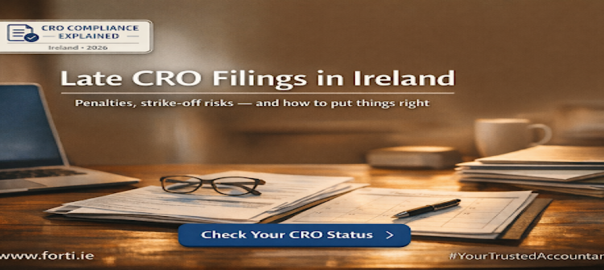
What Happens If You File Your CRO Returns Late in Ireland

What Happens If You File Your CRO Returns Late in Ireland?

Penalties, Strike-Off Risks & How to Fix It (2026 Update)

For many Irish company directors, CRO filings sit quietly in the background — until something goes wrong.

As we move through 2026, filing late with the CRO is no longer a low-risk mistake. Following the Companies (Corporate Governance, Enforcement and Regulatory Provisions) Act 2024, the Companies Registration Office has fully resumed involuntary strike-off actions, and enforcement is far more active than it was in recent years.

If you’re concerned about late CRO filing penalties, audit costs, or whether your company is at risk, this guide explains what actually happens — and how to fix the situation properly.

Why the CRO Annual Return Is So Important

Every Irish company must file an Annual Return (Form B1) every year.

This filing confirms that your company:

  • Is legally compliant
  • Has accurate public records

Can continue trading with full legal protection

Missing this deadline is not an admin issue — it is a statutory breach of company law.

This is why many directors choose structured [annual compliance for Irish companies]  — so deadlines are managed, not chased at the last minute.

1. Late CRO Filing Penalties: The Real Cost of Missing the Deadline

Once you miss your Annual Return Date (ARD) plus the 56-day grace period, penalties apply automatically.

There are no reminders and no discretion.

The Financial Breakdown

  • €100 late fee applied immediately
  • €3 per day for every day the return remains outstanding
  • Maximum penalty: €1,200 per return

If more than one year is outstanding, penalties stack.
A company three years behind can face €3,600 in fines, just to become compliant again.

These late CRO filing penalties are not tax deductible.

2. Audit Exemption in 2026: What Directors Often Miss

One of the most expensive consequences of filing late is the loss of audit exemption.

The Updated Rule (2026)

Under the 2024 legislation:

  • The first late filing in a five-year period does not automatically remove audit exemption
  • A second late filing within five years does

Once audit exemption is lost:

  • A statutory auditor must be appointed
  • Annual costs can increase by thousands of euro
  • Compliance becomes more complex and time-consuming

This is why proactive [annual compliance for Irish companies] is far cheaper than dealing with avoidable audit costs later.

3. Strike-Off Risk: When CRO Non-Compliance Becomes Serious

If filings remain outstanding, the CRO can begin involuntary strike-off proceedings.

How Strike-Off Happens

  • Statutory notice sent to the registered office
  • Company listed in the CRO Gazette after 28 days
  • Company dissolved 28 days later

What Directors Often Don’t Realise

Once struck off:

  • Bank accounts are frozen
  • All company assets vest in the State
  • Limited liability protection disappears
  • Directors may become personally liable
  • Director disqualification can follow

This is why unresolved CRO issues should never be ignored.

Directors facing this risk should act early and seek [CRO Filings / Company Secretarial Services]

4. Director Responsibilities (You Are Personally Accountable)

Many directors assume CRO compliance sits with their accountant.

Legally, that’s not the case.

Director responsibilities include ensuring:

  • The Annual Return (B1) is filed on time
  • Financial statements are correctly attached
  • Public records are accurate

Responsibility cannot be delegated away, even if an adviser is involved.

5. What If Your Company Is Dormant?

A common mistake is assuming dormant companies don’t need to file.

They do.
Dormant companies:

  • Still have CRO filing obligations
  • Still incur penalties if deadlines are missed
  • Can expose directors to personal fines if handled incorrectly

This is why proper Dormant Company Services exist — to keep inactive companies compliant without unnecessary cost or risk.

6. How to Fix a Late CRO Filing (Before It Gets Worse)

If you’ve already missed a deadline, the priority is speed and accuracy.

Immediate Steps

  • Confirm which filings are overdue
  • Check audit exemption status
  • Prepare compliant accounts
  • File correctly with the CRO
  • Put controls in place to prevent recurrence

In limited cases, a Section 343 District Court application may allow an extension, but this route is narrow and must be handled carefully.

This is where professional [CRO Filings / Company Secretarial Services] make the difference between resolving the issue — and compounding it.

7. Real-Life Examples We See All the Time

Late CRO filings rarely happen because someone is careless.
In most cases, it’s down to timing, assumptions, or simply not realising how quickly things escalate.

Here are a few situations we regularly come across with Irish companies.

A Profitable Business That Thought “A Few Weeks Late” Wasn’t a Big Deal

This was a well-run consultancy business based in Dublin. Profitable, organised, and busy.

The director missed the Annual Return deadline by a few weeks and assumed it would just mean a small fine. Nothing urgent, nothing serious.

What they didn’t realise was that the late filing was now on record. A couple of years later, another deadline slipped during a busy period — and that was enough.

Suddenly:

  • Audit exemption was gone
  • A statutory audit was required
  • Annual costs jumped by several thousand euro

What caught them most by surprise was how long the impact lasted, compared to how small the original delay felt.

Their takeaway was simple: keeping annual compliance for Irish companies tidy is far cheaper than dealing with knock-on effects later.

“It’s Dormant, So It Doesn’t Need Filing” — A Common Assumption

We often meet directors who keep an old company on the shelf. It’s not trading, there’s no income, and it’s parked there “just in case”.

One director did exactly that and didn’t file CRO returns for two years, genuinely believing nothing was required.

Then the letters started.

Penalties had built up, and a strike-off notice was issued. On top of that, the director was warned about personal exposure if it wasn’t dealt with quickly.

The company was eventually brought back into order, but it took time, money, and a fair bit of stress — all of which could have been avoided.

This is why Dormant Company Services exist: to keep inactive companies compliant quietly, without drama.

A Strike-Off Notice That Froze a Bank Account Overnight

This one usually comes as a shock.

A small trading company missed filings during a period of internal disruption. Staff changes, address updates — the usual things that happen when a business is under pressure.

The CRO notices went to the registered office on file, but no one saw them.

By the time the director realised what was happening:

  • The company had been listed for strike-off
  • The bank account was frozen
  • Suppliers couldn’t be paid

There was no warning call. No grace period. Just an urgent problem that had to be fixed immediately.

That’s when directors realise why relying on reminders or assumptions isn’t enough — and why proper CRO Filings / Company Secretarial Services matter.

Catching It Early and Avoiding the Mess Altogether

Not every story ends badly.

One director got in touch because they weren’t sure if their Annual Return Date was coming up or had already passed. They didn’t want to take a chance.

We checked the position, got the accounts finalised, and filed everything on time. A simple compliance calendar was put in place going forward.

No penalties.
No audit issues.
No stress.

That’s usually the difference — not luck, just clarity.

Why This Keeps Happening

In nearly every case, the root cause is the same:

  • No clear ownership of CRO compliance
  • Assumptions that “someone else is handling it”
  • Deadlines not being tracked properly

Late CRO filings are rarely about bad management. They’re about busy directors trying to juggle too much without a simple system in place.

A Straightforward Next Step

If any of these situations sound even slightly familiar, it’s worth checking your position before the CRO forces your hand.

Get your CRO position checked now.

A quick review can confirm:

  • Whether your filings are up to date
  • If audit exemption is at risk
  • Whether strike-off action has started
  • What (if anything) needs to be fixed — and how urgent it is

If you want help reviewing your CRO status, fixing a late return, or putting compliance on autopilot, it’s far easier to deal with it now than after penalties or notices arrive.

A small check today can save a serious headache later.

What You Should Do Now

If you’re unsure about:

  • Your current Annual Return Date
  • Whether your company is at risk of penalties or strike-off
  • Whether audit exemption has been affected

Do not wait until the CRO contacts you.

Get your CRO position checked now.

A quick review can confirm whether everything is compliant — or whether action is needed immediately.

If you want help:

  • Reviewing your CRO status
  • Fixing a late filing
  • Putting annual compliance on autopilot

Our team can guide you through it clearly and properly.

Reach out now and get certainty — before penalties or strike-off notices arrive.

Request CRO Review
Common Compliance Mistakes Small Businesses Make (and How to Avoid Them)

Common Compliance Mistakes Small Businesses Make (and How to Avoid Them)

Running a small business in Ireland is exciting, but it also comes with responsibilities — especially when it comes to compliance. Whether you’re a sole trader, freelancer, or managing a limited company, keeping on top of Revenue, CRO, and bookkeeping obligations is non-negotiable.

Yet many small businesses unintentionally make mistakes that can cost them money, time, and peace of mind. From missing deadlines to poor record-keeping, these errors can lead to penalties, audits, and unnecessary stress.

The good news? Most compliance mistakes are avoidable with the right knowledge, organisation, and professional support.

In this guide, we’ll cover

  • The most common compliance mistakes small businesses in Ireland make
  • Real-world examples of how they happen
  • The risks and penalties involved
  • Practical tips to avoid them

1. Missing Revenue Deadlines

One of the biggest compliance mistakes is simply missing tax deadlines. Revenue doesn’t send friendly reminders. If you forget, you pay.

Examples:

  • Sole traders failing to file their Form 11 Income Tax Return by 31 October (or mid-November for ROS filers).
  • Limited companies filing their CT1 Corporation Tax Return late.
  • Employers missing PAYE submissions through ROS.

Risks & Penalties:

  • Late filing surcharges (up to 10% of your tax bill).
  • Interest on overdue tax.
  • Risk of being flagged for audit.

How to Avoid:

  • Use a compliance calendar with all key dates.
  • File early, not at the last minute.
  • Work with an accountant who monitors deadlines and submits on your behalf.

💡 Forti LTD Tip: We track deadlines for every client, so nothing slips through the cracks.

2. Filing Incorrect or Incomplete Returns

Another common mistake is submitting incorrect or incomplete returns. This often happens when business owners rush through filings or try to do everything themselves.

Examples:

  • Forgetting to declare additional income sources (e.g., rental income alongside business profits).
  • Incorrect VAT calculations, especially when dealing with multiple VAT rates.
  • Mistakes in payroll submissions, leading to underpaid PRSI or USC.

Risks & Penalties:

  • Revenue queries or full audits.
  • Interest and penalties for underpayments.
  • Damaged credibility with lenders if financial statements don’t match.

How to Avoid:

  • Keep accurate, up-to-date records.
  • Double-check returns before submission.
  • Use professional support for complex filings.

💡 Forti LTD Tip: Our review process ensures all filings are checked thoroughly before submission.

3. Poor Record-Keeping

Good compliance starts with good records. Unfortunately, many small businesses still rely on a shoebox of receipts or unorganised spreadsheets.

Examples:

  • Losing VAT invoices needed for reclaim.
  • Forgetting mileage logs for business travel claims.
  • Mixing personal and business expenses in the same bank account.

Risks & Penalties:

  • Inability to claim legitimate expenses.
  • Problems during a Revenue audit.
  • Overpaying tax because deductions can’t be supported.

How to Avoid:

  • Open a dedicated business bank account.
  • Use cloud accounting software (Xero, QuickBooks, Sage).
  • Store receipts digitally (scanned or photographed).

💡 Forti LTD Tip: We help clients set up simple, digital bookkeeping systems that save time and money.

4. Ignoring CRO Compliance (for Limited Companies)

Limited companies in Ireland have specific obligations with the Companies Registration Office (CRO) — and missing them is one of the most expensive mistakes.

Examples:

  • Failing to file the Annual Return (B1).
  • Not updating CRO with changes (e.g., directors, address, shareholding).
  • Missing Beneficial Ownership Register (RBO) deadlines.

Risks & Penalties:

  • Late filing penalty of €100 + €3 per day, capped at €1,200.
  • Loss of audit exemption (forcing full audit costs).
  • Strike-off proceedings if obligations are repeatedly ignored.

How to Avoid:

  • Mark the CRO annual return date on your calendar.
  • Update CRO whenever company details change.
  • Use an accountant or company secretary to manage filings.

💡 Forti LTD Tip: Our annual compliance package covers CRO filings, so you never face late fees.

5. Not Registering (or Deregistering) for VAT Properly

VAT is an area where many small businesses get tripped up.

Examples:

  • Not registering for VAT when turnover passes the threshold (€37,500 for services, €75,000 for goods).
  • Staying VAT-registered when no longer required, adding unnecessary admin.
  • Failing to apply the correct VAT rate to sales.

Risks & Penalties:

  • Backdated VAT liabilities if Revenue discovers late registration.
  • Overcharging or undercharging clients.
  • Loss of credibility with customers.

How to Avoid:

  • Monitor your turnover regularly.
  • Speak to your accountant about the benefits/risks of voluntary VAT registration.
  • Keep clear VAT records for sales and purchases.

💡 Forti LTD Tip: We advise clients on whether VAT registration is beneficial and handle all returns.

6. Mismanaging Payroll

If you employ staff (or pay yourself as a director), payroll compliance is essential.

Examples:

  • Failing to register as an employer with Revenue.
  • Missing real-time PAYE submissions.
  • Incorrectly calculating USC, PRSI, or pension contributions.

Risks & Penalties:

  • Revenue penalties for late submissions.
  • Employee dissatisfaction and loss of trust.
  • Potential disputes or legal claims over underpaid wages.

How to Avoid:

  • Use payroll software that links directly to Revenue.
  • Outsource payroll to your accountant.
  • Keep employee records up to date.

💡 Forti LTD Tip: Our payroll service ensures wages are accurate and submissions are always on time.

7. Mixing Personal and Business Finances

Many sole traders and even some limited company directors fall into the trap of mixing personal and business money.

Examples:

  • Using one bank account for both personal and business expenses.
  • Paying for personal holidays or shopping from the business account.
  • Taking cash out of the business without proper records.

Risks & Penalties:

  • Confused accounts that don’t reflect true profits.
  • Problems with Revenue if personal expenses are claimed as business costs.
  • Difficulties securing loans or investment.

How to Avoid:

  • Keep separate business and personal accounts.
  • Document any drawings or director’s loans properly.
  • Use bookkeeping software to track transactions clearly.

💡 Forti LTD Tip: We help clients separate finances so accounts are always clear and compliant.

8. Failing to Plan for Tax Liabilities

Many small businesses treat tax as an afterthought — paying whatever is due when the bill arrives. This can lead to cash flow crises.

Examples:

  • Spending all profits without setting money aside for tax.
  • Forgetting about preliminary tax for sole traders.
  • Limited companies failing to budget for corporation tax.

Risks & Penalties:

  • Struggling to pay Revenue on time.
  • Interest charges on late payments.
  • Stress and poor financial planning.

How to Avoid:

  • Estimate tax liabilities throughout the year.
  • Set aside money monthly into a tax savings account.
  • Use management accounts to forecast profits and taxes.

💡 Forti LTD Tip: Our management reports include tax forecasts, so clients aren’t caught by surprise.

9. Not Seeking Professional Advice Early

Many business owners try to do everything themselves — either to save money or because they think compliance is straightforward. Unfortunately, mistakes multiply, and by the time they seek help, it’s more expensive to fix.

Examples:

  • A sole trader trying to file their own Form 11 but missing allowable expenses.
  • A company director preparing accounts incorrectly, triggering a Revenue query.
  • Businesses waiting until after penalties arrive before calling an accountant.

Risks & Penalties:

  • Overpaying tax unnecessarily.
  • Higher accountancy fees to correct mistakes.
  • Lost time and stress.

How to Avoid:

  • Seek professional advice early, especially when starting out.
  • Build a relationship with an accountant who knows your business.
  • View accountancy as an investment, not just a cost.

💡 Forti LTD Tip: We provide free initial consultations to help new businesses start on the right foot.

Key Compliance Deadlines for Small Businesses in Ireland

One of the biggest compliance mistakes small businesses make is not knowing their deadlines. Missing even one can lead to fines, penalties, and unnecessary stress. Here’s a clear overview of the most important dates every Irish business owner should mark on their calendar:

Sole Traders & Partnerships

  • Income Tax Return (Form 11):
    • 31 October each year (paper filing).
    • Extended to mid-November if filing and paying online via ROS.
  • Preliminary Tax:
    • Due on the same date (31 October / mid-November).

Limited Companies

  • Corporation Tax Return (CT1):
    • Due 9 months after the company’s year-end, and no later than the 23rd of that month if filed online.
  • Preliminary Corporation Tax:
    • Large companies (tax liability > €200k): 21st of the 11th month of the accounting period.
    • Small companies: by the 23rd of the month before year-end.
  • Annual Return (CRO B1):
    • First return: 6 months after incorporation (no accounts needed).
    • Every year after: within 56 days of the company’s annual return date (ARD).

VAT-Registered Businesses

  • VAT Returns (VAT3):
    • Usually bi-monthly (every 2 months), e.g., Jan–Feb due by 23rd March.
    • Some businesses may be on 4-monthly or 6-monthly cycles (depending on turnover).
  • Annual Return of Trading Details (RTD):
    • Due once a year after the VAT year-end.

Employers (Payroll)

  • PAYE Modernisation:
    • Real-time reporting required. Payroll submissions must be sent to Revenue on or before each payday.
  • P35 End-of-Year Return:
    • Replaced by monthly real-time reporting (no longer required separately since 2019).

Other Compliance Deadlines

  • RBO (Register of Beneficial Ownership):
    • Initial registration within 5 months of incorporation.
    • Updates within 14 days of any change.
  • Local Property Tax (if applicable):
    • Annual payment/return due by 10th January for the year.

FAQs – Compliance for Small Businesses

Q1. What are the biggest compliance deadlines I need to know about in Ireland?

For sole traders: 31 October (or mid-November via ROS) for the Form 11. For limited companies: CT1 is due 9 months after year-end, CRO annual return within 6 months of incorporation and every year after. Employers must submit payroll to Revenue every pay cycle. VAT returns are usually bi-monthly.

Q2. How long do I need to keep business records?

In Ireland, you must keep business records for 6 years. This includes invoices, receipts, bank statements, payroll records, and CRO filings.

Q3. Can I be fined if I don’t keep proper records?

Yes. Revenue can disallow expense claims, charge penalties, and even audit your business. Poor record-keeping is one of the fastest ways to trigger an audit.

Q4. Do all small businesses need to register for VAT?

No. Only if your turnover exceeds €37,500 for services or €75,000 for goods. However, you can register voluntarily if it benefits your business (e.g., reclaiming VAT on expenses).

Q5. Is it really worth paying for an accountant?

Yes. A good accountant prevents penalties, saves you tax, and gives you peace of mind. Most clients find the savings more than cover the fee.

Conclusion

Compliance might sound like red tape, but it’s a vital part of running a successful business in Ireland. The most common mistakes — missed deadlines, poor records, incorrect returns, ignoring CRO obligations — are easy to make, but they’re also easy to avoid with the right systems and support.

At Forti LTD, we help small businesses stay compliant with simple, transparent, and professional accountancy services. From annual returns to VAT, payroll, and bookkeeping, we keep everything on track — so you can focus on running your business.

👉 Talk to Forti.ie today about how we can help your business stay compliant and stress-free.

_Talk to Forti.ie today