Tag Archives: tax pay

E-com Accounting

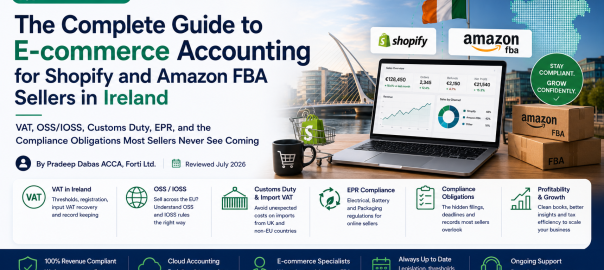
The Complete Guide to E-commerce Accounting for Shopify and Amazon FBA Sellers in Ireland

QUICK ANSWER
E-commerce accounting differs from standard Irish SME accounting because several distinct compliance regimes apply from the first sale, with no minimum threshold. The biggest blind spots are: VAT registration is required in every country where Amazon physically stores your stock (OSS does not cover this); the EU’s low-value customs duty exemption ended 1 July 2026; and packaging, electronics, or battery sellers may owe Extended Producer Responsibility (EPR) registration in Ireland regardless of where the business is based.

Running an e-commerce business looks deceptively simple from the outside: list a product, make a sale, ship it out. In reality, the moment a business starts selling across borders — which almost every Shopify or Amazon seller does within their first year — it inherits a compliance footprint that looks nothing like a typical Irish SME’s. A standard bookkeeping model built around one VAT number, one set of accounts, and domestic sales simply doesn’t hold up.

This guide walks through what actually makes e-commerce accounting different, covering the areas that most catch sellers out: VAT and OSS/IOSS, the specific VAT trap hidden inside Amazon’s Pan-European FBA programme, the customs duty change that took effect in July 2026, an environmental compliance obligation most sellers have never heard of, and how to actually reconcile the mess of data a marketplace generates every month.

The Irish E-commerce Market at a Glance

E-commerce isn’t a side channel in Ireland any more — it’s mainstream. Retail e-commerce in Ireland reached an estimated €8.8 billion in 2025, up around 6% year-on-year, and roughly 37.5% of Irish businesses now report having e-commerce sales. Amazon remains the single largest online retailer serving the Irish market by a wide margin. Growth of this scale is exactly why compliance gaps that were once minor — a missed VAT registration, an overlooked packaging obligation — now carry real financial exposure for sellers who are scaling faster than their back-office setup can keep up with.

Why E-commerce Accounting Doesn’t Fit a Standard Bookkeeping Model

A typical Irish limited company sells to Irish customers, charges Irish VAT, and files one VAT3 return covering one jurisdiction. An e-commerce business rarely works that way for long. Within months of scaling past a modest turnover, a Shopify or Amazon seller is likely to be:

  • Selling to customers in multiple EU countries, each with its own VAT rate
  • Holding stock in fulfilment centres outside Ireland, which changes where VAT is actually owed
  • Generating hundreds or thousands of small transactions a month, each bundled with marketplace fees, refunds, and currency conversions
  • Subject to environmental and product compliance obligations that have nothing to do with tax at all

None of this is optional or something that can be addressed “later, once the business is bigger.” Several of these obligations apply from the very first sale, with no minimum threshold. Getting the structure right early avoids a much more expensive clean-up exercise down the line.

VAT and OSS/IOSS Registration for Cross-Border Sellers

The starting point for any Irish e-commerce business is Irish VAT registration. As of May 2026, the Irish VAT registration thresholds are €85,000 for goods and €42,500 for services. Below these thresholds, registration is optional; above them, it’s mandatory.

But for a business selling into other EU countries, Irish registration is only the beginning. The One Stop Shop (OSS) scheme lets a business report VAT on cross-border B2C sales to other EU countries through a single return filed in Ireland, rather than registering separately in every country it sells into. The OSS threshold remains €10,000 — combined across all cross-border EU sales, not per country — above which OSS (or individual country registration) becomes necessary.

For non-EU sellers shipping low-value goods directly to EU consumers, the Import One Stop Shop (IOSS) serves a similar purpose for import VAT, allowing VAT to be collected at the point of sale rather than at the border.

A caution on registering below the threshold: sellers below the €85,000/€42,500 thresholds can register for VAT voluntarily, which is often worthwhile if there are significant VAT-bearing costs to reclaim. But Revenue does scrutinise voluntary applications from pre-trading or pre-revenue businesses more closely than standard registrations. Be ready to show concrete evidence of an intention to trade — supplier contracts, a live Shopify store, or inventory invoices — as applications lacking this can be queried or rejected outright.

Importing Stock Into Ireland? Don’t Overlook PVA and Your EORI Number

Many Irish e-commerce sellers import stock from Great Britain (now treated as a non-EU import post-Brexit) or from Asia before listing it on Shopify or Amazon. Two additional pieces of the compliance picture come into play the moment goods are imported from outside the EU:

  • An EORI number (Economic Operators Registration and Identification) is required to clear customs, and needs to be linked to the business’s Revenue VAT registration.
  • Postponed VAT Accounting (PVA) lets a VAT-registered, Customs & Excise-registered importer account for import VAT directly on their VAT3 return — declaring and reclaiming it in the same return — rather than paying it in cash at the point of entry. This is a genuine cash-flow advantage for any business importing stock regularly, and Revenue’s own guidance confirms it removes the need to pay VAT at the point of importation, subject to the usual deductibility rules.

Businesses that were both VAT- and Customs & Excise-registered before PVA’s introduction received automatic entitlement to use it; anyone registering for VAT and Customs & Excise since then should confirm their postponed accounting position is properly set up — including the correct PA1 entries on the VAT3 — before their first import lands.

Comparing OSS, IOSS, and Local VAT Registration

These three mechanisms are frequently confused, and mixing them up is the single most common VAT mistake among growing e-commerce sellers.

OSS IOSS Local VAT Registration
What it covers Cross-border B2C sales to other EU countries, from stock held in one EU country Import VAT on low-value goods (≤€150) shipped directly to EU consumers from outside the EU VAT on sales and stock held physically within that specific country
Threshold €10,000 combined cross-border EU sales No threshold — per consignment≤€150 No threshold — triggered by holding stock in-country≤€150
Common mistake Assuming it covers Pan-EU FBA stock-holding — it doesn’t Assuming it still means duty-free after 1 July 2026 — it doesn’t Assuming Amazon handles this automatically — it doesn’t

The crucial limitation to understand: OSS only covers where VAT is owed on the sale, not where a business is required to hold a full local VAT registration. That distinction becomes critical the moment stock is physically stored outside Ireland — which is exactly what happens with Amazon’s Pan-European FBA programme.

Pan-EU FBA: The VAT Obligation Most Sellers Don’t See Coming

This is the single most common compliance gap among growing Amazon sellers, and it catches out businesses that are otherwise fully VAT compliant in Ireland.

Amazon’s Pan-European FBA programme distributes a seller’s inventory automatically across its European fulfilment network to speed up delivery and reduce shipping costs. It’s a genuinely useful feature — but it comes with a rule that has nothing to do with sales thresholds: the moment inventory is physically held in a country, VAT registration is required in that country, from the very first unit stored. OSS does not cover this. There is no minimum threshold and no grace period.

In practice, this means a seller enrolled in Pan-EU FBA can find their stock automatically moved into Germany, France, Italy, Spain, Poland, and the Czech Republic — sometimes more — without VAT registration in any of them. Amazon has tightened this further: as of January 2026, sellers must hold VAT registrations in a minimum of five EU countries just to remain eligible for the Pan-EU programme at all. Fall short, and Amazon can restrict or block inventory transfers, which quietly removes the delivery-speed and fee advantages the programme exists to provide in the first place.

Sellers who want to avoid this exposure without giving up FBA altogether typically use the European Fulfilment Network (EFN) instead — storing stock in a single country and shipping cross-border from there — which limits the VAT footprint to that one country plus OSS for cross-border sales, at the cost of slightly slower delivery in some markets.

Illustrative Example: How a Growing Seller’s VAT Footprint Changes

This is a composite scenario based on patterns we see repeatedly across e-commerce clients — not a specific named business.

A Shopify and Amazon seller starts out shipping only from Ireland. In year one, all stock sits in a single Irish warehouse , one VAT registration, one VAT3 return, straightforward. As EU sales grow past €10,000, the seller registers for OSS, which now handles the cross-border VAT on those sales through a single Irish filing ; still manageable.

In year two, the seller opts into Amazon’s Pan-EU FBA programme to speed up delivery across Europe. Overnight, Amazon begins distributing stock into Germany, France, Italy, Spain, and Poland. OSS does not cover any of this stock-holding — the seller now needs five separate local VAT registrations, five sets of local filing obligations, and (per Amazon’s current rules) must have all five in place simply to stay eligible for the programme. A seller who enrolled without anticipating this can find inventory transfers frozen mid-flow while registrations are sorted out — often the first sign something has gone wrong, and a costly one during a peak sales period.

The practical takeaway: before opting into Pan-EU FBA, know exactly which countries your stock will land in and have VAT registrations in place before it arrives, not after. Amazon’s Inventory Event Detail Report is the standard way to track where stock is actually being held.

Unsure where your stock is currently being stored?

Amazon FBA inventory transfers happen automatically behind the scenes, which is exactly how sellers end up with an unregistered VAT obligation without realising it.
Request a free e-commerce VAT & EPR review → forti.ie

The 2026 Customs Duty Change: What It Means for Low-Value Consignments

Until recently, the EU allowed goods valued at €150 or less to enter the bloc free of customs duty. That exemption ended on 1 July 2026. In its place, a temporary flat customs duty of approximately €3 per HS-code line item now applies to consignments of €150 or less, regardless of whether the Import One Stop Shop is used. This interim measure is expected to run until 1 July 2028, ahead of a broader EU customs reform.

The detail that trips people up: IOSS still simplifies how VAT is collected at checkout, but it no longer means duty-free. These are two separate things that used to align neatly and no longer do. A seller who assumes their IOSS registration still covers “no extra charges at the border” for small parcels is working from an outdated assumption that changed only recently — worth flagging explicitly to customers and factoring into landed-cost pricing for low-value items shipped directly from outside the EU.

A Compliance Obligation Most Sellers Have Never Heard Of: Extended Producer Responsibility (EPR)

This is the area most e-commerce guides skip entirely, and it’s a genuine blind spot for sellers focused only on VAT.

Extended Producer Responsibility is an environmental compliance regime that makes anyone placing packaged goods, electrical equipment, or batteries on the Irish market financially responsible for that product’s end-of-life collection and recycling. In Ireland, packaging EPR is administered through Repak, the country’s approved compliance body, with separate schemes covering WEEE (waste electrical and electronic equipment) and batteries.

The important point for e-commerce sellers: this obligation applies to distance sellers, not just Irish-based manufacturers. A business based outside Ireland — including a non-resident seller — that supplies packaged goods directly to Irish consumers is treated as a “producer” under Irish packaging regulations and carries the same registration and reporting obligation as a local manufacturer would. The same logic applies to anyone selling electronics or battery-powered products to Irish buyers via Amazon.ie or a Shopify store shipping into Ireland.

  • Businesses placing packaging on the Irish market above certain thresholds (broadly, larger volumes and turnover) are classed as “major producers” and must join Repak, reporting packaging weights and paying a fee based on volume
  • Smaller producers typically have a simplified registration route with a fixed annual fee rather than the full major-producer reporting burden
  • Sellers of electrical or battery-powered goods have a parallel obligation through the National WEEE Register

This is easy to overlook because it isn’t a tax and doesn’t show up on a VAT return — but it’s a genuine legal obligation with financial penalties for non-compliance, and it’s one that grows more relevant every year as EU packaging waste rules tighten. Any e-commerce business shipping packaged goods into Ireland at meaningful volume should have this checked, not assumed away.

Reconciling Amazon and Shopify Settlements With A2X or Link My Books

Beyond registration and compliance, the day-to-day bookkeeping challenge for e-commerce sellers is different in kind from a typical business. A single Amazon settlement report can bundle together gross sales, referral fees, FBA fees, storage fees, refunds, promotional discounts, and VAT — all in different currencies if selling across multiple marketplaces — and dumping that raw data into a general ledger produces a mess that no accountant can make sense of, let alone use for accurate VAT filings.

This is where reconciliation tools like A2X and Link My Books earn their keep. Both integrate directly with Amazon, Shopify, and other marketplaces, breaking down each settlement into its individual components and posting a clean, correctly categorised summary into Xero or QuickBooks — with VAT correctly split by jurisdiction, which matters enormously once a seller has multiple VAT registrations in play. Attempting to reconcile marketplace settlements manually, without one of these tools, is one of the most common causes of inaccurate VAT filings among growing e-commerce sellers.

Corporation Tax and Multi-Marketplace Bookkeeping Considerations

Once the VAT and reconciliation side is under control, standard Irish company obligations still apply on top: Corporation Tax (CT1) on annual profits, CRO annual returns, and — where turnover and other thresholds are exceeded — statutory audit requirements. The complexity multiplies with the number of marketplaces and currencies involved: a seller running Shopify, Amazon, and perhaps eBay simultaneously needs bookkeeping that consolidates all three cleanly into one set of management accounts, ideally on a monthly cycle rather than being reconstructed at year-end.

What to Look for in an E-commerce Accountant

Given everything above, a generalist accountant without e-commerce experience will typically miss at least one of these areas — most often the Pan-EU FBA VAT trap or the EPR obligation, since neither shows up unless someone is specifically looking for it. When choosing who handles your accounts, look for:

  • Direct, practical experience with Amazon and Shopify settlement reconciliation, not just general bookkeeping
  • Familiarity with OSS/IOSS registration and the distinction between cross-border sales VAT and local stock-holding VAT
  • Awareness of EPR/Repak obligations for physical goods sellers — not every accountant will think to raise this
  • Comfort working with tools like A2X or Link My Books as standard practice, not an unfamiliar add-on

Frequently Asked Questions

Do I need to register for VAT in every country where Amazon stores my stock?

Yes. The moment Amazon physically holds your inventory in a country under Pan-EU FBA, you need a local VAT registration there — there’s no threshold and no grace period. OSS does not cover this; it only applies to cross-border sales, not stock-holding.

What’s the difference between OSS and IOSS?

OSS covers cross-border B2C sales of goods and services to other EU countries where you hold stock in one EU country. IOSS covers import VAT on low-value consignments (€150 or less) shipped directly to EU consumers from outside the EU. They serve different situations and aren’t interchangeable.

Does OSS cover Pan-EU FBA VAT registration?

No. This is the most common misunderstanding among growing sellers. OSS handles VAT on the sale itself; it does not replace the local VAT registration required wherever your stock is physically held.

Is IOSS still duty-free for orders under €150?

No, not since 1 July 2026. The EU’s duty-free exemption for consignments of €150 or less ended on that date. A flat customs duty of roughly €3 per HS-code line item now applies regardless of whether IOSS is used, as an interim measure expected to run until 1 July 2028.

Do I need to register for EPR/Repak if I only sell through Amazon FBA?

Potentially, yes. If you supply packaged goods, electronics, or batteries directly to Irish consumers — including via Amazon.ie — you may be classed as a “producer” under Irish packaging regulations regardless of where your business is based, and carry a Repak (or WEEE Register) registration obligation.

How many EU VAT registrations do I need for Amazon Pan-EU FBA in 2026?

As of January 2026, Amazon requires a minimum of five EU VAT registrations to remain eligible for the Pan-EU FBA programme. The exact countries depend on where your stock is distributed — commonly Germany, France, Italy, Spain, and Poland.

What tools help reconcile Amazon and Shopify settlements for VAT?

A2X and Link My Books are the two most widely used tools. Both break marketplace settlement reports into their individual components (sales, fees, refunds, VAT) and post a clean summary into Xero or QuickBooks, split correctly by jurisdiction.

How does Postponed VAT Accounting (PVA) help Irish e-commerce importers?

PVA lets a VAT-registered, Customs & Excise-registered business account for import VAT on its VAT3 return instead of paying it in cash at the point of import. It preserves working capital on imported stock, but requires an active EORI number and correct PA1 reporting on the VAT3.

E-commerce accounting isn’t harder than standard SME accounting because the numbers are more complicated — it’s harder because there are simply more distinct compliance regimes running in parallel, several of which apply from the first sale with no threshold to build up to. Getting the structure right from the outset is considerably cheaper than untangling it after a few years of growth.

Get Your E-commerce VAT and Compliance Position Reviewed

If you’re selling on Shopify or Amazon — or planning to opt into Pan-EU FBA — it’s worth having your VAT registrations, OSS/IOSS setup, and EPR obligations checked by someone who works with e-commerce sellers day to day, before a gap like the ones above turns into a frozen inventory transfer or a backdated liability.

Forti works with Shopify and Amazon FBA sellers on VAT registration, OSS/IOSS compliance, and monthly bookkeeping using A2X and Link My Books — from €195/month.

Talk to Forti about your e-commerce accounts → forti.ie

Company Secretary

The Comprehensive Guide to Company Secretary Services in Ireland (2026)

When you’re first getting a business off the ground in Ireland, your head is usually in a dozen places at once. You’re chasing the first big customer, haggling over a lease, or trying to get a website live. The “administrative” side of things—the paperwork and the legal filings—often feels like a job for “future you.”

However, every Irish company comes with a backpack of legal responsibilities from day one. At the heart of that is the Company Secretary.

Despite the name, this isn’t about typing memos or answering phones. Under the Companies Act 2014, the secretary is essentially your compliance anchor. They’re the person tasked with making sure the company stays on the right side of the law, keeping your records straight, and ensuring the Companies Registration Office (CRO) doesn’t come knocking with a fine.

1. Decoding the Role: It’s More Than Just a Title

In the eyes of the Irish courts, the Company Secretary is a “high-ranking officer” of the company. That sounds a bit grand, doesn’t it? But it means they carry a specific weight of responsibility.

If the directors are the ones driving the car and making the big decisions, the company secretary is the one checking the map, ensuring the road tax is paid, and keeping a log of every turn the car takes.

The Statutory “Must-Dos”

In a practical sense, the secretary handles the nitty-gritty that keeps a company legally healthy:

  • The Paper Trail: Keeping the official registers (directors, shareholders, and beneficial owners) accurate.
  • The Deadlines: Filing the Annual Return on time (messing this up is the fastest way to lose your audit exemption).
  • The Formalities: Recording minutes of board meetings and making sure changes to the company—like a new office address or a change in shares—are reported to the CRO within the strict legal windows.

2. The Legal Landscape: The Companies Act 2014

To understand why this role is so vital, you have to look at the Companies Act 2014. This was a massive piece of legislation that simplified life for Irish businesses but also got very firm about “corporate governance.”

The Act states that every company must have a secretary. If you are a Single Director Company, you cannot be your own secretary. You need a second person or a professional firm to step in. This is a common stumbling block for solo entrepreneurs who think they can do it all themselves.

Even if you have two directors and one acts as the secretary, the law expects that person to have the “skills and resources” to do the job. You can’t just put a name on a form and hope for the best; the person needs to actually know what a B1 form is and when it’s due.

3. Deep Dive: The Statutory Registers

This is where many businesses fall down. Every company is required to keep a “Register Office” (usually your accountant’s office or your own business premises) where your statutory books are held. These aren’t just for show; they are the “DNA” of your company.

The Register of Members (Shareholders)

This is the most important document in your company. It is the prima facie evidence of who owns the business. If your name isn’t in this register, you technically don’t own the shares, regardless of what’s written on a napkin or an email. A good secretary ensures that every time a share changes hands, the register is updated immediately.

The Register of Directors and Secretaries

This tracks who is in charge. It includes their names, residential addresses (though you can apply for a service address for privacy in some cases), and their dates of birth.

The Register of Beneficial Ownership (RBO)

This is a relatively new and very “hot” topic in Irish compliance. Since 2019, you must report who actually controls the company to a central government database. The secretary handles this filing. If you ignore it, the fines can be eye-watering—up to €500,000 if it goes to court (though usually, it’s just a very stiff administrative fine).

4. The Annual Return (Form B1): The “Do Not Miss” Deadline

If there is one thing you take away from this guide, let it be this: Do not miss your Annual Return Date (ARD).

Every Irish company is assigned an ARD. This is the date by which you must tell the CRO that you’re still alive, who is running the show, and what your finances look like.

The Consequence of Being Late

In the old days, you might get a slap on the wrist. In 2026, the CRO is automated and unforgiving.

  1. Late Filing Fees: These start at €100 the day after the deadline and tick up by €3 a day, capped at €1,200.
  2. Loss of Audit Exemption: This is the real killer. Most small Irish companies don’t need an expensive audit. But if you’re late with your B1, you lose that right for the next two years. You’ll have to hire an auditor to go through your books, which could easily cost you €3,000 to €10,000 depending on your turnover.
  3. Strike-Off: If you ignore it long enough, the CRO will simply strike your company off the register. This means you no longer exist, your bank accounts are frozen, and your assets technically belong to the State.

A professional company secretary lives and breathes these deadlines so you don’t have to.

5. Board Meetings and Minutes: Why Bother?

I often hear business owners say, “It’s just me and my co-founder, why do we need to write down minutes of our meetings? We talk every day over lunch!”

Legally, you are required to hold an Annual General Meeting (AGM) and keep minutes of board decisions.

The “Protection” Factor

Minutes aren’t just red tape; they are your protection. If there is ever a dispute between shareholders, or if the Revenue Commissioners ever audit your business, those minutes prove that the directors acted reasonably and followed the law.

A company secretary attends (or helps draft) these minutes to ensure the language is “legally sound.” They record who was there, what was decided, and any “disclosures of interest” (e.g., if a director is buying a car from their own company).

6. Corporate Changes: Navigating the CRO

Business is fluid. You’ll eventually want to change things. Each change requires a specific form and a specific timeframe (usually 14 to 28 days).

  • Change of Registered Office: Form B2.
  • Appointing/Resigning a Director: Form B10.
  • Issuing New Shares: Form B5.
  • Changing the Constitution: This requires a “Special Resolution” and a filing with the CRO.

If you don’t file these on time, your public record becomes “stale.” This becomes a massive headache when you try to open a new bank account or apply for a grant from Enterprise Ireland, as they will check the CRO first.

7. The Single Director Dilemma

Ireland is a great place for solo entrepreneurs, but the “Single Director” rule catches people out. Because a single director cannot be the secretary, you have a few choices:

  1. The “Family” Option: Appointing a spouse or parent. This is free, but are they going to remember to file the RBO returns? Probably not.
  2. The “Accountant” Option: Many accountants offer this, but it’s often a secondary service for them.
  3. The “Professional” Option: Hiring a dedicated Company Secretarial firm.

In my experience, the third option is the safest for a growing business. It keeps your personal relationships and your business compliance separate.

8. Outsourcing vs. In-House: The Pros and Cons

As your company grows, you might wonder if you should hire a full-time secretary.

In-House

  • Pros: They are in the office, they know the business inside out, and they can handle other admin.
  • Cons: Expensive (salary, PRSI, pension) and they might not be a “specialist” in the latest company law changes.

Outsourced (Professional Service)

  • Pros: Cost-effective (a few hundred Euro vs. a salary), they have “bulk” experience with the CRO, and they use specialized software to track deadlines.
  • Cons: They aren’t in your office daily, so you have to be proactive about telling them when something changes.

9. What Does “Good” Look Like? (Costs and Expectations)

You shouldn’t be paying thousands for basic secretarial support. For a standard SME, the annual fee is usually €300 to €800.

What should be included for that price?

  • Acting as the named Company Secretary.
  • Annual Return filing (Form B1).
  • Maintenance of the Statutory Registers.
  • Reminders for all key deadlines.
  • Basic advice on governance.

If you’re doing a “Share Buyback” or a “Group Reorganisation,” expect to pay an extra project fee. These are complex legal maneuvers that require a specialist’s touch.

10. The International Perspective

If you’re a US or UK company setting up an Irish subsidiary, the Company Secretary is your local eyes and ears.

Ireland has strict “Section 137” rules where at least one director must be resident in the EEA (European Economic Area). If you don’t have a resident director, you have to take out a Section 137 Bond. A professional secretary will manage this bond and ensure that the Irish subsidiary stays compliant with local laws that might differ wildly from your home country.

11. Common Mistakes to Avoid

In my years advising Irish firms, I’ve seen it all. Here are the “Big Three” errors:

  1. The “Residential Address” Slip: Directors often forget to update the CRO when they move house. This is technically a breach of the Act.
  2. The “Lost” Minute Book: Keeping minutes in a random Word document on a laptop that eventually breaks. You need a centralized, secure “Minute Book.”
  3. Incorrect Share Allocations: Issuing shares without checking if you have enough “Authorised Share Capital” left. This can be a nightmare to fix retrospectively.

12. Why It Matters for the Future (The “Exit” Strategy)

You might not be thinking about selling your company today, but you should be. When a big company or a VC firm looks to buy you, they perform Due Diligence.

They will send a team of lawyers to look at your secretarial records. If they find missing minutes, unfiled share transfers, or messy registers, they see risk. It can delay a deal by months or even cause the buyer to knock €50,000 off the price because they have to “clean up” your mess.

Good secretarial work is like keeping a clean engine; it makes the car much easier to sell when the time comes.

13. Summary: The Quiet Foundation

The company secretary isn’t the “star” of the show. They don’t bring in the sales or design the products. But they are the foundation.Without a solid secretary, your company is built on sand. One missed deadline or one messy shareholder dispute can bring the whole thing crashing down. By investing a small amount in professional services, you’re buying yourself the freedom to focus on growth, knowing that the “back office” is bulletproof.

Frequently Asked Questions (FAQs)

1. Does the Company Secretary have to live in Ireland?

Not necessarily. Unlike the requirement for at least one director to be resident in the EEA (European Economic Area), a company secretary can technically live anywhere. However, they need to be reachable and capable of filing Irish documents. Most people choose a local professional because they understand the specific quirks of the Irish CRO and the 2014 Act.

2. Can my accountant also be my Company Secretary?

Yes, many accounting firms offer this. It’s a handy “all-in-one” solution. Just ensure they are actually doing the secretarial work and not just filing the accounts. Some firms treat it as an afterthought, but as we’ve discussed, the legal registers are just as important as the profit and loss statement.

3. What happens if I just don’t appoint a secretary?

If you try to register a company without one, the CRO will simply reject the application. If your secretary resigns and you don’t replace them, your company is in breach of the Companies Act. This can lead to the company being struck off the register, which is a legal nightmare to fix.

4. Is the Company Secretary liable for the company’s debts?

Generally, no. Like directors, secretaries have “limited liability.” However, they can be held personally liable—or face fines and prosecution—if they are found to be complicit in fraud or if they consistently fail in their statutory duties (like failing to keep proper books).

5. We’re a tiny “husband and wife” team. Do we really need to hold an AGM?

Legally, yes. However, the 2014 Act allows private companies with two or more directors to “dispense” with holding a physical AGM if all the members sign a written resolution. It saves you sitting in the kitchen pretending to be at a formal meeting, but you still have to do the paperwork to make it official.

6. Can a “Body Corporate” (another company) be a secretary?

Yes. This is very common. Instead of naming an individual, you can hire a professional secretarial company. They act as the “Corporate Secretary.” This is often more stable because a company doesn’t go on holiday or get sick in the middle of a filing deadline.

7. Does the Secretary have a vote on the Board?

Only if they are also a Director. If they are just the secretary, they attend board meetings to take minutes and provide advice on procedure, but they don’t get a vote on business decisions like hiring, firing, or spending money

8. My company is currently “dormant” (not trading). Do I still need a secretary?

Yes. Even if your company doesn’t have a single Euro in its bank account and hasn’t sold a thing, it is still a legal entity. You still have to file an Annual Return and you still must have a secretary on record.

9. Can I change my Company Secretary at any time?

Absolutely. If you’re unhappy with your current provider or if your internal secretary leaves, you just need to file a Form B10 with the CRO within 14 days of the change. It’s a straightforward process.

10. What is the difference between a “Registered Office” and a “Business Address”?

The Registered Office is the official “legal” address where the CRO and Revenue send formal notices. This is where your secretary usually keeps the statutory registers. Your Business Address is where you actually do your day-to-day work. They can be the same, but many

Monthly Financial Review

The 15-Minute Monthly Money Check Every Founder Should Do

A simple habit that keeps your business steady, confident, and in control

Most founders don’t avoid their numbers because they don’t care — they avoid them because they feel overwhelming, unclear, or always slightly out of date. And by the time you do look, it’s usually because something feels off.

The truth is, you don’t need hours of reports to stay on top of your finances. You just need a simple rhythm. A short monthly check-in with your bookkeeper can give you a clear picture of where you stand, what needs attention, and what you can confidently ignore.

This 15-minute ritual isn’t about accounting — it’s about peace of mind. It’s about replacing guesswork with clarity and making sure there are no surprises waiting around the corner.

Why This Matters More Than You Think

Running a business is busy, and finance often slips down the priority list until a deadline or cash worry pushes it back up. But the businesses that feel calm around money aren’t necessarily the most profitable — they’re the ones with visibility.

A short monthly conversation keeps you connected to the reality of the business. It helps you spot small issues early, make decisions with confidence, and sleep a little better knowing there’s nothing lurking in the background. Over time, this habit builds trust in your numbers and confidence in your direction.

When to Do It — Before the 10th Each Month

There’s something powerful about having a fixed point in the month when you pause and look at the financial picture. Doing this before the 10th works well because most of the previous month’s activity is settled, but you still have time to act if something needs attention.

Once it becomes routine, it stops feeling like a meeting and starts feeling like a reset. You know it’s coming, your bookkeeper knows it’s coming, and the conversation becomes easier every month. That consistency is what turns finance from reactive to proactive.

Phase 1: A Quick Reality Check (3 Minutes)

Before diving into performance, it’s worth making sure the numbers you’re looking at actually reflect reality. There’s no value in analysing reports if the basics aren’t right.

This quick check builds trust. When you know the data is clean and complete, the rest of the conversation becomes far more useful. It removes doubt and allows you to focus on what matters — understanding the story behind the numbers rather than questioning them.

Are All Accounts Reconciled?

This simply means every transaction showing in the bank is recorded correctly in your accounts. It sounds small, but it’s the difference between clarity and confusion.

When payment platforms like Stripe or Revolut are included, you get a full picture of your cash rather than just part of it. Keeping this tidy each month prevents bigger tidy-ups later and ensures you’re always looking at a reliable position.

Is Anything Sitting in “Uncategorised”?

Every business ends up with a few transactions that don’t quite have a home yet. Left alone, they quietly build up and make reports harder to trust.

Clearing them monthly keeps things clean and often highlights where processes could be smoother — maybe receipts aren’t being uploaded quickly, or suppliers need clearer references. It’s a small step that keeps everything running more smoothly.

Are Any Important Invoices Missing?

This is mostly about making sure you’re not leaving money behind, especially when it comes to VAT reclaims. If a high-value purchase isn’t documented properly, it can delay claims and create unnecessary back-and-forth later.

Checking this regularly encourages good habits across the business. Documentation becomes part of the process rather than an afterthought, and year-end becomes far less stressful.

Here is the quick checklist: 

Bank Reconciliation

Ask: Are all accounts reconciled to month-end?

This includes:

  • Current accounts
  • Savings accounts
  • Stripe / PayPal
  • Revolut or payment processors

If accounts aren’t reconciled, the rest of the discussion is guesswork.

The “Suspense” or Uncategorised Review

Ask: Is anything sitting in Suspense or Uncategorised?

These usually indicate:

  • Missing receipts
  • Unknown transactions
  • Incorrect postings

Clearing them ensures your reports reflect reality, not placeholders.

The Receipt Gap Check

Ask: Are any high-value purchase invoices missing?

Why this matters:

  • Protects VAT reclaims
  • Keeps audit trails clean
  • Prevents last-minute scrambles

Outcome of Phase 1:
You now know the numbers are reliable.

Phase 2: The Numbers That Actually Matter (7 Minutes)

You don’t need to review dozens of reports to understand your business — just a handful of meaningful numbers. These metrics give you a quick snapshot of health, momentum, and risk.

Over time, you start to develop an instinct for them. You’ll notice trends sooner, ask better questions, and feel far more connected to how the business is performing beyond just “busy” or “quiet.”

What’s Your Real Cash Position?

Your bank balance alone doesn’t tell the full story because some of that money already belongs to Revenue. When you subtract upcoming tax liabilities, you see what’s truly available.

This number removes false comfort and replaces it with clarity. It helps you make confident decisions about spending, investing, or holding back — all based on reality rather than assumptions.

Who Still Owes You Money?

Late payments are one of the biggest sources of unnecessary stress in any business. A quick look at who’s overdue keeps collections proactive rather than awkward or last-minute.

When customers know you review this regularly, payment behaviour naturally improves. It’s less about chasing and more about keeping expectations clear.

Has Your Margin Shifted?

Margins tell you how efficiently your business is operating. A small movement can signal supplier changes, pricing issues, or shifts in what you’re selling.

Spotting these early gives you options — renegotiate, adjust pricing, or rethink discounts. It’s far easier to correct course now than months down the line.

How Long Would Cash Last?

This is one of the most reassuring numbers you can know. Instead of worrying vaguely about the future, you have a clear timeline.

Knowing your runway helps you plan with confidence — whether that’s hiring, investing, or simply deciding to hold steady. It replaces uncertainty with perspective.

Are You Growing, Flat, or Slowing?

Looking at revenue compared to last month keeps you grounded in trajectory rather than isolated results. Even small changes can tell you a lot about demand or momentum.

It’s not about reacting emotionally to every fluctuation, but about staying aware of direction so you can respond thoughtfully.

Are Costs Quietly Creeping Up?

Subscriptions, small tools, and operational tweaks can gradually increase your monthly spend without you noticing. A quick scan keeps this in check.

This habit encourages intentional spending and makes it easier to decide what’s genuinely adding value and what might be trimmed.

Profit vs Cash — Do They Tell the Same Story?

Sometimes the business looks profitable but still feels tight on cash. Understanding why helps avoid confusion and unnecessary worry.

This perspective ensures you’re balancing growth with liquidity and not mistaking accounting profit for available funds.

Here is the quick checklist:

This is where insight happens. These are the seven numbers every founder should understand — not just accountants.

True Cash Position

Formula:
Bank balance − real-time tax liabilities (VAT, PAYE, CT accrual)

Why it matters:
Your bank balance is not your spending power. This figure shows what you actually have available.

Debtors Deep Dive

Ask: Who are the top 3 customers over 60 days?

Then decide:

  • Who calls them
  • When payment is expected

Cash flow problems are often collection problems in disguise.

Gross Margin Health

Ask: Did margin move by more than 2%?

If yes, investigate:

  • Supplier price increases
  • Discounting
  • Product mix changes

Margins rarely collapse overnight — but they erode quietly.

Cash Runway

Ask: If we make no new sales, what exact date does cash run out?

This single metric reduces anxiety and improves planning.
It turns vague worry into a clear timeline.

Revenue Trend vs Last Month

Is revenue:

  • Growing
  • Flat
  • Declining

Even a quick comparison highlights momentum early.

Cost Creep Check

Have any recurring costs increased?
Software subscriptions and small expenses quietly add up.

Profit vs Cash Reality

Are you profitable but still cash-tight?
That’s usually due to debtors, stock, or tax timing.

Outcome of Phase 2:
You understand performance, risk, and momentum.

Phase 3: Staying on the Right Side of Compliance (5 Minutes)

Compliance doesn’t need to feel heavy or intimidating when it’s handled little and often. A quick monthly check keeps everything visible and manageable.

Rather than scrambling at year-end, you’re simply confirming that things are ticking along as they should. It’s a calm, steady approach that reduces risk without adding stress.

Have Expenses and Benefits Been Reported?

With real-time reporting becoming more common, it’s helpful to confirm everything has been logged correctly before payments go through.

This keeps you aligned with Revenue expectations and ensures there’s no backlog building quietly in the background.

Is the Director’s Loan Moving?

Director’s loans can creep up without much notice, so a quick monthly glance keeps things transparent.

It’s less about restriction and more about awareness — making sure personal and business finances stay balanced and predictable.

Is Payroll Fully Up to Date?

Payroll touches both compliance and team trust, so it’s worth confirming everything is accurate.

A regular check reduces the risk of surprises and reassures you that contributions and filings are exactly where they should be.

Here is the quick checklist:

Compliance isn’t just about avoiding penalties — it’s about protecting the business and the directors.

Enhanced Reporting Requirements (ERR)

Confirm: Have vouchers, small benefits, and expenses been reported before payment?

Irish Revenue now expects real-time reporting, not year-end adjustments.

Director’s Loan Position

Ask: Has the director’s loan increased?

Watchpoints:

  • Potential 25% surcharge
  • Personal tax implications
  • Cash extraction planning

Monitoring monthly prevents surprises at year-end.

Payroll & Auto-Enrolment

Confirm: Are pension contributions and payroll compliance up to date?

With auto-enrolment changes, monthly checks reduce risk significantly.

Outcome of Phase 3:
Your compliance risk is under control.

Ending With Three Clear Actions

The real value of this ritual is what you do afterwards. Agreeing on just three actions keeps things focused and manageable.

It ensures the conversation leads to progress rather than simply awareness. Small, consistent actions each month create momentum and prevent issues from lingering.

When Numbers Aren’t Ready — It’s Usually a Process Issue

If the data isn’t ready by the time you meet, it’s rarely because reporting is slow. More often, it’s because receipts, invoices, or systems aren’t flowing smoothly.

Fixing how information is captured — through automation or clearer processes — transforms the whole experience. The conversation shifts from searching for documents to making decisions.

What Changes When This Becomes a Habit

Founders who adopt this ritual often describe a noticeable shift — less anxiety, clearer thinking, and more confidence in planning.

It doesn’t change the business overnight, but it changes how you feel running it. And that clarity compounds over time, making growth feel far more manageable.

The Implementation Tool: The RAG Action List

The ritual only works if it leads to action.

At the end of the 15 minutes, agree on exactly three actions using a traffic-light system.

🔴 RED — Immediate Action

Examples:

  • Chase overdue debtors
  • Pause spending
  • Review cash urgently

Owner: Founder

🟡 AMBER — Investigate

Examples:

  • Margin drop analysis
  • Supplier renegotiation
  • Cost review

Owner: Bookkeeper / Finance lead

🟢 GREEN — Optimise

Examples:

  • Move excess cash to savings
  • Increase pension contributions
  • Invest in growth

Owner: Founder

This keeps the meeting focused and prevents “analysis paralysis.”

Real-World Scenario: How a 15-Minute Ritual Changed a Founder’s Cash Flow

The Situation
A Dublin-based service business with a team of six was growing steadily, but the founder constantly felt short on cash. Sales were strong, yet there was always pressure before VAT deadlines. The feeling was familiar — “We’re busy, so why does it always feel tight?”

What We Found
After introducing the monthly 15-minute check-in, two patterns became obvious within the first month:

  • Over €38,000 sitting in invoices older than 60 days
  • A VAT liability that wasn’t being factored into “available cash”

The business wasn’t struggling — it simply didn’t have visibility.

The Actions Taken

  • Implemented a weekly debtor follow-up process
  • Started reviewing true cash (after taxes) monthly
  • Reduced non-essential subscriptions

The Result After 3 Months

  • Cash buffer increased by 42%
  • No more last-minute stress before VAT
  • Founder reported feeling “back in control” of decisions

The key takeaway: nothing dramatic changed operationally — just awareness and timing.

Quick Summary: The 15-Minute Ritual in Plain English

If you remember nothing else, remember this:

1️⃣ Make sure the numbers are accurate
2️⃣ Check the few metrics that really matter
3️⃣ Confirm nothing risky is slipping through compliance
4️⃣ Leave with three clear actions

That’s it. No complicated dashboards. No finance jargon. Just a simple monthly reset that keeps your business grounded.

Frequently Asked Questions

Reports are useful, but conversations create clarity. This ritual turns information into decisions.

1. Is 15 minutes really enough?

Yes — the goal isn’t deep analysis, it’s awareness. If something needs more time, it becomes an action item rather than dragging out the meeting.

2. Do I need accounting software for this?

You don’t need anything fancy, but cloud software makes the process faster and more accurate.

3. What if my business is very small?

This ritual is arguably even more valuable for small businesses because cash visibility is critical.

4. Should this replace management accounts?

No — think of it as a monthly pulse check, while management accounts provide deeper quarterly insight.

5. What if my bookkeeper already sends reports?

Reports are useful, but conversations create clarity. This ritual turns information into decisions.

6. How does this help with cash flow?

It highlights overdue invoices, upcoming taxes, and spending trends early — before they become pressure points.

7. Who should attend the meeting?

Usually just the founder and bookkeeper. It works best when it stays simple and focused.

8. Can this help with growth planning?

Absolutely — knowing your runway and margins gives you confidence to invest at the right time.

9. What’s the biggest mistake founders make?

Looking at their bank balance without considering tax liabilities.

10. How long before I see results?

Most businesses feel the difference within 1–2 months because visibility improves immediately.
If you’re running a business and your finances only get attention at year-end or tax deadlines, this small monthly habit can genuinely change how in control you feel.
Start simple:
📅 Book a 15-minute check-in before the 10th of next month
📊 Review the key metrics
✅ Agree on three actions
Consistency beats complexity every time.
👉 If you’d like a simple checklist or want help setting up a monthly financial rhythm, our team is always happy to point you in the right direction.

Client Compliance Checklist How Irish Businesses Can Avoid Revenue Sheriff Action

Client Compliance Checklist: How Irish Businesses Can Avoid Revenue Sheriff Action

Revenue Sheriff action is one of the most stressful experiences an Irish business owner can face. It often arrives with what feels like no warning, involves third-party enforcement, and gives the Sheriff legal authority to seize goods and chattels to satisfy a tax debt.

For many directors, the shock is not the amount owed — it is how quickly the situation escalates.

The Reality

Revenue Sheriff action is avoidable in almost 99% of cases. In practice, enforcement rarely arises because a business cannot pay. It almost always arises because Revenue systems interpret silence as non-compliance.

Missed messages.
Unfiled “nil” returns.
Unlinked tax agents.
Late responses.

This guide explains the real triggers behind Sheriff action and sets out a clear compliance framework to ensure it never reaches that stage.

1. The “Deemed Served” Rule: ROS Communication

Under Irish tax law, any notice issued to your Revenue Online Service (ROS) inbox is considered legally served once it is delivered — whether you read it or not.

If you do not log in to ROS, the law still treats you as having received the notice.

Why this matters

Revenue does not need to prove you opened the message. It only needs to show that it was delivered to your ROS inbox.

This is the single most common reason businesses end up in enforcement without realising they were already in difficulty.

Action Required

  • Enable Email Notifications in your ROS profile
  • Check your ROS inbox at least once per month
  • Ensure your contact email on ROS is current and monitored

2. The “Nil Return” Trap

One of the most dangerous misconceptions in Irish tax compliance is this:

“If I owe nothing, I don’t need to file.”

This is incorrect.

If a VAT3, PAYE, or other return is not filed on time, Revenue is legally entitled to estimate your liability.

The Risk

Revenue estimates are often significantly higher than the true figure.
Once raised, those estimates become legally enforceable debts.

A Sheriff can be instructed to collect a Revenue estimate even where your actual liability is zero.

The only way to displace an estimate is to file the missing return.

Key Rule

You must file every return — even when:

  • VAT is nil
  • No trading occurred
  • A refund is due

3. Professional Linkage: Agent Control on ROS

Your accountant cannot protect you if they cannot see what Revenue is issuing.

If your tax agent is not properly linked via ROS (TAIN / TARA), they will not receive alerts, warnings, or escalation notices.

Action Required

  • Log into ROS and check the Agent Details section
  • Confirm your accountant is actively linked
  • Review this annually or after any change of advisor

A missing agent link is often only discovered after enforcement has begun — when intervention options are already limited.

4. Payment Discipline: Direct Debit vs. Missed Deadlines

Late payment — even by 24 hours — triggers automatic interest (currently 0.0219% per day for most taxes), and repeated delays flag your account for escalation.

Best Practice

  • Use ROS Direct Debit Instructions (RDI) where possible
  • Ensure funds are available at least 3 days before due dates
  • Retain payment confirmations

Consistent direct debit payments create a compliance history that signals good faith to Revenue systems.

What If You Cannot Pay?

Cash-flow pressure does not automatically lead to enforcement — silence does.
Revenue provides legal mechanisms to halt Sheriff action before it begins.

Phased Payment Arrangements (PPA)

  • Allows tax debts to be paid over 24–36 months
  • Can immediately stop enforcement if applied for early

The Non-Negotiable Rule

You must be fully up to date with all filings to qualify.
You can be short of cash —
but you cannot be late on paperwork.

5. Registered Office Accuracy: Where the Sheriff Goes First

Sheriff visits are typically made to the Registered Office listed on the Companies Registration Office (CRO).

If this address is:

  • An old premises
  • A former accountant’s office
  • No longer monitored

You may never receive the Notice of Enforcement.

Action Required

Ensure your CRO Registered Office reflects:

  • Your current business address, or
  • Your active professional agent’s address

Incorrect CRO data is a silent but serious enforcement risk.

6. The 72-Hour Enforcement Window

Once the Collector-General issues a Seven-Day Demand, the escalation timeline accelerates rapidly.

In practice:

  • You often have 48–72 hours to act
  • After transfer to the Sheriff, a mandatory 10% Sheriff’s fee is added to the debt

At that point, the matter is no longer negotiable.

Summary: Compliance Checklist for Directors

Action Item Frequency Why It Matters
Check ROS Inbox Monthly Prevents “deemed served” surprises
File Nil Returns Every period Stops Revenue estimates
Confirm Agent Link Annually Allows early intervention
Check Bank Funds 3 days pre-due Avoids payment failure
Apply for PPA Immediately if needed Stops Sheriff action

Final Reality Check

The Revenue Sheriff is not a negotiator.
They are an enforcement officer executing a warrant that has already been issued.

The only way to stop a Sheriff visit is to prevent the warrant from being printed — and that happens upstream, through timely filings, accurate records, and active communication with the Collector-General.

In Irish tax compliance, silence is the real risk.

Real-World Case Studies (Anonymised)

Case Study 1: The “Nil VAT” Enforcement Shock

Sector: Retail
Issue: Non-filed VAT3 returns (nil trading period)

The business assumed no filing was required because trading had paused. Revenue issued estimated VAT assessments across multiple periods. Within weeks, the matter escalated to the Collector-General.

Outcome:

  • VAT3 returns filed retrospectively
  • Estimates displaced
  • Enforcement halted before Sheriff instruction

Lesson: Nil returns must always be filed. Silence triggers estimates.

Case Study 2: Missed ROS Messages After Accountant Change

Sector: Construction
Issue: Agent link not updated on ROS

After changing accountants, the new agent was never formally linked on ROS. Revenue warnings and demands were issued but never seen.

Outcome:

  • Seven-Day Demand issued
  • File transferred to Sheriff
  • 10% Sheriff fee applied

Lesson: An unlinked agent is effectively invisible. ROS linkage is critical.

Case Study 3: Cash-Flow Crisis Avoided Through Early PPA

Sector: Professional Services
Issue: Temporary inability to pay Corporation Tax

The director contacted their accountant immediately after receiving a demand notice. All filings were up to date.

Outcome:

  • Phased Payment Arrangement approved
  • Sheriff action halted
  • No penalties or enforcement fees

Lesson: Early communication stops enforcement. Payment difficulty is manageable; non-communication is not.

Final Takeaway for Business Owners

Revenue Sheriff action is not random, personal, or sudden.
It is the final step in an automated process triggered by:

  • Missed filings
  • Missed messages
  • Missed deadlines

Businesses that:

  • Monitor ROS
  • File on time (even nil returns)
  • Keep agent links active
  • Act immediately on notices

do not face enforcement.

Frequently Asked Questions (FAQs)

Q1. Can Revenue really send a Sheriff if I owe no tax?

Yes. Sheriff action can arise from non-filing, not just non-payment. If a return is missing, Revenue may raise an estimated assessment, which becomes legally collectible until the correct return is filed.

Q2. What is the most common reason businesses face Sheriff action?

Missed communication on ROS. Notices are legally “deemed served” once delivered to your ROS inbox, even if they were never opened.

Q3. How much notice do Revenue give before involving the Sheriff?

In many cases, very little. Once a Seven-Day Demand is issued by the Collector-General, files can be transferred to the Sheriff within 48–72 hours if no action is taken.

Q4. Can my accountant stop Sheriff action?

Yes — but only if they are linked on ROS and involved early. Once a warrant is issued to the Sheriff, the scope for intervention becomes extremely limited.

Q5. What happens if I ignore a Revenue estimate?

Revenue estimates remain legally enforceable until replaced by a filed return. Interest accrues daily, and enforcement can proceed even if the estimate is incorrect.

Q6. Does changing my business address matter?

Absolutely. Sheriffs typically attend the Registered Office listed on the CRO. If this address is outdated, enforcement may proceed without your knowledge.

Q7. Can Sheriff fees be avoided?

Yes — but only by stopping enforcement before the warrant is issued. Once the Sheriff receives the file, a mandatory 10% fee is added by law.

Q8. What if my business genuinely cannot pay right now?

Revenue provides Phased Payment Arrangements (PPAs), but you must be fully up to date with all filings. Filing compliance is non-negotiable.

Q9. Is a direct debit safer than manual payments?

In most cases, yes. Direct Debits reduce human error and demonstrate good-faith compliance, which can help prevent escalation.

Q10. How often should I review my Revenue compliance position?

At least quarterly. Regular compliance health checks dramatically reduce the risk of unexpected enforcement.

Who Is Responsible for Tax Compliance in Ireland

Who Is Responsible for Tax Compliance in Ireland – The Director or the Accountant?

This is one of the most common — and most misunderstood — questions we hear from Irish company directors:

“Sure isn’t that what the accountant is for?”

It’s a fair question. You pay professional fees, you provide the information, and you expect filings to be done properly. But when it comes to Irish tax law, the line between who does the work and who carries the responsibility is very clear.

And it often only becomes clear when something goes wrong.

This article explains, in plain English, who is legally responsible for tax compliance in Ireland, what directors are personally accountable for, and where accountants actually fit into the picture.

The Short Answer (Up Front)

  • The director is legally responsible for tax compliance
  • The accountant supports compliance — but does not carry the liability

That applies whether your business is large or small, profitable or struggling, fully outsourced or managed internally.

Understanding this distinction can save directors from penalties, audits, and personal exposure later on.

What “Tax Compliance” Actually Means in Ireland

Tax compliance is not one single task. It covers a range of ongoing obligations, including:

All of these obligations ultimately fall under Irish tax law, enforced by the Revenue Commissioners.

Director Responsibilities: What the Law Says

Under Irish company law and tax legislation, directors are responsible for ensuring the company complies with its statutory obligations.

That includes:

  • Making sure correct information is provided
  • Ensuring deadlines are met
  • Ensuring filings are accurate
  • Acting when issues arise

These director responsibilities Ireland cannot be delegated away.

Even if:

  • You have a bookkeeper
  • You have an accountant
  • You have an external advisor

The legal responsibility remains with the director.

This is why many directors engage Director Advisory Services — not just to “file returns”, but to understand risk, obligations, and decision-making clearly.

So What Is the Accountant Responsible For?

Accountants play a vital role — but it’s important to be clear on what that role actually is.

An accountant is responsible for:

  • Preparing returns based on the information provided
  • Advising on tax treatment and compliance
  • Filing returns where authorised
  • Flagging issues or risks when they arise

What they are not responsible for:

  • Business decisions made by directors
  • Incomplete or incorrect information supplied
  • Missed deadlines due to delayed inputs
  • Ongoing compliance failures where warnings were ignored

In other words, accountants support compliance, but they do not replace director accountability.

That’s why good tax compliance support works best when there is clarity and communication on both sides.

Where Directors Get Caught Out (Common Scenarios)

“I Thought the Accountant Was Handling It”

This is by far the most common issue.

A filing is missed, a penalty arrives, or Revenue raises a query — and the director assumes it’s an accountant error. In reality, the deadline may have passed because:

  • Information was provided late
  • Approvals were delayed
  • Decisions weren’t made in time

From Revenue’s perspective, that distinction doesn’t matter. The company — and the director — remain responsible.

“The Company Isn’t Making Money”

Lack of profit does not remove compliance obligations.

Corporation tax returns, VAT filings, and CRO filings are still required, even if:

  • The business is struggling
  • The company is dormant
  • Cashflow is tight

This is why ongoing Annual Compliance is about much more than year-end accounts — it’s about staying on the right side of the system all year round.

“The Bookkeeper Does That”

Bookkeepers are essential for day-to-day accuracy, but bookkeeping alone does not equal compliance.

Without proper oversight, review, and filing:

  • Errors can go unnoticed
  • VAT issues can build up
  • PAYE problems can escalate

That’s where structured Bookkeeping Services , aligned with tax and compliance oversight, make a real difference.

What Happens When Compliance Breaks Down?

When tax compliance issues arise, the consequences can include:

  • Interest and penalties
  • Revenue audits
  • Restriction on directors
  • Cashflow pressure
  • Reputational damage

In serious cases, directors may face personal exposure, particularly where there is repeated non-compliance or failure to engage.

This is why clarity around responsibility matters before there’s a problem — not after.

How Good Directors Actually Manage Compliance

In well-run Irish companies, the approach is usually simple and effective:

  • Directors own the responsibility
  • Advisors own the execution and advice
  • Deadlines are planned, not chased
  • Issues are flagged early
  • Decisions are documented

This is the difference between reactive compliance and controlled compliance.

A Practical Way to Think About It

A useful rule of thumb:

If Revenue has a question, they will look to the director first — not the accountant.

That doesn’t mean you should manage everything yourself. It means you should:

  • Understand what’s being filed
  • Know when it’s due
  • Know where the risks are
  • Have proper tax compliance support in place

Questions Directors Ask Us All the Time

Q1. If my accountant files everything, am I still responsible?

Yes — and this is where many directors get caught out.
Even if your accountant prepares and submits the returns, the responsibility still sits with you as the director. From Revenue’s point of view, the company (and its directors) are accountable, not the adviser.
That doesn’t mean your accountant isn’t doing their job — it just means the responsibility doesn’t transfer.

Q2. Can I personally get into trouble if something goes wrong?

In some situations, yes.
Most issues start with penalties and interest. But if problems are repeated, ignored, or allowed to drag on, directors can face much more serious consequences. That’s why it’s better to deal with issues early, before they escalate.

Q3. What if the information I gave the accountant was late or incomplete?

This happens more often than people like to admit.
If information is delayed, missing, or unclear, deadlines can slip. When that happens, the responsibility doesn’t move to the accountant — it stays with the director.
That’s why timing and communication matter just as much as the filing itself.

Q4. Does this really apply to small companies and startups?

Yes, it does.
The rules don’t change just because a business is small or new. Startups, one-person companies, and family businesses all have the same basic obligations.
The difference is usually not the rules — it’s how closely compliance is monitored.

Q5. What if the company didn’t make any money?

This is another common misunderstanding.
Even if a company makes no profit, returns still need to be filed. CRO filings, corporation tax returns, and VAT (where relevant) don’t stop just because trading was quiet.
Revenue and the CRO don’t look at intent — they look at whether filings were done.

Q6. Isn’t this what my bookkeeper is for?

Bookkeepers are vital, but their role is different.
They keep the records up to date. They don’t make decisions, assess risk, or deal with deadlines in the same way an accountant or adviser does.
Without oversight, small issues can build up quietly and only come to light when Revenue gets involved.

Q6. Isn’t this what my bookkeeper is for?

Bookkeepers are vital, but their role is different.
They keep the records up to date. They don’t make decisions, assess risk, or deal with deadlines in the same way an accountant or adviser does.
Without oversight, small issues can build up quietly and only come to light when Revenue gets involved.

Q7. I’ve missed deadlines before — is it too late to fix things?

In most cases, no.
Many past issues can be corrected, especially if you deal with them before Revenue raises questions. The longer problems are left, though, the harder (and more expensive) they become.
Early action nearly always leads to a better outcome.

Q8. How often should I, as a director, be checking this stuff?

You don’t need to be looking at it every week, but you shouldn’t be relying on a once-a-year conversation either.
Most directors benefit from having visibility at least every few months — knowing what’s due, what’s been filed, and whether anything needs attention.

Q9. Can accountants ever be held responsible?

Only in very limited situations.
In day-to-day compliance, the responsibility sits with the director. Accountants advise, prepare, and file — but they don’t take on legal responsibility for the business.

Q10. What’s the safest way to manage all this without it taking over my life?

Clarity and structure.
Knowing what’s due, when it’s due, and who’s doing what removes most of the stress. Problems usually arise when things are assumed rather than checked.

Real Situations We See with Irish Businesses

Case Study 1: “I Thought It Was All Being Handled”

A professional services firm had been trading for years without any major issues. The directors assumed compliance was under control because they sent everything to their accountant.

Over time, deadlines slipped during busy periods. VAT returns were filed late, and a Revenue query followed.

From the directors’ point of view, it felt unfair — they hadn’t ignored anything on purpose. But Revenue looked at it simply: filings were late, and the company was responsible.

The issue was resolved, but it came with penalties, interest, and a lot of unnecessary stress.

What they learned: Sending information over isn’t the same as actively managing compliance.

Case Study 2: “We’re Small — It Can’t Be That Serious”

A small owner-managed company assumed the rules were more relaxed because turnover was modest.

Returns were filed late more than once, and CRO deadlines were missed. Eventually, audit exemption was flagged as being at risk.

What started as a few missed dates turned into a much bigger problem than the director expected — both in cost and in time spent fixing it.

What they learned: The size of the business doesn’t change the rules.

Case Study 3: Bookkeeping Without Oversight

A growing business relied heavily on an internal bookkeeper and felt confident everything was under control.

Over time, VAT figures drifted, payroll issues went unnoticed, and no one stepped back to review the bigger picture.

When Revenue raised questions, the director had to deal with corrections, explanations, and penalties — all while trying to keep the business running.

What they learned: Good records are important, but oversight is what keeps things safe.

A Final Word for Directors

Most compliance problems don’t come from bad decisions.
They come from assumptions.

Assuming:

  • Someone else is watching the deadlines
  • It’s probably fine this year
  • Issues will be flagged before they become serious

In reality, compliance works best when directors have clear visibility, even if they’re not involved day to day.

Final Thought: Responsibility Doesn’t Mean Doing Everything Yourself

Being responsible doesn’t mean being buried in paperwork.

It means:

  • Knowing where you stand
  • Having the right advice
  • Putting structure around compliance

That’s exactly where experienced Director Advisory Services and ongoing tax compliance support add real value — not just at filing time, but throughout the year.

If you’re not 100% clear on:

  • What you’re personally responsible for
  • Whether your company is fully compliant
  • Where your risks actually sit

👉 Now is a good time to get clarity.

A short compliance review can confirm:

  • Whether filings are on track
  • Whether any issues are building quietly
  • Whether your current setup is protecting you — or exposing you

Getting clarity early is far easier (and cheaper) than dealing with Revenue questions later.

Stay Compliant. Avoid Penalties. Get Director-Level Tax Clarity with Forti.

What Happens If You File Your CRO Returns Late in Ireland

What Happens If You File Your CRO Returns Late in Ireland?

Penalties, Strike-Off Risks & How to Fix It (2026 Update)

For many Irish company directors, CRO filings sit quietly in the background — until something goes wrong.

As we move through 2026, filing late with the CRO is no longer a low-risk mistake. Following the Companies (Corporate Governance, Enforcement and Regulatory Provisions) Act 2024, the Companies Registration Office has fully resumed involuntary strike-off actions, and enforcement is far more active than it was in recent years.

If you’re concerned about late CRO filing penalties, audit costs, or whether your company is at risk, this guide explains what actually happens — and how to fix the situation properly.

Why the CRO Annual Return Is So Important

Every Irish company must file an Annual Return (Form B1) every year.

This filing confirms that your company:

  • Is legally compliant
  • Has accurate public records

Can continue trading with full legal protection

Missing this deadline is not an admin issue — it is a statutory breach of company law.

This is why many directors choose structured [annual compliance for Irish companies]  — so deadlines are managed, not chased at the last minute.

1. Late CRO Filing Penalties: The Real Cost of Missing the Deadline

Once you miss your Annual Return Date (ARD) plus the 56-day grace period, penalties apply automatically.

There are no reminders and no discretion.

The Financial Breakdown

  • €100 late fee applied immediately
  • €3 per day for every day the return remains outstanding
  • Maximum penalty: €1,200 per return

If more than one year is outstanding, penalties stack.
A company three years behind can face €3,600 in fines, just to become compliant again.

These late CRO filing penalties are not tax deductible.

2. Audit Exemption in 2026: What Directors Often Miss

One of the most expensive consequences of filing late is the loss of audit exemption.

The Updated Rule (2026)

Under the 2024 legislation:

  • The first late filing in a five-year period does not automatically remove audit exemption
  • A second late filing within five years does

Once audit exemption is lost:

  • A statutory auditor must be appointed
  • Annual costs can increase by thousands of euro
  • Compliance becomes more complex and time-consuming

This is why proactive [annual compliance for Irish companies] is far cheaper than dealing with avoidable audit costs later.

3. Strike-Off Risk: When CRO Non-Compliance Becomes Serious

If filings remain outstanding, the CRO can begin involuntary strike-off proceedings.

How Strike-Off Happens

  • Statutory notice sent to the registered office
  • Company listed in the CRO Gazette after 28 days
  • Company dissolved 28 days later

What Directors Often Don’t Realise

Once struck off:

  • Bank accounts are frozen
  • All company assets vest in the State
  • Limited liability protection disappears
  • Directors may become personally liable
  • Director disqualification can follow

This is why unresolved CRO issues should never be ignored.

Directors facing this risk should act early and seek [CRO Filings / Company Secretarial Services]

4. Director Responsibilities (You Are Personally Accountable)

Many directors assume CRO compliance sits with their accountant.

Legally, that’s not the case.

Director responsibilities include ensuring:

  • The Annual Return (B1) is filed on time
  • Financial statements are correctly attached
  • Public records are accurate

Responsibility cannot be delegated away, even if an adviser is involved.

5. What If Your Company Is Dormant?

A common mistake is assuming dormant companies don’t need to file.

They do.
Dormant companies:

  • Still have CRO filing obligations
  • Still incur penalties if deadlines are missed
  • Can expose directors to personal fines if handled incorrectly

This is why proper Dormant Company Services exist — to keep inactive companies compliant without unnecessary cost or risk.

6. How to Fix a Late CRO Filing (Before It Gets Worse)

If you’ve already missed a deadline, the priority is speed and accuracy.

Immediate Steps

  • Confirm which filings are overdue
  • Check audit exemption status
  • Prepare compliant accounts
  • File correctly with the CRO
  • Put controls in place to prevent recurrence

In limited cases, a Section 343 District Court application may allow an extension, but this route is narrow and must be handled carefully.

This is where professional [CRO Filings / Company Secretarial Services] make the difference between resolving the issue — and compounding it.

7. Real-Life Examples We See All the Time

Late CRO filings rarely happen because someone is careless.
In most cases, it’s down to timing, assumptions, or simply not realising how quickly things escalate.

Here are a few situations we regularly come across with Irish companies.

A Profitable Business That Thought “A Few Weeks Late” Wasn’t a Big Deal

This was a well-run consultancy business based in Dublin. Profitable, organised, and busy.

The director missed the Annual Return deadline by a few weeks and assumed it would just mean a small fine. Nothing urgent, nothing serious.

What they didn’t realise was that the late filing was now on record. A couple of years later, another deadline slipped during a busy period — and that was enough.

Suddenly:

  • Audit exemption was gone
  • A statutory audit was required
  • Annual costs jumped by several thousand euro

What caught them most by surprise was how long the impact lasted, compared to how small the original delay felt.

Their takeaway was simple: keeping annual compliance for Irish companies tidy is far cheaper than dealing with knock-on effects later.

“It’s Dormant, So It Doesn’t Need Filing” — A Common Assumption

We often meet directors who keep an old company on the shelf. It’s not trading, there’s no income, and it’s parked there “just in case”.

One director did exactly that and didn’t file CRO returns for two years, genuinely believing nothing was required.

Then the letters started.

Penalties had built up, and a strike-off notice was issued. On top of that, the director was warned about personal exposure if it wasn’t dealt with quickly.

The company was eventually brought back into order, but it took time, money, and a fair bit of stress — all of which could have been avoided.

This is why Dormant Company Services exist: to keep inactive companies compliant quietly, without drama.

A Strike-Off Notice That Froze a Bank Account Overnight

This one usually comes as a shock.

A small trading company missed filings during a period of internal disruption. Staff changes, address updates — the usual things that happen when a business is under pressure.

The CRO notices went to the registered office on file, but no one saw them.

By the time the director realised what was happening:

  • The company had been listed for strike-off
  • The bank account was frozen
  • Suppliers couldn’t be paid

There was no warning call. No grace period. Just an urgent problem that had to be fixed immediately.

That’s when directors realise why relying on reminders or assumptions isn’t enough — and why proper CRO Filings / Company Secretarial Services matter.

Catching It Early and Avoiding the Mess Altogether

Not every story ends badly.

One director got in touch because they weren’t sure if their Annual Return Date was coming up or had already passed. They didn’t want to take a chance.

We checked the position, got the accounts finalised, and filed everything on time. A simple compliance calendar was put in place going forward.

No penalties.
No audit issues.
No stress.

That’s usually the difference — not luck, just clarity.

Why This Keeps Happening

In nearly every case, the root cause is the same:

  • No clear ownership of CRO compliance
  • Assumptions that “someone else is handling it”
  • Deadlines not being tracked properly

Late CRO filings are rarely about bad management. They’re about busy directors trying to juggle too much without a simple system in place.

A Straightforward Next Step

If any of these situations sound even slightly familiar, it’s worth checking your position before the CRO forces your hand.

Get your CRO position checked now.

A quick review can confirm:

  • Whether your filings are up to date
  • If audit exemption is at risk
  • Whether strike-off action has started
  • What (if anything) needs to be fixed — and how urgent it is

If you want help reviewing your CRO status, fixing a late return, or putting compliance on autopilot, it’s far easier to deal with it now than after penalties or notices arrive.

A small check today can save a serious headache later.

What You Should Do Now

If you’re unsure about:

  • Your current Annual Return Date
  • Whether your company is at risk of penalties or strike-off
  • Whether audit exemption has been affected

Do not wait until the CRO contacts you.

Get your CRO position checked now.

A quick review can confirm whether everything is compliant — or whether action is needed immediately.

If you want help:

  • Reviewing your CRO status
  • Fixing a late filing
  • Putting annual compliance on autopilot

Our team can guide you through it clearly and properly.

Reach out now and get certainty — before penalties or strike-off notices arrive.

Request CRO Review
VAT in Ireland The Plain-English Guide for Business Owners

VAT in Ireland: The Plain-English Guide for Business Owners

There comes a moment in the life of every growing Irish business when you have to face it: Value-Added Tax, or VAT.

It’s the tax that feels like it’s everywhere. It’s on your invoices, on your receipts, and it’s a form you have to file with Revenue every couple of months. For many, it’s the single most confusing and time-consuming part of their financial admin.

But what if you could understand it? What if you knew exactly when you needed to regis er, what rates to charge, and crucially, what you could claim back?

That’s what this guide is for. We’re going to demystify Irish VAT, step-by-step.

Part 1: The Big Question – “Do I Need to Register for VAT?”

This is the starting line. VAT is a tax on consumer spending, and as a business, you act as the collector for Revenue. You are required to register for VAT if your turnover (your total sales, not your profit) exceeds certain thresholds within any 12-month period.

For 2025, the main thresholds are:

  • €80,000 for the Sale of Goods: If you sell products—be it coffee machines, handmade candles, or building materials—this is your magic number.
  • €40,000 for the Sale of Services: If you provide services—like a consultant, a graphic designer, or a mechanic—this is your threshold.

What about voluntary registration?

Even if you are below these thresholds, you can choose to register for VAT voluntarily. Why would you do this?

Pro

  • You can reclaim the VAT on your business costs and purchases (e.g., laptops, stock, professional fees).
  • It can make your business appear larger and more established, which is important when dealing with other VAT-registered businesses.

Con

  • You have to charge VAT on all your sales, which makes you more expensive to customers who are not VAT-registered.
  • You take on the administrative burden of filing regular VAT returns.

Part 2: The VAT Rate Maze – A Simple Breakdown

Ireland has several different VAT rates, and applying the correct one is crucial.

  • The Standard Rate (23%): This is the default rate and applies to most goods and services. Think professional services, electronics, cars, alcohol, and adult clothing.
  • The Reduced Rate (13.5%): This rate applies to a specific list of items, most commonly tourism-related activities (like hotel accommodation), building services, and fuel.
  • The Second Reduced Rate (9%): This is often called the “hospitality rate” and applies to things like restaurant meals (excluding alcohol), hot takeaway food, and some entertainment tickets.
  • The Zero Rate (0%): This is NOT the same as being exempt. Zero-rated goods are still “VAT-able,” but the rate is 0%. This applies to most staple foods (bread, milk, vegetables), children’s clothing and shoes, and books. The key benefit here is that you can still reclaim the VAT on any costs associated with making these sales.
  • Exempt Activities: Some services are exempt from VAT, such as financial services, insurance, and education. If your activities are exempt, you do not charge VAT, but critically, you cannot reclaim the VAT on your related costs.

Part 3: The Golden Rule – What VAT Can You

This is the part every business owner loves: getting money back from the taxman. You can reclaim the VAT you have paid on goods and services that are used for the purpose of your taxable business activities.

Clear “Yes” – You Can Generally Reclaim VAT on:

  • Stock and raw materials for resale.
  • Business phone bills and utilities.
  • Accountancy and legal fees.
  • Laptops, software, and essential equipment.
  • Marketing and advertising costs.

Firm “No” – You Generally Cannot Reclaim VAT on:

  • Client entertainment. Taking a client for lunch is not a reclaimable expense.
  • Food & Drink. (Unless it’s for a qualifying overnight business trip).
  • Personal use items.
  • Petrol. (You can reclaim VAT on diesel, but not on petrol).
  • Entertainment for staff (e.g., the Christmas party).

The rule of thumb is: “Was this purchase wholly and exclusively for the purpose of making my taxable sales?” If the answer is yes, you can likely reclaim the VAT.

Part 3A: The VAT Minefield – Common Risks That Cost Irish Businesses Dearly

Navigating VAT is like walking through a minefield. One wrong step can have explosive consequences for your cash flow and your relationship with Revenue. The manual, “shoebox” approach to bookkeeping leaves you wide open to these common and costly mistakes:

  • Charging the Wrong VAT Rate: You’re a builder doing a renovation and you charge 23% instead of the correct 13.5%. You’ve just overcharged your client and created a compliance mess. Or worse, you sell a standard-rated product but only charge 9%, leaving you to pay the difference to Revenue out of your own pocket.
  • Missing Invoices & Lost Reclaims: That receipt for a new €1,000 laptop? It falls out of your pocket. The invoice for diesel for the van? It fades in the sun on your dashboard. Just like that, you’ve lost the ability to reclaim €230 in VAT on the laptop and the VAT on your fuel. This “VAT leakage” from lost or forgotten receipts can add up to thousands of euros per year, bleeding profit directly from your business.
  • Paying for Items but Not Claiming the VAT: This is a classic. You pay a supplier’s invoice that includes VAT, but you forget to include it in the “Input VAT” section of your VAT3 return. You’ve essentially given that money away for free.
  • Inaccurate Record Keeping: A blurry photo of a receipt, a typo in a spreadsheet, a handwritten note you can’t decipher… these small errors compound. They lead to returns that don’t match your bank statements, creating a giant red flag for Revenue. An audit is not a matter of “if” but “when” if your records are a mess.
  • The Cross-Border Confusion: You sell a service to a company in Germany. Do you charge VAT? Do you need their VAT number? What’s a VIES return? Getting international VAT rules wrong is one of the fastest ways to attract unwanted attention from tax authorities, both in Ireland and abroad.

These aren’t just theoretical risks; they are the everyday reality for businesses struggling with outdated systems. Each one erodes your profit, wastes your time, and increases your stress.

Part 3B: The Modern Solution – How Technology Makes VAT Compliance Easy

If the previous section felt a bit too familiar, don’t worry. There is a powerful solution that turns this chaotic minefield into a clear, manageable path. Modern technology, powered by Artificial Intelligence (AI), is the antidote to VAT risk.

Here’s how it works in practice:

  1. Eliminating Lost Receipts with Receipt Capture Apps:
    Tools like Dext or Hubdoc are game-changers. You take a photo of a receipt with your phone. The app’s AI reads the document, extracts the supplier, date, total amount, and—crucially—the VAT amount. It then automatically publishes this, with a digital copy of the receipt, into your accounting software. The risk of losing a receipt and its reclaimable VAT is completely eliminated.
  2. Ensuring Accuracy with AI-Powered Software:
    Modern accounting software like Xero or QuickBooks uses AI to streamline the process. When it sees an invoice from a supplier you’ve used before, it can automatically suggest the correct expense category and VAT rate based on past entries. This drastically reduces the human error of applying the wrong rate. The software does the heavy lifting, and your accountant provides the expert oversight.
  3. Real-Time Record Keeping:
    With cloud accounting, your books are always up-to-date. Your bank transactions are fed in daily, and your receipts are scanned as you get them. This means that when it’s time to file your VAT return, you’re not facing a two-month mountain of paperwork. The data is already there, categorised and ready. The VAT3 return is generated from this live, accurate data in minutes, not days.
  4. A Digital Audit Trail:
    Imagine Revenue asks for proof of a particular expense from three years ago. With a manual system, that means digging through dusty boxes. With a modern digital system, it means a few clicks. Every transaction has a digital source document (the invoice or receipt) attached to it, creating a perfect, easily searchable audit trail that keeps Revenue happy and your stress levels low.

Technology transforms VAT from a reactive, stressful task into a proactive, automated process. It minimises risk, maximises your reclaims, and frees up your mental energy to focus on what actually matters: running your business.

Part 4: The Paperwork – Filing Your VAT Return (The VAT3)

Once you’re registered, you’ll need to file a VAT return, usually every two months, via Revenue’s Online Service (ROS). This form, the VAT3, is a summary of two key figures for the period:

  1. VAT on Sales (Output VAT): The total VAT you have charged your customers.
  2. VAT on Purchases (Input VAT): The total VAT you have paid on your eligible business expenses.

If your Output VAT is more than your Input VAT, you owe the difference to Revenue. If your Input VAT is more than your Output VAT (common for new businesses buying a lot of equipment), Revenue owes you a refund.

A Crucial Choice: Invoice Basis vs. Cash Receipts Basis

You must account for VAT on one of two bases:

  • Invoice Basis: You account for VAT based on the date of your invoices, regardless of when you get paid. This is the default method.
  • Cash Receipts Basis: You only account for VAT when your customer actually pays you. This is much better for cash flow and is available to businesses whose turnover is less than €2 million or who primarily sell services.

Choosing the right basis can have a huge impact on your business’s cash flow.

Part 4 B: The Nuts and Bolts of Your VAT Return – Filing, Deadlines, and Consequences

Understanding the theory is one thing, but the practical reality of filing your VAT return is where the rubber really hits the road. Getting this process right isn’t just good practice; it’s a legal obligation with very serious consequences if ignored.

Your Filing Frequency: How Often Do You Report?

You don’t get to choose your filing frequency; Revenue assigns it to you based on your annual VAT liability. Here’s how it generally breaks down:

  • Bi-monthly (Every 2 months): This is the standard and most common frequency. If your annual VAT liability is over €14,400, or if you’re newly registered, you’ll almost certainly be on a bi-monthly cycle (e.g., Jan/Feb, Mar/Apr, etc.).
  • Four-monthly: If your annual VAT liability is between €3,001 and €14,400, you may be placed on a 4-monthly filing basis.
  • Six-monthly: For very small businesses with an annual VAT liability of €3,000 or less, a twice-yearly return may be an option.
  • Annual: This is less common but can be available for businesses on a direct debit scheme who have a solid compliance history.

For most growing businesses, you should plan and budget for six VAT returns per year.

The Unmissable Deadlines

Let’s be crystal clear about this: Revenue deadlines are not suggestions. Your VAT return (the VAT3 form) and the corresponding payment are due on the 19th day of the month following the end of your taxable period.

For a Jan/Feb period, the deadline is the 19th of March. For a Mar/Apr period, it’s the 19th of May.

The Golden ROS Extension:

There is one crucial lifeline. If you file your return and make your payment online through Revenue’s Online Service (ROS), the deadline is automatically extended to the 23rd of the month. Every smart business in Ireland uses this extension as it gives you a few extra days of breathing room and improves cash flow.

The Consequences of Getting it Wrong: More Than Just a Slap on the Wrist

This is where it gets serious. Failing to file and pay your VAT on time isn’t just a minor administrative slip-up. It triggers a cascade of negative consequences that can cripple a business.

  • Immediate Financial Penalties: The moment you miss the deadline, a fixed penalty can be applied. On top of that, Revenue will charge you daily interest on the late payment. The current rate is approximately 0.0219% per day, which works out to about 8% per annum. It adds up frighteningly fast.
  • Loss of Tax Clearance: This is a killer blow for many businesses. Without a valid Tax Clearance Certificate, you cannot apply for or renew many state licenses, and you will be barred from securing any government or public sector contracts. Your business is effectively frozen out of a huge part of the economy.
  • Withholding of Refunds: If you are due a refund from another tax head (like Income Tax or Corporation Tax), Revenue can and will withhold it to offset your outstanding VAT liability.
  • Increased Audit Risk: Consistent late filing is one of the biggest red flags for Revenue. It signals that your internal financial controls are weak, making you a prime candidate for a full-blown, stressful, and time-consuming Revenue audit.
  • The Sheriff and Bank Account Attachment: This is the nuclear option, and it is very real. If you ignore demands for payment, Revenue can refer the debt to the Sheriff’s office for collection. The Sheriff has the power to visit your premises and seize assets. Furthermore, Revenue has the power to issue an “attachment order” directly to your bank, legally forcing them to freeze your account and transfer the funds directly to Revenue to settle the debt. It can happen overnight, and it can shut your business down.
  • Publication on the List of Tax Defaulters: For significant defaults, your name (or your company’s name) and the settlement amount can be published publicly in Revenue’s quarterly list of tax defaulters. The reputational damage can be immense and long-lasting.

Managing your VAT correctly is not just about compliance; it’s about protecting the very survival and reputation of your business.

Part 5: VAT in a Global World – A Quick Look at International Trade

  • Selling to EU Businesses (B2B): If you sell services to a VAT-registered business in another EU country, you generally apply a “reverse charge” mechanism. You don’t charge Irish VAT, but you must report the sale on a separate VIES return.
  • Importing Goods: When you import goods from outside the EU, Irish VAT is due. However, under the Postponed Accounting system, you can account for this VAT on your VAT3 return rather than paying it upfront at the point of entry, which is a massive cash flow benefit.

These cross-border rules are complex, and getting them wrong can be costly.

Don’t Drown in VAT Admin – There is a Better Way

As you can see, VAT isn’t just one thing; it’s a web of thresholds, rates, rules, and deadlines. Managing it correctly takes time, focus, and expertise—three things a busy business owner is often short on.

Making a mistake can lead to penalties, interest charges, and the dreaded prospect of a Revenue audit. Trying to manage it all yourself means hours stolen from your real work: serving your customers and growing your business.

At Forti, we turn VAT from a burden into a streamlined, stress-free process. We are experts in the intricacies of Irish VAT. We live and breathe this stuff so you don’t have to.

Our dedicated VAT Return service ensures:

  • Total Compliance: Your returns are prepared accurately and filed on time, every time.
  • Maximised Reclaims: We make sure you reclaim every single cent of VAT you are entitled to, improving your bottom line.
  • Expert Oversight: We handle the complexities of different rates, international trade, and property transactions.
  • Peace of Mind: You can relax, knowing your VAT obligations are in expert hands, freeing you to focus on what you do best.

Frequently Asked Questions (FAQs) about Irish VAT

What are the penalties if I file my VAT return late?

Revenue takes deadlines seriously. Late filing will result in an immediate penalty, and if you’re due a refund, it will be restricted. If you file and pay late, you will also be charged interest on the overdue amount. Consistent late filing is a major red flag and significantly increases your chances of being selected for a Revenue audit.

How long do I need to keep my invoices and receipts for VAT purposes?

You are legally required to keep all records related to your VAT returns for a period of six years from the end of the taxable period to which they relate. These records must be made available to Revenue upon request, so a robust digital filing system is essential.

What’s the main difference between the Invoice Basis and Cash Basis for VAT?

It all comes down to cash flow. On the Invoice Basis, you owe Revenue the VAT as soon as you issue an invoice, even if your client takes 90 days to pay you. On the Cash Basis, you only owe Revenue the VAT once your client has actually paid you. The Cash Basis is far better for managing your money but is only available to businesses meeting certain criteria.

Can I claim VAT back on a car or on petrol for my car?

This is a common point of confusion. For company cars, you generally cannot reclaim the VAT on the purchase of the vehicle itself. When it comes to fuel, you can reclaim the VAT on diesel, but you cannot reclaim VAT on petrol. It’s a specific rule that often catches people out.

What is the difference between “Zero-Rated” (0%) and “Exempt” from VAT?

They sound similar but are critically different for your business. If you sell a Zero-Rated item (like bread or children’s shoes), you don’t charge VAT to the customer, but you can still reclaim all the VAT on the costs you incurred to make that sale. If you provide an Exempt service (like financial advice), you don’t charge VAT, and you cannot reclaim any VAT on your related costs. It’s a crucial distinction that impacts your bottom line.

Ready to take VAT off your to-do list for good?

Explore our professional VAT Return service. See how our expertise and transparent pricing can give you complete peace of mind and help you manage your cash flow effectively. Book your free consultation today.

If you want to learn more, please visit our service page: VAT Return

Tax Reliefs and Savings for Your Business-A Complete Guide

Tax Reliefs and Savings for Your Business-A Complete Guide

Basically, every business in Ireland, big or small, needs to get a handle on corporate taxes. This rundown covers the various types of taxes, why having an accountant is key, ways to cut down on what you owe, tax breaks and credits you can use, and what happens if you don’t follow the rules. Knowing this stuff helps your business stay on the right side of the law and keep your tax bill as low as possible.

Types of Corporate Taxes in Ireland

Types of Corporate Taxes in Ireland

Ireland offers a competitive corporate tax environment, with some of the lowest rates in Europe. However, it is essential to understand the different types of taxes and how they apply to your business.

1. Corporation Tax on Trading Income

This is the standard tax rate applied to businesses actively trading in Ireland, including those providing services, manufacturing, retailing, and more.

  • Rate: 12.5% on profits from trading activities.
  • Who It Applies To: Any business actively selling goods or services.

This low rate makes Ireland an attractive place for businesses to operate, particularly for international companies looking to set up their European headquarters.

2. Corporation Tax on Non-Trading Income

Income from investments, such as dividends, rental income, or interest, is subject to a higher tax rate.

  • Rate: 25% on non-trading income.
  • Examples: Rental income from property, dividends from investments, or interest from savings.

While the rate is higher than for trading income, businesses involved in property investment or financial services should plan for this tax appropriately.

3. Capital Gains Tax (CGT)

Capital Gains Tax is charged on the profit made when selling an asset, such as property, shares, or other investments.

  • Rate: 33% on the gain made from selling assets.
  • Examples: Selling property, shares, or even cryptocurrencies.

If you sell an asset for more than you bought it, the profit is considered a capital gain, and CGT applies. However, there are exemptions available, such as Principal Private Residence Relief (PPR), which exempts the sale of your main home from CGT.

4. Capital Gains from Property

The sale of property can trigger CGT if it’s not your primary residence.

  • Rate: 33% on the gain.
  • Exemptions: If it’s your principal private residence, you can claim exemption from CGT.

For businesses that own commercial or rental property, CGT will be applicable on any gains made from selling such assets. However, businesses can also claim reliefs, such as Entrepreneur Relief, to reduce the CGT rate to 10% on the sale of business assets.

5. Capital Gains from Cryptocurrency

With the rise of digital currencies like Bitcoin and Ethereum, businesses and individuals may now need to consider how profits from cryptocurrency trading are taxed.

  • Rate: 33% on the profit made from selling cryptocurrency.
  • Tax Treatment: The Irish tax authority treats cryptocurrency as an asset, so any profits from selling cryptocurrency are subject to CGT.

If you’re holding crypto for investment purposes, the profits will be taxed as a capital gain, but if you’re trading cryptocurrency as part of your business, the profits could be treated as trading income and taxed at 12.5%.

Make Smart Tax Decisions With Confidence

6. Research and Development (R&D) Tax Credit

Ireland incentivises business innovation through its R&D Tax Credit, which provides financial relief to companies investing in eligible research and development activities.

  • Rate: 25% tax credit on qualifying R&D expenditure.
  • Eligibility: To qualify, the business must be engaged in technological or scientific research activities.

The Research and Development (R&D) tax credit offers substantial benefits to businesses engaged in innovation. By lowering their total tax liability, this credit serves as a significant incentive for companies in industries such as technology, pharmaceuticals, and engineering to continue their R&D efforts.

7. Knowledge Development Box (KDB)

The Knowledge Development Box (KDB) is designed to reward companies for developing intellectual property (IP) in Ireland.

  • Rate: 6.25% on profits derived from the use of certain intellectual property.
  • Eligibility: Companies must conduct qualifying research and development activities and earn income from the exploitation of IP.

For companies with patents or proprietary software, the KDB can offer a reduced tax rate, incentivising the development of intellectual property in Ireland.

The Role of an Accountant in Corporate Taxation

The Role of an Accountant in Corporate Taxation

An accountant is essential for ensuring your business stays compliant with Irish tax laws and optimising your tax liabilities. Here’s how an accountant helps:

Tax Compliance and Filing

Accountants handle the preparation and filing of your corporation tax returns, ensuring that all deadlines are met. They also assist with VAT returns and other necessary filings to keep your business in good standing with Revenue.

Tax Planning and Strategy

An accountant helps your business develop tax-efficient strategies. This includes advising on how to structure your business, what reliefs and credits to claim, and how to reduce your tax burden in a legal and compliant way.

Financial Reporting

Accountants prepare financial statements that are required for tax filing, such as profit and loss accounts, balance sheets, and cash flow statements. These documents are crucial for calculating your tax liabilities accurately.

Dealing with Revenue

If there are any issues with your tax filings, an accountant can liaise with Revenue on your behalf. Whether it’s dealing with audits, clarifying tax notices, or managing disputes, having a professional accountant represent you can save time and money.

How to Save Taxes Legally

How to Save Taxes Legally

There are several ways businesses can legally minimise their tax liabilities in Ireland:

1. Claim Tax Credits

The R&D Tax Credit and the Knowledge Development Box are two excellent tax-saving opportunities for businesses. These credits can significantly reduce the amount of tax you owe, but you’ll need an accountant to ensure you meet all the criteria and document the necessary expenses.

2. Maximise Capital Allowances

Capital allowances allow businesses to claim deductions on capital expenditures, such as buying machinery, vehicles, or other assets necessary for the business. By spreading the cost of these assets over several years, businesses reduce their taxable profits.

3. Offsetting Losses

If your business incurs a loss in one year, you can use that loss to offset future profits, reducing your tax liability in the following years. This is a great strategy for businesses in their early years or during tough economic times.

4. Utilise Pension Contributions

Contributions to pensions are tax-deductible, so setting up a pension scheme for yourself or your employees can reduce your taxable income and lower your overall tax burden.

5. Tax-Efficient Corporate Structure

Choosing the right structure for your business (sole trader, partnership, limited company) can have significant tax implications. An accountant can help you decide the best structure for your needs, taking into account taxes on profits, gains, and other considerations.

Important Deadlines for Corporate Tax in Ireland

Important Deadlines for Corporate Tax in Ireland

1. Corporation Tax Return (CT1)

The CT1 is due 9 months after the end of the company’s accounting period. Failure to file on time can result in penalties.

2. VAT Returns

If your business is VAT-registered, VAT returns are generally due quarterly or annually, depending on the turnover. These returns need to be filed on time to avoid penalties.

3. Income Tax Returns (Form 11)

For sole traders and individuals, income tax returns are due by October 31st for the previous tax year.

Penalties for Non-Compliance

Penalties for Non-Compliance

Failing to meet tax obligations can result in significant penalties. These include:

  • Late Filing Penalties: A penalty of €100 is applied for every month a tax return is late, with an additional €100 for each subsequent month.
  • Interest on Late Payments: Interest at 0.0219% per day is charged on overdue tax payments.
  • Prosecution: Serious cases of tax evasion can lead to legal action, including hefty fines or even prison sentences.

FAQs: Corporate Taxes in Ireland

1. What is Corporation Tax in Ireland?

Corporation Tax is the tax that companies in Ireland must pay on their profits. The standard rate is 12.5% for trading income, making Ireland one of the most tax-efficient places to do business in Europe. Other types of income, such as investment income, are taxed at a higher rate of 25%.

2. How is Capital Gains Tax (CGT) calculated?

CGT is charged on the profit made from selling assets like property, shares, or cryptocurrency. The tax rate is 33% on the capital gain (the difference between the sale price and the original purchase price). However, reliefs such as Principal Private Residence Relief and Entrepreneur Relief can reduce or eliminate the tax in certain circumstances.

3. Do I have to pay tax on rental income?

Yes, rental income is subject to 25% Corporation Tax, as it is considered non-trading income. However, businesses can deduct certain expenses associated with the property, such as maintenance costs, mortgage interest, and management fees, to reduce the taxable rental income.

4. What reliefs are available to businesses in Ireland to reduce taxes?

There are several reliefs available, including:
R&D Tax Credit (25% on qualifying research and development activities)
Knowledge Development Box (6.25% on income from intellectual property)
Entrepreneur Relief (reduces CGT to 10% on gains from the sale of business assets)
Capital Allowances (deductions for capital expenditures such as machinery and equipment)
Principal Private Residence Relief (exempts gains from the sale of your main home)

5. Can I save taxes by reinvesting in my business?

Yes, reinvesting profits into your business can help reduce your taxable income. For instance, purchasing capital assets like machinery or vehicles may allow you to claim capital allowances, which reduce the amount of profit that is subject to tax. Additionally, reinvesting in R&D can make you eligible for the R&D tax credit.

6. How do I avoid paying taxes on the sale of my primary residence?

If the property being sold is your Principal Private Residence (PPR), then the gain on the sale is generally exempt from Capital Gains Tax (CGT). However, if the property was not used as your main home for the entire period of ownership, only the portion of the gain relating to the time it was your main residence may be exempt.

7. When are corporate tax returns due in Ireland?

The deadline for filing a Corporation Tax Return (CT1) is 9 months after the end of the company’s accounting period. For example, if your accounting year ends on December 31st, the return is due by September 30th of the following year.

8. What are the penalties for late filing of tax returns?

Failure to file a tax return on time can result in:
> A €100 penalty for each month the return is late.
> Interest of 0.0219% per day on overdue payments.
> Serious cases can lead to prosecution and legal action, including fines and even imprisonment.

9. Is cryptocurrency taxed in Ireland?

Cryptocurrency profits are subject to Capital Gains Tax (CGT) at 33%. However, if cryptocurrency is used within your business, profits might be considered trading income and taxed at the standard corporate rate of 12.5%. Maintaining thorough records of all cryptocurrency transactions is crucial for accurate reporting.

10. What types of income are exempt from tax in Ireland?

Certain types of income may be exempt from tax, including:
> Dividends received from Irish subsidiaries are generally exempt from tax.
> Interest on certain government bonds or securities may also be exempt.
> Capital Gains on the sale of PPR (Principal Private Residence) are exempt under certain conditions.

11. How can I offset losses in my business?

If your business has incurred a loss in one year, you may carry that loss forward to offset against future profits. This helps reduce future taxable income and the taxes you will owe. Losses can also be carried back in certain situations, allowing for a refund of taxes paid in previous years.

Conclusion

Corporate taxes in Ireland are manageable, but navigating them can be complex without the right expertise. An accountant plays a vital role in ensuring compliance, optimising your tax strategy, and helping you take full advantage of the various reliefs and credits available. By understanding the different types of taxes, the role of tax planning, and how to manage gains from assets like property or cryptocurrency, businesses can significantly reduce their tax liabilities and avoid costly mistakes.

If you’re unsure about your tax situation or need help with tax planning, it’s a good idea to speak with a professional accountant. They can help you structure your business tax-efficiently, file your returns on time, and ensure you’re making the most of the tax-saving opportunities available in Ireland.

Need Help with Your Taxes? Let FORTI Ltd. Guide You

forti-final-logo

We know tax season can be overwhelming, but with the right support, it doesn’t have to be. At FORTI Ltd., we’re here to help make sense of your corporate tax obligations, save you time, and ensure you’re making the most of the tax benefits available to you.

Whether you’re a new business owner or a well-established company, we can provide tailored advice, handle your tax filings, and ensure everything’s done on time and correctly.

Let’s make tax time easier – get in touch with us today!

  • Call us at: 01-9065862
  • Email us at: info@forti.ie

We’d love to help you take the stress out of tax season.

Make Smart Tax Decisions With Confidence
Online Tax Filing in Ireland A Simple Guide for Sole Traders and Companies

Online Tax Filing in Ireland: A Simple Guide for Sole Traders and Companies

MyAccount, ROS, and LPT Online

Managing taxes doesn’t have to be complicated. In Ireland, Revenue offers three online services

  • MyAccount
  • ROS, and
  • LPT Online

The purpose of ROS and LPT Online is to simplify the process for all individuals in managing their tax obligations. Depending on whether you’re an individual taxpayer, a business owner, or a property owner, there’s a platform that’s perfect for you.

This guide will explain how each platform works, when and why to use them, and give practical examples. Let’s get into it!

1. myAccount: The Easy Way for Individuals to Manage Personal Taxes

myAccount platform

If you’re an individual taxpayer (FAQ 6) in Ireland, myAccount is the platform you’ll likely use to handle your personal tax affairs. It’s designed for employees, self-employed individuals, pensioners, and anyone else who needs to file personal tax returns or manage tax credits.

How myAccount Works:

Let’s say Jack is employed full-time in Dublin. He uses myAccount to check his tax credits, file his Income Tax return, and pay his PRSI contributions at the end of the year.

Or maybe Anna, who’s self-employed, uses myAccount to file her Self-Assessment tax return and pay her USC and Income Tax. She can also update her tax credits based on her medical expenses.

What Can You Do on myAccount?

  • File your Income Tax return if you’re self-employed or need to balance your taxes.
  • Apply for Tax Credits (like the PAYE credit or medical expenses).
  • Manage PRSI and USC contributions.
  • File and pay Local Property Tax (LPT) if you own property.
  • Request a Tax Refund if you’ve overpaid during the year.

How to Access it:

Simply visit the myAccount Portal and log in with your PPSN. It’s all straightforward once you’re signed up!

2. ROS: The Business Platform for VAT, PAYE, and More

ROS platform

If you’re a business owner, self-employed, or tax agent (an accountant or a tax advisor), then ROS (Revenue Online Service) is the platform you’ll use to handle business-related taxes. Whether you’re filing Corporation Tax, income tax, VAT, PAYE, or other taxes, ROS gives you all the tools you need to stay compliant.

How ROS Works:

Take Ciara, for example. She owns a small retail business in Cork. She uses ROS to file her VAT returns every quarter, pay her PAYE for employees, and submit her Corporation Tax return each year.

Dara, a tax agent, uses ROS to file tax returns for his clients – businesses and self-employed individuals – including VAT and Corporation Tax returns.

What Can You Do on ROS?

  • Submit Corporation Tax returns (e.g., CT1).
  • File VAT returns and make payments for VAT due.
  • Handle PAYE returns for employees (e.g., P30, P35).
  • Apply for a Tax Clearance Certificate when needed for business dealings.
  • Make payments for various taxes, including VAT, PAYE, and Corporation Tax.

How to Access it:

To get started with ROS, you’ll need to create a ROS account. Visit ROS Registration to sign up, and make sure to have your ROS Access Number (RAN) and digital certificate ready. Ref: FAQ 7.

3. LPT Online: For Property Owners Managing Local Property Tax

LPT Online platform

If you’re a property owner, LPT Online is the platform you’ll use to manage your Local Property Tax (LPT). This service allows property owners to file their LPT returns, make payments, and even apply for exemptions or deferrals if needed.

How LPT Online Works:

For example, Tom owns a home in Galway. He uses LPT Online to file his LPT return by declaring the value of his property. He then uses the platform to pay his LPT.

Siobhán, who has a second property, applies for an LPT deferral because of financial hardship. She files her return and claims a deferral through LPT Online.

What Can You Do on LPT Online?

  • File your LPT Return and declare the value of your property.
  • Pay your Local Property Tax directly through the platform.
  • Apply for deferrals or exemptions from LPT if you meet the criteria.
  • Update your property details (e.g., if you move or sell a property).
  • Access your payment history and balances.

How to Access it:

To get started with LPT Online, visit the LPT Online Portal. You’ll need your PPSN and property details to register.

Which Service Should You Use?

Choosing between myAccount, ROS, and LPT Online depends on your situation. Here’s a quick guide to help:

  • Use myAccount if you’re an individual managing personal taxes like Income Tax, PRSI, USC, or LPT (if you own a property).
  • Use ROS if you’re a business owner, self-employed, or a tax agent managing VAT, Corporation Tax, PAYE, and other business-related tax filings.
  • Use LPT Online if you’re a property owner managing your Local Property Tax.
Simplify your tax filing

Summary: A Quick Comparison

Feature myAccount ROS LPT Online
Who is it for? Individuals (employees, self-employed, pensioners) Businesses, self-employed, tax agents Property owners
Main Focus Personal income tax, PRSI, USC, tax credits, LPT Corporation Tax, VAT, PAYE, business taxes Local Property Tax (LPT)
Common Use Cases File personal tax returns, update credits, manage LPT File corporate tax returns, manage VAT and PAYE File and pay LPT, claim deferrals/exemptions
What Tax Types Income Tax, PRSI, USC, LPT Corporation Tax, VAT, PAYE, PRSI Local Property Tax (LPT)
Best For Employees, pensioners, self-employed Businesses, professionals, and tax agents Homeowners and property owners
Access myAccount ROS LPT Online

Additional Guidance for Sole Traders and Limited Companies

Whether you’re just starting out or have been in business for years, understanding your responsibilities is key to staying compliant and avoiding penalties. Here’s a quick guide tailored to sole traders and limited companies in Ireland:

✅ For Sole Traders:

If you’re self-employed and not trading through a registered company, you’re considered a sole trader.

What You Need to Do:

  • Register as self-employed with Revenue (if you haven’t already)
  • Use myAccount to:
    • File your Form 11 (Income Tax Return) annually
    • Pay USC and PRSI
    • Claim business-related expenses and tax credits
  • If you’re VAT-registered, use ROS to:
    • File VAT returns (usually bi-monthly or quarterly)
    • Make tax payments and apply for a Tax Clearance Certificate
  • If you own property, use LPT Online to manage your Local Property Tax

Top Tip: Even if your income is modest, staying organised with digital records and submitting returns on time builds a strong financial track record — which can help if you apply for loans or grants later.

Simplify your tax filing

✅ For Limited Companies:

If your business is a registered company with the Companies Registration Office (CRO), different rules apply.

What You Need to Do:

  • Use ROS to:
    • File your CT1 (Corporation Tax Return) annually
    • Submit VAT and PAYE returns
    • Handle employer PRSI for any staff
    • Apply for Tax Clearance and make all business tax payments
  • File your Annual Return separately through the CRO
  • Use LPT Online if the company owns any property

Important: You’ll also need a digital certificate for ROS — a secure file that acts like a digital signature. This is essential for submitting returns and managing payments.

Top Tip: Many companies choose to work with accountants or tax advisors to help manage deadlines and compliance. It’s a worthwhile investment, especially during busy financial periods.

How to Access Each Service

Here are the direct links to the three platforms mentioned:

  • myAccount: https://www.ros.ie/myaccount-web/sign_in.html
    (For individuals managing personal taxes like Income Tax, PRSI, USC, or tax credits)
  • ROS (Revenue Online Service): https://www.ros.ie/
    (For business owners, self-employed professionals, and tax agents to handle VAT, PAYE, Corporation Tax, and more)
  • LPT Online (Local Property Tax): https://lpt.revenue.ie/lpt-web/views/login.html
    (For property owners to file, pay, or defer Local Property Tax)

Additional Guidance for Sole Traders and Limited Companies

✅ For Sole Traders:

  • Register and manage personal taxes via myAccount
  • File VAT returns and make payments via ROS (if VAT registered)
  • Manage Local Property Tax (if applicable) via LPT Online

✅ For Limited Companies:

  • Submit Corporation Tax, VAT, and PAYE returns via ROS
  • Apply for a Tax Clearance Certificate via ROS
  • Manage property-related taxes via LPT Online (if the company owns property)

Frequently Asked Questions (FAQs)

Q1: Can I use more than one platform at the same time?

Yes! For example, if you’re self-employed and own a property, you might use myAccount for your income tax and LPT Online to manage your property tax.

Q2: Do I need a tax agent to use ROS?

Not at all. While tax agents use ROS regularly, any registered business owner can file their own returns through ROS after completing the registration.

Q3: What if I forget my login details?

Each platform has a “Forgot Login” or recovery process. For myAccount, you can reset access using your PPSN and date of birth. For ROS, recovery may require reissuing your digital certificate. LPT Online access can be recovered through your PPSN and property ID.

Q4: Is it safe to make payments on these platforms?

Absolutely. All Revenue portals use secure encryption and authentication processes. Just make sure you’re accessing the official government websites.

Q5: Can I apply for exemptions or refunds online?

Yes, both myAccount and LPT Online allow you to apply for tax credits, exemptions, or refunds if you meet the eligibility criteria.

Q6: Who is an individual taxpayer?

An individual taxpayer in Ireland refers to a person who is personally responsible for paying taxes on their income, rather than doing so through a business entity like a limited company.
This includes:
✅ Employees
⏩ People who earn wages or salaries from an employer (PAYE system)
⏩ Taxes are usually deducted at source by the employer
✅ Self-Employed Individuals / Sole Traders
⏩ People who run their own business or freelance
⏩ Responsible for calculating and paying their own taxes through self-assessment
✅ Pensioners
⏩ Retired individuals receiving pensions that may be subject to income tax
✅ People with Additional Income
⏩ For example, someone employed full-time but also earning rental income, investment income, or freelance income on the side
✅ Non-residents with Irish income
⏩ Individuals living abroad but earning income from an Irish source (e.g. rental income from Irish property)

Q7: How to Get Your ROS Access Number (RAN)

1: Go to the ROS Registration Page
Visit: https://www.ros.ie
2. Select “ROS for Self-Employed or Business”
Choose the option that applies to you:
⏩ Self-Employed / Sole Trader
⏩ Company / Partnership
⏩ Agent (for accountants or tax agents)
3. Enter Your Details
You’ll be asked for:
⏩ PPSN or Tax Reference Number
⏩ Name / Business Name
⏩ Address
⏩ Contact details (email and phone)
4. Receive Your RAN by Post
Once submitted, Revenue will post the RAN to your registered address (the one they have on file for your tax record).
👉 This usually takes 3–5 working days.
5. Continue ROS Registration
Once you have the RAN:
⏩ Return to the ROS login page
⏩ Use the RAN to request your digital certificate
⏩ Download and install your certificate — this is required to securely access ROS services
🔒 Why a RAN and Digital Certificate?
⏩ The RAN confirms your identity and links you to your tax record.
⏩ The digital certificate protects your information and authorises actions like submitting VAT or PAYE returns.

Q8: Can I file my year-end accounts via myaccount?

Yes, you can file your year-end accounts through the Revenue Online Service (ROS), but not via myAccount.
Filing Year-End Accounts in Ireland
If you’re self-employed or a sole trader, you can file your Income Tax Return (Form 11) through myAccount. This allows you to:
⏩ Declare additional income
⏩ Claim tax credits and reliefs
⏩ Get a Statement of Liability
⏩ Request refunds for any overpaid taxes
However, if you’re filing as a company, you’ll need to submit your year-end accounts in iXBRL format via ROS. This includes:
⏩ Directors’ report
⏩ Auditor’s report
⏩ Statement of profit and loss
⏩ Balance sheet
⏩ Statement of cash flows
⏩ Statement of changes in equity
⏩ Notes to the accounts
⏩ Detailed profit and loss account
For more detailed guidance on submitting financial statements in iXBRL, you can check out Revenue’s official page here: Revenue.ie – Submitting Financial Statements.
Steps to File Your Year-End Accounts
1. Register for ROS: If you haven’t done so already, you’ll need to register for ROS (Revenue Online Service). You’ll also need a digital certificate, which you can get through myAccount. For more details on registering, check out this guide: ROS Registration Instructions.
2. Prepare Your Financial Statements: Make sure your financial statements are in the correct iXBRL format. You may need accounting software or a professional accountant’s help to generate these.
3. Sign in to ROS: Once you’re registered, sign in to ROS at revenue.ie – ROS Sign In.
4. Submit Your Financial Statements: Head to the relevant section on ROS for submitting your financial statements, then follow the instructions to upload your iXBRL files.
5. Complete the Corporation Tax Return (CT1): Along with your financial statements, you’ll also need to complete and submit your CT1 form, which is also done through ROS.
A Few Important Things to Keep in Mind:
myAccount vs. ROS: myAccount is mainly for personal taxes, while ROS is designed for businesses and tax agents, so your company tax filings should go through ROS.
Deadlines: Make sure you’re aware of the deadlines for filing your returns to avoid any penalties.
Professional Help: If you’re unsure about preparing your iXBRL statements, it might be worth speaking to an accountant or tax professional.

Conclusion: Making Tax Management Simple

Thanks to myAccount, ROS, and LPT Online, managing your taxes in Ireland has never been easier. Each platform is designed to make tax filings, payments, and updates straightforward, and knowing which service to use will help you stay compliant and avoid any stress come tax season.

Whether you’re an employee trying to sort your Income Tax, a business owner filing VAT, or a property owner managing Local Property Tax, there’s a service for you. If you’re still unsure about which one to use, don’t hesitate to get in touch with Revenue or ask for help.