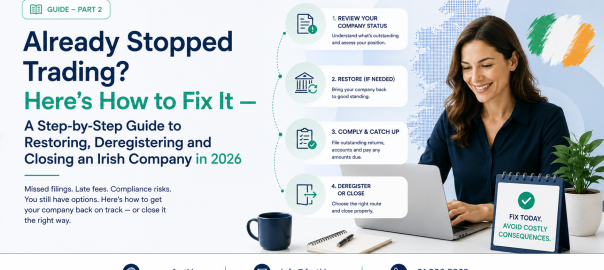
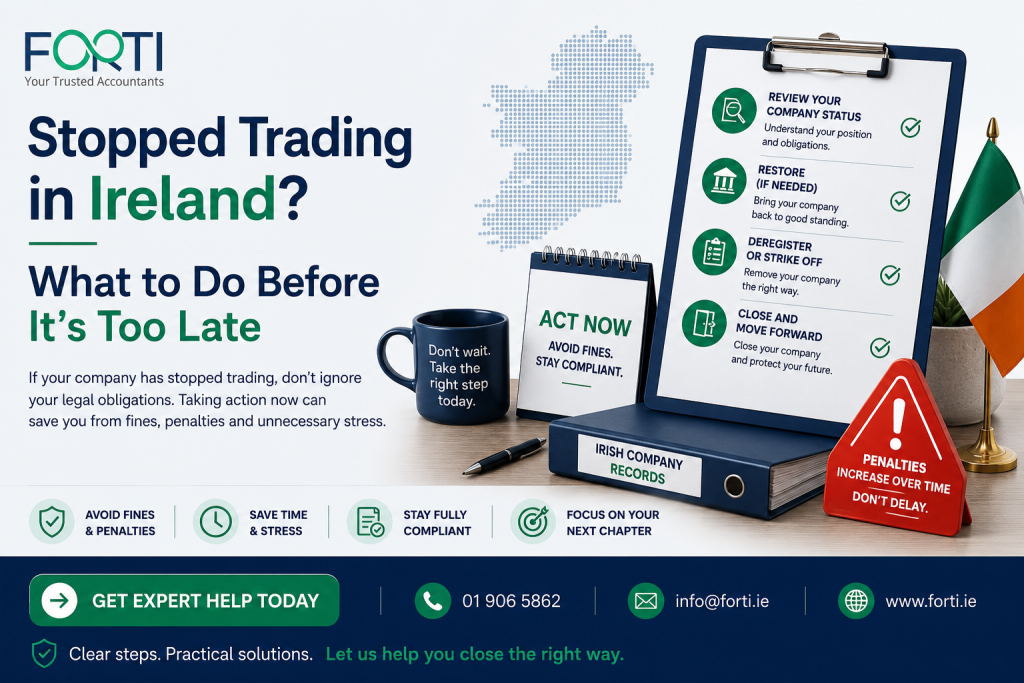
In Part 1, we looked at why ‘stopped trading’ isn’t the same as ‘closed down,’ and what it costs when business owners leave that gap unresolved. This follow-up is the practical playbook: the exact steps to restore a struck-off company, deregister properly with Revenue, close a company the right way, or keep a dormant one compliant — with the current CRO fees and timelines for each route.
Step One: Work Out Which Situation You’re Actually In
Before picking a fix, confirm the starting point. The route — and the cost — depends entirely on which of these applies to you right now.
Your company is still on the CRO register, but annual returns are overdue — you’re at risk, but not yet struck off.
Your company has already been struck off and dissolved — you need restoration if you want it back.
Your company is trading-inactive but compliant so far — you want to formally mark it dormant or close it properly before anything lapses.
You stopped self-employment as a sole trader — your fix runs through Revenue and, if you registered a business name, the CRO’s RBN3 form.
Search the CRO’s public register (cro.ie) for your company name or number — it will show your last filed annual return and current status, which tells you immediately which path below applies.
Path A: Restoring a Struck-Off Company
If it’s been less than 12 months since dissolution — Administrative Restoration
1. File Form H1 through the CRO’s CORE portal. The filing fee is €300, payable by bank draft, CRO deposit account, or online payment — cheques are no longer accepted.
2. File every outstanding annual return, each with its financial statements. Late filing penalties apply per return (€100 plus €3/day, capped at €1,200), though on a restoration the cumulative late-filing exposure across the last three returns is capped at €3,600.
3. If the company was struck off for Revenue non-compliance rather than CRO non-filing, you’ll also need written confirmation from Revenue that all outstanding statements have been delivered before the CRO will process restoration.
4. Confirm the company still meets the Section 137 requirement for an EEA-resident director (or holds the relevant bond), and that director/secretary details are up to date.
5. Once the Registrar is satisfied, the company is restored and treated, for continuity purposes, as if it had never been dissolved — though the gap in filings and the strike-off itself remain on the public record permanently.
If it’s been more than 12 months — Court Order Restoration
After the 12-month administrative window closes, restoration can only happen through the High Court, under Section 738 of the Companies Act 2014, provided fewer than 20 years have passed since dissolution.
This route requires a solicitor, a letter of no objection from the CRO’s Enforcement Section, confirmation from Revenue that all liabilities are discharged, and a court hearing before the order is filed with the CRO (a further €15 fee). It is slower, adds legal costs on top of the same outstanding CRO penalties and Revenue confirmations, and can take several months from start to finish — which is exactly why administrative restoration, actioned promptly, is the route worth protecting.
Path B: Closing a Company Properly (Voluntary Strike-Off)
If the company is solvent, has no outstanding creditors, and you genuinely want to close it rather than restore or reactivate it, voluntary strike-off is the cheapest and cleanest route — a fraction of the cost of letting the CRO strike it off involuntarily and dealing with the fallout later.
1. Confirm the company meets the Section 733 conditions: it has ceased trading (or never traded), has no assets or liabilities, and is not the subject of any court proceedings.
2. Ensure all Revenue tax registrations are cancelled and any final returns filed — the CRO’s H15 process assumes no outstanding Revenue position.
3. File Form H15 through CORE. The filing fee is €15.
4. Place a newspaper advertisement (published within 30 days of your CRO submission) announcing the intention to strike off, and submit the full page of that newspaper alongside the H15.
5. The CRO publishes a notice in the CRO Gazette. Any party has 90 days to object using Form H16; if no valid objection is received, the company is struck off and dissolved in an orderly, planned way — not an enforcement action against you.
Path C: Deregistering Correctly With Revenue
Whether you’re closing a company, pausing it as dormant with no further tax activity, or winding up a sole trade, Revenue registrations don’t cancel themselves — you have to tell them.
1. Submit a Tax Registration Cancellation Notification (Form TRCN1), or cancel online through ROS/myAccount where the facility is available, for each registration that no longer applies: VAT, employer PAYE, Corporation Tax, or Income Tax.
2. File all outstanding returns up to the date of cessation first. Cancelling the registration stops future obligations — it does not remove liability for periods before the cessation date.
3. Account for VAT on any assets or stock retained at the point of deregistration; Revenue treats this as a deemed supply in your final VAT return.
4. If you employed staff, complete final payroll submissions and issue final pay and tax details before cancelling your employer PAYE registration.
5. Keep the cancellation confirmation Revenue issues — you’ll need it if you later apply to have a company restored to the CRO register, since the CRO requires written confirmation that all Revenue statements were delivered.
Path D: Keeping a Dormant Company Properly Compliant
If the plan is to keep the company on the register — perhaps to protect a name, hold an asset, or pause before restarting
dormancy is a valid, low-cost status, but it still comes with a fixed annual routine.
Hold a directors’ meeting before the financial year end to formally record the decision that the company is dormant and will claim the dormant company audit exemption, minuted in accordance with Section 365.
File the CRO annual return (Form B1) every year, on time, with a balance sheet carrying the required dormant company exemption statement.
Submit a nil Corporation Tax return (CT1) to Revenue within nine months of the financial year end, every year, without exception.
Leave VAT and employer PAYE registrations cancelled unless there’s a specific reason to keep them live — an unused live VAT number is one of the most common sources of unexpected penalties.
Diarise the Annual Return Date itself; missing it even for a genuinely dormant company triggers the same late fees and, after repeated lapses, the same loss of audit exemption as an active company.
A Quick Reference: Fees at Each Stage
CRO Fees Table 2026
Action
CRO fee (2026)
Annual return (Form B1), filed online
€20
Late filing penalty per return
€100 + €3/day, capped €1,200
Voluntary strike-off (Form H15)
€15
Administrative restoration (Form H1)
€300
Court order restoration lodgement
€15 (plus legal costs)
Business name cessation (Form RBN3)
No fee
These are the direct CRO fees only. Revenue penalties, interest, and any professional fees for preparing outstanding accounts or liaising with Revenue sit on top, and are almost always the larger part of the final bill for anyone recovering from a lapse rather than acting proactively.
Case Studies: Three Business Owners Who Fixed It
Case Study 1 — Restored Within the 12-Month Window
A Dublin design consultancy discovered, eight months after the fact, that its company had been struck off for missing two annual returns. Because it was still inside the 12-month administrative window, the director filed Form H1, submitted both outstanding annual returns with accounts, paid the capped late filing penalties, and had the company restored within several weeks — materially cheaper and faster than the court route it would have needed a few months later.
Case Study 2 — A Clean Voluntary Strike-Off
A part-time online retailer decided to close permanently after two years of declining sales. Before applying to the CRO, the director cancelled the VAT registration, filed a final VAT return accounting for the small amount of remaining stock, and confirmed no creditors were outstanding. The Form H15 application, newspaper notice, and 90-day objection period ran smoothly, and the company was dissolved in an orderly way with no penalties and no restoration ever required.
Case Study 3 — Reactivating a Dormant Company Instead of Starting Fresh
A founder who had paused a company for eighteen months while exploring a new venture wanted to start trading through it again rather than incorporate a new entity. Because the company had continued filing its annual return and nil CT1 every year while dormant, reactivation simply meant registering for VAT and employer PAYE again and updating Revenue on the resumption of trading — no restoration, no penalties, and no gap in the company’s history.
(These case studies are illustrative composites reflecting patterns we see regularly among Irish business owners, not individual clients.)
Frequently Asked Questions
How quickly should I act once I realise a company has been struck off?
Immediately. Administrative restoration is only available within 12 months of dissolution — after that, the only route is a High Court application, which costs significantly more and takes considerably longer.
Can I do the administrative restoration myself, or do I need a solicitor?
Form H1 can be filed directly through CORE without a solicitor, provided you can gather the outstanding returns, accounts, and any required Revenue confirmation yourself. Court restoration, by contrast, generally requires a solicitor to prepare the court application.
What happens to contracts or a bank account if the company is later restored?
Restoration is treated, for continuity purposes, as though the company had never been dissolved, which is what makes it possible to pick up existing arrangements. In practice, banks and counterparties may still ask questions about the gap, so it’s worth having the restoration paperwork ready to show.
Do I need to cancel VAT before I can voluntarily strike off a company?
Yes, in practice. The voluntary strike-off process assumes no outstanding Revenue position, and a live VAT registration with returns still due will hold up or invalidate the application.
Is it cheaper to restore an old company or just incorporate a new one?
It depends on the value tied up in the old entity — its trading history, contracts, VAT registration, or name. If none of that matters, incorporating fresh is often simpler. If the company has an established track record, restoring it within the 12-month window is usually the better value.
What if I genuinely can’t afford the restoration or penalty costs right now?
Speak to Revenue and, where relevant, the CRO before the relevant deadlines pass. Revenue operates phased payment arrangements for tax debts, and addressing the position early — even in instalments — is materially better than letting a strike-off or court restoration become the only remaining option.
How Forti Helps
We handle the practical side of every path above — restoration filings, voluntary strike-off applications, Revenue deregistration, and ongoing dormant company compliance — so the paperwork gets done correctly the first time, rather than compounding into a bigger bill later.
Get Back on Track With Forti
Monthly bookkeeping and management accounts from €195/month + VAT
Irish company formation, CRO fee included: €250
Company restoration, voluntary strike-off and dormant company filing support available on reques
Whether you’re inside the 12-month restoration window, ready to close a company for good, or need a dormant company kept compliant, get in touch with the Forti team at forti.ie — the earlier you act, the fewer of these fees actually apply to you.
When you’re first getting a business off the ground in Ireland, your head is usually in a dozen places at once. You’re chasing the first big customer, haggling over a lease, or trying to get a website live. The “administrative” side of things—the paperwork and the legal filings—often feels like a job for “future you.”
However, every Irish company comes with a backpack of legal responsibilities from day one. At the heart of that is the Company Secretary.
Despite the name, this isn’t about typing memos or answering phones. Under the Companies Act 2014, the secretary is essentially your compliance anchor. They’re the person tasked with making sure the company stays on the right side of the law, keeping your records straight, and ensuring the Companies RegistrationOffice (CRO) doesn’t come knocking with a fine.
1. Decoding the Role: It’s More Than Just a Title
In the eyes of the Irish courts, the Company Secretary is a “high-ranking officer” of the company. That sounds a bit grand, doesn’t it? But it means they carry a specific weight of responsibility.
If the directors are the ones driving the car and making the big decisions, the company secretaryis the one checking the map, ensuring the road tax is paid, and keeping a log of every turn the car takes.
The Statutory “Must-Dos”
In a practical sense, the secretary handles the nitty-gritty that keeps a company legally healthy:
The Paper Trail: Keeping the official registers (directors, shareholders, and beneficial owners) accurate.
The Deadlines: Filing the Annual Returnon time (messing this up is the fastest way to lose your audit exemption).
The Formalities: Recording minutes of board meetings and making sure changes to the company—like a new office address or a change in shares—are reported to the CRO within the strict legal windows.
2. The Legal Landscape: The Companies Act 2014
To understand why this role is so vital, you have to look at the Companies Act 2014. This was a massive piece of legislation that simplified life for Irish businesses but also got very firm about “corporate governance.”
The Act states that every company must have a secretary. If you are a Single Director Company, you cannot be your own secretary. You need a second person or a professional firm to step in. This is a common stumbling block for solo entrepreneurs who think they can do it all themselves.
Even if you have two directors and one acts as the secretary, the law expects that person to have the “skills and resources” to do the job. You can’t just put a name on a form and hope for the best; the person needs to actually know what a B1 form is and when it’s due.
3. Deep Dive: The Statutory Registers
This is where many businesses fall down. Every company is required to keep a “Register Office” (usually your accountant’s office or your own business premises) where your statutory books are held. These aren’t just for show; they are the “DNA” of your company.
The Register of Members (Shareholders)
This is the most important document in your company. It is the prima facie evidence of who owns the business. If your name isn’t in this register, you technically don’t own the shares, regardless of what’s written on a napkin or an email. A good secretary ensures that every time a share changes hands, the register is updated immediately.
The Register of Directors and Secretaries
This tracks who is in charge. It includes their names, residential addresses (though you can apply for a service address for privacy in some cases), and their dates of birth.
The Register of Beneficial Ownership (RBO)
This is a relatively new and very “hot” topic in Irish compliance. Since 2019, you must report who actually controls the company to a central government database. The secretary handles this filing. If you ignore it, the fines can be eye-watering—up to €500,000 if it goes to court (though usually, it’s just a very stiff administrative fine).
4. The Annual Return (Form B1): The “Do Not Miss” Deadline
If there is one thing you take away from this guide, let it be this: Do not miss your Annual Return Date (ARD).
Every Irish company is assigned an ARD. This is the date by which you must tell the CRO that you’re still alive, who is running the show, and what your finances look like.
The Consequence of Being Late
In the old days, you might get a slap on the wrist. In 2026, the CRO is automated and unforgiving.
Late Filing Fees: These start at €100 the day after the deadline and tick up by €3 a day, capped at €1,200.
Loss of Audit Exemption: This is the real killer. Most small Irish companies don’t need an expensive audit. But if you’re late with your B1, you lose that right for the next two years. You’ll have to hire an auditor to go through your books, which could easily cost you €3,000 to €10,000 depending on your turnover.
Strike-Off: If you ignore it long enough, the CRO will simply strike your company off the register. This means you no longer exist, your bank accounts are frozen, and your assets technically belong to the State.
A professional company secretary lives and breathes these deadlines so you don’t have to.
5. Board Meetings and Minutes: Why Bother?
I often hear business owners say, “It’s just me and my co-founder, why do we need to write down minutes of our meetings? We talk every day over lunch!”
Legally, you are required to hold an Annual General Meeting (AGM) and keep minutes of board decisions.
The “Protection” Factor
Minutes aren’t just red tape; they are your protection. If there is ever a dispute between shareholders, or if the Revenue Commissioners ever audit your business, those minutes prove that the directors acted reasonably and followed the law.
A company secretary attends (or helps draft) these minutes to ensure the language is “legally sound.” They record who was there, what was decided, and any “disclosures of interest” (e.g., if a director is buying a car from their own company).
6. Corporate Changes: Navigating the CRO
Business is fluid. You’ll eventually want to change things. Each change requires a specific form and a specific timeframe (usually 14 to 28 days).
Change of Registered Office: Form B2.
Appointing/Resigning a Director: Form B10.
Issuing New Shares: Form B5.
Changing the Constitution: This requires a “Special Resolution” and a filing with the CRO.
If you don’t file these on time, your public record becomes “stale.” This becomes a massive headache when you try to open a new bank account or apply for a grant from Enterprise Ireland, as they will check the CRO first.
7. The Single Director Dilemma
Ireland is a great place for solo entrepreneurs, but the “Single Director” rule catches people out. Because a single director cannot be the secretary, you have a few choices:
The “Family” Option: Appointing a spouse or parent. This is free, but are they going to remember to file the RBO returns? Probably not.
The “Accountant” Option: Many accountants offer this, but it’s often a secondary service for them.
The “Professional” Option: Hiring a dedicated Company Secretarial firm.
In my experience, the third option is the safest for a growing business. It keeps your personal relationships and your business compliance separate.
8. Outsourcing vs. In-House: The Pros and Cons
As your company grows, you might wonder if you should hire a full-time secretary.
In-House
Pros: They are in the office, they know the business inside out, and they can handle other admin.
Cons: Expensive (salary, PRSI, pension) and they might not be a “specialist” in the latest company law changes.
Outsourced (Professional Service)
Pros: Cost-effective (a few hundred Euro vs. a salary), they have “bulk” experience with the CRO, and they use specialized software to track deadlines.
Cons: They aren’t in your office daily, so you have to be proactive about telling them when something changes.
9. What Does “Good” Look Like? (Costs and Expectations)
You shouldn’t be paying thousands for basic secretarial support. For a standard SME, the annual fee is usually €300 to €800.
What should be included for that price?
Acting as the named Company Secretary.
Annual Return filing (Form B1).
Maintenance of the Statutory Registers.
Reminders for all key deadlines.
Basic advice on governance.
If you’re doing a “Share Buyback” or a “Group Reorganisation,” expect to pay an extra project fee. These are complex legal maneuvers that require a specialist’s touch.
10. The International Perspective
If you’re a US or UK company setting up an Irish subsidiary, the Company Secretary is your local eyes and ears.
Ireland has strict “Section 137” rules where at least one director must be resident in the EEA (European Economic Area). If you don’t have a resident director, you have to take out a Section 137 Bond. A professional secretary will manage this bond and ensure that the Irish subsidiary stays compliant with local laws that might differ wildly from your home country.
11. Common Mistakes to Avoid
In my years advising Irish firms, I’ve seen it all. Here are the “Big Three” errors:
The “Residential Address” Slip: Directors often forget to update the CRO when they move house. This is technically a breach of the Act.
The “Lost” Minute Book: Keeping minutes in a random Word document on a laptop that eventually breaks. You need a centralized, secure “Minute Book.”
Incorrect Share Allocations: Issuing shares without checking if you have enough “Authorised Share Capital” left. This can be a nightmare to fix retrospectively.
12. Why It Matters for the Future (The “Exit” Strategy)
You might not be thinking about selling your company today, but you should be. When a big company or a VC firm looks to buy you, they perform Due Diligence.
They will send a team of lawyers to look at your secretarial records. If they find missing minutes, unfiled share transfers, or messy registers, they see risk. It can delay a deal by months or even cause the buyer to knock €50,000 off the price because they have to “clean up” your mess.
Good secretarial work is like keeping a clean engine; it makes the car much easier to sell when the time comes.
13. Summary: The Quiet Foundation
The company secretary isn’t the “star” of the show. They don’t bring in the sales or design the products. But they are the foundation.Without a solid secretary, your company is built on sand. One missed deadline or one messy shareholder dispute can bring the whole thing crashing down. By investing a small amount in professional services, you’re buying yourself the freedom to focus on growth, knowing that the “back office” is bulletproof.
Frequently Asked Questions (FAQs)
1. Does the Company Secretary have to live in Ireland?
Not necessarily. Unlike the requirement for at least one director to be resident in the EEA (European Economic Area), a company secretary can technically live anywhere. However, they need to be reachable and capable of filing Irish documents. Most people choose a local professional because they understand the specific quirks of the Irish CRO and the 2014 Act.
2. Can my accountant also be my Company Secretary?
Yes, many accounting firms offer this. It’s a handy “all-in-one” solution. Just ensure they are actually doing the secretarial work and not just filing the accounts. Some firms treat it as an afterthought, but as we’ve discussed, the legal registers are just as important as the profit and loss statement.
3. What happens if I just don’t appoint a secretary?
If you try to register a company without one, the CRO will simply reject the application. If your secretary resigns and you don’t replace them, your company is in breach of the Companies Act. This can lead to the company being struck off the register, which is a legal nightmare to fix.
4. Is the Company Secretary liable for the company’s debts?
Generally, no. Like directors, secretaries have “limited liability.” However, they can be held personally liable—or face fines and prosecution—if they are found to be complicit in fraud or if they consistently fail in their statutory duties (like failing to keep proper books).
5. We’re a tiny “husband and wife” team. Do we really need to hold an AGM?
Legally, yes. However, the 2014 Act allows private companies with two or more directors to “dispense” with holding a physical AGM if all the members sign a written resolution. It saves you sitting in the kitchen pretending to be at a formal meeting, but you still have to do the paperwork to make it official.
6. Can a “Body Corporate” (another company) be a secretary?
Yes. This is very common. Instead of naming an individual, you can hire a professional secretarial company. They act as the “Corporate Secretary.” This is often more stable because a company doesn’t go on holiday or get sick in the middle of a filing deadline.
7. Does the Secretary have a vote on the Board?
Only if they are also a Director. If they are just the secretary, they attend board meetings to take minutes and provide advice on procedure, but they don’t get a vote on business decisions like hiring, firing, or spending money
8. My company is currently “dormant” (not trading). Do I still need a secretary?
Yes. Even if your company doesn’t have a single Euro in its bank account and hasn’t sold a thing, it is still a legal entity. You still have to file an Annual Return and you still must have a secretary on record.
9. Can I change my Company Secretary at any time?
Absolutely. If you’re unhappy with your current provider or if your internal secretary leaves, you just need to file a Form B10 with the CRO within 14 days of the change. It’s a straightforward process.
10. What is the difference between a “Registered Office” and a “Business Address”?
The Registered Office is the official “legal” address where the CRO and Revenue send formal notices. This is where your secretary usually keeps the statutory registers. Your Business Address is where you actually do your day-to-day work. They can be the same, but many
Ireland has spent the last decade cementing its status as the most pragmatic gateway for global business. In 2026, despite a shifting global tax landscape, the country remains a “top-tier” jurisdiction. For some, it’s the 12.5% Corporation Tax; for others, it’s the ease of being the only English-speaking nation in the Eurozone.
But for the entrepreneur at the starting line, the focus is more immediate: What is the real cost of entry?
At first glance, the official government fee toregister a company is a modest €50. However, any seasoned business owner knows that the filing fee is just the “cover charge.” The true cost of setting up an Irish company involves a blend of legal requirements, compliance structures, and administrative essentials that ensure your business is built on a solid foundation.
This guide provides a transparent, “no-surprises” breakdown of the costs you will encounter in 2026—from the initial CRO filing to the hidden compliance traps that catch non-residents off guard.
1. Why Founders Still Choose Ireland in 2026
Before we dive into the line items, it is worth looking at the “Value Proposition.” Costs are relative; a €2,000 setup fee is expensive for a shell company but a bargain for a vehicle that grants you full access to the European Single Market.
The Strategic Advantages
The Tax Pillar: While the global minimum tax (Pillar Two) affects massive multinationals, the 12.5% rate remains the standard for most trading SMEs.
Common Law Stability: Ireland’s legal system is based on Common Law, making it familiar and predictable for founders coming from the US, UK, or Australia.
Access to Capital: Ireland is home to a sophisticated venture capital ecosystem and serves as a primary hub for European headquarters for the world’s tech giants.
Post-Brexit Practicality: Since the UK’s departure from the EU, Ireland has become the de facto bridge for companies needing a footprint within the Union while operating in English.
2. The Initial Incorporation Phase
The first milestone is getting your Certificate of Incorporation. This document is the “birth certificate” of your business, and the process is managed by the Companies Registration Office (CRO).
2.1 Mandatory CRO Government Fees
In 2026, the CRO is almost entirely digital. The days of posting thick envelopes of paper to Carlow are largely over.
Filing Method
Cost
Processing Time
Online Registration (Form A1)
€50
3 – 5 Working Days
Business Name Registration (RBN1)
€50
2 – 4 Working Days
Paper Registration (A1)
€100
4 – 6 Weeks
The “Paper Trap”: We strongly advise against paper filings. Beyond being double the price, they have a rejection rate significantly higher than digital filings. A single typo can set your project back by over a month.
2.2 Formation Agent Packages
While you can file an A1 yourself through the CORE portal, most founders use an agent. The reason is simple: your Constitution. This document replaces the old Memorandum and Articles of Association. If it isn’t drafted correctly to reflect your specific share classes or director powers, you’ll pay much more in legal fees later to fix it.
Basic Digital Package (€150 – €250 + VAT): This covers the €50 CRO fee and provides you with a PDF of your documents. It’s perfect for a simple, single-director company.
The Professional Startup Bundle (€250 – €400 + VAT): This is the standard for most serious ventures. It usually includes a Company Seal, share certificates, and the minutes of your first board meeting.
White-Label/B2B Services: For accountants or solicitors forming companies on behalf of clients, specialised bulk rates often apply, emphasising speed and “ready-to-go” compliance folders.
3. The “Residency” Factor: A Fork in the Road
One of the most significant variables in your budget is where your directors live. Under Section 137 of the Companies Act 2014, every Irish company must have at least one director resident in the European Economic Area (EEA).
3.1 For Resident Founders
If you or a co-founder live in Ireland or anywhere in the EU/EEA, this requirement is satisfied for free. Your costs remain at the “Basic” level.
3.2 For Non-Resident Founders (The Section 137 Bond)
If all your directors live in the US, UK, or elsewhere outside the EEA, the law requires a “financial link” to the state. This comes in the form of a Section 137 Bond.
What it is: A type of insurance policy that guarantees the state up to €25,000 if your company fails to pay its fines or taxes.
The Actual Cost: You don’t pay €25,000. You pay a premium to a broker. In 2026, this typically costs €1,600 – €2,000 for a two-year bond.
Important Note: This bond is non-refundable and must be renewed every two years unless you appoint an EEA-resident director.
4. The New Identity Requirement: VIFs and PPSNs
A recent but critical addition to the cost of setup is identity verification. To prevent the creation of “ghost” companies, the CRO now requires a Verified Identity Number (VIF) for any director who does not already have an Irish PPS Number (tax ID).
The VIF Process: You must submit a Form V1, which includes your name, date of birth, and a verification of your identity witnessed by a Notary Public.
Professional Fee: Agents typically charge €150 – €200 + VAT to manage this filing. If you have four non-resident directors, this “small” requirement can add €800 to your startup costs.
5. Mandatory Structural Expenses
Once the company is registered, it needs a “home” and a “guardian.” In Ireland, these are the Registered Office and the Company Secretary.
5.1 The Registered Office Address (€250 – €450 /year)
Every company must have a physical address in the Republic of Ireland (not a PO Box). This is where all formal legal notices from the CRO and Revenue are sent.
Why use a service? Using your home address is free, but it places your personal residence on the public record, searchable by anyone. A professional registered office service provides privacy and ensures you never miss a time-sensitive legal notice.
5.2 The Company Secretary (€350 – €600 /year)
Irish law requires every company to have a Secretary. Their job is to ensure the company meets its “statutory” duties—like filing the annual return on time.
The Single-Director Rule: If your company only has one director, that person cannot also be the Secretary. You must appoint a second person or, more commonly, a professional secretarial firm.
6. The First Year “Hidden” Budget
Many founders celebrate their incorporation and then forget that the first six months are critical.
6.1 The First Annual Return (The 6-Month Mark)
Six months after you incorporate, you must file your first Annual Return (Form B1).
The Cost: €20 (CRO fee) + Agent fee (~€200-500).
The Risk: No financial accounts are required for this first filing, but if you miss the deadline, the penalties are severe. You lose your “Audit Exemption,” meaning you will be forced to hire an auditor for the next two years—an expense that can easily reach €3,000 per year.
6.2 The Company Seal (€40 – €80)
Even in a digital world, Irish law still requires companies to have a physical metal embosser. It is used to “seal” certain deeds and share certificates. While a small cost, it is a mandatory one-off purchase.
Phase 1 Summary: Resident vs. Non-Resident Comparison
Moving into the second phase of your guide, we shift from the paperwork of the “birth” of the company to the practicalities of making it operational. This is where many founders encounter the most friction, particularly regarding banking and tax.
7. Navigating the Revenue Landscape
Once you have your Certificate of Incorporation, your company exists as a legal entity, but it is effectively “invisible” to the tax man. You must proactively register for the relevant tax heads.
7.1 The Registration Process
In 2026, most registrations are handled through the Revenue Online Service (ROS). While Revenue does not charge a fee for registration, the “cost” is often in the professional time required to ensure the application isn’t rejected.
Corporation Tax (CT): This is mandatory for all trading companies. It establishes your 12.5% (or 15% for very large groups) tax link.
Value Added Tax (VAT): You must register if you expect your turnover to exceed €80,000 for goods or €40,000 for services. Many companies choose to register voluntarily even if below these thresholds to reclaim VAT on startup expenses.
PAYE (Employer): Essential if you intend to pay yourself or employees a salary.
7.2 Professional Fees for Tax Setup
Most founders include this in their accountant’s “onboarding” package.
Standard Registration Bundle:€250 – €500. * VAT Modernisation Note: As of 2026, Revenue has begun a phased rollout of eInvoicing. Ensuring your accounting software (like Xero or QuickBooks) is compatible with Irish eInvoicing standards is now a “day-one” requirement.
8. The Banking Hurdle: High-Street vs. Digital
Opening a business bank account in Ireland has historically been the biggest bottleneck for new companies. In 2026, the landscape has split into two distinct paths.
8.1 Traditional High-Street Banks (AIB, BOI, PTSB)
These banks offer “Startup Packages” that typically waive transaction fees for the first 24 months.
Pros: Access to credit lines, overdrafts, and a physical branch network.
Cons: Stricter residency checks. If you are a non-resident director, they will often insist on a physical, in-person meeting in Dublin or Cork to verify your identity.
Timeframe: 4 – 8 weeks.
8.2 Digital Banking (Revolut Business, Wise, Fire.com)
For many startups, digital-first platforms are now the primary choice.
Pros: Opening an account takes days, not weeks. Integration with your accounting software is seamless, and you get multi-currency IBANs (EUR, GBP, USD) instantly.
Cost:Free to €50 setup. Monthly fees range from €0 to €100 depending on volume.
Non-Resident Advantage: These platforms are far more comfortable with international directors and rarely require a physical visit to Ireland.
9. Ongoing Professional Maintenance
Running a company carries a “compliance floor”—a minimum annual spend regardless of whether you make a profit or not.
9.1 Accountancy and Tax Filing (€1,500 – €3,500 /year)
A Limited Company must file annual financial statements. Unlike a Sole Trader, you cannot simply submit a summary of your income.
The CT1 Return: The annual Corporation Tax filing.
Bookkeeping: If you handle your own bookkeeping via cloud software, you can keep costs toward the €1,500 mark. If you outsource everything, expect to pay €80-€250+ per month, depending on on the volume of work involved. The benchmark which bookkeepers take in ireland is 2-3 minutes per transaction reconciliation. Bookkeeping hour rate could be anything from €25 per hour to €50+ per hour.
9.2 The “Late Filing” Trap
This is the most expensive mistake a founder can make.
CRO Late Fees: Start at €100 and increase by €3 every day you are late.
The Audit Penalty: If you miss your Annual Return deadline, you lose your “Audit Exemption.” You will be legally required to have your accounts professionally audited for the next two years.
Estimated Cost of a Penalty:€3,000 – €5,000 in additional auditor fees.
10. Incentives: Recovering Your Setup Costs
The Irish government is aware that setup costs can be a burden. To counter this, there are several “pro-enterprise” tax measures available in 2026.
10.1 The R&D Tax Credit (35%)
If your startup is developing a new product or process, you may be eligible for a 35% tax credit on qualifying research and development expenditure. In 2026, the first-year payment threshold was increased to €87,500, meaning smaller startups get their cash back much faster.
10.2 Start-Up Relief for Entrepreneurs (SURE)
This is a powerful relief that allows you to claim back a refund of the Income Tax you paid while you were an employee in the four years prior to starting your business. For some founders, this can result in a cash injection of tens of thousands of euros.
10.3 Section 486A (Start-up Relief)
New companies may be exempt from Corporation Tax for their first three years of trading, provided their tax liability is below certain thresholds (typically related to the amount of PRSI paid for employees).
Phase 2 Summary: Operational Budget (Months 1-12)
Operational Item
Resident Estimated Cost
Non-Resident Estimated Cost
Tax Registration (Agent)
€350
€500
Banking Setup
€0
€50
Accounting Software (Xero/Quickbooks)
€360
€360
First Year Bookkeeping/Accounts
€1,800
€2,200
Annual Return Filing (B1)
€120
€120
Total Operational Year 1
€2,630
€3,230
The final part of this guide will cover the advanced legal structures, the 2026 eInvoicing mandates, and a step-by-step 12-month compliance calendar so you never miss a deadline.
11. Scaling and Structure: Insights for Professionals
For accountants and solicitors managing a portfolio of clients, the “cost” of company setup isn’t just a monetary figure—it’s a risk-management calculation. In 2026, the trend has shifted toward White-Label Formation Partnerships.
11.1 The Holding Company Strategy
Many successful startups in Ireland now launch with a Holding Company structure from day one.
The Cost: Effectively double the setup (€1,200 – €2,000).
The Benefit: It allows for tax-free movement of dividends between subsidiaries and protects the “Intellectual Property” in one entity while the “Trading” occurs in another. For solicitors, advising on this structure early prevents the massive capital gains tax (CGT) costs of restructuring three years down the line.
12. The 2026 Digital Shift: eInvoicing & ViDA
As of late 2025 and moving into 2026, the Irish Revenue Commissioners have accelerated the VAT in the Digital Age (ViDA) initiative.
The Mandate: While full B2B eInvoicing is being phased in, all new companies are now expected to have “digital-ready” systems.
The Compliance Cost: You can no longer rely on Excel spreadsheets for invoicing. You must budget for “Revenue-compliant” software (Xero, Sage, or QuickBooks) which costs roughly €30–€60 per month.
The Risk: Revenue now uses AI-driven “Real-Time Reporting” tools to flag discrepancies in VAT filings. Being “cheap” on your accounting software is now a high-risk strategy.
13. Your 12-Month Compliance Calendar (The “Peace of Mind” Checklist)
Critical: No accounts required, but must be on time.
Month 9
Preliminary Tax
Revenue
Payment of estimated Corp Tax for the current year.
Month 12
Financial Year End
Internal
Finalize books and prepare for the accountant.
Month 18
Second Annual Return
CRO
Must include full Financial Statements.
Month 21
CT1 Return
Revenue
Final Corporation Tax return and payment.
14. Final Summary: Is Ireland Worth the Investment?
When you add up the registration, the residency bonds, the office address, and the professional fees, an Irish company is not the “cheapest” in the world—but it is one of the most valuable.
In 2026, a company with a “Dublin, Ireland” registered office carries a weight of transparency and regulatory quality that makes it easier to open global bank accounts, attract venture capital, and trade across the EU.
Final Cost Recap (Year 1)
Resident Total: ~€1,200 (Setup + basic 1st year compliance).
Non-Resident Total: ~€3,800 (Includes S.137 Bond, VIF, and Address).
Ready to Launch Your Success Story?
The difference between a company that thrives and one that gets bogged down in Revenue audits is the quality of the first 30 days. Don’t leave your incorporation to chance.
We are the partner of choice for:
Entrepreneurs: Who want to focus on their product, not the Companies Act.
International Startups: Who need a “remote-first” setup that handles all local residency hurdles.
Accountants & Solicitors: Who require a fast, reliable, and white-label formation desk for their clients.
Start your journey with a Free Company Name Check today. We’ll ensure your name is compliant with CRO guidelines and help you choose the package that fits your 2026 goals.
The First Step is Free
Before you commit to a structure or pay a single fee, you need to ensure your identity is protected. Use ourFree Company Name Check tool to see if your brand is available and meets the 2026 CRO guidelines.
Who We Work With:
Resident Entrepreneurs & Startups: Get your Certificate of Incorporation in as little as 3 working days with our “Express Resident” package.
Non-Resident Founders: We handle the “heavy lifting”—from securing your Section 137 Bond and VIF verification to providing a premium Dublin 2 Registered Office.
Accountants & Solicitors: Partner with us for a seamless, white-label formation experience for your clients. We act as your back-office experts so you can stay the lead advisor.
Selecting the right legal structure is one of the most consequential decisions you will make when establishing a presence in Ireland. In 2026, the Companies Act 2014 remains the bedrock of Irish corporate law, but recent updates—including the 2024 Corporate Governance Act—have added new layers to how these entities must be managed.
While the “LTD” is the default for most, choosing the wrong type can lead to unnecessary administrative burdens or, conversely, a lack of the legal protection your specific venture requires.
This guide provides a deep dive into the six primary company types available in Ireland today.
1. Private Company Limited by Shares (LTD)
TheLTDis the “gold standard” for the vast majority of commercial enterprises in Ireland. It was designed to be as unrestrictive as possible, removing many of the traditional legal hurdles that once slowed down small business owners.
Key Characteristics
Legal Capacity: An LTD has the full legal capacity of a natural person. This means it does not have a “Main Objects” clause in its constitution; it can legally undertake any lawful business activity without needing to update its founding documents.
Single Director Status: This is the only company type in Ireland that allows for a single director. However, if you choose this route, that director cannot also be the company secretary.
Liability: Shareholders’ liability is strictly limited to the amount (if any) unpaid on the shares they hold.
Governance: It can dispense with the requirement to hold a physical Annual General Meeting (AGM), provided all shareholders sign a written resolution.
When to Choose an LTD
Choose this if you are an entrepreneur, a tech startup, or a small-to-medium enterprise (SME) looking for maximum flexibility and minimum red tape.
2. Designated Activity Company (DAC)
The DAC is essentially a private limited company that has “blinkers” on. It is legally restricted to specific activities defined in its constitution.
Why the Restriction Matters
Unlike the LTD, the DAC retains a Memorandum of Association which includes an “Objects Clause.” Any action taken by the company outside these stated objects is technically Ultra Vires (beyond its powers), though Irish law provides significant protection for third parties dealing with a DAC in good faith.
Key Characteristics
Minimum Two Directors: Unlike the LTD, a DAC must have at least two directors at all times.
Mandatory Objects: It must define what it does (e.g., “The principal object is the holding of property in Dublin 2”).
Listing Securities: A DAC is the primary vehicle for companies that wish to list debt securities (like bonds) on an exchange but do not want to go fully “public.”
When to Choose a DAC
You should opt for a DAC if you are setting up a Joint Venture where partners want to ensure the company doesn’t “pivot” into other industries, or if you are a Financial Institution or Special Purpose Vehicle (SPV) required by law or lenders to have a narrow scope.
3. Company Limited by Guarantee (CLG)
A CLG is a unique structure that does not have share capital. Instead of shareholders, it has members.
The “Guarantee” Explained
Each member “guarantees” to contribute a specific (usually nominal) amount—often just €1—to the assets of the company if it is wound up. Because there are no shares, there are no dividends; any profit made is typically reinvested back into the company’s mission.
Key Characteristics
Non-Profit Focus: This is the standard vehicle for charities, sports clubs, trade associations, and professional bodies.
Public Nature: Even though it is often used for small clubs, a CLG is technically a public company type in terms of its reporting obligations.
Two Directors: A minimum of two directors is required.
When to Choose a CLG
This is the correct choice for any not-for-profit organization or community group that needs a legal identity to sign leases, hire staff, or apply for state grants without putting members’ personal assets at risk.
4. Public Limited Company (PLC)
The PLC is designed for large-scale operations that intend to raise capital from the general public.
Key Characteristics
Share Capital Minimum: A PLC must have a minimum allotted share capital of €25,000, and at least 25% of this must be fully paid up before the company can even begin trading.
Public Listing: Only a PLC can offer its shares to the public or seek a listing on a regulated stock exchange like Euronext Dublin.
Strict Oversight: PLCs face the highest level of regulatory scrutiny, including mandatory audits and more complex financial reporting standards.
When to Choose a PLC
Choose a PLC if you are planning an Initial Public Offering (IPO) or if the sheer scale of your capital requirements necessitates the ability to issue shares to thousands of individual investors.
5. Unlimited Company (ULC)
An Unlimited Company is a rare but strategically powerful structure. Its name is its biggest warning: the members have unlimited liability for the company’s debts.
The “Privacy” Trade-off
Why would anyone accept unlimited liability? In Ireland, certain types of Unlimited Companies have historically been exempt from the requirement to file their annual accounts publicly with the CRO.
Key Characteristics
Privacy: For very wealthy families or private multinational subsidiaries, the ability to keep financial performance away from competitors’ eyes is worth the risk of unlimited liability.
No Capital Maintenance Rules: ULCs have much more flexibility in how they return capital to their members compared to limited companies.
When to Choose a ULC
This is almost exclusively used by multinational corporations for specific tax or privacy strategies, or by professional partnerships (like some law or accounting firms) where the members want to signal total confidence to their clients.
6. Societas Europaea (SE)
The SE is a “European Company,” a structure governed by EU law rather than just Irish national law.
Key Characteristics
Cross-Border Mobility: An SE can transfer its registered office from Ireland to another EU Member State (like France or Germany) without having to wind up the company or create a new legal entity.
High Capital Requirement: A minimum share capital of €120,000 is required.
Merger Focus: It is usually created through the merger of two or more companies from different EU countries.
When to Choose an SE
Choose an SE if you are planning a pan-European operation and want a corporate identity that is recognized equally across the entire European Union, making future cross-border mergers or relocations seamless.
Comparison Matrix: Irish Company Types at a Glance
Feature
LTD
DAC
CLG
PLC
ULC
Min. Directors
1
2
2
2
2
Share Capital
Yes
Yes/No
No
Yes (€25k min)
Yes
Objects Clause
No
Yes
Yes
Yes
Yes
AGM Required
No*
Yes
Yes
Yes
Yes
Suffix
LTD / Limited
DAC
CLG
PLC
Unlimited Company
Don’t Guess Your Structure
Choosing the wrong company type can lead to a “re-registration” process later, which involves special resolutions, new constitutions, and CRO fees.
How We Help
We provide the technical expertise to ensure your foundation is right from day one:
Startups: Most of our clients begin with an LTD, but we evaluate your 5-year plan to ensure it’s the right fit.
Foundations & Charities: We specialise in CLG setups that meet the strict requirements of the Charities Regulator.
Professional Advisors: We provide white-label PLC and ULC formation services for law and accounting firms.
Ensure your company name and structure are available and compliant. Use our Free Company Name Check to secure your spot in the Irish market.
[Start Your Free Name Check] | [Compare Detailed Packages] | [Talk to an Expert]
In 2026, the landscape of corporate governance in Ireland is defined by a shift toward digital-first compliance and heightened individual accountability. Whether you are the sole director of an LTD or sitting on the board of a PLC, the legal weight of your decisions has never been more transparent.
This second part of our guide explores the governance requirements and fiduciary duties that distinguish each company type, updated with the latest 2024 and 2025 legislative changes.
7. The Core Fiduciary Duties: A 2026 Perspective
Under the Companies Act 2014 (and reinforced by the Corporate Governance Act 2024), directors’ duties are no longer just “best practices”—they are codified in statute. Regardless of the company type, every director is bound by eight principal fiduciary duties.
Act in Good Faith: You must act in what you honestly believe to be the best interests of the company (not yourself or a specific shareholder).
Act Honestly and Responsibly: This is the baseline for all corporate conduct in Ireland.
Act in Accordance with the Constitution: Especially critical for DACs and CLGs, where the “Objects Clause” strictly limits what the company is allowed to do.
Avoid Conflicts of Interest: Any personal interest in a company contract must be formally disclosed.
Exercise Care, Skill, and Diligence: You are expected to bring the level of knowledge a reasonable person in your position would have.
Do Not Misuse Property: Company assets, information, or opportunities cannot be used for personal gain.
Independent Judgment: You cannot “fetter” your discretion or simply do what a majority shareholder tells you without thinking.
Employee Regard: Directors must have regard for the interests of the company’s employees as well as its members.
8. Governance Differences by Company Type
While the core duties are universal, the administrative burden of governance varies wildly between an LTD and a PLC.
8.1 The “Solo” Advantage: Governance in an LTD
The LTD is the only structure that allows for a Single Director.
The Secretary Requirement: Even with one director, you must have a separate Secretary. This can be a person or a professional firm.
AGM Flexibility: In 2026, LTDs can almost entirely dispense with physical Annual General Meetings. By signing a “Written Resolution,” shareholders can approve the accounts and reappoint auditors digitally.
8.2 The Rigidity of the DAC and CLG
Because DACs and CLGs are often used for regulated or charitable purposes, their governance is more formal.
Minimum Two Directors: You cannot have a “one-man show” in these structures.
Mandatory AGMs: Unless the company is a single-member DAC, a physical (or hybrid) AGM is generally required to ensure transparency among members/guarantors.
8.3 The High Stakes of the PLC
A Public Limited Company faces the most grueling governance schedule.
Audit Committees: PLCs are often required to establish formal committees to oversee financial reporting.
Compliance Statements: Directors of PLCs must include a formal “Compliance Statement” in their annual report, confirming that the company has appropriate structures in place to secure material compliance with tax and company law.
9. 2026 Compliance: What’s New?
Two major updates have changed the “cost of compliance” for Irish boards in the last 24 months.
9.1 Permanent Virtual Meetings
The Corporate Governance Act 2024 finally made “Hybrid” and “Fully Virtual” meetings a permanent fixture.
The Cost Saving: Companies no longer need to rent physical venues or pay for international travel for board members.
The Caveat: Your Constitution must not specifically prohibit virtual meetings. If you have an older constitution from pre-2020, you may need a professional to update it to take advantage of this.
9.2 The “One-Strike” Audit Rule (2025/2026 Update)
Previously, failing to file an annual return on time meant an automatic loss of Audit Exemption for two years.
The New Rule: As of 2025, small companies are granted a “grace” period. You only lose the exemption if you file late more than once in a five-year period.
The Strategic Benefit: This saves small businesses from the devastating €3,000–€5,000 cost of a mandatory audit for a simple administrative slip-up.
10. Summary Governance Matrix
Feature
LTD
DAC
CLG
PLC
Director Minimum
1
2
2 (3 for Charities)
2
Written Resolutions
Fully Allowed
Limited
Limited
Prohibited (mostly)
Audit Exemption
Available
Available
Available
Never
Virtual Meetings
Permanent
Permanent/td>
Permanent
Permanent
11. The Role of the Company Secretary in 2026
The Secretary is the “Compliance Officer” of the board. Their role has expanded significantly with the introduction of the Register of Beneficial Ownership (RBO).
Identity Verification: The Secretary must now ensure all directors have a PPSN or a VIF (Verified Identity Number).
Late Filing Prevention: In 2026, the Corporate Enforcement Authority (CEA) has increased its focus on “Involuntary Strike-offs.” The Secretary’s primary value is ensuring the company doesn’t vanish from the register due to missed deadlines.
Your Foundation, Our Expertise
Whether you are opting for the streamlined governance of an LTD or the specialized structure of a DAC, the “objects” and “powers” defined in your constitution today will dictate your freedom tomorrow.
Who We Work With
Founders & Entrepreneurs: Helping you navigate the single-director versus multi-director decision.
Charities & Associations: Structuring CLG constitutions to satisfy both the CRO and the Charities Regulator.
Legal Professionals: Providing white-label technical support for complex PLC and ULC formations.
Ready to select your structure? Don’t leave your corporate governance to chance. Start with a Free Company Name Check to confirm your path and ensure your preferred name is legally viable.
[Start Your Free Name Check]| [Talk to a Specialist]
Building a company in Ireland is rarely a static process. As your business scales, your original structure might become a “tight suit” that no longer fits your ambitions.
In this final section, we look at how to pivot between company types (re-registration) and how to eventually exit with maximum value.
15. The Pivot: Re-Registering Your Company Type
Circumstances change. A startup that began as a simple LTD might need to become a PLC to attract public investment, or a family business might decide to become an Unlimited Company (ULC) to keep its financials private.
The Re-Registration Process
In 2026, re-registering is a streamlined legal maneuver, but it requires precision. Under Part 20 of the Companies Act 2014, the steps are generally as follows:
Special Resolution: Shareholders must pass a special resolution (requiring 75% approval) authorizing the change.
Constitutional Update: You must adopt a entirely new Constitution that reflects the new company type (e.g., adding an “Objects Clause” if moving to a DAC).
CRO Filing (Form D20): This is the formal application to the Registrar.
Issuance of New Certificate: The CRO issues a new Certificate of Incorporation. Crucially, the Company Number (CRO Number) stays the same—only the suffix (and the legal rules) change.
Common Scenario: Many private companies re-register as a DAC specifically to satisfy a bank’s lending requirements or to issue debt securities on the market.
16. The Exit Strategy: Winding Up and Dissolution
Every entrepreneur should “build with the end in mind.” How you close a company is just as important as how you open it.
16.1 Voluntary Strike-Off (€295 – €500)
If your company has no assets and no liabilities (and has never traded or has ceased trading), this is the cleanest exit.
Requirements: You must advertise the strike-off in a daily newspaper and obtain a “Letter of No Objection” from Revenue.
Timeline: Takes about 12 months for the CRO to fully remove the name from the register.
16.2 Members’ Voluntary Liquidation (MVL)
If your company is successful and has surplus cash (over €25,000), you should use an MVL.
The Tax Benefit: An MVL allows you to extract the company’s cash as Capital rather than Income, potentially qualifying for a 10% or 33% tax rate rather than the 52% income tax rate.
The Cost: You must appoint a liquidator. Expect professional fees to range from €3,000 to €7,000.
16.3 Creditors’ Voluntary Liquidation (CVL)
If the business is insolvent (cannot pay its debts), the directors have a legal duty to stop trading and call a meeting of creditors to appoint a liquidator. Delaying this can lead to personal liability for the directors.
17. Final Strategic Comparison (The Multi-Level View)
Company Type
Best For…
Governance Level
Typical Exit
LTD
Startups & SMEs
Low / Flexible
Sale or Strike-off
DAC
Joint Ventures/Debt
Medium/Fixed
MVL/Trade Sale
CLG
Charities / Clubs
High / Non-Profit
Asset Transfer
PLC
Public Funding
Maximum
IPO / Acquisition
ULC
Privacy / Multinationals
Medium
Restructuring
Closing Your 2026 Roadmap
Choosing the right Irish company type is about balancing your current needs with your future exit. Whether you need the simplicity of a single-director LTD or the structural prestige of a PLC, the legal framework in Ireland is designed to support your growth at every stage.
How We Can Help
Decision Support: We help you weigh the “Privacy of a ULC” against the “Limited Liability of an LTD.”
Swift Execution: Most re-registrations can be prepared and filed within 5-10 working days.
Professional Partnerships: We provide the technical “engine” for accountants and solicitors who need to give their clients the best possible structural advice.
Don’t leave your structure to chance. The wrong box checked today can cost thousands in legal fees tomorrow. Start with a Free Company Name Check to secure your brand and get a professional opinion on the right structure for your 2026 goals.
FAQs
Starting a business is a big move, and the paperwork can feel like a different language. Here are the plain-English answers to the questions we hear most often in 2026.
1. I don’t live in Ireland. Can I still start a business here?
Absolutely. You can own 100% of your Irish company from anywhere in the world. The only “hitch” is that Irish law likes to have someone nearby to talk to. If none of your directors live in the European Economic Area (EEA), you’ll just need to put a “Bond” in place (think of it as a specialized insurance policy) that costs around €1,500–€2,000. It’s a standard box-ticking exercise we handle all the time.
2. How fast can I get up and running?
In 2026, the digital system is pretty snappy. Usually, the CRO (Companies Registration Office) turns things around in 3 to 5 working days. If you’re in a rush, using an agent is the best bet—we know the “red flag” mistakes that usually cause delays, so we get it right the first time.
3. I’m on a budget. What’s the cheapest way to do this?
Go for the Private Company Limited by Shares (LTD). It’s the most popular for a reason. The government fee is just €50. By the time you add in a company seal and someone to help with the legal bits, most local founders find they can get fully set up for between €250 and €500.
4. Do I really need a physical office in Ireland?
Yes, but don’t worry—you don’t need to rent a skyscraper. You just need a “Registered Office” address where legal mail can land. It can’t be a PO Box. Many founders who work from home or live abroad use a Registered Office Service (roughly €200–€400 a year) to keep their home address private and their business professional.
5. Can I be the only person in my company?
Almost. You can be the sole Director and own all the shares. However, Irish law says you can’t be your own “Secretary.” Think of the Secretary as the person who minds the company’s “legal health.” You’ll need to appoint a friend, a business partner, or a professional service to hold that title.
6. What on earth is a VIF?
It stands for Verified Identity Number. Basically, the government wants to make sure you are who you say you are. If you don’t have an Irish PPS number, you’ll just need to get your ID verified by a Notary. It’s a bit of extra paperwork, but it’s a one-time thing to keep everything secure.
7. Will I need an expensive audit every year?
Probably not. Most small businesses are “audit exempt.” As long as your turnover is under €15M and you have fewer than 50 staff, you’re likely in the clear. The golden rule, though: file your paperwork on time. If you’re late, the government “punishes” you by making you pay for an audit for the next two years.
8. LTD vs. DAC—what’s the difference?
Think of an LTD as a blank canvas; you can do any kind of business you want. A DAC is a bit more rigid—it’s “designated” for a specific job. Unless you’re a bank or in a very specific joint venture, the LTD is almost certainly the right move for you.
That happens after the company is born. You apply to the Revenue Commissioners. They’ll want to see that you’re actually planning to trade in Ireland (or the EU). It usually takes about 2 to 4 weeks to get that number in your hand.
10. What does it cost to “keep the lights on” each year?
Beyond your own business costs, you’ll have a few “legal health” fees. Between filing your annual return and having an accountant help with your taxes, a small, active company usually budgets between €1,500 and €3,000 a year to stay 100% compliant.
Ready to make it official?
Choosing the right path today saves you a massive headache next year. Let’s make sure your name is available and your plan is solid.
Every few years, the rules of money in Ireland undergo a fundamental shift.
These changes rarely arrive with the fanfare of a budget-day siren. Instead, they happen gradually—through regulatory directives like IORP II or phased legislative updates in the Finance Act. For the casual observer, they are invisible. For the informed company director, they represent either a significant threat to their net worth or a generational opportunity to build wealth.
2026 is one of those years. Between the landmark pension compliance deadline in April and the aggressive new “Salary Engineering” requirements, the gap between the “informed” and the “unaware” is about to widen significantly. For Irish company directors, the message is clear: the days of “passive compliance” are over. If you want to build wealth in 2026, you must move from being an employee of your business to becoming a strategist of your structure.
The Biggest Mistake Directors Make
Most directors still approach their finances like high-earning PAYE employees. They view their company as a source of monthly income rather than a wealth-building vehicle. They follow a predictable, yet inefficient, pattern:
Pull profits as salary or dividends when cash flow allows.
Pay the “obligatory” 52% tax rate (Income Tax, USC, and PRSI).
Attempt to invest the remaining 48 cents of every euro into personal assets.
In the current environment of persistent inflation and rising business uncertainty, this “extraction-first” approach is a leak that quietly erodes wealth over decades.
The directors who will thrive in 2026 realize that their company is not their bank account—it is their most powerful financial tool. By utilizing the 5-layer framework below, smart directors are turning company profits into long-term personal wealth with surgical precision.
The 2026 Wealth Framework: 5 Critical Layers
1. The April 2026 Pension Deadline: Act or Freeze
This is the most urgent item on the 2026 agenda. If you hold a traditional “Executive Pension” (a One-Member Arrangement) established before April 2021, you are currently in a “derogation period” that is about to end.
Under the IORP II Directive, the Pensions Authority has mandated that these old-style schemes must be transitioned to a Master Trust or a PRSA by April 22, 2026.
The Risk: If you miss this deadline, your scheme will likely be “frozen.” You will no longer be able to make tax-efficient contributions, and you may face significant administrative hurdles to access your funds.
The Opportunity: Transitioning now allows you to modernize your investment strategy and align your pension with the new, higher thresholds mentioned below.
2. The “100% Rule” (Salary Engineering)
In 2026, your salary is no longer just about your lifestyle; it is a “key” that unlocks your pension capacity.
Following recent Finance Act updates, employer contributions to a PRSA are now capped at 100% of the director’s annual salary.
The Trap: Many directors traditionally took a “minimum salary” (e.g., €20,000) to minimise personal tax while the company made massive pension contributions (e.g., €100,000). Doing this in 2026 triggers a Benefit in Kind (BIK) charge on the excess, effectively wiping out the tax advantage.
The Strategy: Smart directors are now “engineering” their salaries. By setting a strategic salary level, they maximise their 20% tax band while simultaneously “opening the door” for higher tax-deductible company pension contributions.
3. Exploiting the New €2.2M SFT Threshold
The Standard Fund Threshold (SFT)—the lifetime limit on the value of your pension—is finally on the move. After a decade of being frozen at €2.0m, it has increased to €2.2m for 2026.
This is part of a legislated roadmap to reach €2.8m by 2029.
For directors who had “stopped” funding their pensions because they were nearing the old limit, this is a massive green light.
Expanding your pension pot by an extra €200,000 this year allows that capital to grow tax-free, sheltered from the 40% “Chargeable Excess Tax” that plagued high earners in years past.
4. Retained Profits & the “Close Company” Trap
Not every euro earned needs to be extracted immediately. Retaining profits within the company provides a vital buffer for lean years and allows for “optionality.” However, it must be managed carefully to avoid the Close Company Surcharge.
Revenue applies a 20% surcharge on undistributed “passive” income (such as rent or investment interest) if it is not distributed within 18 months.
The Goal: Strong directors don’t ask, “How much can I take out?” They ask, “How much should I take out to balance current lifestyle needs against future tax liabilities?” * By maintaining a balance between “Active Trading Income” (taxed at 12.5%) and “Passive Income,” you can use your company as a low-tax environment to compound wealth before eventual extraction.
5. Exit Planning: The €1.5M Entrepreneur Relief
If your ultimate goal is to sell your business or wind it down, 2026 has introduced a major incentive. The lifetime limit for Revised Entrepreneur Relief has officially increased from €1m to €1.5m.
This allows you to pay a reduced 10% Capital Gains Tax (CGT) rate on the first €1.5m of gains from the sale of your business.
For a director selling in 2026 vs. 2024, this change alone represents an additional €115,000 in after-tax wealth (the difference between the 10% relief rate and the standard 33% CGT on that extra €500k).
The Catch: Your company structure must be “clean” and meet specific trading requirements for years prior to the sale. You cannot “fix” your eligibility on the day of the exit.
Why 2026 Will Separate Directors
The next few years won’t reward the “hustle” mentality alone. They will reward Visibility and Structure.
PAYE workers build wealth through saving—painstakingly putting away money after the taxman has taken his share. Company directors build wealth through structuring—deciding exactly when, where, and how a euro is taxed (or not taxed) before it ever leaves the business entity.
If you haven’t reviewed your extraction strategy, your pension compliance, or your exit roadmap in the last 12 months, you are likely leaking wealth. The April 2026 deadline isn’t just a regulatory hurdle; it’s a “line in the sand” for your financial future.
Getting the Foundations Right
Before any of these advanced wealth strategies can be implemented, you need one thing: Control over your numbers.
In our experience at Forti, poor wealth decisions rarely come from bad intentions. They come from reactive accounting. If you only see your “real” profits once a year when your tax return is due, you are already 12 months too late to make a strategic decision.
To build wealth like a 2026 director, you need:
Real-Time Visibility: Knowing your exact profit and tax position every month.
Structured Reporting: Moving beyond “box-ticking” compliance to meaningful quarterly reviews.
Proactive Strategy: Making pension and dividend decisions in June, not December.
Good wealth management doesn’t start with a “product” or a hot tip. It starts with a clean set of books and a clear strategy.
Is your business structure ready for the April 2026 deadline?
At Forti, we help Irish company directors gain the financial clarity they need to stop reacting and start building. From accurate, monthly bookkeeping to strategic wealth structuring, we ensure your foundations are solid so you can focus on growth.
Learn more about our structured approach at www.forti.ie.
Disclaimer: This article is for general information and educational purposes only and does not constitute financial, investment, pension, or wealth advice. Every individual and business situation is different. You should consider speaking with a qualified financial adviser, pension specialist, or tax professional before making any decisions based on the information above.
Ireland is seeing record levels of new incorporations. The Companies Registration Office (CRO) reported that 23,652 new companies were formed in 2024, up 5.7% on 2023. That’s an average of almost 2,000 new companies a month.
Meanwhile, Irish SMEs remain the backbone of the economy, making up 99.8% of all businesses according to the CSO’s Business Demography series.In fact, Q1 2025 saw 6,340 new startups opening their doors, a 3.9% rise on the same period in 2024.
Are you also thinking about setting up a limited company here, but not sure where to start?
Whether you’re moving beyond sole trader status or setting up a new venture from scratch, this guide will walk you through:
What a limited company actually is
The legal requirements in Ireland in 2025
The exact steps to register with the CRO and Revenue
Why So Many Irish Entrepreneurs Are Choosing A Limited Company
Limited liability and separate legal status
A Private Company Limited by Shares (LTD) is a separate legal person in the eyes of the law. That means the company, not you personally, signs contracts, owns assets and is sued if something goes wrong.
For most shareholders, their financial risk is limited to what they have invested in shares. Your personal home and savings are generally better protected than they would be as a sole trader, where you are personally on the hook for business debts.
Potential tax efficiency
Irish limited companies pay 12.5% Corporation Tax on trading profits, with higher rates only applying to certain passive or non-trading income.
For many growing businesses, leaving some profit in the company at 12.5 percent and paying yourself a mix of salary and dividends can be more efficient than having all profit taxed as personal income, which can reach effective rates over 50 percent.
Credibility and growth potential
A limited company structure can:
Make it easier to raise investment by issuing shares
Improve credibility with larger customers and suppliers
Help you separate your personal finances from the business more clearly
With more than 23,000 new companies set up in 2024 and over 6,300 startups in the first quarter of 2025 alone, there is clear evidence that Irish entrepreneurs see company formation as a serious route to growth.
Core Features Of An Irish Limited Company
When people talk about “going limited” in Ireland, they almost always mean forming a Private Company Limited by Shares (LTD) under Part 2 of the Companies Act 2014.
For most company types, two directors are required, but an LTD can have one director if it appoints a separate company secretary
At least one director must be resident in the European Economic Area (EEA)
If you do not have an EEA resident director, you can instead put a Section 137 Bond in place. The bond provides a €25,000 guarantee to the State and typically costs around €1,600 to €2,000 for a two-year period, according to specialist formation providers.
Registered office address
Your company must have a registered office in the Republic of Ireland where CRO and Revenue post can be delivered and where certain records are available for inspection. Virtual office providers are acceptable as long as a physical address is available for document inspection.
Share capital
There is no statutory minimum share capital for an Irish LTD. Many small companies start with a simple structure such as 100 ordinary shares of €1 each.
You will include details of authorised and issued share capital in the company’s constitution and keep a register of shareholders.
Beneficial owners
Separate from shareholders on paper, Irish and EU anti-money laundering rules require you to identify your beneficial owners. New Irish companies must:
The RBO’s 2024 annual report shows that around 88% of Irish companies had filed their beneficial ownership details by the end of 2024, showing how seriously this is enforced.
Step By Step Company Formation In Ireland
Let us break the process down so you can see what is involved.
Step 1: Decide if a limited company is right for you
Choosing a business structure can feel confusing, so it helps to start with what actually matters to you. Think about how you like to work, what risks you want to protect yourself from and where you see your business going. Factor in:
Your appetite for admin and deadlines
Whether you need limited liability
Your projected profit and personal income needs
How important external investment or credibility is in your sector
Your name must be unique and not too similar to an existing company. Check the CORE (Companies Online Registration Environment) in advance. Names which are misleading, offensive or suggest State backing will be rejected.
Usually, an Irish LTD name ends in “Limited” or “Ltd”.
Step 3: Decide on directors, secretary and shareholders
Now it is time to sort out who will help run your company. People who will carry the legal and practical responsibilities of the business. Who do you trust to take on the key roles, and how will you want ownership to be distributed? Determine:
Who will act as directors
Who will act as company secretary
How many shares will be issued and to whom
If no director is EEA resident, you should build in time and budget for a Section 137 bond.
Step 4: Prepare the constitution
Under the Companies Act 2014, Irish companies must adopt a constitution that sets out their rules. For LTDs, this replaces the older memorandum and articles of association.
The Irish Statute Book has examples of constitutions. However, businesses prefer to have an accountant or solicitor tailor it to their needs, especially if there will be multiple shareholders.
Step 5: File Form A1 and supporting documents
You register the company with the CRO using Form A1 and uploading your constitution through the online CORE system. The CRO’s fee schedule currently has an electronic A1 filing costing €50, with paper incorporations no longer used for standard LTDs.
Once filed correctly, many companies are incorporated in around five working days, although complex structures can take longer.
Step 6: Receive your CRO documents
When the CRO approves your application, you will receive:
Your Certificate of Incorporation
Your Company Number
The stamped Constitution
From this point on, your company is alive in law. Public filings can be inspected on the CRO register.
Essential Registrations After Incorporation
Getting your CRO number is only the beginning. You also need to set things up with Revenue and other bodies.
Register with Revenue
New companies must:
Register for Corporation Tax shortly after starting to trade
Register for VAT once your turnover is likely to exceed Revenue’s thresholds
Register as an employer for PAYE if you will pay salaries
From 1 January 2025, the VAT registration thresholds have increased to €42,500 for services and €85,000 for goods, which provides more breathing space for smaller traders.
Register beneficial ownership
As noted earlier, you must file your beneficial ownership data with the RBO within five months of incorporation. Failure to do so is an offence and can lead to fines.
You can file online and will need Personal Public Service Numbers (PPSNs) or verified identity forms for the beneficial owners.
Set up banking and internal systems
The best practice is to:
Open a business bank account in the company name
Put basic bookkeeping software in place
Decide how you will store invoices and receipts, ideally in digital format
This is where working with an accountant from day one can keep things simple.
Your Ongoing Compliance Checklist
Once you are up and running, there are a few recurring obligations to keep on your radar.
Annual return to the CRO
Your first Annual Return (Form B1) is due exactly six months after incorporation. No financial statements are filed with this first return.
After that:
An Annual Return is due every 12 months
Financial statements must be filed with the second and all subsequent returns
Late filing leads to automatic late fees and loss of audit exemption for two years
Corporation Tax and other taxes
Revenue sets out that Corporation Tax applies to your company’s profits at:
12.5% for trading income
25% for certain non-trading income
You will need to:
File a CT1 Corporation Tax return usually within nine months of your year-end
Pay preliminary Corporation Tax during the year once you are established
Ensure directors file personal Form 11 returns if they are self-assessed
If you are VAT registered, you will also have regular VAT 3 filings, usually every two months, and PAYE filings if you run payroll.
Keeping proper books and records
Companies are legally required to keep proper books of account, and VAT and tax rules require you to retain records for at least six years.
Good records are not just about staying legal. They also make your year-end accounts, loan applications and funding pitches much easier.
Realistic Costs Of Running A Limited Company
It is worth being honest about the costs so you can budget properly. Basic government and professional costs typically look like this:
CRO incorporation fee
€50 for online Form A1 filing
Legal or formation support
Often €500 to €1,500 depending on complexity
Accounting setup and ongoing support
For a straightforward small company, many firms quote from €1,000 to €2,000 a year for accounts and tax compliance
More complex or high-volume businesses will naturally pay more
Section 137 bond (if needed)
Around €1,600 to €2,000 for a two-year bond that provides €25,000 cover
These costs might feel heavy at the start, but they are part of buying peace of mind and avoiding far more expensive penalties later.
Is A Limited Company Right For You Now?
There is no one-size-fits-all answer. Let’s go over some common rules of thumb.
A limited company can be a good fit if:
You expect profits to grow beyond what you need personally
You want to ring-fence risk and protect your personal assets
You plan to bring in investors or business partners
You are tendering for contracts where a company structure is expected
Staying as a sole trader may suit you longer if:
Your profits are modest and you need to take out almost everything you earn
You prefer minimal admin and are relaxed about personal liability
You are testing a side project before committing fully
The nice thing is that you can start as a sole trader and incorporate later. That transition is common in Ireland, but it has tax and legal steps, so it is worth planning with an accountant.
How Forti Accountants Can Support Your Limited Company
If all of this feels like a lot to juggle on top of actually running the business, you are exactly the kind of client Forti was built for.
We are a Dublin based firm that focuses on Irish SMEs and growing companies. Our company formation service handles the full CRO process for you, including:
Drafting or reviewing your constitution
Advising on director, secretary and share structure
Providing a registered office and company secretarial support if needed
Coordinating Section 137 bonds for non EEA director structures
Once you are up and running, our limited company accounting packages cover:
Ongoing bookkeeping and management accounts
VAT, payroll and Corporation Tax filings
Annual financial statements and CRO Annual Returns
Reminders and support so you do not miss key deadlines
How long does it take to register a limited company in Ireland?
If your documents are in order, many LTDs are incorporated within five to ten working days once they are submitted through the CRO’s online system. Using an accountant or formation agent often helps avoid name rejections or missing information that can cause delays.
Do I always need an EEA resident director?
In general, yes. Section 137 of the Companies Act 2014 requires at least one EEA resident director.
If you cannot meet that requirement, you will need to arrange a Section 137 bond that provides €25,000 cover and usually lasts two years.
What is the current Corporation Tax rate for Irish companies?
For most Irish trading companies, the Corporation Tax rate on trading income is 12.5%. Non-trading or passive income is generally taxed at 25%.
Large multinationals that fall under OECD Pillar Two rules may face an effective minimum rate of 15 percent, but this does not affect typical Irish SMEs.
When is my first Annual Return due?
Your first CRO Annual Return (Form B1) is due exactly six months after incorporation, and you do not attach accounts to that first filing.
After that, an Annual Return is due every 12 months and must be accompanied by financial statements, unless your company has very specific exemptions.
If you are ready to move from “thinking about it” to actually owning your limited company, you do not have to figure everything out alone.
Talk to Forti Accountants about setting up and managing your limited company in Ireland so you can focus on building the business while we keep you compliant and confident.
“Written by the Forti Accountants team – helping Irish businesses stay compliant and confident since 2017“
Every company has a lifecycle. Some flourish for decades, others run their course in just a few years. In Ireland, not every limited company continues indefinitely. Directors may reach a point where the company is no longer trading, or worse, is unable to pay its debts.
When that moment arrives, it’s vital to close the company properly. Simply ignoring it or “leaving it there” can lead to serious consequences for directors — fines, restrictions, Revenue issues, and personal liability.
In Ireland, there are two main ways to close down a company voluntarily:
Voluntary Strike Off
Liquidation (Members’ Voluntary Liquidation or Creditors’ Voluntary Liquidation).
This guide explains both options in detail, with practical examples, case studies, and implications — so you can make an informed decision.
1. Why Close a Company Properly?
Running a company in Ireland isn’t just about selling products, paying staff, or managing clients. Behind the scenes, there’s always a layer of compliance ticking away — annual returns to the Companies Registration Office (CRO), tax filings with Revenue, and director duties under the Companies Act 2014.
When a company has stopped trading or is no longer needed, many directors think they can simply leave it sitting there. After all, “it’s dormant, so what’s the harm?” But the reality is very different.
Dormant Doesn’t Mean Forgotten
Even if your company never traded, or stopped years ago, the CRO still expects you to:
Keep your accounts up to date, no matter how basic.
Maintain directors and secretary on record.
Failure to do so can start a domino effect:
Late filing penalties quickly add up (€100 initial fine, plus €3 per day thereafter).
Loss of audit exemption for future years.
Eventual compulsory strike off by the CRO.
And here’s the sting: if your company is struck off while it still has assets, debts, or tax liabilities, you as the director could be left exposed.
The Risks of Doing Nothing
If you leave a dormant or inactive company without properly closing it, you could face:
CRO strike off – If annual returns aren’t filed, the CRO can strike off your company compulsorily.
Revenue chasing you – Any unpaid tax (even small amounts like VAT or PAYE arrears) doesn’t vanish. Revenue can pursue directors personally if the company no longer exists.
Directors’ restrictions – If your company is struck off with debts, you could be restricted from acting as a director in any other Irish company for five years. That’s a huge career limitation if you plan to set up another business.
Unclaimed assets gone to the State – If your company had money in its bank account or owned property when it was struck off, those assets are automatically forfeited to the State. Getting them back is a costly, court-driven process.
A Example
Let’s say David started a limited company in Galway to test an online retail idea. After six months, he realised the business model wasn’t viable, so he parked the company. He assumed that because the company wasn’t trading, there was nothing to do.
Fast forward two years:
He hadn’t filed annual returns.
The CRO issued late filing penalties of over €1,000.
The company was struck off.
Unfortunately, the company still had €5,000 in its bank account. That money was transferred to the State on strike off.
David lost out simply because he didn’t close the company properly.
Why Proper Closure Matters
Closing a company is not just “ticking a box”. It’s about:
Protecting your personal reputation as a director.
Avoiding unnecessary costs (penalties, legal fees, loss of assets).
Getting peace of mind — knowing the business is fully wrapped up, with no skeletons left behind.
At FORTI, we often meet clients who only come to us when problems have already surfaced — late filing notices, Revenue chasing old liabilities, or creditors reappearing years later. The cost and stress at that stage is always much higher than if the company had been closed correctly in the first place.
👉 In short: closing a company the right way is as important as running it the right way. It’s not about giving up; it’s about finishing responsibly and protecting yourself for the future.
2. Voluntary Strike Off
What Is It?
So, if you’re looking to close down your company in Ireland, Voluntary Strike Off is probably your best bet. It’s the easiest and cheapest way to do it. Basically, you just ask the Companies Registration Office (CRO) to take your company off their official list, and once that’s done, your company is legally no more.
Think of it as asking for your company to be “switched off” in a tidy, orderly fashion — but only if it has no debts and is no longer trading.
When It’s Suitable
Voluntary strike off is designed for “clean” companies, where there are no loose ends. For example:
A company that never traded — maybe set up with an idea in mind, but the business never launched.
A dormant company — the business stopped years ago but is still sitting there on the register.
Subsidiaries in group structures — where the parent company no longer needs them.
Side businesses — where a director tried something out but now wants to focus elsewhere.
It’s not suitable if there are debts, disputes, or significant assets still in the company.
Requirements in Detail
To apply for voluntary strike off, you need to meet a checklist of conditions:
No debts or liabilities
The company must not owe money to Revenue, suppliers, banks, or staff.
If there’s even a €1 unpaid tax bill, Revenue can object.
All annual returns filed
You can’t apply if the company is behind on filings. Even if the company never traded, annual returns (Form B1) are still required.
Revenue clearance
A “letter of no objection” must be obtained from Revenue. This confirms the company owes no outstanding taxes.
Assets dealt with
Any bank accounts must be closed and any remaining funds distributed to shareholders. Otherwise, assets automatically transfer to the State once the company is struck off.
Application to CRO
Submit Form H15 with the CRO (fee: €15).
Advertisement in a daily newspaper
You must publish a notice of intention to strike off in one national daily paper (e.g. Irish Independent, Irish Times). This gives creditors or stakeholders a chance to object if necessary.
The Process Step by Step
Talk to your accountant – confirm eligibility for strike off.
Clear debts – make sure all creditors are paid.
Finalise accounts – even dormant accounts must be prepared.
Apply to Revenue – request a no objection letter.
Publish the newspaper notice – costs around €200–€300.
File Form H15 with CRO – attach the Revenue letter and newspaper copy.
Wait for CRO processing – if no objections, the company will be struck off after about 3–6 months.
Case Study 1 – The Never-Traded Startup
In 2022, Sarah registered a limited company to launch a digital marketing app. She quickly realised she didn’t have the resources to continue and never traded. By 2024, she still had the company sitting on the register, with CRO reminders coming through.
Sarah worked with an accountant to:
File her nil returns,
Publish the required notice,
Apply for strike off.
Within four months, the company was removed from the CRO register. Total cost? Less than €500 including professional fees.
Case Study 2 – The Dormant Subsidiary
A manufacturing group in Cork had set up a second company years earlier for a project that never materialised. The subsidiary was dormant but still costing the group money each year in CRO filings and basic accounting fees.
By using voluntary strike off:
They tidied up their group structure,
Saved annual compliance costs,
Removed unnecessary administrative burden.
Pros of Voluntary Strike Off
Low cost – CRO fee is €15, though professional fees apply.
Straightforward – paperwork is limited.
Quick – usually completed within 3–6 months.
Peace of mind – clean closure with minimal hassle.
Cons of Voluntary Strike Off
Only works if there are no debts – even small tax arrears can block it.
Assets must be distributed first – otherwise they go to the State.
Directors remain exposed – if hidden debts or liabilities surface later, directors can still be held responsible.
Possible objections – creditors, Revenue, or even shareholders can object to the strike off.
A Warning Story
Take Brian, who ran a small import business in Limerick. He thought the company had no debts and applied for voluntary strike off. Months later, Revenue identified an unfiled VAT return with a liability of €4,000. The strike off was cancelled, and Brian was personally chased for the amount because the company was technically inactive at the time.
Lesson: always check thoroughly before applying.
👉 Voluntary strike off works best when the company is truly dormant and tidy. If there’s any doubt about debts, assets, or tax obligations, liquidation is the safer route.
3. Liquidation
What Is Liquidation?
If voluntary strike off is the “light touch” way of closing a company, liquidation is the formal and structured route. It’s what you need when the company has either assets, debts, or employees, and you want to make sure everything is wrapped up fairly and legally.
Liquidation simply means appointing a licensed liquidator who steps into the shoes of the directors. Their job is to:
Take over the company,
Sell whatever assets it has,
Pay creditors in the proper order,
And finally, close the company once all loose ends are tied up.
It sounds daunting, but in reality it’s just a process — one that can protect directors, employees, and creditors from years of headaches later.
The Different Types of Liquidation
Liquidation isn’t one-size-fits-all. There are three different flavours, depending on the company’s situation.
(a) Members’ Voluntary Liquidation (MVL) – For Solvent Companies
An MVL is used when the company is solvent — in other words, it has enough money or assets to pay every single debt within 12 months.
You’d go this route if:
You’ve finished trading and want to take out the remaining profits in a tax-efficient way,
You’re retiring and winding down the business,
Or you’re restructuring and no longer need a certain company in the group.
Example – Retirement Exit
After 30 years running a design agency in Dublin, Aidan decides to retire. The company has about €200,000 in retained profits, plus a few outstanding bills. Instead of leaving the money sitting in the company, Aidan goes through an MVL. The liquidator pays the bills and distributes the balance to Aidan, who can benefit from retirement relief. It’s a clean, tax-efficient way to close the chapter.
(b) Creditors’ Voluntary Liquidation (CVL) – For Insolvent Companies
A CVL is used when the company is insolvent — meaning it simply can’t pay its debts as they fall due.
This often happens to small businesses after tough trading conditions: cafés with rent arrears, shops with supplier bills, or companies that took on loans during COVID and never managed to recover.
The process is straightforward:
The directors call a creditors’ meeting,
A “statement of affairs” is shared (basically, a list of assets and debts),
Creditors vote to appoint a liquidator,
The liquidator then sells what’s left and pays creditors fairly.
Example – Insolvent Café
Bríd runs a café in Dublin. After COVID, she owes €100,000 to suppliers and €20,000 in back rent. Her coffee machines and furniture are worth maybe €15,000. Rather than ignoring the problem, she opts for a CVL. The liquidator sells the café equipment, suppliers get some of their money back, and her staff are able to claim redundancy through the State’s Insolvency Payments Scheme. Bríd avoids personal liability because she acted responsibly.
(c) Court Liquidation
This is the most serious form and usually happens when:
Creditors or Revenue lose patience and petition the courts,
There’s suspicion of fraud or serious misconduct,
Or directors fail to take action themselves.
Court liquidation is public, often more expensive, and can damage a director’s reputation. It’s usually the last resort when all other options are ignored.
Why Liquidation Matters for Directors
For directors, liquidation offers protection. By going through a formal process:
You reduce the risk of being personally chased for debts,
You ensure creditors and employees are treated fairly,
And you demonstrate you’ve acted responsibly, which matters if you ever want to be a director again.
Compare that with simply abandoning a company: creditors can come after you, the CRO can restrict you for five years, and Revenue may take legal action.
Pros of Liquidation (in plain terms)
It gives you a formal, legal full stop.
Employees aren’t left in the lurch — they can claim redundancy.
Directors can sleep at night, knowing debts are settled properly.
Creditors get transparency, reducing disputes.
Cons of Liquidation
It costs more (liquidator fees usually start around €3,000).
It takes longer (anywhere from six months to over a year).
It’s more public — notices are filed and creditors are involved.
A Warning Story
Siobhán, an events manager in Galway, had a company that collapsed after losing major contracts. She ignored the mounting supplier debts and hoped the CRO would just strike the company off. Eventually, Revenue petitioned the High Court and forced the company into liquidation. Because Siobhán had ignored her duties, she was restricted as a director for five years.
Had she chosen a CVL from the start, the process would have been far less stressful — and her reputation intact.
👉 In short:
MVL is the tidy option for solvent companies.
CVL is the lifeline for insolvent ones.
Court liquidation is what happens if you don’t act and creditors force your hand.
4. Strike Off vs Liquidation — Key Differences
When it comes to closing a company in Ireland, the big question directors face is:
👉 “Can I just do a strike off, or do I need a liquidation?”
At first glance, voluntary strike off sounds far more appealing. It’s quick, cheap, and doesn’t involve bringing in a liquidator. But choosing the wrong option can backfire badly, leaving directors personally liable or restricted for years.
Let’s break it down in plain English.
The Core Difference
Voluntary Strike Off: For clean, debt-free companies that are no longer needed.
Liquidation: For companies with debts, assets, or staff — whether solvent or insolvent — where you need a formal wind-up.
Think of it this way:
Strike off is like quietly handing in your keys and closing the front door.
Liquidation is like hiring a professional to lock up, clear the shelves, pay the landlord, and file the final paperwork.
Side-by-Side Comparison
Feature
Voluntary Strike Off
Liquidation
Best For
Dormant or never-traded companies
Companies with assets, debts, or employees
Cost
Very low (CRO fee €15 + accountant fee)
Higher (liquidator’s fees, usually €3k+)
Timeline
3–6 months
6–18 months
Debts Allowed?
No – must be debt-free
Yes – debts are settled through the process
Oversight
CRO (light touch)
Licensed liquidator (full legal oversight)
Director Risk
High if debts later arise
Lower – debts formally dealt with
Employees
No protection – must be settled first
Protected – redundancy claims go through State scheme
Public Record
CRO notice & newspaper ad
CRO + creditors’ meetings + Gazette notices
Examples
Case 1 – Strike Off Done Right Gráinne set up a limited company in 2020 to try a small e-commerce project. It never really got going, and by 2023 she decided to move on. The company:
Never traded,
Had no debts,
Had €200 in its bank account.
She worked with her accountant to clear the bank account, publish a notice in the Irish Independent, and apply for strike off. Within four months, the company was gone — no stress, no fuss.
Case 2 – Strike Off Gone Wrong Mark ran a small construction company. He assumed the business was “done and dusted” and applied for strike off. But he hadn’t realised there was a €6,000 Revenue VAT liability still outstanding. Revenue objected, the strike off was blocked, and Mark ended up having to enter liquidation anyway — with more stress and higher costs.
Case 3 – Liquidation Done Right A Dublin retailer had debts of €120,000 and assets worth about €40,000. The directors called a Creditors’ Voluntary Liquidation. The liquidator sold assets, creditors got a partial return, employees received redundancy from the State, and the directors walked away without personal liability.
Case 4 – Ignored Company Aoife’s events company collapsed after COVID. She ignored creditors, stopped filing returns, and let the CRO strike it off. Creditors weren’t paid, Revenue took her to court, and she was restricted as a director for five years. This meant she couldn’t set up another company when she wanted to restart her career.
How to Decide
Ask yourself three key questions:
Does the company have debts or assets left?
If yes → Liquidation is the proper route.
If no → You may qualify for Voluntary Strike Off.
Are there employees or redundancy entitlements involved?
If yes → You need Liquidation.
Strike off won’t protect employees.
Do I want certainty that no one can chase me later?
Liquidation provides that formal closure.
Strike off leaves a risk if something was missed.
The Cost vs Peace of Mind Trade-Off
Strike Off is cheaper and faster but only safe for truly dormant, debt-free companies.
Liquidation costs more, but it’s worth it if debts or staff are involved — because it protects you from far bigger risks down the line.
As one client told us after finishing a CVL:
“Yes, it cost a few thousand, but I got to sleep at night again knowing it was all handled properly.”
👉 In short:
If the company is tidy, small, and debt-free → Strike off.
If there’s any debt, staff, or significant assets → Liquidation.
If you ignore it → The courts may decide for you — and that’s never the cheaper option.
5. Implications for Directors
When people set up a limited company, they often think the “limited” part gives them absolute protection. While it’s true that a limited company creates a legal barrier between the business and its directors, that barrier isn’t bulletproof.
If a company isn’t closed properly — or if directors ignore their duties — the fallout can land squarely on their own shoulders.
What Happens If You Do Nothing
Some directors mistakenly believe they can just stop trading and walk away. But in Ireland, the CRO and Revenue don’t forget.
Compulsory strike off by CRO If you stop filing annual returns, the CRO can strike off your company without your consent. At first, that might sound handy — but the consequences are serious:
Directors can’t act in another company for five years unless they go to the High Court.
Any company assets (bank balances, property, vehicles) are automatically forfeited to the State.
Creditors and Revenue can still chase you personally if they’ve lost out.
Revenue action Revenue doesn’t stop pursuing tax just because a company is struck off. If PAYE, VAT, or Corporation Tax was due, they can (and do) pursue directors for repayment.
Court petitions Creditors can ask the courts to restore the company to the register just to chase unpaid debts.
Restriction and Disqualification
If a company goes into liquidation or is struck off with debts, directors risk being restricted or disqualified under the Companies Act 2014.
Restriction order A restriction means you can only act as a director in future companies if those companies meet strict capitalisation rules (e.g., minimum €50,000 in paid-up share capital). These restrictions last for five years and can seriously damage your reputation.
Disqualification order In more serious cases, directors can be banned outright from acting as a director or managing a company. This usually happens where there’s evidence of fraud, reckless trading, or failure to cooperate with a liquidator.
Personal Liability Risks
Even with limited liability, directors can be personally exposed if they:
Trade recklessly (e.g., taking on debts knowing they can’t be repaid),
Fail to remit PAYE or VAT collected from employees/customers,
Move company assets for personal use before closure,
Or apply for voluntary strike off while debts are still outstanding.
Examples
Case 1 – The Forgotten Company Declan registered a construction company during the boom. After 2010, work dried up and he stopped trading. He never filed returns, assuming the company would just “fade away.” Years later, Revenue chased him personally for unpaid VAT. The CRO had struck off the company, but because taxes were due, Declan couldn’t hide behind “limited liability.”
Case 2 – The Responsible Exit Emma ran a boutique in Wicklow. After struggling post-COVID, she accepted the company couldn’t pay its debts. Instead of ignoring it, she opted for a CVL. Employees received redundancy, creditors got partial repayment, and Emma avoided any restriction order. She later set up a new online retail venture with her record intact.
Case 3 – The Reckless Director Patrick ran a haulage business. Knowing the company was insolvent, he continued ordering supplies and running up debts. When the company collapsed, the liquidator reported him for reckless trading. The High Court disqualified him from being a director for 7 years.
Why It Matters to Close Properly
For directors, it’s not just about the company disappearing off the CRO register. It’s about:
Your personal reputation — banks, partners, and investors look at your director history.
Your financial exposure — hidden debts can follow you.
Your future freedom — being restricted or disqualified can stop you from starting new ventures.
As one client told us:
“I thought strike off was just a piece of paper. I didn’t realise it could follow me personally for years.”
👉 The takeaway: Closing your company the right way isn’t just about tidying up the old business. It’s about protecting your future as a director and entrepreneur.
6. Common Scenarios
Every company has its own journey. Some start with big dreams that never quite take off. Others trade successfully for years before the market turns, or the owners simply want to retire. In all these cases, the way you close the company depends on its circumstances.
Here are a few common situations we see at FORTI every week, told in plain language.
Scenario A – The Dormant Company
The story: Aoife, a young designer in Galway, set up a limited company to sell digital artwork. She registered the company, opened a bank account, and even printed business cards. But life got busy, and the project never launched. The company sat idle for two years.
The problem: The CRO didn’t forget about her company. Letters started arriving about annual returns. Late filing penalties began to build up — money Aoife really didn’t want to waste on a company that never traded.
The solution: Her accountant advised a voluntary strike off. Together they filed nil returns, closed the bank account, and got Revenue clearance. A notice was published in the paper, and within a few months the company was gone.
👉 Lesson: If your company never traded or stopped years ago, don’t keep paying for filings. A strike off saves time, money, and hassle.
Scenario B – The Insolvent Small Business
The story: Brendan and Siobhán ran a small events business in Galway. Things were good before the pandemic, but by 2024 they were €70,000 in debt to suppliers and had €25,000 in unpaid VAT. Their event equipment was worth maybe €15,000.
The problem: They were getting calls from creditors every week. They couldn’t pay everyone, and the stress was overwhelming.
The solution: With advice, they chose a Creditors’ Voluntary Liquidation (CVL). A liquidator was appointed, assets were sold, creditors received what could be paid, and their employees were able to claim redundancy through the State. Brendan and Siobhán weren’t restricted as directors — because they acted responsibly.
👉 Lesson: If you can’t pay your debts, don’t ignore the problem. A CVL offers a fair, legal way to close, while protecting you personally.
Scenario C – The Retirement Exit
The story: Michael ran a family engineering company in Limerick for over 35 years. He sold the trading arm of the business but kept the limited company, which still held €400,000 in retained profits and some property.
The problem: Michael didn’t want to keep paying accountants every year for a company that was no longer trading. But he also didn’t want to pay unnecessary tax on winding it down.
The solution: With a Members’ Voluntary Liquidation (MVL), a liquidator distributed the company’s remaining assets to Michael. He availed of retirement relief, which saved him a large tax bill. The process gave him peace of mind and a proper close to his career.
👉 Lesson: MVL isn’t about failure — it’s a smart way to close a solvent company and release funds in a tax-efficient way.
Scenario D – The Group Restructure
The story: A Dublin-based tech company had four subsidiaries, set up for different projects. Two were no longer needed, but the group was still paying annual CRO filing fees and basic accountancy costs to keep them alive.
The problem: It was costing thousands every year, and the accounts looked messy for investors.
The solution: The directors opted for voluntary strike off for the dormant subsidiaries. This tidied up the group structure, cut costs, and made reporting clearer for investors.
👉 Lesson: Strike off isn’t just for individuals. It’s also a practical tool for larger businesses managing multiple entities.
Scenario E – Ignoring the Problem
The story: Declan owned a construction company. When contracts dried up, he stopped trading and simply walked away. No filings, no closure, no communication with creditors.
The problem: The CRO eventually struck the company off. But Declan still had unpaid VAT and trade debts. Revenue and creditors restored the company to chase him. He ended up with a 5-year restriction order, blocking him from acting as a director elsewhere.
The solution (too late): Had he gone through liquidation, creditors would have been treated fairly, and Declan would have avoided personal consequences.
👉 Lesson: Doing nothing is the worst choice. It’s the one that hurts your finances, your reputation, and your future.
Bringing It All Together
Voluntary Strike Off – best for dormant, tidy, debt-free companies.
Liquidation – best when debts, staff, or significant assets are involved.
Ignoring it – always the most damaging choice.
At FORTI, we guide business owners through these decisions every day. Whether it’s a clean strike off for a dormant company, a CVL for an insolvent business, or an MVL for a retirement exit, the key is acting early and choosing the right path.
7. Frequently Asked Questions (FAQs)
When directors think about closing a company, the same questions come up again and again. Some are practical, some are about costs, and some are about fear — “Will I be personally liable?” “Will this affect my future?”
Here’s a set of straight-talking answers to the most common concerns.
Q1: Can I just strike off my company even if it has debts?
No. Voluntary strike off is only for debt-free companies. If your company owes Revenue, suppliers, or staff, those debts must be cleared first. If not, liquidation is the only proper route. 👉 Trying to strike off with debts is like trying to sell a house without paying the mortgage — it will be blocked, and you’ll end up in a worse mess.
Q2: What happens to company assets during strike off?
If you don’t deal with them first, they automatically transfer to the State once the company is struck off. Example: A company with €10,000 in its bank account applies for strike off without distributing it to shareholders. That €10,000 is legally forfeited to the State. Getting it back means going through the High Court, which is expensive and stressful. 👉 Always empty the company’s bank accounts and transfer any assets before applying.
Q3: How long does liquidation take?
If you don’t deal with them first, they automatically transfer to the State once the company is struck off. Example: A company with €10,000 in its bank account applies for strike off without distributing it to shareholders. That €10,000 is legally forfeited to the State. Getting it back means going through the High Court, which is expensive and stressful. 👉 Always empty the company’s bank accounts and transfer any assets before applying.
Q4: How much does it cost to close a company?
Voluntary strike off – CRO filing fee is €15. You’ll also need to budget for: Accountant’s fees (filing accounts, getting Revenue clearance), Newspaper notice (~€200–€300). Total: usually under €600–€750 for a simple case. Liquidation – Fees are higher because you’re appointing a professional liquidator. Typical fees start around €3,000 for simple cases, but can be higher for complex ones with lots of creditors or assets.
👉 It may feel expensive, but compare it to being restricted as a director or losing your reputation — liquidation costs are worth it.
Q5: Will I be personally liable for company debts?
Not if you’ve acted responsibly. Limited liability generally protects directors. But if a liquidator finds evidence of: Reckless trading (running up debts you knew you couldn’t pay), Misuse of company assets, Or unpaid taxes deliberately withheld,
…then yes, directors can be made personally liable. For the vast majority of directors who’ve simply run out of road, liquidation offers a clean break with no personal fallout.
Q6: What happens to my employees if I close the company?
If you use strike off, you must settle all employee entitlements before applying. If not, it will be blocked. In a CVL, employees can claim redundancy and certain entitlements through the State’s Insolvency Payments Scheme. This ensures staff aren’t left out of pocket, and directors aren’t left carrying the bill.
Q7: Will closing my company stop me setting up another one?
Not if you close it properly. Directors who use strike off correctly or go through liquidation responsibly are free to start again. However, if you abandon a company and let it be struck off with debts, the courts can restrict you for five years. That means you can’t act as a director in another company unless you inject at least €50,000 in share capital. 👉 Close properly = free to start again. Ignore it = risk your future.
Q8: What if I change my mind after applying for strike off?
As long as the company hasn’t been formally struck off, you can withdraw the application. But once the CRO has completed the strike off process, the company is dissolved. To bring it back, you’d need a High Court restoration — time-consuming and expensive.
Q9: Do I need a solicitor to close my company?
Not usually for voluntary strike off — your accountant can handle it. For liquidation, you’ll need a licensed liquidator, who may work alongside solicitors if disputes arise.
Q10: What’s the worst thing that can happen if I ignore my company?
CRO will strike it off compulsorily, Any assets are forfeited to the State, Creditors or Revenue may restore the company just to chase debts, You may be restricted as a director for five years, And your reputation as a businessperson could be seriously damaged.
👉 Ignoring a company never ends well. It costs more in the long run.
A Closing Thought on FAQs
Most directors only close a company once in their lifetime, so it’s natural to be confused. But the golden rule is simple:
If the company is clean and debt-free → strike off.
If debts or assets remain → liquidation.
If you ignore it → expect headaches later.
At FORTI Accountants, we answer these exact questions every day. We don’t just file forms — we help directors understand the process and choose the right path with confidence.
Final Thoughts
Closing a company in Ireland isn’t something most people do often. For many directors, it’s a once-in-a-lifetime decision. That’s why it feels daunting — the forms, the rules, the risk of “getting it wrong.”
But here’s the truth: it doesn’t have to be complicated or scary. What matters most is choosing the right route for your situation.
If your company is dormant, debt-free, and tidy, voluntary strike off is usually the best option. It’s quick, low-cost, and gives you peace of mind.
If your company has debts, staff, or significant assets, liquidation is the safer path. It’s more formal, yes, but it protects you from personal liability and ensures creditors and employees are treated fairly.
If you’re retiring or restructuring, liquidation can even work in your favour, helping you extract funds in a tax-efficient way.
The one option to avoid? Doing nothing. Ignoring your company will almost always lead to penalties, restrictions, or worse — headaches that last years.
The director who thought a dormant company could just “fade away” until Revenue came knocking,
The couple who carried the weight of insolvency until a CVL gave them relief,
The retiree who smiled with relief after using an MVL to release funds tax-efficiently.
In every case, the common thread was this: once the right decision was made, the stress lifted.
As one client told us after their liquidation was finalised:
“It felt like a huge weight off my shoulders. I wish I’d spoken to you six months earlier.”
Why Choose FORTI
We know closing a company isn’t just about forms and fees. It’s about:
Protecting your personal reputation,
Giving you peace of mind,
And helping you move on to your next chapter — whether that’s a new business, retirement, or simply a clean break.
With FORTI, you get:
✅ Local expertise – We understand the Irish system inside out. ✅ Absolute price transparency – You’ll always know the costs upfront, with no surprises. ✅ Personal service – We guide you step by step, explaining things in plain English.
Ready to Take the Next Step?
If you’re thinking about closing your company — whether it’s dormant, insolvent, or ready for a structured wind-down — don’t carry the stress alone.
📧 Email us at info@forti.ie
We’ll help you figure out the best option — strike off or liquidation — and make the process as smooth and stress-free as possible.Because at the end of the day, closing your company isn’t about failure. It’s about finishing well and protecting your future.
Entrepreneurs love Ireland. The opportunities, the growth potential, the excitement of building something from the ground up—you get a supportive environment for it all. But the never-ending paperwork is not so thrilling. If you’ve ever found yourself knee-deep in annual returns, legal jargon, and rushing to beat CRO deadlines, you’re not alone.
What Even Is a Company Secretary?
A Company Secretary is the person who keeps your business compliant with legal and regulatory requirements. They ensure you don’t miss deadlines, avoid penalties, and—most importantly—keep your company in good standing.
In Ireland, every company except single-director companies is legally required to appoint a Company Secretary. But even if you’re not legally obliged, having one can save you from compliance nightmares.
What Does a Company Secretary Actually Do?
A lot. Here’s the breakdown:
1. Handles Legal Filings with the CRO
Deadlines matter. A Company Secretary ensures that annual returns, financial statements, and company changes are submitted on time. If you make changes to directors, your registered address, or shareholders, they handle the updates with the Companies Registration Office (CRO).
2. Managing Board & Shareholder Meetings (So You Don’t Have To)
A Company Secretary takes care of:
Scheduling board meetings
Preparing meeting agendas
Recording minutes and keeping everything documented
3. Corporate Governance & Compliance (Keeping Your Business Above Board)
Great governance isn’t just for big corporations. A Company Secretary ensures:
Your business follows Irish corporate law
Your records are updated and correct (so you’re always audit-ready)
Every company needs to keep business records in check. That includes:
Director and shareholder details
Share capital information
Beneficial ownership data
Your Company Secretary makes sure all these records are accurate and submitted on time. No last-minute scrambling.
5. Filing Annual Returns & Financial Statements
A single late filing can mean penalties, audit issues, or—worst case—the CRO dissolving your company. A Company Secretary ensures everything is on track, so you never miss a deadline.
Why Should You Outsource Company Secretary Services?
Many small and medium-sized business owners try to handle this role themselves or hand it over to a junior employee. Bad idea. Here’s why outsourcing makes life way easier:
1. Saves You Hours of Admin Work
Time is money, and getting burdened with compliance work isn’t the best use of yours. Outsourcing your Company Secretary duties lets you focus on growing your business.
2. Avoids Legal Risks and Penalties
One missed deadline could cost you thousands in penalties. A professional Company Secretary makes sure everything is done right—first time, every time.
3. Keeps You Up to Date with Changing Laws
Irish corporate laws and regulations frequently change. A professional service ensures your company always stays compliant with the latest legal requirements.
4. Enhances Your Business’s Reputation
Investors and stakeholders love a well-run business. Proper governance increases their confidence. They want to know your operations are solid, professional, and trustworthy.
5. Costs Less Than an In-House Hire
Hiring a full-time Company Secretary is expensive. Outsourcing gives you expert-level support at a fraction of the cost.
Why Choose Forti for Company Secretary Services?
At Forti, we take the stress out of compliance. Our expert Company Secretary Services include:
Filing annual returns and financial statements on time
Organising and recording board meetings
Maintaining statutory records
Ensuring compliance with the Companies Act 2014
Handling CRO filings and updates.
Frequently Asked Questions (FAQs)
Is a Company Secretary required in Ireland? Yes, unless you’re a single-director company. Every other business needs one by law.
Can a company director also be the Company Secretary? Yes, but only in companies with multiple directors. If you’re a single-director company, you must appoint someone else.
What happens if I miss my annual return deadline? Late filings can result in fines or loss of audit exemptions. There are cases where the company may be involuntarily dissolved. A Company Secretary makes sure that never happens.
How much does it cost to outsource Company Secretary services? It depends on your needs, but Forti offers affordable, tailored solutions to fit your business.
How do I get started with Forti’s Company Secretary services? Easy. Just contact us, and we’ll handle the rest—so you can focus on growing your business.
Structural Changes
If your company structure changes, we handle all required CRO filings and statutory updates. Includes:
Director appointments or resignations
Share transfers or allotments
Company name changes
We ensure your company records remain accurate and legally compliant.
Strike
If you decide to close your company, we manage the full voluntary strike-off process, including compliance review, documentation, and filing with the Companies Registration Office (CRO), ensuring the company is properly and safely dissolved.
Additional CRO Filings
Director changes, share transfers, share allotments, company name changes or other statutory updates.
RBO Filing / Ownership Updates
Required whenever shareholders or beneficial ownership changes (25%+). We prepare and submit the update to the Central Register to keep your company compliant
Registered Office Address
Secure and reliable registered office solution to improve your business reputation. This add-on service provides an official business address for company registration and ensures important business correspondence is handled professionally. Includes:
Official registered business address
Use for company registration
Handling of business correspondence
Professional business presence
Reliable address for official records
Full Company Secretary Service
Our full company secretary service ensures your company adheres to corporate governance standards. This includes maintaining statutory registers, filing annual returns, handling board resolutions, and advising on legal compliance. By outsourcing this service, you can reduce administrative workload and ensure your company avoids compliance-related risks.
Register of Beneficial Owners (RBO) Filing / Update
Every Irish company must file and maintain accurate beneficial ownership details with the Central Register of Beneficial Owners (RBO). Our service includes:
Preparation and electronic filing with the Central RBO
Review of 25%+ ownership or control thresholds
Confirmation of submission for your records
Required within 5 months of incorporation and whenever shareholding changes. Failure to file can result in significant penalties — we ensure your company remains fully compliant.
Strike Off
If you need to close your company — whether within the first year or later — we manage the entire voluntary strike-off process professionally and compliantly. Our team handles:
Director resolutions and required documentation
Pre-strike-off compliance review
Preparation and filing with the Companies Registration Office (CRO)
We ensure your company is properly wound down to avoid delays, penalties, or future compliance issues.
Please note: CRO filing fee and required newspaper advertisement costs are separate.
Digital Marketing Services (Free Consultation)
Reaching your audience effectively is key to growth. This free consultation introduces startups and small businesses to digital marketing strategies, including social media management, search engine optimisation (SEO), and online advertising, tailored to your industry and goals.
Introduction to Website Development Company (Free)
Building a strong online presence is vital for any business. This free service connects you with experienced website development companies, offering startups and small businesses tailored consultations to help establish or upgrade their online platforms.
Modern businesses thrive on effective communication. This service provides VoIP phone solutions and professional call answering with calendar management and call forwarding. It ensures no business opportunities are missed while projecting a professional image to clients and partners.
6-Month Annual Return Filing
Filing the first Annual Return (B1) is an important requirement to keep your company compliant and in good standing. This service includes the preparation, filing, and management of all required documents for the year, such as financial statements, shareholder reports, and any necessary changes to the company structure. It allows you to focus on growing your business while ensuring your obligations are met. Includes:
Preparation and electronic filing
Deadline monitoring
Audit exemption protection
This filing is required even if no financial statements are due.
Annual Return Filing per Year
Annual returns are essential for keeping your company information up-to-date with the Companies Registration Office (CRO). This service ensures that all required information, such as directors, shareholders, and company financials, is filed accurately and on time, avoiding late penalties and maintaining good standing.
Annual Compliance Support
Annual compliance is critical for avoiding fines and maintaining good standing with regulatory authorities. This service includes the preparation, filing, and management of all required documents for the year, such as financial statements, shareholder reports, and any necessary changes to the company structure. It allows you to focus on growing your business while ensuring your obligations are met. Includes:
Annual Return (B1) filing
Statutory register maintenance
Deadline tracking
Audit exemption monitoring
Compliance advisory support
Ideal for directors who want ongoing professional oversight.
Annual Return (B1) Filing
Preparation and filing of yearly CRO Annual Return (after year one).
Helps maintain good standing and avoid late filing penalties.
Full Company Secretary Service
Our full company secretary service ensures your company adheres to corporate governance standards. This includes maintaining statutory registers, filing annual returns, handling board resolutions, and advising on legal compliance. By outsourcing this service, you can reduce administrative workload and ensure your company avoids compliance-related risks.
Historical filing and bookkeeping services are for businesses that have gaps in their financial year filings. We will require this information for compliance and reporting purposes, regardless of the gap duration.
Manage Annual Returns Deadline (Included)
File Annual Return in CORE (Included)
File PDF Financial Statements in CORE File Manager (Included)
Signing Annual Return and Bank Application Documents (Included (Limited)**)
Company Secretarial Paperwork Filing (Included)
Maintaining and Updating Company Registers (Included)
Drafting Minutes for Board Meetings (AGM Included) (Included)
Ongoing Company Secretarial Advice (Annual Limit) (Up to 300 minutes)
Countersignatures for Company Bank Applications/Reports (Not Included)
Traditional phone systems are transformed by VoIP (vocal over Internet Protocol) technology, which facilitates vocal communication over the internet. This technology is extensively employed in cloud-based phone services. The latest technology provides businesses with substantial advantages, such as seamless integration with a variety of digital tools and increased flexibility. Our call answering services ensure that you never miss an important call. We ensure that your business’s communication is both efficient and effective by managing your diary, receiving inquiries, and forwarding them to you.
Our Business Address Service will improve your company’s corporate image by providing a prestigious address for your correspondence. We will forward your business correspondence to an alternative address of your choosing via post for a nominal fee of €55 per month. This service is renewable annually, with an additional fee for forwarding general business correspondence.
If you need cloud based phone services, enquire now.
Company Formation
Includes CRO Filing Fee for Private Limited Company or DAC.
Manage Annual Returns Deadline (Included)
File Annual Return in CORE (Included)
File PDF Financial Statements in CORE File Manager (Included)
Signing Annual Return and Bank Application Documents (Included (Limited)**)
Company Secretarial Paperwork Filing (Included)
Maintaining and Updating Company Registers (Included)
Drafting Minutes for Board Meetings (AGM Included) (Included)
Ongoing Company Secretarial Advice (Annual Limit) (Up to 300 minutes)