Monthly Archives: July 2025

A Start-Up's Guide to Annual Compliance in Ireland

A Start-Up’s Guide to Annual Compliance in Ireland

Everything You Need to Know to Stay Legally Compliant and Financially Fit

Starting a limited company in Ireland? Then annual compliance is a term you’ll be hearing a lot. Whether you’re a first-time entrepreneur or scaling up your venture, understanding your compliance responsibilities is essential to avoid penalties and ensure smooth business operations. In this guide, we break down annual compliance in simple terms — including key filings, deadlines, and costs — and how they apply to different industries.

What Is Annual Compliance?

Annual compliance means staying legally up to date with the CRO and Revenue.

If that sounds a bit vague (or a bit scary), don’t worry — you’re not alone. As a qualified accountant who works with start-ups every day, I can tell you this: annual compliance isn’t as complicated as it sounds — but it is important.

Every limited company in Ireland must file certain returns and financial documents each year to remain in good standing. This includes confirming company details, submitting accounts, and paying any taxes due. Think of it as the legal health check for your business.

Annual Compliance Checklist for Irish Limited Companies

Here’s what your accountant or finance team should be handling every year:

Task Authority Deadline
Annual Return (Form B1) CRO Every year on your ARD
Abridged Accounts CRO With second return onwards
Full Year-End Accounts Revenue & CRO 9 months after year-end
Corporation Tax Return (CT1) Revenue Same as above
Director’s Income Tax (Form 11) Revenue 31st October each year
VAT Returns (if registered) Revenue Usually every 2 months
Payroll Returns (if employing) Revenue Monthly
Maintain Company Registers Internal/CRO Ongoing

What Does Annual Compliance Include?

It’s more than just ticking boxes — it’s a full-circle legal and tax package.

Most annual compliance packages in Ireland will include:

  • Annual Return (Form B1) filing
  • Preparation and filing of abridged financial statements
  • Full year-end accounts for Revenue
  • Corporation Tax Return (CT1)
  • Revenue reminders & support
  • Sometimes: Director’s Income Tax Return (Form 11)

Depending on your accountant, VAT returns, payroll, and secretary services may be included or offered separately.

What Does It Cost?

Your compliance cost depends on your setup and service level.

As a rule of thumb, our estimated fee ranges between 1–2% of your annual turnover, depending on your industry, volume of transactions, and services required.

Company Type Typical Cost (Ex. VAT)
Simple Ltd Co. (no VAT, no payroll) €750 – €1,200
VAT-registered, 1–2 employees €1,500 – €2,500
With regular bookkeeping €2,500 – €4,000+
Complex or growing company €5,000+

Breakdown of Typical Fees:

Service Range (Ex. VAT)
Annual Return (Form B1) Filing €150 – €250
Abridged Accounts €250 – €400
Corporation Tax Return (CT1) €400 – €600
Director’s Income Tax (Form 11) €150 – €250
VAT Returns €50 – €150/return
Payroll Processing €40 – €80/month
Registered Office / Secretary €450 – €800/year

Annual Return vs Year-End Accounts

These are two different filings, often confused.

Feature Annual Return (Form B1) Year-End Accounts
Filed With CRO Revenue & CRO (abridged only)
Purpose Legal & structural info Financial performance & tax
Includes Accounts? From second return onward Always
Deadline ARD + 56 days 9 months post year-end
Penalties €100 + €3/day + audit loss Interest + audit risk

Case Studies

What annual compliance and bookkeeping typically look like across industries:

1. Marketing Agency – Turnover €200k

  • Two directors, 50–60 transactions per month (sales, purchases, bank)
  • Needs: Annual Return, CT1, year-end accounts, basic bookkeeping
  • Expected Cost: Annual compliance €1,200–€1,500, Bookkeeping €120–€150/month

2. Tradesman – Turnover €500k

  • Up to 100 transactions/month
  • Needs: Full bookkeeping, VAT returns, annual compliance, tax planning
  • Expected Cost: Compliance €1,500–€2,000, Bookkeeping €150–€250/month

3. Business Consultant – Turnover €100k

  • 30–50 transactions, payroll for 1, VAT registered
  • Needs: Payroll, VAT returns, annual accounts, CT1, B1, and Form 11
  • Expected Cost: Compliance €1,200–€1,500, Bookkeeping & payroll €150–€200/month

4. Health & Fitness Startup – Turnover < €50k

  • No VAT, limited activity, sole director
  • Needs: Basic annual compliance (B1, CT1, abridged accounts)
  • Expected Cost: €750–€950/year all-in

5. E-Commerce Retailer – Turnover €1M

  • Trading on Shopify, Etsy, Amazon; 500+ transactions/month
  • Needs: Monthly bookkeeping, VAT, payroll, CT1, Form 11s, multi-channel reporting
  • Expected Cost: Compliance €2,000+, Bookkeeping & all services €400–€700/month

Frequently Asked Questions (FAQs)

Q1. What happens if I miss my Annual Return deadline?

You’ll face late filing penalties (€100 plus €3 per day) and may lose audit exemption for two years.

Q2. Do I need to file a tax return if my company made no profit?

Yes. Even dormant or zero-profit companies must file a CT1 and B1 annually.

Q3. Can I do my own annual compliance?

Technically yes, but it’s risky. Errors or missed filings can lead to penalties. It’s best to use a qualified accountant.

Q4: What’s the difference between CRO and Revenue filings?

CRO is for your company’s legal standing; Revenue is for taxes. Both are legally required.

Q5: How long does company registration take?

Typically 5–10 working days, but it can vary depending on CRO processing times.

Q6: Is bookkeeping included in annual compliance packages?

Not always. Many accountants offer it as a separate service unless bundled.

Q7: What’s the typical accounting year-end in Ireland?

Most companies choose 31st December, but it can be any date.

Q8: When do I need to register for VAT?

When your turnover exceeds €37,500 (services) or €75,000 (goods) in a 12-month period.

Q9: Are directors personally liable for company taxes?

No, but they are responsible for ensuring the company meets its obligations.

Q10: Can Forti handle everything for me?

Yes! We offer full-service compliance, bookkeeping, payroll, and CRO support tailored to your business.

Final Word

Annual compliance might not be glamorous, but it’s essential. Whether you’re applying for funding, trying to stay off Revenue’s radar, or just want peace of mind — investing in proper compliance is the best place to start.

If you’re unsure about your current setup or want a second opinion, talk to a qualified accountant. One good conversation could save you thousands.

forti-final-logo

Let Forti Take Care of It

At Forti, we specialise in helping Irish start-ups and growing businesses stay fully compliant, without the hassle. From company formation to bookkeeping, VAT, payroll, and all Revenue and CRO filings — we offer flexible, fixed-fee support tailored to your needs.

The Journey of a Sole Trader in Ireland – From Set-Up to Staying Compliant

The Journey of a Sole Trader in Ireland – From Set-Up to Staying Compliant

Setting up as a sole trader in Ireland is one of the easiest ways to get your business off the ground. Registering as a sole trader is quick and cost-effective, whether you’re a freelancer, a tradesperson, or running a side hustle.

That said, while there’s less paperwork than running a limited company, there are still a few key steps to follow—and a few pitfalls to avoid. In this guide, we’ll walk you through everything from registering with Revenue to tax returns, to the tools that can save you hours of admin each week.

Key Steps To Follow

Step 1: Registering as a Sole Trader

Unlike a limited company, you don’t need to go through the Companies Registration Office (CRO). But you must register with Revenue once you start trading — ideally within 30 days.

Here’s what you’ll need to do:

  • Register for Income Tax (self-assessed) using Form TR1 (or TR1(FT) for foreign nationals)
  • Choose your trading name (if not using your own name, register it with the CRO via RBN1)
  • Set up a business bank account to separate personal and business finances
  • Get insurance if needed (e.g., public liability or professional indemnity)

Do:

  • Register with Revenue early — don’t wait until your first tax return.
  • Keep your receipts and records from day one — even small ones.

Don’t:

  • Use your personal name for business unless you’re happy with it being public.
  • Mix business and personal transactions — it’ll cause confusion later.

Step 2: Running the Day-to-Day

Managing a business as a sole trader requires multitasking, including marketing, sales, service delivery, and administrative tasks. Staying on top of your finances throughout the year will save you from last-minute panic come October.

Here’s what you’ll be doing:

  • Issue invoices for your services or sales
  • Track your income and expenses monthly
  • If applicable, register for VAT and file returns
  • Pay yourself directly (as it’s not a separate legal entity)

Do:

  • Set aside 20–30% of your income for tax — trust us, you’ll need it.
  • Consider using a simple app or spreadsheet to track your expenses.

Don’t:

  • Avoid waiting until tax season to compile all your expenses as it can become a daunting task.
  • Forget about PRSI and USC – they’re part of your tax bill too.

Step 3: Annual Compliance – Your Tax Return

As a sole trader, your biggest yearly obligation is your self-assessed Income Tax Return, also known as Form 11.

Important Dates:

  • 31st October – Deadline for submitting and paying via post
  • Mid-November – Extended deadline if you file online via ROS

You’ll declare:

  • Total income from your business
  • Any allowable expenses (e.g. phone, mileage, software, insurance)
  • Any PAYE income (if you have another job)
  • Pension contributions, medical expenses, etc.

If your income is above certain thresholds, you may also need to make preliminary tax payments for the following year.

Do:

  • File on time to avoid late penalties and interest charges.
  • Use a qualified accountant to help you claim every expense you’re entitled to.

Don’t:

  • Underestimate your income — Revenue cross-checks against bank and card processors.
  • Miss your deadlines — it affects your credit and could cause Revenue audits.

Optional (But Smart) Services for Sole Traders

Sole traders don’t have to hire a company secretary or file annual returns like limited companies — but there are still services that make life a lot easier.

Hiring a Bookkeeper

  • Keeps your records up to date
  • Saves you hours come tax season

Getting Tax Advice

  • Helps reduce your tax bill through proper planning (e.g. capital allowances, pensions)

Registering for VAT

Do:

  • Get advice early — even one meeting a year with an accountant can save you money.
  • Keep mileage logs and expense receipts properly stored.

Don’t:

  • Leave taxes to chance. The self-assessment system in Ireland relies on your honesty and accuracy — Revenue takes errors seriously.
Take control of your finances — explore Forti’s smart services for
sole traders.

The Role of Software – Making Life Easier for Sole Traders

Thankfully, software has made the admin side of things easier than ever for sole traders in Ireland. You don’t need a big accounting team — just a few clever tools:

Top Picks:

  • Xero or QuickBooks Simple Start – For basic invoicing, income tracking, and expense management
  • Revolut Business / AIB Business – Great for separating personal and business transactions
  • AutoEntry or Dext – Snap your receipts and log them instantly
  • Google Sheets – Still a solid option if you’re just starting out

With these tools, many sole traders can now:

  • Send and track invoices in minutes
  • Automatically categorise expenses
  • See a running tally of how much tax they owe
  • Hand off clean, ready-to-file reports to their accountant

“I used to spend hours each week chasing invoices and sorting receipts. Now it’s all done through my phone. I wish I’d done this sooner.”
– Claire, Sole Trader – Graphic Designer, Galway

Top 10 FAQs About Being a Sole Trader in Ireland

Q1: Do I need to register a company?

No — you just register with Revenue as a sole trader using Form TR1.

Q2: How much tax do sole traders pay in Ireland?

You’ll pay Income Tax, USC, and PRSI on your profits. Rates depend on your income level.

Q3: Can I claim expenses?

Absolutely — things like phone, travel, insurance, subscriptions, and home office costs (if applicable).

Q4: Do I need a separate bank account?

Not legally, but it’s strongly advised — it makes tax time far easier.

Q5: Do I have to register a business name?

Only if you’re trading under a name other than your own.

Q6: When do I file my tax return?

By 31st October each year (or mid-November if filing online via ROS).

Q7: Can I hire someone as a sole trader?

Yes, but you’ll need to register for PAYE and file payroll returns.

Q8: What if I make a loss?

Losses can be carried forward to offset future profits (or possibly against PAYE income).

Q9: Do I need to charge VAT?

Only if your turnover exceeds €37,500 (services) or €75,000 (goods).

Q10: Can Forti help with this?

Yes! We work with sole traders across Ireland to handle tax returns, bookkeeping, VAT, and more.

Wrapping Up

In Ireland, operating as a sole trader offers a simplified approach to managing a small business with minimal bureaucratic burdens. But that doesn’t mean there’s no responsibility. The key to success is staying organised, filing your tax return on time, and closely monitoring your numbers.

At Forti Ltd, we assist sole traders throughout Ireland with the following services:

  • Registration & tax setup
  • Bookkeeping
  • Annual returns
  • VAT & payroll (if needed)
  • Cloud accounting setup & training

Whether you’re just starting out or growing fast, we’re here to make things easier.

Take control of your finances — explore Forti’s smart services for
sole traders.

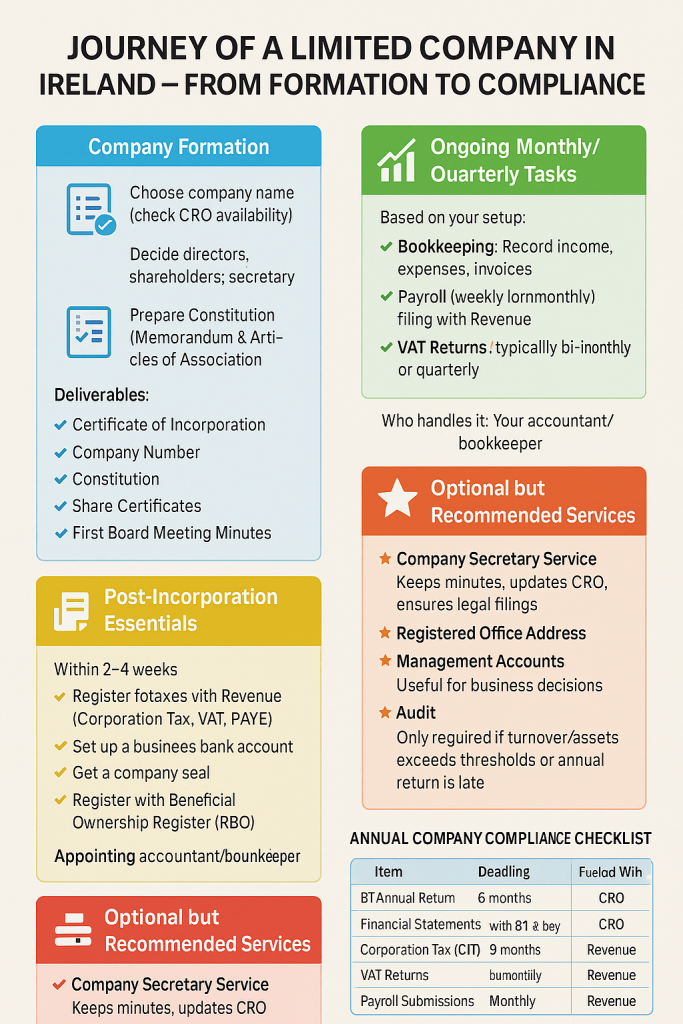
The Journey of a Limited Company in Ireland – From Start-Up to Staying Compliant

The Journey of a Limited Company in Ireland – From Start-Up to Staying Compliant

Are you considering establishing a limited company in Ireland? Discover the full journey – from formation and VAT registration to bookkeeping, annual returns, and corporation tax. This is a practical guide designed specifically for Irish SMEs.

Setting up a limited company in Ireland is a big step – and a very exciting one too. Whether you’re a first-time entrepreneur, moving your freelance business to a more formal structure or expanding from abroad, knowing what happens after incorporation is just as important as getting started.

In this guide, we’ll walk you through the full journey of an Irish limited company – from formation and early steps to ongoing responsibilities and annual compliance. We’ll keep it practical, clear, and honest. After all, no one likes surprises when it comes to Revenue or the CRO!

Step 1: Starting Out – Company Formation in Ireland

Let’s begin with the basics. Setting up a Private Company Limited by Shares (LTD) in Ireland is the most common route. It offers flexibility, limited liability, and is suitable for most businesses.

Here’s what you’ll need:

  • A unique company name (CRO will need to approve it)
    • Search the company name in just a few seconds: Click Here!
  • At least one director (one must be EEA-resident unless bonded)
  • One company secretary (can’t be the same person as the sole director)
  • A registered office address in the Republic of Ireland
  • Shareholders and details of share capital
  • A company constitution (used to be called Memorandum & Articles)

Once you submit the Form A1 and supporting documents to the Companies Registration Office (CRO), you’ll receive:

  • Certificate of Incorporation
  • Company Number
  • Constitution
  • Share Certificates
  • First Board Meeting Minutes

This stage is usually handled by an accountant or a company formation agent, and can be done within 5–10 working days.

✅ Do:

  • Use a professional company formation agent or accountant to get it right first time.
  • Double-check the company name with the CRO before finalising anything.

❌Don’t:

Assume the CRO will approve any name – many are rejected for being too similar to existing names.

Step 2: What Comes Next – Post-Incorporation Essentials

Now that your company is officially registered, there are a few important steps you’ll need to tick off:

  • Register with Revenue – for Corporation Tax, VAT (if applicable), and PAYE (if you’ll have employees)
  • Open a business bank account – make sure it’s in the company’s name
  • Get a company seal – used for official documents
  • Register with the RBO – the Beneficial Ownership Register
  • Find a bookkeeper or accountant – trust us, you’ll thank yourself later

Pro Tip: If you’ve got a good accountant, they’ll guide you through all of this and make sure nothing’s missed.

✅ Do:

  • Register for Corporation Tax within 30 days of trading.
  • Make sure the RBO registration is done within 5 months – it’s mandatory.

❌ Don’t:

  • Use your personal bank account for business – it’s not just unprofessional, it causes accounting headaches.
  • Delay appointing a tax agent – you’ll risk missing deadlines later on.

Step 3: Day-to-Day Running – Bookkeeping, Payroll & VAT

As your business begins trading, there’s regular financial housekeeping to be done.

Here’s what that usually includes:

  • Bookkeeping – tracking income, expenses, invoices, and receipts
  • Payroll – processing salaries and filing with Revenue via ROS
  • VAT Returns – filed bi-monthly or quarterly, depending on your setup

If you’re not comfortable managing all this yourself (and most business owners aren’t), outsourcing to a bookkeeper or accountant is a smart move. It’ll save you hours each month and ensure you stay on the right side of Revenue.

✅ Do:

  • Keep digital copies of receipts – they’ll save your bacon at year-end.
  • Use cloud accounting software (or a reliable bookkeeper) to stay organised.

❌ Don’t:

  • Wait until the end of the year to sort your books – late filing leads to penalties.
  • Miss payroll filings – Revenue are very strict about this.

Step 4: Staying Compliant – Annual Filing & Tax Returns

Once you’ve hit the six-month mark, it’s time to think about annual compliance. Here’s what’s involved:

  1. B1 Annual Return
    • Your first B1 return is due 6 months after incorporation (no accounts required)
    • Every year after, your B1 return must be filed with financial statements
  2. Financial Statements
    • Includes profit & loss, balance sheet, and director’s report
    • Must follow Irish GAAP or IFRS standards
  3. Corporation Tax Return (Form CT1)
    • Due 9 months after your company’s year-end
    • Submitted to Revenue with iXBRL-tagged accounts
  4. Income Tax Return (Form 11) for Directors
    • Required if you’re a director and self-assessed for income tax

Miss a B1 deadline by even a single day and you’ll lose your audit exemption for two years – which means paying for a full audit even if you’re a small business.

✅ Do:

  • Mark deadlines in your calendar and get professional help with returns.
  • File the B1 on time every year to retain audit exemption.

❌ Don’t:

  • Assume your accountant will file unless you ask – follow up regularly.
  • Ignore iXBRL – it’s not optional for most companies.

Optional (But Highly Recommended) Services

Here are a few services that aren’t legally required but make life much easier:

📌 Company Secretary Service

  • Handles statutory registers, board meeting minutes, CRO filings, and ensures you don’t miss key deadlines

📌 Registered Office Address

  • Keeps your home address private
  • Ensures important post from Revenue and CRO is handled properly

📌 Management Accounts

  • Quarterly reports that show how your business is doing – especially useful if you’re applying for a loan or grant

📌 Audit

  • Only required if you lose exemption or grow beyond certain thresholds
  • Even if optional, it can boost credibility with investors or banks

✅ Do:

  • Use a registered office address if you work from home – it looks more professional.
  • Get quarterly management accounts to keep an eye on business health.

❌ Don’t:

  • Rely on memory for deadlines – use a professional or set up reminders.
  • Think audits are only for big companies – one late return and you’re in.

Quick Annual Compliance Checklist (for Irish Limited Companies)

Task Due Who You File With
B1 Annual Return 6 months after incorporation CRO
Financial Statements With second and future B1s CRO
Corporation Tax (CT1) 9 months after financial year-end Revenue
VAT Returns Every 2 or 3 months Revenue
Payroll Submissions (RTD/P30) Monthly Revenue

Smart Software = Less Admin Hassle

Accounting and compliance software significantly alleviates the burden on businesses today. Gone are the days of chasing receipts in shoeboxes or manually filing VAT returns. With the right tools in place, you can cut down your admin time significantly – and reduce the chances of errors.

Here’s what we typically use (or recommend) for Irish limited companies:

  • Xero or QuickBooks Online – Both are cloud-based accounting platforms that make invoicing, bank reconciliation, expense tracking, and VAT reporting a breeze. You can access them anytime, anywhere – and they integrate beautifully with banks and payroll systems.
  • Surf Accounts or Big Red Cloud – Also popular with Irish SMEs, especially for those who prefer a more localised interface or need simple bookkeeping features.
  • BrightPay – Our go-to payroll software. It automates submissions to Revenue (via ROS), calculates tax, USC, and PRSI for each employee, and handles payslips and leave tracking too.
  • Hubdoc AutoEntry or Dext (formerly Receipt Bank) – These tools let you scan receipts with your phone and automatically extract the data into your accounts. No more typing in totals or guessing VAT amounts — it’s all done for you.
  • Google Drive /Dropbox – For securely storing all your company documents — everything from incorporation papers to tax returns.

The Result?

By combining the right software with professional support, we’ve helped clients reduce their manual admin by up to 90%. Things like:

  • Automated bank feeds & reconciliations
  • One-click VAT and payroll filings
  • Real-time dashboards showing how your business is performing
  • Fewer missed deadlines
  • More time to actually run your business

“Since moving to Xero with Forti, I don’t touch the books anymore. I just upload my receipts and check the reports once a week – everything else is handled.”
– Cian, Retail Business Owner, Co. Kildare

FAQs About Running a Limited Company in Ireland

1. How long does it take to register a company in Ireland?

It usually takes around 5 to 10 working days once the documents are submitted to the Companies Registration Office (CRO). If everything’s in order, it can move quite quickly.

2. Do I need an Irish-based director?

Not exactly — but you do need at least one director who is resident in the European Economic Area (EEA). If not, you’ll need to put a Section 137 bond in place to meet the CRO’s requirements.

3. What happens if I miss the B1 deadline?

If you miss the deadline, even by a day, you’ll lose your audit exemption for two years. You might also get hit with late filing penalties — so it’s one to stay on top of.

4. When should I register for VAT?

If your turnover is going to exceed €37,500 for services or €75,000 for goods, you’ll need to register. Even if you’re under the limit, some businesses choose to register early for credibility or to reclaim VAT.

5. Can I handle the bookkeeping myself?

You can, especially if things are simple early on. But unless you’re very confident with numbers, it’s usually best to bring in a professional bookkeeper or accountant. It saves time and reduces the risk of mistakes.

6. Do directors have to file personal tax returns too?

Yes — most directors in Ireland are self-assessed, which means you’ll need to file a Form 11 each year for your personal income.

7. What’s the difference between Corporation Tax and Income Tax?

Corporation Tax is paid by the company on its profits. Income Tax is what you pay personally on any income you take from the business (like salary or dividends).

8. Do I legally need a company secretary?

Yes – if there’s only one director, you must appoint a separate company secretary. They help make sure your company stays compliant with the CRO.

9. How much does it cost to stay compliant each year?

It depends on what services you need, but for most small companies it’s somewhere between €2,500 and €4,000 per year. That would typically cover bookkeeping, tax returns, annual filings, and company secretarial work.

10 Can Forti help with all of this?

Absolutely. We look after everything from company formation and bookkeeping to tax filing, payroll, and compliance. Whether you’re just starting out or running a growing business, we’ll guide you through the whole journey.

Wrapping Up

Setting up a limited company in Ireland is a great way to build something lasting, but there’s more to it than just filling out a few forms. From day one, there are important responsibilities — bookkeeping, tax returns, VAT, payroll, and making sure you don’t miss key deadlines.

The good news? You don’t have to do it alone.

At Forti Ltd, we’ve helped multiple business owners across Ireland set up, stay compliant, and focus on growing their business. Whether you’re a start-up, a sole trader going limited, or expanding into Ireland from abroad — we’re here to help every step of the way.

The Role of Accountants for Sole Traders and Limited Companies

The Role of Accountants for Sole Traders and Limited Companies

An effective accountant is vital for business success in Ireland, regardless of whether you operate as a sole trader or a limited company. Their expertise in areas like tax management and financial planning ensures efficient operations. To clarify the specific support accountants offer each business structure, let’s explore the distinct services they provide to sole traders and limited companies in a straightforward manner.

1. Accountants for Sole Traders: Keeping it Simple and Straightforward

A sole trader is someone who runs their own business as an individual. If you’re a sole trader, you’re the person responsible for everything – from managing the business day-to-day to handling the finances. However, even though it’s a simpler structure, you still need an accountant to help make sure everything is done right, especially when it comes to taxes.

What Does an Accountant Do for Sole Traders?

1. Income Tax and Self-Assessment:

One of the accountant’s main roles is to help with the Income Tax Return (Form 11). This is where you file your self-assessment for the year, based on the income you earned through your business. Your accountant will ensure it’s filed correctly and that you’re not overpaying your taxes.

2. Managing PRSI and USC:

If you’re self-employed, you need to pay PRSI (Pay-Related Social Insurance) and USC (Universal Social Charge). Your accountant will help you calculate these correctly and ensure you’re not missing any payments.

3. Tax Planning:

An accountant will also help with tax planning – for example, by advising on the best ways to claim business expenses, such as office supplies, phone bills, or any other relevant costs that reduce your tax liability.

4. VAT Returns:

If your business’s turnover exceeds the VAT threshold, you’ll need to register for VAT. Your accountant will make sure your VAT returns are filed correctly, and that you’re paying the correct amount of VAT on your services or products.

5. Financial Record Keeping:

While your bookkeeper might handle the day-to-day record-keeping, your accountant ensures that everything adds up properly, helps with year-end accounts, and makes sure you’re on top of any tax filings or legal requirements.

When to Involve an Accountant as a Sole Trader:

  • When you’re ready to file your Income Tax Return.
  • If you’re unsure about how to handle VAT registration or returns.
  • When you want to make sure you’re claiming all the tax reliefs you’re entitled to.

2. Accountants for Limited Companies: More Complex, but Still Essential

Running a limited company brings more complexities, but it also offers benefits such as limited liability, which protects your personal assets from business debts. With this extra complexity comes the need for a more detailed approach to managing your finances. An accountant’s role in a limited company is more extensive compared to a sole trader.

What Does an Accountant Do for Limited Companies?

1. Corporation Tax:

A limited company has to pay Corporation Tax on its profits. Your accountant prepares and files the Corporation Tax Return (Form CT1) for you, making sure all income and expenses are accounted for, and the correct amount of tax is paid.

2. Annual Financial Statements:

Limited companies are required to submit annual accounts, including a balance sheet and profit and loss statement. Your accountant helps prepare these documents and ensures they’re filed with the Companies Registration Office (CRO).

3. PAYE and Payroll:

If you employ staff, or even pay yourself as a director, your accountant will handle PAYE (Pay As You Earn) and ensure that all PRSI and USC contributions are correct. They’ll also manage any employee benefits and deductions.

4. VAT:

Just like sole traders, if your company’s turnover exceeds a certain amount, you’ll need to register for VAT. Your accountant will manage your VAT returns, ensure you’re claiming back VAT on expenses, and that you’re charging VAT correctly on your services or products.

5. Tax Planning and Strategy:

Accountants provide advice on how to structure your business finances in a tax-efficient way. For example, they can help with decisions about whether to pay yourself a salary or take dividends as a director of the company. They may also advise on capital allowances, research and development tax credits, and other ways to minimise your tax burden.

6. Compliance with Company Law:

Limited companies have legal obligations to comply with company law, including filing Annual Returns with the CRO. Your accountant will ensure your company meets all of these requirements and stays compliant.

When to Involve an Accountant for a Limited Company:

  • When you need to file your Corporation Tax Return and prepare your annual financial statements.
  • If you have employees and need help with PAYE, PRSI, and USC.
  • When you’re ready to start tax planning for dividends, capital allowances, and tax-efficient strategies.

Sole Trader vs Limited Company: What’s the Difference in Accountant’s Role?

Feature Sole Trader Accountant Limited Company Accountant
Tax Returns Income Tax Return (Form 11) Corporation Tax Return (CT1)
Financial Statements Not typically required Profit & Loss, Balance Sheet, Cash Flow
Payroll and PAYE Not applicable PAYE, PRSI, USC for employees & directors
VAT Returns File VAT3 if registered File VAT3 if registered
Strategic Advice Tax credits, expense deductions Corporate structure, tax planning, dividends
Business Structure Sole trader, simple structure Limited company, more complex structure
Compliance File Income Tax Returns annually File Annual Returns with CRO, comply with company law

FAQs: Everything You Need to Know

Here are some common questions that can help clear up any confusion:

1. What’s the main difference between an accountant for a sole trader and an accountant for a limited company?

For sole traders, the accountant focuses on Income Tax returns, PRSI, USC, VAT returns, and business expenses. For limited companies, the accountant manages more complex tasks like Corporation Tax returns, payroll, and annual financial statements.

2. Do I need an accountant if I’m a sole trader?

While it’s not required by law, having an accountant can save you time, money, and stress. They’ll ensure you’re filing everything correctly, claiming the right deductions, and staying compliant.

3. How much does it cost to hire an accountant for a limited company?

Fees vary depending on the size and complexity of your business, but typically, accountants for limited companies charge more than for sole traders. Expect to pay anywhere from €500 to €2,000+ per year.

4. When should I switch from being a sole trader to a limited company?

It might be time to switch if your income is growing, you want to limit personal liability, or you want to explore more tax-efficient options. An accountant can help you make the decision.

5. Do I still need a bookkeeper if I have an accountant?

Yes, a bookkeeper handles the daily financial tasks, while the accountant oversees the bigger picture – preparing tax returns, financial statements, and offering strategic advice.

6. Can an accountant help me with tax planning?

Absolutely! An accountant can help you identify tax-saving opportunities, plan for the future, and make your business as tax-efficient as possible.

7. How do I choose the right accountant for my business?

Look for someone who understands your business type (sole trader or limited company), has experience in your industry, and offers a fair fee structure. Most importantly, you should feel comfortable with them and trust their advice.

8. Can an accountant help with business growth strategies?

Yes, an accountant can advise on cash flow forecasting, tax-efficient growth strategies, and ways to fund business expansion, ensuring you’re set up for long-term success.

Conclusion: The Right Accountant Can Make All the Difference

Whether you’re a sole trader or running a limited company, your accountant is an essential part of your financial team. As a sole trader, an accountant helps you manage taxes, file returns, and explore tax reliefs to ensure you don’t pay more than you need to. As a limited company, the accountant’s role becomes more complex, helping you navigate corporate tax, compliance with company law, and long-term financial strategy.

Both accountants for sole traders and limited companies provide valuable insights and peace of mind, ensuring your business is compliant with all tax obligations and helping you make the most of your financial resources.

If you’re unsure which accountant you need, or if you’ve been managing things on your own but want a bit more guidance, it’s never too late to get the right help. A great accountant can free up your time to focus on growing your business, knowing your finances are in safe hands.