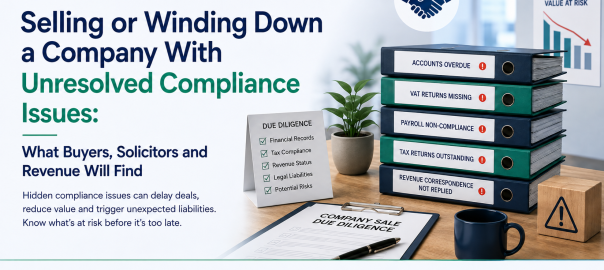
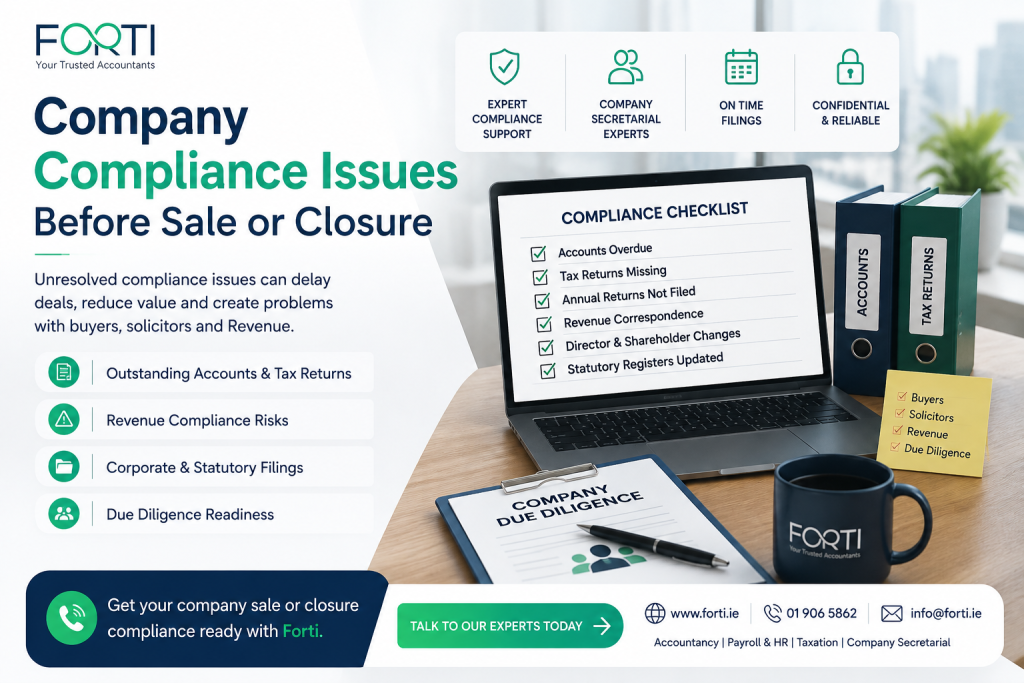
A missed annual return or an uncancelled VAT registration is one thing when nobody’s looking. It’s a different problem entirely when a buyer’s solicitor, an investor’s due diligence team, or Revenue’s own tax clearance system starts looking — which is exactly what happens the moment you try to sell, merge, or formally close a company.
Why Compliance History Becomes Visible at Exactly the Wrong Moment
Throughout this series we’ve looked at what happens when a business owner simply stops trading and leaves the paperwork unresolved. Selling a company, bringing in an investor, or even just formally winding it down properly surfaces every one of those gaps at once — because each process relies on independent, third-party verification of exactly the things that tend to get left until later: CRO filing history, Revenue’s tax clearance system, and the Register of Beneficial Ownership.
None of this is hidden. A company’s late filing history is publicly searchable on the CRO register, RBO discrepancies are checked as standard AML due diligence, and Revenue’s tax clearance status is verified electronically in real time. A buyer’s solicitor will find what’s there — the only question is whether it’s found before or after you’ve agreed a price.
Share Sale vs Asset Sale: Why Compliance History Matters Differently
Share Sale
When shares in the company are sold, the buyer acquires the company itself — its history, its liabilities, and its compliance record, warts and all. Every unresolved CRO filing, every unpaid Revenue liability, and every RBO discrepancy transfers with it unless specifically carved out. This is why share sale agreements lean so heavily on warranties and indemnities: the buyer is pricing in exactly this risk, and will expect the seller to stand behind it contractually.
Asset Sale
When the buyer instead purchases specific assets — a customer list, equipment, a brand, a lease — out of the company rather than the company itself, historic compliance issues are less likely to transfer directly. But the company itself still needs a clean compliance position to complete the sale in the first place: a Tax Clearance Certificate is often required to satisfy the buyer and their bank, and if the sale involves property, a CG50 clearance certificate is required under Section 980 of the Taxes Consolidation Act 1997 — without it, the purchaser is legally required to withhold part of the sale proceeds and remit them to Revenue.
What Due Diligence Actually Uncovers
Late CRO filing history — publicly visible on the register and an immediate flag for any buyer’s solicitor running standard checks.
Loss of audit exemption from a prior late filing — meaning historic accounts may need to be re-audited before a deal can close cleanly.
An expired or refused Tax Clearance Certificate — Revenue’s electronic system checks compliance in real time and will not issue clearance while returns or liabilities remain outstanding.
RBO mismatches — beneficial ownership details that don’t match the actual shareholding, a standard check under anti-money-laundering due diligence.
Unresolved VAT, OSS, or foreign VAT registrations — particularly relevant for ecommerce or multi-country sellers, as covered in Part 3 of this series.
A CG50 requirement the seller wasn’t aware applied — relevant wherever property or certain high-value assets form part of what’s being sold.
Preparing a Company for Sale or Formal Closure
Bring every CRO annual return up to date well before entering negotiations — a clean filing history removes one of the most visible red flags in due diligence.
Apply for a Tax Clearance Certificate early. The electronic system checks compliance automatically, and any gap will surface immediately rather than at the point you actually need it.
Confirm the Register of Beneficial Ownership entry matches the current shareholding exactly, updating within 14 days of any change.
Resolve any dormant, ceased-trading, or multi-country VAT ambiguity — as set out in Parts 1 through 3 of this series — so the buyer’s due diligence team isn’t the one working out what category the company actually falls into.
If property or qualifying assets are involved, apply for CG50 clearance as soon as contracts are signed rather than waiting until closing, since Revenue can take up to several weeks to process it.
Where the company won’t be sold at all but simply needs to close, follow the voluntary strike-off process from Part 2 rather than leaving it to lapse mid-negotiation.
What Happens If You Sell Anyway, Issues Unresolved
Deals don’t usually collapse outright over compliance gaps — they get renegotiated. A buyer who discovers late filings, a lapsed audit exemption, or an unresolved VAT position will typically respond in one of a few predictable ways: a reduction in price to reflect the cost of fixing it, a specific indemnity requiring the seller to cover any resulting liability after completion, or a delay to closing while the seller resolves the position. In each case, the seller ends up paying for the same fix they could have made earlier — just later, under time pressure, and with less negotiating leverage.
Case Studies
Case Study 1 — A Share Sale Delayed by an Expired Audit Exemption
A services company preparing to sell discovered during due diligence that a prior year’s late annual return had cost it audit exemption for two years — years for which the accounts had never actually been audited. Completion was delayed by several weeks while a retrospective audit was arranged, and the buyer negotiated a price reduction to reflect the delay and the risk.
Case Study 2 — A Missed CG50 Almost Cost the Seller Cash at Closing
A business owner selling a company that held a small commercial property assumed the sale would proceed like any other share transaction. Their solicitor identified that a CG50 clearance certificate was required under Section 980 given the property involved, and without it, the purchaser would have been legally required to withhold part of the proceeds. Applying as soon as contracts were signed avoided a hold-back at closing that would otherwise have tied up a meaningful portion of the sale price.
Case Study 3 — An RBO Mismatch That Slowed Down Investor Due Diligence
A founder seeking investment for an otherwise healthy business found the round delayed when the investor’s AML checks flagged a discrepancy between the Register of Beneficial Ownership and the company’s actual shareholding, following an earlier share transfer that had never been updated on the register. The correction itself was straightforward, but it added weeks to a process the founder had expected to close quickly.
(These case studies are illustrative composites reflecting patterns we see regularly among Irish business owners, not individual clients.)
1. Capital Gains Tax Clearance (Section 980 & Form CG50A)
When an asset sale or a share sale involves specific Irish assets (such as land, buildings, goodwill, or unquoted shares deriving their value from Irish land), strict statutory thresholds apply under Section 980 of the Taxes Consolidation Act 1997:
The Triggers: A Form CG50A clearance certificate is legally required if the disposal consideration exceeds:
€500,000 for commercial property, land, business goodwill, or qualifying unquoted shares.
€1,000,000 for residential property.
The Withholding Penalty: If the seller fails to produce a valid CG50A certificate to the buyer prior to or at closing, the purchaser is legally mandated to withhold exactly 15% of the gross purchase price and remit it directly to Revenue within 30 days.
Processing Timelines: Applications must be submitted electronically via the eCG50 facility on ROS (Revenue Online Service). Revenue standard processing times typically range from 3 to 4 weeks, meaning applications should ideally be initiated as soon as contracts are exchanged.
Filing histories are scrutinized heavily during corporate transactions due to the severe downstream legal impacts of a missed deadline:
Automatic Loss of Exemption: Under the Companies Act 2014, if a company files its annual return late by even one day, it automatically forfeits its right to claim an audit exemption for the financial year in question and the subsequent financial year.
The Transaction Impact: If a company has traded through those years without an audit under the assumption it was exempt, it will be forced to commission a retrospective audit before a share sale can cleanly close. This frequently causes severe delays and triggers price chips from buyers.
3. Register of Beneficial Ownership (RBO) Compliance
The 14-Day Rule: To comply with statutory Anti-Money Laundering (AML) frameworks, any internal corporate restructuring, share transfer, or allotment must be updated on the central Register of Beneficial Ownership within 14 days of the change.
Due Diligence Friction: Discrepancies between the company’s internal stock transfer book and the public RBO register automatically flag during a buyer’s or investor’s standard AML checks, halting funds from being drawn down until rectified.
Key Action Checklist for Pre-Sale Due Diligence
Compliance Area
Verification Action
Timing Requirement
1.Tax Clearance Certificate (TCC)
Check ROS electronic status across all tax heads (VAT, Relevant Contracts Tax, Corporation Tax, PAYE/PRSI).
Run 6–8 weeks before negotiations to catch hidden flags.
2.CG50 Clearance
File electronic application via eCG50 on ROS if transaction hits the €500k/€1m thresholds.
File immediately upon exchange of contracts.
3.CRO History
Verify that no annual returns are pending and check for past late filings that might have triggered an audit requirement
Review before drafting the initial Heads of Terms.
4.RBO Alignment
Cross-reference the central RBO register against the current register of members
Remediate any discrepancies at least 3 weeks prior to closing.
Frequently Asked Questions
Do I need a Tax Clearance Certificate to sell my company?
It’s frequently required by buyers, their banks, or as part of standard due diligence, even where not strictly a legal precondition of the sale itself. Applying early, since Revenue’s electronic system checks compliance automatically, avoids delay at the point you actually need it.
What’s the difference between a Tax Clearance Certificate and a CG50?
A Tax Clearance Certificate confirms your overall tax affairs are in order. A CG50 is a separate clearance specifically relevant where property or certain qualifying assets are part of the sale, confirming Revenue doesn’t require the purchaser to withhold part of the proceeds.
Can late CRO filings actually stop a sale from completing?
They rarely stop a sale outright, but they routinely delay it and give the buyer leverage to negotiate a lower price or demand a specific indemnity covering the risk.
Does an asset sale avoid all these compliance issues?
Not entirely. While historic liabilities are less likely to transfer with specific assets rather than the company as a whole, the company itself typically still needs a Tax Clearance Certificate and, where property is involved, a CG50 to complete the transaction.
How long does it take to fix these issues once discovered mid-deal?
We prepare companies for sale or formal closure well before a buyer’s solicitor gets involved — bringing CRO filings current, securing tax clearance, correcting RBO entries, and resolving any dormant or ceased-trading ambiguity, so the compliance story is already clean by the time due diligence begins.
Preparing to Sell or Close? Talk to Forti Early
Monthly bookkeeping and management accounts from€195/month + VAT
Tax clearance, RBO correction and pre-sale compliance clean-up available on request
If a sale, investment round, or formal closure is on the horizon, get in touch with the Forti team at forti.ie before a buyer’s due diligence team finds the gaps for you.
When you’re first getting a business off the ground in Ireland, your head is usually in a dozen places at once. You’re chasing the first big customer, haggling over a lease, or trying to get a website live. The “administrative” side of things—the paperwork and the legal filings—often feels like a job for “future you.”
However, every Irish company comes with a backpack of legal responsibilities from day one. At the heart of that is the Company Secretary.
Despite the name, this isn’t about typing memos or answering phones. Under the Companies Act 2014, the secretary is essentially your compliance anchor. They’re the person tasked with making sure the company stays on the right side of the law, keeping your records straight, and ensuring the Companies RegistrationOffice (CRO) doesn’t come knocking with a fine.
1. Decoding the Role: It’s More Than Just a Title
In the eyes of the Irish courts, the Company Secretary is a “high-ranking officer” of the company. That sounds a bit grand, doesn’t it? But it means they carry a specific weight of responsibility.
If the directors are the ones driving the car and making the big decisions, the company secretaryis the one checking the map, ensuring the road tax is paid, and keeping a log of every turn the car takes.
The Statutory “Must-Dos”
In a practical sense, the secretary handles the nitty-gritty that keeps a company legally healthy:
The Paper Trail: Keeping the official registers (directors, shareholders, and beneficial owners) accurate.
The Deadlines: Filing the Annual Returnon time (messing this up is the fastest way to lose your audit exemption).
The Formalities: Recording minutes of board meetings and making sure changes to the company—like a new office address or a change in shares—are reported to the CRO within the strict legal windows.
2. The Legal Landscape: The Companies Act 2014
To understand why this role is so vital, you have to look at the Companies Act 2014. This was a massive piece of legislation that simplified life for Irish businesses but also got very firm about “corporate governance.”
The Act states that every company must have a secretary. If you are a Single Director Company, you cannot be your own secretary. You need a second person or a professional firm to step in. This is a common stumbling block for solo entrepreneurs who think they can do it all themselves.
Even if you have two directors and one acts as the secretary, the law expects that person to have the “skills and resources” to do the job. You can’t just put a name on a form and hope for the best; the person needs to actually know what a B1 form is and when it’s due.
3. Deep Dive: The Statutory Registers
This is where many businesses fall down. Every company is required to keep a “Register Office” (usually your accountant’s office or your own business premises) where your statutory books are held. These aren’t just for show; they are the “DNA” of your company.
The Register of Members (Shareholders)
This is the most important document in your company. It is the prima facie evidence of who owns the business. If your name isn’t in this register, you technically don’t own the shares, regardless of what’s written on a napkin or an email. A good secretary ensures that every time a share changes hands, the register is updated immediately.
The Register of Directors and Secretaries
This tracks who is in charge. It includes their names, residential addresses (though you can apply for a service address for privacy in some cases), and their dates of birth.
The Register of Beneficial Ownership (RBO)
This is a relatively new and very “hot” topic in Irish compliance. Since 2019, you must report who actually controls the company to a central government database. The secretary handles this filing. If you ignore it, the fines can be eye-watering—up to €500,000 if it goes to court (though usually, it’s just a very stiff administrative fine).
4. The Annual Return (Form B1): The “Do Not Miss” Deadline
If there is one thing you take away from this guide, let it be this: Do not miss your Annual Return Date (ARD).
Every Irish company is assigned an ARD. This is the date by which you must tell the CRO that you’re still alive, who is running the show, and what your finances look like.
The Consequence of Being Late
In the old days, you might get a slap on the wrist. In 2026, the CRO is automated and unforgiving.
Late Filing Fees: These start at €100 the day after the deadline and tick up by €3 a day, capped at €1,200.
Loss of Audit Exemption: This is the real killer. Most small Irish companies don’t need an expensive audit. But if you’re late with your B1, you lose that right for the next two years. You’ll have to hire an auditor to go through your books, which could easily cost you €3,000 to €10,000 depending on your turnover.
Strike-Off: If you ignore it long enough, the CRO will simply strike your company off the register. This means you no longer exist, your bank accounts are frozen, and your assets technically belong to the State.
A professional company secretary lives and breathes these deadlines so you don’t have to.
5. Board Meetings and Minutes: Why Bother?
I often hear business owners say, “It’s just me and my co-founder, why do we need to write down minutes of our meetings? We talk every day over lunch!”
Legally, you are required to hold an Annual General Meeting (AGM) and keep minutes of board decisions.
The “Protection” Factor
Minutes aren’t just red tape; they are your protection. If there is ever a dispute between shareholders, or if the Revenue Commissioners ever audit your business, those minutes prove that the directors acted reasonably and followed the law.
A company secretary attends (or helps draft) these minutes to ensure the language is “legally sound.” They record who was there, what was decided, and any “disclosures of interest” (e.g., if a director is buying a car from their own company).
6. Corporate Changes: Navigating the CRO
Business is fluid. You’ll eventually want to change things. Each change requires a specific form and a specific timeframe (usually 14 to 28 days).
Change of Registered Office: Form B2.
Appointing/Resigning a Director: Form B10.
Issuing New Shares: Form B5.
Changing the Constitution: This requires a “Special Resolution” and a filing with the CRO.
If you don’t file these on time, your public record becomes “stale.” This becomes a massive headache when you try to open a new bank account or apply for a grant from Enterprise Ireland, as they will check the CRO first.
7. The Single Director Dilemma
Ireland is a great place for solo entrepreneurs, but the “Single Director” rule catches people out. Because a single director cannot be the secretary, you have a few choices:
The “Family” Option: Appointing a spouse or parent. This is free, but are they going to remember to file the RBO returns? Probably not.
The “Accountant” Option: Many accountants offer this, but it’s often a secondary service for them.
The “Professional” Option: Hiring a dedicated Company Secretarial firm.
In my experience, the third option is the safest for a growing business. It keeps your personal relationships and your business compliance separate.
8. Outsourcing vs. In-House: The Pros and Cons
As your company grows, you might wonder if you should hire a full-time secretary.
In-House
Pros: They are in the office, they know the business inside out, and they can handle other admin.
Cons: Expensive (salary, PRSI, pension) and they might not be a “specialist” in the latest company law changes.
Outsourced (Professional Service)
Pros: Cost-effective (a few hundred Euro vs. a salary), they have “bulk” experience with the CRO, and they use specialized software to track deadlines.
Cons: They aren’t in your office daily, so you have to be proactive about telling them when something changes.
9. What Does “Good” Look Like? (Costs and Expectations)
You shouldn’t be paying thousands for basic secretarial support. For a standard SME, the annual fee is usually €300 to €800.
What should be included for that price?
Acting as the named Company Secretary.
Annual Return filing (Form B1).
Maintenance of the Statutory Registers.
Reminders for all key deadlines.
Basic advice on governance.
If you’re doing a “Share Buyback” or a “Group Reorganisation,” expect to pay an extra project fee. These are complex legal maneuvers that require a specialist’s touch.
10. The International Perspective
If you’re a US or UK company setting up an Irish subsidiary, the Company Secretary is your local eyes and ears.
Ireland has strict “Section 137” rules where at least one director must be resident in the EEA (European Economic Area). If you don’t have a resident director, you have to take out a Section 137 Bond. A professional secretary will manage this bond and ensure that the Irish subsidiary stays compliant with local laws that might differ wildly from your home country.
11. Common Mistakes to Avoid
In my years advising Irish firms, I’ve seen it all. Here are the “Big Three” errors:
The “Residential Address” Slip: Directors often forget to update the CRO when they move house. This is technically a breach of the Act.
The “Lost” Minute Book: Keeping minutes in a random Word document on a laptop that eventually breaks. You need a centralized, secure “Minute Book.”
Incorrect Share Allocations: Issuing shares without checking if you have enough “Authorised Share Capital” left. This can be a nightmare to fix retrospectively.
12. Why It Matters for the Future (The “Exit” Strategy)
You might not be thinking about selling your company today, but you should be. When a big company or a VC firm looks to buy you, they perform Due Diligence.
They will send a team of lawyers to look at your secretarial records. If they find missing minutes, unfiled share transfers, or messy registers, they see risk. It can delay a deal by months or even cause the buyer to knock €50,000 off the price because they have to “clean up” your mess.
Good secretarial work is like keeping a clean engine; it makes the car much easier to sell when the time comes.
13. Summary: The Quiet Foundation
The company secretary isn’t the “star” of the show. They don’t bring in the sales or design the products. But they are the foundation.Without a solid secretary, your company is built on sand. One missed deadline or one messy shareholder dispute can bring the whole thing crashing down. By investing a small amount in professional services, you’re buying yourself the freedom to focus on growth, knowing that the “back office” is bulletproof.
Frequently Asked Questions (FAQs)
1. Does the Company Secretary have to live in Ireland?
Not necessarily. Unlike the requirement for at least one director to be resident in the EEA (European Economic Area), a company secretary can technically live anywhere. However, they need to be reachable and capable of filing Irish documents. Most people choose a local professional because they understand the specific quirks of the Irish CRO and the 2014 Act.
2. Can my accountant also be my Company Secretary?
Yes, many accounting firms offer this. It’s a handy “all-in-one” solution. Just ensure they are actually doing the secretarial work and not just filing the accounts. Some firms treat it as an afterthought, but as we’ve discussed, the legal registers are just as important as the profit and loss statement.
3. What happens if I just don’t appoint a secretary?
If you try to register a company without one, the CRO will simply reject the application. If your secretary resigns and you don’t replace them, your company is in breach of the Companies Act. This can lead to the company being struck off the register, which is a legal nightmare to fix.
4. Is the Company Secretary liable for the company’s debts?
Generally, no. Like directors, secretaries have “limited liability.” However, they can be held personally liable—or face fines and prosecution—if they are found to be complicit in fraud or if they consistently fail in their statutory duties (like failing to keep proper books).
5. We’re a tiny “husband and wife” team. Do we really need to hold an AGM?
Legally, yes. However, the 2014 Act allows private companies with two or more directors to “dispense” with holding a physical AGM if all the members sign a written resolution. It saves you sitting in the kitchen pretending to be at a formal meeting, but you still have to do the paperwork to make it official.
6. Can a “Body Corporate” (another company) be a secretary?
Yes. This is very common. Instead of naming an individual, you can hire a professional secretarial company. They act as the “Corporate Secretary.” This is often more stable because a company doesn’t go on holiday or get sick in the middle of a filing deadline.
7. Does the Secretary have a vote on the Board?
Only if they are also a Director. If they are just the secretary, they attend board meetings to take minutes and provide advice on procedure, but they don’t get a vote on business decisions like hiring, firing, or spending money
8. My company is currently “dormant” (not trading). Do I still need a secretary?
Yes. Even if your company doesn’t have a single Euro in its bank account and hasn’t sold a thing, it is still a legal entity. You still have to file an Annual Return and you still must have a secretary on record.
9. Can I change my Company Secretary at any time?
Absolutely. If you’re unhappy with your current provider or if your internal secretary leaves, you just need to file a Form B10 with the CRO within 14 days of the change. It’s a straightforward process.
10. What is the difference between a “Registered Office” and a “Business Address”?
The Registered Office is the official “legal” address where the CRO and Revenue send formal notices. This is where your secretary usually keeps the statutory registers. Your Business Address is where you actually do your day-to-day work. They can be the same, but many
A simple habit that keeps your business steady, confident, and in control
Most founders don’t avoid their numbers because they don’t care — they avoid them because they feel overwhelming, unclear, or always slightly out of date. And by the time you do look, it’s usually because something feels off.
The truth is, you don’t need hours of reports to stay on top of your finances. You just need a simple rhythm. A short monthly check-in with your bookkeeper can give you a clear picture of where you stand, what needs attention, and what you can confidently ignore.
This 15-minute ritual isn’t about accounting — it’s about peace of mind. It’s about replacing guesswork with clarity and making sure there are no surprises waiting around the corner.
Why This Matters More Than You Think
Running a business is busy, and finance often slips down the priority list until a deadline or cash worry pushes it back up. But the businesses that feel calm around money aren’t necessarily the most profitable — they’re the ones with visibility.
A short monthly conversation keeps you connected to the reality of the business. It helps you spot small issues early, make decisions with confidence, and sleep a little better knowing there’s nothing lurking in the background. Over time, this habit builds trust in your numbers and confidence in your direction.
When to Do It — Before the 10th Each Month
There’s something powerful about having a fixed point in the month when you pause and look at the financial picture. Doing this before the 10th works well because most of the previous month’s activity is settled, but you still have time to act if something needs attention.
Once it becomes routine, it stops feeling like a meeting and starts feeling like a reset. You know it’s coming, your bookkeeper knows it’s coming, and the conversation becomes easier every month. That consistency is what turns finance from reactive to proactive.
Phase 1: A Quick Reality Check (3 Minutes)
Before diving into performance, it’s worth making sure the numbers you’re looking at actually reflect reality. There’s no value in analysing reports if the basics aren’t right.
This quick check builds trust. When you know the data is clean and complete, the rest of the conversation becomes far more useful. It removes doubt and allows you to focus on what matters — understanding the story behind the numbers rather than questioning them.
Are All Accounts Reconciled?
This simply means every transaction showing in the bank is recorded correctly in your accounts. It sounds small, but it’s the difference between clarity and confusion.
When payment platforms like Stripe or Revolut are included, you get a full picture of your cash rather than just part of it. Keeping this tidy each month prevents bigger tidy-ups later and ensures you’re always looking at a reliable position.
Is Anything Sitting in “Uncategorised”?
Every business ends up with a few transactions that don’t quite have a home yet. Left alone, they quietly build up and make reports harder to trust.
Clearing them monthly keeps things clean and often highlights where processes could be smoother — maybe receipts aren’t being uploaded quickly, or suppliers need clearer references. It’s a small step that keeps everything running more smoothly.
Are Any Important Invoices Missing?
This is mostly about making sure you’re not leaving money behind, especially when it comes to VAT reclaims. If a high-value purchase isn’t documented properly, it can delay claims and create unnecessary back-and-forth later.
Checking this regularly encourages good habits across the business. Documentation becomes part of the process rather than an afterthought, and year-end becomes far less stressful.
Here is the quick checklist:
Bank Reconciliation
Ask: Are all accounts reconciled to month-end?
This includes:
Current accounts
Savings accounts
Stripe / PayPal
Revolut or payment processors
If accounts aren’t reconciled, the rest of the discussion is guesswork.
The “Suspense” or Uncategorised Review
Ask: Is anything sitting in Suspense or Uncategorised?
These usually indicate:
Missing receipts
Unknown transactions
Incorrect postings
Clearing them ensures your reports reflect reality, not placeholders.
The Receipt Gap Check
Ask: Are any high-value purchase invoices missing?
Outcome of Phase 1: You now know the numbers are reliable.
Phase 2: The Numbers That Actually Matter (7 Minutes)
You don’t need to review dozens of reports to understand your business — just a handful of meaningful numbers. These metrics give you a quick snapshot of health, momentum, and risk.
Over time, you start to develop an instinct for them. You’ll notice trends sooner, ask better questions, and feel far more connected to how the business is performing beyond just “busy” or “quiet.”
What’s Your Real Cash Position?
Your bank balance alone doesn’t tell the full story because some of that money already belongs to Revenue. When you subtract upcoming tax liabilities, you see what’s truly available.
This number removes false comfort and replaces it with clarity. It helps you make confident decisions about spending, investing, or holding back — all based on reality rather than assumptions.
Who Still Owes You Money?
Late payments are one of the biggest sources of unnecessary stress in any business. A quick look at who’s overdue keeps collections proactive rather than awkward or last-minute.
When customers know you review this regularly, payment behaviour naturally improves. It’s less about chasing and more about keeping expectations clear.
Has Your Margin Shifted?
Margins tell you how efficiently your business is operating. A small movement can signal supplier changes, pricing issues, or shifts in what you’re selling.
Spotting these early gives you options — renegotiate, adjust pricing, or rethink discounts. It’s far easier to correct course now than months down the line.
How Long Would Cash Last?
This is one of the most reassuring numbers you can know. Instead of worrying vaguely about the future, you have a clear timeline.
Knowing your runway helps you plan with confidence — whether that’s hiring, investing, or simply deciding to hold steady. It replaces uncertainty with perspective.
Are You Growing, Flat, or Slowing?
Looking at revenue compared to last month keeps you grounded in trajectory rather than isolated results. Even small changes can tell you a lot about demand or momentum.
It’s not about reacting emotionally to every fluctuation, but about staying aware of direction so you can respond thoughtfully.
Are Costs Quietly Creeping Up?
Subscriptions, small tools, and operational tweaks can gradually increase your monthly spend without you noticing. A quick scan keeps this in check.
This habit encourages intentional spending and makes it easier to decide what’s genuinely adding value and what might be trimmed.
Profit vs Cash — Do They Tell the Same Story?
Sometimes the business looks profitable but still feels tight on cash. Understanding why helps avoid confusion and unnecessary worry.
This perspective ensures you’re balancing growth with liquidity and not mistaking accounting profit for available funds.
Here is the quick checklist:
This is where insight happens. These are the seven numbers every founder should understand — not just accountants.
Why it matters: Your bank balance is not your spending power. This figure shows what you actually have available.
Debtors Deep Dive
Ask: Who are the top 3 customers over 60 days?
Then decide:
Who calls them
When payment is expected
Cash flow problems are often collection problems in disguise.
Gross Margin Health
Ask: Did margin move by more than 2%?
If yes, investigate:
Supplier price increases
Discounting
Product mix changes
Margins rarely collapse overnight — but they erode quietly.
Cash Runway
Ask: If we make no new sales, what exact date does cash run out?
This single metric reduces anxiety and improves planning. It turns vague worry into a clear timeline.
Revenue Trend vs Last Month
Is revenue:
Growing
Flat
Declining
Even a quick comparison highlights momentum early.
Cost Creep Check
Have any recurring costs increased? Software subscriptions and small expenses quietly add up.
Profit vs Cash Reality
Are you profitable but still cash-tight? That’s usually due to debtors, stock, or tax timing.
Outcome of Phase 2: You understand performance, risk, and momentum.
Phase 3: Staying on the Right Side of Compliance (5 Minutes)
Compliance doesn’t need to feel heavy or intimidating when it’s handled little and often. A quick monthly check keeps everything visible and manageable.
Rather than scrambling at year-end, you’re simply confirming that things are ticking along as they should. It’s a calm, steady approach that reduces risk without adding stress.
Have Expenses and Benefits Been Reported?
With real-time reporting becoming more common, it’s helpful to confirm everything has been logged correctly before payments go through.
This keeps you aligned with Revenue expectations and ensures there’s no backlog building quietly in the background.
Is the Director’s Loan Moving?
Director’s loans can creep up without much notice, so a quick monthly glance keeps things transparent.
It’s less about restriction and more about awareness — making sure personal and business finances stay balanced and predictable.
Is Payroll Fully Up to Date?
Payroll touches both compliance and team trust, so it’s worth confirming everything is accurate.
A regular check reduces the risk of surprises and reassures you that contributions and filings are exactly where they should be.
With auto-enrolment changes, monthly checks reduce risk significantly.
Outcome of Phase 3: Your compliance risk is under control.
Ending With Three Clear Actions
The real value of this ritual is what you do afterwards. Agreeing on just three actions keeps things focused and manageable.
It ensures the conversation leads to progress rather than simply awareness. Small, consistent actions each month create momentum and prevent issues from lingering.
When Numbers Aren’t Ready — It’s Usually a Process Issue
If the data isn’t ready by the time you meet, it’s rarely because reporting is slow. More often, it’s because receipts, invoices, or systems aren’t flowing smoothly.
Fixing how information is captured — through automation or clearer processes — transforms the whole experience. The conversation shifts from searching for documents to making decisions.
What Changes When This Becomes a Habit
Founders who adopt this ritual often describe a noticeable shift — less anxiety, clearer thinking, and more confidence in planning.
It doesn’t change the business overnight, but it changes how you feel running it. And that clarity compounds over time, making growth feel far more manageable.
The Implementation Tool: The RAG Action List
The ritual only works if it leads to action.
At the end of the 15 minutes, agree on exactly three actions using a traffic-light system.
This keeps the meeting focused and prevents “analysis paralysis.”
Real-World Scenario: How a 15-Minute Ritual Changed a Founder’s Cash Flow
The Situation A Dublin-based service business with a team of six was growing steadily, but the founder constantly felt short on cash. Sales were strong, yet there was always pressure before VAT deadlines. The feeling was familiar — “We’re busy, so why does it always feel tight?”
What We Found After introducing the monthly 15-minute check-in, two patterns became obvious within the first month:
Over €38,000 sitting in invoices older than 60 days
A VAT liability that wasn’t being factored into “available cash”
The business wasn’t struggling — it simply didn’t have visibility.
Founder reported feeling “back in control” of decisions
The key takeaway: nothing dramatic changed operationally — just awareness and timing.
Quick Summary: The 15-Minute Ritual in Plain English
If you remember nothing else, remember this:
1️⃣ Make sure the numbers are accurate 2️⃣ Check the few metrics that really matter 3️⃣ Confirm nothing risky is slipping through compliance 4️⃣ Leave with three clear actions
That’s it. No complicated dashboards. No finance jargon. Just a simple monthly reset that keeps your business grounded.
Frequently Asked Questions
Reports are useful, but conversations create clarity. This ritual turns information into decisions.
1. Is 15 minutes really enough?
Yes — the goal isn’t deep analysis, it’s awareness. If something needs more time, it becomes an action item rather than dragging out the meeting.
2. Do I need accounting software for this?
You don’t need anything fancy, but cloud software makes the process faster and more accurate.
3. What if my business is very small?
This ritual is arguably even more valuable for small businesses because cash visibility is critical.
4. Should this replace management accounts?
No — think of it as a monthly pulse check, while management accounts provide deeper quarterly insight.
5. What if my bookkeeper already sends reports?
Reports are useful, but conversations create clarity. This ritual turns information into decisions.
6. How does this help with cash flow?
It highlights overdue invoices, upcoming taxes, and spending trends early — before they become pressure points.
7. Who should attend the meeting?
Usually just the founder and bookkeeper. It works best when it stays simple and focused.
8. Can this help with growth planning?
Absolutely — knowing your runway and margins gives you confidence to invest at the right time.
9. What’s the biggest mistake founders make?
Looking at their bank balance without considering tax liabilities.
10. How long before I see results?
Most businesses feel the difference within 1–2 months because visibility improves immediately. If you’re running a business and your finances only get attention at year-end or tax deadlines, this small monthly habit can genuinely change how in control you feel. Start simple: 📅 Book a 15-minute check-in before the 10th of next month 📊 Review the key metrics ✅ Agree on three actions Consistency beats complexity every time. 👉 If you’d like a simple checklist or want help setting up a monthly financial rhythm, our team is always happy to point you in the right direction.
Ireland continues to be a practical and credible entry point into the European Union for international founders. It offers stability, a clear legal system, and a business culture that is familiar to global investors.
This guide walks you through the legal framework, realistic timelines, and what it truly means to manage an Irish limited company from abroad.
The Value Proposition
Founders from the United Kingdom, the United States, India, Germany, Italy and beyond often choose Ireland for consistent reasons.
EU Membership Ireland provides full access to the European Single Market. Companies can register for Intra-Community VAT and use the One-Stop Shop (OSS) to simplify EU-wide VAT reporting.
Common Law System The legal framework feels familiar to international founders and investors. Contracts, shareholder rights and corporate governance follow well-established principles.
It is important to understand that not all income is taxed at 12.5%. Proper classification matters from day one.
Reputation and Credibility Ireland is a fully regulated, white-listed jurisdiction. It is widely recognised by banks, payment processors and global platforms.
Ireland is not the cheapest jurisdiction in Europe. It is one of the most respected.
Core Requirements for Non-Residents
You do not need to live in Ireland to set up a private limited company.
However, Irish company law requires three core pillars to be in place.
1. Director Residency and the Section 137 Bond
Irish law requires at least one director to be resident in the European Economic Area (EEA).
Incorrectly completed VIF forms are frequently rejected.
In practical terms, this means incorporation now depends on your IPN being approved first. Once the IPN is issued, the CRO typically completes incorporation within three to five working days.
The identity stage is now the real starting point of your timeline.
3. The Registered Office
Every Irish company must maintain a registered office address in Ireland.
This address:
Appears on the public register
Receives official correspondence
Must be monitored
Most international founders use a professional registered office service to ensure privacy and structured document handling.
Navigating the Formation Process
The formation journey is straightforward when approached in the correct order.
Phase 1: Planning and Identity (Weeks 1–3)
The first step is verifying the identity of directors.
If you are overseas, booking a Notary appointment for the VIF form is often the slowest part of the process.
Ireland supports serious businesses. It does not favour passive or unmanaged entities.
Case Study 1: The Global Marketplace Anchor
How a US Amazon Seller Established an EU Headquarters
The Background
A US-based private-label seller had grown steadily on Amazon.com. Sales were strong, reviews were consistent, and operations were smooth.
But growth had slowed.
To scale further, the founder needed to enter Europe — particularly Germany, France and Italy. That’s when the complexity became obvious.
Direct EU VAT registration from a US entity felt unclear. Banking was uncertain. The idea of dealing with multiple European tax systems at once was overwhelming.
The Problem
The founder wasn’t short on ambition — they were short on clarity.
Europe meant 27 VAT jurisdictions. Different reporting systems. Different rules.
What they needed was not just an EU VAT number.
They needed a stable entry point — one jurisdiction that felt manageable and familiar, while still providing full access to the European Single Market.
The Approach
We focused on structure first, speed second.
Identity Verification (IPN)
Because the founder did not have an Irish PPS number, they needed an Identified Person Number.
We coordinated the Form VIF process remotely, working with a US Notary to ensure the “wet ink” signature requirement was satisfied correctly. Avoiding rejection at this stage saved weeks.
Section 137 Security
As a non-EEA resident director, a €25,000 Surety Bond was required.
Rather than appointing a local nominee director, we arranged the bond efficiently, allowing the founder to retain full control of the company.
VAT & OSS Activation
We registered the company for VAT and activated the One-Stop Shop (OSS).
Instead of worrying about 27 separate VAT registrations, the founder could now report EU VAT through a single Irish portal.
The Result
The business launched in Europe sooner than expected.
More importantly, by centralising their “EU life” in Ireland — an English-speaking jurisdiction with a clear legal framework — the founder reduced administrative complexity and regained focus.
Their time returned to sourcing, branding and product strategy.
Compliance became structured, not stressful.
Case Study 2: Restoring the Bridge
How a UK Consultancy Reclaimed Frictionless EU Trade
The Situation
A London-based consultancy had worked comfortably with EU clients for years.
After Brexit, something shifted.
EU clients became cautious. Questions around VAT status, contract structure and “Third Country” treatment began appearing in renewal discussions.
Nothing dramatic — just hesitation.
And hesitation can quietly erode revenue.
The Strategy
The solution was not to replace the UK company.
It was to complement it.
We established an Irish subsidiary to act as the firm’s EU-facing entity. This restored the familiar EU-to-EU relationship their clients expected.
Addressing the 2026 Reality
Post-Brexit Residency
Because UK directors are now treated as non-EEA, we arranged a Section 137 Bond to satisfy Companies Act requirements.
The process was administrative, not strategic — but necessary.
The “Two-Strike” Safety Net
The board was concerned about audit risk.
We explained the updated audit exemption rules: audit exemption is only lost after two late filings within five years.
Understanding this provided reassurance without reducing discipline.
Contractual Substance
To avoid any doubt around tax residence, we formalised governance:
Documented board decisions
Recorded Irish-based management activity
Structured operations properly
This satisfied both Irish Revenue and the compliance departments of their EU clients.
The Result
Three major EU contracts — previously uncertain — were renewed.
The Irish company became the public-facing EU entity.
The UK parent continued to focus on domestic growth.
The bridge to Europe was restored — not through marketing, but through structure.
Case Study 3: The SaaS Simplification
How a German Founder Centralised European Subscriptions
The Background
A SaaS founder in Berlin was growing quickly.
Subscriptions were increasing across multiple EU countries. Revenue was strong.
But VAT compliance was expanding faster than the product roadmap.
Different thresholds. Different reporting cycles. Different rules.
The founder described it as “engineering time being spent on tax admin.”
The Pivot
The decision was made to centralise global billing and intellectual property under an Irish company.
The goal was simplicity, not relocation.
Ireland provided:
Access to VAT OSS
English-language corporate documentation
A well-recognised EU jurisdiction
The Technical Execution
Verified Identity (VIF)
Although the founder was an EU resident, an Irish IPN was still required.
We coordinated German notarisation and CRO submission carefully, avoiding delays.
The rules are clear. The process is structured. The expectations are higher than before.
The founders who experience fewer difficulties are those who approach incorporation as part of a long-term structure — not just as an administrative task.
As you consider expanding into the European market, it may be worth asking:
Are you creating a company simply to access the EU — or are you building a structure designed to operate confidently and compliantly for years to come?
Frequently Asked Questions
1. Can I open an Irish business bank account without living in Ireland?
Yes, you can — but this is often the slowest part of the process. In 2026, many non-resident founders choose digital-first business banks such as Revolut Business or Fire. These provide Irish IBANs and can usually be opened remotely. If you prefer a traditional high-street Irish bank, the process is more detailed. You should expect: A thorough Know Your Customer (KYC) review Clear documentation of your business activity Sometimes, a physical visit to Ireland It is entirely possible. It just requires planning and patience.
2. How does the Section 137 Bond actually work?
If none of your directors live in the EEA, the bond is mandatory. It is not insurance for you personally. It is a €25,000 financial guarantee to the Irish State in case the company fails to meet certain tax or compliance obligations. You pay a one-time premium — typically between €1,600 and €2,000 — and the bond is valid for two years.
Once arranged, you can incorporate without needing to appoint a local resident director. It is simply a compliance safeguard built into Irish company law.
3. What is the difference between an IPN and a PPS Number?
This is a common point of confusion. A PPS Number is for individuals who live or work in Ireland. It is linked to social services and personal taxation. An Identified Person Number (IPN) is different. It is issued by the Companies Registration Office to verify the identity of company directors.
If you are a non-resident director, you apply for an IPN through Form VIF. Having an IPN does not make you an Irish tax resident. It simply allows you to legally sit on the board of an Irish company.
4. Will I be taxed twice on my Irish company profits?
In most cases, no — but it depends on your home country’s tax rules. Ireland has an extensive double taxation treaty network, covering over 70 countries including the US, UK and India. Typically: The company pays 12.5% Corporation Tax in Ireland on trading profits. When profits are distributed as dividends, your home country’s tax rules apply. You may receive credit for Irish tax already paid. The structure should always be reviewed in light of your personal tax position.
5. Do I need an Irish-based Company Secretary?
If your company has only one director, Irish law requires a separate person or entity to act as Company Secretary. The role is not symbolic. The Company Secretary is responsible for: Maintaining statutory registers Filing annual returns Keeping board documentation in order Many non-resident founders appoint a professional service provider to handle this, ensuring nothing is missed.
6. What happens if my company is dormant in the first year?
Even if your company has no transactions, your compliance obligations still apply. You must still file: Your first Annual Return (B1) at the six-month mark An annual Corporation Tax (CT1) return Failing to file a “zero” return is one of the most common mistakes made by non-resident founders. Dormant does not mean exempt.
Thinking About Your Next Step?
Starting a company in another jurisdiction should feel like growth — not like administrative pressure.
The key is understanding the structure before you move.
Some founders simply want reassurance that their current setup is compliant. Others are ready to incorporate but want a clear timeline and checklist. Many prefer to outsource the bookkeeping and filings from day one so nothing is missed.
If you are considering Ireland as your EU base, it may be worth pausing and asking:
Is your current structure giving you confidence — or is it creating uncertainty as your business grows?
And if you were to begin today, would you rather navigate the system reactively, or build it calmly and correctly from the start?
If you sell online, your finances are rarely as simple as “sales minus expenses”. Money arrives in batches, fees get deducted before you ever see the cash, refunds can hit days later, and VAT can change depending on where your customer lives. That is why e-commerce accounting is its own speciality.
This guide walks you through what an e-commerce accountant actually does, how it differs from general small business accounting, and what to look for if you are hiring one.
Why E-Commerce Accounting Is A Different Job
A traditional business might have a few income streams and a bank account that matches the invoices. E-commerce is more like a web of systems.
You Are Not Just Selling, You Are Settling
In e-commerce, the “sale” and the “cash in your bank” are often two different things.
Platforms and payment processors bundle transactions and pay you out on a schedule, not instantly. Stripe, for example, pays out based on a payout schedule that can vary by country and business type.
Shopify Payments also runs on payout timing and payout reports, with fees, refunds, and adjustments affecting what lands in your bank.
An e-commerce accountant’s job is to make sure your accounts reflect what actually happened, not just what hit the bank.
Your Numbers Live Across Multiple Systems
Even a simple online shop can involve:
A store platform (Shopify, WooCommerce)
A payment processor (Stripe, Shopify Payments, PayPal)
Marketplaces (Amazon, Etsy)
Shipping tools and couriers
Ad platforms (Meta, Google)
An accounting system
E-commerce accounting is the discipline of pulling all that into one clean financial picture that you can trust.
The Core Job: Turning Messy Data Into Clean Financials
This is the less glamorous part, but it is the foundation of everything else.
Sales Reconciliation That Matches Reality
Reconciliation means proving that your reported sales, fees, refunds, and payouts line up with your bank deposits.
Shopify provides payout details and exports that help you connect orders to payouts. Stripe provides payout reconciliation reporting so you can match bank payouts back to the underlying transactions.
An e-commerce accountant typically:
Maps each payout to the correct accounting entries
Splits gross sales from fees, refunds, and adjustments
Flags timing differences, negative balances, or missing payouts
Makes sure you are not accidentally recording “net deposits” as revenue
If you only ever book the net payout that lands in your bank, your revenue and fees will be wrong, and your reporting will be misleading.
Fee Tracking So You Know Your True Cost Of Selling
Payment processing fees, platform fees, marketplace commissions, and chargeback fees can quietly eat margin. You can view payout fees inside Shopify Payments. Stripe’s payout reconciliation reporting also supports fee-level transparency when you pull reports correctly.
A specialist accountant will structure your chart of accounts so fees are not buried, and you can see the real cost per channel.
VAT and E-Commerce: The Compliance Layer Most Sellers Miss
When selling online, tax rules become more complex — especially once you start trading across borders.
Understanding VAT Registration Thresholds in Ireland
For many Irish businesses, the first question is whether you need to register for VAT based on turnover. Revenue sets out the main thresholds, including €42,500 for services and €85,000 for goods (with specific rules for mixed supplies and other cases).
An e-commerce accountant helps you:
Track turnover correctly (not just cash received)
Decide when registration is required
Set up VAT coding so returns are not guesswork later
OSS And IOSS: If You Sell Across The EU, It Gets More Complex
If you sell B2C across EU borders, the One Stop Shop (OSS) was designed to simplify VAT obligations by letting businesses account for VAT through a single member state in certain situations. Revenue explains OSS and how it works, including the Union and non-Union schemes.
For imports, the EU’s VAT e-commerce rules removed the old low-value import VAT exemption and introduced the Import One Stop Shop (IOSS) for certain distance sales of low value goods not exceeding €150.
An e-commerce accountant’s job here is not to drown you in rules. It is to help you understand what applies to your setup, and make sure your VAT reporting is consistent with how you sell.
Marketplaces Can Change Who Is Responsible For VAT
If you sell through an online marketplace, VAT responsibility can shift in certain circumstances.
For instance, there’s the “deemed supplier” concept for electronic interfaces facilitating goods, and the VAT obligations that can apply to the deemed supplier. Marketplaces can be treated as having received and supplied the goods themselves in certain cases.
Practically, this affects how your sales are treated, what records you keep, and what gets reported where. A specialist accountant helps you avoid double-counting VAT obligations or assuming the marketplace “handles everything” when it does not.
Inventory And Cost Of Goods: Where Profitability Gets Distorted
If you sell physical products, inventory and cost of goods sold (COGS) can make or break your numbers.
COGS Is Not Just “What You Paid For Stock”
A specialist e-commerce accountant helps you build a method to track:
Opening and closing stock
Landed costs (shipping, duties, packaging where relevant)
Stock write-offs, damaged goods, and shrinkage
Timing differences between buying stock and selling it
If inventory is wrong, your profit is wrong. That can lead to bad decisions, like scaling ads on a product that looks profitable but is not.
Gross Margin By Product And Channel
E-commerce businesses often sell through more than one channel. The margin on your website sales may differ from marketplace sales once you include marketplace fees, fulfilment fees, and returns behaviour.
A specialist accountant structures your reporting so you can see:
Margin by product category
Margin by channel (site vs marketplace)
Margin by campaign periods (for promos and seasonal sales)
Refunds, Returns, And Chargebacks
Returns are normal in e-commerce. The accounting needs to reflect that reality.
Refund Tracking That Does Not Break Your Books
Platforms like Shopify provide guidance on refunds, including how they are processed and tracked, and even details like using ARNs for certain card networks.
An e-commerce accountant will make sure refunds are:
Linked back to the original sale
Not accidentally booked twice
Reflected in a way that keeps revenue and VAT reporting accurate
Chargebacks And Disputes Need Proper Treatment
Chargebacks are not just customer service problems. They are financial events.
A specialist accountant helps you:
Track chargeback losses separately from normal refunds
Account for chargeback fees
Spot patterns that point to fraud or fulfilment issues
Cash Flow Management For E-Commerce Is Its Own Skill
You can be profitable and still run out of cash, especially if you hold stock.
Timing Differences You Need To Plan For
E-commerce cash flow is affected by:
Payout delays and rolling reserves
Inventory buying cycles
VAT payment timing
Refund spikes after sales periods
Reconciliation and quick matching can help spot mismatches early and keep financial data accurate, which also supports better cash planning.
A specialist accountant uses your actual payout and inventory patterns to help you forecast realistically, not optimistically.
The Value-Add: Reporting That Helps You Run The Business
A general accountant might give you accounts that are technically correct. An e-commerce accountant aims to give you numbers that are useful.
KPIs That Actually Matter Online
Depending on your model, a specialist accountant can help you track:
Contribution margin (after product costs, shipping, and fees)
Return rate and its cost
Customer acquisition cost alongside gross margin
Fee rates by processor or channel
This is where you start making better decisions, like which products to push, which channels to prioritise, and what needs fixing in fulfilment.
Making Your Financials Investor And Lender Friendly
If you ever plan to raise funding, apply for a loan, or sell the business, clean e-commerce accounting is a huge asset. Proper reconciliation, clear fee reporting, and VAT compliance create confidence.
How To Choose An E-Commerce Accountant
Here is a simple way to evaluate whether someone truly understands e-commerce, without needing to become an accountant yourself.
Questions to ask them:
How do you reconcile payouts to sales?
Listen for mention of payout reports and reconciliation, not “we just use the bank feed”.
How do you handle refunds, partial refunds, and chargebacks in the books?
Refunds and chargebacks should be treated as routine accounting events, not as rare or “unusual” exceptions.
If I sell to EU consumers, how do you help with OSS or IOSS considerations?
A knowledgeable accountant will understand the OSS and IOSS structures and know where to source accurate guidance.
If I sell via marketplaces, how do you treat deemed supplier situations?
It’s important they recognise that marketplaces can be deemed suppliers in certain cases, as this directly affects VAT reporting and compliance.
How do you track inventory and COGS for an online seller?
You want a clear, repeatable method, not vague reassurance.
Watch For Red Flags
They talk only about year-end accounts and tax returns, with no mention of reconciliation.
They treat “net payouts” as revenue.
They have no plan for cross-border VAT complexity.
They cannot explain their process in simple language.
An e-commerce accountant is part bookkeeper, part systems translator, and part risk manager. They reconcile platforms and payouts, track fees properly, handle refunds and chargebacks cleanly. And hold your hand through VAT complexity like OSS, IOSS, and marketplace rules.
Most importantly, they give you numbers you can use to make better decisions.
How AI, automation and proper bookkeeping can save thousands — and why so many Irish SMEs are still years behind.
The World Has Moved On. Irish Accounting Hasn’t — Yet.
Over the last decade, accounting has changed more than it did in the previous fifty years. Around the world, AI, automation and cloud accounting are now the norm. Bank feeds update automatically, invoices are read by software, VAT is calculated in real time, and owners check a dashboard instead of wrestling with spreadsheets.
But here in Ireland, we see a very different picture every day.
Many Irish businesses have embraced digital tools — but a surprisingly large portion haven’t. Not just early-stage startups. Not just sole traders. Even long-established companies — family businesses trading for 30, 40 and even 50 years — are still managing their accounts through Excel spreadsheets, paper files, and end-of-year-only bookkeeping.
The Central Statistics Office and ISME both point to more than 270,000 active enterprises in the country, with over 99.8% classified as SMEs. Many of these companies have embraced digital tools. But a large share still run their finances on Excel, paper files or basic bank statement summaries, often updated only once a year. A major EU study on the digitalisation of Irish SMEs found that around 40% of companies completely lack key digital technologies, and a further 30% only use a few basic tools.In practice, that often means manual bookkeeping, disconnected systems and very little automation in day to day accounts.
We see this every week at Forti:
a construction firm operating for 47 years, still doing cashbooks manually
a new startup recording expenses in Google Sheets
an online retailer reconciling thousands of transactions in Excel
a professional services company with decades of history filing VAT based only on bank statements
businesses keeping shoeboxes of receipts for year-end
directors who don’t see their accountant until everything is already too late
Even though software, automation and AI have become incredibly advanced, the everyday experience of bookkeeping for many Irish businesses still feels like 1998.
This gap has consequences — financial, operational, and emotional.
Old school bookkeeping has a cost that goes far beyond a bit of admin. When everything is manual, the risk of:
late or incorrect VAT returns
missed tax deductions
overstated profits and higher tax
messy year end accounts
goes up sharply.
And it also costs something far more valuable than money: time.
Business owners — at every stage — are spending hours each month:
searching for receipts
fixing spreadsheet errors
sorting email invoices
manually calculating VAT
checking payments
chasing missing records
and trying to understand the numbers
All while the global accounting industry has already moved into a world of automation, instant reconciliation, AI-powered insights and proactive alerts.
And this is the real message:
It’s not that Irish businesses are doing something wrong — it’s that the world has moved forward so fast, and the tools have advanced so quietly, that most haven’t had the chance to keep up.
The opportunity now is enormous: by modernising accounting before 2026, Irish SMEs can save time, reduce tax, improve compliance, and run far healthier businesses — without any extra effort.
2026: The Year Accounting Finally Goes Fully Digital
The pace of digital adoption in Ireland is accelerating, but accounting is the area seeing the greatest shift as we approach 2026. Across Ireland, more and more SMEs are moving to cloud systems, bank feeds and AI helpers.
A recent Enterprise Nation survey found that while half of Irish SMEs see themselves as “digital,” only about 36 percent are actually using accounting software and 50 percent are using cloud computing. Another Irish survey shows that more than a third of SMEs have already adopted AI and almost half plan to bring it in.
So the direction is clear. By 2026, “old school accounts once a year in Excel” will feel completely out of step with how most serious businesses operate. Accounting is shifting from something reactive and paper heavy to something intelligent, real time and almost effortless in the background.
And this matters, because the role of accounting has changed too.
Accounting is no longer just about “keeping the books.”
It’s about:
forecasting cash flow
protecting against Revenue penalties
preventing tax overpayment
spotting financial risk early
guiding smarter business decisions
giving business owners clarity at all times
Modern systems don’t just help you stay compliant — they actively improve the financial health of your business.
Here’s what the shift looks like in 2026.
Real-Time Bookkeeping — Not the Old “Year-End Panic”
With cloud accounting and AI tools, bookkeeping is happening continuously, not retroactively.
Every time a payment hits your bank: → It appears instantly in your accounting software. → AI attempts to categorise it. → Your accountant reviews and approves. → Your dashboard updates automatically.
That alone takes away a lot of the stress most Irish owners feel around money. You are no longer:
guessing VAT from the bank balance
guessing how much profit you have actually made
guessing the next tax bill
waiting months for accounts
discovering problems when it is already too late
Real-time books replace uncertainty with weekly clarity. You can see where you stand and make decisions while you still have time to act.
Cash-Flow Forecasting Powered by AI
One of the biggest challenges for Irish SMEs is managing cash flow, especially with irregular payments, seasonal revenue, or lumpy invoices. Many owners say they struggle to plan far enough ahead.
Traditional spreadsheets are not built to handle all the moving parts. AI tools are.
They can look at patterns in your:
bank behaviour
payment cycles
seasonal patterns
VAT schedules
supplier habits
payroll timelines
recurring expenses
Then they use this information to predict your cash position for the next 6 to 12 months.
Instead of being surprised by a tight month, you get:
an early warning when a cash dip is coming
time to talk to your bank or suppliers
time to adjust spending or chase key invoices
You move from reacting to problems to steering your cash with confidence.
Automated Receipt Capture — No More Lost Deductions
In Ireland, a huge portion of missed tax relief comes down to one problem: missing or disorganised receipts.
AI has made this problem much easier to solve.
You simply take a photo of a receipt and the software pulls out the key details:
VAT rate
supplier
category
date
payment method
It then matches it automatically with your bank transaction.
This ensures:
no missed VAT
no missing expenses
no incorrect filing
no paper trails
no chaos at year-end
For many small businesses, this alone recovers hundreds or thousands in tax deductions every year.
Bank reconciliation that almost runs itself
Before automation, the accuracy of accounts depended almost entirely on the person entering the data — and on how busy or tired they were. Bank reconciliation used to mean hours of ticking through lines on a paper statement or Excel printout. Now, accuracy is supported by technology.
In a modern setup your accounting system connects securely to your bank and imports transactions every day. The software then:
suggests matches for invoices and bills
flags anything that looks unusual
highlights duplicate or suspicious entries
shows you which items still need attention
You still stay in control, but the system does most of the heavy lifting. That reduces errors and lowers the chances of Revenue asking awkward questions about unexplained gaps in your records.
Admin Work Has Collapsed — Giving Time Back to Business Owners
The biggest benefit of modern accounting is not the technology itself. It is the time you win back.
Irish and international surveys show that small businesses lose many hours each week to low value admin. One Irish study found SMEs spend around nine hours a week on manual HR tasks alone. A separate AI survey reported that almost a third of Irish SMEs believe AI could save up to four hours a week on admin, and another 23% think it could save more than six hours.
Automation now eliminates most of the work business owners used to do:
no more typing invoices
no more manually calculating VAT
no more chasing receipts
no more guessing tax liabilities
no more spreadsheets
no more last-minute panic
One earlier study for Sage estimated that Irish SMEs could save up to €2.2 billion a year in administration costs by using digital tools, and noted that more than half still were not using digital aids at the time.
That is the real promise of modern accounting. You get hours back that you can spend on sales, customers, staff, or simply having a life outside the business.
Accounting Is Becoming Proactive, Not Reactive
With real time data and automation in place, your accounting stops being a historical record and starts acting like an early warning system.
You can receive alerts when:
cash is likely to run short
VAT liabilities are creeping up faster than usual
customers are paying later than normal
spending in certain areas is drifting above budget
important invoices are overdue
unusual or duplicate transactions appear
The system does the watching so you do not have to. Instead of waiting for your accountant to tell you what happened last year, you can see what is happening this week and what is likely to happen next month.
8 Reasons Why So Many Irish Businesses Are Still Years Behind
Even with all the advancements in AI and automation, thousands of Irish businesses — from sole traders to companies operating for decades — still rely on bookkeeping methods that simply weren’t designed for the pace or complexity of 2026.
That is not because you are careless or old fashioned.Far from it.
Most Irish business owners are doing the work of three or four people. You are serving customers, managing staff, dealing with suppliers and putting out fires every week. Accounting gets whatever time is left at the end of the day.
Nearly a third of Irish SMEs say a lack of time is a major barrier to doing more online, and many also highlight duplication of effort with paper receipts and manual processes. A recent summary of digital skills in Ireland found that almost 40% of SME owners feel they do not have the digital skills needed to use new tools properly.
So if you feel behind, you are not alone.
The real reasons for outdated accounting systems are far more practical — and far more human.
1️⃣ Business Owners Never Get Time to Modernise Their Systems
Most Irish businesses are run by small teams or owner-managers. When things are busy, accounting becomes a “fix it later” task.
But “later” almost never comes.
A typical story we hear:
“We always meant to move off Excel, but between payroll, clients, suppliers, and running the business, it just never happened.”
By the time owners realise the system is slowing them down, years have passed — and the books have become more complicated and harder to clean up.
2️⃣ Excel Feels Familiar — Even If It’s Costing Money
Excel is a brilliant tool for reporting, forecasting and modelling. It is just not built to be a full accounting system.
When you rely on spreadsheets for day to day accounts, you often end up with
broken formulas you do not notice
copied tabs that drift away from the original
version clashes between different team members
manual VAT calculations that can be wrong
no clear audit trail if Revenue asks questions
It feels safe because you know how to use it. In reality, it quietly increases the risk of errors, missed reliefs and time consuming fixes. Over a few years, that can easily cost more than the subscription for a proper accounting system.
3️⃣ Many Accountants Are Still Using Old-School, Year-End Models
This is one of the biggest reasons Irish businesses fall behind.
A large portion of accountants still operate with a “year-end only” mindset:
no monthly reporting
no bookkeeping oversight
no forecasting
no real-time support
limited tax planning
slow communication
reactive instead of proactive
We meet clients who haven’t spoken to their accountant in 11 months — then receive accounts long after they can do anything useful with the information.
In 2026, this approach is no longer enough. Revenue has more real time visibility than ever, and banks increasingly expect up to date figures when you apply for finance. If your accountant is only looking at your books once a year, you are always reacting rather than planning.
4️⃣ The Fear of ‘Messing Something Up’
A lot of owners tell us:
“I didn’t want to switch to new software in case I made a mistake or lost something.”
This is incredibly common — and completely understandable.
Switching from spreadsheets or paper to digital accounting can feel overwhelming whenyou’re busy, have no time, and you don’t fully understand the systems.
But modern migration is simple — and when planned properly, nothing should be lost. You can run the new system in parallel for a period, check the figures line by line and have an accountant oversee the move. The risk of staying where you are is usually far higher than the risk of changing.
5️⃣ Old Habits Stay Longer in Family Businesses
We see this with companies trading 30–50+ years.There is often a strong sense of “this is how we have always done it”.
The person who used to manage the books may have been a parent, uncle or long serving administrator.
Changing systems can feel like
disrespecting how they did things
admitting that the old way was wrong
taking on a project nobody has time for
In reality, modernising is often a way of honouring that work. You are taking the same care with the numbers, just using better tools so the next generation is not buried in paperwork.
6️⃣ Lack of Real-Time Visibility Creates a ‘False Sense of Control’
When business owners look at:
the bank balance
invoices sent
invoices received
…it feels like they have a good sense of the business.
But behind the scenes, the numbers may tell a very different story.
We regularly find:
unreconciled bank accounts
VAT coded incorrectly
missing invoices
unclaimed expenses
duplicated payments
suppliers not fully tracked
incorrect payroll costs
overstated profit
overstated corporation tax
That lack of visibility creates a false sense of control. Decisions are made on gut feel and bank balance, not on accurate, up-to-date numbers. Over time, that can lead to underpricing, over hiring, or missing warning signs until it is too late to correct course gently.
7️⃣ The idea that you only need an accountant once a year
It is very common to hear “I only need my accountant to file the returns”. On the surface, this seems like a way to save money.
In practice, treating accounting as a once a year event is one of the most expensive habits you can have. Bookkeeping, VAT, payroll and corporation tax are all connected.
VAT impacts cash flow
payroll impacts tax and compliance
expenses impact corporation tax
missing receipts impact VAT
unreconciled transactions impact everything
If nobody is watching these pieces through the year, you are more likely to get surprises, pay avoidable penalties, or miss legitimate reliefs.
8️⃣ The Biggest Reason: Irish SMEs Are Busy Surviving, Not Digitising
This is a truth we see every day. Businesses only working to keep the doors open.
Between:
price pressures
rising costs
staff shortages
competition
regulations
day-to-day operations
…most SMEs don’t have the luxury of stepping back to modernise.
When you are firefighting, “digital transformation” naturally drops to the bottom of the list. It feels like a nice to have rather than a must do.
The problem is that outdated accounting quietly makes all of those pressures worse. It eats into your time, increases errors and makes it harder to spot problems early.
The good news is that you do not have to fix everything overnight. Even a few small steps such as connecting your bank feed, using receipt capture or getting monthly reports instead of yearly ones can move you from survival mode to a much more controlled position.
2026 is the perfect time to change that.
The Hidden Cost of Old-School Accounting (What It’s Really Costing Irish Businesses)
When you think about “problems with the accounts”, you probably picture late returns or a messy spreadsheet.
The real cost goes much deeper. Slow, manual bookkeeping quietly eats into your cash, your time and your ability to grow. Most owners only see the damage when someone finally does a proper tidy up and the numbers are laid out clearly.
In our work with Irish SMEs, we see the same hidden costs over and over again.
Missed VAT Refunds — One of the Most Expensive Hidden Losses
In Ireland, VAT is one of the biggest areas where businesses unintentionally hemorrhage money.
We regularly see:
expenses coded without VAT
invoices missing
duplicated entries
wrong VAT rates
VAT that could have been reclaimed but wasn’t
receipts captured too late (so the VAT period closes)
For many SMEs, this adds up quickly.
Typical loss? €500–€3,000 every six months. Some cases are much higher.
One client we onboarded in 2024 had €7,400 in unclaimed VAT sitting in their books purely due to manual inaccuracies.
This is money that belongs to the business — but gets left behind because the system isn’t modernised.
Overpaying Corporation Tax Because of Incorrect Coding
When bookkeeping is done manually or once a year, mistakes multiply quietly.
Common scenarios:
expenses coded as “general” instead of into the correct categories
capital items coded incorrectly
supplier invoices missing
owner expenses never recorded
payments duplicated
receipts not entered
bank fees overlooked
mileage or home office deductions missing
. Late or incorrect returns can trigger surcharges and interest on top of the tax itself, including surcharges of up to 10 percent of the corporation tax liability for late filing.
So you can lose out in two ways:
you pay more tax than you genuinely owe
you risk extra surcharges if the return is not correct or on time
We often reduce new clients’ tax bills by €1,500–€6,000 just by correcting poor bookkeeping.
This is not aggressive tax planning — it’s simply getting the basics right.
Financial Blind Spots That Hurt Decision-Making
Old school accounting also makes it much harder to steer the business.
If your numbers live in a spreadsheet that is only updated every few months, you cannot easily see:
which customers are slow to pay
which products or services are actually profitable
where your margins are shrinking
how much cash is really free after VAT and tax
You end up making big decisions on gut feel and the bank balance instead of clear, up to date reports. That can lead to:
underpricing work
taking on extra staff before the business can support them
delaying price changes while costs climb
missing early warning signs of falling profit
Modern bookkeeping tools make it easy to track revenue, margins and cash in real time, but you only get that clarity once the underlying records are accurate.
Unnecessary Penalties That Should Never Happen
Penalties are one of the most frustrating hidden costs, because they are almost always avoidable.
Examples you may recognise:
VAT returns filed late
payroll submissions missed or corrected repeatedly
preliminary tax payments underestimated
errors discovered during a Revenue compliance intervention
Revenue can apply fixed penalties for incorrect records (for example €3,000 for careless behaviour and €5,000 for deliberate behaviour) and can also charge daily interest on late VAT and surcharges on late tax returns.
Missed deadlines or messy records can also increase the risk of a Revenue audit, which brings extra professional fees and management time on top of any interest and penalties.
With a modern, automated setup, most of this simply does not happen. Deadlines are tracked, records are clearer, and errors are spotted much earlier.
Higher Stress and Lower Confidence
Financial stress isn’t just a side effect — it affects how a business is run.
Owners with outdated systems often feel:
unsure about cash
afraid of Revenue letters
uncertain about tax
anxious before deadlines
overwhelmed by paperwork
confused by their own numbers
unable to plan anything long-term
This is extremely common, especially among owner-managed Irish businesses.
Modern accounting removes this stress completely because:
everything is up to date
everything is transparent
everything is forecasted
everything is automated
Owners feel in control again. When you have up-to-date reports, that anxiety usually drops sharply. You know where you stand, you can answer questions quickly, and you stop dreading year-end.
Hours Lost Every Month (Time That Should Be Spent on Business Growth)
Manual accounting is also a major time drain.
Sorting receipts, cleaning spreadsheets, chasing invoices, fixing errors, and preparing VAT manually can easily consume:
5–10 hours/month for small businesses
12–20 hours/month for growing ones
more for anyone juggling multiple banks or revenue streams
That’s 100–200 hours a year. The equivalent of:
2–5 full working weeks
a full month of evenings
lost weekends
lost family time
lost productivity
Once modernised, most owners get an entire working week back — every year — without doing anything extra.
Difficulty Accessing Finance, Loans or Mortgages
Irish surveys report that almost two-thirds of SMEs have found it difficult to access credit in recent years. When you apply for a loan, overdraft, grant or even a personal mortgage, lenders want to see:
clean accounts
proof of income
management accounts
profitability trends
up-to-date tax filings
clean compliance history
Messy books = refusal or delays.
We’ve seen business owners almost lose:
mortgages
refinancing opportunities
overdraft extensions
grants
investment rounds
supplier credit terms
…all because the accounts weren’t ready when needed.
Modern accounting fixes this instantly.
The Compounding Cost — What Happens Over 3–5 Years
One year of poor bookkeeping is expensive. Three to five years? It becomes crippling.
Over that period, a typical SME might lose:
€4,000–€20,000 in unclaimed VAT
€3,000–€12,000 in excess corporation tax
€1,000–€3,000 in penalties
hundreds of hours of wasted time
business opportunities missed
cash-flow stability lost
The exact figures will be different for every business, but the pattern is the same. Small leaks in year one turn into a serious drag on cash, time and energy by year five.
Fixing the system once, and keeping it up to date, is almost always cheaper than living with the ongoing cost of doing everything by hand.
What Modern Accounting Should Look Like in 2026 (The Forti Standard)
Modern accounting is not just about using software — it’s about creating a system where the business runs smoother, the owner has complete clarity, and decisions are made based on accurate, real-time financial information.
For many Irish SMEs, “accounting” has traditionally meant paperwork, spreadsheets, year-end surprises and a lot of guesswork.
But the modern standard — the standard we use at Forti — is the opposite.
It’s simple. It’s automated. It’s transparent. It’s proactive. And it gives business owners a level of control they often say they’ve never had before.
Below is what a truly modern, 2026-ready accounting system looks like.
Xero as the Single Financial Source of Truth
Xero is at the heart of modern accounting for Irish SMEs. The central hub where all your numbers live.
When it is set up properly you get:
automatic bank feeds
live transaction updates
accurate categorisation
clear dashboards
real-time P&L
instant VAT visibility
seamless integrations
secure cloud storage
audit-proof records
This eliminates the need for:
Excel bookkeeping
manual reconciliation
folders of receipts
emailing files back and forth
Instead, everything the business needs is accessible 24/7 — clean, current and organised.
The biggest benefit? You always know where your business stands today, not six months later.
Dext for Automated Receipt Capture & Invoicing
Instead of:
keeping receipts in envelopes
trying to remember expenses
typing invoice details
misplacing documents
Dext handles everything automatically.
Simply take a photo → AI extracts:
supplier
amount
VAT
category
payment date
It then sends the data into Xero, reducing manual input to almost zero.
This system alone helps Irish businesses reclaim thousands in missed VAT and deductions every year.
Bank Feeds That Update Daily — Zero Manual Work
In older systems you had to download bank statements, reformat CSV files and key in lines one by one.
With proper bank feeds you simply connect your Irish bank account to Xero or another cloud platform. The software then
imports transactions automatically each day
suggests matches to invoices and bills
lets you set rules for regular payments
keeps your running bank balance in sync
Xero reports that customers who use bank feeds and automated matching can save up to 5.5 hours a week on bookkeeping because so much of the routine work disappears.Open banking style bank statement automation tools show that processing time can be cut by as much as 75 percent in some workflows, although the real saving will depend on your business.
For you, that means
far less manual typing
fewer reconciliation errors
a clearer, more up-to-date view of cash
less time spent “doing the bank” at the end of the month
AI-Assisted Reconciliation — Accuracy You Can Trust
AI has quietly made the messiest part of bookkeeping much easier.
Instead of filing paper receipts and hoping you can find them later, you simply
snap a photo on your phone
forward a bill from your email
upload a PDF statement
Tools such as Hubdoc and Dext read the document, pull out the key details, and send them into Xero or QuickBooks, ready for approval.
Done properly, this helps you
capture more VAT on expenses
avoid missing legitimate tax-deductible costs
build a clean digital audit trail for Revenue
stop worrying about faded or lost paper receipts
At Forti, this AI-powered capture is already part of how VAT return services are delivered for Irish SMEs, tying invoice capture directly into ongoing bookkeeping.
Monthly Management Accounts — Your Financial GPS
Instead of waiting a full year to understand your numbers, modern accounting gives you a monthly financial update.
Every 30 days, you should receive:
profit & loss
VAT summary
balance sheet
cash-flow insights
revenue trends
category-level spending
tax forecasts
comparison to previous months
This transforms accounting from a backwards-looking function into a forward-looking strategic tool.
You can see:
where profits are coming from
where costs are creeping
which months are strongest
where margins are shrinking
what’s causing cash-flow dips
what investments you can or can’t afford
Most Irish businesses have never had this level of clarity — and it changes everything.
Quarterly Strategy & Tax Planning Reviews
Tax planning doesn’t happen in November. It happens throughout the year.
A modern setup includes quarterly check-ins to:
adjust expenses
optimise for tax
plan cash flow
review profitability
identify opportunities
avoid surprises
correct errors early
forecast liabilities
plan upcoming investments
This prevents the classic Irish situation of:
“Here are your accounts… and here’s a big tax bill you weren’t expecting.”
Quarterly reviews eliminate the shock factor entirely.
Fully Integrated Annual Compliance — One Firm, No Fragmentation
When modern accounting is set up properly, annual compliance becomes the easiest part of the entire process.
Forti handles:
CT1
VAT
RTD
Payroll returns
CRO B1
RBO
Director returns
management accounts
year-end adjustments
tax planning
There’s no chasing. No missing documents. No panic. No “last-minute scrambling.”
Because the books are clean every single month.
The End Result:
Accounting That Works For the Business, Not Against It**
A modern system gives you:
fewer mistakes
fewer penalties
fewer tax surprises
more control
more confidence
more clarity
more time
more compliance
more savings
more peace of mind
When everything is automated and up to date, the business becomes easier to run. Financial decisions become faster and smarter. And the owner finally feels supported — not stressed.
Forti’s 6-Step Modern Accounting Process
(Designed to Save You Time, Money, and Stress — Quickly)
Most business owners don’t switch accountants or modernise their systems because they fear the process will be messy, disruptive, or overwhelming. At Forti, we’ve designed our entire onboarding around one principle:
Make the transition easy — even for busy owners with years of messy records.
Whether your books are in Excel, paper files, partial software, or a mixture of everything, our process cleans, modernises and automates your system with almost no effort required from you.
Here’s exactly how it works.
Step 1 — Free Accounting Health Check (Your Financial X-Ray)
Before touching anything, we analyse your current system with a full diagnostic review.
We check:
bookkeeping accuracy
VAT treatment
missed or unclaimed deductions
coding mistakes
unreconciled bank transactions
software setup
gaps in compliance
financial blind spots
Revenue exposure
profit accuracy
cash-flow structure
You receive a clear written report outlining what’s working, what’s not, how much money you can save, where the biggest risks are, and what you need to fix urgently.
For many SMEs, this is the first time they truly understand what’s happening in their accounts.
Step 2 — System Setup & Migration
(We Modernise Everything For You)
You don’t have to move a single file. We handle 100% of the setup.
This includes:
Xero setup
Dext setup
bank feed connections
chart of accounts tailored to your business
automated rules for suppliers
VAT settings
user permissions
document storage
receipt workflows
project profitability (if relevant)
inventory setup (if ecommerce/product based)
Our aim is simple: Give you a clean, modern accounting system that works immediately.
Even if you’ve been on Excel for 20–50 years, the transition is smooth and painless.
Step 3 — Full Bookkeeping Clean-Up
(Fixing Years of Errors, Properly)
Once the system is ready, we clean the data that goes into it. This is one of the most valuable stages for Irish SMEs.
Our team goes through every detail and repairs the core issues that cause:
incorrect VAT
overstated profit
overpaid tax
Revenue risk
inaccurate accounts
cash-flow confusion
We fix:
duplicated entries
missing transactions
incorrect VAT rates
old balances
messy spreadsheets
supplier mismatches
missing receipts
incorrect categories
bank feed gaps
payroll miscodings
This is the stage where many clients recover:
missed VAT
missed expenses
incorrect tax
historic inaccuracies
The clean-up alone often pays for the full year of accounting.
Step 4 — AI-Powered Daily Bookkeeping
(Accuracy + Automation = Zero Stress)
With clean data and the right tools in place, your bookkeeping starts to run in the background.
Your records become:
automated
accurate
real-time
continuously maintained
automatically categorised
supported by AI
reviewed by our accountants
Instead of trying to keep up with receipts and transactions, the system keeps up with you.
Every day:
new bank entries pull into Xero
AI suggests matches
receipts flow in from Dext
coding is checked for VAT accuracy
anomalies are flagged
everything is reconciled
reports stay fresh
You no longer “catch up on accounts.” Your accounts stay up to date by default.
Step 5 — Monthly Reports & Tax Monitoring
(No More Guessing, No More Surprises)
Once the daily work is under control, we focus on the information you actually need to run the business.
Each month, you receive a clear pack that usually includes:
Profit & Loss
VAT summary
Balance sheet
Cash-flow insights
Key business ratios
Comparison to previous months
Tax forecast
Upcoming payments
Notes on risks or opportunities
This means you always know:
how much profit you’ve actually made
if you’re overspending
where cash is going
how much VAT is coming up
what your tax bill looks like
whether you can afford an investment
whether margins are getting tight
how the business is genuinely performing
For many clients, this is the first time they have had real financial visibility. It changes how decisions are made, because the numbers are finally clear and current.
Step 6 — Annual Compliance
(Fully Managed, No Chasing, No Panic)**
Because your books are clean every month, year-end becomes simple, accurate and fast.
We handle:
Corporation Tax (CT1)
VAT returns
RTD
Payroll submissions
CRO B1
RBO filings
Management accounts
End-of-year adjustments
Director returns
Tax planning meetings
You get peace of mind knowing:
no deadlines are missed
no documents go missing
no penalties will arise
financial statements reflect true profitability
tax reliefs are fully maximised
everything is done correctly the first time
Your business stays compliant — without the stress or uncertainty.
The Forti Process Is Built for Busy Irish SMEs
It gives you:
a modern system
clean books
no manual work
lower tax
clearer decisions
zero penalties
ongoing support
real visibility
peace of mind
more time — and more headspace
It’s not just accounting. It’s a complete upgrade to how your business operates.
Practical Accounting Tips for Irish Businesses
(Real Issues We See Every Week — and How Owners Can Avoid Them)**
Not every business is the same. A sole trader in Kildare, a Shopify store in Cork and a family garage in Galway all feel very different day to day. The money stresses are different, the tax rules feel different and the bookkeeping headaches are definitely different.
Below are the most important tips — based on real patterns we see across Irish SMEs — grouped by business type. These are practical insights every owner should know moving into 2026.
For Sole Traders
Cash flow is everything when it is just you— and simple habits make a huge difference.
Sole traders often handle everything themselves: sales, operations, invoices, admin, accounts. Because of this, even small financial mistakes can scale quickly.
1️⃣ Keep a clear separation between personal and business spending
Try not to run everything through one account. When personal and business transactions are mixed, it becomes much harder to:
work out VAT
see your real expenses
know your true profit
explain anything to Revenue
Even a basic current account used only for business gives you instant clarity.
2️⃣ Record expenses as you go, not once a year
Piling everything up for year-end leads to:
missing receipts
lost deductible expenses
overstated profits
higher income tax
Using tools like Dext or the Xero app means you can snap a receipt on your phone and forget about it. The software stores it, reads it and sends it to your books.
3️⃣ Know your tax deadlines
Late income tax filings create:
interest
surcharges
problems with future credit applications
Even a simple reminder in your phone for preliminary tax and filing deadlines can save you money and stress.
4️⃣ Don’t underprice your work
Most sole traders undercharge because:
they don’t fully understand their cost base
they mix personal/business spending
they don’t track time properly
A monthly profit-and-loss report helps you see whether your rates actually work once tax, tools and travel are included.
For Limited Companies
Compliance matters — and mistakes compound over time.
Limited companies have more moving parts and more serious penalties if things slip. Getting the basics right saves a lot of grief later.
1️⃣ Keep directors’ spending separate from company spending
Director loans, personal purchases on the company card, and mixed expenses can cause:
incorrect tax
messy books
Revenue scrutiny
BIK complications
Aim to keep director drawings clear and deliberate, not hidden in day-to-day costs.
2️⃣ Maintain real-time bookkeeping (don’t leave it to year-end)
If your accounts are rebuilt once a year, you are guessing all year and only discovering problems when you cannot fix them. That often leads to:
overstated profit
incorrect VAT
missing invoices
sudden cash squeezes
Monthly bookkeeping is now standard for serious limited companies.
3️⃣ Track all liabilities — not just the bank balance
It is easy to feel comfortable because there is money in the bank, then realise that:
VAT is due soon
corporation tax is building
payroll will hit next week
suppliers need paying
A cash flow view that includes these items gives a much truer sense of how much cash is really free.
4️⃣ File the CRO B1 on time
Missing B1 deadlines leads to automatic late penalties and loss of audit exemption — a costly mistake.
For E-Commerce Retailers
Volume, accuracy and automation are everything.
Online retailers face unique challenges:
hundreds or thousands of transactions
multiple payment gateways
Shopify/Stripe/PayPal fees
multi-channel inventory
cross-border VAT
returns and chargebacks
1️⃣ Reconcile all payment gateways separately
Shopify payouts are not the same as Shopify sales. Stripe payouts are not the same as total Stripe revenue.
Each gateway should be reconciled separately so you avoid:
overstated sales
VAT errors
doubled up entries
distorted profit
2️⃣ Track COGS (cost of goods sold) properly
If you do not track cost of goods sold, your profit figure is almost meaningless. It becomes very hard to:
set prices that actually work
see which products are worth pushing
calculate tax correctly
SKU level controls and proper stock movement records make a huge difference here.
3️⃣ Keep receipt of all import duty and customs VAT
These are major tax-deductible expenses — e-commerce owners often forget to capture them.
4️⃣ Understand VAT obligations across borders
E-commerce often triggers:
OSS
IOSS
distance selling thresholds
EU VAT complexities
If the setup is wrong, you can underpay or overpay by a lot. Getting advice early saves you from big corrections later.
For IT Contractors & Consultants
The biggest risk is Revenue chasing you for more tax — it’s poor structuring and poor record-keeping.
Contractors often earn solid income but have little admin support. That leads to:
inflated reported profits
muddled director loan accounts
missing expenses
no pension plan
1️⃣ Track all business expenses, not just big items
Many contractors forget to claim:
software subscriptions
Laptops and equipment
books/courses
professional memberships
home office allocation
mileage
On their own these feel minor, but together they can reduce taxable profit by a meaningful amount.
A mix of salary and dividends that suits your income level and goals is usually more efficient than random transfers. Done properly it helps with:
income tax
PRSI
clean accounts
clear separation of personal and company finances
3️⃣ Build pension planning into your structure
Company pension contributions can be one of the most powerful tax tools available to contractors. Many leave this to the last minute or ignore it completely. Regular, modest contributions often work better than last minute lump sums.
4️⃣ Avoid year-end panic
If you only touch the accounts when the return is due, you will almost always:
lose receipts
pay more tax than needed
risk late filing
Monthly bookkeeping turns tax season into a simple sign off instead of a crisis.
For Service-Based Businesses (Trades, Therapists, Coaches, Salons, Agencies)
Cash flow and pricing are the biggest pressure points.
These businesses deal with irregular payments, cancellations, seasonal dips, or client churn.
1️⃣ Track unpaid invoices weekly
Plenty of healthy service businesses run into trouble simply because they do not chase late payers. A weekly review of open invoices and gentle follow ups can do more for cash than a whole new marketing campaign.
2️⃣ Use software to track appointments, sales and deposits
If you are tracking everything in a notebook, it becomes very easy to:
double charge
miss invoices
lose track of deposits
Even a basic booking or invoicing system gives you a clearer list of who owes what and when.
3️⃣ Separate staff wages, contractor payments, and owner drawings
Mixing everything under one heading hides your margins. Clean separation helps you see:
what you really make per project or client
whether prices are still right
whether staffing levels are sustainable
4️⃣ Watch subscription creep
Marketing tools, booking apps, design platforms and other software are easy to sign up for and hard to remember to cancel. A significant share of SaaS spend is wasted on unused or underused tools, often adding up to thousands per year in hidden costs for organisations of all sizes.
A quarterly review can save €500–€2,000 per year.
For Family-Run & Long-Established Businesses
Legacy habits are the biggest silent cost.
Businesses trading for 20–50+ years often rely on systems built decades ago. Small problems compound over time.
1️⃣ Modernise — even if “the old system works fine”
Paper files and Excel feel safe because you know them well, but they often hide:
missed VAT claims
unrecorded invoices
repeated manual errors
higher tax than needed
You are not throwing away how things were done before. You are keeping the same care with better tools.
2️⃣ Create process consistency for the next generation
In many long running firms there is one person who “knows everything”. If they retire or become unwell, the business can suddenly feel blind. Documented, digital processes protect everyone.
3️⃣ Review pricing every 12 months
It is common for older businesses to still charge prices set years ago, even though wages, rent and materials have climbed. A yearly review, backed by proper numbers, helps you stay profitable without feeling like you are going with the flow.
4️⃣ Don’t mix personal and business finances
This is one of the hardest habits to shift in multi generation firms and one of the most expensive. Clean separation of family spending and company spending makes your accounts clearer, your tax position cleaner and family conversations easier.
The Bottom Line
Different business models have different risks — but the solution is always the same: clean systems, real-time visibility, and automated bookkeeping.
The 2026 Message for Irish Businesses:
Modern Accounting Isn’t a Luxury Anymore — It’s a Requirement**
As we move into 2026, one thing has become undeniable: the gap between businesses with modern systems and those without is widening every single month.
On one side, you have businesses that:
know their numbers daily
track cash flow in real time
file VAT with zero stress
understand their tax months before it’s due
reclaim every euro of allowable expenses
plan ahead with confidence
make decisions based on clear data
avoid penalties, errors and surprise bills
On the other side, you have businesses still stuck in:
Excel
paper receipts
year-end bookkeeping
guesswork
outdated systems
unnecessary tax
messy files
late filings
monthly stress
blind financial decisions
The difference between the two camps is no longer small — it affects profits, time, stress, and the long-term health of the business.
And here’s the real truth:
Most business owners are not behind because they’re careless. They’re behind because the world has moved incredibly fast.**
AI accounting, real-time dashboards, automated VAT workflows, digital receipt capture, and intelligent forecasting have only become mainstream in the last 18–24 months.
Many owners simply haven’t had the time to stop, review and make the shift.
Why 2026 is the perfect time to modernise
Several trends are all pointing in the same direction.
Revenue is steadily becoming more data driven, with stronger focus on digital records, real time reporting and audit trails.
Compliance checks and interventions are increasing, and penalties for poor records or late filings are becoming more visible.
Irish SMEs are facing higher costs and tighter margins, which makes every missed deduction or avoidable penalty more painful.
Banks and lenders want cleaner, more up to date accounts when you apply for credit or refinancing, and many SMEs already report difficulty accessing finance.
Staying with a manual or once-a-year setup does not just slow you down. It makes it harder to stay compliant, to borrow, to grow and to protect your profit.
What changes when your books are truly modern
Once your accounts are clean, automated and visible, the whole business feels different.
You
stop guessing VAT and tax from the bank balance
see problems months earlier instead of after year end
make pricing, hiring and investment decisions with confidence
spend far less time chasing receipts or fixing spreadsheets
sleep better because you know where you stand
Your team
has clearer targets and numbers to work from
spends less time on low value admin
can focus on service, sales and delivery
Your external partners
Revenue sees better records and fewer mistakes
banks see clean, current figures when you apply for finance
potential investors see a business that knows its numbers
The technology is important, but the real benefit is practical. You protect your profit, your time and your peace of mind.
How Forti Helps You Modernise Your Accounting — Quickly, Smoothly and Without Stress
When you work with Forti, you are not just buying software or a once off tidy up. You are getting a partner who takes your current reality, however messy it feels, and turns it into a clear, calm system that actually works for you.
We specialise in bringing Irish businesses into the modern accounting world — even those with decades of paperwork or years of Excel bookkeeping.
Built around your reality as a busy owner
You do not have time to babysit an accounting project. So we design everything around that fact.
When you come on board, we:
listen to how you work now and what frustrates you
look at your existing records and tools
agree what “good” looks like for you in the next 12 months
handle the setup, migration and clean up in the background
Your day to day routine does not have to grind to a halt. You keep serving customers. We get on with sorting the numbers.
Our approach is designed for busy owners who need:
a clean, accurate bookkeeping system
lower tax liabilities
fewer penalties
real-time numbers
better decision-making
clear reporting
predictable cash flow
more time back
peace of mind
Help for different types of Irish business
Because we work with a wide range of Irish clients, we know that each business type has its own pressure points.
When you are:
a sole trader, we keep things lean, simple and focused on cash flow and tax deadlines
a limited company, we tighten bookkeeping, payroll, VAT and CRO obligations so nothing slips
an ecommerce retailer, we make sure gateways, stock and cross border VAT are handled correctly
Everything You Need to Know to Stay Legally Compliant and Financially Fit
Starting a limited company in Ireland? Then annual compliance is a term you’ll be hearing a lot. Whether you’re a first-time entrepreneur or scaling up your venture, understanding your compliance responsibilities is essential to avoid penalties and ensure smooth business operations. In this guide, we break down annual compliance in simple terms — including key filings, deadlines, and costs — and how they apply to different industries.
What Is Annual Compliance?
Annual compliance means staying legally up to date with the CRO and Revenue.
If that sounds a bit vague (or a bit scary), don’t worry — you’re not alone. As a qualified accountant who works with start-ups every day, I can tell you this: annual compliance isn’t as complicated as it sounds — but it is important.
Every limited company in Ireland must file certain returns and financial documents each year to remain in good standing. This includes confirming company details, submitting accounts, and paying any taxes due. Think of it as the legal health check for your business.
Annual Compliance Checklist for Irish Limited Companies
Here’s what your accountant or finance team should be handling every year:
Task
Authority
Deadline
Annual Return (Form B1)
CRO
Every year on your ARD
Abridged Accounts
CRO
With second return onwards
Full Year-End Accounts
Revenue & CRO
9 months after year-end
Corporation Tax Return (CT1)
Revenue
Same as above
Director’s Income Tax (Form 11)
Revenue
31st October each year
VAT Returns (if registered)
Revenue
Usually every 2 months
Payroll Returns (if employing)
Revenue
Monthly
Maintain Company Registers
Internal/CRO
Ongoing
What Does Annual Compliance Include?
It’s more than just ticking boxes — it’s a full-circle legal and tax package.
Most annual compliance packages in Ireland will include:
Annual Return (Form B1) filing
Preparation and filing of abridged financial statements
Your compliance cost depends on your setup and service level.
As a rule of thumb, our estimated fee ranges between 1–2% of your annual turnover, depending on your industry, volume of transactions, and services required.
Company Type
Typical Cost (Ex. VAT)
Simple Ltd Co. (no VAT, no payroll)
€750 – €1,200
VAT-registered, 1–2 employees
€1,500 – €2,500
With regular bookkeeping
€2,500 – €4,000+
Complex or growing company
€5,000+
Breakdown of Typical Fees:
Service
Range (Ex. VAT)
Annual Return (Form B1) Filing
€150 – €250
Abridged Accounts
€250 – €400
Corporation Tax Return (CT1)
€400 – €600
Director’s Income Tax (Form 11)
€150 – €250
VAT Returns
€50 – €150/return
Payroll Processing
€40 – €80/month
Registered Office / Secretary
€450 – €800/year
Annual Return vs Year-End Accounts
These are two different filings, often confused.
Feature
Annual Return (Form B1)
Year-End Accounts
Filed With
CRO
Revenue & CRO (abridged only)
Purpose
Legal & structural info
Financial performance & tax
Includes Accounts?
From second return onward
Always
Deadline
ARD + 56 days
9 months post year-end
Penalties
€100 + €3/day + audit loss
Interest + audit risk
Case Studies
What annual compliance and bookkeeping typically look like across industries:
1. Marketing Agency – Turnover €200k
Two directors, 50–60 transactions per month (sales, purchases, bank)
Trading on Shopify, Etsy, Amazon; 500+ transactions/month
Needs: Monthly bookkeeping, VAT, payroll, CT1, Form 11s, multi-channel reporting
Expected Cost: Compliance €2,000+, Bookkeeping & all services €400–€700/month
Frequently Asked Questions (FAQs)
Q1. What happens if I miss my Annual Return deadline?
You’ll face late filing penalties (€100 plus €3 per day) and may lose audit exemption for two years.
Q2. Do I need to file a tax return if my company made no profit?
Yes. Even dormant or zero-profit companies must file a CT1 and B1 annually.
Q3. Can I do my own annual compliance?
Technically yes, but it’s risky. Errors or missed filings can lead to penalties. It’s best to use a qualified accountant.
Q4: What’s the difference between CRO and Revenue filings?
CRO is for your company’s legal standing; Revenue is for taxes. Both are legally required.
Q5: How long does company registration take?
Typically 5–10 working days, but it can vary depending on CRO processing times.
Q6: Is bookkeeping included in annual compliance packages?
Not always. Many accountants offer it as a separate service unless bundled.
Q7: What’s the typical accounting year-end in Ireland?
Most companies choose 31st December, but it can be any date.
Q8: When do I need to register for VAT?
When your turnover exceeds €37,500 (services) or €75,000 (goods) in a 12-month period.
Q9: Are directors personally liable for company taxes?
No, but they are responsible for ensuring the company meets its obligations.
Q10: Can Forti handle everything for me?
Yes! We offer full-service compliance, bookkeeping, payroll, and CRO support tailored to your business.
Final Word
Annual compliance might not be glamorous, but it’s essential. Whether you’re applying for funding, trying to stay off Revenue’s radar, or just want peace of mind — investing in proper compliance is the best place to start.
If you’re unsure about your current setup or want a second opinion, talk to a qualified accountant. One good conversation could save you thousands.
Let Forti Take Care of It
At Forti, we specialise in helping Irish start-ups and growing businesses stay fully compliant, without the hassle. From company formation to bookkeeping, VAT, payroll, and all Revenue and CRO filings — we offer flexible, fixed-fee support tailored to your needs.
An effective accountant is vital for business success in Ireland, regardless of whether you operate as a sole trader or a limited company. Their expertise in areas like tax management and financial planning ensures efficient operations. To clarify the specific support accountants offer each business structure, let’s explore the distinct services they provide to sole traders and limited companies in a straightforward manner.
1. Accountants for Sole Traders: Keeping it Simple and Straightforward
A sole trader is someone who runs their own business as an individual. If you’re a sole trader, you’re the person responsible for everything – from managing the business day-to-day to handling the finances. However, even though it’s a simpler structure, you still need an accountant to help make sure everything is done right, especially when it comes to taxes.
What Does an Accountant Do for Sole Traders?
1. Income Tax and Self-Assessment:
One of the accountant’s main roles is to help with the Income Tax Return (Form 11). This is where you file your self-assessment for the year, based on the income you earned through your business. Your accountant will ensure it’s filed correctly and that you’re not overpaying your taxes.
2. Managing PRSI and USC:
If you’re self-employed, you need to pay PRSI (Pay-Related Social Insurance) and USC (Universal Social Charge). Your accountant will help you calculate these correctly and ensure you’re not missing any payments.
3. Tax Planning:
An accountant will also help with tax planning – for example, by advising on the best ways to claim business expenses, such as office supplies, phone bills, or any other relevant costs that reduce your tax liability.
4. VAT Returns:
If your business’s turnover exceeds the VAT threshold, you’ll need to register for VAT. Your accountant will make sure your VAT returns are filed correctly, and that you’re paying the correct amount of VAT on your services or products.
5. Financial Record Keeping:
While your bookkeeper might handle the day-to-day record-keeping, your accountant ensures that everything adds up properly, helps with year-end accounts, and makes sure you’re on top of any tax filings or legal requirements.
When to Involve an Accountant as a Sole Trader:
When you’re ready to file your Income Tax Return.
If you’re unsure about how to handle VAT registration or returns.
When you want to make sure you’re claiming all the tax reliefs you’re entitled to.
2. Accountants for Limited Companies: More Complex, but Still Essential
Running a limited company brings more complexities, but it also offers benefits such as limited liability, which protects your personal assets from business debts. With this extra complexity comes the need for a more detailed approach to managing your finances. An accountant’s role in a limited company is more extensive compared to a sole trader.
What Does an Accountant Do for Limited Companies?
1. Corporation Tax:
A limited company has to pay Corporation Tax on its profits. Your accountant prepares and files the Corporation Tax Return (Form CT1) for you, making sure all income and expenses are accounted for, and the correct amount of tax is paid.
2. Annual Financial Statements:
Limited companies are required to submit annual accounts, including a balance sheet and profit and loss statement. Your accountant helps prepare these documents and ensures they’re filed with the Companies Registration Office (CRO).
3. PAYE and Payroll:
If you employ staff, or even pay yourself as a director, your accountant will handle PAYE (Pay As You Earn) and ensure that all PRSI and USC contributions are correct. They’ll also manage any employee benefits and deductions.
4. VAT:
Just like sole traders, if your company’s turnover exceeds a certain amount, you’ll need to register for VAT. Your accountant will manage your VAT returns, ensure you’re claiming back VAT on expenses, and that you’re charging VAT correctly on your services or products.
5. Tax Planning and Strategy:
Accountants provide advice on how to structure your business finances in a tax-efficient way. For example, they can help with decisions about whether to pay yourself a salary or take dividends as a director of the company. They may also advise on capital allowances, research and development tax credits, and other ways to minimise your tax burden.
6. Compliance with Company Law:
Limited companies have legal obligations to comply with company law, including filing Annual Returns with the CRO. Your accountant will ensure your company meets all of these requirements and stays compliant.
When to Involve an Accountant for a Limited Company:
When you need to file your Corporation Tax Return and prepare your annual financial statements.
If you have employees and need help with PAYE, PRSI, and USC.
When you’re ready to start tax planning for dividends, capital allowances, and tax-efficient strategies.
Sole Trader vs Limited Company: What’s the Difference in Accountant’s Role?
Feature
Sole Trader Accountant
Limited Company Accountant
Tax Returns
Income Tax Return (Form 11)
Corporation Tax Return (CT1)
Financial Statements
Not typically required
Profit & Loss, Balance Sheet, Cash Flow
Payroll and PAYE
Not applicable
PAYE, PRSI, USC for employees & directors
VAT Returns
File VAT3 if registered
File VAT3 if registered
Strategic Advice
Tax credits, expense deductions
Corporate structure, tax planning, dividends
Business Structure
Sole trader, simple structure
Limited company, more complex structure
Compliance
File Income Tax Returns annually
File Annual Returns with CRO, comply with company law
FAQs: Everything You Need to Know
Here are some common questions that can help clear up any confusion:
1. What’s the main difference between an accountant for a sole trader and an accountant for a limited company?
For sole traders, the accountant focuses on Income Tax returns, PRSI, USC, VAT returns, and business expenses. For limited companies, the accountant manages more complex tasks like Corporation Tax returns, payroll, and annual financial statements.
2. Do I need an accountant if I’m a sole trader?
While it’s not required by law, having an accountant can save you time, money, and stress. They’ll ensure you’re filing everything correctly, claiming the right deductions, and staying compliant.
3. How much does it cost to hire an accountant for a limited company?
Fees vary depending on the size and complexity of your business, but typically, accountants for limited companies charge more than for sole traders. Expect to pay anywhere from €500 to €2,000+ per year.
4. When should I switch from being a sole trader to a limited company?
It might be time to switch if your income is growing, you want to limit personal liability, or you want to explore more tax-efficient options. An accountant can help you make the decision.
5. Do I still need a bookkeeper if I have an accountant?
Yes, a bookkeeper handles the daily financial tasks, while the accountant oversees the bigger picture – preparing tax returns, financial statements, and offering strategic advice.
6. Can an accountant help me with tax planning?
Absolutely! An accountant can help you identify tax-saving opportunities, plan for the future, and make your business as tax-efficient as possible.
7. How do I choose the right accountant for my business?
Look for someone who understands your business type (sole trader or limited company), has experience in your industry, and offers a fair fee structure. Most importantly, you should feel comfortable with them and trust their advice.
8. Can an accountant help with business growth strategies?
Yes, an accountant can advise on cash flow forecasting, tax-efficient growth strategies, and ways to fund business expansion, ensuring you’re set up for long-term success.
Conclusion: The Right Accountant Can Make All the Difference
Whether you’re a sole trader or running a limited company, your accountant is an essential part of your financial team. As a sole trader, an accountant helps you manage taxes, file returns, and explore tax reliefs to ensure you don’t pay more than you need to. As a limited company, the accountant’s role becomes more complex, helping you navigate corporate tax, compliance with company law, and long-term financial strategy.
Both accountants for sole traders and limited companies provide valuable insights and peace of mind, ensuring your business is compliant with all tax obligations and helping you make the most of your financial resources.
If you’re unsure which accountant you need, or if you’ve been managing things on your own but want a bit more guidance, it’s never too late to get the right help. A great accountant can free up your time to focus on growing your business, knowing your finances are in safe hands.
The basics of accounting never change. Numbers remain the same. You can’t compromise on precision with the details. But the way you work is changing.
AI is speeding up tasks and changing how financial data is analysed and interpreted. Instead of drowning in spreadsheets, you now have tools that process massive datasets in seconds. Less manual work. More time for strategy.
In Ireland’s fast-moving business world, ignoring AI isn’t an option. Accountants who embrace it will stay ahead. Those who don’t? Risk falling behind.
This guide breaks down how AI is reshaping accounting and how you can use it to make smarter, faster decisions—for yourself and your clients.
The Role of AI in Accounting
1. Automating the Repetitive Tasks
No one enjoys manual data entry, invoice processing, or endless reconciliations. AI takes over these mundane activities. Now you have platforms like Xero and QuickBooks automatically matching transactions. Reconciliation time is cut dramatically. Less manual work means fewer errors and faster results.
2. Spotting Fraud Before It Happens
Fraud isn’t always obvious. Sometimes, the red flags are buried in thousands of transactions.
AI-powered systems scan financial data in real time, flagging anything that looks suspicious. Missing entries, duplicate invoices, unusual spending patterns—AI picks up what humans might miss.
For accountants in Ireland, where compliance is strict, this is essential. AI tools catch risky transactions and highlight potential breaches. That way businesses can remain on the right side of the law.
3. Predictive Analytics
Traditional accounting was basically like looking in the rearview mirror. With AI, you get a clearer clear view of what’s ahead.
Spot cash flow patterns, revenue trends, and expense shifts before they impact your business. Predict financial outcomes to make smarter decisions on investments, hiring, and risk management—before problems arise.
4. Natural Language Processing (NLP)
Invoices, contracts, emails—financial data is buried everywhere. Sifting through endless documents? That’s yesterday’s problem.
AI-powered NLP tools scan, interpret, and extract key financial details in seconds. Need to pull payment terms from a contract? Find tax clauses buried in an email thread? NLP does the heavy lifting for you.
It’s faster document analysis, fewer manual errors, and more accurate reporting.
Why AI Should Be Part of Your Accounting Toolkit
Bringing AI into your accounting workflow is an upgrade that fundamentally shift in how you work.
Here’s what AI brings to the table:
1. Get More Done, Faster
Time is money, and AI slashes the hours wasted on manual work. Data entry, reconciliations, and transaction matching? AI handles them in seconds. That means you can focus on high-value tasks like financial strategy and business planning.
For clients, that translates to lower costs. For accounting firms, it means higher efficiency, improved profitability, and the ability to take on more work without increasing staff.
2. Make Smarter Financial Decisions
AI isn’t just about automation—it’s about giving you better insights. With real-time analytics and forecasting, you don’t have to rely on gut feeling or outdated reports.
Want to spot cash flow issues before they become a crisis? Need to predict revenue trends for the next quarter? AI crunches the numbers and delivers clear, data-backed answers.
Human errors in accounting can lead to serious financial trouble. A mistyped figure, a duplicated entry, or a missing transaction can throw entire reports off balance.
AI takes human error out of the equation. It scans vast amounts of data with laser precision, flagging inconsistencies before they become costly headaches. No more compliance worries, no more frantic last-minute corrections—just accurate, reliable reports you can trust.
4. Grow Without the Growing Pains
Scaling a business isn’t easy. More clients usually mean more workload, more stress, and more room for errors. AI changes that.
With the right tools, you can handle increasing volumes of data without sacrificing quality. Whether you’re managing accounts for 50 clients or 500, AI keeps operations running smoothly, accurately, and efficiently.
5. Stand Out from the Competition
If you just file taxes and prepare reports, there are thousands of you for every client. Business want advisors who use the best tools, the best insights, and the best strategies.
Bring AI into your workflow and up the ante.
AI won’t replace accountants. But accountants who use AI will replace those who don’t.
Challenges with Adopting AI Adoption in Accounting
Despite its benefits, integrating AI into your workflow isn’t a walk in the park. Here’s what might stand in your way—and how to tackle it.
Skills Gap
Many accountants aren’t trained in AI tools, making the transition difficult.
Earning to use AI tools, interpret data insights, and troubleshoot systems takes time. Without the right skills, AI can feel more like a barrier than a boost.
The fix? Upskilling. The more you understand AI solutions,, the better they’ll work for you.
The Price of Progress
AI isn’t exactly budget-friendly. Big firms might have the resources to invest, but for smaller practices, the price tag can be daunting.
Between licensing fees, software integration, and continuous updates, the costs add up fast. However, not investing in AI could be even more expensive in the long run. Falling behind on efficiency and accuracy could eventually eat into your bottom line.
The key is strategic investment. Start small, scale gradually, and choose AI tools that offer real value. The right approach can turn AI from a costly experiment into a long-term asset.
Data Privacy and Security Risks
AI needs data to work. Lots of it.
That means accountants must handle large volumes of sensitive financial information. And anytime data is stored, analysed, or shared, security risks follow.
Cyberattacks, breaches, and regulatory compliance issues are real threats. If AI systems aren’t protected, client data is exposed, and reputations are on the line.
Investing in encrypted systems, strong authentication measures, and regular cybersecurity training is the only way to keep financial data safe.
Resistance to Change
AI brings progress, but not everyone is excited about it.
Some accountants see AI as a threat. They worry about job losses, role changes, and a future where machines take over. Others simply don’t trust AI’s ability to handle financial decision-making.
AI isn’t replacing accountants. It’s replacing manual work, inefficiency, and outdated processes. Those who embrace AI will stay ahead. Those who resist risk getting left behind.
Making AI Work for You—Steps to Overcome the Challenges
Get the Skills You Need
AI won’t work for you if you don’t know how to use it.
So invest in training. Online courses, workshops, or certifications…plenty of tools are available. The more you know, the more valuable you become.
Start Small, Then Expand
Jumping in too fast can end up frustrating you. Sure, AI is powerful, but using it to overhaul your entire workflow at once is risky.
Instead, test AI in specific areas. Automate reconciliations, invoice processing, or report generation. See what works, what saves time, and what needs tweaking. Once you’ve mastered the basics, scale up.
Pick the Right AI Tools for Your Needs
Not every AI system is built for accountants.
Choose tools that match your firm’s size, budget, and client needs. Some AI platforms are best for small firms, while others cater to high-volume corporate accounting.
And don’t just go for flashy features. Reliability matters. Work with trusted software providers that offer strong support and regular updates.
Protect Your Data—Or Risk Everything
AI runs on massive amounts of financial data. If that data isn’t secure, it’s a liability waiting to happen.
Use encrypted systems, restrict access to sensitive data, and follow strict compliance rules. A single breach can wreck client trust—and your reputation.
Adopt a Growth Mindset
If you keep seeing AI as a threat to your jobs, it will hold you back.
AI has not come to replace you. AI eliminates mundane tasks, allowing you to concentrate on providing higher-value services. At the end of the day, your clients want analysis, strategy, and financial guidance.
AI Is Here—The Question Is, Are You Ready?
AI is rewriting how accounting works.
Repetitive tasks automated.
Financial insights made sharper
Faster and smarter decision-making backed by real-time data.
The accountants who embrace AI and upskill will get a competitive edge. Those who ignore it will struggle to keep up.
Tech is driving big changes in accounting. Aautomation, artificial intelligence (AI), and cloud solutions—it’s the digital age after all.
You no longer need to spend hours on spreadsheets to balance the books. Clients now expect real-time insights, smart financial advice, and smooth digital services. If you’re still sticking to the old ways, your doing yourself a disservice.
Ireland is a global hub for tech and business. Accountants like you need to stay sharp. You need to remain competitive.
This guide breaks down how technology is reshaping traditional accounting and, most importantly, how you can adapt.
The Digital Revolution in Accounting
Automation takes care of processing, analysis, and reporting tasks. Cloud-based tools like Xero, QuickBooks, and Sage give businesses instant access to financial data. No more delays. No more outdated reports.
AI and machine learning take this even further. They detect fraud, spot trends, and flag unusual activity in seconds. No human can match their speed or accuracy. These tools reduce errors, cut busywork, and free up time for what really matters—helping clients make smart financial choices.
The Changing Role of Accountants
While technology handles routine tasks, you are left with a bigger job—guiding businesses through complex financial decisions. Clients don’t just want compliance. They want advice. Growth strategies. Risk management. Long-term planning.
To keep up, you need more than technical skills. You need strong communication, sharp problem-solving, and the ability to adapt. Digital tools are everywhere, and knowing how to use them effectively is now part of the job.
Accountants in Ireland are looked at as advisors. Analysts. Strategists. The businesses you work with depend on you to make sense of the numbers and turn them into real action.
Opportunities in a Digital-First Landscape
Right now, you have more opportunities than ever.
New services, clients, and revenue opportunities are expanding. Cloud-based platforms let you give real-time financial insights. No delays. No outdated reports. Just instant access to data that helps businesses make smarter decisions.
With predictive analytics using AI, you can spot trends before they happen. Forecast cash flow. Pinpoint risks. Suggest tax strategies that actually work.
Ireland is also stepping up on sustainability and ESG reporting. Businesses need accountants who understand these new requirements. Digital tools can crunch ESG data quickly, giving you the insights to help companies meet regulations and prove they’re serious about sustainability.
Accounting isn’t what it used to be. It’s bigger. Broader. More strategic. Are you ready to make the most of it?
The Toughest Challenges—and How to Stay Ahead
Sure, technology is changing accounting, but that’s not to say things have been smooth.
One major challenge is the skills gap. If you’ve been in accounting for years, new technology can feel overwhelming. But you can’t afford to ignore it. Training, certifications, and workshops on digital tools are a must. The accountants who keep learning will be the ones who stay ahead.
Then there’s data security. Moving financial information to the cloud means more risk. Cyberattacks, data breaches, and compliance issues are real threats. You need strong security measures in place. That means encrypted systems, regular updates, and working with trusted technology providers. Ignoring security can lead to disastrous consequences.
And if we’re being really honest, the speed of change is exhausting. Every day, there’s a new tool, system, or trend. Which of them are worth your time? Research. Ask tech experts. Test solutions before you commit. Not every new tool will be useful, but the right ones can transform the way you work.
Preparing for the Future
Here’s how you can stay ahead:
Work with Digital Tools—We’re talking cloud-based accounting software, AI-driven analytics, and automation tools.
Sharpen Your Tech Skills—Invest in training and certifications to build your expertise in emerging technologies and data analysis.
Move Beyond Compliance—Businesses don’t just need reports. They need real advice. Develop your expertise in financial planning, risk management, and strategy to stay valuable.
Prioritise Cybersecurity—Cyber threats are real, and financial data is a target. Stay updated on security best practices and choose secure systems that protect your clients.
Stay informed—Regulations and trends undergo constant changes. Stay informed about industry updates to avoid being unprepared.
Build Your Network—Connect with fellow accountants. Join professional groups. Dust off that suit and show up at industry events. Conversations with the right people will give you more insights.
Adapt or Be Left Behind
The shift to digital isn’t coming—it’s already here. Yes, change brings challenges. But it also brings new opportunities.
Businesses need you to make sense of complex data, provide real financial insight, and guide them through an increasingly digital world.
The choice is simple. Stay ahead, keep learning, and take control of your future—or risk falling behind.
Structural Changes
If your company structure changes, we handle all required CRO filings and statutory updates. Includes:
Director appointments or resignations
Share transfers or allotments
Company name changes
We ensure your company records remain accurate and legally compliant.
Strike
If you decide to close your company, we manage the full voluntary strike-off process, including compliance review, documentation, and filing with the Companies Registration Office (CRO), ensuring the company is properly and safely dissolved.
Additional CRO Filings
Director changes, share transfers, share allotments, company name changes or other statutory updates.
RBO Filing / Ownership Updates
Required whenever shareholders or beneficial ownership changes (25%+). We prepare and submit the update to the Central Register to keep your company compliant
Registered Office Address
Secure and reliable registered office solution to improve your business reputation. This add-on service provides an official business address for company registration and ensures important business correspondence is handled professionally. Includes:
Official registered business address
Use for company registration
Handling of business correspondence
Professional business presence
Reliable address for official records
Full Company Secretary Service
Our full company secretary service ensures your company adheres to corporate governance standards. This includes maintaining statutory registers, filing annual returns, handling board resolutions, and advising on legal compliance. By outsourcing this service, you can reduce administrative workload and ensure your company avoids compliance-related risks.
Register of Beneficial Owners (RBO) Filing / Update
Every Irish company must file and maintain accurate beneficial ownership details with the Central Register of Beneficial Owners (RBO). Our service includes:
Preparation and electronic filing with the Central RBO
Review of 25%+ ownership or control thresholds
Confirmation of submission for your records
Required within 5 months of incorporation and whenever shareholding changes. Failure to file can result in significant penalties — we ensure your company remains fully compliant.
Strike Off
If you need to close your company — whether within the first year or later — we manage the entire voluntary strike-off process professionally and compliantly. Our team handles:
Director resolutions and required documentation
Pre-strike-off compliance review
Preparation and filing with the Companies Registration Office (CRO)
We ensure your company is properly wound down to avoid delays, penalties, or future compliance issues.
Please note: CRO filing fee and required newspaper advertisement costs are separate.
Digital Marketing Services (Free Consultation)
Reaching your audience effectively is key to growth. This free consultation introduces startups and small businesses to digital marketing strategies, including social media management, search engine optimisation (SEO), and online advertising, tailored to your industry and goals.
Introduction to Website Development Company (Free)
Building a strong online presence is vital for any business. This free service connects you with experienced website development companies, offering startups and small businesses tailored consultations to help establish or upgrade their online platforms.
Modern businesses thrive on effective communication. This service provides VoIP phone solutions and professional call answering with calendar management and call forwarding. It ensures no business opportunities are missed while projecting a professional image to clients and partners.
6-Month Annual Return Filing
Filing the first Annual Return (B1) is an important requirement to keep your company compliant and in good standing. This service includes the preparation, filing, and management of all required documents for the year, such as financial statements, shareholder reports, and any necessary changes to the company structure. It allows you to focus on growing your business while ensuring your obligations are met. Includes:
Preparation and electronic filing
Deadline monitoring
Audit exemption protection
This filing is required even if no financial statements are due.
Annual Return Filing per Year
Annual returns are essential for keeping your company information up-to-date with the Companies Registration Office (CRO). This service ensures that all required information, such as directors, shareholders, and company financials, is filed accurately and on time, avoiding late penalties and maintaining good standing.
Annual Compliance Support
Annual compliance is critical for avoiding fines and maintaining good standing with regulatory authorities. This service includes the preparation, filing, and management of all required documents for the year, such as financial statements, shareholder reports, and any necessary changes to the company structure. It allows you to focus on growing your business while ensuring your obligations are met. Includes:
Annual Return (B1) filing
Statutory register maintenance
Deadline tracking
Audit exemption monitoring
Compliance advisory support
Ideal for directors who want ongoing professional oversight.
Annual Return (B1) Filing
Preparation and filing of yearly CRO Annual Return (after year one).
Helps maintain good standing and avoid late filing penalties.
Full Company Secretary Service
Our full company secretary service ensures your company adheres to corporate governance standards. This includes maintaining statutory registers, filing annual returns, handling board resolutions, and advising on legal compliance. By outsourcing this service, you can reduce administrative workload and ensure your company avoids compliance-related risks.
Historical filing and bookkeeping services are for businesses that have gaps in their financial year filings. We will require this information for compliance and reporting purposes, regardless of the gap duration.
Manage Annual Returns Deadline (Included)
File Annual Return in CORE (Included)
File PDF Financial Statements in CORE File Manager (Included)
Signing Annual Return and Bank Application Documents (Included (Limited)**)
Company Secretarial Paperwork Filing (Included)
Maintaining and Updating Company Registers (Included)
Drafting Minutes for Board Meetings (AGM Included) (Included)
Ongoing Company Secretarial Advice (Annual Limit) (Up to 300 minutes)
Countersignatures for Company Bank Applications/Reports (Not Included)
Traditional phone systems are transformed by VoIP (vocal over Internet Protocol) technology, which facilitates vocal communication over the internet. This technology is extensively employed in cloud-based phone services. The latest technology provides businesses with substantial advantages, such as seamless integration with a variety of digital tools and increased flexibility. Our call answering services ensure that you never miss an important call. We ensure that your business’s communication is both efficient and effective by managing your diary, receiving inquiries, and forwarding them to you.
Our Business Address Service will improve your company’s corporate image by providing a prestigious address for your correspondence. We will forward your business correspondence to an alternative address of your choosing via post for a nominal fee of €55 per month. This service is renewable annually, with an additional fee for forwarding general business correspondence.
If you need cloud based phone services, enquire now.
Company Formation
Includes CRO Filing Fee for Private Limited Company or DAC.
Manage Annual Returns Deadline (Included)
File Annual Return in CORE (Included)
File PDF Financial Statements in CORE File Manager (Included)
Signing Annual Return and Bank Application Documents (Included (Limited)**)
Company Secretarial Paperwork Filing (Included)
Maintaining and Updating Company Registers (Included)
Drafting Minutes for Board Meetings (AGM Included) (Included)
Ongoing Company Secretarial Advice (Annual Limit) (Up to 300 minutes)