Tag Archives: Bookkeeping for linited companies

Monthly Financial Review

The 15-Minute Monthly Money Check Every Founder Should Do

A simple habit that keeps your business steady, confident, and in control

Most founders don’t avoid their numbers because they don’t care — they avoid them because they feel overwhelming, unclear, or always slightly out of date. And by the time you do look, it’s usually because something feels off.

The truth is, you don’t need hours of reports to stay on top of your finances. You just need a simple rhythm. A short monthly check-in with your bookkeeper can give you a clear picture of where you stand, what needs attention, and what you can confidently ignore.

This 15-minute ritual isn’t about accounting — it’s about peace of mind. It’s about replacing guesswork with clarity and making sure there are no surprises waiting around the corner.

Why This Matters More Than You Think

Running a business is busy, and finance often slips down the priority list until a deadline or cash worry pushes it back up. But the businesses that feel calm around money aren’t necessarily the most profitable — they’re the ones with visibility.

A short monthly conversation keeps you connected to the reality of the business. It helps you spot small issues early, make decisions with confidence, and sleep a little better knowing there’s nothing lurking in the background. Over time, this habit builds trust in your numbers and confidence in your direction.

When to Do It — Before the 10th Each Month

There’s something powerful about having a fixed point in the month when you pause and look at the financial picture. Doing this before the 10th works well because most of the previous month’s activity is settled, but you still have time to act if something needs attention.

Once it becomes routine, it stops feeling like a meeting and starts feeling like a reset. You know it’s coming, your bookkeeper knows it’s coming, and the conversation becomes easier every month. That consistency is what turns finance from reactive to proactive.

Phase 1: A Quick Reality Check (3 Minutes)

Before diving into performance, it’s worth making sure the numbers you’re looking at actually reflect reality. There’s no value in analysing reports if the basics aren’t right.

This quick check builds trust. When you know the data is clean and complete, the rest of the conversation becomes far more useful. It removes doubt and allows you to focus on what matters — understanding the story behind the numbers rather than questioning them.

Are All Accounts Reconciled?

This simply means every transaction showing in the bank is recorded correctly in your accounts. It sounds small, but it’s the difference between clarity and confusion.

When payment platforms like Stripe or Revolut are included, you get a full picture of your cash rather than just part of it. Keeping this tidy each month prevents bigger tidy-ups later and ensures you’re always looking at a reliable position.

Is Anything Sitting in “Uncategorised”?

Every business ends up with a few transactions that don’t quite have a home yet. Left alone, they quietly build up and make reports harder to trust.

Clearing them monthly keeps things clean and often highlights where processes could be smoother — maybe receipts aren’t being uploaded quickly, or suppliers need clearer references. It’s a small step that keeps everything running more smoothly.

Are Any Important Invoices Missing?

This is mostly about making sure you’re not leaving money behind, especially when it comes to VAT reclaims. If a high-value purchase isn’t documented properly, it can delay claims and create unnecessary back-and-forth later.

Checking this regularly encourages good habits across the business. Documentation becomes part of the process rather than an afterthought, and year-end becomes far less stressful.

Here is the quick checklist: 

Bank Reconciliation

Ask: Are all accounts reconciled to month-end?

This includes:

  • Current accounts
  • Savings accounts
  • Stripe / PayPal
  • Revolut or payment processors

If accounts aren’t reconciled, the rest of the discussion is guesswork.

The “Suspense” or Uncategorised Review

Ask: Is anything sitting in Suspense or Uncategorised?

These usually indicate:

  • Missing receipts
  • Unknown transactions
  • Incorrect postings

Clearing them ensures your reports reflect reality, not placeholders.

The Receipt Gap Check

Ask: Are any high-value purchase invoices missing?

Why this matters:

  • Protects VAT reclaims
  • Keeps audit trails clean
  • Prevents last-minute scrambles

Outcome of Phase 1:
You now know the numbers are reliable.

Phase 2: The Numbers That Actually Matter (7 Minutes)

You don’t need to review dozens of reports to understand your business — just a handful of meaningful numbers. These metrics give you a quick snapshot of health, momentum, and risk.

Over time, you start to develop an instinct for them. You’ll notice trends sooner, ask better questions, and feel far more connected to how the business is performing beyond just “busy” or “quiet.”

What’s Your Real Cash Position?

Your bank balance alone doesn’t tell the full story because some of that money already belongs to Revenue. When you subtract upcoming tax liabilities, you see what’s truly available.

This number removes false comfort and replaces it with clarity. It helps you make confident decisions about spending, investing, or holding back — all based on reality rather than assumptions.

Who Still Owes You Money?

Late payments are one of the biggest sources of unnecessary stress in any business. A quick look at who’s overdue keeps collections proactive rather than awkward or last-minute.

When customers know you review this regularly, payment behaviour naturally improves. It’s less about chasing and more about keeping expectations clear.

Has Your Margin Shifted?

Margins tell you how efficiently your business is operating. A small movement can signal supplier changes, pricing issues, or shifts in what you’re selling.

Spotting these early gives you options — renegotiate, adjust pricing, or rethink discounts. It’s far easier to correct course now than months down the line.

How Long Would Cash Last?

This is one of the most reassuring numbers you can know. Instead of worrying vaguely about the future, you have a clear timeline.

Knowing your runway helps you plan with confidence — whether that’s hiring, investing, or simply deciding to hold steady. It replaces uncertainty with perspective.

Are You Growing, Flat, or Slowing?

Looking at revenue compared to last month keeps you grounded in trajectory rather than isolated results. Even small changes can tell you a lot about demand or momentum.

It’s not about reacting emotionally to every fluctuation, but about staying aware of direction so you can respond thoughtfully.

Are Costs Quietly Creeping Up?

Subscriptions, small tools, and operational tweaks can gradually increase your monthly spend without you noticing. A quick scan keeps this in check.

This habit encourages intentional spending and makes it easier to decide what’s genuinely adding value and what might be trimmed.

Profit vs Cash — Do They Tell the Same Story?

Sometimes the business looks profitable but still feels tight on cash. Understanding why helps avoid confusion and unnecessary worry.

This perspective ensures you’re balancing growth with liquidity and not mistaking accounting profit for available funds.

Here is the quick checklist:

This is where insight happens. These are the seven numbers every founder should understand — not just accountants.

True Cash Position

Formula:
Bank balance − real-time tax liabilities (VAT, PAYE, CT accrual)

Why it matters:
Your bank balance is not your spending power. This figure shows what you actually have available.

Debtors Deep Dive

Ask: Who are the top 3 customers over 60 days?

Then decide:

  • Who calls them
  • When payment is expected

Cash flow problems are often collection problems in disguise.

Gross Margin Health

Ask: Did margin move by more than 2%?

If yes, investigate:

  • Supplier price increases
  • Discounting
  • Product mix changes

Margins rarely collapse overnight — but they erode quietly.

Cash Runway

Ask: If we make no new sales, what exact date does cash run out?

This single metric reduces anxiety and improves planning.
It turns vague worry into a clear timeline.

Revenue Trend vs Last Month

Is revenue:

  • Growing
  • Flat
  • Declining

Even a quick comparison highlights momentum early.

Cost Creep Check

Have any recurring costs increased?
Software subscriptions and small expenses quietly add up.

Profit vs Cash Reality

Are you profitable but still cash-tight?
That’s usually due to debtors, stock, or tax timing.

Outcome of Phase 2:
You understand performance, risk, and momentum.

Phase 3: Staying on the Right Side of Compliance (5 Minutes)

Compliance doesn’t need to feel heavy or intimidating when it’s handled little and often. A quick monthly check keeps everything visible and manageable.

Rather than scrambling at year-end, you’re simply confirming that things are ticking along as they should. It’s a calm, steady approach that reduces risk without adding stress.

Have Expenses and Benefits Been Reported?

With real-time reporting becoming more common, it’s helpful to confirm everything has been logged correctly before payments go through.

This keeps you aligned with Revenue expectations and ensures there’s no backlog building quietly in the background.

Is the Director’s Loan Moving?

Director’s loans can creep up without much notice, so a quick monthly glance keeps things transparent.

It’s less about restriction and more about awareness — making sure personal and business finances stay balanced and predictable.

Is Payroll Fully Up to Date?

Payroll touches both compliance and team trust, so it’s worth confirming everything is accurate.

A regular check reduces the risk of surprises and reassures you that contributions and filings are exactly where they should be.

Here is the quick checklist:

Compliance isn’t just about avoiding penalties — it’s about protecting the business and the directors.

Enhanced Reporting Requirements (ERR)

Confirm: Have vouchers, small benefits, and expenses been reported before payment?

Irish Revenue now expects real-time reporting, not year-end adjustments.

Director’s Loan Position

Ask: Has the director’s loan increased?

Watchpoints:

  • Potential 25% surcharge
  • Personal tax implications
  • Cash extraction planning

Monitoring monthly prevents surprises at year-end.

Payroll & Auto-Enrolment

Confirm: Are pension contributions and payroll compliance up to date?

With auto-enrolment changes, monthly checks reduce risk significantly.

Outcome of Phase 3:
Your compliance risk is under control.

Ending With Three Clear Actions

The real value of this ritual is what you do afterwards. Agreeing on just three actions keeps things focused and manageable.

It ensures the conversation leads to progress rather than simply awareness. Small, consistent actions each month create momentum and prevent issues from lingering.

When Numbers Aren’t Ready — It’s Usually a Process Issue

If the data isn’t ready by the time you meet, it’s rarely because reporting is slow. More often, it’s because receipts, invoices, or systems aren’t flowing smoothly.

Fixing how information is captured — through automation or clearer processes — transforms the whole experience. The conversation shifts from searching for documents to making decisions.

What Changes When This Becomes a Habit

Founders who adopt this ritual often describe a noticeable shift — less anxiety, clearer thinking, and more confidence in planning.

It doesn’t change the business overnight, but it changes how you feel running it. And that clarity compounds over time, making growth feel far more manageable.

The Implementation Tool: The RAG Action List

The ritual only works if it leads to action.

At the end of the 15 minutes, agree on exactly three actions using a traffic-light system.

🔴 RED — Immediate Action

Examples:

  • Chase overdue debtors
  • Pause spending
  • Review cash urgently

Owner: Founder

🟡 AMBER — Investigate

Examples:

  • Margin drop analysis
  • Supplier renegotiation
  • Cost review

Owner: Bookkeeper / Finance lead

🟢 GREEN — Optimise

Examples:

  • Move excess cash to savings
  • Increase pension contributions
  • Invest in growth

Owner: Founder

This keeps the meeting focused and prevents “analysis paralysis.”

Real-World Scenario: How a 15-Minute Ritual Changed a Founder’s Cash Flow

The Situation
A Dublin-based service business with a team of six was growing steadily, but the founder constantly felt short on cash. Sales were strong, yet there was always pressure before VAT deadlines. The feeling was familiar — “We’re busy, so why does it always feel tight?”

What We Found
After introducing the monthly 15-minute check-in, two patterns became obvious within the first month:

  • Over €38,000 sitting in invoices older than 60 days
  • A VAT liability that wasn’t being factored into “available cash”

The business wasn’t struggling — it simply didn’t have visibility.

The Actions Taken

  • Implemented a weekly debtor follow-up process
  • Started reviewing true cash (after taxes) monthly
  • Reduced non-essential subscriptions

The Result After 3 Months

  • Cash buffer increased by 42%
  • No more last-minute stress before VAT
  • Founder reported feeling “back in control” of decisions

The key takeaway: nothing dramatic changed operationally — just awareness and timing.

Quick Summary: The 15-Minute Ritual in Plain English

If you remember nothing else, remember this:

1️⃣ Make sure the numbers are accurate
2️⃣ Check the few metrics that really matter
3️⃣ Confirm nothing risky is slipping through compliance
4️⃣ Leave with three clear actions

That’s it. No complicated dashboards. No finance jargon. Just a simple monthly reset that keeps your business grounded.

Frequently Asked Questions

Reports are useful, but conversations create clarity. This ritual turns information into decisions.

1. Is 15 minutes really enough?

Yes — the goal isn’t deep analysis, it’s awareness. If something needs more time, it becomes an action item rather than dragging out the meeting.

2. Do I need accounting software for this?

You don’t need anything fancy, but cloud software makes the process faster and more accurate.

3. What if my business is very small?

This ritual is arguably even more valuable for small businesses because cash visibility is critical.

4. Should this replace management accounts?

No — think of it as a monthly pulse check, while management accounts provide deeper quarterly insight.

5. What if my bookkeeper already sends reports?

Reports are useful, but conversations create clarity. This ritual turns information into decisions.

6. How does this help with cash flow?

It highlights overdue invoices, upcoming taxes, and spending trends early — before they become pressure points.

7. Who should attend the meeting?

Usually just the founder and bookkeeper. It works best when it stays simple and focused.

8. Can this help with growth planning?

Absolutely — knowing your runway and margins gives you confidence to invest at the right time.

9. What’s the biggest mistake founders make?

Looking at their bank balance without considering tax liabilities.

10. How long before I see results?

Most businesses feel the difference within 1–2 months because visibility improves immediately.
If you’re running a business and your finances only get attention at year-end or tax deadlines, this small monthly habit can genuinely change how in control you feel.
Start simple:
📅 Book a 15-minute check-in before the 10th of next month
📊 Review the key metrics
✅ Agree on three actions
Consistency beats complexity every time.
👉 If you’d like a simple checklist or want help setting up a monthly financial rhythm, our team is always happy to point you in the right direction.


Why Good Bookkeeping Saves You Time and Money

Why Good Bookkeeping Saves You Time and Money

If you’re running a business in Ireland – whether you’re a sole trader, a freelancer, or managing a small company – you’ll know that keeping on top of the paperwork can be a bit of a chore. Bookkeeping often ends up at the bottom of the list, squeezed between client work, staff, and family.

But here’s the thing: good bookkeeping isn’t just about ticking Revenue’s boxes. Done right, it actually saves you time, keeps you out of trouble, and – most importantly – saves you money.

At FORTI LTD, we’ve sat with countless business owners who’ve admitted, “I just shoved everything in a drawer and hoped for the best.” And that’s fair enough – you didn’t go into business to become an accountant. But with a few small changes (and the right support), bookkeeping can go from a dreaded task to something that quietly keeps your business healthy and your mind at ease.

Let’s walk through why it matters, what goes wrong when it’s ignored, and how to do it the smart way.

What Bookkeeping Really Means (and Why It Matters)

When people hear the word bookkeeping, they often think of endless spreadsheets and a shoebox of receipts. In reality, it’s much simpler: bookkeeping is just keeping an accurate record of every euro that comes in and out of your business.

It matters because:

  • It shows you if you’re actually making money (profit, not just sales).
  • It makes tax season painless, instead of panic stations.
  • It protects you if Revenue ever calls for an audit.
  • It helps you sleep at night, knowing you’re on top of things.

Example: You might feel like business is booming because the shop is busy, but without clear records you don’t know if the margin on your products is enough to cover your bills. Bookkeeping shines a light on what’s really happening – no guesswork, just facts.

What Happens When It’s Ignored

We’ve seen it all: plastic bags of receipts, half-finished Excel sheets, and “I’ll do it later” turning into a mountain of admin. And the results are always the same: stress, wasted time, and lost money.

The big risks are:

  • Lost receipts → means lost expenses → higher tax bills.
  • Missed deadlines → CRO fines, Revenue interest, and late payment charges.
  • Wrong numbers → you could be overcharging VAT or under-declaring income.
  • Cash flow surprises → you don’t know what’s in the bank versus what’s owed.

And the worst part? It’s avoidable.

Real story: A tradesman client of ours kept no mileage log for three years. When we fixed his books, we discovered he had missed out on €7,500 worth of legitimate mileage claims. That’s money that should have been back in his pocket.

How Good Bookkeeping Saves You Time

Time is precious, and poor bookkeeping eats it up. Here’s how tidy books give you your time back:

  • No year-end chaos – You don’t need to spend weekends digging through old bank statements.
  • Tax done quickly – When records are in order, your accountant can file with minimal back-and-forth.
  • Invoicing made simple – Proper systems send and chase invoices automatically.
  • Peace of mind – You’re not worrying about “what if Revenue comes knocking.”

Example: One of our clients, a salon owner in Cork, used to dread Sundays because she spent them updating spreadsheets. We moved her to a cloud system where she takes a photo of each receipt. Her bookkeeping now takes 10 minutes a week – and she gets her Sundays back.

How Good Bookkeeping Saves You Money

This is where most business owners have their “lightbulb moment.”

  • Avoiding fines: Late CRO filings = €1,200 penalty. Late tax returns = interest and surcharges. Good records mean nothing slips through.
  • Claiming every cent: From software subscriptions to petrol, every expense matters. Without records, you can’t claim them back.
  • Better decisions: When you know your numbers, you don’t overspend, overstock, or undercharge.
  • Cash flow control: Knowing what’s owed to you and what you owe stops you from dipping into overdrafts.

Example: A shopkeeper in Limerick thought she was breaking even. Once we cleaned up her books, it turned out she was overspending €800/month on wasted stock. Fixing it not only saved money but turned her into profit.

Practical Tips You Can Start Today

You don’t need to overhaul your whole system overnight. Small changes make a big difference.

  • Open a separate bank account for your business.
  • Keep it digital – snap receipts with your phone.
  • Update little and often – 15 minutes a week beats a week in October.
  • Use software like Xero or QuickBooks if you’ve more than a few invoices.
  • Ask for help – a bookkeeper or accountant can keep you right.

Case Studies – Good vs Bad Bookkeeping

The Shoebox Electrician

Mark from Galway used to hand over a box of receipts once a year. His accountant charged more for sorting the mess, and he lost out on hundreds in VAT refunds. After moving to monthly bookkeeping, he saved €2,400/year and cut his accountancy bill.

The Expanding Retailer

A shop in Limerick with five staff couldn’t keep track of payroll or supplier payments. Cash flow was always a guess. We introduced proper bookkeeping and monthly management accounts. Within six months, the owner secured a loan to expand because the bank finally trusted the numbers.

The Freelance Designer

Siobhan in Dublin thought she was organised with her spreadsheets. But she missed small subscriptions and home office costs every year, overpaying Revenue by €3,000 over three years. Once her records were managed properly, she claimed everything and kept more of her hard-earned income.

What’s the Difference Between Bookkeeping for a Sole Trader and a Limited Company?

Bookkeeping is essential no matter what structure you choose, but the way it’s handled differs between sole traders and limited companies. Understanding these differences helps you stay compliant and avoid surprises.

Sole Trader Bookkeeping

As a sole trader, the bookkeeping is usually simpler:

  • Income & Expenses: You track your business income and allowable expenses.
  • Personal vs Business: There’s no legal separation between you and the business, so profits are taxed as personal income.
  • Tax Returns: You file an annual Form 11 Income Tax Return through Revenue.
  • VAT (if registered): You’ll need to file VAT returns, usually every 2 months.
  • Records: While less complex, you still need to keep receipts, invoices, and bank records for 6 years.

Example: A freelance copywriter earning €40,000/year as a sole trader just needs to track client invoices, software subscriptions, mileage, and phone bills. At year-end, their accountant prepares the accounts and files a Form 11.

Limited Company Bookkeeping

For limited companies, the responsibilities are heavier:

  • Separate Entity: The company is a legal entity, separate from the directors. Its finances must be kept separate.
  • Statutory Accounts: You must prepare and file full company accounts every year.
  • Corporation Tax (CT1): The company pays corporation tax on profits.
  • Annual CRO Return (B1): You must file with the Companies Registration Office. Missing deadlines = €1,200 penalty + possible loss of audit exemption.
  • Payroll: If you or anyone else takes a salary, payroll must be processed through Revenue.
  • Dividends: Must be tracked separately from wages.
  • VAT: Still applies if you’re registered.

Example: A small marketing agency in Dublin with 2 directors and 3 staff needs to track payroll, VAT, client invoices, staff expenses, corporation tax, and CRO filings. It’s more complex than a sole trader, and bookkeeping must be airtight.

In short:

  • Sole traders have simpler bookkeeping but pay personal tax on profits.
  • Limited companies face stricter compliance, more filings, and heavier penalties if records aren’t in order.

FORTI Accountants Tip: If you’re unsure which route is right for you, good bookkeeping not only keeps you compliant but also helps you and your accountant decide whether staying a sole trader or moving to a limited company makes financial sense.

FAQs – Straight Answers

FAQs – Bookkeeping for Sole Traders & Limited Companies in Ireland

Q1. Do sole traders need bookkeeping if their income is small?

Yes. Even if you only earn €10,000, you still need to file a tax return. Proper bookkeeping ensures you claim expenses and don’t overpay Revenue.

Q2. Can a sole trader use their personal bank account for business?

It’s allowed, but not recommended. Mixing personal and business finances makes bookkeeping messy and can cause problems during an audit.

Q3. How long do I need to keep my records?

Both sole traders and limited companies must keep financial records for 6 years, including invoices, receipts, and bank statements.

Q4. Do limited companies need to hire a bookkeeper?

Not legally, but in practice, yes. The requirements (CRO, CT1, payroll, VAT) are too complex for most directors to manage themselves without risk.

Q5. Are bookkeeping costs tax-deductible?

Yes. For both sole traders and companies, accountancy and bookkeeping fees are an allowable business expense.

Q6. What’s the biggest bookkeeping mistake sole traders make?

Mixing personal and business finances. This leads to lost expenses and confusion about what’s truly business-related

Q7. What’s the biggest mistake limited companies make?

Missing CRO filing deadlines. This triggers an immediate €1,200 penalty and may force you into a costly audit.

Q8. Do I need to use accounting software?

Sole traders with very low transactions may manage with spreadsheets. Limited companies should use proper software like Xero or QuickBooks to handle VAT, payroll, and compliance.

Q9. How often should bookkeeping be updated?

Weekly is best, monthly at a minimum. Leaving it until year-end is risky and often more expensive.

Q10. Should I switch from sole trader to limited company for tax reasons?

It depends. Companies can be more tax-efficient at higher profits, but compliance costs are higher. Proper bookkeeping gives your accountant the data to advise if switching makes sense.

Wrapping Up

Whether you’re a sole trader keeping things lean or a limited company juggling payroll, VAT, and CRO filings, good bookkeeping is the backbone of your business. It saves you time, keeps you compliant, and ensures you never pay more tax than you need to.

At FORTI Accountants, we tailor bookkeeping to your structure — simple and affordable for sole traders, thorough and compliant for limited companies. With our support, you’ll have tidy books, peace of mind, and more time to focus on your business.

Ready to take control of your bookkeeping? Talk to FORTI Accountants today.

How FORTI Accountants Can Help

We know most business owners don’t love bookkeeping – and that’s where we step in.

At FORTI Accountants, our job is to keep things simple, transparent, and calm. We’ll:

  • Set up easy systems that fit how you already work.
  • Handle VAT, payroll, and CRO filings so deadlines never slip.
  • Give you management reports so you know your numbers every month.
  • Keep pricing clear, with no hidden extras.

Most importantly, we’ll free you up to focus on what you do best, while we quietly keep the books in order.

Final Word

Good bookkeeping is like brushing your teeth. Ignore it and problems build up. Stay on top of it and everything runs smoother, cheaper, and healthier.

It saves you time. It saves you money. And it saves you from unnecessary stress.

At FORTI Accountants, we’re here to take the weight off your shoulders. With us, you get more than compliance – you get peace of mind and a clear path for your business.

Ready to take the hassle out of bookkeeping? Talk to Forti.ie today.

Ready to take the hassle out of Bookkeeping
Bookkeeping For E-Commerce Businesses

The Ultimate Guide To Bookkeeping For E-Commerce Businesses In Ireland

Running an e-commerce business in Ireland provides exciting opportunities, but it also presents distinct bookkeeping challenges. For financial clarity and compliance, it is imperative to maintain effective bookkeeping in light of online sales, inventory management, and fluctuating cash flow. In this guide we will go over the basics of e commerce business bookkeeping, discussing procedures, typical mistakes, and recommended strategies. Additionally, discover how FORTI can assist with your e-commerce bookkeeping needs, allowing you to concentrate on expansion as we handle the details.

Why Bookkeeping Matters for E-Commerce Businesses

Bookkeeping is not merely a compliance obligation for e-commerce enterprises; it is a strategic asset. Here’s why it’s important:

1. Inventory Management

Accurate inventory tracking is essential for comprehending profit margins, guaranteeing appropriate stock levels, and preventing costly write-offs.

2. VAT Compliance

VAT on sales must be collected by Irish e-commerce companies. Maintaining accurate records helps you avoid fines by making sure you report and pay VAT accurately.

3. Cash Flow Management

Maintaining a healthy cash flow and reinvesting in growth requires accurate tracking of income and expenses when transaction volumes are high.

4. Financial Clarity for Decision-Making

Strategic decisions are aided by the insights that detailed records offer into profitable products, seasonal trends, and consumer purchasing patterns.

Key Bookkeeping Steps for E-Commerce Businesses

Here’s how to simplify your e-commerce bookkeeping step-by-step:

1. Set Up a Dedicated Business Bank Account

It’s essential to have a dedicated business bank account for all your e-commerce transactions to maintain a distinction between your business finances and make tracking easier while also complying with Irish tax laws.

2. Track All Sales and Income Sources

Ensure to keep track of all earnings received from sources such as sales from your website through third-party marketplaces, as well as other revenue streams. It’s important to monitor not only the income but also consider any fees and shipping costs to better understand the overall profitability of your business. Make sure you don’t just focus on how much you earn but also take into account any charges and shipping expenses to get a picture of how profitable your business is.

3. Record Cost of Goods Sold (COGS)

The expenses linked to creating or acquiring the goods you sell are reflected in your COGS (Cost of Goods Sold). It’s important to keep your COGS up to date to ensure the profitability and inventory valuation are accurate; this includes costs related to manufacturing processes such as shipping and warehousing expenses.

4. Manage Inventory Effectively

In the world of businesses, like e commerce stores and shops selling goods over the internet or other electronic platforms, inventories are a significant asset to manage well and keep track of properly to run a successful operation smoothly and effectively which includes maintaining precise records of available stock levels monitoring expenses and updating data for any inventory losses or reductions due to theft damage or other factors that may affect the overall inventory quantity The use of specialised software for inventory management can make this entire process easier by seamlessly connecting with your accounting system, allowing for better organisation and control over your business operations.

5. Record Expenses and Overheads

Remember to keep track of all your business costs, such as advertising expenses and hosting fees, along with shipping and software subscriptions, in order to maximise your deductions and lower your income effectively.

6. Track VAT on Sales and Purchases

Irish online businesses are required to apply VAT on transactions within the EU and ensure reporting of it by maintaining records of VAT on sales as well as purchases and expenses. Utilise accounting tools to streamline VAT calculations and schedule reminders for submitting VAT returns.

7. Reconcile Payment Gateway Fees

Make sure to factor in the transaction fees charged by payment gateways such as PayPal, Stripe, or credit card processors when reconciling the income with the sales figures.

8. Monitor Accounts Receivable and Payable

It’s crucial, for businesses that offer credit or have vendor accounts to keep an eye, on money owed and money coming due to ensure cash flow and prevent penalties for late payments.

9. Generate Monthly Financial Reports

Regular monthly reports that consist of profit and loss statements along, with balance sheets and cash flow statements offer insights, into the well being of your business entity.Use these reports to assess profitability and make informed business choices.

Common errors in e-commerce bookkeeping

1. Not Tracking Inventory Changes Accurately

Profit calculations may become erroneous if stock level fluctuations are ignored. Utilise software to keep tabs on inventory and make necessary record adjustments.

2. Failing to Reconcile Payment Gateway Fees

Payment gateway fees mount up. Ignoring the need to reconcile these fees may lead to unexpected discrepancies and inaccurate revenue tracking. If you dont record the expenses, you end up paying additional taxes.

3. Overlooking VAT Compliance

Inaccurately recording VAT on both domestic and EU sales can result in expensive fines and problems with Revenue compliance.

4. Not Separating Income Sources

Revenue can be easily misclassified when there are several sales channels. Better financial analysis and tax accuracy are made possible by tracking each source independently.

5. Inconsistent COGS Recording

Inaccurate profit margins and skewed financial statements are the results of inconsistent cost tracking. Update COGS monthly for accuracy on regular basis. Keep your books clean and health.

6. Neglecting to Record Small Expenses

Running a store involves minor costs, like packaging materials and software subscriptions that should be accurately tracked to gauge the actual profitability of the business.

Best Practices for Efficient E-Commerce Bookkeeping

Use E-Commerce Accounting Software

Accounting software tailored for e-commerce businesses, such as QuickBooks Commerce or Xero, allows seamless integration with sales platforms to automate inventory tracking and manage VAT and expenses efficiently without the need for data entry. Reducing errors significantly.

Implement Inventory Management Tools

Tools such as TradeGecko or the inventory management features integrated into Shopify assist in monitoring stock quantities and replenishment requirements while also managing costs of goods sold (COGS). This efficient system saves time. Effectively mitigates problems related to insufficient stock levels.

Schedule Monthly Financial Reviews

Regularly checking your statements every month enables you to identify patterns and manage your funds effectively while also making changes in a timely manner. Moreover, reviewing your finances on a regular basis ensures that you are well prepared for tax season with records that adhere to regulations.

Plan for VAT and Tax Payments

Online retail companies should remember to submit VAT returns on a basis and allocate funds each month to account for VAT and taxes so that they are ready when its time to make payments.

Work with a Bookkeeper Experienced in E-Commerce

Managing finances for e-commerce comes with its own set of hurdles to overcome—an accountant well acquainted with digital enterprises can navigate VAT issues and monitor inventory while assisting in optimising tax benefits.

Monthly Bookkeeping Checklist for E-Commerce Businesses

Your bookkeeping procedure can be streamlined and you can avoid missing any important steps by using a monthly checklist:

TaskFrequencyCompleted (Y/N)
Record all sales and income sourcesWeekly
Update inventory and COGSWeekly
Record expenses and overheadsWeekly
Reconcile bank and payment gateway feesMonthly
Track VAT on sales and purchasesMonthly
Generate profit and loss statementMonthly
Review cash flow and inventory levelsMonthly
Prepare VAT return (if applicable)Quarterly

Monthly and Annual Bookkeeping and Tax Compliance Activities

Monthly Bookkeeping Activities:

  1. Sales Invoices and Revenue Recording
  2. Purchase Invoices and Expense Tracking
  3. Bank Account Reconciliation
  4. Creditors Reconciliation (Supplier Balances)
  5. Debtors Reconciliation (Customer Balances)
  6. Payroll and PAYE Reconciliation
  7. Loan Account Reconciliation
  8. Other Reconciliation Tasks (e.g., Petty Cash, Intercompany Accounts)

Bi-Monthly and Year-End Tax & Compliance Activities:

  1. Bi-Monthly VAT Returns (Cash or Accrual Basis Reconciliation)
  2. Payroll Processing and Submissions
  3. Year-End Financial Reconciliations
  4. Preparation of Financial Statements
  5. CT1 Corporate Tax Filing
  6. B1 Annual Return Filing
  7. Personal Income Tax Returns (Self-Assessment)

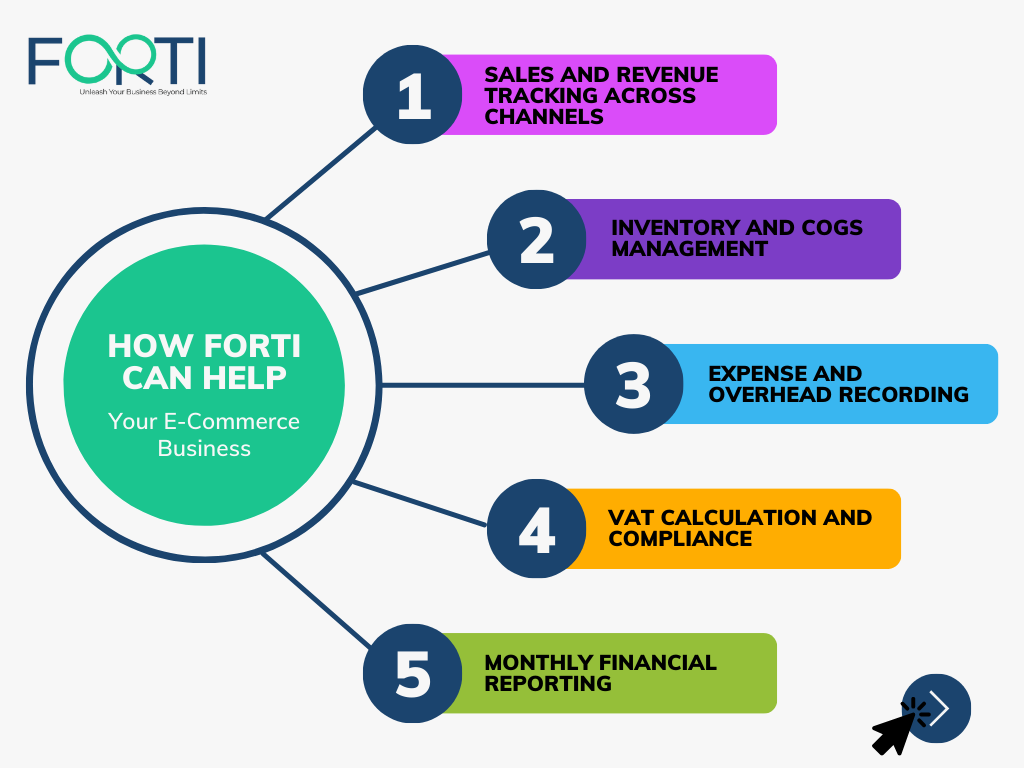
How FORTI Can Help Your E-Commerce Business

We recognise the requirements of online retail companies and offer tailored accounting solutions to simplify your financial processes and ensure precision and transparency for you to concentrate on expanding your enterprise.

Our Bookkeeping Services for E-Commerce Businesses Include:

  • Sales and Revenue Tracking Across Channels
    We keep a record of earnings from every sales source. Compare payment gateway charges to guarantee revenue calculations.
  • Inventory and COGS Management
    We make sure to keep our inventory records up-to-date and accurately calculate the cost of goods sold (COGS) to reflect our profit margins.
  • Expense and Overhead Recording
    We keep a record of every cost related to our business operations. From packaging expenses to marketing expenditures. To make sure that we cover all the expenses incurred.
  • VAT Calculation and Compliance
    We handle VAT computations for your sales in Ireland and the EU to guarantee reporting and submission to prevent any penalties.
  • Monthly Financial Reporting
    To help you understand the performance of your business, FORTI offers monthly balance sheets, cash flow reports, and profit and loss statements.
  • Document Management for Tax Compliance
    We prepare you for audits and tax filings by organising and safely storing all supporting documentation, including invoices and receipts.

Ready to streamline your e-commerce bookkeeping?

FORTI can handle the complexities of your e-commerce accounting. With our tailored bookkeeping solutions, you can maintain VAT compliance, manage inventory, and make data-driven growth decisions.

Essential Bookkeeping Tips for Limited Companies in Ireland

Essential Bookkeeping Tips for Limited Companies in Ireland

Limited companies in Ireland must maintain bookkeeping practices not for daily business activities but also to meet legal obligations as mandated by the law. Unlike traders, who have stringent reporting requirements compared to limited companies, such as filing annual financial statements and corporation tax returns along with payroll filings. To ensure accuracy and compliance, it’s essential to establish solid bookkeeping practices from the start. This guide serves as a resource for companies to grasp the significance of bookkeeping practices and lays out steps while pointing out common mistakes and offering best practices. Explore how FORTI can assist your business with customised accounting services, check these bookkeeping tips:

Monthly and Annual Bookkeeping and Tax Compliance Activities

Monthly Bookkeeping Activities:

  1. Sales Invoices and Revenue Recording
  2. Purchase Invoices and Expense Tracking
  3. Bank Account Reconciliation
  4. Creditors Reconciliation (Supplier Balances)
  5. Debtors Reconciliation (Customer Balances)
  6. Payroll and PAYE Reconciliation
  7. Loan Account Reconciliation
  8. Other Reconciliation Tasks (e.g., Petty Cash, Intercompany Accounts)

Bi-Monthly and Year-End Tax & Compliance Activities:

  1. Bi-Monthly VAT Returns (Cash or Accrual Basis Reconciliation)
  2. Payroll Processing and Submissions
  3. Year-End Financial Reconciliations
  4. Preparation of Financial Statements
  5. CT1 Corporate Tax Filing
  6. B1 Annual Return Filing
  7. Personal Income Tax Returns (Self-Assessment)

Why Bookkeeping is Crucial for Limited Companies

Bookkeeping for limited companies in Ireland is more complicated than for sole traders. Here’s why effective bookkeeping is essential:

1. Legal Compliance

Under legislation, it is mandatory for companies to keep precise financial documentation and present yearly reports to both the Companies Registration Office (CRO) and the Revenue authorities.

2. Corporation and VAT tax

Maintaining records is crucial, for filing taxes and complying with Irish Revenue regulations to avoid penalties related to corporation tax and VAT returns.

3. Corporate Tax and VAT

Proper bookkeeping helps ensure accurate tax filings, including corporation tax and VAT returns, to avoid penalties and stay compliant with Irish Revenue requirements.

4. Financial Transparency

Detailed records provide stakeholders, such as shareholders and investors, with an accurate picture of the company’s financial health and performance.

5. Cash Flow Management

Proper bookkeeping ensures that cash flow is closely monitored, allowing your company to meet financial obligations while also planning for growth.

Key Bookkeeping Steps for Limited Companies

Here’s how to build a solid bookkeeping foundation for your limited company:

1. Separate Business and Personal Finances

It’s essential to follow this rule: All business dealings must be conducted using a corporate bank account, as mandated for limited companies. This practice eases accounting tasks. Guarantees transparency in records.

2. Keep track of all the money coming in and going out

Keep track of all transactions related to the business, from sales and expenses to loan repayments and investment income. Ensure that every transaction is categorised correctly to avoid misclassification, which can lead to incorrect tax filings.

3. Track Receivables and Payables

Keep an eye on outstanding invoices (receivables) and upcoming payments (payables). This is crucial for cash flow management and helps you avoid late fees or interest on overdue bills.

4. Manage Payroll Accurately

Limited companies’ payroll includes calculating employee pay, tax deductions, PRSI, and USC. Use a compliant payroll system to manage these tasks accurately, and ensure you file payroll taxes with Revenue on time.

5. Keep Detailed Records for VAT

If your company is registered for VAT, you must accurately track VAT on sales and purchases. Use accounting software to calculate VAT returns and set filing deadline reminders to avoid penalties.

6. Maintain Supporting Documentation

Irish Revenue mandates that you keep all supporting paperwork, such as receipts and contracts, for a period of six years and suggests using a document management system to store and organise these documents.

7. Reconcile Bank Statements Monthly

Reconciling your bank statements with your books every month ensures that your records are accurate and highlights any discrepancies early on. This is essential for maintaining reliable cash flow records.

8. Prepare Financial Statements

Limited companies are required to prepare financial statements, such as profit and loss statements, balance sheets, and cash flow statements. These statements give a snapshot of the company’s financial health and are crucial for decision-making and compliance.

Comprehensive Legal and Tax Compliance Services

Common Bookkeeping Mistakes to Avoid

1. Failing to Separate Business Transactions

Mixing personal and business finances can lead to serious bookkeeping issues, and it is against Irish accounting regulations for limited companies.

2. Ignoring Regular Reconciliation

Without monthly reconciliation, errors or missing transactions are easily overlooked, resulting in inaccuracies in financial reporting.

3. Misclassifying Expenses and Income

Incorrectly categorising transactions can lead to inaccurate tax filings and financial statements, affecting decision-making and tax liabilities.

4. Overlooking Payroll Compliance

Payroll compliance errors, such as incorrect deductions or late payments, can result in fines and reduce employee trust.

5. Inadequate VAT Tracking

Failure to properly track VAT on sales and expenses can result in errors in VAT returns, penalties, or overpayment/underpayment of VAT.

6. Neglecting Accounts Receivable and Payable Management

Poor receivables and payables management can put a strain on cash flow, making meeting financial obligations difficult.

7. Missing Documentation

Your tax liability may increase if you lose supporting documentation, which may cause problems during audits and result in missed deductions.

Best Practices for Efficient Bookkeeping in Limited Companies

1. Use Accounting Software

Accounting software simplifies bookkeeping tasks, such as invoicing, payroll, VAT calculations, and financial reporting. Popular options include Xero, Sage, and QuickBooks, which are designed to support compliance with Irish accounting standards. These software also uses platforms such as Hubdoc, which simplify your process of expense recording.

2. Schedule Monthly Financial Reviews

Sit down with your bookkeeper and review the monthly transactions. Monthly reviews provide an opportunity to examine your cash flow, track spending patterns, and address issues early. Making informed business decisions is also aided by routine financial reviews.

3. Work with a Professional Bookkeeper or Accountant

Taking the help of an expert means doing things more efficiently and quickly. With complex compliance requirements, many limited companies benefit from working with an experienced bookkeeper or accountant. Professionals can handle regulatory filings, tax compliance, and provide strategic financial advice. It also avoids any type of error that may arise from wrong expense categorisation.

4. Plan for Corporate Tax Payments

As a limited company, you’re required to pay corporation tax. Make smart financial decisions. A portion of income should be set aside for taxes throughout the year to avoid cash flow problems during tax season.

5. Implement a Document Management System

Organise your documents. A secure, organised document management system makes it easier to locate receipts, invoices, and other supporting documents when needed for audits or tax filings.

Monthly Bookkeeping Checklist for Limited Companies

A simple checklist can help ensure you don’t miss any essential bookkeeping tasks:

TaskFrequencyCompleted (Y/N)
Record all income and expensesWeekly
Save and organise receipts and invoicesOngoing
Reconcile bank statementsMonthly
Track accounts receivable/payableWeekly
Review payroll and tax deductionsMonthly
Prepare VAT calculations (if applicable)Monthly
Generate financial statementsMonthly
Review cash flow and profit/lossMonthly

This checklist can help streamline your bookkeeping, ensuring compliance and accuracy every month.

How FORTI Can Support Your Limited Company’s Bookkeeping

We recognise the challenges that come with managing bookkeeping for companies. Our comprehensive bookkeeping services are designed to handle everything from day-to-day recording to VAT returns and payroll management, ensuring your accounts are compliant and up-to-date.

Our Bookkeeping Services for Limited Companies Include:

  1. Transaction Recording & Expense Tracking:
    We precisely document every transaction, classifying them to give a transparent financial picture.
  2. Accounts Receivable & Payable Management:
    Our team monitors receivables and payables to help you manage cash flow and meet deadlines.
  3. Payroll Compliance:
    We manage payroll, including tax deductions and PRSI, while adhering to Irish payroll regulations.
  4. Monthly Reconciliations:
    Reconcilliations are the key exercise to keep the records clean and compliant. Regular reconciliations keep your accounts balanced, reducing errors and highlighting discrepancies early.
  5. VAT Filing and Tax Preparation:
    We handle VAT calculations, track VAT on all relevant transactions, and prepare accurate tax filings to ensure your compliance.
  6. Detailed Financial Reporting:
    FORTI provides monthly financial reports, such as profit and loss, balance sheets, and cash flow statements, to keep you up to date on your company’s financial health.
  7. Document Management:
    We maintain a digital system for storing and organising all necessary documents, ensuring that you are ready for audits and tax returns.

Are you prepared to streamline your accounting tasks?

Allow FORTI to handle your documentation while you focus on growing your business effectively! Count on our team to deliver bookkeeping services that align with the needs of Irish businesses.

👋 Reach out to us now for a consultation. Uncover how FORTI can assist you in bookkeeping/annual compliance, impeccable financial records, and enhancing your company’s effectiveness while ensuring adherence to Irish regulations!