Monthly Archives: August 2026

Irish Startup Accounting Checklist

The Irish Startup Accounting Checklist: What You Need to Get Right From Day One

Starting a Business in Ireland? Here Is What No One Tells You About Compliance

You have the idea. You have the drive. You might even have your first customer lined up.

But between registering your company and issuing your first invoice, there is a maze of compliance obligations that catches many Irish founders off guard — Revenue registrations, CRO deadlines, VAT thresholds, payroll requirements, and beneficial ownership filings. Miss one, and you are looking at penalties, surcharges, and the kind of paperwork headache that eats into time you should be spending on your business.

This guide is a plain-English walkthrough of every accounting and compliance step a new Irish limited company needs to take, in the right order, so you can focus on building rather than firefighting.

Sole trader or limited company? Almost everything below applies to Irish Private Limited Companies (LTDs). If you are trading as a sole trader, your obligations differ — particularly around income tax (Form 11 vs PAYE), legal liability and accounting requirements. If you are deciding between the two structures, speak to an accountant before you start trading. The right structure depends on your turnover, risk profile and growth plans.

Step 1: Register Your Company With the CRO

Before anything else, your business needs a legal structure. Most Irish startups incorporate as a Private Limited Company (LTD) — it gives you limited liability, a professional profile, and the ability to access business banking and contracts.

Company registration is handled by the Companies Registration Office (CRO) at cro.ie. You will need:

  • A company name — checked against the CRO register; duplicates are rejected
  • At least one director — who must be EEA-resident, or the company must hold a Section 137 bond
  • A registered office address in Ireland
  • A company secretary — note that if the company has only one director, that director cannot also act as company secretary

Annual return dates — what founders regularly miss

Your company’s first Annual Return Date (ARD) falls six months after the date of incorporation. Importantly, no financial statements are required with this first B1 return — only the form itself must be filed. Subsequent B1 returns fall annually from that ARD and must include financial statements.

Under the rules applicable since 16 July 2025, a single late annual return no longer automatically causes loss of audit exemption. A company now generally loses audit exemption for the following two years where it files late more than once within a five-year period. This is a meaningful change from the previous position, but filing on time remains strongly advisable — late filing fees apply regardless, and the consequences of repeated lateness remain serious.

Step 2: Register Your Beneficial Ownership (RBO)

This step is missed by a significant number of newly incorporated companies, and the consequences can include fines.

Within five months of incorporation, your company must register its beneficial ownership information on the Register of Beneficial Ownership (RBO) at rbo.gov.ie. A beneficial owner is generally any individual who ultimately owns or controls more than 25% of the shares or voting rights, or who otherwise exercises control over the company.

What you will need for each beneficial owner:

  • Full name, date of birth and nationality
  • Residential address
  • Nature and extent of interest held
  • PPS Number — or, where the individual does not have a PPS Number, a verified identity via the VIF (Verification of Identity Form) process

The RBO must also be updated whenever there is a relevant change in beneficial ownership. Failure to file within the deadline is an offence under the European Union (Anti-Money Laundering: Beneficial Ownership of Corporate Entities) Regulations.

Step 3: Register With Revenue

Incorporation at the CRO does not automatically register your company with Revenue. You need to register separately — via ROS (Revenue Online Service) — for each tax head that applies to your business:

  • Corporation Tax (CT) — mandatory for all Irish limited companies from the date of incorporation
  • Employer PAYE/PRSI — required as soon as you take on staff or pay a salary to a director
  • VAT — see Step 4

Revenue registration is a separate process and can take time. Delays here can hold up your VAT registration and your ability to reclaim Irish input tax, so it is worth starting early.

Step 4: Understand Your VAT Position

VAT registration is mandatory in Ireland once your turnover exceeds:

  • €85,000 for the supply of goods
  • €42,500 for the supply of services

These thresholds took effect from 1 January 2025 (increased from €80,000 and €40,000 respectively) and remain in force as of the date of this guide. You can also register voluntarily below these thresholds — which many startups do, particularly if they are selling to other VAT-registered businesses and wish to reclaim input VAT on their costs.

Cross-border and EU VAT considerations

If your company makes intra-Community distance sales of goods or supplies certain cross-border telecommunications, broadcasting or electronic (TBE) services to consumers in other EU Member States, the €10,000 annual threshold for cross-border B2C supplies is relevant. Once exceeded, VAT must be accounted for in each customer’s Member State — unless you register for the OSS (One Stop Shop) scheme in Ireland, which allows you to file all EU VAT centrally via Revenue.

EU VAT SME Scheme (from 1 January 2025): Qualifying small Irish businesses with EU-wide turnover not exceeding €100,000 may be able to use VAT exemptions in participating EU Member States, subject to national thresholds and conditions. This can offer meaningful administrative simplification for startups selling across the EU in small volumes.

Reverse charge VAT: Nearly every startup purchases services from abroad — Google, Meta, Microsoft, Shopify and other SaaS providers. Where you receive services from a non-Irish supplier and you are VAT-registered, the reverse charge mechanism typically applies: you account for the VAT yourself on your VAT3 return. This is commonly overlooked in early-stage bookkeeping.

Step 5: Set Up Your Bookkeeping System From the Start

Irish company law requires that every company keep proper books of account that correctly record and explain its transactions. This is a legal requirement — books must be retained for at least six years. Good bookkeeping also makes VAT returns, payroll submissions and annual accounts significantly faster and cheaper to prepare.

At Forti, we work with Xero, QuickBooks and Zoho Books. Cloud-based platforms give real-time visibility and allow us to collaborate on your records without emailing spreadsheets back and forth.

What your bookkeeping needs to capture from day one:

  • All sales invoices issued
  • All purchase invoices and receipts received and stored
  • Bank transactions reconciled to your records
  • Director expenses — with receipts; undocumented expenses are not allowable
  • Payroll journals once payroll is running
  • Director’s loan account movements
Director’s loan account: When a founder puts money into the company or takes money out outside of payroll or a declared dividend, this is typically recorded as a director’s loan. The tax treatment depends on the nature and timing of the transaction. Overdrawn director’s loan accounts can have PAYE implications — worth understanding early.

Pre-trading expenses: Certain costs incurred in the three years before trading commenced — wholly and exclusively for the purposes of the trade — may be allowable as deductions in the first trading period. Keep receipts from the very beginning.

Step 6: Payroll — Even If It Is Just You

Many founder-directors pay themselves a salary through the company’s payroll. This is normal and common, but it carries compliance obligations.

How payroll reporting works in 2026

Payroll in Ireland is reported under PAYE Modernisation, in place since January 2019. There are no P30 or P35 forms. Instead:

  • Before or on the date employees (including directors) are paid, a payroll submission is made to Revenue reporting each individual’s pay, tax, PRSI and USC
  • Revenue issues a monthly statement based on those submissions, which becomes the employer’s return
  • PAYE, PRSI and USC are paid to Revenue on a monthly or quarterly basis depending on the employer’s arrangement
  • Payslips must be issued to each employee for every pay period
  • Revenue Payroll Notifications (RPNs) must be retrieved and applied before each payroll run — these replace the old tax credit certificates

My Future Fund auto-enrolment (from 1 January 2026)

Ireland’s new workplace pension scheme is now mandatory for eligible employees. An employee is generally automatically enrolled where they:

  • Are aged between 23 and 60
  • Earn more than €20,000 per year
  • Are not already contributing to a qualifying pension arrangement through payroll

During Phase 1 (2026–2028), contributions are: Employee 1.5% | Employer 1.5% | State 0.5% — all based on gross earnings. Eligibility depends on each individual’s employment and pension circumstances. Not every company director automatically falls within the scheme.

BIK (Benefit in Kind) — company vehicles, health insurance and other benefits provided to directors or employees must be valued and reported through payroll. BIK is subject to PAYE, PRSI and USC.

Step 7: Know Your Corporation Tax Position

Irish companies pay Corporation Tax at 12.5% on trading profits — one of the most competitive rates in the EU. Non-trading income (such as investment or rental income) is generally taxed at 25%.

Section 486C Start-Up Relief

Qualifying new companies may be entitled to a reduction or elimination of their Corporation Tax liability under Section 486C TCA 1997. The relief is available for the first five years of a qualifying trade that commences on or before 31 December 2026. It is calculated by reference to qualifying employer PRSI paid:

  • Up to €5,000 per qualifying employee (including directors paying Class A PRSI)
  • Since 1 January 2025, a director’s own Class S PRSI also qualifies, up to €1,000 per individual
  • Aggregate PRSI relief cap: €40,000 per year

Full relief applies where the CT liability does not exceed the PRSI cap. Marginal relief applies where the CT liability falls between the PRSI amount and €40,000 above it. This is a genuine Revenue-sanctioned relief that many startups do not claim simply because they are not aware of it.

Preliminary Corporation Tax — important startup exemption

New companies do not have to pay Preliminary Corporation Tax in their first accounting period where the CT liability for that period is below €200,000. The full CT liability is instead paid when the CT1 return is filed. This is a meaningful cash-flow benefit that many early-stage founders are not aware of.

Your CT1 is due nine months after your accounting year-end (no later than the 23rd of that month for ROS filers). A company with a 31 December year-end must file by 23 September the following year.

Step 8: Annual Compliance — The Recurring Calendar

Once you are set up and trading, your compliance calendar looks like this:

Obligation Frequency Filed With
VAT3 Return Generally bi-monthly (other periods may apply) Revenue
Payroll Submission On or before each pay date Revenue
PAYE/PRSI/USC Payment Monthly or quarterly Revenue
CRO Annual Return (B1) Annual — first ARD 6 months after incorporation CRO
Corporation Tax Return (CT1) Annual — 9 months after year-end Revenue
Statutory Financial Statements Annual CRO / Revenue
RBO Update As and when beneficial ownership changes RBO
Form 11 (proprietary director) Annual — where director is a chargeable person Revenue
 
Form 11 note: A proprietary director — broadly, a director who owns more than 15% of the company’s shares — is a chargeable person and must file a Form 11 income tax return annually via ROS. A non-proprietary director whose income is dealt with entirely through PAYE does not necessarily have the same obligation, but the position depends on individual circumstances.

Common Mistakes Irish Startups Make (and How to Avoid Them)

1. Not separating company and personal finances

A limited company is a separate legal entity. It should operate through a dedicated company bank account, with company and personal spending kept clearly separate from day one.

2. Missing the RBO five-month deadline

The Register of Beneficial Ownership obligation is not well-publicised. Many founders are unaware of it until year-end — by which point they are already in breach.

3. Not registering for VAT on time

Many startups realise they have exceeded the threshold only when preparing annual accounts — months after the obligation arose. Retrospective registration and back-payment of VAT is painful and costly.

4. Misunderstanding the first CRO annual return

The first B1 is due six months after incorporation — earlier than most expect. No financial statements are needed with that first return, but the return itself must still be filed on time.

5. Treating director withdrawals as salary without a payroll structure

Taking money from the company without a proper payroll, dividend or director loan structure creates PAYE and Revenue risk.

6. Ignoring reverse charge VAT on overseas services

Buying Google Ads, Shopify subscriptions or any other service from a non-Irish supplier while VAT-registered creates a reverse charge obligation. It is very commonly missed in early-stage bookkeeping.

7. Not understanding My Future Fund eligibility

Auto-enrolment is now live. Failing to assess employee eligibility and make contributions on time will result in compliance breaches.

Ready to Get Your Compliance Right From the Start?

Whether you are incorporating next week or already trading and trying to get on top of your obligations, Forti can help. Book a free 30-minute consultation with our team. We will review your current position, identify any gaps, and give you a clear plan — with no obligation and no jargon.

▣  01 906 5862 | ▣  info@forti.ie | ▣  www.forti.ie
Office 106, Nesta Business Centre, Burton Hall Road, Sandyford, Dublin 18

Frequently Asked Questions

Do I need an accountant to set up a company in Ireland?

You do not legally need an accountant to incorporate, but professional support saves time, avoids early structural mistakes, and ensures the company is set up tax-efficiently from day one.

What is the Corporation Tax rate for Irish startups?

The standard trading rate is 12.5%. Qualifying new companies may also be entitled to Section 486C Start-Up Relief, which can reduce or eliminate Corporation Tax in the first five years of trading.

When do I need to register for VAT in Ireland?

VAT registration is mandatory once annual turnover exceeds €85,000 for goods or €42,500 for services (thresholds in effect since 1 January 2025). Voluntary registration below these thresholds is also possible and often advisable.

What is the first CRO annual return deadline?

Your first Annual Return Date falls six months after incorporation. No financial statements are required with that first B1 — but the return itself must be filed on time.

What is My Future Fund?

My Future Fund is Ireland’s mandatory workplace pension auto-enrolment scheme, effective 1 January 2026. Eligible employees aged 23–60 earning over €20,000 are automatically enrolled. Phase 1 contributions: 1.5% employee, 1.5% employer, 0.5% State.

What replaced P30 and P35 forms?

P30 and P35 were abolished in January 2019. Employers now submit payroll data to Revenue on or before each pay date. Revenue issues a monthly statement which serves as the employer return.

What is the RBO and when do I need to file?

The Register of Beneficial Ownership requires companies to register details of individuals who ultimately own or control more than 25% of the company. The initial filing must be made within five months of incorporation.
Irish Company Setup Guide for EU Sales

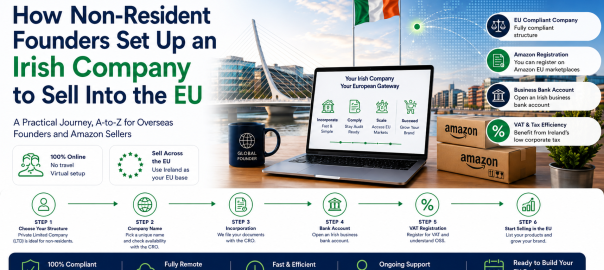
How Non-Resident Founders Set Up an Irish Company to Sell Into the Eu

QUICK ANSWER
Non-resident e-commerce founders can set up an Irish company without living in Ireland or the EEA — but the journey has two separate compliance tracks running in parallel: getting the company itself legally formed (Section 137 Bond, identity verification, AML/KYC), and getting it ready to actually trade across the EU (VAT registration, OSS/IOSS, and — if using Amazon FBA — a VAT footprint that can expand fast). Missing either track causes real delays; missing both at once is how most non-resident e-commerce setups go wrong.

At a Glance

Track One: Legal Formation Track Two: Trading & Tax Readiness
1. Identity verification (VIF/IPN) — often the real starting point 1. Irish VAT registration (+ EORI if importing stock)
2. Section 137 Bond arrangement 2. OSS/IOSS setup for cross-border sales
3. CRO incorporation & RBO filing 3. Marketplace settlement reconciliation (A2X/Link My Books)
4. Fintech or corporate banking setup 4. Local VAT registration in each country if using Pan-EU FBA

If you’re running an e-commerce business from the US, UK, UAE, or anywhere else outside the EEA and looking at Ireland as your EU entry point, you’re not alone — Ireland is a common choice for exactly this reason: English-speaking, EU/eurozone membership, and a well-understood company law framework. But non-resident founders setting up specifically to sell online run into two distinct sets of requirements that rarely get covered together: the rules around forming a company without an EEA-resident director, and the e-commerce-specific VAT obligations that kick in the moment you start trading. This guide walks through both, in the order you’ll actually hit them.

Why Overseas E-commerce Sellers Choose an Irish Company for EU Market Access

An Irish limited company gives a non-resident e-commerce founder a genuine EU legal entity — which matters for more than just optics. It means access to the EU’s VAT simplification schemes (OSS/IOSS) as an EU-established business rather than a non-EU one, straightforward eligibility for Amazon’s European marketplaces and fulfilment programmes, and a recognised EU corporate structure that EU-based suppliers, payment processors, and logistics partners are set up to work with by default.

None of that requires you to live in Ireland, or anywhere in the EEA. It does require getting two things right at the outset: how the company itself satisfies Irish director-residency law, and how it registers for VAT before its first sale.

Track One: Getting the Company Legally Formed

Identity Verification Usually Comes First

Almost no non-resident founder holds an Irish PPSN, which CRO filings require by default. The workaround is a Verification of Identity Form (VIF), which gets you an Identified Person Number (IPN) usable on all future CRO and RBO filings. This is worth starting immediately, not treating as a formality alongside everything else — for many non-resident founders, IPN approval is now the actual gating step on the whole incorporation timeline, since CRO processing depends on it being in place first. One detail that catches founders out: as of 30 April 2026, this form must be witnessed with the declarant and witness physically in the same room — a fully remote, video-witnessed process is no longer accepted, so this needs to be booked and planned for early rather than assumed to be a same-day online task.

This applies to beneficial owners too, not just directors. Anyone owning more than 25% of the company who lacks a PPSN also needs their own VIF-based IPN for the Register of Beneficial Owners (RBO) filing. The RBO filing deadline is five months from incorporation, but there’s no reason to wait — get the beneficial owner’s identity verification done in the same window as the director’s, using the same process, rather than treating it as a separate task to pick up later.

The EEA-Resident Director Requirement

Under Section 137 of the Companies Act 2014, every Irish company needs at least one director resident in the EEA (EU plus Iceland, Norway, and Liechtenstein) — residency, not nationality. If none of your founding team lives there, which is the normal situation for an overseas e-commerce founder, the standard route is a Section 137 Bond: a surety bond covering the company for €25,000, arranged at incorporation and renewed every two years. It’s the fastest option available to a brand-new company — the alternative (a Section 140 “real and continuous link” certificate) isn’t available until a company has an established Irish trading history, which obviously doesn’t exist yet at formation.

AML/KYC

Standard anti-money-laundering due diligence applies to all incoming officers and shareholders, non-resident or not — proof of identity, proof of address, and source-of-funds documentation, gathered as part of formation rather than as a separate step afterwards.

For the full breakdown of the bond, the identity verification process, common mistakes, and pricing, see “Setting Up an Irish Company Without an EEA-Resident Director.”

The Part Founders Don’t Expect: Opening a Bank Account

This is the step that surprises most non-resident founders. Traditional Irish banks can open corporate accounts for non-resident-owned companies, but a fully remote process is genuinely difficult — most traditional banks still expect some form of in-person or video verification and a clear business rationale for banking in Ireland specifically. In practice, many non-resident e-commerce founders start with an EU-facing fintech business account (providers like Wise Business or Revolut Business are commonly used for this) to get trading immediately, and either keep that as their primary account or move to a traditional bank later once the business has an established trading history. Either path is workable — the mistake is not planning for this step at all and assuming a bank account will be ready the moment the company is incorporated.

Track Two: Getting Ready to Actually Trade

Company formation and VAT registration are separate processes, and treating them as sequential rather than parallel is one of the most common causes of delay we see.

VAT Registration From Day One

Once incorporated, an Irish company selling to Irish or EU customers needs Irish VAT registration once it crosses €85,000 (goods) or €42,500 (services) — or can register voluntarily below that, useful if there are significant VAT-bearing setup costs to reclaim early. For sales into other EU countries, the One Stop Shop (OSS) scheme lets you report that cross-border VAT through a single Irish return once combined EU sales pass €10,000, rather than registering separately in every country you sell into.

Importing inventory into Ireland? If you’re shipping physical stock from outside the EU — Great Britain, the US, or China — into an Irish hub, you’ll also need an EORI number linked to your VAT profile. It’s worth setting up Postponed VAT Accounting (PVA) alongside your VAT registration at the same time: this lets you declare import VAT on your bi-monthly VAT3 return instead of paying it in cash at the border, which matters for cash flow if you’re importing stock regularly.

The Amazon-Specific Trap

If you’re planning to use Amazon’s Pan-European FBA programme, be aware before you opt in: the moment Amazon physically stores your stock in a country, you need a local VAT registration in that country — OSS does not cover this. As of January 2026, Amazon requires a minimum of five EU VAT registrations just to remain eligible for Pan-EU FBA. This is very commonly misunderstood by founders who assume OSS is a complete solution, and it’s worth deciding your fulfilment approach (Pan-EU FBA vs. the single-country European Fulfilment Network) before your VAT registrations are in place, not after stock has already started moving.

Planning to use Amazon Pan-EU FBA?
Don’t let inventory transfers freeze mid-launch because a VAT registration wasn’t in place before stock landed. Request a free e-commerce & non-resident formation review and Forti will map your required VAT footprint before you opt in.

For the full detail on OSS vs IOSS vs local VAT registration, the Pan-EU FBA VAT trap, the 2026 customs duty changes, and Extended Producer Responsibility (EPR/Repak) obligations for sellers of packaged goods, see “The Complete Guide to E-commerce Accounting for Shopify and Amazon FBA Sellers in Ireland.”

Ongoing Compliance

Once trading, a non-resident-owned Irish e-commerce company carries the same ongoing obligations as any Irish company — CRO annual returns, Corporation Tax (CT1), VAT3 filings, and Register of Beneficial Owners (RBO) filings, required within five months of incorporation and whenever ownership changes — on top of the e-commerce-specific bookkeeping challenge of reconciling Amazon and Shopify settlement reports (typically via A2X or Link My Books) across currencies and jurisdictions.

Choosing a Partner Who Understands Both Sides

This is the practical reason most non-resident e-commerce founders end up frustrated with their first advisor: a generalist formation agent understands the Section 137 Bond but not OSS/IOSS or the Pan-EU FBA VAT trap. An e-commerce-focused accountant understands VAT and marketplace reconciliation but may not have handled a non-resident director bond or VIF/IPN identity verification before. Getting both tracks right — the formation side and the trading side — usually means working with one partner who handles both, rather than coordinating a formation agent and a separate accountant who’ve never had to think about how the two interact.

Two Founders, Two Different Starting Points

These are composite, illustrative scenarios based on patterns we see across non-resident e-commerce clients — not specific named businesses.

The FBA seller who assumed OSS was enough

A US-based founder incorporated an Irish company, registered for Irish VAT and OSS, and started selling on Amazon — all correctly. Six months later, they opted into Pan-EU FBA to speed up EU delivery, assuming their existing OSS registration already covered it. It didn’t. Amazon began distributing stock into Germany, France, and Poland, and inventory transfers stalled while five local VAT registrations were arranged retroactively — during what should have been their busiest sales period.

The founder who left identity verification too late

A Dubai-based founder lined up their Section 137 Bond and company name in advance, expecting incorporation within days. They hadn’t accounted for the VIF process — booking an in-person notary appointment abroad took over two weeks, during which the CRO filing sat waiting on the IPN. The bond was never the bottleneck; the identity verification step was.

Both are avoidable with the same fix: treat both tracks as running from day one, not one after the other.

Frequently Asked Questions

Can a non-resident register a company in Ireland to sell on Amazon or Shopify?

Yes. There’s no requirement to live in Ireland or the EEA to form or own an Irish company. You do need to satisfy the EEA-resident director requirement, typically via a Section 137 Bond, and complete identity verification if you don’t hold an Irish PPSN.

Do I need to be VAT registered before I start selling?

You need Irish VAT registration once you exceed €85,000 (goods) or €42,500 (services) in turnover, though many non-resident founders register voluntarily from the outset. If you’re selling cross-border into the EU from day one, registering for OSS alongside your Irish VAT number is standard practice.

Can I open an Irish business bank account remotely as a non-resident?

It’s difficult with traditional banks, which usually expect some in-person or video verification. Most non-resident founders start with an EU-facing fintech business account to begin trading, then reassess once the company has an established history.

Does forming the company and registering for VAT happen at the same time?

They’re separate processes that can run in parallel, but they aren’t automatic — VAT registration has to be actively applied for once you know your trading plans, and it’s worth starting this alongside incorporation rather than waiting until the company is fully formed.

Do beneficial owners need identity verification too, or just directors?

Both. Anyone who owns more than 25% of the company and lacks an Irish PPSN needs their own VIF-based IPN for the RBO filing, separate from any director’s IPN. It’s worth doing both at the same time rather than leaving the beneficial owner’s verification until closer to the five-month RBO deadline.

Do I need an EORI number if I’m not importing anything myself?

No — an EORI number is only required if you’re importing physical stock into Ireland from outside the EU. If you’re sourcing entirely from EU suppliers or drop-shipping, it doesn’t apply.

What’s the biggest mistake non-resident e-commerce founders make?

Assuming OSS covers all their EU VAT obligations. It doesn’t cover local VAT registration triggered by holding stock in a country — which is exactly what happens under Amazon’s Pan-EU FBA programme.

Get Your Non-Resident E-commerce Setup Right From Day One

Forming the company and getting it ready to trade are two different jobs — Forti handles both together, so your identity verification, Section 137 Bond, VAT/OSS registration, and ongoing bookkeeping are managed as one process rather than passed between separate providers.

Talk to Forti about setting up your Irish e-commerce company → forti.ie


E-com Accounting

The Complete Guide to E-commerce Accounting for Shopify and Amazon FBA Sellers in Ireland

QUICK ANSWER
E-commerce accounting differs from standard Irish SME accounting because several distinct compliance regimes apply from the first sale, with no minimum threshold. The biggest blind spots are: VAT registration is required in every country where Amazon physically stores your stock (OSS does not cover this); the EU’s low-value customs duty exemption ended 1 July 2026; and packaging, electronics, or battery sellers may owe Extended Producer Responsibility (EPR) registration in Ireland regardless of where the business is based.

Running an e-commerce business looks deceptively simple from the outside: list a product, make a sale, ship it out. In reality, the moment a business starts selling across borders — which almost every Shopify or Amazon seller does within their first year — it inherits a compliance footprint that looks nothing like a typical Irish SME’s. A standard bookkeeping model built around one VAT number, one set of accounts, and domestic sales simply doesn’t hold up.

This guide walks through what actually makes e-commerce accounting different, covering the areas that most catch sellers out: VAT and OSS/IOSS, the specific VAT trap hidden inside Amazon’s Pan-European FBA programme, the customs duty change that took effect in July 2026, an environmental compliance obligation most sellers have never heard of, and how to actually reconcile the mess of data a marketplace generates every month.

The Irish E-commerce Market at a Glance

E-commerce isn’t a side channel in Ireland any more — it’s mainstream. Retail e-commerce in Ireland reached an estimated €8.8 billion in 2025, up around 6% year-on-year, and roughly 37.5% of Irish businesses now report having e-commerce sales. Amazon remains the single largest online retailer serving the Irish market by a wide margin. Growth of this scale is exactly why compliance gaps that were once minor — a missed VAT registration, an overlooked packaging obligation — now carry real financial exposure for sellers who are scaling faster than their back-office setup can keep up with.

Why E-commerce Accounting Doesn’t Fit a Standard Bookkeeping Model

A typical Irish limited company sells to Irish customers, charges Irish VAT, and files one VAT3 return covering one jurisdiction. An e-commerce business rarely works that way for long. Within months of scaling past a modest turnover, a Shopify or Amazon seller is likely to be:

  • Selling to customers in multiple EU countries, each with its own VAT rate
  • Holding stock in fulfilment centres outside Ireland, which changes where VAT is actually owed
  • Generating hundreds or thousands of small transactions a month, each bundled with marketplace fees, refunds, and currency conversions
  • Subject to environmental and product compliance obligations that have nothing to do with tax at all

None of this is optional or something that can be addressed “later, once the business is bigger.” Several of these obligations apply from the very first sale, with no minimum threshold. Getting the structure right early avoids a much more expensive clean-up exercise down the line.

VAT and OSS/IOSS Registration for Cross-Border Sellers

The starting point for any Irish e-commerce business is Irish VAT registration. As of May 2026, the Irish VAT registration thresholds are €85,000 for goods and €42,500 for services. Below these thresholds, registration is optional; above them, it’s mandatory.

But for a business selling into other EU countries, Irish registration is only the beginning. The One Stop Shop (OSS) scheme lets a business report VAT on cross-border B2C sales to other EU countries through a single return filed in Ireland, rather than registering separately in every country it sells into. The OSS threshold remains €10,000 — combined across all cross-border EU sales, not per country — above which OSS (or individual country registration) becomes necessary.

For non-EU sellers shipping low-value goods directly to EU consumers, the Import One Stop Shop (IOSS) serves a similar purpose for import VAT, allowing VAT to be collected at the point of sale rather than at the border.

A caution on registering below the threshold: sellers below the €85,000/€42,500 thresholds can register for VAT voluntarily, which is often worthwhile if there are significant VAT-bearing costs to reclaim. But Revenue does scrutinise voluntary applications from pre-trading or pre-revenue businesses more closely than standard registrations. Be ready to show concrete evidence of an intention to trade — supplier contracts, a live Shopify store, or inventory invoices — as applications lacking this can be queried or rejected outright.

Importing Stock Into Ireland? Don’t Overlook PVA and Your EORI Number

Many Irish e-commerce sellers import stock from Great Britain (now treated as a non-EU import post-Brexit) or from Asia before listing it on Shopify or Amazon. Two additional pieces of the compliance picture come into play the moment goods are imported from outside the EU:

  • An EORI number (Economic Operators Registration and Identification) is required to clear customs, and needs to be linked to the business’s Revenue VAT registration.
  • Postponed VAT Accounting (PVA) lets a VAT-registered, Customs & Excise-registered importer account for import VAT directly on their VAT3 return — declaring and reclaiming it in the same return — rather than paying it in cash at the point of entry. This is a genuine cash-flow advantage for any business importing stock regularly, and Revenue’s own guidance confirms it removes the need to pay VAT at the point of importation, subject to the usual deductibility rules.

Businesses that were both VAT- and Customs & Excise-registered before PVA’s introduction received automatic entitlement to use it; anyone registering for VAT and Customs & Excise since then should confirm their postponed accounting position is properly set up — including the correct PA1 entries on the VAT3 — before their first import lands.

Comparing OSS, IOSS, and Local VAT Registration

These three mechanisms are frequently confused, and mixing them up is the single most common VAT mistake among growing e-commerce sellers.

OSS IOSS Local VAT Registration
What it covers Cross-border B2C sales to other EU countries, from stock held in one EU country Import VAT on low-value goods (≤€150) shipped directly to EU consumers from outside the EU VAT on sales and stock held physically within that specific country
Threshold €10,000 combined cross-border EU sales No threshold — per consignment≤€150 No threshold — triggered by holding stock in-country≤€150
Common mistake Assuming it covers Pan-EU FBA stock-holding — it doesn’t Assuming it still means duty-free after 1 July 2026 — it doesn’t Assuming Amazon handles this automatically — it doesn’t

The crucial limitation to understand: OSS only covers where VAT is owed on the sale, not where a business is required to hold a full local VAT registration. That distinction becomes critical the moment stock is physically stored outside Ireland — which is exactly what happens with Amazon’s Pan-European FBA programme.

Pan-EU FBA: The VAT Obligation Most Sellers Don’t See Coming

This is the single most common compliance gap among growing Amazon sellers, and it catches out businesses that are otherwise fully VAT compliant in Ireland.

Amazon’s Pan-European FBA programme distributes a seller’s inventory automatically across its European fulfilment network to speed up delivery and reduce shipping costs. It’s a genuinely useful feature — but it comes with a rule that has nothing to do with sales thresholds: the moment inventory is physically held in a country, VAT registration is required in that country, from the very first unit stored. OSS does not cover this. There is no minimum threshold and no grace period.

In practice, this means a seller enrolled in Pan-EU FBA can find their stock automatically moved into Germany, France, Italy, Spain, Poland, and the Czech Republic — sometimes more — without VAT registration in any of them. Amazon has tightened this further: as of January 2026, sellers must hold VAT registrations in a minimum of five EU countries just to remain eligible for the Pan-EU programme at all. Fall short, and Amazon can restrict or block inventory transfers, which quietly removes the delivery-speed and fee advantages the programme exists to provide in the first place.

Sellers who want to avoid this exposure without giving up FBA altogether typically use the European Fulfilment Network (EFN) instead — storing stock in a single country and shipping cross-border from there — which limits the VAT footprint to that one country plus OSS for cross-border sales, at the cost of slightly slower delivery in some markets.

Illustrative Example: How a Growing Seller’s VAT Footprint Changes

This is a composite scenario based on patterns we see repeatedly across e-commerce clients — not a specific named business.

A Shopify and Amazon seller starts out shipping only from Ireland. In year one, all stock sits in a single Irish warehouse , one VAT registration, one VAT3 return, straightforward. As EU sales grow past €10,000, the seller registers for OSS, which now handles the cross-border VAT on those sales through a single Irish filing ; still manageable.

In year two, the seller opts into Amazon’s Pan-EU FBA programme to speed up delivery across Europe. Overnight, Amazon begins distributing stock into Germany, France, Italy, Spain, and Poland. OSS does not cover any of this stock-holding — the seller now needs five separate local VAT registrations, five sets of local filing obligations, and (per Amazon’s current rules) must have all five in place simply to stay eligible for the programme. A seller who enrolled without anticipating this can find inventory transfers frozen mid-flow while registrations are sorted out — often the first sign something has gone wrong, and a costly one during a peak sales period.

The practical takeaway: before opting into Pan-EU FBA, know exactly which countries your stock will land in and have VAT registrations in place before it arrives, not after. Amazon’s Inventory Event Detail Report is the standard way to track where stock is actually being held.

Unsure where your stock is currently being stored?

Amazon FBA inventory transfers happen automatically behind the scenes, which is exactly how sellers end up with an unregistered VAT obligation without realising it.
Request a free e-commerce VAT & EPR review → forti.ie

The 2026 Customs Duty Change: What It Means for Low-Value Consignments

Until recently, the EU allowed goods valued at €150 or less to enter the bloc free of customs duty. That exemption ended on 1 July 2026. In its place, a temporary flat customs duty of approximately €3 per HS-code line item now applies to consignments of €150 or less, regardless of whether the Import One Stop Shop is used. This interim measure is expected to run until 1 July 2028, ahead of a broader EU customs reform.

The detail that trips people up: IOSS still simplifies how VAT is collected at checkout, but it no longer means duty-free. These are two separate things that used to align neatly and no longer do. A seller who assumes their IOSS registration still covers “no extra charges at the border” for small parcels is working from an outdated assumption that changed only recently — worth flagging explicitly to customers and factoring into landed-cost pricing for low-value items shipped directly from outside the EU.

A Compliance Obligation Most Sellers Have Never Heard Of: Extended Producer Responsibility (EPR)

This is the area most e-commerce guides skip entirely, and it’s a genuine blind spot for sellers focused only on VAT.

Extended Producer Responsibility is an environmental compliance regime that makes anyone placing packaged goods, electrical equipment, or batteries on the Irish market financially responsible for that product’s end-of-life collection and recycling. In Ireland, packaging EPR is administered through Repak, the country’s approved compliance body, with separate schemes covering WEEE (waste electrical and electronic equipment) and batteries.

The important point for e-commerce sellers: this obligation applies to distance sellers, not just Irish-based manufacturers. A business based outside Ireland — including a non-resident seller — that supplies packaged goods directly to Irish consumers is treated as a “producer” under Irish packaging regulations and carries the same registration and reporting obligation as a local manufacturer would. The same logic applies to anyone selling electronics or battery-powered products to Irish buyers via Amazon.ie or a Shopify store shipping into Ireland.

  • Businesses placing packaging on the Irish market above certain thresholds (broadly, larger volumes and turnover) are classed as “major producers” and must join Repak, reporting packaging weights and paying a fee based on volume
  • Smaller producers typically have a simplified registration route with a fixed annual fee rather than the full major-producer reporting burden
  • Sellers of electrical or battery-powered goods have a parallel obligation through the National WEEE Register

This is easy to overlook because it isn’t a tax and doesn’t show up on a VAT return — but it’s a genuine legal obligation with financial penalties for non-compliance, and it’s one that grows more relevant every year as EU packaging waste rules tighten. Any e-commerce business shipping packaged goods into Ireland at meaningful volume should have this checked, not assumed away.

Reconciling Amazon and Shopify Settlements With A2X or Link My Books

Beyond registration and compliance, the day-to-day bookkeeping challenge for e-commerce sellers is different in kind from a typical business. A single Amazon settlement report can bundle together gross sales, referral fees, FBA fees, storage fees, refunds, promotional discounts, and VAT — all in different currencies if selling across multiple marketplaces — and dumping that raw data into a general ledger produces a mess that no accountant can make sense of, let alone use for accurate VAT filings.

This is where reconciliation tools like A2X and Link My Books earn their keep. Both integrate directly with Amazon, Shopify, and other marketplaces, breaking down each settlement into its individual components and posting a clean, correctly categorised summary into Xero or QuickBooks — with VAT correctly split by jurisdiction, which matters enormously once a seller has multiple VAT registrations in play. Attempting to reconcile marketplace settlements manually, without one of these tools, is one of the most common causes of inaccurate VAT filings among growing e-commerce sellers.

Corporation Tax and Multi-Marketplace Bookkeeping Considerations

Once the VAT and reconciliation side is under control, standard Irish company obligations still apply on top: Corporation Tax (CT1) on annual profits, CRO annual returns, and — where turnover and other thresholds are exceeded — statutory audit requirements. The complexity multiplies with the number of marketplaces and currencies involved: a seller running Shopify, Amazon, and perhaps eBay simultaneously needs bookkeeping that consolidates all three cleanly into one set of management accounts, ideally on a monthly cycle rather than being reconstructed at year-end.

What to Look for in an E-commerce Accountant

Given everything above, a generalist accountant without e-commerce experience will typically miss at least one of these areas — most often the Pan-EU FBA VAT trap or the EPR obligation, since neither shows up unless someone is specifically looking for it. When choosing who handles your accounts, look for:

  • Direct, practical experience with Amazon and Shopify settlement reconciliation, not just general bookkeeping
  • Familiarity with OSS/IOSS registration and the distinction between cross-border sales VAT and local stock-holding VAT
  • Awareness of EPR/Repak obligations for physical goods sellers — not every accountant will think to raise this
  • Comfort working with tools like A2X or Link My Books as standard practice, not an unfamiliar add-on

Frequently Asked Questions

Do I need to register for VAT in every country where Amazon stores my stock?

Yes. The moment Amazon physically holds your inventory in a country under Pan-EU FBA, you need a local VAT registration there — there’s no threshold and no grace period. OSS does not cover this; it only applies to cross-border sales, not stock-holding.

What’s the difference between OSS and IOSS?

OSS covers cross-border B2C sales of goods and services to other EU countries where you hold stock in one EU country. IOSS covers import VAT on low-value consignments (€150 or less) shipped directly to EU consumers from outside the EU. They serve different situations and aren’t interchangeable.

Does OSS cover Pan-EU FBA VAT registration?

No. This is the most common misunderstanding among growing sellers. OSS handles VAT on the sale itself; it does not replace the local VAT registration required wherever your stock is physically held.

Is IOSS still duty-free for orders under €150?

No, not since 1 July 2026. The EU’s duty-free exemption for consignments of €150 or less ended on that date. A flat customs duty of roughly €3 per HS-code line item now applies regardless of whether IOSS is used, as an interim measure expected to run until 1 July 2028.

Do I need to register for EPR/Repak if I only sell through Amazon FBA?

Potentially, yes. If you supply packaged goods, electronics, or batteries directly to Irish consumers — including via Amazon.ie — you may be classed as a “producer” under Irish packaging regulations regardless of where your business is based, and carry a Repak (or WEEE Register) registration obligation.

How many EU VAT registrations do I need for Amazon Pan-EU FBA in 2026?

As of January 2026, Amazon requires a minimum of five EU VAT registrations to remain eligible for the Pan-EU FBA programme. The exact countries depend on where your stock is distributed — commonly Germany, France, Italy, Spain, and Poland.

What tools help reconcile Amazon and Shopify settlements for VAT?

A2X and Link My Books are the two most widely used tools. Both break marketplace settlement reports into their individual components (sales, fees, refunds, VAT) and post a clean summary into Xero or QuickBooks, split correctly by jurisdiction.

How does Postponed VAT Accounting (PVA) help Irish e-commerce importers?

PVA lets a VAT-registered, Customs & Excise-registered business account for import VAT on its VAT3 return instead of paying it in cash at the point of import. It preserves working capital on imported stock, but requires an active EORI number and correct PA1 reporting on the VAT3.

E-commerce accounting isn’t harder than standard SME accounting because the numbers are more complicated — it’s harder because there are simply more distinct compliance regimes running in parallel, several of which apply from the first sale with no threshold to build up to. Getting the structure right from the outset is considerably cheaper than untangling it after a few years of growth.

Get Your E-commerce VAT and Compliance Position Reviewed

If you’re selling on Shopify or Amazon — or planning to opt into Pan-EU FBA — it’s worth having your VAT registrations, OSS/IOSS setup, and EPR obligations checked by someone who works with e-commerce sellers day to day, before a gap like the ones above turns into a frozen inventory transfer or a backdated liability.

Forti works with Shopify and Amazon FBA sellers on VAT registration, OSS/IOSS compliance, and monthly bookkeeping using A2X and Link My Books — from €195/month.

Talk to Forti about your e-commerce accounts → forti.ie


COMPLIANCE & RISK INSIGHTS

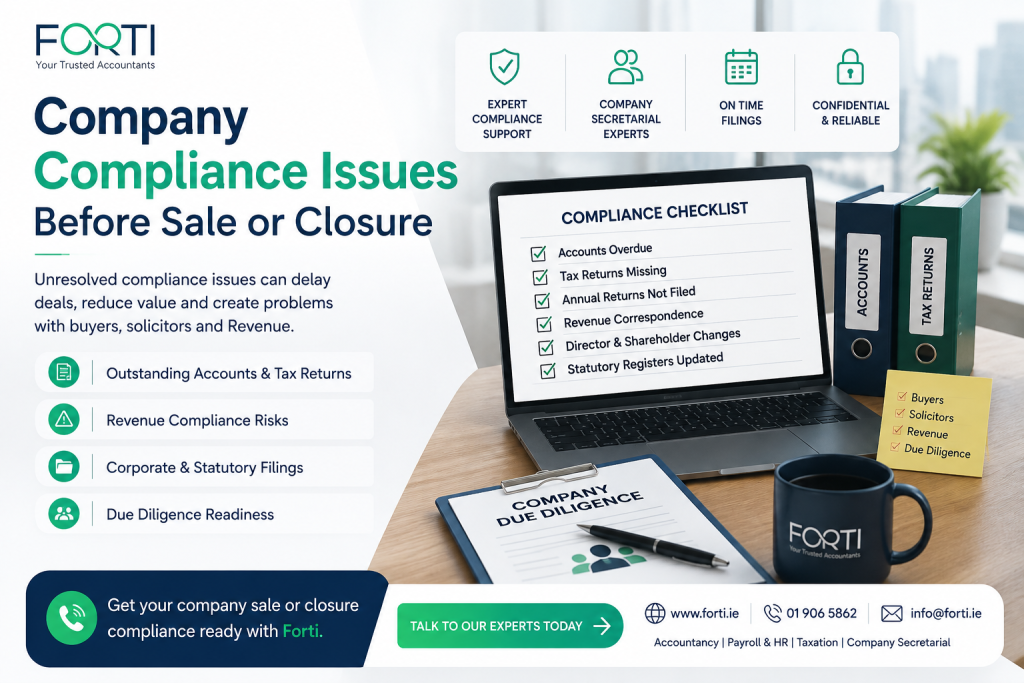
Selling or Winding Down a Company With Unresolved Compliance Issues: What Buyers, Solicitors and Revenue Will Find

A missed annual return or an uncancelled VAT registration is one thing when nobody’s looking. It’s a different problem entirely when a buyer’s solicitor, an investor’s due diligence team, or Revenue’s own tax clearance system starts looking — which is exactly what happens the moment you try to sell, merge, or formally close a company.

Why Compliance History Becomes Visible at Exactly the Wrong Moment

Throughout this series we’ve looked at what happens when a business owner simply stops trading and leaves the paperwork unresolved. Selling a company, bringing in an investor, or even just formally winding it down properly surfaces every one of those gaps at once — because each process relies on independent, third-party verification of exactly the things that tend to get left until later: CRO filing history, Revenue’s tax clearance system, and the Register of Beneficial Ownership.

None of this is hidden. A company’s late filing history is publicly searchable on the CRO register, RBO discrepancies are checked as standard AML due diligence, and Revenue’s tax clearance status is verified electronically in real time. A buyer’s solicitor will find what’s there — the only question is whether it’s found before or after you’ve agreed a price.

Share Sale vs Asset Sale: Why Compliance History Matters Differently

Share Sale

When shares in the company are sold, the buyer acquires the company itself — its history, its liabilities, and its compliance record, warts and all. Every unresolved CRO filing, every unpaid Revenue liability, and every RBO discrepancy transfers with it unless specifically carved out. This is why share sale agreements lean so heavily on warranties and indemnities: the buyer is pricing in exactly this risk, and will expect the seller to stand behind it contractually.

Asset Sale

When the buyer instead purchases specific assets — a customer list, equipment, a brand, a lease — out of the company rather than the company itself, historic compliance issues are less likely to transfer directly. But the company itself still needs a clean compliance position to complete the sale in the first place: a Tax Clearance Certificate is often required to satisfy the buyer and their bank, and if the sale involves property, a CG50 clearance certificate is required under Section 980 of the Taxes Consolidation Act 1997 — without it, the purchaser is legally required to withhold part of the sale proceeds and remit them to Revenue.

What Due Diligence Actually Uncovers

  • Late CRO filing history — publicly visible on the register and an immediate flag for any buyer’s solicitor running standard checks.
  • Loss of audit exemption from a prior late filing — meaning historic accounts may need to be re-audited before a deal can close cleanly.
  • An expired or refused Tax Clearance Certificate — Revenue’s electronic system checks compliance in real time and will not issue clearance while returns or liabilities remain outstanding.
  • RBO mismatches — beneficial ownership details that don’t match the actual shareholding, a standard check under anti-money-laundering due diligence.
  • Unresolved VAT, OSS, or foreign VAT registrations — particularly relevant for ecommerce or multi-country sellers, as covered in Part 3 of this series.
  • A CG50 requirement the seller wasn’t aware applied — relevant wherever property or certain high-value assets form part of what’s being sold.

Preparing a Company for Sale or Formal Closure

  1. Bring every CRO annual return up to date well before entering negotiations — a clean filing history removes one of the most visible red flags in due diligence.
  2. Apply for a Tax Clearance Certificate early. The electronic system checks compliance automatically, and any gap will surface immediately rather than at the point you actually need it.
  3. Confirm the Register of Beneficial Ownership entry matches the current shareholding exactly, updating within 14 days of any change.
  4. Resolve any dormant, ceased-trading, or multi-country VAT ambiguity — as set out in Parts 1 through 3 of this series — so the buyer’s due diligence team isn’t the one working out what category the company actually falls into.
  5. If property or qualifying assets are involved, apply for CG50 clearance as soon as contracts are signed rather than waiting until closing, since Revenue can take up to several weeks to process it.
  6. Where the company won’t be sold at all but simply needs to close, follow the voluntary strike-off process from Part 2 rather than leaving it to lapse mid-negotiation.

What Happens If You Sell Anyway, Issues Unresolved

Deals don’t usually collapse outright over compliance gaps — they get renegotiated. A buyer who discovers late filings, a lapsed audit exemption, or an unresolved VAT position will typically respond in one of a few predictable ways: a reduction in price to reflect the cost of fixing it, a specific indemnity requiring the seller to cover any resulting liability after completion, or a delay to closing while the seller resolves the position. In each case, the seller ends up paying for the same fix they could have made earlier — just later, under time pressure, and with less negotiating leverage.

Case Studies

Case Study 1 — A Share Sale Delayed by an Expired Audit Exemption

A services company preparing to sell discovered during due diligence that a prior year’s late annual return had cost it audit exemption for two years — years for which the accounts had never actually been audited. Completion was delayed by several weeks while a retrospective audit was arranged, and the buyer negotiated a price reduction to reflect the delay and the risk.

Case Study 2 — A Missed CG50 Almost Cost the Seller Cash at Closing

A business owner selling a company that held a small commercial property assumed the sale would proceed like any other share transaction. Their solicitor identified that a CG50 clearance certificate was required under Section 980 given the property involved, and without it, the purchaser would have been legally required to withhold part of the proceeds. Applying as soon as contracts were signed avoided a hold-back at closing that would otherwise have tied up a meaningful portion of the sale price.

Case Study 3 — An RBO Mismatch That Slowed Down Investor Due Diligence

A founder seeking investment for an otherwise healthy business found the round delayed when the investor’s AML checks flagged a discrepancy between the Register of Beneficial Ownership and the company’s actual shareholding, following an earlier share transfer that had never been updated on the register. The correction itself was straightforward, but it added weeks to a process the founder had expected to close quickly.

(These case studies are illustrative composites reflecting patterns we see regularly among Irish business owners, not individual clients.)

Technical Appendix: Statutory Thresholds & Legal Mechanics

1. Capital Gains Tax Clearance (Section 980 & Form CG50A)

When an asset sale or a share sale involves specific Irish assets (such as land, buildings, goodwill, or unquoted shares deriving their value from Irish land), strict statutory thresholds apply under Section 980 of the Taxes Consolidation Act 1997:

  • The Triggers: A Form CG50A clearance certificate is legally required if the disposal consideration exceeds:
    • €500,000 for commercial property, land, business goodwill, or qualifying unquoted shares.
    • €1,000,000 for residential property.
  • The Withholding Penalty: If the seller fails to produce a valid CG50A certificate to the buyer prior to or at closing, the purchaser is legally mandated to withhold exactly 15% of the gross purchase price and remit it directly to Revenue within 30 days.
  • Processing Timelines: Applications must be submitted electronically via the eCG50 facility on ROS (Revenue Online Service). Revenue standard processing times typically range from 3 to 4 weeks, meaning applications should ideally be initiated as soon as contracts are exchanged.

2. Companies Registration Office (CRO) & Audit Exemption Rules

Filing histories are scrutinized heavily during corporate transactions due to the severe downstream legal impacts of a missed deadline:

  • Automatic Loss of Exemption: Under the Companies Act 2014, if a company files its annual return late by even one day, it automatically forfeits its right to claim an audit exemption for the financial year in question and the subsequent financial year.
  • The Transaction Impact: If a company has traded through those years without an audit under the assumption it was exempt, it will be forced to commission a retrospective audit before a share sale can cleanly close. This frequently causes severe delays and triggers price chips from buyers.

3. Register of Beneficial Ownership (RBO) Compliance

  • The 14-Day Rule: To comply with statutory Anti-Money Laundering (AML) frameworks, any internal corporate restructuring, share transfer, or allotment must be updated on the central Register of Beneficial Ownership within 14 days of the change.
  • Due Diligence Friction: Discrepancies between the company’s internal stock transfer book and the public RBO register automatically flag during a buyer’s or investor’s standard AML checks, halting funds from being drawn down until rectified.

Key Action Checklist for Pre-Sale Due Diligence

Compliance Area Verification Action Timing Requirement
1.Tax Clearance Certificate (TCC) Check ROS electronic status across all tax heads (VAT, Relevant Contracts Tax, Corporation Tax, PAYE/PRSI). Run 6–8 weeks before negotiations to catch hidden flags.
2.CG50 Clearance File electronic application via eCG50 on ROS if transaction hits the €500k/€1m thresholds. File immediately upon exchange of contracts.
3.CRO History Verify that no annual returns are pending and check for past late filings that might have triggered an audit requirement Review before drafting the initial Heads of Terms.
4.RBO Alignment Cross-reference the central RBO register against the current register of members Remediate any discrepancies at least 3 weeks prior to closing.

Frequently Asked Questions

Do I need a Tax Clearance Certificate to sell my company?

It’s frequently required by buyers, their banks, or as part of standard due diligence, even where not strictly a legal precondition of the sale itself. Applying early, since Revenue’s electronic system checks compliance automatically, avoids delay at the point you actually need it.

What’s the difference between a Tax Clearance Certificate and a CG50?

A Tax Clearance Certificate confirms your overall tax affairs are in order. A CG50 is a separate clearance specifically relevant where property or certain qualifying assets are part of the sale, confirming Revenue doesn’t require the purchaser to withhold part of the proceeds.

Can late CRO filings actually stop a sale from completing?

They rarely stop a sale outright, but they routinely delay it and give the buyer leverage to negotiate a lower price or demand a specific indemnity covering the risk.

Does an asset sale avoid all these compliance issues?

Not entirely. While historic liabilities are less likely to transfer with specific assets rather than the company as a whole, the company itself typically still needs a Tax Clearance Certificate and, where property is involved, a CG50 to complete the transaction.

How long does it take to fix these issues once discovered mid-deal?

We prepare companies for sale or formal closure well before a buyer’s solicitor gets involved — bringing CRO filings current, securing tax clearance, correcting RBO entries, and resolving any dormant or ceased-trading ambiguity, so the compliance story is already clean by the time due diligence begins.

Preparing to Sell or Close? Talk to Forti Early

Monthly bookkeeping and management accounts from €195/month + VAT

Irish company formation, CRO fee included: €250

Tax clearance, RBO correction and pre-sale compliance clean-up available on request

If a sale, investment round, or formal closure is on the horizon, get in touch with the Forti team at forti.ie before a buyer’s due diligence team finds the gaps for you.