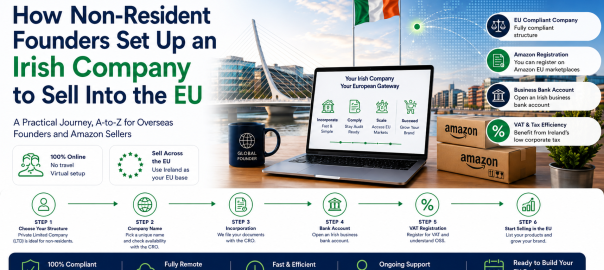
QUICK ANSWER Non-resident e-commerce founders can set up an Irish company without living in Ireland or the EEA — but the journey has two separate compliance tracks running in parallel: getting the company itself legally formed (Section 137 Bond, identity verification, AML/KYC), and getting it ready to actually trade across the EU (VAT registration, OSS/IOSS, and — if using Amazon FBA — a VAT footprint that can expand fast). Missing either track causes real delays; missing both at once is how most non-resident e-commerce setups go wrong.
At a Glance
Track One: Legal Formation
Track Two: Trading & Tax Readiness
1. Identity verification (VIF/IPN) — often the real starting point
1. Irish VAT registration (+ EORI if importing stock)
2. Section 137 Bond arrangement
2. OSS/IOSS setup for cross-border sales
3. CRO incorporation & RBO filing
3. Marketplace settlement reconciliation (A2X/Link My Books)
4. Fintech or corporate banking setup
4. Local VAT registration in each country if using Pan-EU FBA
If you’re running an e-commerce business from the US, UK, UAE, or anywhere else outside the EEA and looking at Ireland as your EU entry point, you’re not alone — Ireland is a common choice for exactly this reason: English-speaking, EU/eurozone membership, and a well-understood company law framework. But non-resident founders setting up specifically to sell online run into two distinct sets of requirements that rarely get covered together: the rules around forming a company without an EEA-resident director, and the e-commerce-specific VAT obligations that kick in the moment you start trading. This guide walks through both, in the order you’ll actually hit them.
Why Overseas E-commerce Sellers Choose an Irish Company for EU Market Access
An Irish limited company gives a non-resident e-commerce founder a genuine EU legal entity — which matters for more than just optics. It means access to the EU’s VAT simplification schemes (OSS/IOSS) as an EU-established business rather than a non-EU one, straightforward eligibility for Amazon’s European marketplaces and fulfilment programmes, and a recognised EU corporate structure that EU-based suppliers, payment processors, and logistics partners are set up to work with by default.
None of that requires you to live in Ireland, or anywhere in the EEA. It does require getting two things right at the outset: how the company itself satisfies Irish director-residency law, and how it registers for VAT before its first sale.
Track One: Getting the Company Legally Formed
Identity Verification Usually Comes First
Almost no non-resident founder holds an Irish PPSN, which CRO filings require by default. The workaround is a Verification of Identity Form (VIF), which gets you an Identified Person Number (IPN) usable on all future CRO and RBO filings. This is worth starting immediately, not treating as a formality alongside everything else — for many non-resident founders, IPN approval is now the actual gating step on the whole incorporation timeline, since CRO processing depends on it being in place first. One detail that catches founders out: as of 30 April 2026, this form must be witnessed with the declarant and witness physically in the same room — a fully remote, video-witnessed process is no longer accepted, so this needs to be booked and planned for early rather than assumed to be a same-day online task.
This applies to beneficial owners too, not just directors. Anyone owning more than 25% of the company who lacks a PPSN also needs their own VIF-based IPN for the Register of Beneficial Owners (RBO) filing. The RBO filing deadline is five months from incorporation, but there’s no reason to wait — get the beneficial owner’s identity verification done in the same window as the director’s, using the same process, rather than treating it as a separate task to pick up later.
The EEA-Resident Director Requirement
Under Section 137 of the Companies Act 2014, every Irish company needs at least one director resident in the EEA (EU plus Iceland, Norway, and Liechtenstein) — residency, not nationality. If none of your founding team lives there, which is the normal situation for an overseas e-commerce founder, the standard route is a Section 137 Bond: a surety bond covering the company for €25,000, arranged at incorporation and renewed every two years. It’s the fastest option available to a brand-new company — the alternative (a Section 140 “real and continuous link” certificate) isn’t available until a company has an established Irish trading history, which obviously doesn’t exist yet at formation.
AML/KYC
Standard anti-money-laundering due diligence applies to all incoming officers and shareholders, non-resident or not — proof of identity, proof of address, and source-of-funds documentation, gathered as part of formation rather than as a separate step afterwards.
For the full breakdown of the bond, the identity verification process, common mistakes, and pricing, see “Setting Up an Irish Company Without an EEA-Resident Director.”
The Part Founders Don’t Expect: Opening a Bank Account
This is the step that surprises most non-resident founders. Traditional Irish banks can open corporate accounts for non-resident-owned companies, but a fully remote process is genuinely difficult — most traditional banks still expect some form of in-person or video verification and a clear business rationale for banking in Ireland specifically. In practice, many non-resident e-commerce founders start with an EU-facing fintech business account (providers like Wise Business or Revolut Business are commonly used for this) to get trading immediately, and either keep that as their primary account or move to a traditional bank later once the business has an established trading history. Either path is workable — the mistake is not planning for this step at all and assuming a bank account will be ready the moment the company is incorporated.
Track Two: Getting Ready to Actually Trade
Company formation and VAT registration are separate processes, and treating them as sequential rather than parallel is one of the most common causes of delay we see.
VAT Registration From Day One
Once incorporated, an Irish company selling to Irish or EU customers needs Irish VAT registration once it crosses €85,000 (goods) or €42,500 (services) — or can register voluntarily below that, useful if there are significant VAT-bearing setup costs to reclaim early. For sales into other EU countries, the One Stop Shop (OSS) scheme lets you report that cross-border VAT through a single Irish return once combined EU sales pass €10,000, rather than registering separately in every country you sell into.
Importing inventory into Ireland? If you’re shipping physical stock from outside the EU — Great Britain, the US, or China — into an Irish hub, you’ll also need an EORI number linked to your VAT profile. It’s worth setting up Postponed VAT Accounting (PVA) alongside your VAT registration at the same time: this lets you declare import VAT on your bi-monthly VAT3 return instead of paying it in cash at the border, which matters for cash flow if you’re importing stock regularly.
The Amazon-Specific Trap
If you’re planning to use Amazon’s Pan-European FBA programme, be aware before you opt in: the moment Amazon physically stores your stock in a country, you need a local VAT registration in that country — OSS does not cover this. As of January 2026, Amazon requires a minimum of five EU VAT registrations just to remain eligible for Pan-EU FBA. This is very commonly misunderstood by founders who assume OSS is a complete solution, and it’s worth deciding your fulfilment approach (Pan-EU FBA vs. the single-country European Fulfilment Network) before your VAT registrations are in place, not after stock has already started moving.
Planning to use Amazon Pan-EU FBA? Don’t let inventory transfers freeze mid-launch because a VAT registration wasn’t in place before stock landed. Request a free e-commerce & non-resident formation review and Forti will map your required VAT footprint before you opt in.
For the full detail on OSS vs IOSS vs local VAT registration, the Pan-EU FBA VAT trap, the 2026 customs duty changes, and Extended Producer Responsibility (EPR/Repak) obligations for sellers of packaged goods, see “The Complete Guide to E-commerce Accounting for Shopify and Amazon FBA Sellers in Ireland.”
Ongoing Compliance
Once trading, a non-resident-owned Irish e-commerce company carries the same ongoing obligations as any Irish company — CRO annual returns, Corporation Tax (CT1), VAT3 filings, and Register of Beneficial Owners (RBO) filings, required within five months of incorporation and whenever ownership changes — on top of the e-commerce-specific bookkeeping challenge of reconciling Amazon and Shopify settlement reports (typically via A2X or Link My Books) across currencies and jurisdictions.
Choosing a Partner Who Understands Both Sides
This is the practical reason most non-resident e-commerce founders end up frustrated with their first advisor: a generalist formation agent understands the Section 137 Bond but not OSS/IOSS or the Pan-EU FBA VAT trap. An e-commerce-focused accountant understands VAT and marketplace reconciliation but may not have handled a non-resident director bond or VIF/IPN identity verification before. Getting both tracks right — the formation side and the trading side — usually means working with one partner who handles both, rather than coordinating a formation agent and a separate accountant who’ve never had to think about how the two interact.
Two Founders, Two Different Starting Points
These are composite, illustrative scenarios based on patterns we see across non-resident e-commerce clients — not specific named businesses.
The FBA seller who assumed OSS was enough
A US-based founder incorporated an Irish company, registered for Irish VAT and OSS, and started selling on Amazon — all correctly. Six months later, they opted into Pan-EU FBA to speed up EU delivery, assuming their existing OSS registration already covered it. It didn’t. Amazon began distributing stock into Germany, France, and Poland, and inventory transfers stalled while five local VAT registrations were arranged retroactively — during what should have been their busiest sales period.
The founder who left identity verification too late
A Dubai-based founder lined up their Section 137 Bond and company name in advance, expecting incorporation within days. They hadn’t accounted for the VIF process — booking an in-person notary appointment abroad took over two weeks, during which the CRO filing sat waiting on the IPN. The bond was never the bottleneck; the identity verification step was.
Both are avoidable with the same fix: treat both tracks as running from day one, not one after the other.
Frequently Asked Questions
Can a non-resident register a company in Ireland to sell on Amazon or Shopify?
Yes. There’s no requirement to live in Ireland or the EEA to form or own an Irish company. You do need to satisfy the EEA-resident director requirement, typically via a Section 137 Bond, and complete identity verification if you don’t hold an Irish PPSN.
Do I need to be VAT registered before I start selling?
You need Irish VAT registration once you exceed €85,000 (goods) or €42,500 (services) in turnover, though many non-resident founders register voluntarily from the outset. If you’re selling cross-border into the EU from day one, registering for OSS alongside your Irish VAT number is standard practice.
Can I open an Irish business bank account remotely as a non-resident?
It’s difficult with traditional banks, which usually expect some in-person or video verification. Most non-resident founders start with an EU-facing fintech business account to begin trading, then reassess once the company has an established history.
Does forming the company and registering for VAT happen at the same time?
They’re separate processes that can run in parallel, but they aren’t automatic — VAT registration has to be actively applied for once you know your trading plans, and it’s worth starting this alongside incorporation rather than waiting until the company is fully formed.
Do beneficial owners need identity verification too, or just directors?
Both. Anyone who owns more than 25% of the company and lacks an Irish PPSN needs their own VIF-based IPN for the RBO filing, separate from any director’s IPN. It’s worth doing both at the same time rather than leaving the beneficial owner’s verification until closer to the five-month RBO deadline.
Do I need an EORI number if I’m not importing anything myself?
No — an EORI number is only required if you’re importing physical stock into Ireland from outside the EU. If you’re sourcing entirely from EU suppliers or drop-shipping, it doesn’t apply.
What’s the biggest mistake non-resident e-commerce founders make?
Assuming OSS covers all their EU VAT obligations. It doesn’t cover local VAT registration triggered by holding stock in a country — which is exactly what happens under Amazon’s Pan-EU FBA programme.
Get Your Non-Resident E-commerce Setup Right From Day One
Forming the company and getting it ready to trade are two different jobs — Forti handles both together, so your identity verification, Section 137 Bond, VAT/OSS registration, and ongoing bookkeeping are managed as one process rather than passed between separate providers.
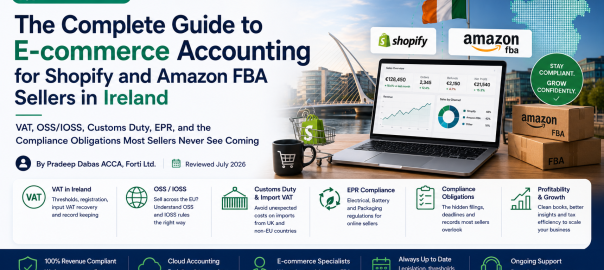
QUICK ANSWER E-commerce accounting differs from standard Irish SME accounting because several distinct compliance regimes apply from the first sale, with no minimum threshold. The biggest blind spots are: VAT registration is required in every country where Amazon physically stores your stock (OSS does not cover this); the EU’s low-value customs duty exemption ended 1 July 2026; and packaging, electronics, or battery sellers may owe Extended Producer Responsibility (EPR) registration in Ireland regardless of where the business is based.
Running an e-commerce business looks deceptively simple from the outside: list a product, make a sale, ship it out. In reality, the moment a business starts selling across borders — which almost every Shopify or Amazon seller does within their first year — it inherits a compliance footprint that looks nothing like a typical Irish SME’s. A standard bookkeeping model built around one VAT number, one set of accounts, and domestic sales simply doesn’t hold up.
This guide walks through what actually makes e-commerce accounting different, covering the areas that most catch sellers out: VAT and OSS/IOSS, the specific VAT trap hidden inside Amazon’s Pan-European FBA programme, the customs duty change that took effect in July 2026, an environmental compliance obligation most sellers have never heard of, and how to actually reconcile the mess of data a marketplace generates every month.
The Irish E-commerce Market at a Glance
E-commerce isn’t a side channel in Ireland any more — it’s mainstream. Retail e-commerce in Ireland reached an estimated €8.8 billion in 2025, up around 6% year-on-year, and roughly 37.5% of Irish businesses now report having e-commerce sales. Amazon remains the single largest online retailer serving the Irish market by a wide margin. Growth of this scale is exactly why compliance gaps that were once minor — a missed VAT registration, an overlooked packaging obligation — now carry real financial exposure for sellers who are scaling faster than their back-office setup can keep up with.
Why E-commerce Accounting Doesn’t Fit a Standard Bookkeeping Model
A typical Irish limited company sells to Irish customers, charges Irish VAT, and files one VAT3 return covering one jurisdiction. An e-commerce business rarely works that way for long. Within months of scaling past a modest turnover, a Shopify or Amazon seller is likely to be:
Selling to customers in multiple EU countries, each with its own VAT rate
Holding stock in fulfilment centres outside Ireland, which changes where VAT is actually owed
Generating hundreds or thousands of small transactions a month, each bundled with marketplace fees, refunds, and currency conversions
Subject to environmental and product compliance obligations that have nothing to do with tax at all
None of this is optional or something that can be addressed “later, once the business is bigger.” Several of these obligations apply from the very first sale, with no minimum threshold. Getting the structure right early avoids a much more expensive clean-up exercise down the line.
VAT and OSS/IOSS Registration for Cross-Border Sellers
The starting point for any Irish e-commerce business is Irish VAT registration. As of May 2026, the Irish VAT registration thresholds are €85,000 for goods and €42,500 for services. Below these thresholds, registration is optional; above them, it’s mandatory.
But for a business selling into other EU countries, Irish registration is only the beginning. The One Stop Shop (OSS) scheme lets a business report VAT on cross-border B2C sales to other EU countries through a single return filed in Ireland, rather than registering separately in every country it sells into. The OSS threshold remains €10,000 — combined across all cross-border EU sales, not per country — above which OSS (or individual country registration) becomes necessary.
For non-EU sellers shipping low-value goods directly to EU consumers, the Import One Stop Shop (IOSS) serves a similar purpose for import VAT, allowing VAT to be collected at the point of sale rather than at the border.
A caution on registering below the threshold: sellers below the €85,000/€42,500 thresholds can register for VAT voluntarily, which is often worthwhile if there are significant VAT-bearing costs to reclaim. But Revenue does scrutinise voluntary applications from pre-trading or pre-revenue businesses more closely than standard registrations. Be ready to show concrete evidence of an intention to trade — supplier contracts, a live Shopify store, or inventory invoices — as applications lacking this can be queried or rejected outright.
Importing Stock Into Ireland? Don’t Overlook PVA and Your EORI Number
Many Irish e-commerce sellers import stock from Great Britain (now treated as a non-EU import post-Brexit) or from Asia before listing it on Shopify or Amazon. Two additional pieces of the compliance picture come into play the moment goods are imported from outside the EU:
An EORI number (Economic Operators Registration and Identification) is required to clear customs, and needs to be linked to the business’s Revenue VAT registration.
Postponed VAT Accounting (PVA) lets a VAT-registered, Customs & Excise-registered importer account for import VAT directly on their VAT3 return — declaring and reclaiming it in the same return — rather than paying it in cash at the point of entry. This is a genuine cash-flow advantage for any business importing stock regularly, and Revenue’s own guidance confirms it removes the need to pay VAT at the point of importation, subject to the usual deductibility rules.
Businesses that were both VAT- and Customs & Excise-registered before PVA’s introduction received automatic entitlement to use it; anyone registering for VAT and Customs & Excise since then should confirm their postponed accounting position is properly set up — including the correct PA1 entries on the VAT3 — before their first import lands.
Comparing OSS, IOSS, and Local VAT Registration
These three mechanisms are frequently confused, and mixing them up is the single most common VAT mistake among growing e-commerce sellers.
OSS
IOSS
Local VAT Registration
What it covers
Cross-border B2C sales to other EU countries, from stock held in one EU country
Import VAT on low-value goods (≤€150) shipped directly to EU consumers from outside the EU
VAT on sales and stock held physically within that specific country
Threshold
€10,000 combined cross-border EU sales
No threshold — per consignment≤€150
No threshold — triggered by holding stock in-country≤€150
Common mistake
Assuming it covers Pan-EU FBA stock-holding — it doesn’t
Assuming it still means duty-free after 1 July 2026 — it doesn’t
Assuming Amazon handles this automatically — it doesn’t
The crucial limitation to understand: OSS only covers where VAT is owed on the sale, not where a business is required to hold a full local VAT registration. That distinction becomes critical the moment stock is physically stored outside Ireland — which is exactly what happens with Amazon’s Pan-European FBA programme.
Pan-EU FBA: The VAT Obligation Most Sellers Don’t See Coming
This is the single most common compliance gap among growing Amazon sellers, and it catches out businesses that are otherwise fully VAT compliant in Ireland.
Amazon’s Pan-European FBA programme distributes a seller’s inventory automatically across its European fulfilment network to speed up delivery and reduce shipping costs. It’s a genuinely useful feature — but it comes with a rule that has nothing to do with sales thresholds: the moment inventory is physically held in a country, VAT registration is required in that country, from the very first unit stored. OSS does not cover this. There is no minimum threshold and no grace period.
In practice, this means a seller enrolled in Pan-EU FBA can find their stock automatically moved into Germany, France, Italy, Spain, Poland, and the Czech Republic — sometimes more — without VAT registration in any of them. Amazon has tightened this further: as of January 2026, sellers must hold VAT registrations in a minimum of five EU countries just to remain eligible for the Pan-EU programme at all. Fall short, and Amazon can restrict or block inventory transfers, which quietly removes the delivery-speed and fee advantages the programme exists to provide in the first place.
Sellers who want to avoid this exposure without giving up FBA altogether typically use the European Fulfilment Network (EFN) instead — storing stock in a single country and shipping cross-border from there — which limits the VAT footprint to that one country plus OSS for cross-border sales, at the cost of slightly slower delivery in some markets.
Illustrative Example: How a Growing Seller’s VAT Footprint Changes
This is a composite scenario based on patterns we see repeatedly across e-commerce clients — not a specific named business.
A Shopify and Amazon seller starts out shipping only from Ireland. In year one, all stock sits in a single Irish warehouse , one VAT registration, one VAT3 return, straightforward. As EU sales grow past €10,000, the seller registers for OSS, which now handles the cross-border VAT on those sales through a single Irish filing ; still manageable.
In year two, the seller opts into Amazon’s Pan-EU FBA programme to speed up delivery across Europe. Overnight, Amazon begins distributing stock into Germany, France, Italy, Spain, and Poland. OSS does not cover any of this stock-holding — the seller now needs five separate local VAT registrations, five sets of local filing obligations, and (per Amazon’s current rules) must have all five in place simply to stay eligible for the programme. A seller who enrolled without anticipating this can find inventory transfers frozen mid-flow while registrations are sorted out — often the first sign something has gone wrong, and a costly one during a peak sales period.
The practical takeaway: before opting into Pan-EU FBA, know exactly which countries your stock will land in and have VAT registrations in place before it arrives, not after. Amazon’s Inventory Event Detail Report is the standard way to track where stock is actually being held.
Unsure where your stock is currently being stored?
Amazon FBA inventory transfers happen automatically behind the scenes, which is exactly how sellers end up with an unregistered VAT obligation without realising it. Request a free e-commerce VAT & EPR review → forti.ie
The 2026 Customs Duty Change: What It Means for Low-Value Consignments
Until recently, the EU allowed goods valued at €150 or less to enter the bloc free of customs duty. That exemption ended on 1 July 2026. In its place, a temporary flat customs duty of approximately €3 per HS-code line item now applies to consignments of €150 or less, regardless of whether the Import One Stop Shop is used. This interim measure is expected to run until 1 July 2028, ahead of a broader EU customs reform.
The detail that trips people up: IOSS still simplifies how VAT is collected at checkout, but it no longer means duty-free. These are two separate things that used to align neatly and no longer do. A seller who assumes their IOSS registration still covers “no extra charges at the border” for small parcels is working from an outdated assumption that changed only recently — worth flagging explicitly to customers and factoring into landed-cost pricing for low-value items shipped directly from outside the EU.
A Compliance Obligation Most Sellers Have Never Heard Of: Extended Producer Responsibility (EPR)
This is the area most e-commerce guides skip entirely, and it’s a genuine blind spot for sellers focused only on VAT.
Extended Producer Responsibility is an environmental compliance regime that makes anyone placing packaged goods, electrical equipment, or batteries on the Irish market financially responsible for that product’s end-of-life collection and recycling. In Ireland, packaging EPR is administered through Repak, the country’s approved compliance body, with separate schemes covering WEEE (waste electrical and electronic equipment) and batteries.
The important point for e-commerce sellers: this obligation applies to distance sellers, not just Irish-based manufacturers. A business based outside Ireland — including a non-resident seller — that supplies packaged goods directly to Irish consumers is treated as a “producer” under Irish packaging regulations and carries the same registration and reporting obligation as a local manufacturer would. The same logic applies to anyone selling electronics or battery-powered products to Irish buyers via Amazon.ie or a Shopify store shipping into Ireland.
Businesses placing packaging on the Irish market above certain thresholds (broadly, larger volumes and turnover) are classed as “major producers” and must join Repak, reporting packaging weights and paying a fee based on volume
Smaller producers typically have a simplified registration route with a fixed annual fee rather than the full major-producer reporting burden
Sellers of electrical or battery-powered goods have a parallel obligation through the National WEEE Register
This is easy to overlook because it isn’t a tax and doesn’t show up on a VAT return — but it’s a genuine legal obligation with financial penalties for non-compliance, and it’s one that grows more relevant every year as EU packaging waste rules tighten. Any e-commerce business shipping packaged goods into Ireland at meaningful volume should have this checked, not assumed away.
Reconciling Amazon and Shopify Settlements With A2X or Link My Books
Beyond registration and compliance, the day-to-day bookkeeping challenge for e-commerce sellers is different in kind from a typical business. A single Amazon settlement report can bundle together gross sales, referral fees, FBA fees, storage fees, refunds, promotional discounts, and VAT — all in different currencies if selling across multiple marketplaces — and dumping that raw data into a general ledger produces a mess that no accountant can make sense of, let alone use for accurate VAT filings.
This is where reconciliation tools like A2X and Link My Books earn their keep. Both integrate directly with Amazon, Shopify, and other marketplaces, breaking down each settlement into its individual components and posting a clean, correctly categorised summary into Xero or QuickBooks — with VAT correctly split by jurisdiction, which matters enormously once a seller has multiple VAT registrations in play. Attempting to reconcile marketplace settlements manually, without one of these tools, is one of the most common causes of inaccurate VAT filings among growing e-commerce sellers.
Corporation Tax and Multi-Marketplace Bookkeeping Considerations
Once the VAT and reconciliation side is under control, standard Irish company obligations still apply on top: Corporation Tax (CT1) on annual profits, CRO annual returns, and — where turnover and other thresholds are exceeded — statutory audit requirements. The complexity multiplies with the number of marketplaces and currencies involved: a seller running Shopify, Amazon, and perhaps eBay simultaneously needs bookkeeping that consolidates all three cleanly into one set of management accounts, ideally on a monthly cycle rather than being reconstructed at year-end.
What to Look for in an E-commerce Accountant
Given everything above, a generalist accountant without e-commerce experience will typically miss at least one of these areas — most often the Pan-EU FBA VAT trap or the EPR obligation, since neither shows up unless someone is specifically looking for it. When choosing who handles your accounts, look for:
Direct, practical experience with Amazon and Shopify settlement reconciliation, not just general bookkeeping
Familiarity with OSS/IOSS registration and the distinction between cross-border sales VAT and local stock-holding VAT
Awareness of EPR/Repak obligations for physical goods sellers — not every accountant will think to raise this
Comfort working with tools like A2X or Link My Books as standard practice, not an unfamiliar add-on
Frequently Asked Questions
Do I need to register for VAT in every country where Amazon stores my stock?
Yes. The moment Amazon physically holds your inventory in a country under Pan-EU FBA, you need a local VAT registration there — there’s no threshold and no grace period. OSS does not cover this; it only applies to cross-border sales, not stock-holding.
What’s the difference between OSS and IOSS?
OSS covers cross-border B2C sales of goods and services to other EU countries where you hold stock in one EU country. IOSS covers import VAT on low-value consignments (€150 or less) shipped directly to EU consumers from outside the EU. They serve different situations and aren’t interchangeable.
Does OSS cover Pan-EU FBA VAT registration?
No. This is the most common misunderstanding among growing sellers. OSS handles VAT on the sale itself; it does not replace the local VAT registration required wherever your stock is physically held.
Is IOSS still duty-free for orders under €150?
No, not since 1 July 2026. The EU’s duty-free exemption for consignments of €150 or less ended on that date. A flat customs duty of roughly €3 per HS-code line item now applies regardless of whether IOSS is used, as an interim measure expected to run until 1 July 2028.
Do I need to register for EPR/Repak if I only sell through Amazon FBA?
Potentially, yes. If you supply packaged goods, electronics, or batteries directly to Irish consumers — including via Amazon.ie — you may be classed as a “producer” under Irish packaging regulations regardless of where your business is based, and carry a Repak (or WEEE Register) registration obligation.
How many EU VAT registrations do I need for Amazon Pan-EU FBA in 2026?
As of January 2026, Amazon requires a minimum of five EU VAT registrations to remain eligible for the Pan-EU FBA programme. The exact countries depend on where your stock is distributed — commonly Germany, France, Italy, Spain, and Poland.
What tools help reconcile Amazon and Shopify settlements for VAT?
A2X and Link My Books are the two most widely used tools. Both break marketplace settlement reports into their individual components (sales, fees, refunds, VAT) and post a clean summary into Xero or QuickBooks, split correctly by jurisdiction.
How does Postponed VAT Accounting (PVA) help Irish e-commerce importers?
PVA lets a VAT-registered, Customs & Excise-registered business account for import VAT on its VAT3 return instead of paying it in cash at the point of import. It preserves working capital on imported stock, but requires an active EORI number and correct PA1 reporting on the VAT3.
E-commerce accounting isn’t harder than standard SME accounting because the numbers are more complicated — it’s harder because there are simply more distinct compliance regimes running in parallel, several of which apply from the first sale with no threshold to build up to. Getting the structure right from the outset is considerably cheaper than untangling it after a few years of growth.
Get Your E-commerce VAT and Compliance Position Reviewed
If you’re selling on Shopify or Amazon — or planning to opt into Pan-EU FBA — it’s worth having your VAT registrations, OSS/IOSS setup, and EPR obligations checked by someone who works with e-commerce sellers day to day, before a gap like the ones above turns into a frozen inventory transfer or a backdated liability.
Forti works with Shopify and Amazon FBA sellers on VAT registration, OSS/IOSS compliance, and monthly bookkeeping using A2X and Link My Books — from €195/month.
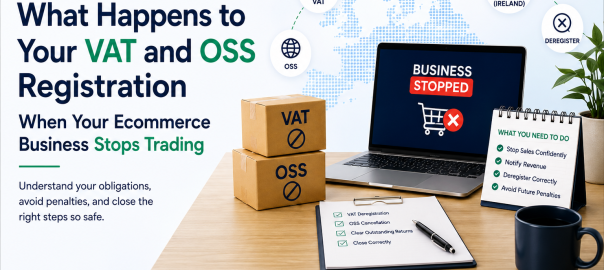
Ecommerce sellers carry more moving parts than most business owners when they stop trading — an OSS registration, possibly a foreign VAT registration tied to stored stock, and a marketplace account that keeps running whether you’re paying attention to it or not. Here’s what needs to be closed down deliberately, and what happens if it isn’t.
Why Ecommerce Sellers Are a Special Case
Most of the compliance failures we’ve covered in this series apply to any Irish business. Ecommerce sellers carry extra exposure on top: a Union OSS registration reporting sales across every EU state you sell into, potentially a local VAT registration in any country where you’ve stored stock, and — if you sell through Amazon, eBay or Etsy — a marketplace account that continues taking orders, holding your inventory, and generating transactions long after you’ve mentally ‘stopped.’ None of these switch off on their own, and each has its own separate deregistration process.
Deregistering From OSS: The Steps That Actually Matter
1. Notify Revenue electronically, through the VAT OSS section in ROS, that you wish to deregister. This must be done at least 15 days before the end of the calendar quarter prior to the quarter in which you intend to stop using the scheme.
2. File your final OSS return covering the last quarter of use, and pay any VAT still due — deregistering doesn’t cancel liability for supplies already made under the scheme.
3. Keep OSS records for the full 10-year retention period required under EU rules, even after deregistration — Revenue and other member states can still request them.
4. If you’re stopping trading altogether rather than switching schemes, also cancel your underlying Irish VAT registration via TRCN1 once all final returns are filed.
Miss the 15-day notice window and simply stop filing instead, and you risk a different outcome entirely: exclusion from the scheme by Revenue for non-compliance, which triggers a quarantine period during which you cannot re-register for OSS even if you resume trading. A deliberate, on-time deregistration and an enforced exclusion are not the same thing on your compliance record.
The Stock Problem: What Happens to Inventory You Still Hold
If you’re deregistering with stock still on hand, Revenue treats the retention of that stock — for personal use, write-off, or simply because it wasn’t sold — as a deemed supply, meaning VAT still needs to be accounted for on it in your final return. This is one of the most commonly missed steps in a rushed closure: sellers cancel the registration and quietly dispose of remaining stock without accounting for the VAT position on it first.
The bigger risk sits with sellers using Amazon FBA or another pan-EU fulfilment model. OSS never covered the stock itself — only the sale to the end consumer. If stock is still sitting in a warehouse in Germany or Poland when you deregister from OSS and cancel your Irish VAT number, the local VAT registration in that country doesn’t disappear with it. It has to be separately closed, and any stock still physically there needs to be cleared, transferred, or accounted for under that country’s own rules first.
Marketplace Accounts Don’t Close Themselves Either
Closing an Amazon, eBay or Etsy seller account is a commercial step, not a tax one — but leaving it active after you’ve stopped trading creates exactly the kind of loose end that causes problems later. Outstanding orders, returns, and marketplace-collected VAT under the deemed supplier rules can continue generating activity on an account you’ve mentally already closed, and reconciling that activity months later, against tax registrations that have already been cancelled, is far harder than closing everything in the right order at the time.
A Sensible Closing Order
Stop taking new orders across every channel and let existing orders and returns run to completion.
Clear or transfer any stock held in foreign warehouses, and close the associated local VAT registration in that country.
Account for VAT on any stock you retain rather than sell, in your final return.
Submit your OSS deregistration at least 15 days before the end of the prior quarter, and file the final OSS return.
Cancel your underlying Irish VAT registration via TRCN1 once all final returns are filed and settled.
Close the marketplace seller accounts themselves once orders, returns and payouts have fully settled.
If the business traded through a limited company, follow the CRO closure steps covered in Part 2 of this series — dormancy, voluntary strike-off, or restoration, depending on where things stand.
Case Studies
Case Study 1 — A Clean OSS Deregistration
A Shopify-based homeware seller decided to close the business at the end of a calendar quarter. The deregistration notice was submitted to Revenue in good time, the final OSS return was filed and paid, and the underlying Irish VAT registration was cancelled once no further stock remained. No penalties, no quarantine period, and no loose ends.
Case Study 2 — Stranded Stock in a German Warehouse
An Amazon FBA seller cancelled their Irish VAT registration and OSS scheme without first arranging for stock still held in Amazon’s German fulfilment centre to be cleared. The German VAT registration tied to that stock remained technically open, and Amazon continued to report inventory movements against it. The position was only resolved once the stock was removed and the foreign registration formally closed — a step that should have preceded, not followed, the Irish deregistration.
Case Study 3 — Missing the Notice Window
A multi-channel seller simply stopped filing OSS returns after winding the business down informally, without submitting a deregistration notice. Revenue excluded the registration for non-compliance rather than processing a clean deregistration, which placed the business in a quarantine period before it could register for OSS again — relevant a year later when the same founder started a new ecommerce venture and found the scheme temporarily unavailable to them.
(These case studies are illustrative composites reflecting patterns we see regularly among Irish ecommerce clients, not individual businesses.)
When an asset sale or a share sale involves specific Irish assets—such as land, buildings, business goodwill, or unquoted shares deriving their value from Irish land—specific financial thresholds apply:
The Triggers: A clearance certificate is required if the transaction value exceeds:
€500,000 for commercial property, land, business goodwill, or qualifying unquoted shares.
€1,000,000 for residential property.
The Withholding Penalty: If the seller fails to produce a valid clearance certificate to the buyer prior to or at closing, the purchaser is legally required to withhold exactly 15% of the gross purchase price and pay it directly to Revenue within 30 days.
Processing Timelines: Applications must be submitted electronically. Standard processing times typically range from 3 to 4 weeks, meaning applications should be initiated as soon as contracts are signed.
2. Company Registration History & Audit Exemption Rules
Filing histories are scrutinized heavily during corporate transactions due to the severe downstream impacts of a missed deadline:
Automatic Loss of Exemption: If a company files its annual return late by even a single day, it automatically loses its right to claim an audit exemption for that financial year and the subsequent financial year.
The Transaction Impact: If a company has traded through those years without an audit under the assumption it was exempt, it will be forced to commission a retrospective audit before a share sale can cleanly close. This causes severe transaction delays and often triggers price reductions from buyers.
3. Register of Beneficial Ownership (RBO) Compliance
The 14-Day Rule: Any internal corporate restructuring, share transfer, or new allotment must be updated on the central Register of Beneficial Ownership within 14 days of the change.
Due Diligence Friction: Discrepancies between the company’s internal share register and the public RBO register automatically flag during standard anti-money laundering checks, halting funds from being drawn down until corrected.
4. One Stop Shop (OSS) Timelines & Penalties
The Cut-off Logic: To stop using the Union OSS scheme, a business must notify Revenue by the 15th day of the final month of a calendar quarter (e.g., to exit from 1 October, notice must be submitted on or before 15 September). Missing this deadline locks the business into the scheme for the next full 3-month cycle.
The Quarantine Mechanic: A forced exclusion from the scheme due to persistent non-compliance (such as failing to file or pay for 3 consecutive quarters) results in an automatic 2-year suspension. During this time, the business cannot register for OSS in any EU Member State and must instead seek multiple local retail VAT registrations.
Data Retention Mandate: All records supporting OSS returns must be maintained digitally and made available upon request for exactly 10 years from the end of the year of the transaction.
5. Domestic VAT Cessation & Stock Asset Disposal
Deemed Supply Rule: Goods forming part of the assets of a business that ceases to trade are treated as sold by the business to itself.
Valuation: The VAT on unsold closing stock must be calculated based on the cost price (or purchase price) of the goods at the time of cessation, not the retail price.
Cancellation Mechanism: The domestic VAT cancellation is processed through an electronic registration facility once all final returns and liabilities hit zero.
6. Cross-Border Fulfillment & Marketplace Rules
Storage vs. Sale: Holding stock in a fulfillment center outside of Ireland immediately triggers a local VAT registration requirement in that host country. Canceling the Irish OSS scheme does not automatically close foreign VAT accounts.
Marketplace Rules: Digital platforms are responsible for collecting tax on certain transactions. However, if a merchant account is left active with automated returns or customer credits processing post-closure, the platform will continue to generate data entries that conflict with cancelled tax registrations.
Pre-Sale & Pre-Closure Sequence Checklist
Step
Compliance Channel
Metric / Deadline
1. Stock Liquidation
Marketplace / Warehouse
Clear, destroy, or legally transfer all foreign inventory out of non-Irish fulfillment hubs.
2. Foreign VAT Closure
International Tax Authorities
File final local returns and submit formal deregistration forms to every individual country where stock was stored.
3. Tax Clearance Certificate
Electronic Revenue System
Check status across all tax heads (VAT, Corporation Tax, PAYE/PRSI) 6–8 weeks before negotiations.
4. Deemed Supply Calculation
Domestic VAT Return
Value remaining Irish stock at cost price; include this figure on the final VAT return.
5. OSS Exit Notice
Electronic OSS Portal
Submit deregistration request 15 days or more before the quarter’s end.
6. Capital Gains Clearance
Electronic Revenue System
File clearance application if the transaction hits the €500k/€1m thresholds immediately upon exchange of contracts.
7. Domestic Cancellation
Electronic Revenue System
Submit formal cancellation for the underlying domestic VAT number once all liabilities are clear.
8. RBO Alignment
Central Register
Cross-reference the central RBO register against the current internal register of members at least 3 weeks prior to closing.
Frequently Asked Questions
1.Can I just stop filing OSS returns once I’ve stopped trading?
Ans: You can, but it’s the wrong way to close it. Simply stopping without notifying Revenue can result in exclusion from the scheme rather than a clean deregistration, which carries a quarantine period before you can register again.
2. Do I need to deregister OSS and Irish VAT at the same time?
Ans: Not necessarily at the same moment, but in the right order — OSS deregistration first (with its 15-day notice requirement), followed by cancellation of the underlying Irish VAT registration once all final returns are filed and settled.
3. What happens to VAT on stock I don’t sell before closing?
Ans: It’s treated as a deemed supply and needs to be accounted for in your final VAT return, whether you retain it, write it off, or dispose of it another way.
4. Does closing my Amazon or eBay seller account cancel my VAT obligations?
Ans: No. The marketplace account and your tax registrations are entirely separate. Closing one has no effect on the other, and outstanding marketplace activity can continue to affect a tax position you thought was already closed.
5. If stock is stored in another EU country, do I need to do anything before deregistering?
Ans: Yes. Clear or transfer the stock and close the local VAT registration in that country first — OSS and your Irish VAT registration never covered that separate obligation.
How Forti Helps
We handle the full sequence — OSS and VAT deregistration, foreign VAT closures tied to stored stock, and the underlying CRO position — so an ecommerce business closes cleanly across every channel, rather than leaving a registration open somewhere that resurfaces later.
The Amazon Opportunity — and Why Accounting Catches Sellers Out
Ireland has one of the fastest-growing cohorts of Amazon sellers in Western Europe. From cottage industry crafters selling handmade goods to entrepreneurs running six-figure private label operations from a home office in Leinster, the Amazon marketplace has opened up genuinely global distribution to Irish businesses of every size.
But there is a gap that catches almost every Amazon seller at some point: the gap between what Amazon pays you and what you actually owe Revenue. Amazon is extraordinarily good at getting your products in front of customers. It is not, however, your accountant, your tax adviser, or your compliance officer. The platform handles some VAT on your behalf in some markets — but the responsibility for your Irish income tax, your VAT registration obligations, your EU compliance, and your bookkeeping sits squarely with you.
The sellers who get into trouble are not usually the ones who are deliberately cutting corners. They are the ones who did not know what they did not know. This guide sets out to fix that.
EU law — Amazon reports your sales data to Revenue quarterly
How Amazon Income Is Taxed in Ireland
Every euro of profit you make from selling on Amazon is taxable income in Ireland. The way that income is taxed depends on your business structure — whether you operate as a sole trader or through alimited company. Most new Amazon sellers start as sole traders and many stay that way; some reach a point where incorporation makes financial sense. We cover the comparison in Section 8.
Sole Traders — Self-Assessment and Form 11
If you sell on Amazon as a sole trader, your Amazon profits are added to any other income you have (employment, rental, investments) and taxed under the self-assessment system. You must:
Register for income tax with Revenue if your non-PAYE income exceeds €5,000 net or €30,000 gross in a tax year
File an annual Form 11 tax return by 31 October each year for the previous tax year (extended to mid-November if filing and paying via ROS)
Pay Preliminary Tax for the current year at the same time — typically 100% of your previous year’s liability, or 90% of your estimated current year liability
Pay Class S PRSI at 4.2% on your net trading profits (with a minimum contribution of €500/year)
Pay USC on all income above €13,000 per year — in bands of 0.5%, 2%, 3%, and 8%
Your Amazon profit is not your Amazon turnover. It is your sales revenue less all allowable business expenses. See Section 7 for a full list of what you can claim. This distinction matters enormously — many sole trader Amazon sellers overpay tax because they do not claim all the expenses they are entitled to.
THE PRELIMINARY TAX TRAP
A common shock for first-year Amazon sellers: when your business takes off and you file your first Form 11, you may owe both your first year’s tax balance and preliminary tax for the current year simultaneously. On profits of €50,000, that combined bill can easily reach €25,000–€30,000.
The fix is straightforward but requires planning: set aside approximately 30–35% of your net Amazon profits into a separate tax savings account every month. Do not wait for October to calculate what you owe.
Income Tax Rates (2026)
Income Level
Rate
Notes
First €42,000 (single person)
20% income tax
Standard rate band — increases for married couples / civil partners
Above €42,000
40% income tax
Higher rate on all income above threshold
USC Band 1: €0–€12,012
0.5%
Universal Social Charge
USC Band 2: €12,013–€25,760
2%
USC Band 3: €25,761–€70,044
3%
USC Band 4: Above €70,044
8%
Class S PRSI (self-employed)
4.2%
Minimum €500/year; rises to 4.35% from Oct 2026
A sole trader Amazon seller making €60,000 net profit in 2026 faces an effective total tax rate (income tax + USC + PRSI) of approximately 42–45% on the income above the standard rate band. This is a significant cost, and it is one of the primary reasons established Amazon sellers consider incorporating.
Limited Companies — Corporation Tax
A limited company pays corporation tax at 12.5% on Irish trading profits — substantially lower than the top personal income tax rate of 40%. However, corporation tax is only one layer: getting money from the company into your personal pocket involves salary (PAYE), dividends, or a combination, each with its own tax implications. We cover this in Section 8.
VAT Registration — Your Irish Obligations
VAT is one of the most frequently misunderstood obligations for Irish Amazon sellers — and one of the most expensive to get wrong. There are two distinct layers to think about: your Irish VAT obligations (whether you need to register here) and your EU VAT obligations (whether you need to register or use OSS in other member states). This section covers the Irish side. Section 4 covers the EU picture.
When Must an Irish Amazon Seller Register for VAT?
In Ireland, VAT registration is mandatory when your taxable turnover exceeds the relevant threshold:
Supply Type
VAT Registration Threshold
Notes
Goods
€80,000 per year
Most Amazon sellers selling physical products fall here
Services
€40,000 per year
Applies if your primary supply is a service rather than goods
Both goods and services
Lower threshold applies
If you supply both, use the goods threshold if goods dominate
Once registered, you must charge Irish VAT at the appropriate rate (23% standard rate for most goods), file VAT returns (typically bi-monthly), and pay VAT to Revenue on time. You can also reclaim input VAT on business purchases — including stock, packaging, software, and professional fees.
DO NOT WAIT UNTIL YOU HIT THE THRESHOLD
Many Amazon sellers only register for VAT when they realise they have already exceeded the threshold. At that point, they owe VAT on all sales from the date they should have registered — not the date they actually did. Revenue can also charge interest and penalties on the under-declared VAT.
If your Amazon business is growing quickly, get a VAT adviser involved early. Registering voluntarily before you hit the threshold is often the right move — particularly because VAT registration lets you reclaim input VAT on stock and business costs from day one.
Some building materials, hospitality-related goods
9% (Second reduced)
Newspapers, certain sports facilities
Limited application for most Amazon sellers
0% (Zero-rated)
Children’s clothing/footwear, most food, books
Exempt but still reportable on VAT return
Can I Reclaim VAT on My Amazon Costs?
Yes — once VAT registered, you can reclaim the VAT element of allowable business expenses, including:
Stock purchases from VAT-registered Irish or EU suppliers (who issue valid VAT invoices)
Packaging, labelling, and fulfilment materials purchased in Ireland
Software subscriptions that have an Irish VAT element
Professional fees (accountant, solicitor, consultant) from Irish VAT-registered providers
Import VAT paid on goods brought into Ireland from outside the EU (via C79 certificate)
Amazon’s fees themselves (referral fees, FBA fees) are generally subject to a reverse charge mechanism rather than direct VAT — your accountant will handle this correctly on your VAT return.
EU VAT, One Stop Shop (OSS), and Amazon FBA
If you sell on Amazon to customers across Europe — or if you use Amazon’s Fulfilment by Amazon (FBA) service with stock stored in EU warehouses — you have EU VAT obligations that go well beyond your Irish registration. This is the area where Irish Amazon sellers are most frequently non-compliant, and where the financial exposure can be largest.
The EU-Wide Distance Selling Threshold
Since July 2021, a single EU-wide threshold of €10,000 applies to cross-border B2C (business to consumer) sales. If your total cross-border B2C sales to EU customers across all countries combined exceed €10,000 in a calendar year, you are required to either:
Register for the One Stop Shop (OSS) in your home EU member state (Ireland) and file quarterly OSS returns accounting for VAT in each destination country, OR
Register for VAT individually in each EU country where you have customers
For most Irish Amazon sellers selling B2C across Europe, OSS is the correct and most efficient route — one return, filed in Ireland, covering all EU member states. However, OSS is not a complete solution for all Amazon sellers.
OSS Does NOT Cover Everything — FBA Changes the Picture
The One Stop Shop scheme only applies to cross-border B2C sales. It does not cover:
Sales from locally-stored stock — if Amazon holds your inventory in a German warehouse and you sell to a German customer, that is a domestic German sale, not a cross-border sale. It falls outside OSS and requires a German VAT registration.
Intra-community stock transfers — when Amazon moves your goods between fulfilment centres in different EU countries, those movements are treated as self-supplies and must be reported locally.
B2B (business to business) sales — OSS only applies to B2C transactions.
Import VAT — on goods imported from outside the EU, separate IOSS rules or local import VAT procedures apply.
PAN-EU FBA SELLERS – CRITICAL CHANGE FROM JANUARY 2026
If you use Amazon’s Pan-European FBA (Pan-EU FBA)
programme, Amazon moves your stock between fulfilment centres in multiple
EU countries to optimise delivery times. From
1 January 2026, Pan-EU FBA requires VAT registration in a
minimum of five countries: Germany, France, Poland, Italy, and Spain.
Storing inventory in any EU country — even temporarily, even if Amazon moves
it there without your direct instruction — creates a
local VAT registration obligation in that country regardless
of your sales volume. Many Irish FBA sellers are currently non-compliant with
local VAT registrations in Germany, France, and Poland. Revenue authorities in
those countries are now actively cross-referencing Amazon’s DAC7 data against
their local VAT registration databases.
OSS Returns — Deadlines and Rates
If registered for OSS in Ireland, you file quarterly OSS returns through Revenue Online Service (ROS). Deadlines are:
Quarter
Period
Filing Deadline
Q1
January – March
30 April
Q2
April – June
31 July
Q3
July – September
31 October
Q4
October – December
31 January (following year)
Each OSS return must account for sales in each destination EU country at that country’s applicable VAT rate. VAT rates vary significantly across the EU — German standard VAT is 19%, French is 20%, Italian is 22%. Your accounting software or VAT service needs to apply the correct rate for each sale by destination country.
THE FIX
If you use FBA and sell across Europe, you almost certainly need specialist
eCommerce VAT advice. The OSS + local registration combination that most
Pan-EU FBA sellers require is not something a generalist accountant typically
handles. Forti.ie specialises in exactly this — contact us for a VAT position review.
DAC7 — Why Revenue Already Knows What You’re Earning
Here is something every Irish Amazon seller needs to understand: Revenue does not rely solely on self-reported income to know what you earn on Amazon. Since January 2024, Amazon has been legally required to report your earnings directly to EU tax authorities under the DAC7 Directive — and it has been doing so on a quarterly basis.
What Is DAC7?
DAC7 (Council Directive 2021/514) is EU legislation that requires digital marketplace operators — including Amazon, Etsy, eBay, and Airbnb — to collect and verify information about their sellers and report that information to the relevant national tax authorities each year. In Ireland, Amazon reports to Revenue. Revenue then exchanges data with other EU member states.In Ireland, the reporting threshold that triggers DAC7 inclusion is €2,000 in total consideration or 30 or more transactions in a reporting period. The vast majority of active Amazon sellers will exceed both thresholds.
What Information Does Amazon Share with Revenue?
Amazon provides Revenue with the following seller information each reporting year:
Your full legal name and business name
Your address and Tax Identification Number (Irish PPS number or company tax number)
Your total gross sales revenue for the year, broken down by quarter
The number of transactions you completed
Any fees deducted by Amazon (referral fees, FBA fees, etc.)
Details of bank accounts to which Amazon pays you
WHAT THIS MEANS IF YOU HAVE NOT FILED
Revenue now has three years of DAC7 data on Irish Amazon sellers — covering 2023, 2024, and 2025 — all submitted by Amazon directly. In 2026, that represents sufficient historical data for Revenue to identify sellers who have not registered for income tax, not registered for VAT, or significantly under-declared their Amazon income./strong>
If your Amazon income has not been declared to Revenue, this is not a situation where you can hope it goes unnoticed. The data is already there. Acting now — via a voluntary qualifying disclosure — is significantly less costly than waiting for Revenue to make contact.
DAC7 and You — What To Do
If you are a compliant Irish Amazon seller with all income declared, VAT filed, and tax returns submitted accurately, DAC7 is not a problem. It is simply Revenue having visibility that matches what you have already told them.
If you are not yet compliant, or uncertain about your compliance position, the correct approach is:
1. Conduct a compliance review
Establish what income has been earned, what has been declared, and what the gap might be.
2. Quantify any underpayment
Work out the income tax, USC, PRSI, and VAT that may be outstanding.
3. Make a qualifying disclosure
Before Revenue contacts you, a voluntary qualifying disclosure significantly reduces penalties — from up to 100% of the underpayment down to 3–20%. The window is before Revenue initiates contact about a specific liability.
4. Get compliant going forward
Register for income tax and VAT as required, file returns, and maintain proper records.
Amazon Bookkeeping — Reconciling Your Payouts
Amazon’s payment system is notoriously complex from a bookkeeping perspective. The amount that lands in your bank account every two weeks is not your revenue — it is a net settlement figure after Amazon has deducted dozens of line items including referral fees, FBA fees, advertising charges, storage fees, returns, refunds, and adjustments. Treating your bank deposits as your income figure is one of the most common — and most expensive — accounting mistakes Irish Amazon sellers make.
Understanding Your Amazon Settlement
Each Amazon settlement report contains:
Item
What It Represents
Tax Treatment
Product sales
Gross revenue from customer purchases
Taxable income — record as turnover
Shipping credits
Amounts customers paid for shipping
Taxable income if you receive it
Referral fees
Amazon’s commission (typically 8–15% of sale price)
Allowable business expense
FBA fees
Picking, packing, and shipping fees charged by Amazon
Allowable business expense
FBA storage fees
Monthly charges for warehouse space
Allowable business expense
Advertising (PPC)
Amazon Sponsored Products / Brands costs
Allowable business expense
Returns and refunds
Gross refunds to customers
Reduces turnover; also releases some fees
Promotional rebates
Discounts funded by Amazon
Reduces gross revenue
Vine programme fees
Costs for Amazon Vine review programme
Allowable business expense
Loan repayments
Amazon Lending repayments if applicable
Principal is balance sheet; interest is P&L
Correct Bookkeeping Methodology
The correct approach for Amazon seller bookkeeping is:
Record gross product sales as turnover — not the net settlement amount
Record each category of Amazon fees as a separate expense line — this gives you visibility on your cost structure and ensures all deductible costs are captured
Reconcile your settlement reports to your bank deposits every settlement period — any discrepancy needs to be investigated
Track inventory purchases separately as stock (a balance sheet item, not immediately an expense — it becomes cost of goods sold when the items are sold)
Record VAT separately from revenue, particularly if selling to OSS-liable countries at different rates
Maintain records of returns and refunds by month to correctly adjust your VAT position
Software Recommendations for Amazon Sellers
Managing Amazon bookkeeping manually in a spreadsheet becomes impractical above modest volumes. The following platforms integrate with Amazon Seller Central and can import settlement data automatically:
A2X — specifically built for Amazon sellers; automatically categorises Amazon transactions and maps them to accounting software
Xero or QuickBooks — combined with A2X for automated settlement reconciliation; both support Irish VAT returns and OSS filing
Linnworks or Katana — for sellers with complex multi-channel inventory management needs
Whatever software you use, the key is ensuring your data is reconciled correctly before your accountant files your returns. Garbage in, garbage out — and in this case, garbage out means an incorrect tax return and the risk of Revenue scrutiny.
THE FIX
A dedicated eCommerce accountant who understands Amazon’s settlement structure
will save you significantly more than their fee in correctly claimed expenses
and correctly filed VAT returns. Forti.ie works with Amazon sellers across
Ireland — contact us to discuss your bookkeeping setup.
Allowable Expenses for Amazon Sellers in Ireland
One of the most significant ways an Irish Amazon seller can legally reduce their tax bill is by correctly identifying and claiming all allowable business expenses. Your taxable profit is your revenue minus allowable expenses — every euro of genuinely incurred business expense that you fail to claim increases your tax bill unnecessarily.Revenue allows deductions for expenses that are wholly and exclusively incurred for the purpose of the trade. For Amazon sellers, the following categories typically qualify:
Cost of Goods Sold (COGS)
The single largest deductible expense for most Amazon sellers. This includes:
Purchase price of inventory sold during the year
Import duties, customs charges, and freight costs on stock purchases
Cost of product samples and testing
Quality inspection fees paid to third-party inspectors (e.g. in China)
Note: Inventory that has not yet been sold is a balance sheet asset (stock), not an immediate expense. Only the cost of goods actually sold in the tax year is deducted from that year’s profit.
Amazon Platform Fees
Referral fees (Amazon’s commission on each sale)
FBA fees (pick, pack, and ship per unit)
FBA storage fees (monthly and long-term storage)
Amazon Seller Central subscription (Individual or Professional plan fee)
Sponsored Products and Sponsored Brands advertising spend
Amazon Vine programme fees
Returns processing fees
Removal and disposal fees for stranded or unsellable inventory
Logistics and Fulfilment
Freight forwarder fees (sea or air freight from supplier to Amazon warehouse)
Courier and shipping costs (if using FBM — Fulfilment by Merchant)
Third-party logistics (3PL) costs if you use a prep centre in Ireland or the UK
Photography, graphic design, and brand asset creation
Other Allowable Expenses
Home office costs — a proportion of rent/mortgage interest, utilities, and broadband if you work from home (Revenue approved method)
Business banking fees and payment processing charges
Relevant training courses, books, and subscriptions
Travel expenses for supplier visits or trade shows (wholly business-related)
Capital allowances on equipment (computer, camera, office furniture) at 12.5% per year over 8 years
EXPENSES THAT ARE NOT ALLOWABLE
The following are commonly claimed incorrectly and disallowed by Revenue: personal clothing (unless a uniform or specialist protective clothing), meals and entertainment without a clear business purpose, personal phone costs not exclusively for business, and capital items expensed as revenue (they must be capitalised and claimed via capital allowances).
Sole Trader vs Limited Company for Irish Amazon Sellers
The question of whether to operate as a sole trader or through a limited company is one of the most important financial decisions an Irish Amazon seller can make. The right answer depends on your profit level, your personal financial situation, and your plans for the business. There is no universal correct answer — but there are clear indicators.
SOLE TRADER — DRAWBACKS
✗ All profits taxed at personal rates (up to 40% + USC + PRSI)
✗ Combined effective tax rate can exceed 50% on higher earnings
✗ Personal liability for all business debts
✗ Less scope for tax planning and retained earnings
✗ May look less credible to some suppliers
LIMITED COMPANY — ADVANTAGES
✓ 12.5% corporation tax on trading profits
✓ Profits retained in company taxed at 12.5% vs 40%+ personally
✓ Limited liability protection
✓ More tax planning options (salary + dividends)
✓ Can own IP, assets, invest surplus profits tax-efficiently
When Does Incorporation Make Sense for an Amazon Seller?
As a general rule of thumb, incorporation typically makes financial sense when your Amazon net profit exceeds €40,000–€50,000 per year and you do not need to extract all of that profit personally to live on. If you can leave retained profits in the company (investing in stock, growth, or other purposes), the tax saving from paying 12.5% corporation tax instead of 40%+ personal income tax is substantial.An Amazon seller making €80,000 net profit as a sole trader might face a combined income tax / USC / PRSI bill of around €34,000–€38,000. The same profit in a limited company paying corporation tax at 12.5% results in a company tax bill of €10,000 — leaving €70,000 in the company. The director then draws a tax-efficient salary (typically set to maximise PRSI credits without hitting the 40% band) and takes the remainder as dividends when and if needed.
INCORPORATION IS NOT ALWAYS THE RIGHT MOVE
A limited company comes with additional compliance costs: annual CRO filing,
directors’ returns, corporation tax returns (Form CT1), potential audit
requirements at higher turnover, and payroll to run if you pay yourself a
salary. The accounting fees are higher. For a seller making €30,000 net
profit who needs all of that to live on, the tax savings from incorporation
may not outweigh the compliance costs.
Take professional advice before incorporating. Forti.ie will model the tax
position for you across both structures so you can make an informed decision
based on your specific numbers.
Case Studies
The following case studies are based on real client situations handled by the Forti.ie team. Names, identifying details, and specific figures have been changed or anonymised. They are illustrative of the types of challenges Irish Amazon sellers face and how specialist accounting support resolves them.
1. The Handmade Goods Seller Who Did Not Know About VAT
Background:
A sole trader in the west of Ireland had been selling handmade homeware products on Amazon.co.uk and Amazon.de for three years, building turnover to approximately €95,000 per year. She operated from home and managed everything herself, including her own bookkeeping on a spreadsheet.
The Problem:
When she came to Forti.ie, she had never registered for VAT in Ireland and had not filed a self-assessment tax return for any of the three years she had been trading. She was aware she should probably be doing something but had not known what. Her combined unpaid Irish income tax, VAT, and PRSI across three years was estimated at approximately €48,000 before interest and penalties. She had also not registered for VAT in Germany despite having significant sales to German customers — a separate exposure.
What We Did:
We conducted a full compliance review, reconstructed her accounts for all three years from Amazon settlement reports and bank records, and quantified the exact liability. We then prepared and filed an unprompted qualifying disclosure with Revenue for the Irish liabilities. Simultaneously, we engaged a German VAT agent to address the German registration and file back-returns with the German tax authority under their voluntary disclosure equivalent.
The Outcome:
The qualifying disclosure resulted in penalties being capped at 3% of the Irish liability rather than the potential 100%. The total amount paid, including all tax, PRSI, VAT, interest, and penalties, was approximately €54,000 — substantially less than the unmanaged exposure would have been. She was then set up with a proper accounting and VAT compliance system going forward, including quarterly OSS filings through Revenue.
2. The FBA Seller Unaware of Pan-EU Stock Obligations
Background:
A private label seller in Dublin had been using Amazon Pan-European FBA for two years, selling into markets across Germany, France, Spain, Poland, and Italy. He was VAT-registered in Ireland and filed regular Irish VAT returns. He believed he was compliant because he had ‘sorted VAT’. His turnover had grown to approximately €320,000 across EU markets.
The Problem:
A review of his account revealed he had VAT registration obligations in Germany, France, Poland, Spain, and Italy due to Amazon storing his inventory in fulfilment centres in all five countries. He had no local VAT registrations in any of those countries. His Irish VAT return was also incorrectly treating EU sales as if OSS applied to all of them — but OSS cannot cover domestic sales from locally-stored stock. Additionally, DAC7 data submitted by Amazon to German tax authorities had flagged his inventory presence and triggered a registration demand letter from the German Finanzamt.
What We Did:
Forti.ie coordinated VAT registrations in all five required countries through specialist local agents in each jurisdiction. Back-filings were completed in Germany, France, and Poland under their respective voluntary disclosure frameworks where available. His OSS filings were reconstructed to correctly exclude domestic sales from local stock. His Irish VAT returns were also corrected to remove the incorrectly claimed input VAT on German import VAT (which should have been reclaimed locally in Germany).
The Outcome:
The total cost of remediation — registrations, back-filings, penalties, and professional fees across all jurisdictions — was approximately €28,000. Had he waited for Revenue authorities in each country to complete their investigations, the exposure would have been significantly higher. His business is now fully compliant across all five EU markets with automated VAT filing managed by Forti.ie on an ongoing basis.
3. The Successful Seller Who Incorporated at Exactly the Right Time
Background:
A sole trader in Cork had been selling sports nutrition products on Amazon for four years, growing from a side income to a primary income of approximately €110,000 net profit per year. He was registered for income tax and VAT, filed his Form 11 on time each year, and had a reasonable grasp of his obligations. His problem was a growing tax bill: as a sole trader on €110,000 net profit, he was paying approximately €48,000 in combined income tax, USC, and PRSI — leaving him €62,000 to live on.
The Problem:
He approached Forti.ie asking whether incorporation would save him money, and if so, when and how to do it. He had heard from other sellers that a limited company would reduce his tax bill but was unclear on the specifics and worried about compliance complexity.
What We Did:
We modelled his tax position across four scenarios: remaining as a sole trader; incorporating immediately; incorporating and paying himself a salary only; incorporating and taking salary plus dividends. The analysis showed that by incorporating and drawing a salary of €42,000 (using the full standard rate band) plus dividends of €25,000 at a point that suited his personal cash needs, his overall tax position could be improved materially. The remaining profits, retained in the company and reinvested in stock, were taxed at 12.5% rather than at personal rates. We managed the incorporation, registered the company with the CRO and Revenue, transferred trading to the new entity, set up payroll, and established the correct dividend policy.
The Outcome:
In the first full year of trading through the limited company, his combined personal and company tax bill reduced from approximately €48,000 to approximately €27,000 — a saving of €21,000, against annual accounting fees of €3,800. The retained profits in the company are now being used to fund new product launches. He has since expanded to three additional product lines and is on track for €200,000 turnover this year.
Frequently Asked Questions
The following questions are among the most common we receive from Irish Amazon sellers. They cover the practical day-to-day compliance questions that arise when running an Amazon business in Ireland in 2026.
Do I need to register for VAT to sell on Amazon in Ireland?
Not immediately — but you may need to sooner than you think. If your Amazon turnover from goods exceeds €80,000 in a 12-month period, VAT registration in Ireland is mandatory. However, even below this threshold, you may need to register for EU OSS if your cross-border EU sales exceed €10,000. And if you use Amazon FBA with stock stored in other EU countries, you may need local VAT registrations in those countries regardless of your sales volume. Review your position early — do not wait until you breach a threshold.
Does Amazon collect and pay VAT on my behalf?
It depends on the marketplace and transaction type. Amazon operates as a deemed supplier for certain sales — particularly sales by non-EU sellers to EU customers. For Irish-registered Amazon sellers selling on Amazon.co.uk or EU marketplaces, Amazon may collect and remit VAT in certain circumstances (e.g. UK sales under the UK marketplace facilitator rules). However, for your Irish VAT obligations and your OSS obligations on cross-border EU sales, you remain responsible. Amazon’s VAT Calculation Service can assist with setting correct VAT rates, but it does not file your returns or manage your registrations. Do not assume Amazon has handled your VAT compliance.
I sell on Amazon as a hobby — do I still owe tax?
If you are making a profit — even occasionally — Revenue takes the view that this is a taxable trade, not a hobby. The distinction between hobby and trade in Irish tax law is not based on how casually you approach the business; it is based on whether you are engaging in a systematic and sustained effort to make a profit. Most Amazon sellers, even those who started as hobbyists, meet this test. If your non-PAYE income (including Amazon income) exceeds €5,000 net or €30,000 gross in a tax year, you must register for self-assessment and file a Form 11.
What is DAC7 and does it affect me?
DAC7 is EU legislation that requires digital marketplace operators (including Amazon) to report seller earnings and transaction details to EU tax authorities annually. In Ireland, Amazon reports directly to Revenue. The threshold that triggers inclusion in DAC7 reporting is €2,000 in total income or 30 or more transactions in a reporting period. The vast majority of active Amazon sellers exceed this. Since January 2024, Amazon has submitted annual DAC7 reports to Revenue. Revenue now has several years of data on Irish Amazon sellers’ earnings — making undisclosed Amazon income significantly easier to identify.
What is the One Stop Shop (OSS) and do I need to use it?
The One Stop Shop (OSS) is an EU VAT simplification scheme that allows you to file a single quarterly VAT return in Ireland covering B2C sales to customers in all 27 EU member states, rather than registering for VAT in each country individually. You need to use OSS (or register locally in each country) once your total cross-border EU B2C sales exceed €10,000 per year. OSS does not cover sales of goods stored in other EU countries — those require local VAT registrations regardless of the OSS threshold.
Should I use Amazon FBA or FBM from a tax perspective?
From a pure Irish tax perspective, both FBA and FBM create the same Irish income tax obligations. The difference arises with EU VAT: FBA significantly increases your EU VAT complexity because Amazon may store your goods in multiple EU countries, creating local VAT registration obligations in each of those countries. FBM (Fulfilment by Merchant), where you ship directly from Ireland, typically only creates OSS obligations for cross-border B2C sales above €10,000. Many sellers choose FBA for its operational and sales rank benefits, but they should do so with full awareness of the VAT compliance requirements — and budget for the cost of managing multiple EU VAT registrations.
How far back can Revenue go if I have not declared my Amazon income?
Revenue can generally go back 4 years for innocent errors in self-assessment. Where deliberate non-compliance, fraud, or neglect is involved, there is no fixed time limit. Given that DAC7 reporting started for the 2023 tax year (submitted by Amazon in January 2024), Revenue now has at minimum the 2023 and 2024 tax years as a starting point. The appropriate response if you have undisclosed Amazon income is to take professional advice and make an unprompted qualifying disclosure to Revenue before Revenue contacts you. This significantly reduces the applicable penalties.
What expenses can I claim against my Amazon income?
You can claim any expense that is wholly and exclusively incurred for the purpose of your Amazon trade. This includes cost of goods sold (inventory), Amazon fees (referral, FBA, advertising, storage), freight and logistics costs, packaging, accounting and VAT compliance fees, Amazon seller tools and software, a portion of home office costs, capital allowances on business equipment, and professional development costs. You cannot claim personal expenses, the personal portion of dual-purpose costs, or capital items that should be depreciated via capital allowances.
When should I consider incorporating my Amazon business as a limited company?
The general trigger point for considering incorporation is when your Amazon net profit exceeds €40,000–€50,000 per year and you do not need to extract all of that profit personally for living expenses. The tax saving from paying 12.5% corporation tax on retained profits versus 40%+ personal income tax on those same profits can be substantial. However, incorporation also brings additional compliance costs (payroll, CT1 returns, CRO filings, higher accounting fees) that need to be weighed against the tax savings. Take professional advice before making this decision — the right answer depends on your specific financial situation.
What records do I need to keep as an Irish Amazon seller?
You are required to maintain records for a minimum of 6 years from the end of the relevant tax year. Records should include: Amazon settlement reports for all periods, purchase invoices for all stock and business expenses, records of inventory (opening stock, purchases, closing stock), bank statements, VAT records (sales, purchases, OSS returns), and correspondence with Revenue. Amazon settlement reports can be downloaded from Seller Central — we recommend downloading and archiving these monthly, as historical data may not be available indefinitely.
If your business sells services, software or goods outside Ireland, VAT can become complicated very quickly.
The moment a transaction crosses a border, the normal domestic VAT logic often stops applying. Instead, you need to work out where the supply is deemed to take place, whether your customer is a business or a consumer, whether the reverse charge applies, and whether you now have reporting obligations through OSS, VIES or your VAT3 return.
For many Irish businesses, this is where risk starts to build. Not because the rules are impossible, but because small mistakes in classification can create liabilities in more than one country.
In this guide, we break down the2026 cross-border VAT rules in a practical way for Irish businesses. We’ll cover the place of supply, B2B versus B2C treatment, reverse charge, OSS, digital services, imports and exports, and the reporting framework that ties it all together.
Why cross-border VAT matters
Cross-border VAT is not simply an accounting issue. It is a compliance issue, a cash flow issue and, in many cases, a systems issue.
If you apply the wrong VAT treatment to international sales, the consequences can include:
charging Irish VAT when foreign VAT should apply
failing to use the reverse charge correctly
missing OSS registration obligations
filing incomplete VIES returns
under-reporting imports or exports
exposing your business to interest, penalties and multi-country queries
In 2026, Irish businesses trading internationally need to move beyond guesswork. VAT must be built into the way invoices, checkouts, contracts and reporting systems operate.
1. Place of supply: the starting point for every cross-border transaction
The first question in cross-border VAT is not “what VAT rate applies?” It is:
Where does this transaction legally take place for VAT purposes?
This is called the place of supply. It is the rule that determines which country has the right to tax the transaction.
In simple terms, VAT generally follows the country of consumption.
For an Irish business, that means:
if the place of supply is Ireland, Irish VAT may apply
if the place of supply is outside Ireland, Irish VAT may not apply
even where Irish VAT does not apply, there may still be reporting or registration obligations elsewhere
General rule for B2B services
Where services are supplied to a business customer, the place of supply is generally where the customer is established.
Example: An Irish marketing agency invoices a VAT-registered company in France. The place of supply is France. The Irish supplier normally invoices at 0% VAT, and the French customer accounts for VAT under the reverse charge.
General rule for B2C services
Where services are supplied to a private consumer, the general rule is different. The place of supply is usually where the supplier is established.
Example: An architect based in Dublin provides a consultation to a private individual in Spain. The place of supply is Ireland, so Irish VAT generally applies.
Key exceptions
There are important exceptions where the general rules do not apply. These include:
digital services supplied to consumers
distance sales of goods to EU consumers
services connected to immovable property
admission to events
certain transport-related services
These exceptions are where many businesses get caught out.
2. B2B vs B2C: the distinction that changes everything
One of the biggest VAT mistakes in international trade is getting customer status wrong.
For VAT purposes, the difference between a business customer and a consumer is critical. It changes the place of supply, the invoicing treatment and the reporting obligations.
If the customer is B2B
For most cross-border services, a verified business customer means:
place of supply is the customer’s location
invoice may be issued at 0%
reverse charge may apply
VIES reporting may be required for EU customers
If the customer is B2C
For consumers, treatment depends on the type of supply:
many general services remain taxable in Ireland
digital services are taxed in the customer’s country
distance sales of goods may fall under OSS rules once the EU threshold is exceeded
The practical rule in 2026
If an EU customer cannot provide a valid VAT number, they are generally treated as a consumer by default.
That means Irish businesses should not assume B2B treatment just because a customer says they are a company. You need evidence.
VIES validation matters
For EU B2B transactions, the main evidence is a valid VAT number checked through VIES. In practical terms, businesses should retain proof that the number was valid at the time of supply.
Without that, a 0% invoice can become difficult to defend.
3. The reverse charge: when the customer accounts for VAT
The reverse charge mechanism is a core part of cross-border VAT. It shifts responsibility for accounting for VAT from the supplier to the customer.
This avoids forcing businesses to register for VAT in every country where they have clients.
When selling services to an EU business
If an Irish business supplies qualifying services to an EU VAT-registered business, the Irish supplier usually does not charge Irish VAT. Instead, the customer accounts for VAT locally under the reverse charge.
The invoice should clearly state that VAT is to be accounted for by the recipient under the reverse charge.
When buying services from abroad
The reverse charge also applies in the other direction.
If an Irish VAT-registered business buys services from an overseas supplier, it may need to self-account for Irish VAT even if the supplier’s invoice shows no VAT.
Example: An Irish company buys software from a US provider for €10,000. No VAT appears on the invoice. The Irish company may still need to account for 23% Irish VAT on that purchase through its VAT return.
Why this catches businesses out
Many companies think that because no VAT appears on the invoice, there is nothing to report. That is incorrect.
For fully taxable businesses, the reverse charge can be a wash entry. But for partially exempt businesses, or businesses without full recovery rights, it can become a real cash cost.
That is particularly important for sectors such as:
healthcare
financial services
education in certain cases
property-related exempt activities
4. Digital services: where VAT follows the customer
Digital services are one of the biggest areas of VAT misunderstanding.
For B2C digital services, the place of supply is generally where the customer is located, not where the Irish supplier is based.
A service is generally treated as a digital service where it is:
delivered online
largely automated
supplied with minimal human intervention
If there is significant live human involvement, the treatment may differ.
Why this matters
If an Irish company sells digital services to consumers in Germany, France or Italy, it may need to charge those countries’ VAT rates rather than Irish VAT.
That creates an immediate need for the correct systems, country mapping and evidence capture.
Two pieces of location evidence
For B2C digital services, businesses are generally expected to hold two pieces of non-contradictory evidence showing where the customer is located. Examples include:
billing address
IP address
bank or card country data
mobile SIM country code
This is one reason why VAT on digital services is no longer just a finance issue. It often requires coordination between finance, operations and web development.
5. OSS: the practical solution for EU B2C sales
The One Stop Shop (OSS) is designed to simplify VAT compliance for cross-border B2C sales in the EU.
Without OSS, an Irish business selling to consumers in multiple EU countries could end up needing VAT registrations in each country.
OSS allows the business to report those sales through one central filing system in Ireland.
When OSS becomes relevant
OSS commonly applies where an Irish business makes:
B2C digital sales to consumers in other EU countries
distance sales of goods to EU consumers
The €10,000 threshold
A key threshold for Irish businesses is €10,000 in total cross-border EU B2C sales.
Once this threshold is exceeded, destination VAT rules generally apply. That means the business must charge VAT based on the customer’s country rather than simply charging Irish VAT.
This threshold is cumulative across the EU. It is not measured country by country.
Example
An Irish wellness company sells:
€6,000 to consumers in France
€5,000 to consumers in Germany
That creates total EU B2C sales of €11,000. The threshold has been breached. From that point, destination VAT rules apply and OSS should be considered.
Important point
OSS is a reporting mechanism for output VAT. It does not replace your domestic VAT3, and it is not used to recover input VAT.
6. Imports, exports and the post-Brexit reality
When goods move between Ireland and non-EU countries, including Great Britain, the VAT treatment changes again.
Exports of goods
Exports from Ireland to non-EU countries can generally be zero-rated, but only where proper proof of export exists.
This is not a casual requirement. If you cannot prove the goods physically left the EU, Revenue may deny the zero rate and treat the sale as taxable in Ireland.
Typical evidence includes:
customs documentation
movement reference numbers
transport records
commercial invoices showing delivery outside the EU
Imports of goods
Goods imported into Ireland from outside the EU create an import VAT event.
The import VAT calculation is not just based on the invoice value. It can also include:
transport costs
insurance
customs duties where relevant
The UK split
Post-Brexit, the UK must be handled carefully.
Great Britain is treated as a non-EU territory for goods
Northern Ireland has a different treatment for goods under the relevant post-Brexit arrangements
This means businesses need to be careful with VAT numbers, documentation and customs treatment depending on whether they are dealing with GB or NI.
7. Reporting: VAT3, VIES and OSS must align
Cross-border VAT does not end with the invoice. The reporting side is just as important.
Irish businesses dealing internationally may have to manage several reporting channels, including:
VAT3
VIES
OSS
customs records
annual trading details and reconciliations
Common reporting risks
Some of the most common issues include:
reporting EU B2B sales on the VAT3 but forgetting the matching VIES return
charging destination VAT but failing to register or file through OSS
importing goods but not properly reconciling customs values
reporting figures that do not tie back to accounting records or payment data
In 2026, cross-border VAT reporting is increasingly data-driven. Businesses should expect greater alignment checks between invoicing, banking, customs and return submissions.
8. A practical mindset for Irish businesses
If your business sells abroad, buys overseas services, runs SaaS, or ships goods internationally, the safest approach is to build VAT logic into your day-to-day systems.
That means:
verifying EU VAT numbers before issuing 0% invoices
classifying customers correctly as B2B or B2C
monitoring the €10,000 OSS threshold
capturing digital evidence of customer location
retaining export documentation properly
ensuring VAT3, VIES and OSS filings reconcile
The biggest cross-border VAT problems usually do not come from obscure legal points. They come from basic rules being applied incorrectly.
Case Studies
Case Study 1: Irish SaaS Company Selling to EU Consumers
A Dublin-based software company sells monthly subscriptions to consumers in Germany, France and Spain. Initially, it charges 23% Irish VAT on all sales because the business assumes its Irish registration covers everything.
Over time, its total B2C EU sales exceed €10,000. At that point, the VAT treatment changes. The company should no longer charge Irish VAT on those EU consumer subscriptions. Instead, it should charge the VAT rate of each customer’s country and report those sales through OSS.
Because the business did not switch treatment on time, it ends up with a compliance issue. It may have overpaid VAT in Ireland while under-reporting VAT in the customer countries. This creates both an administrative and cash-flow problem.
Lesson: If you sell digital services to EU consumers, monitor the €10,000 threshold carefully and set up OSS as soon as required.
Case Study 2: Irish Agency Providing Services to an EU Business
A Cork-based marketing agency provides services to a company in the Netherlands. The Dutch client confirms that it is a business, but the Irish agency does not obtain or validate the client’s VAT number. The agency issues an invoice at 0% VAT, assuming reverse charge applies.
During a compliance review, it becomes clear that the VAT number was never properly verified. This means the agency cannot clearly support the B2B treatment used. Revenue may challenge the zero-rating and argue that VAT should have been charged.
The issue becomes even more serious if the VIES return was not filed correctly or if the figures on the VAT3 do not match the supporting documentation.
Lesson: Never apply 0% VAT to an EU B2B service invoice without first validating the customer’s VAT number and keeping a record of that check.
Case Study 3: Irish Importer Buying Software from the US
A Galway business buys specialist cloud software from a US supplier for €15,000. The invoice arrives with no VAT, and the accounts team posts it as a straightforward overhead cost.
However, because the service is purchased from outside Ireland for business use, the Irish company may need to apply the reverse charge. That means it should self-account for Irish VAT through the VAT return.
The team misses this step entirely. Later, during a review of overseas supplier payments, the omission is identified. The business now has to correct the VAT treatment and may also face interest or penalties if the error has continued over multiple periods.
Lesson: No VAT on the supplier invoice does not mean no VAT reporting is required. Imported services often trigger reverse charge obligations in Ireland.
Case Study 4: Irish E-commerce Store Selling Physical Goods Across the EU
A Shopify-basede-commerce business in Dublin sells home décor products across Ireland and the EU. Initially, most of its sales are domestic, so it correctly charges 23% Irish VAT.
As the brand grows, orders begin coming in from France, Germany and Italy. Over a few months, EU consumer sales reach €12,500.
However, the business continues charging Irish VAT on all EU orders, assuming that being VAT registered in Ireland is sufficient.
What went wrong
The €10,000 EU-wide B2C threshold had already been breached. This means:
The place of supply shifted to the customer’s country
The business should have started charging destination VAT rates
20% in France
19% in Germany
22% in Italy
The business should have registered for OSS and reported these sales accordingly
Because it did not, the company created a compliance issue across multiple EU jurisdictions.
The impact
VAT was overpaid in Ireland at 23%
VAT was under-reported in the destination countries
The business may need to register retrospectively for OSS
Corrections could involve reclaiming Irish VAT and paying VAT abroad
This creates administrative complexity and potential cash flow pressure
In addition, payment data from platforms and banks can be used by tax authorities to identify where customers are located, increasing the likelihood of detection.
How it should have been handled
Monitor EU sales monthly to track the €10,000 threshold
Configure Shopify (or other platforms) to apply VAT rates based on customer location
Register for OSS as soon as the threshold is exceeded
Ensure proper reporting of EU B2C sales through OSS instead of VAT3
Lesson
E-commerce businesses often scale quickly across borders without adjusting VAT treatment. The biggest risk is not growth — it’s failing to update your VAT logic as you grow.
Final thoughts
Cross-border VAT in Ireland has become more operational, more digital and more exposed to error than ever before.
The good news is that the core principles are still manageable when approached in the right order:
identify the customer
identify where the supply takes place
determine whether reverse charge or destination VAT applies
decide whether OSS, VIES or customs reporting is needed
retain the supporting evidence
For Irish businesses trading internationally in 2026, VAT is no longer something to review at year-end. It needs to be checked at the point of sale, at the point of invoice and in the reporting system behind it.
At Forti, we help Irish businesses understand how VAT works in the real world — not just in theory. Whether you are selling software into the EU, importing services from the US, exporting goods to the UK or trying to understand your OSS position, getting the treatment right early can save a huge amount of cost and stress later.
FAQs: Cross-Border VAT in Ireland
1. When should an Irish business charge Irish VAT on overseas sales?
An Irish business should charge Irish VAT where the place of supply is Ireland. For many B2C services, this means Irish VAT still applies even if the customer is abroad. However, for many B2B services and certain digital services, the VAT treatment changes depending on the customer’s location and status.
2. What is the difference between B2B and B2C for VAT purposes?
B2B means you are supplying another business. B2C means you are supplying a private consumer. This distinction is crucial because it often determines where the place of supply is, whether reverse charge applies, and whether you need to use OSS.
3. Do I need a VAT number from my EU customer to invoice at 0% VAT?
Yes, in most B2B EU service situations, you should obtain and validate your customer’s VAT number. If the customer cannot provide a valid VAT number, you may need to treat them as a consumer and charge VAT differently.
4. What is the reverse charge mechanism?
The reverse charge is a VAT rule where the customer, rather than the supplier, accounts for VAT. It commonly applies when an Irish business supplies services to a VAT-registered business in another country, or when an Irish business buys services from overseas suppliers.
5. Does reverse charge always mean no VAT is payable?
No. For many fully taxable businesses, the reverse charge can be a wash entry. However, if your business is partly exempt or cannot reclaim all VAT, the reverse charge can create a real VAT cost.
6. What is the OSS scheme?
OSS stands for One Stop Shop. It allows Irish businesses to report certain EU B2C sales through one system in Ireland instead of registering separately for VAT in multiple EU countries.
7. What is the €10,000 OSS threshold?
The €10,000 threshold applies to total cross-border EU B2C sales of certain goods and services. Once you exceed it, you generally need to apply the VAT rate of the customer’s country rather than Irish VAT.
8. Do digital services follow the same VAT rules as general services?
No. B2C digital services usually follow the customer’s location, not the supplier’s location. This means an Irish business selling apps, SaaS or other automated digital services to EU consumers may need to charge foreign VAT and report through OSS.
9. What proof do I need for zero-rated exports?
You need proper documentary evidence showing that the goods physically left the EU. This can include customs records, transport documents, commercial invoices and other export evidence. Without this, Revenue may refuse the 0% treatment.
10. What are the main cross-border VAT mistakes Irish businesses make?
The most common errors are misclassifying customers, not validating VAT numbers, applying Irish VAT when destination VAT should apply, forgetting reverse charge on imported services, and failing to align VAT3, VIES and OSS reporting.
Accounting for Digital Platforms in Ireland: Agent vs Principal Explained
Ireland has become the global de facto hub for digital intermediaries—marketplaces, gift card aggregators, and SaaS platforms. However, many international groups (particularly from the Nordics and the US) fall into a dangerous trap: mistaking “Gross Merchandise Value” (GMV) for “Revenue.”
If your Irish subsidiary processes €10,000,000 in transactions but only retains a 5% commission, your books should reflect €500,000 in revenue. If you record the full €10M, you aren’t just “inflating” your size; you are creating a massive tax,VAT, and audit liability that can lead to a “Revenue Audit” nightmare.
The expensive mistake: they record the total transaction value as their own revenue. In the eyes of the Irish Revenue and accounting standards (FRS 102), there is a massive difference between being a Principal (the seller) and an Agent (the middleman). Getting this wrong doesn’t just mess up your books—it can block your bank accounts and inflate your tax bills.
1. The “Middleman” Test: Principal vs. Agent
In Ireland, your “Revenue” isn’t necessarily the money that hits your Stripe account. It is the money you are legally entitled to keep.
The Principal: You buy a gift card for €80 and sell it for €100. Your revenue is €100.
The Agent: You facilitate a €100 sale and take a €5 commission. Your revenue is €5.
Why this matters for your Irish Company:
If you process €10M in sales but only keep €500k, recording €10M as revenue could push you into a Mandatory Audit bracket. In Ireland, once you cross certain turnover thresholds (currently €12M), you are legally required to have a full statutory audit, which adds thousands to your annual accounting costs.
Current Irish Audit Exemption Thresholds (Small Company Criteria):
To qualify for audit exemption, a company must meet 2 out of 3:
Turnover: ≤ €12 million
Balance Sheet Total: ≤ €6 million
Employees: ≤ 50
Expert Insight: Recording “Gross” when you are an “Agent” artificially inflates your turnover, which may push you into a mandatory statutory audit bracket earlier than necessary in Ireland (currently €12m turnover threshold).
2. The Banking Hurdle: Why Your Model Affects Onboarding
As many tech firms find out the hard way, Irish banks and payment acquirers are wary of “high-volume, low-margin” businesses.
Irish banks and global acquirers (Stripe, Adyen, Elavon) see high-volume digital platforms as “High Risk.” They see millions of Euro flowing through an account with only a few thousand in “Profit.”
When a bank sees millions flowing through a startup’s account, they flag it for Anti-Money Laundering (AML) risks. To get through onboarding, you often need an Accountant’s Comfort Letter.
The Accountant’s Comfort Letter
To pass KYC, you need an Irish Chartered Accountant to issue a Comfort Letter confirming:
The Business Model: Explicitly stating the “Agent vs. Principal” structure.
The Fund Flow: Confirming that customer funds are segregated or handled as “Pass-through.”
Regulatory Standing: Confirming the entity is not a “Money Service Business” (MSB) but a “Digital Intermediary.”
Without this clarity, banks may classify you as a “Money Service Business,” which is much harder (and more expensive) to get licensed and insured.
3. The VAT Trap for Digital Platforms
Irish VAT law (VAT Consolidation Act 2010) looks at “Agency” differently than accounting does. This is where most firms get caught.
The Disclosed Agent (The Safer Route)
A disclosed agent acts in the name of the principal. The customer knows they are buying a “Brand X” gift card via “Platform Y.”
VAT Impact: VAT is only due on the commission.
Reporting: The “flow-through” funds are treated as balance sheet items (monies held in trust), not P&L items.
The Undisclosed Agent (The “Buy-Sell” Model)
If you act in your own name, Irish Revenue treats you as having bought the item and resold it.
VAT Impact: You must account for VAT on the full face value.
The Danger: If you are a digital intermediary dealing with “Exempt” or “Out of Scope” vouchers, misclassifying your agency status can lead to “VAT leakage” where you owe 23% on money you never actually “earned.”
4. Setting Up from Abroad (The Nordic-Irish Link)
If you are managing an Irish entity from a parent company in Sweden, Norway, or the US, you have extra compliance layers.
Director Residency: You need at least one director resident in the EEA, or you must take out a “Section 137 Bond.“
The “Mind and Management” Rule: To keep your 12.5% tax rate safe, key decisions should be documented as happening in Ireland.
5. Checklist: Is Your Irish Subsidiary “Compliance-Ready”?
Before you file your first B1 Annual Return, ask your accountant these three questions:
“Are we reporting on a Net Basis?” (Crucial for Marketplace models).
“Do we have a Revenue-approved VAT structure for our agency model?”
“Is our RBO (Register of Beneficial Ownership) up to date for our banking partners?”
A Practical Example: When €8M Isn’t Really €8M
Consider a Dublin-based digital platform facilitating prepaid services across Europe.
At first glance, the numbers looked impressive:
Reported turnover: €8 million
Actual retained margin: ~€420,000
Like many businesses in this space, they were reporting revenue on a gross basis, assuming it reflected scale.
What started to happen
Over time, a few issues began to surface:
The company was edging closer to the €12M audit threshold
Their VAT position became uncertain and harder to justify
Banks began questioning the gap between high inflows and low retained income
Financial reports didn’t reflect the true performance of the business
What the analysis showed
When the model was reviewed under FRS 102 principles, it became clear:
The business did not control pricing
It did not carry inventory risk
It was not responsible for delivering the underlying service
In substance, it was acting as an agent, not a principal.
What changed
Once revenue was aligned to a net (commission-only) basis:
Reported turnover reduced from €8M → €420k
The company remained well below audit thresholds
VAT treatment became clear and defensible
Banking and compliance conversations became far simpler
The takeaway
Nothing about the business model changed — only the way it was reported.
But that shift:
Removed unnecessary compliance pressure Reduced potential tax exposure Gave a much clearer picture of the business
Before This Becomes a Costly Fix
If you’re running a business where large amounts of money flow through your account — but only a small portion is actually yours — this is something you don’t want to ignore.
We’ve seen too many cases where:
Revenue is overstated
VAT is handled incorrectly
Audit thresholds are triggered unnecessarily
Banks start asking uncomfortable questions
And by the time it’s picked up, it’s already messy (and expensive) to fix.
How Forti can help
At Forti, we work with digital businesses and intermediaries every day — from SaaS resellers to platforms and international structures.
We’ll help you:
✔ Clearly determine whether you’re acting as agent or principal ✔ Structure your revenue properly (so you’re not overstating turnover) ✔ Get your VAT treatment aligned from day one ✔ Keep you within audit thresholds where possible ✔ Put the right documentation in place for banks and compliance
If you’re unsure whether your current setup is right, it’s worth a quick review.
Have a look here:www.forti.ie Or just reach out — we’re happy to take a look and point you in the right direction.
FAQs: Straight Answers to Common Questions
1. I’m collecting large amounts from customers — does that automatically mean it’s my revenue?
Not necessarily. If you’re passing most of it on and only keeping a commission, it may not be your revenue in accounting terms.
2. Can I report gross revenue just to show higher numbers?
It might look good on paper, but it can create real issues — especially with audit thresholds and VAT. It’s always better to report what’s actually correct.
3. How do I know if I’m an agent or a principal?
It comes down to control — who sets the price, who takes the risk, and who is responsible if something goes wrong.
4. Will reporting gross push me into an audit?
It can. If your reported turnover crosses €12M, you may lose audit exemption even if your actual earnings are much lower.
5. Do I pay VAT on the full amount or just my commission?
In many intermediary models, VAT applies only to your commission — but only if everything is structured properly.
6. Why do banks question these types of businesses?
Because high transaction volumes with low retained income can look unusual unless clearly explained and documented.
7. Should I separate client money from my own?
It’s not always legally required, but it’s good practice and makes things much clearer for banks and auditors.
8. I’ve been reporting gross for years — is it too late to fix?
Not at all. But the sooner it’s reviewed, the easier (and cheaper) it is to correct.
9. Does this apply only to SaaS businesses?
No — it applies to many models: gift cards, booking platforms, marketplaces, and more.
10. When should I get this reviewed?
Ideally at setup — but definitely when your volumes start increasing or if you’re unsure about your current structure.
If you sell online, your finances are rarely as simple as “sales minus expenses”. Money arrives in batches, fees get deducted before you ever see the cash, refunds can hit days later, and VAT can change depending on where your customer lives. That is why e-commerce accounting is its own speciality.
This guide walks you through what an e-commerce accountant actually does, how it differs from general small business accounting, and what to look for if you are hiring one.
Why E-Commerce Accounting Is A Different Job
A traditional business might have a few income streams and a bank account that matches the invoices. E-commerce is more like a web of systems.
You Are Not Just Selling, You Are Settling
In e-commerce, the “sale” and the “cash in your bank” are often two different things.
Platforms and payment processors bundle transactions and pay you out on a schedule, not instantly. Stripe, for example, pays out based on a payout schedule that can vary by country and business type.
Shopify Payments also runs on payout timing and payout reports, with fees, refunds, and adjustments affecting what lands in your bank.
An e-commerce accountant’s job is to make sure your accounts reflect what actually happened, not just what hit the bank.
Your Numbers Live Across Multiple Systems
Even a simple online shop can involve:
A store platform (Shopify, WooCommerce)
A payment processor (Stripe, Shopify Payments, PayPal)
Marketplaces (Amazon, Etsy)
Shipping tools and couriers
Ad platforms (Meta, Google)
An accounting system
E-commerce accounting is the discipline of pulling all that into one clean financial picture that you can trust.
The Core Job: Turning Messy Data Into Clean Financials
This is the less glamorous part, but it is the foundation of everything else.
Sales Reconciliation That Matches Reality
Reconciliation means proving that your reported sales, fees, refunds, and payouts line up with your bank deposits.
Shopify provides payout details and exports that help you connect orders to payouts. Stripe provides payout reconciliation reporting so you can match bank payouts back to the underlying transactions.
An e-commerce accountant typically:
Maps each payout to the correct accounting entries
Splits gross sales from fees, refunds, and adjustments
Flags timing differences, negative balances, or missing payouts
Makes sure you are not accidentally recording “net deposits” as revenue
If you only ever book the net payout that lands in your bank, your revenue and fees will be wrong, and your reporting will be misleading.
Fee Tracking So You Know Your True Cost Of Selling
Payment processing fees, platform fees, marketplace commissions, and chargeback fees can quietly eat margin. You can view payout fees inside Shopify Payments. Stripe’s payout reconciliation reporting also supports fee-level transparency when you pull reports correctly.
A specialist accountant will structure your chart of accounts so fees are not buried, and you can see the real cost per channel.
VAT and E-Commerce: The Compliance Layer Most Sellers Miss
When selling online, tax rules become more complex — especially once you start trading across borders.
Understanding VAT Registration Thresholds in Ireland
For many Irish businesses, the first question is whether you need to register for VAT based on turnover. Revenue sets out the main thresholds, including €42,500 for services and €85,000 for goods (with specific rules for mixed supplies and other cases).
An e-commerce accountant helps you:
Track turnover correctly (not just cash received)
Decide when registration is required
Set up VAT coding so returns are not guesswork later
OSS And IOSS: If You Sell Across The EU, It Gets More Complex
If you sell B2C across EU borders, the One Stop Shop (OSS) was designed to simplify VAT obligations by letting businesses account for VAT through a single member state in certain situations. Revenue explains OSS and how it works, including the Union and non-Union schemes.
For imports, the EU’s VAT e-commerce rules removed the old low-value import VAT exemption and introduced the Import One Stop Shop (IOSS) for certain distance sales of low value goods not exceeding €150.
An e-commerce accountant’s job here is not to drown you in rules. It is to help you understand what applies to your setup, and make sure your VAT reporting is consistent with how you sell.
Marketplaces Can Change Who Is Responsible For VAT
If you sell through an online marketplace, VAT responsibility can shift in certain circumstances.
For instance, there’s the “deemed supplier” concept for electronic interfaces facilitating goods, and the VAT obligations that can apply to the deemed supplier. Marketplaces can be treated as having received and supplied the goods themselves in certain cases.
Practically, this affects how your sales are treated, what records you keep, and what gets reported where. A specialist accountant helps you avoid double-counting VAT obligations or assuming the marketplace “handles everything” when it does not.
Inventory And Cost Of Goods: Where Profitability Gets Distorted
If you sell physical products, inventory and cost of goods sold (COGS) can make or break your numbers.
COGS Is Not Just “What You Paid For Stock”
A specialist e-commerce accountant helps you build a method to track:
Opening and closing stock
Landed costs (shipping, duties, packaging where relevant)
Stock write-offs, damaged goods, and shrinkage
Timing differences between buying stock and selling it
If inventory is wrong, your profit is wrong. That can lead to bad decisions, like scaling ads on a product that looks profitable but is not.
Gross Margin By Product And Channel
E-commerce businesses often sell through more than one channel. The margin on your website sales may differ from marketplace sales once you include marketplace fees, fulfilment fees, and returns behaviour.
A specialist accountant structures your reporting so you can see:
Margin by product category
Margin by channel (site vs marketplace)
Margin by campaign periods (for promos and seasonal sales)
Refunds, Returns, And Chargebacks
Returns are normal in e-commerce. The accounting needs to reflect that reality.
Refund Tracking That Does Not Break Your Books
Platforms like Shopify provide guidance on refunds, including how they are processed and tracked, and even details like using ARNs for certain card networks.
An e-commerce accountant will make sure refunds are:
Linked back to the original sale
Not accidentally booked twice
Reflected in a way that keeps revenue and VAT reporting accurate
Chargebacks And Disputes Need Proper Treatment
Chargebacks are not just customer service problems. They are financial events.
A specialist accountant helps you:
Track chargeback losses separately from normal refunds
Account for chargeback fees
Spot patterns that point to fraud or fulfilment issues
Cash Flow Management For E-Commerce Is Its Own Skill
You can be profitable and still run out of cash, especially if you hold stock.
Timing Differences You Need To Plan For
E-commerce cash flow is affected by:
Payout delays and rolling reserves
Inventory buying cycles
VAT payment timing
Refund spikes after sales periods
Reconciliation and quick matching can help spot mismatches early and keep financial data accurate, which also supports better cash planning.
A specialist accountant uses your actual payout and inventory patterns to help you forecast realistically, not optimistically.
The Value-Add: Reporting That Helps You Run The Business
A general accountant might give you accounts that are technically correct. An e-commerce accountant aims to give you numbers that are useful.
KPIs That Actually Matter Online
Depending on your model, a specialist accountant can help you track:
Contribution margin (after product costs, shipping, and fees)
Return rate and its cost
Customer acquisition cost alongside gross margin
Fee rates by processor or channel
This is where you start making better decisions, like which products to push, which channels to prioritise, and what needs fixing in fulfilment.
Making Your Financials Investor And Lender Friendly
If you ever plan to raise funding, apply for a loan, or sell the business, clean e-commerce accounting is a huge asset. Proper reconciliation, clear fee reporting, and VAT compliance create confidence.
How To Choose An E-Commerce Accountant
Here is a simple way to evaluate whether someone truly understands e-commerce, without needing to become an accountant yourself.
Questions to ask them:
How do you reconcile payouts to sales?
Listen for mention of payout reports and reconciliation, not “we just use the bank feed”.
How do you handle refunds, partial refunds, and chargebacks in the books?
Refunds and chargebacks should be treated as routine accounting events, not as rare or “unusual” exceptions.
If I sell to EU consumers, how do you help with OSS or IOSS considerations?
A knowledgeable accountant will understand the OSS and IOSS structures and know where to source accurate guidance.
If I sell via marketplaces, how do you treat deemed supplier situations?
It’s important they recognise that marketplaces can be deemed suppliers in certain cases, as this directly affects VAT reporting and compliance.
How do you track inventory and COGS for an online seller?
You want a clear, repeatable method, not vague reassurance.
Watch For Red Flags
They talk only about year-end accounts and tax returns, with no mention of reconciliation.
They treat “net payouts” as revenue.
They have no plan for cross-border VAT complexity.
They cannot explain their process in simple language.
An e-commerce accountant is part bookkeeper, part systems translator, and part risk manager. They reconcile platforms and payouts, track fees properly, handle refunds and chargebacks cleanly. And hold your hand through VAT complexity like OSS, IOSS, and marketplace rules.
Most importantly, they give you numbers you can use to make better decisions.
Running an online shop sounds simple enough, doesn’t it? You set up a Shopify or WooCommerce store, list your products, and the orders start rolling in. But anyone who’s been in the game knows it’s not that straightforward. Between juggling Amazon fees, PayPal payouts, VAT returns, and stock that disappears faster than you can count it, things get messy – very quickly.
That’s where a good accountant comes in. But not just any accountant. You need someone who understands how e-commerce works – the platforms, the fees, the cross-border sales, and the headaches that come with them.
In this post, I’ll walk you through what makes an accountant good for e-commerce, with real examples and simple checklists you can use when picking the right partner.
In this article, we’ll explore:
The features that make an accountant good for e-commerce.
Real-life examples of what happens if these areas are ignored.
Checklists and FAQs to help you choose the right accountant.
Practical tips for Irish online businesses selling at home and abroad.
Why E-Commerce Needs Specialist Accounting
If you’ve ever run a traditional bricks-and-mortar shop, you’ll know the setup:
Sales are made face-to-face.
Stock is kept in one place.
VAT is charged at the local rate.
You can usually track your takings by looking at the till at the end of the day.
Now compare that with e-commerce. On the surface it looks simple – customers order online and you ship – but behind the scenes, the financial side is far more complex.
Here’s why:
Sales Channels Are Multi-Layered
In a local shop, sales come from one till. In e-commerce, you might have:
Shopify for direct-to-consumer sales.
Amazon FBA handling storage, packing, and shipping.
Etsy or eBay for niche markets.
Facebook or Instagram shops generating social sales.
Each platform takes its own cut, applies its own rules, and pays out on its own schedule. If these aren’t tracked properly, your accounts will never balance.
Example: An Irish skincare brand selling on Shopify and Amazon found that their accountant only recorded Shopify payouts. Amazon sales were showing in the bank later, with storage and fulfilment fees deducted – so the accounts didn’t reflect the true profit.
VAT Is a Moving Target
In a traditional business, VAT is fairly straightforward: you charge the Irish rate and file bi-monthly returns. But in e-commerce:
Selling €12,000 of goods to EU customers means you need to register for the One Stop Shop (OSS) scheme.
Selling to UK customers requires UK VAT registration once you pass £85,000.
Different products may even have different VAT rates (e.g. children’s clothing vs adult clothing).
Startups often overlook this, only realising when Revenue queries their returns or when Amazon asks for proof of VAT compliance.
Payments and Currencies Complicate the Picture
A café deals in cash and card. An e-commerce store deals in:
Stripe, PayPal, Klarna, Apple Pay.
Payouts arriving days later, minus hidden fees.
Orders from Ireland, the UK, Europe, or the US – often in different currencies.
This means €10,000 in sales on your platform might only equal €9,500 in your bank account after fees and conversions. Unless these differences are reconciled properly, you’re either overstating revenue or underestimating expenses.
Inventory Moves Faster and Costs More to Manage
A shopkeeper can walk into their stockroom and count what’s left. E-commerce businesses might have:
A warehouse in Ireland.
Stock stored at Amazon FBA in the UK or Germany.
Dropshipping arrangements with suppliers in Asia.
You also need to account for delivery, packaging, customs charges, and returns. Without accurate tracking of these costs, your “best seller” might actually be losing money.
The Pace of Growth Is Faster
A local shop might grow steadily year on year. E-commerce can grow overnight. One viral TikTok post and your orders triple in a week. But with fast growth comes new challenges:
Cash flow strains from reordering stock.
Higher VAT and tax obligations.
Hiring staff to help with fulfilment.
Without financial systems that scale, you could burn out or run out of cash even while sales look great.
🔑 In short: E-commerce isn’t just retail online – it’s a completely different beast. From VAT rules to multi-currency payments, from inventory spread across borders to growth that can outpace your systems, it takes an accountant who understands these unique pressures to keep your business safe, compliant, and profitable.
Knows the Platforms You Sell On
When you’re running an online shop, your sales don’t just come from one till or one card machine. Instead, you might be selling through:
Shopify for your main website.
WooCommerce if you’re on WordPress.
Amazon FBA for Prime customers.
Etsy or eBay for niche or handmade products.
Even Instagram and Facebook shops, where people buy directly through social media.
Each of these platforms has its own way of recording sales, charging fees, handling refunds, and paying you. And unless your accountant understands them – and can integrate them into your accounts – your numbers will never tell the full story.
Why It Matters
A sale isn’t always a sale. Here’s why:
A Shopify sale might look like €50 in revenue, but after Stripe fees you only receive €48.50.
An Amazon FBA sale might show as €30, but after storage, fulfilment, and referral fees, only €22.40 actually hits your account.
An Etsy order could be €40, but when paid in dollars, converted back to euro, and fees deducted, the final figure might be €36.
If your accountant just records the payouts from your bank, they’re missing the full picture: how much the platform charged, what VAT was applied, and whether that sale was profitable at all.
Example from Ireland
An Irish jewellery seller was recording only Shopify payouts in their accounts. They didn’t realise that PayPal fees were never deducted in the bookkeeping. At year-end, their accounts showed €120,000 in sales. In reality, after platform charges, their turnover was closer to €110,000. This not only overstated revenue but also created a higher VAT and tax bill than necessary.
What a Good E-Commerce Accountant Does
Integrates your platforms with accounting software. Tools like A2X, Dext, or Link My Books automatically pull Shopify, Amazon, and PayPal data into Xero or QuickBooks.
Records fees properly. Instead of just looking at the bank balance, they’ll show you exactly how much Amazon or Stripe took in fees.
Tracks refunds and chargebacks. These often slip through the cracks. Without recording them, you’re overstating income.
Separates VAT from sales. Platforms don’t always display VAT clearly, so your accountant needs to untangle it.
What Startups Should Ask
If you’re just starting out, here are three questions to ask before hiring an accountant:
“Can you connect my Shopify/Amazon/WooCommerce store directly into Xero or QuickBooks?”
“How do you make sure platform fees and VAT are recorded properly?”
“Do you work with other e-commerce clients, and can you share examples?”
If they can’t answer confidently, they’re not the right fit for an online business.
Practical Tip for Startups
Even if you’re only making a handful of sales per week, set up your integrations early. Automating Shopify or Amazon into your accounts from day one means:
You don’t waste weekends manually entering sales.
You won’t get a shock at year-end when fees suddenly appear.
You’ll see the real profit per sale, not just the top-line number.
🔑 In short: A good accountant knows that Shopify, Amazon, and PayPal aren’t just sales channels – they’re complex systems with fees, VAT, and hidden costs. By integrating them properly, you’ll always know where your money’s going and whether your store is truly profitable.
Gets Inventory and Stock Right
If you’re running an e-commerce business, your stock is your lifeline. Without it, you’ve no sales. But inventory isn’t just about counting boxes in a warehouse – it’s about understanding the true cost of getting products to customers and making sure every sale actually turns a profit.
This is one of the biggest areas where e-commerce businesses trip up, especially startups. It’s easy to look at your Shopify dashboard, see “€10,000 in sales this month,” and think things are going well. But if you’re not factoring in packaging, shipping, storage fees, and returns, you might be losing money without even realising it.
Why Inventory Accounting Matters
Here’s what makes e-commerce stock so tricky compared to a normal retail shop:
Multiple Locations: You might have stock in your spare bedroom, with Amazon FBA in the UK, and maybe even a dropshipping supplier in Asia.
Extra Costs: It’s not just the product cost. Think customs charges, packaging, couriers, warehousing, and even promotional freebies.
Returns: Fashion and consumer goods can have return rates of 10–30%. If you don’t record these properly, your sales look better than reality.
Dead Stock: Products that don’t sell tie up cash. If your accountant isn’t helping you track turnover, you could be sitting on shelves of wasted money.
Real Example from Ireland
A small Galway-based fashion brand thought they were making €20 profit per hoodie. The numbers looked fine in Shopify, but once their accountant dug deeper, here’s what was actually happening:
Hoodie cost from supplier: €25
Amazon FBA fulfilment fee: €6
Amazon referral fee: €5
Packaging and branding: €2
Delivery costs on returns (20% of orders): €3
👉 Net profit per hoodie = €-1 (a loss)
On paper, the shop looked successful. In reality, they were slowly bleeding cash. A proper e-commerce accountant would have flagged this early and suggested adjusting prices or reducing fees.
What a Good Accountant Will Do
A specialist e-commerce accountant won’t just tick off invoices – they’ll:
Record Cost of Goods Sold (COGS) correctly, including shipping, packaging, customs, and storage.
Track gross margin per SKU so you know which products are profitable.
Monitor inventory turnover (how quickly stock is selling) to avoid cash tied up in slow movers.
Help with stock forecasting – essential if one viral Instagram post doubles your sales overnight.
Startup Advice: Don’t Wait Until Year-End
Many new sellers think: “I’ll just focus on sales now and sort the accounts later.” That’s a dangerous mindset. If you don’t build proper inventory tracking into your accounts from the start, you’ll struggle to:
Price products correctly.
Understand which items make or lose money.
Raise finance or funding (investors want accurate COGS and margins).
Even simple spreadsheets, backed by proper guidance from your accountant, can make a massive difference in the early days.
Practical Steps for E-Commerce Sellers
Record the real cost per product. Don’t just include what you pay your supplier – add shipping, packaging, and customs.
Track returns separately. If 20% of your products are coming back, you need to know the impact on profit.
Use accounting software with inventory features. Xero and QuickBooks both have options, and you can link Shopify or Amazon for live updates.
Ask your accountant for gross margin reports. This will quickly show which products keep your business alive and which are dragging it down.
🔑 In short: Inventory isn’t just boxes in storage – it’s your cash flow, your profit, and your future growth. A good e-commerce accountant will help you understand the real cost per product, stop you underpricing, and give you the clarity to scale with confidence.
VAT & Sales Tax Compliance Across Jurisdictions
Ask any online seller what keeps them up at night, and chances are VAT will come up. When you’re just starting, it seems simple: you charge VAT if you’re over the Irish threshold, and file returns every two months. But once you start selling across borders — UK, Europe, or further afield — VAT becomes a maze.
Why VAT is Trickier for E-Commerce
Different Thresholds: In Ireland, you must register once turnover hits €40,000 (services) or €75,000 (goods). In the UK, it’s £85,000. In the EU, once you pass €10,000 in cross-border sales, you must register for OSS (One Stop Shop).
Different Rates: Kids’ clothes, food, and digital products can all have different VAT rates.
Marketplaces & VAT: Platforms like Amazon and Etsy sometimes collect VAT at source, sometimes they don’t — leaving you responsible.
Imports & Brexit: Since Brexit, shipping goods to or from the UK can mean customs declarations and import VAT, even for Irish businesses.
Real Example from Ireland
A Cork-based home décor business expanded into Europe through Etsy. They hit €15,000 in EU sales but didn’t register for the OSS scheme. Six months later, Revenue queried their returns, pointing out that they owed VAT not just in Ireland but across multiple EU countries. The business ended up paying penalties — all because they didn’t know about the €10,000 threshold.
What a Good Accountant Will Do
A specialist e-commerce accountant will:
Monitor thresholds: Keep track of your Irish, UK, and EU sales to know exactly when you need to register.
Register for OSS or UK VAT: Handle the paperwork so you don’t miss deadlines.
File returns correctly: Whether it’s bi-monthly Irish VAT, UK VAT, or OSS, they’ll make sure each sale is reported to the right authority.
Advise on marketplace VAT rules: Amazon, for example, may collect VAT on some transactions, but not all — your accountant should know the difference.
Why Startups Trip Up
When you’re new to selling online, VAT doesn’t seem urgent. Many startups think:
“I’ll worry about VAT once I’m bigger.”
“Amazon handles it, so I don’t have to.”
“It’s just a few sales abroad — Revenue won’t notice.”
But VAT rules don’t wait until you’re ready. Once you cross a threshold, you’re responsible — whether you knew it or not. Missing this can lead to backdated bills and penalties.
Practical Steps for Online Sellers
Know your thresholds: Keep an eye on €40k/€75k in Ireland, £85k in the UK, and €10k in EU cross-border sales.
Keep sales reports by region: Most platforms let you export by country — check monthly.
Ask about OSS early: If you’re selling to Europe, register before you hit €10k, not after.
Don’t assume marketplaces handle VAT: Double-check how Amazon, Etsy, or eBay collect tax.
Work with an accountant who knows e-commerce: VAT for online sellers is too complex to DIY once sales start growing.
Extra Tip for Irish Startups
Even if you’re under the Irish VAT threshold, consider voluntary VAT registration if:
You’re buying stock from VAT-registered suppliers.
You expect to cross the threshold soon.
You want to reclaim VAT on startup costs.
For some businesses, registering early makes financial sense.
🔑 In short: VAT for e-commerce isn’t just a formality — it’s a moving target across Ireland, the UK, and the EU. The sooner you understand your obligations (and get help tracking them), the less chance you’ll face penalties or cash flow surprises.
Currency & Payment Gateway Handling
One of the most overlooked parts of running an online shop is how you actually get paid. Unlike a local shop, where money goes straight into the till, e-commerce businesses deal with payment gateways — Stripe, PayPal, Klarna, Revolut, Apple Pay, or direct bank transfers. Add in multiple currencies, and things get messy quickly.
Why It Matters
At first glance, it seems simple: you sell something for €50, and the customer pays. But behind the scenes:
Payment gateway fees are deducted before the money hits your account.
Currency conversions can eat into profits if you’re selling in sterling or dollars.
Settlement timings vary — Stripe might pay in 3 days, PayPal in 7, Amazon in 14.
Refunds and chargebacks reduce your balance, often weeks after the original sale.
If you’re not tracking these, your Shopify “sales report” will never match your bank statement.
Real Example from Ireland
A Dublin-based Etsy seller listed prices in dollars to appeal to US customers. They assumed €1,000 in dollar sales equalled €1,000 in their bank. In reality, by the time PayPal took fees and applied currency conversion, the payout was €930. Over the year, that missing €70 per €1,000 added up to over €7,000 in lost profit they hadn’t accounted for.
Another Amazon FBA seller in Cork thought their €50,000 in sales meant €50,000 revenue. After Amazon’s 15% referral fee, fulfilment charges, and bank conversion costs, their true net revenue was closer to €40,000.
What a Good E-Commerce Accountant Does
Reconciles gateways automatically. Instead of manually matching Stripe or PayPal payouts, they use tools like A2X or Dext to import transactions into Xero or QuickBooks.
Accounts for fees correctly. Every €0.30 Stripe fee, every PayPal commission, every Klarna deduction is recorded.
Tracks multi-currency sales. They ensure sales in GBP or USD are reported in euro correctly, with fees and FX rates included.
Flags hidden costs. For example, they’ll show you how much Amazon fees are eating into your margins — something sellers often miss.
Why Startups Struggle
Most startups look only at their Shopify dashboard or PayPal balance. The problem? Those figures show gross sales, not what you actually receive. This creates three common pitfalls:
Overstated turnover. You think you sold €50k, but after fees, it’s really €45k. That can mean overpaying VAT or corporation tax.
Cash flow confusion. A big sales week doesn’t always mean cash in the bank if Amazon holds funds for 14 days.
Ignored chargebacks. A refund or chargeback can hit weeks later, leaving you out of pocket if it’s not tracked.
Practical Steps for Online Sellers
Know your fee structures. Stripe typically charges 1.4% + €0.25 per transaction in the EU. PayPal can be up to 3.4% + €0.35. Amazon takes 15%+ depending on category.
Check settlement timing. Don’t assume today’s sales equal today’s cash. Plan your cash flow around payout cycles.
Record gross vs net. Keep track of both — gross sales for VAT, net for actual income.
Monitor currency exposure. If you’re selling heavily in GBP or USD, consider a multi-currency account (e.g. Wise, Revolut Business) to avoid conversion losses.
Ask your accountant for fee reports. A good accountant will show you exactly how much gateways are costing you each month.
Extra Tip for Startups
When margins are tight, even a 2–3% fee difference can make or break profitability. If you’re scaling fast, review your payment processors regularly. Sometimes moving from PayPal to Stripe, or setting up a multi-currency account, can save thousands per year.
🔑 In short: Getting paid in e-commerce isn’t as simple as “sale = income.” Between fees, conversions, and delays, your true revenue can be 10–20% lower than your dashboard suggests. A good accountant will make sure you see the real numbers so you can make smarter decisions.
Financial Reporting, Metrics & KPI Building
Running an online store isn’t just about how many orders came in this week. To really know if your e-commerce business is working, you need to look beyond sales and focus on profitability, cash flow, and growth trends.
That’s where financial reporting and KPIs (Key Performance Indicators) come in. A good e-commerce accountant doesn’t just file tax returns — they turn your numbers into insights you can act on.
Why This Matters
E-commerce can be deceptive. A Shopify dashboard might proudly flash “€50,000 in sales this month”, but:
After returns, it could drop to €45,000.
After Amazon/PayPal fees, you might only get €42,000.
After cost of stock, packaging, and delivery, your gross profit could be just €18,000.
And after ads, staff, and overheads, your net profit may be closer to €5,000.
Without proper reports, you won’t see where the money is going — or which products are actually making you money.
What Metrics Really Matter in E-Commerce
A specialist accountant will help you track the numbers that count, including:
Gross Margin per Product (SKU): Shows how much profit each item brings after costs. Example: One T-shirt might have a 60% margin, another just 20%. Without this, you might keep pushing the wrong product.
Cash Flow Forecasting: Essential for startups. You might have big sales today but no cash for stock next month if payouts are delayed. A forecast keeps you from running out of money when demand spikes.
Customer Acquisition Cost (CAC): How much does it cost in ads and promotions to get one new customer?
Customer Lifetime Value (LTV): How much revenue does one customer generate over time? If your LTV is €200 but CAC is €150, you’re in trouble.
Channel Profitability: Are you making more on Shopify, Amazon, Etsy, or social media? Sometimes one channel looks busy but barely breaks even once fees are added.
Return Rates & Refund Impact: Especially in fashion and consumer goods. A product with a 25% return rate might not be worth keeping.
Example from an Irish Startup
A Cork-based health supplements brand thought Facebook ads were “working” because sales were increasing. But when their accountant ran proper reports, it turned out the Customer Acquisition Cost (CAC) was €35 and the average order value was only €30. They were losing €5 on every new customer.
By tracking LTV, the accountant showed that customers who subscribed stayed for six months, making them profitable in the long run. That insight gave the business confidence to keep investing — but with smarter targeting.
What a Good Accountant Will Do
Build clear reports: Monthly P&L, balance sheet, and cash flow that actually make sense.
Custom dashboards: Some accountants provide real-time dashboards linked to Shopify or Xero.
Highlight trends: Not just numbers, but insights — “Product A is 3x more profitable than Product B.”
Guide decisions: Show whether to raise prices, cut low-margin products, or invest in ads.
Startup Advice: Keep It Simple at First
In your first year, you don’t need a 50-page report. Focus on three basics:
Cash flow forecast (do I have enough to pay suppliers and taxes?).
Gross margin per product (which items keep me profitable?).
Monthly P&L (am I making money or losing it?).
As you grow, layer in CAC, LTV, and channel profitability.
Practical Steps for E-Commerce Sellers
Don’t rely only on platform dashboards. Shopify shows revenue, not profit. Amazon reports can be confusing.
Ask your accountant for margin analysis. Even a simple report on top 5 products can be a game-changer.
Check cash flow weekly. Growth without cash is a killer — many e-commerce businesses fail not from lack of sales, but from lack of liquidity.
Review ad spend vs return. If ads are eating your margins, it’s time to pause and reassess.
Keep an eye on refunds. A high return rate might mean a pricing or quality issue you need to fix.
🔑 In short: Sales numbers look nice on Shopify, but they don’t tell you if you’re making money. The right accountant helps you focus on the real KPIs — margins, cash flow, and profitability — so you can grow with confidence instead of flying blind.
Scale & Growth Advisory
Every online seller dreams of growth. More orders, more customers, more sales — that’s the goal. But here’s the part people don’t always talk about: growth can be just as stressful as it is exciting.
When sales pick up, so do your costs. You need more stock, more staff, and suddenly your VAT bill doubles. If you’re not prepared, you can find yourself flat out busy — but short of cash.
That’s why the best e-commerce accountants don’t just file your VAT return and disappear. They act as advisors, helping you plan ahead so growth doesn’t trip you up.
Why Growth Can Be Risky
Cash runs out faster. A viral TikTok might double your orders, but if suppliers want payment up front, you’ll need serious cash flow to keep up.
Tax bills get bigger. Hitting new VAT thresholds in Ireland, the UK, or Europe can be a shock if you weren’t watching.
Expansion brings red tape. Selling in Germany or France isn’t just about translating your website — you’ll need VAT compliance and may face customs issues.
People costs creep in. Hiring even one person for fulfilment or customer service means payroll, PRSI, and pensions.
A Real Story from Dublin
One fitness brand in Dublin exploded during lockdown. They jumped from €30k to €150k in sales per month practically overnight. Sounds like a dream, right? But within weeks they were in trouble:
Suppliers demanded bigger, faster payments.
Revenue was looking for VAT on the higher turnover.
They had to take on staff but didn’t have payroll in place.
Their accountant helped them build a cash flow forecast, secure a short-term loan, and set up payroll properly. Without that, the business could have collapsed — not because of lack of sales, but because of poor planning.
How an Accountant Helps You Grow Safely
A good e-commerce accountant will:
Map out cash flow so you can see when money will be tight.
Prepare for funding by pulling together proper accounts for banks or investors.
Guide market expansion — explaining VAT rules for the UK, EU OSS, or even US sales tax.
Handle payroll when you take on your first employee, making sure you’re compliant with Revenue.
Be a sounding board — giving you the numbers you need to decide if it’s worth adding new products or channels.
Advice for Startups
Don’t wait until you’re “big enough” to think about growth planning. Even if you’re only selling a few dozen orders a week, planning ahead saves headaches later. For example:
If you know you’ll hit the €10k EU sales threshold this year, register for OSS early.
If you’re testing ads, check that your customer acquisition cost isn’t higher than your profit per sale.
If you’re about to hire your first employee, ask your accountant to set up payroll before you start paying them.
Simple Steps to Get Started
Sit down with your accountant and build a 12-month forecast — sales, costs, VAT, everything.
Ask about funding options now, not when you’re desperate.
Check your profit margins before expanding into new markets.
Review growth monthly — compare what actually happened against your forecast.
Don’t be afraid to ask “dumb” questions. Good accountants want you to understand, not just nod along.
🔑 In plain terms: Sales growth is brilliant, but only if it’s sustainable. A great e-commerce accountant makes sure you don’t run out of money, fall foul of VAT rules, or hire staff before you’re ready. They help you grow steadily — without losing sleep.
Knowledge of Software & Tech Stack
If there’s one thing that separates traditional accountants from e-commerce specialists, it’s how they use technology. Running an online shop means you’re already dealing with apps, dashboards, and platforms every day. Your accountant should be the same — using the right tools to make your life easier, not harder.
Why Software Matters
Gone are the days of shoeboxes full of receipts and Excel spreadsheets that never balance. A good e-commerce accountant uses cloud-based software to:
Pull your Shopify, WooCommerce, Amazon, Etsy, Stripe, and PayPal data directly into your accounts.
Reconcile transactions automatically, so you don’t spend Sundays matching numbers.
Give you real-time reports instead of waiting months to see if you’re making a profit.
This isn’t just about saving time — it’s about making sure your accounts are accurate and always up to date.
Tools That Make a Difference
Here are some of the tools many Irish e-commerce businesses use:
Xero or QuickBooks Online: Cloud accounting software that connects directly to your bank and sales platforms.
A2X or Link My Books: Automates Shopify and Amazon data, breaking out fees, VAT, and refunds properly.
Dext or Hubdoc: Snap a photo of a supplier invoice and it’s uploaded straight into your accounts.
Wise or Revolut Business: Multi-currency accounts that save you money on FX fees.
Shopify Analytics + Xero Reporting: Together, these show you not just sales, but true profitability.
Real Example from Galway
A Galway-based e-commerce startup selling handmade cosmetics used to spend hours every week copying numbers from Shopify into Excel. They constantly felt behind and never really knew their margins.
When their accountant introduced Xero + A2X, everything changed. Shopify and PayPal transactions synced automatically, fees were recorded, and monthly reports were ready in minutes. Suddenly, the founder had clarity on which products made the most money — and could finally focus on growing the business instead of chasing spreadsheets.
What Startups Should Do Early
Even if you’re only doing a handful of orders per week, set up the right systems early. Here’s why:
You’ll save hours of admin as you grow.
You’ll avoid costly mistakes like missed VAT or unrecorded fees.
You’ll always know your cash flow and profit per product.
Think of it like building your shop on a strong foundation — the sooner you set it up, the easier scaling becomes.
Practical Steps for Online Sellers
Choose cloud software. Avoid desktop tools or Excel — they don’t scale.
Connect your sales channels. Link Shopify, WooCommerce, Amazon, and payment gateways to your accounting software.
Automate what you can. Use A2X or Dext to cut down on manual data entry.
Ask your accountant to train you. Even basic knowledge of Xero or QuickBooks helps you keep on top of things.
Review your tech stack once a year. As you grow, new tools may save you money and time.
🔑 In short: A good e-commerce accountant doesn’t drown you in spreadsheets. They use tools like Xero, A2X, and Dext to automate the boring bits, keep your accounts accurate, and give you real-time insights into how your business is really performing.
Final Thoughts: Why Choosing the Right Accountant Matters
Running an e-commerce business in Ireland can be exciting — the sales notifications, the thrill of shipping orders worldwide, the chance to grow faster than a traditional shop ever could. But behind the scenes, the numbers can quickly get overwhelming.
From VAT deadlines to Stripe fees, from stock sitting in Amazon warehouses to refund rates climbing higher than expected — the financial side of e-commerce is not something to leave to chance.
A good e-commerce accountant isn’t just someone who files your tax return. They’re your financial partner:
Helping you understand your numbers.
Keeping you compliant with Revenue, HMRC, and EU VAT rules.
Saving you time with the right software and integrations.
Giving you clarity so you can make smarter decisions about growth.
In short — they make sure your business is not only selling, but profitable.
Quick Checklist: Choosing the Right E-Commerce Accountant
Here’s a step-by-step guide you can use when speaking to potential accountants:
✅ Do they understand e-commerce platforms? (Shopify, WooCommerce, Amazon, Etsy)
✅ Can they integrate payment gateways? (Stripe, PayPal, Klarna)
✅ Do they know VAT rules for Ireland, the UK, and EU OSS?
✅ Will they track true product costs (COGS)? Not just sales, but packaging, delivery, returns.
✅ Do they offer real-time reporting? Not just once a year.
✅ Have they worked with online sellers before? Ask for examples or references.
✅ Will they help with growth planning? Funding, payroll, expansion into new markets.
If they can’t tick most of these boxes, keep looking.
FAQs: Common Questions Irish E-Commerce Owners Ask
Q1: Do I really need a specialist accountant if I’m only starting out?
Yes. Even small online sellers face VAT thresholds, payment fees, and returns. Setting things up properly from day one avoids messy (and costly) corrections later.
Q2: Can’t I just rely on Shopify or Amazon reports?
No. Shopify shows sales, not profit. Amazon reports are complicated and often exclude VAT or fees. An accountant translates platform data into proper accounts that Revenue and banks recognise.
Q3: What’s the difference between a bookkeeper and an accountant for e-commerce?
A bookkeeper records sales and expenses. An accountant for e-commerce goes further — managing VAT across borders, reconciling payment gateways, advising on pricing and margins, and helping you scale.
Q4: I sell on Amazon FBA — do I need a UK accountant as well?
Not necessarily. An Irish accountant with FBA experience can handle UK VAT registration and returns for you. Just make sure they understand cross-border compliance.
Q5: What software should I start with?
Most Irish e-commerce sellers use Xero or QuickBooks Online. Pair this with A2X (for Shopify/Amazon) and Dext (for receipts/invoices) to keep things automated and accurate.
Q6: How much does an e-commerce accountant cost in Ireland?
It depends on transaction volume and services. Expect to pay a monthly package (often €150–€500+) that covers bookkeeping, VAT returns, and advice. Think of it as an investment — the right accountant often saves you more in tax and errors than they cost.
Q7: Should I register for VAT voluntarily as a startup?
In some cases, yes. If you’re buying from VAT-registered suppliers, registering early can save you money. An accountant can tell you if this makes sense for your business.
Final Word
E-commerce is one of the most exciting ways to build a business today — but only if your finances are under control. By working with an accountant who understands Shopify, Amazon, VAT, payment gateways, and growth challenges, you give yourself the best chance of building something sustainable.
So, whether you’re just starting out on Etsy or running a six-figure Shopify store, don’t settle for a “traditional” accountant who doesn’t get e-commerce. Find one who speaks your language — and your numbers will finally make sense.
Ready to Take the Next Step?
If you’re running an online business, you already know how quickly the numbers can get complicated. The good news is you don’t have to figure it all out alone.
At Forti Accountants, we specialise in working with Irish e-commerce businesses — from ambitious startups to established online retailers. Our team understands Shopify, Amazon FBA, WooCommerce, Stripe, and PayPal inside out, and we’ll help you with:
VAT & cross-border compliance (Ireland, UK, EU OSS)
Bookkeeping & accounts that reflect the real cost of selling online
Smart reporting so you can see margins, cash flow, and profitability at a glance
Growth planning to scale your business with confidence
With local expertise, absolute price transparency, and a focus on great customer service, we’re here to take the stress out of your finances so you can focus on growing your store.
Structural Changes
If your company structure changes, we handle all required CRO filings and statutory updates. Includes:
Director appointments or resignations
Share transfers or allotments
Company name changes
We ensure your company records remain accurate and legally compliant.
Strike
If you decide to close your company, we manage the full voluntary strike-off process, including compliance review, documentation, and filing with the Companies Registration Office (CRO), ensuring the company is properly and safely dissolved.
Additional CRO Filings
Director changes, share transfers, share allotments, company name changes or other statutory updates.
RBO Filing / Ownership Updates
Required whenever shareholders or beneficial ownership changes (25%+). We prepare and submit the update to the Central Register to keep your company compliant
Registered Office Address
Secure and reliable registered office solution to improve your business reputation. This add-on service provides an official business address for company registration and ensures important business correspondence is handled professionally. Includes:
Official registered business address
Use for company registration
Handling of business correspondence
Professional business presence
Reliable address for official records
Full Company Secretary Service
Our full company secretary service ensures your company adheres to corporate governance standards. This includes maintaining statutory registers, filing annual returns, handling board resolutions, and advising on legal compliance. By outsourcing this service, you can reduce administrative workload and ensure your company avoids compliance-related risks.
Register of Beneficial Owners (RBO) Filing / Update
Every Irish company must file and maintain accurate beneficial ownership details with the Central Register of Beneficial Owners (RBO). Our service includes:
Preparation and electronic filing with the Central RBO
Review of 25%+ ownership or control thresholds
Confirmation of submission for your records
Required within 5 months of incorporation and whenever shareholding changes. Failure to file can result in significant penalties — we ensure your company remains fully compliant.
Strike Off
If you need to close your company — whether within the first year or later — we manage the entire voluntary strike-off process professionally and compliantly. Our team handles:
Director resolutions and required documentation
Pre-strike-off compliance review
Preparation and filing with the Companies Registration Office (CRO)
We ensure your company is properly wound down to avoid delays, penalties, or future compliance issues.
Please note: CRO filing fee and required newspaper advertisement costs are separate.
Digital Marketing Services (Free Consultation)
Reaching your audience effectively is key to growth. This free consultation introduces startups and small businesses to digital marketing strategies, including social media management, search engine optimisation (SEO), and online advertising, tailored to your industry and goals.
Introduction to Website Development Company (Free)
Building a strong online presence is vital for any business. This free service connects you with experienced website development companies, offering startups and small businesses tailored consultations to help establish or upgrade their online platforms.
Modern businesses thrive on effective communication. This service provides VoIP phone solutions and professional call answering with calendar management and call forwarding. It ensures no business opportunities are missed while projecting a professional image to clients and partners.
6-Month Annual Return Filing
Filing the first Annual Return (B1) is an important requirement to keep your company compliant and in good standing. This service includes the preparation, filing, and management of all required documents for the year, such as financial statements, shareholder reports, and any necessary changes to the company structure. It allows you to focus on growing your business while ensuring your obligations are met. Includes:
Preparation and electronic filing
Deadline monitoring
Audit exemption protection
This filing is required even if no financial statements are due.
Annual Return Filing per Year
Annual returns are essential for keeping your company information up-to-date with the Companies Registration Office (CRO). This service ensures that all required information, such as directors, shareholders, and company financials, is filed accurately and on time, avoiding late penalties and maintaining good standing.
Annual Compliance Support
Annual compliance is critical for avoiding fines and maintaining good standing with regulatory authorities. This service includes the preparation, filing, and management of all required documents for the year, such as financial statements, shareholder reports, and any necessary changes to the company structure. It allows you to focus on growing your business while ensuring your obligations are met. Includes:
Annual Return (B1) filing
Statutory register maintenance
Deadline tracking
Audit exemption monitoring
Compliance advisory support
Ideal for directors who want ongoing professional oversight.
Annual Return (B1) Filing
Preparation and filing of yearly CRO Annual Return (after year one).
Helps maintain good standing and avoid late filing penalties.
Full Company Secretary Service
Our full company secretary service ensures your company adheres to corporate governance standards. This includes maintaining statutory registers, filing annual returns, handling board resolutions, and advising on legal compliance. By outsourcing this service, you can reduce administrative workload and ensure your company avoids compliance-related risks.
Historical filing and bookkeeping services are for businesses that have gaps in their financial year filings. We will require this information for compliance and reporting purposes, regardless of the gap duration.
Manage Annual Returns Deadline (Included)
File Annual Return in CORE (Included)
File PDF Financial Statements in CORE File Manager (Included)
Signing Annual Return and Bank Application Documents (Included (Limited)**)
Company Secretarial Paperwork Filing (Included)
Maintaining and Updating Company Registers (Included)
Drafting Minutes for Board Meetings (AGM Included) (Included)
Ongoing Company Secretarial Advice (Annual Limit) (Up to 300 minutes)
Countersignatures for Company Bank Applications/Reports (Not Included)
Traditional phone systems are transformed by VoIP (vocal over Internet Protocol) technology, which facilitates vocal communication over the internet. This technology is extensively employed in cloud-based phone services. The latest technology provides businesses with substantial advantages, such as seamless integration with a variety of digital tools and increased flexibility. Our call answering services ensure that you never miss an important call. We ensure that your business’s communication is both efficient and effective by managing your diary, receiving inquiries, and forwarding them to you.
Our Business Address Service will improve your company’s corporate image by providing a prestigious address for your correspondence. We will forward your business correspondence to an alternative address of your choosing via post for a nominal fee of €55 per month. This service is renewable annually, with an additional fee for forwarding general business correspondence.
If you need cloud based phone services, enquire now.
Company Formation
Includes CRO Filing Fee for Private Limited Company or DAC.
Manage Annual Returns Deadline (Included)
File Annual Return in CORE (Included)
File PDF Financial Statements in CORE File Manager (Included)
Signing Annual Return and Bank Application Documents (Included (Limited)**)
Company Secretarial Paperwork Filing (Included)
Maintaining and Updating Company Registers (Included)
Drafting Minutes for Board Meetings (AGM Included) (Included)
Ongoing Company Secretarial Advice (Annual Limit) (Up to 300 minutes)