Category Archives: Non-Resident Director

Irish Company Setup Guide for EU Sales

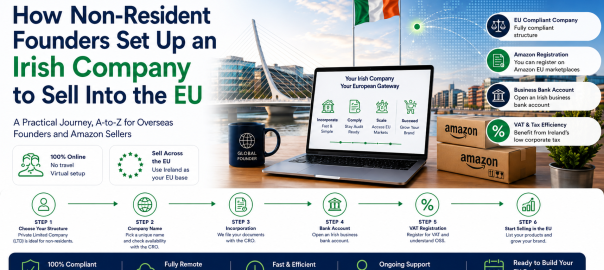
How Non-Resident Founders Set Up an Irish Company to Sell Into the Eu

QUICK ANSWER
Non-resident e-commerce founders can set up an Irish company without living in Ireland or the EEA — but the journey has two separate compliance tracks running in parallel: getting the company itself legally formed (Section 137 Bond, identity verification, AML/KYC), and getting it ready to actually trade across the EU (VAT registration, OSS/IOSS, and — if using Amazon FBA — a VAT footprint that can expand fast). Missing either track causes real delays; missing both at once is how most non-resident e-commerce setups go wrong.

At a Glance

Track One: Legal Formation Track Two: Trading & Tax Readiness
1. Identity verification (VIF/IPN) — often the real starting point 1. Irish VAT registration (+ EORI if importing stock)
2. Section 137 Bond arrangement 2. OSS/IOSS setup for cross-border sales
3. CRO incorporation & RBO filing 3. Marketplace settlement reconciliation (A2X/Link My Books)
4. Fintech or corporate banking setup 4. Local VAT registration in each country if using Pan-EU FBA

If you’re running an e-commerce business from the US, UK, UAE, or anywhere else outside the EEA and looking at Ireland as your EU entry point, you’re not alone — Ireland is a common choice for exactly this reason: English-speaking, EU/eurozone membership, and a well-understood company law framework. But non-resident founders setting up specifically to sell online run into two distinct sets of requirements that rarely get covered together: the rules around forming a company without an EEA-resident director, and the e-commerce-specific VAT obligations that kick in the moment you start trading. This guide walks through both, in the order you’ll actually hit them.

Why Overseas E-commerce Sellers Choose an Irish Company for EU Market Access

An Irish limited company gives a non-resident e-commerce founder a genuine EU legal entity — which matters for more than just optics. It means access to the EU’s VAT simplification schemes (OSS/IOSS) as an EU-established business rather than a non-EU one, straightforward eligibility for Amazon’s European marketplaces and fulfilment programmes, and a recognised EU corporate structure that EU-based suppliers, payment processors, and logistics partners are set up to work with by default.

None of that requires you to live in Ireland, or anywhere in the EEA. It does require getting two things right at the outset: how the company itself satisfies Irish director-residency law, and how it registers for VAT before its first sale.

Track One: Getting the Company Legally Formed

Identity Verification Usually Comes First

Almost no non-resident founder holds an Irish PPSN, which CRO filings require by default. The workaround is a Verification of Identity Form (VIF), which gets you an Identified Person Number (IPN) usable on all future CRO and RBO filings. This is worth starting immediately, not treating as a formality alongside everything else — for many non-resident founders, IPN approval is now the actual gating step on the whole incorporation timeline, since CRO processing depends on it being in place first. One detail that catches founders out: as of 30 April 2026, this form must be witnessed with the declarant and witness physically in the same room — a fully remote, video-witnessed process is no longer accepted, so this needs to be booked and planned for early rather than assumed to be a same-day online task.

This applies to beneficial owners too, not just directors. Anyone owning more than 25% of the company who lacks a PPSN also needs their own VIF-based IPN for the Register of Beneficial Owners (RBO) filing. The RBO filing deadline is five months from incorporation, but there’s no reason to wait — get the beneficial owner’s identity verification done in the same window as the director’s, using the same process, rather than treating it as a separate task to pick up later.

The EEA-Resident Director Requirement

Under Section 137 of the Companies Act 2014, every Irish company needs at least one director resident in the EEA (EU plus Iceland, Norway, and Liechtenstein) — residency, not nationality. If none of your founding team lives there, which is the normal situation for an overseas e-commerce founder, the standard route is a Section 137 Bond: a surety bond covering the company for €25,000, arranged at incorporation and renewed every two years. It’s the fastest option available to a brand-new company — the alternative (a Section 140 “real and continuous link” certificate) isn’t available until a company has an established Irish trading history, which obviously doesn’t exist yet at formation.

AML/KYC

Standard anti-money-laundering due diligence applies to all incoming officers and shareholders, non-resident or not — proof of identity, proof of address, and source-of-funds documentation, gathered as part of formation rather than as a separate step afterwards.

For the full breakdown of the bond, the identity verification process, common mistakes, and pricing, see “Setting Up an Irish Company Without an EEA-Resident Director.”

The Part Founders Don’t Expect: Opening a Bank Account

This is the step that surprises most non-resident founders. Traditional Irish banks can open corporate accounts for non-resident-owned companies, but a fully remote process is genuinely difficult — most traditional banks still expect some form of in-person or video verification and a clear business rationale for banking in Ireland specifically. In practice, many non-resident e-commerce founders start with an EU-facing fintech business account (providers like Wise Business or Revolut Business are commonly used for this) to get trading immediately, and either keep that as their primary account or move to a traditional bank later once the business has an established trading history. Either path is workable — the mistake is not planning for this step at all and assuming a bank account will be ready the moment the company is incorporated.

Track Two: Getting Ready to Actually Trade

Company formation and VAT registration are separate processes, and treating them as sequential rather than parallel is one of the most common causes of delay we see.

VAT Registration From Day One

Once incorporated, an Irish company selling to Irish or EU customers needs Irish VAT registration once it crosses €85,000 (goods) or €42,500 (services) — or can register voluntarily below that, useful if there are significant VAT-bearing setup costs to reclaim early. For sales into other EU countries, the One Stop Shop (OSS) scheme lets you report that cross-border VAT through a single Irish return once combined EU sales pass €10,000, rather than registering separately in every country you sell into.

Importing inventory into Ireland? If you’re shipping physical stock from outside the EU — Great Britain, the US, or China — into an Irish hub, you’ll also need an EORI number linked to your VAT profile. It’s worth setting up Postponed VAT Accounting (PVA) alongside your VAT registration at the same time: this lets you declare import VAT on your bi-monthly VAT3 return instead of paying it in cash at the border, which matters for cash flow if you’re importing stock regularly.

The Amazon-Specific Trap

If you’re planning to use Amazon’s Pan-European FBA programme, be aware before you opt in: the moment Amazon physically stores your stock in a country, you need a local VAT registration in that country — OSS does not cover this. As of January 2026, Amazon requires a minimum of five EU VAT registrations just to remain eligible for Pan-EU FBA. This is very commonly misunderstood by founders who assume OSS is a complete solution, and it’s worth deciding your fulfilment approach (Pan-EU FBA vs. the single-country European Fulfilment Network) before your VAT registrations are in place, not after stock has already started moving.

Planning to use Amazon Pan-EU FBA?
Don’t let inventory transfers freeze mid-launch because a VAT registration wasn’t in place before stock landed. Request a free e-commerce & non-resident formation review and Forti will map your required VAT footprint before you opt in.

For the full detail on OSS vs IOSS vs local VAT registration, the Pan-EU FBA VAT trap, the 2026 customs duty changes, and Extended Producer Responsibility (EPR/Repak) obligations for sellers of packaged goods, see “The Complete Guide to E-commerce Accounting for Shopify and Amazon FBA Sellers in Ireland.”

Ongoing Compliance

Once trading, a non-resident-owned Irish e-commerce company carries the same ongoing obligations as any Irish company — CRO annual returns, Corporation Tax (CT1), VAT3 filings, and Register of Beneficial Owners (RBO) filings, required within five months of incorporation and whenever ownership changes — on top of the e-commerce-specific bookkeeping challenge of reconciling Amazon and Shopify settlement reports (typically via A2X or Link My Books) across currencies and jurisdictions.

Choosing a Partner Who Understands Both Sides

This is the practical reason most non-resident e-commerce founders end up frustrated with their first advisor: a generalist formation agent understands the Section 137 Bond but not OSS/IOSS or the Pan-EU FBA VAT trap. An e-commerce-focused accountant understands VAT and marketplace reconciliation but may not have handled a non-resident director bond or VIF/IPN identity verification before. Getting both tracks right — the formation side and the trading side — usually means working with one partner who handles both, rather than coordinating a formation agent and a separate accountant who’ve never had to think about how the two interact.

Two Founders, Two Different Starting Points

These are composite, illustrative scenarios based on patterns we see across non-resident e-commerce clients — not specific named businesses.

The FBA seller who assumed OSS was enough

A US-based founder incorporated an Irish company, registered for Irish VAT and OSS, and started selling on Amazon — all correctly. Six months later, they opted into Pan-EU FBA to speed up EU delivery, assuming their existing OSS registration already covered it. It didn’t. Amazon began distributing stock into Germany, France, and Poland, and inventory transfers stalled while five local VAT registrations were arranged retroactively — during what should have been their busiest sales period.

The founder who left identity verification too late

A Dubai-based founder lined up their Section 137 Bond and company name in advance, expecting incorporation within days. They hadn’t accounted for the VIF process — booking an in-person notary appointment abroad took over two weeks, during which the CRO filing sat waiting on the IPN. The bond was never the bottleneck; the identity verification step was.

Both are avoidable with the same fix: treat both tracks as running from day one, not one after the other.

Frequently Asked Questions

Can a non-resident register a company in Ireland to sell on Amazon or Shopify?

Yes. There’s no requirement to live in Ireland or the EEA to form or own an Irish company. You do need to satisfy the EEA-resident director requirement, typically via a Section 137 Bond, and complete identity verification if you don’t hold an Irish PPSN.

Do I need to be VAT registered before I start selling?

You need Irish VAT registration once you exceed €85,000 (goods) or €42,500 (services) in turnover, though many non-resident founders register voluntarily from the outset. If you’re selling cross-border into the EU from day one, registering for OSS alongside your Irish VAT number is standard practice.

Can I open an Irish business bank account remotely as a non-resident?

It’s difficult with traditional banks, which usually expect some in-person or video verification. Most non-resident founders start with an EU-facing fintech business account to begin trading, then reassess once the company has an established history.

Does forming the company and registering for VAT happen at the same time?

They’re separate processes that can run in parallel, but they aren’t automatic — VAT registration has to be actively applied for once you know your trading plans, and it’s worth starting this alongside incorporation rather than waiting until the company is fully formed.

Do beneficial owners need identity verification too, or just directors?

Both. Anyone who owns more than 25% of the company and lacks an Irish PPSN needs their own VIF-based IPN for the RBO filing, separate from any director’s IPN. It’s worth doing both at the same time rather than leaving the beneficial owner’s verification until closer to the five-month RBO deadline.

Do I need an EORI number if I’m not importing anything myself?

No — an EORI number is only required if you’re importing physical stock into Ireland from outside the EU. If you’re sourcing entirely from EU suppliers or drop-shipping, it doesn’t apply.

What’s the biggest mistake non-resident e-commerce founders make?

Assuming OSS covers all their EU VAT obligations. It doesn’t cover local VAT registration triggered by holding stock in a country — which is exactly what happens under Amazon’s Pan-EU FBA programme.

Get Your Non-Resident E-commerce Setup Right From Day One

Forming the company and getting it ready to trade are two different jobs — Forti handles both together, so your identity verification, Section 137 Bond, VAT/OSS registration, and ongoing bookkeeping are managed as one process rather than passed between separate providers.

Talk to Forti about setting up your Irish e-commerce company → forti.ie


Yes, Someone Can Set Up Your Irish Limited Company For You

Every week, people search for some version of the same question: “Can I hire someone to open a company in Ireland for me?” The answer is yes — and it is simpler, faster, and more affordable than most people expect.

Whether you are a non-resident founder wanting an EU base, an IT contractor transitioning from PAYE, a returning emigrant setting up a consultancy, or an international business establishing an Irish subsidiary — Forti Accountants handles the entire formation and compliance process on your behalf. You do not attend an office. You do not fill in CRO forms. You do not call Revenue. We do all of it.

Why Most People Want Someone Else to Handle This

Irish company formation is not technically complex — but it is time-consuming, procedurally specific, and easy to get wrong if you are not familiar with how the Companies Registration Office (CRO) and Revenue operate. The typical DIY journey involves:

  • Researching CRO requirements and choosing the correct company type
  • Drafting and filing a Constitution (previously called a Memorandum and Articles of Association)
  • Selecting and registering a company name, including conflict checks against the CRO register
  • Appointing at least one EEA-resident director — or arranging a Section 137 bond if non-EEA
  • Registering a company registered address in Ireland (a physical address, not a PO Box)
  • Filing Form A1 with the CRO — the primary incorporation document
  • Registering with Revenue for Corporation Tax, VAT, and Employer PAYE
  • Opening a business bank account — which itself requires certified company documents
  • Setting up payroll, bookkeeping, and real-time Revenue reporting (ERR) systems

Each step involves specific forms, reference numbers, and processing timelines. A single error — a misspelt director name, an incorrect PPSN, a missing signature field — can delay incorporation by weeks. For someone running a business or operating from abroad, this is not the best use of their time.

The Core Reason People Outsource Formation
It is not that the process is impossible. It is that the cost of getting it wrong — delays, incorrect registrations, compliance gaps from day one — far exceeds the cost of having a specialist handle it correctly the first time.

What “We Handle Everything” Actually Means

When Forti says we handle everything, that is a precise statement. Below is every task Forti manages on your behalf as part of a full company formation engagement:

Task Handled by When
Company name search and reservation ✔ Forti Day 1
Constitution drafting (company rules document) ✔ Forti Day 1
Form A1 preparation and CRO filing ✔ Forti Day 1–2
Registered address provision (if needed) ✔ Forti Day 1
EEA director arrangement (if applicable) ✔ Forti Day 1–3
Revenue — Corporation Tax registration (TR2) ✔ Forti Post-CRO
Revenue — VAT registration ✔ Forti Post-CRO
Revenue — Employer PAYE registration ✔ Forti Post-CRO
ROS (Revenue Online Service) setup ✔ Forti Post-CRO
Xero cloud accounting setup + bank feed ✔ Forti Week 1
Payroll system setup + first payrun ✔ Forti Week 1–2
Bank account referral and documentation pack ✔ Forti Week 1
Director’s service agreement template ✔ Forti Week 1
Ongoing compliance calendar + deadline reminders ✔ Forti Ongoing

Your role in the process is limited to: providing your personal details, signing completed documents electronically, and attending a single onboarding call of approximately 30–45 minutes. Everything else is handled by Forti.

The Step-by-Step Process — From First Call to Trading

Here is exactly what happens once you engage Forti to handle your company formation:

Free consultation call (Day 0)

A 30-minute call with your Forti accountant to understand your business type, revenue model, expected income, client base, and whether you need VAT registration, multiple directors, or specialist structure. No cost, no obligation.

Information collection (Day 1)

Forti sends you a short secure onboarding form — your full legal name, date of birth, home address, PPSN (or foreign tax identifier), and proposed company name preferences. This takes approximately 10 minutes to complete.

Name check and CRO filing (Day 1–2)

Forti searches the CRO register for conflicts, confirms your preferred name, drafts the Constitution, prepares Form A1, and files with the CRO electronically. Standard CRO processing takes 3–5 business days. Expedited processing (same-day) is available at an additional CRO fee of €50.

Certificate of Incorporation issued (Day 5–7)

The CRO issues your Certificate of Incorporation with your unique Company Registration Number (CRN). Forti receives it on your behalf and sends you a copy immediately.

Revenue registrations (Day 7–10)

Using your CRN, Forti registers the company with Revenue for Corporation Tax, VAT (if applicable), and Employer PAYE. Revenue assigns your Tax Reference Number (TRN). Forti handles all ROS access setup.

Banking and accounting setup (Week 2)

Forti provides a bank referral letter and full documentation pack for your business bank account application. Simultaneously, your Xero cloud accounting environment is set up with automated bank feeds.

Payroll and first invoice (Week 2)

Your director salary is configured on payroll and your first payslip is processed. If billing clients from day one, Forti provides an invoice template with your company number, VAT number, and correct Irish payment terms.

You start trading — Forti handles everything else

From this point, Forti manages your ongoing compliance: bi-monthly VAT returns, monthly payroll, annual financial statements, corporation tax return, and ERR reporting. You focus on your work.

Typical Timeline
From your first call to a fully operational company — registered with the CRO and Revenue, with accounting and payroll set up — takes approximately 10–14 business days in standard cases. Expedited CRO formation can issue your Certificate of Incorporation within 24 hours of filing.

Setting Up Remotely — No Irish Address Required

One of the most common questions from international enquirers: “Do I need to be in Ireland to set up the company?” The answer is no. Forti has completed formations entirely remotely for clients in the United States, Canada, Australia, the UK, across the EU, and the Middle East.

The Non-EEA Director Requirement

Irish company law requires at least one director ordinarily resident in an EEA country. If you are not EEA-resident, two compliant solutions are available:

  • Section 137 bond: A €25,000 insurance bond placed with a registered insurer — Forti arranges this on your behalf.
  • Nominee EEA director: Forti can refer you to a compliant nominee director service. The nominee has no operational control — they exist solely to satisfy the legal requirement.

Registered Address in Ireland

Every Irish company must have a registered address in Ireland — a physical address where CRO and Revenue correspondence is received. Forti provides a registered address service as part of the formation package. All correspondence received is scanned and forwarded to you digitally on the day of receipt.

Fully Remote Formation — What You Need to Provide
To set up an Irish company remotely through Forti, you need: (1) a government-issued photo ID; (2) proof of your home address; (3) your PPSN if you have one — or a foreign tax identification number; (4) approximately 10 minutes to complete an online form. Everything else is handled by Forti.

Case Studies: Two Real Formation Stories

The following case studies are based on composite client profiles from Forti’s formation client base. Names and details have been fictionalised. Financial outcomes are realistic representations under current Irish Revenue rules.

1. Łukasz — Polish-born Software Engineer, Remote Formation from Warsaw

14 days
Call to trading
€700/day
Contract day rate
0
Forms filled by Łukasz

Łukasz is a senior DevOps engineer who moved from Ireland to Warsaw in 2022 after his employer went fully remote. In early 2026, he secured a contract with a Dublin-based fintech paying €700 per day. The client required him to invoice through an Irish-registered entity — either an umbrella company or his own limited company.

Background

Łukasz had no Irish address, no Irish bank account, and had not used his PPSN in several years. He had never formed a company before. He found Forti through an online search and booked a free consultation the same day.

What Forti handled

  • Confirmed Łukasz’s PPSN was still active with Revenue
  • Provided a registered Irish address for the company
  • Filed Form A1 with the CRO — Certificate of Incorporation issued in 4 business days
  • Registered the company for Corporation Tax and VAT with Revenue
  • Set up Xero with automated bank feeds linked to his Wise Business account
  • Issued his first invoice template — he sent it to his client on day 14
Key Complexity Resolved
Łukasz’s client required a VAT number on the invoice. Because his annual billing would exceed €40,000 from a single Irish client, VAT registration was mandatory. Forti registered the company for VAT within 5 days of the Certificate of Incorporation — meaning there was no delay to his first invoice.

Results after 12 months

Metric Outcome
Gross annual revenue (200 days @ €700) €140,000
Director salary extracted €42,000
Employer PRSA contribution €40,000
Corporation tax paid €6,100
PSS surcharge €0
Forms filled by Łukasz personally 0
Forti monthly fee €195 + VAT
“I genuinely had no idea how to set up an Irish company from abroad. I assumed it would take months and involve a solicitor. Forti had it done in two weeks and I never had to travel to Ireland once. The whole thing was done over email and one video call.”
— Łukasz, DevOps Engineer, client since January 2026

2. Sinéad — Irish Marketing Consultant, Transitioning from Agency to Freelance

7 days
Call to incorporated
€95k
Year-one revenue
3
Active clients by month 3

Background

Sinéad spent eight years as a senior digital marketing manager at a Dublin agency before going independent in late 2025. She had two clients lined up and a clear service offering — brand strategy and performance media for Irish SMEs. Her projected year-one revenue was €90,000–€100,000.

Sinéad’s concern was not whether to form a company — she knew she needed one. It was about getting it right: the correct structure, the right VAT setup, and a system that would keep her compliant without consuming her time. A contractor friend referred her to Forti.

What Forti handled

  • Advised on optimal company structure — single-director LTD was appropriate
  • Confirmed VAT registration was required from day one given projected revenue
  • Filed Form A1 — Certificate of Incorporation issued in 7 business days
  • Registered for Corporation Tax, VAT (23%), and Employer PAYE with Revenue
  • Set up Xero with automated expense capture via Hubdoc
  • Configured payroll for a monthly director salary of €3,500 (€42,000 per annum)
  • Prepared client contract template and invoice template with correct Irish VAT wording
  • Modelled Sinéad’s optimal extraction strategy: salary + PRSA contributions + dividend timing

Results after 12 months

Metric Outcome
Gross company revenue (year one) €96,000
Director salary (net after tax) ~€34,000
Employer PRSA contribution €25,000
Corporation tax paid €4,800
vs. equivalent PAYE role (estimated net) +€19,000 additional wealth
Active client count by month 12 5
“What I valued most was that Forti didn’t just set up the company and disappear. They explained what I should be paying myself, when to think about pension contributions, and what to do at year-end — before those decisions became urgent. That proactive advice is what I was really paying for.”
— Sinéad, Marketing Consultant, client since November 2025

What It Costs — Transparent Pricing

Forti‘s formation and ongoing accounting fees are straightforward. There are no hidden charges, no surprise add-ons, and no annual fee hikes without notice.

Service Fee Notes
Initial consultation Free 30–45 minute call, no obligation
Company formation (CRO filing + all Revenue registrations) €200 + VAT One-off. Includes name search, Form A1, TR2, VAT & PAYE registration
CRO standard processing fee €50 Paid directly to CRO — not a Forti charge
Expedited CRO processing (same-day) €100 additional Optional — Certificate within 24 hours of filing
Registered office address (if needed) €450/year + VAT Includes scanning and digital forwarding of all correspondence
Section 137 bond (non-EEA directors) At cost Forti manages — typically €1,500–€2,000 first year
Full-service monthly LTD management From €195 + VAT/month VAT, payroll, Xero, ERR, year-end accounts, CT return, proactive planning
€200
One-off formation fee (+ VAT)
10–14
Business days to fully operational
€195
Monthly from — full LTD management
Is the Formation Fee Worth It?
A qualified accountant charges €150–€300 per hour. Correct company formation — name checks, Constitution drafting, CRO filing, and all Revenue registrations — typically takes 4–6 hours of professional time. Forti’s flat formation fee of €200 + VAT represents significant value versus hourly billing, and eliminates the risk of errors that delay your trading start date.

10 Frequently Asked Questions

1. Do I need to be in Ireland to form an Irish company?

No. The entire formation process can be completed remotely. Forti handles all CRO filings and Revenue registrations electronically. You will need to provide proof of identity and address, sign documents electronically, and complete a short online information form. No in-person attendance is required at any stage. Forti has completed formations for clients based in the US, UK, Poland, UAE, Australia, and across the EU — all without the client setting foot in Ireland.

2. How long does it take to form an Irish company?

The CRO’s standard processing time is currently 3–5 business days from the date of filing. Once Forti has your information (typically day one of engagement), Form A1 is filed that day or the next. Your Certificate of Incorporation typically arrives within 5–7 business days. Expedited CRO processing is available for an additional €50 fee, issuing the Certificate within 24 hours. Revenue registrations follow and are typically completed within a further 5 business days. Total time from first contact to fully operational: approximately 10–14 business days.

3. What type of company should I form?

For the vast majority of Irish contractors, consultants, and small business owners, a Private Company Limited by Shares (LTD) is the correct structure. It requires a minimum of one director and one shareholder (who can be the same person), has no minimum share capital requirement, and benefits from the 12.5% Corporation Tax rate on trading profits. Forti will confirm the right structure during your initial consultation — in some cases a DAC or CLG may be more appropriate, and Forti will explain why.

4. I don’t have an Irish address — can I still form a company?

Yes. Every Irish company must have a registered address in Ireland where official CRO and Revenue correspondence is received. If you do not have an Irish address, Forti provides a registered address service at €450 per year + VAT. All official correspondence received is scanned and forwarded to you digitally on the day of receipt. This is entirely standard practice used by thousands of Irish companies.

5. Do I need a PPSN to form an Irish company?

Directors of Irish companies are required to provide a PPS number when registering with Revenue. If you are an Irish citizen or previously worked in Ireland, you will already have a PPSN — Forti can verify it is still active. If you have never held a PPSN and are not resident in Ireland, Revenue accepts foreign tax identifiers for non-resident directors. Forti navigates this process on your behalf.

6. What is the difference between company formation and company registration?

In common usage the terms are interchangeable. Technically, ‘formation’ describes the legal act of creating the company entity (CRO filing and Certificate of Incorporation), while ‘registration’ refers to the broader combined process of formation plus Revenue tax registrations. When Forti handles your formation, both are included: CRO filing and all Revenue registrations are managed as a single, complete process for the one flat fee.

7. Can Forti set up a company for me if I already have a UK company?

Yes — this is a common scenario since Brexit. Many UK-based businesses want an Irish (and therefore EU) entity for regulatory reasons, EU client relationships, or EU procurement access. Forti handles this as a standard formation. Your Irish company will be a separate legal entity from your UK company, with its own CRN, tax reference, and bank account. Forti can also advise on intercompany arrangements and transfer pricing considerations.

8. What ongoing responsibilities do I have after the company is formed?

An Irish LTD has several annual compliance obligations: filing an Annual Return with the CRO; submitting a Corporation Tax return (CT1) within 9 months of your financial year-end; filing VAT returns (bi-monthly for most companies); running monthly payroll; and meeting Enhanced Reporting Requirements (ERR) for employee expenses in real time. All of the above are managed by Forti as part of the monthly service. You will never miss a filing deadline.

9. What happens if my company doesn’t trade for a while after formation?

A company that is not yet trading is known as a dormant company. Dormant companies still have Annual Return obligations with the CRO — failure to file results in late fees and, ultimately, the company being struck off the register. Revenue obligations are suspended during dormancy but must be formally notified to Revenue. Forti manages dormancy status on your behalf — we notify Revenue, file nil returns where required, and ensure your company remains in good standing.

10. Why use Forti rather than an online company formation service?

Online formation services typically file your Form A1 and stop there — you receive a Certificate of Incorporation and are left to handle Revenue registrations, VAT, payroll, accounting, and ongoing compliance yourself. Forti’s formation service is the beginning of a complete, managed accounting relationship. We handle the CRO filing, all Revenue registrations, Xero setup, payroll configuration, and ongoing monthly compliance — under one fee, with one point of contact, and with proactive tax planning built in from day one.

How to Register an Irish Company as a Non-Resident 1

How to Register an Irish Company as a Non-Resident

If you’re running a SaaS startup in San Francisco, scaling an e-commerce brand in Dubai, or leading a tech powerhouse in New Delhi, the European Union is likely your “final boss” of market expansion. It’s a massive prize, but with 27 countries, dozens of languages, and a dizzying patchwork of local tax codes, knowing where to “plant your flag” is a high-stakes decision.

For over a decade, Ireland has been dubbed the “Silicon Valley of Europe.” But in 2026, it’s much more than just a catchy nickname—it’s a strategic necessity.

The “Frictionless” Factor

While the 12.5% corporation tax usually grabs the headlines, the seasoned founders we talk to choose Ireland for the “frictionless” factor. Post-Brexit, Ireland stands alone as the only English-speaking gateway to the EU that operates on a Common Law system. If you’ve ever done business in the US, UK, or India, the legal logic here will feel like home. You aren’t just getting a tax rate; you’re getting a digital-first regulatory environment that speaks your language.

Navigating the “Administrative Hangover”

Let’s be real, though: expanding to the Emerald Isle isn’t as simple as a “click-and-incorporate” checkout. The 2026 landscape has its own hurdles. Between securing a mandatory Section 137 Bond, navigating the new Verified Identity Number (VIN) security protocols, and satisfying the latest CRO regulations, there is a bit of a climb before you reach the view.

We’ve built this guide to be your roadmap. This isn’t a collection of dry legal statutes—it’s a straight-talking, humanised breakdown of how to build your Irish base without the administrative headache.

This guide provides a definitive, step-by-step roadmap for non-residents looking to plant their flag in Ireland, updated with the latest 2026 Revenue and CRO regulations.

1. Why Non-Residents Choose Ireland

Ireland is consistently ranked among Europe’s most attractive jurisdictions for international business. But beyond the headline numbers, there are structural reasons why founders from the United States, the United Kingdom, India, the UAE, Singapore, and beyond choose Ireland as their European base of operations.

Advantage What it means in practice Notes
12.5% corporation tax Unchanged since 2003. Applies to active trading income only. Passive income taxed at 25%. Source: Revenue.ie, Finance Act 2025
Only English-speaking EU member Post-Brexit, Ireland is the sole English-speaking country in the EU — the only common-law jurisdiction with full EU membership. Practical advantage for legal/commercial deals.
EU Single Market access An Irish company can trade across all 27 EU member states, register for One-Stop Shop VAT, and access EU R&D and innovation grants. Critical for US/Asian brands entering Europe.
Extensive tax treaty network Ireland has double taxation treaties with over 76 countries, including the USA, UK, China, Japan, Canada, Australia and India. Source: Revenue.ie tax treaties list
Common law legal system Familiar framework for founders from the UK, US, Canada, Australia, India, Hong Kong and Singapore. Reduces legal friction vs civil law systems.

Revenue cross-check — Corporation Tax Residency

Per Revenue.ie: “A company is deemed to be tax resident in Ireland if it was incorporated in Ireland on or after 1 January 2015, unless it is treated as tax resident in another country under a Double Taxation Agreement.”

Source: revenue.ie

2.1 The EEA Residency Rule — the single most important concept

Under Section 137 of the Companies Act 2014, every Irish private limited company (LTD) must have at least one director who is resident in the European Economic Area (EEA). This is not about citizenship — it is about where you actually live.

Critical distinction: citizenship vs residency

An Irish citizen living in New York = non-EEA resident. The bond is required.

A US citizen living in Berlin = EEA resident (Germany). No bond needed.

A French citizen living in Dubai = non-EEA resident. The bond is required.

A UK citizen living in London = non-EEA resident (post-Brexit). The bond is required.

The rule follows where you live — not your passport.

2.2 The 30 EEA countries — full list

The European Economic Area comprises 27 EU member states plus three EFTA nations (Norway, Iceland, Liechtenstein). Residents of any of these countries satisfy the EEA director requirement:

EEA Country (Column A) EEA Country (Column B)
AT Austria BE Belgium
BG Bulgaria HR Croatia
CY Cyprus CZ Czechia
DK Denmark EE Estonia
FI Finland FR France
DE Germany GR Greece
HU Hungary IS Iceland (EFTA)
IE Ireland IT Italy
LV Latvia LI Liechtenstein (EFTA)
LT Lithuania LU Luxembourg
MT Malta NL Netherlands
NO Norway (EFTA) PL Poland
PT Portugal RO Romania
SK Slovakia SI Slovenia
ES Spain SE Sweden

Switzerland — a common source of confusion

Switzerland is NOT in the EEA. Swiss residents do not satisfy the EEA director requirement.

Switzerland has bilateral agreements with the EU but is not a member of the EEA. A Swiss-resident director would require the Section 137 bond.

Source: worldpopulationreview.com/country-rankings/eea-countries

2.3 Non-EEA residents — your situation by region

If none of your directors live in an EEA country, you still have clear paths to incorporation. Here is how the situation breaks down for the most common jurisdictions:

Founder’s Country of Residence EEA Status Notes
United States Non-EEA. US founders are among the most common non-resident directors of Irish companies. Bond or EEA director required. Popular choice: Irish company as EU gateway for Amazon, Stripe, and SaaS businesses.
United Kingdom Non-EEA since Brexit (1 Jan 2021). UK citizens living in the UK no longer satisfy the EEA requirement. One of the most-asked questions. The answer is clear: bond required.
Canada Non-EEA. Same position as the US. Bond or EEA director required.
Australia / NZ Non-EEA. Bond or EEA director required.
India Non-EEA. Bond or EEA director required. Very active group of Irish company founders. India is one of Ireland’s top non-EEA incorporation markets.
UAE / Gulf States Non-EEA. Bond required. Growing interest from Dubai-based founders seeking EU access.
Singapore / Hong Kong Non-EEA. Bond required. Common for Asian businesses wanting EU presence.
China / Taiwan Non-EEA. Bond required.
Japan / South Korea Non-EEA. Bond required.
South Africa Non-EEA. Bond required.
Brazil / LATAM Non-EEA. Bond required.
Switzerland Not in EEA despite EU proximity. Bond required. A common mistake — Switzerland ≠ EEA
Turkey Not in EEA. Bond required. EU candidate status does not confer EEA membership.
Norway / Iceland / Liechtenstein EEA members (EFTA). No bond required — EEA director requirement satisfied. EFTA membership grants EEA status.

3. Choosing the Right Company Structure

Ireland offers several types of legal entity. For the vast majority of non-resident founders, one structure dominates by a wide margin.

3.1 Private Company Limited by Shares (LTD) — recommended for most

The LTD is the Irish equivalent of a private limited company. It is the most common corporate structure in Ireland and the most appropriate for non-resident founders. Its key characteristics:

  • Limited liability: shareholders’ personal assets are protected; liability is limited to the value of shares held
  • Minimum one director (with a separate company secretary if there is only one director)
  • No minimum share capital for private companies (most companies are incorporated with €100 in share capital)
  • Single-member companies are permitted — you can be the sole director and sole shareholder
  • No requirement to state an objects clause — an LTD can carry on any lawful business
  • Annual accounts must be filed with the CRO after year one

3.2 Other structures — when they might apply

Structure When to consider it
Designated Activity Company (DAC) Like an LTD but must state specific business objects in its constitution. Used for regulated activities (e.g. lending, fund vehicles). Rare for general trading.
Public Limited Company (PLC) Requires minimum €25,000 share capital (25% paid up before trading). For companies planning a public share offering. Not relevant for most non-residents.
Branch of a foreign company If you have an existing company abroad, you can register a branch in Ireland instead of incorporating a new entity. This preserves the parent company’s legal identity.
Unlimited Company No limited liability protection. Used in specific tax or holding structures. Rarely appropriate.

4. Step-by-Step: How to Register Your Irish Company

The full formation process has seven distinct stages. The order matters — some steps cannot begin until others are complete. Here is the sequence in full:

Step 1 — Determine your director situation (before anything else)

This decision shapes everything that follows. Ask yourself: does any director on your board live in an EEA country?

  • If YES: you satisfy the Section 137 requirement. Proceed to Step 2.
  • If NO: you have two options — (a) appoint a professional nominee director who is EEA-resident, or (b) purchase a Section 137 Non-Resident Director Bond. See Section 5 below for full details on both options.

Revenue cross-check — director requirements

The Companies Act 2014, Section 137 sets out the EEA director requirement.

The CRO’s Company Officers Guidance confirms the two compliant alternatives: an EEA-resident director, or the Section 137 bond.

Source: cro.ie — Company Officers Guidance

Step 2 — Choose and check your company name

Your company name must be registered with the Companies Registration Office (CRO). Rules include:

  • The name must be unique — the CRO’s CORE system (core.cro.ie) allows you to search existing names
  • The name must end with ‘Limited’ or ‘Ltd’ for a private limited company
  • Words such as ‘Bank’, ‘Insurance’, ‘University’, ‘Ireland’, or ‘Irish’ require special ministerial consent
  • The name cannot be misleading about the nature of the business
  • You can reserve a name for 28 days while you finalise other paperwork

Practical tip: register the .ie and .com domain names and relevant social media handles immediately after checking availability — before submitting to the CRO.

Step 3 — Obtain Irish identity numbers (PPS Number or IPN/VIN)

Since June 2023, the CRO requires all directors, company secretaries, and shareholders owning more than 25% of the company to have a verified Irish identity number. There are two types:

PPS Number

Irish PPS Number (PPSN)

For Irish residents and those who have previously worked in Ireland or received Irish state payments.

Obtained from the Department of Social Protection.

Most non-residents will not hold a PPSN.

If you are also applying for a PPSN via Forti, the process typically takes 3–6 weeks.

IPN / Verified Identity Number (VIN)

An Identified Person Number (IPN) / Verified Identity Number (VIN)

For non-residents with no prior connection to Ireland.

Obtained by completing Form VIF1 and having it witnessed and signed by a Notary Public in your country.

The standard route for non-residents.

IPN processing typically takes 2–3 working days once the correctly completed form is received by the CRO.

Important — the VIF form must be notarised

Form VIF1 is a Declaration as to Verification of Identity. It must be solemnly declared and witnessed by a Notary Public — not just a solicitor or commissioner for oaths.

Incorrectly completed VIF forms are a leading cause of incorporation delays. In 2026, CRO rejection rates for poorly prepared VIF submissions have increased.

The IPN stage is now, in practice, the real starting point of your timeline — incorporation cannot proceed until it is approved.

Source: cro.ie — Company Officers Guidance; incorpro.ie guidance on non-resident registration

Step 4 — Secure the Section 137 Bond (if no EEA director)

If none of your directors are EEA-resident, the Section 137 bond must be in place before you can submit your incorporation application. The bond cannot be obtained after filing — it must accompany the A1 form. See Section 5 for full details.

Step 5 — Prepare your incorporation documents

The CRO requires a specific set of documents to incorporate an Irish company. These are:

  1. Form A1 — the principal incorporation form, containing: company name, registered office address, directors, company secretary, shareholders, share capital details, and the presenter’s details
  2. Constitution of the Company — the founding document of the company. For an LTD, this replaces the old Memorandum and Articles of Association. It sets out the company’s rules of governance.
  3. Section 137 Bond certificate (if applicable)
  4. Identity numbers (PPS or IPN) for all directors, the company secretary, and shareholders with more than 25% of shares

Registered office — a physical Irish address is mandatory

Every Irish company must have a registered office within the state. It cannot be a PO Box.

The registered office does not need to be your place of business — most non-residents use a professional registered office service.

This address will appear on the public CRO register and will receive all official correspondence from the CRO and Revenue.

Source: Companies Act 2014

Step 6 — File with the Companies Registration Office (CRO)

Incorporation applications are filed through the CRO’s online CORE portal (core.cro.ie). The CRO processes applications in the following approximate timelines:

Stage Estimated time Notes
Standard online filing 5–7 working days Most common route; e-signatures accepted.
Paper filing 10–15 working days Not recommended.
If IPN still pending Additional 3–5 days IPN must be approved first.
If Section 137 bond required Additional 5–10 days for bond issuance Bond must be included in A1 submission.
Full end-to-end (no delays) Approximately 7–14 working days Realistic estimate for most non-residents.
Full end-to-end (with IPN + bond) Up to 3–4 weeks Allow extra time for bond and VIF processing.

On successful registration, the CRO issues a Certificate of Incorporation. Your company is now a legal entity with a unique CRO registration number. This number is your company’s permanent identifier.

Step 7 — Post-incorporation obligations (the work begins here)

Receiving your Certificate of Incorporation is the beginning, not the end. The following must be completed immediately after incorporation:

Obligation Detail & deadline
Register of Beneficial Owners (RBO) Within 5 months of incorporation. All individuals who own or control 25% or more of the company’s shares must be registered with the central RBO. Filing is free and done online at rbo.gov.ie.
Corporation Tax registration with Revenue Within 30 days of commencing trading. File Form TR2 (for resident companies) or Form TR2(FT) (for foreign companies). Mandatory for all incorporated companies.
First Annual Return (Form B1) Within 6 months of incorporation. The first B1 does not require financial accounts — subsequent returns do. This deadline is critical.
Hold first board meeting Directors should formally record the first meeting of the company. Minutes should be prepared and retained in the company register.
Open a business bank account Required to trade. See Section 7 for banking options for non-residents.
VAT registration (if applicable) When turnover exceeds or is expected to exceed €85,000 (goods) or €42,500 (services) in a 12-month period. Source: Revenue.ie.
Employer/PAYE registration If you hire any employee in Ireland, you must register as an employer with Revenue before making any payment. Separate from corporation tax registration.
GDPR / Data Protection Commission If your company processes personal data, understand your obligations under GDPR. Registration with the DPC may be required for certain data controllers.

5. The Section 137 Non-Resident Director Bond — Explained in Full

The Section 137 bond is one of the most misunderstood aspects of Irish company formation for non-residents. Here is a clear, factual explanation.

5.1 What the bond actually is

The Section 137 bond is a financial guarantee — not personal insurance. It is a €25,000 surety bond issued to the Irish State. If your company fails to meet certain obligations under the Companies Acts or the Taxes Consolidation Act, the bond provides a financial backstop for the state.

You, as the company, pay a premium to a bond provider — typically €1,500 to €2,000 for a two-year term. This premium is your cost. The €25,000 is the bond’s face value — the maximum amount the bond would pay out in a worst-case compliance failure.

5.2 What the bond covers

The bond insures the company against specific breaches, including:

  • Failure to file annual returns with the CRO
  • Failure to register for and pay taxes as required by Revenue
  • Other material breaches of the Companies Acts

It is not a general business insurance product. It does not cover commercial claims, employee liability, or professional indemnity.

6. Tax Obligations — What Revenue Requires

6.1 Corporation Tax

Corporation Tax registration is mandatory for all Irish companies. It must be completed within 30 days of commencing trading. The registration is done via Revenue’s online system ROS (Revenue Online Service) using Form TR2.

Detail Information
Trading income rate 12.5% — applies to active trading profits (the selling of goods and services, professional fees, etc.)
Passive income rate 25% — applies to rental income, investment income, interest income not from trading
Corporation tax return (CT1) Filed annually, even if no tax is payable. Filed within 9 months of the company’s accounting period end.
Payment Due by the 23rd day of the 9th month after the year end (electronic payment via ROS)
R&D Tax Credit (2026) 25% credit on qualifying R&D expenditure — increased in Finance Act 2025
Knowledge Development Box Effective 6.25% rate on qualifying intellectual property income
Late filing interest 0.0219% per day on outstanding tax — Revenue applies this automatically
Source Revenue.ie — Corporation Tax for Companies section

Revenue cross-check — tax residency of an Irish company

Per Revenue.ie: A company incorporated in Ireland on or after 1 January 2015 is deemed to be Irish tax resident unless treated as resident in another territory under a Double Taxation Agreement.

The central management and control test applies to foreign-incorporated companies: if managed and controlled in Ireland, they are Irish tax resident regardless of incorporation location.

Revenue assesses central management and control by looking at: where company policy is decided, where investment decisions are made, where major contracts are defined, and where the majority of directors live.

6.2 VAT (Value Added Tax)

VAT registration is not automatic — it becomes mandatory when your turnover reaches certain thresholds, and is optional (voluntary registration) below those thresholds.

Detail Information
VAT mandatory threshold (goods) €85,000 in any 12-month period
VAT mandatory threshold (services) €42,500 in any 12-month period
Standard VAT rate 23%
Reduced VAT rate 13.5% — fuels, building services, take-away food, some tourism services
Second reduced rate 9% — newspapers, certain sporting facilities (subject to change annually)
Intra-EU VAT registration Required if trading with EU businesses. Revenue requires evidence of genuine economic activity before issuing an EU VAT number. New companies may face scrutiny.
One-Stop Shop (OSS) Allows Irish-registered companies to report VAT on all EU B2C sales through one Irish return — avoiding 27 separate registrations.
Source Revenue.ie — VAT section; Finance Act 2025

6.3 Other key tax registrations

Tax / Levy Detail
Employer PAYE registration Required before hiring any employee or paying any director a salary in Ireland. Register via Form TR2 or ROS.
PRSI (Social Insurance) Employers pay PRSI at 11.15%–11.4% on employee wages. New auto-enrolment pension contributions of 1.5% apply from January 2026.
Relevant Contracts Tax (RCT) Applies to construction, meat processing, and forestry contracts. If your business involves these sectors, RCT registration is mandatory.
Dividend Withholding Tax (DWT) 25% applies on dividends paid to non-resident shareholders, subject to treaty exemptions. EU Parent-Subsidiary Directive may apply (0% for qualifying EU corporate parents).
Source Revenue.ie — Starting a business; Registering for tax

7. Banking for Non-Resident Companies

Opening a business bank account is often the most challenging part of the process for non-residents. Planning for banking from the start — not after incorporation — is essential.

7.1 Banking options

Option What you need to know
Digital-first banks (Revolut Business, Fire.com) Fastest to open for non-residents. Provide Irish IBANs. Can usually be opened remotely. Note: these are e-money institutions, not fully licensed banks. For most transaction types they are sufficient; for some regulated sectors or traditional counterparties, a full bank account may be required.
Irish high-street banks (AIB, Bank of Ireland, Permanent TSB) More thorough KYC process. May require evidence of Irish trading activity, physical presence documentation, and sometimes an in-person visit to Ireland. Process can take 2–8 weeks. Best for companies expecting significant Irish-based revenue or large transaction volumes.
Your own bank (home country) Some founders successfully open an account in their home country in the name of the Irish company. Depends on your bank’s policies. Ask about ‘account for a foreign subsidiary’.

Banking reality for non-residents

Digital-first banks (Revolut Business, Fire.com) are legitimate and widely used by Irish companies. They provide Irish IBANs and are integrated with accounting software.

However, they are e-money institutions — not banks. This distinction matters for certain payment processors, some EU contract counterparties, and regulated sector requirements.

Forti can introduce you to both digital-first and traditional banking options depending on your business needs. Do not leave banking until after incorporation.

8. Ongoing Compliance — Year One and Beyond

A recurring theme in non-resident Irish company formation is the gap between what formation services explain and what actually happens after year one. Here is the full picture of your annual compliance obligations:

Obligation What it involves
Annual Return (Form B1) Filed with the CRO within 56 days of your Annual Return Date (ARD). The first ARD falls 6 months after incorporation. From year two, accounts must be attached. Filing late triggers late fees and, after two late filings within five years (updated July 2025), loss of audit exemption.
Corporation Tax Return (CT1) Filed annually with Revenue via ROS. Due within 9 months of the company’s financial year end. Must be filed even if no tax is payable — the return is mandatory.
VAT Returns (VAT3) Usually bi-monthly. Deadline: 23rd of the month following the end of the VAT period.
Payroll (P30) Monthly or quarterly payroll returns via ROS if you have employees. Auto-enrolment pension from January 2026 adds new obligations.
Section 137 Bond renewal The bond must be renewed every two years — before it expires. Set a calendar reminder 90 days before expiry. A lapsed bond places the company in breach of the Companies Act.
RBO updates Any change in beneficial ownership (ownership of 25%+ shares) must be reported to the Register of Beneficial Ownership promptly.
Company secretarial records Maintain minute books, share registers, and company records. These must be available for inspection. Non-compliance can result in fines.
Source Revenue.ie; cro.ie; rbo.gov.ie

Updated audit exemption rules (July 2025)

As of July 2025, Irish companies lose their audit exemption only after two late CRO filings within a rolling five-year period — not after a single late filing as was previously the rule.

This is a more proportionate approach, but the discipline still matters. A missed deadline is an expensive mistake that a good company secretarial service prevents.

Source: Companies (Corporate Governance, Enforcement and Regulatory Provisions) Act 2024

9. Document Checklist for Non-Resident Directors

Before approaching a formation agent, gather the following. Having these ready significantly reduces delays:

Document / Decision Notes
Passport (certified copy) For each director, company secretary, and shareholder with 25%+. Must be certified by a Notary Public or other approved authority.
Proof of address (certified copy) A utility bill or bank statement dated within the last 3 months. Must show your full residential address.
Form VIF1 (notarised) Required if you do not have an Irish PPS number. Must be completed and witnessed by a Notary Public in your country.
Proposed company name With two or three alternatives in case the first choice is unavailable.
Proposed registered office address Can be provided by a formation agent or accountant. Must be a physical Irish address — not a PO Box.
Proposed share structure Who will own what percentage of the company? At least one share must be issued.
Director decision Have you identified an EEA-resident director, or will you require the Section 137 bond?
Business description A brief summary of what the company will do. Required for tax registration and may be asked for by banks.

10. Realistic Costs — Setup and Annual

Formation services often quote headline fees without the full picture. Here is a transparent breakdown of realistic costs for a non-EEA resident company formation in Ireland:

10.1 One-off setup costs

Cost item Indicative cost (2026)
Company formation (including CRO fees) €300 – €600 via a formation agent. DIY via CORE: €50 government fee.
VIF / IPN application (per person) €99 – €190 per director or shareholder who lacks a PPS number.
Section 137 Bond (if required) €1,500 – €2,000 premium for the 2-year bond.
PPS Number application (if required) €150 – €190 per applicant (if obtained through a service provider).
Corporation Tax registration Included in most formation packages. €0 if filed directly via ROS.
RBO registration €0 — filing with the Register of Beneficial Ownership is free.
First Annual Return (B1) Often included in formation packages. If not: €30 CRO filing fee + agent fee.

10.2 Annual ongoing costs

Annual cost item Indicative cost (2026)
Registered office address €199 – €540 per year depending on provider.
Nominee Company Secretary €199 – €300 per year.
Annual Return (B1) filing €30 CRO fee + accountant/agent fee. Typically €150 – €300 total.
Accounts preparation (year-end) €500 – €2,500+ depending on complexity and turnover.
Corporation Tax return (CT1) Typically included in accounts preparation fee, or €300 – €800 standalone.
VAT returns (bi-monthly) €50 – €150 per return if managed by an accountant.
Section 137 Bond renewal (every 2 years) €1,500 – €2,000 per renewal.
Payroll compliance (if applicable) €30 – €100 per payroll run depending on headcount and frequency.

11. The Most Common Mistakes Non-Residents Make

Based on the most frequent issues we see with non-resident Irish company formations, here are the mistakes that cause the most delay, cost, and compliance risk:

Mistake Why it matters
Confusing citizenship with residency The EEA requirement is about where you live, not your passport. An Irish citizen in New York still needs the bond. A German citizen in London still needs the bond.
Assuming UK founders are still EEA Brexit changed this. Since 1 January 2021, UK residents are treated as non-EEA. The bond or an EEA nominee director is required.
Submitting incomplete VIF forms The VIF1 form must be notarised correctly. Errors are a leading cause of CRO rejection and weeks of delay. Use a formation agent experienced with non-resident filings.
Treating formation as the finish line Incorporation gives you a company number. It does not register you for tax, VAT, payroll, or the RBO. These steps must follow immediately.
Ignoring the Annual Return deadline The first Annual Return is due 6 months after incorporation. Missing it incurs late fees and, after two misses in five years, loss of audit exemption.
Assuming Revolut/Fire is a bank These are e-money institutions, not banks. They are practical and widely used, but understand the distinction — some counterparties and regulators require a full bank account.
Letting the Section 137 bond lapse The bond must be renewed before its two-year expiry. A lapsed bond = breach of the Companies Act. Set calendar reminders 90 days in advance.
Not planning for tax residency An Irish company is Irish tax resident. Its worldwide profits are subject to Irish corporation tax. The central management and control test means the location of decision-making matters enormously.
Attempting Intra-EU VAT with no Irish activity Revenue requires evidence of genuine commercial activity in Ireland before issuing an EU VAT number. A dormant company with only a registered office address is unlikely to succeed.

12. How Forti Can Help

Forti is an Irish accounting and advisory firm based in Dublin. We specialise in helping international founders establish and manage compliant Irish companies — from initial formation through annual compliance, tax optimisation, and growth planning.

Our non-resident company formation service covers:

  • End-to-end incorporation — company name check, Constitution drafting, A1 filing, CRO submission
  • VIF / IPN applications for all non-resident directors and shareholders
  • Section 137 bond procurement
  • Corporation Tax registration with Revenue (Form TR2 / TR2(FT))
  • VAT registration (domestic and Intra-EU where applicable)
  • RBO (Register of Beneficial Owners) filing
  • Registered office address (physical Irish address)
  • Nominee Company Secretary service
  • First Annual Return preparation and filing
  • Ongoing annual compliance — accounts, tax returns, VAT, payroll
  • Banking introduction — digital-first and traditional Irish banks
  • Tax planning — corporation tax structure, dividends, treaty planning

13. Official Sources and Further Reading

All material facts in this guide have been cross-referenced against the following official Irish government sources:

Source URL / Location
Irish Revenue — Company residency rules View Source
Irish Revenue — Registering for tax View Source
Irish Revenue — How to register as a new company View Source
Irish Revenue — VAT registration thresholds View Source
Irish Revenue — Corporation Tax View Source
Companies Registration Office (CORE portal) core.cro.ie
Companies Registration Office — Guidance cro.ie
Companies Act 2014 — Section 137 irishstatutebook.ie
Register of Beneficial Ownership (RBO) rbo.gov.ie
Data Protection Commission dataprotection.ie
Enterprise Ireland — EEA definition enterprise.gov.ie

Disclaimer

This guide is provided for educational purposes only. It does not constitute legal, tax, or financial advice. While every effort has been made to cross-reference information with official Irish Revenue (revenue.ie) and CRO (cro.ie) sources, laws and regulations may change over time.

Always consult a qualified Irish accountant, solicitor, or tax advisor before making decisions regarding company formation, tax registration, or compliance obligations.

© 2026 Forti Accountants & Advisors | www.forti.ie | 01 906 5862


Starting a company in Ireland

Complete Guide to Starting a Company in Ireland as a Non-Resident (2026 Edition)


Ireland continues to be a practical and credible entry point into the European Union for international founders. It offers stability, a clear legal system, and a business culture that is familiar to global investors.

At the same time, 2026 has brought tighter compliance standards. The process is still structured and transparent — but it requires careful sequencing and attention to detail.

This guide walks you through the legal framework, realistic timelines, and what it truly means to manage an Irish limited company from abroad.

The Value Proposition

Founders from the United Kingdom, the United States, India, Germany, Italy and beyond often choose Ireland for consistent reasons.

EU Membership
Ireland provides full access to the European Single Market. Companies can register for Intra-Community VAT and use the One-Stop Shop (OSS) to simplify EU-wide VAT reporting.

Common Law System
The legal framework feels familiar to international founders and investors. Contracts, shareholder rights and corporate governance follow well-established principles.

Tax Infrastructure
Ireland applies:

  • 12.5% corporation tax on trading income
  • 25% corporation tax on passive income
  • A broad double taxation treaty network

It is important to understand that not all income is taxed at 12.5%. Proper classification matters from day one.

Reputation and Credibility
Ireland is a fully regulated, white-listed jurisdiction. It is widely recognised by banks, payment processors and global platforms.

Ireland is not the cheapest jurisdiction in Europe. It is one of the most respected.

Core Requirements for Non-Residents

You do not need to live in Ireland to set up a private limited company.

However, Irish company law requires three core pillars to be in place.

1. Director Residency and the Section 137 Bond

Irish law requires at least one director to be resident in the European Economic Area (EEA).

If your board does not include an EEA-resident director, you must arrange a Section 137 Non-Resident Director Bond.

This bond:

  • Acts as a financial guarantee to the Irish State
  • Covers up to €25,000
  • Is valid for two years
  • Must be renewed unless an EEA director is appointed

The typical premium is approximately €1,500–€2,000.

For UK founders, this is particularly relevant. Since Brexit, UK residents are treated as non-EEA, which means a bond (or EEA director) is required.

This step is procedural — but essential.

2. Verified Identity – The IPN and Form VIF (2026 Update)

Every director must have a verified identity number.

If you do not hold an Irish PPS number, you must apply for an Identified Person Number (IPN) using Form VIF1.

In 2026, this process has become more technical.

The Companies Registration Office now requires:

  • A wet-ink signature
  • Notary witnessing
  • Strict date formatting
  • No digital signatures

Incorrectly completed VIF forms are frequently rejected.

In practical terms, this means incorporation now depends on your IPN being approved first. Once the IPN is issued, the CRO typically completes incorporation within three to five working days.

The identity stage is now the real starting point of your timeline.

3. The Registered Office

Every Irish company must maintain a registered office address in Ireland.

This address:

  • Appears on the public register
  • Receives official correspondence
  • Must be monitored

Most international founders use a professional registered office service to ensure privacy and structured document handling.

Navigating the Formation Process

The formation journey is straightforward when approached in the correct order.

Phase 1: Planning and Identity (Weeks 1–3)

The first step is verifying the identity of directors.

If you are overseas, booking a Notary appointment for the VIF form is often the slowest part of the process.

At this stage, you should also:

  • Check name availability with the CRO
  • Confirm share structure
  • Decide whether VAT registration will be required
  • Arrange the Section 137 Bond (if needed)
  • Prepare constitutional documents

Taking time here prevents complications later.

Phase 2: Incorporation (Week 4)

Once your IPN is issued and the bond is in place (if required), the incorporation application is filed.

Typically:

  • The Certificate of Incorporation is issued within 3–5 working days
  • The Constitution is adopted
  • Shares are issued

Your company legally exists from that point.

Phase 3: Statutory Registrations (Months 2–3)

After incorporation, further obligations follow.

Register of Beneficial Owners (RBO)

You must declare any individual who owns or controls more than 25% of the company.

  • Legal deadline: within 5 months
  • Recommended practice: within 14 days

Banks and payment providers increasingly check this before activating accounts.

Tax Registration

You must register for:

VAT and Evidence of Trade (2026 Reality)

Irish Revenue now requires evidence of genuine commercial intent before issuing an Intra-EU VAT number.

This may include:

  • Signed contracts
  • Supplier agreements
  • A functioning website
  • Inventory or fulfilment arrangements
  • Clear trading plans

A dormant company without visible activity may struggle to obtain VAT registration.

Planning ahead makes this smoother.

The 2026 Compliance Environment

Incorporation is the beginning — not the end — of your responsibilities.

Ireland’s system is structured around clear deadlines.

First Annual Return (Six-Month Mark)

Six months after incorporation, your company must file its first Annual Return (Form B1).

This is often called the “zero return.”

  • No financial statements required
  • Late penalty: €100 plus €3 per day
  • Missing this filing can affect audit exemption

This deadline should be treated as critical.

The “Two-Strike” Audit Exemption Rule

Since July 2025, companies only lose audit exemption if they file late twice within a rolling five-year period.

This is more balanced than the previous rule.

However:

  • Late penalties still apply
  • Group companies may face different obligations
  • A subsidiary of a UK or US group may still require an audit depending on structure

One missed deadline is no longer catastrophic — but discipline remains essential.

Ongoing Tax and VAT Responsibilities

Corporation Tax (CT1)
Annual filing required, even if no tax is payable.

VAT (VAT3)
Usually filed every two months.
Gross income must be recorded correctly — not just net platform deposits.

OSS (One-Stop Shop)
If selling across the EU, OSS allows reporting VAT for all 27 member states through Ireland.

Bookkeeping
Irish Revenue increasingly expects cloud-based systems.
Accurate multi-currency tracking, platform fee separation and transaction-level detail are essential.

Early organisation avoids difficult year-end corrections.

Banking Considerations

Opening a high-street Irish bank account as a non-resident can be challenging.

In many cases:

  • A physical visit may be requested
  • Enhanced due diligence applies

Digital-first banks often provide a more practical alternative.

It is sensible to plan banking alongside formation rather than after it.

Privacy and Residential Addresses

Director privacy has become a common concern.

In 2026, directors may apply to:

  • Keep their residential address off the public register
  • Display a contact address instead

This protects personal privacy while maintaining full legal compliance.

The 2026 Compliance Scorecard

Requirement Status Importance
Director ID VIF/IPN secured High
Residency Section 137 Bond active or EEA director appointed Mandatory
RBO Filing Completed High
VAT Registration Evidence of trade prepared High
Address Privacy Opt-out considered Optional
First Annual Return Filed at 6 months Critical
Audit Exemption No second late filing in 5 years Important
Bookkeeping Cloud accounting system active Recommended
Corporation Tax CT registration confirmed Mandatory

Substance and Long-Term Structure

To benefit from Ireland’s tax framework, your company should demonstrate:

  • Genuine commercial activity
  • Proper board minutes
  • Clear management decisions
  • Transparent financial records

Ireland supports serious businesses. It does not favour passive or unmanaged entities.

Case Study 1: The Global Marketplace Anchor

How a US Amazon Seller Established an EU Headquarters

The Background

A US-based private-label seller had grown steadily on Amazon.com. Sales were strong, reviews were consistent, and operations were smooth.

But growth had slowed.

To scale further, the founder needed to enter Europe — particularly Germany, France and Italy. That’s when the complexity became obvious.

Direct EU VAT registration from a US entity felt unclear. Banking was uncertain. The idea of dealing with multiple European tax systems at once was overwhelming.

The Problem

The founder wasn’t short on ambition — they were short on clarity.

Europe meant 27 VAT jurisdictions. Different reporting systems. Different rules.

What they needed was not just an EU VAT number.

They needed a stable entry point — one jurisdiction that felt manageable and familiar, while still providing full access to the European Single Market.

The Approach

We focused on structure first, speed second.

Identity Verification (IPN)

Because the founder did not have an Irish PPS number, they needed an Identified Person Number.

We coordinated the Form VIF process remotely, working with a US Notary to ensure the “wet ink” signature requirement was satisfied correctly. Avoiding rejection at this stage saved weeks.

Section 137 Security

As a non-EEA resident director, a €25,000 Surety Bond was required.

Rather than appointing a local nominee director, we arranged the bond efficiently, allowing the founder to retain full control of the company.

VAT & OSS Activation

We registered the company for VAT and activated the One-Stop Shop (OSS).

Instead of worrying about 27 separate VAT registrations, the founder could now report EU VAT through a single Irish portal.

The Result

The business launched in Europe sooner than expected.

More importantly, by centralising their “EU life” in Ireland — an English-speaking jurisdiction with a clear legal framework — the founder reduced administrative complexity and regained focus.

Their time returned to sourcing, branding and product strategy.

Compliance became structured, not stressful.

Case Study 2: Restoring the Bridge

How a UK Consultancy Reclaimed Frictionless EU Trade

The Situation

A London-based consultancy had worked comfortably with EU clients for years.

After Brexit, something shifted.

EU clients became cautious. Questions around VAT status, contract structure and “Third Country” treatment began appearing in renewal discussions.

Nothing dramatic — just hesitation.

And hesitation can quietly erode revenue.

The Strategy

The solution was not to replace the UK company.

It was to complement it.

We established an Irish subsidiary to act as the firm’s EU-facing entity. This restored the familiar EU-to-EU relationship their clients expected.

Addressing the 2026 Reality

Post-Brexit Residency

Because UK directors are now treated as non-EEA, we arranged a Section 137 Bond to satisfy Companies Act requirements.

The process was administrative, not strategic — but necessary.

The “Two-Strike” Safety Net

The board was concerned about audit risk.

We explained the updated audit exemption rules: audit exemption is only lost after two late filings within five years.

Understanding this provided reassurance without reducing discipline.

Contractual Substance

To avoid any doubt around tax residence, we formalised governance:

  • Documented board decisions
  • Recorded Irish-based management activity
  • Structured operations properly

This satisfied both Irish Revenue and the compliance departments of their EU clients.

The Result

Three major EU contracts — previously uncertain — were renewed.

The Irish company became the public-facing EU entity.

The UK parent continued to focus on domestic growth.

The bridge to Europe was restored — not through marketing, but through structure.

Case Study 3: The SaaS Simplification

How a German Founder Centralised European Subscriptions

The Background

A SaaS founder in Berlin was growing quickly.

Subscriptions were increasing across multiple EU countries. Revenue was strong.

But VAT compliance was expanding faster than the product roadmap.

Different thresholds. Different reporting cycles. Different rules.

The founder described it as “engineering time being spent on tax admin.”

The Pivot

The decision was made to centralise global billing and intellectual property under an Irish company.

The goal was simplicity, not relocation.

Ireland provided:

  • Access to VAT OSS
  • English-language corporate documentation
  • A well-recognised EU jurisdiction

The Technical Execution

Verified Identity (VIF)

Although the founder was an EU resident, an Irish IPN was still required.

We coordinated German notarisation and CRO submission carefully, avoiding delays.

Revenue Recognition & Bookkeeping

SaaS models create deferred revenue complexities.

We implemented a digital-first bookkeeping system integrated directly with Stripe, ensuring:

  • Subscription tracking
  • Proper revenue allocation
  • Clean VAT reconciliation

Governance & Substance

Because tax residence depends on “mind and management,” we established:

  • Formal board records
  • Documented strategic decisions
  • Clear management structure

This protected the company’s 12.5% trading status and ensured the structure would withstand investor due diligence.

The Result

The founder described the outcome as “compliance calm.”

Instead of fragmented filings across Europe, reporting was centralised.

Roughly 10–15 hours per month of executive time were reclaimed.

More importantly, the structure became investor-ready ahead of a funding round.

A Common Theme

Across the US, UK and Germany, the pattern was similar.

The founders were not looking for shortcuts.

They were looking for:

  • Clarity
  • Structure
  • Credibility
  • Scalability

Ireland did not remove responsibility.

It provided a framework that made growth manageable.

Final Thoughts

Setting up an Irish company as a non-resident is entirely possible in 2026.

The rules are clear.
The process is structured.
The expectations are higher than before.

The founders who experience fewer difficulties are those who approach incorporation as part of a long-term structure — not just as an administrative task.

As you consider expanding into the European market, it may be worth asking:

Are you creating a company simply to access the EU — or are you building a structure designed to operate confidently and compliantly for years to come?

Frequently Asked Questions

1. Can I open an Irish business bank account without living in Ireland?

Yes, you can — but this is often the slowest part of the process.
In 2026, many non-resident founders choose digital-first business banks such as Revolut Business or Fire. These provide Irish IBANs and can usually be opened remotely.
If you prefer a traditional high-street Irish bank, the process is more detailed. You should expect:
A thorough Know Your Customer (KYC) review
Clear documentation of your business activity
Sometimes, a physical visit to Ireland
It is entirely possible. It just requires planning and patience.

2. How does the Section 137 Bond actually work?

If none of your directors live in the EEA, the bond is mandatory.
It is not insurance for you personally. It is a €25,000 financial guarantee to the Irish State in case the company fails to meet certain tax or compliance obligations. You pay a one-time premium — typically between €1,600 and €2,000 — and the bond is valid for two years.

Once arranged, you can incorporate without needing to appoint a local resident director.
It is simply a compliance safeguard built into Irish company law.

3. What is the difference between an IPN and a PPS Number?

This is a common point of confusion. A PPS Number is for individuals who live or work in Ireland. It is linked to social services and personal taxation. An Identified Person Number (IPN) is different. It is issued by the Companies Registration Office to verify the identity of company directors.

If you are a non-resident director, you apply for an IPN through Form VIF. Having an IPN does not make you an Irish tax resident. It simply allows you to legally sit on the board of an Irish company.

4. Will I be taxed twice on my Irish company profits?

In most cases, no — but it depends on your home country’s tax rules.
Ireland has an extensive double taxation treaty network, covering over 70 countries including the US, UK and India.
Typically:
The company pays 12.5% Corporation Tax in Ireland on trading profits.
When profits are distributed as dividends, your home country’s tax rules apply.
You may receive credit for Irish tax already paid.
The structure should always be reviewed in light of your personal tax position.

5. Do I need an Irish-based Company Secretary?

If your company has only one director, Irish law requires a separate person or entity to act as Company Secretary. The role is not symbolic.
The Company Secretary is responsible for:
Maintaining statutory registers
Filing annual returns
Keeping board documentation in order
Many non-resident founders appoint a professional service provider to handle this, ensuring nothing is missed.

6. What happens if my company is dormant in the first year?

Even if your company has no transactions, your compliance obligations still apply.
You must still file:
Your first Annual Return (B1) at the six-month mark
An annual Corporation Tax (CT1) return
Failing to file a “zero” return is one of the most common mistakes made by non-resident founders. Dormant does not mean exempt.

Thinking About Your Next Step?

Starting a company in another jurisdiction should feel like growth — not like administrative pressure.

The key is understanding the structure before you move.

Some founders simply want reassurance that their current setup is compliant.
Others are ready to incorporate but want a clear timeline and checklist.
Many prefer to outsource the bookkeeping and filings from day one so nothing is missed.

If you are considering Ireland as your EU base, it may be worth pausing and asking:

Is your current structure giving you confidence — or is it creating uncertainty as your business grows?

And if you were to begin today, would you rather navigate the system reactively, or build it calmly and correctly from the start?

Understanding the Role of a Non-Resident Director in Ireland

Understanding the Role of a Non-Resident Director in Ireland

Thinking of taking your business global? Ireland encourages you to spread far and wide! For this, you’ll need a non-resident director. Tread carefully though. While they can open doors to international expertise, fresh investment, and new markets, there are legal hoops to jump through.

Let’s break it all down and you can expand while staying on the right side of Irish law.

What is a Non-Resident Director?

A non-resident director is simply someone who serves on the board of an Irish company but doesn’t live in Ireland. Same responsibilities as local directors but reside outside the country. This comes with extra implications, which we cover below.

Legal Requirements To Appoint a Non-Resident Director

Irish law has a few conditions:

1. You Must Have an EEA-Resident Director (Or Take Alternative Steps)

At least one director is required to be a resident of the European Economic Area (EEA). If you don’t have one, you need to:

  • Get a Section 137 Bond – A €25,000 insurance bond (financial safeguard in case of tax or legal violations).
  • Prove a ‘Real and Continuous Link’ to Ireland – If your company has a physical presence in Ireland (like an office or local employees), you might qualify for an exemption from the bond requirement.
Secure your Section 137 Bond Today!

2. Corporate Tax Residency Factor

Ireland determines corporate tax residency based on where key management decisions happen. Your business may be regarded as a tax resident elsewhere if the majority of your board members reside outside of Ireland. This could cause additional difficulties with your tax responsibilities.

3. Compliance with Irish Company Law is Non-Negotiable

Non-resident directors must comply with all legal requirements under the Companies Act 2014, including:

  • Filing annual returns with the Companies Registration Office (CRO)
  • Keeping accurate financial records and accounts.
  • Attending board meetings (virtually or in person)
  • Acting in the company’s best interest

Why Appoint a Non-Resident Director?

Having a non-resident director can bring several advantages to your Irish business:

1. Global Market Access

A director with international experience can open doors to new markets, partnerships, and expansion strategies.

2. Draw in Foreign Capital

Having well-known and seasoned executives on your board gives investors greater comfort. You may be able to get finance through a well-connected non-resident director.

3. Incorporate Industry-Specific Knowledge

Do you need advice from someone with expertise in a particular niche in the area? A non-resident director can offer important contacts and expertise.

4. Enhance Corporate Governance

A diverse board improves decision-making, fortifies governance, and boosts the standing of your business.

Appoint Your Non-Resident Director With Forti Now!

The Challenges of Having a Non-Resident Director

Being a non-resident director comes with its fair share of hurdles. Here are a few key things to keep in mind:

1. Staying on Top of Legal Compliance

Irish corporate law doesn’t cut you any slack just because you’re not physically there. If you or your director aren’t up to date with the latest regulations, you could face fines—or worse, legal trouble.

2. Corporate Tax Residency Confusion

If most of your directors are based outside Ireland, tax authorities might start questioning where your business is actually operating from. That could mean double taxation or losing out on Irish tax benefits. Not ideal!

3. Communication Hurdles

Different time zones and remote work can slow down board meetings and decision-making. Staying connected and keeping everyone on the same page takes extra effort.

4. Extra Costs (Like That Section 137 Bond)

Unless you have a director who’s an EEA resident, you’ll either need to prove a real presence in Ireland or cough up for a Section 137 Bond—another expense to factor in.

How to Stay Compliant with a Non-Resident Director

Here’s how to designate a non-resident director legally and without making any compliance errors:

1. Get a Section 137 Bond or Designate an EEA-Resident Director

Companies are required to get a Section 137 Bond or have at least one director who is an EEA resident

2. Maintain a Strong Irish Presence

If you want to avoid the bond, show that your company has a real connection to Ireland—like a local office, staff, or significant operations.

3. Stay on Top of Compliance & Governance Best Practices

Your non-resident director still needs to attend board meetings, review financial reports, and make sure all legal requirements are fulfilled.

4. Work With Professional Advisors

Working with an experienced Company Secretary or legal expert can help with:

  • Annual return filings & bookkeeping
  • Tax residency & corporate structuring
  • Corporate governance best practices
Avoid Penalties—Get Forti’s Legal Support Today!

How Forti Can Help with Non-Resident Director Compliance

At Forti, we specialize in helping businesses like yours appoint non-resident directors without the legal headaches. Our services include:

  • Securing a Section 137 Bond
  • Handling company registration & tax compliance
  • Maintaining corporate governance best practices
  • Managing annual filings & CRO requirements
  • Providing expert guidance on international business structures

We make compliance simple, stress-free, and 100% legal.

FAQs About Non-Resident Directors in Ireland—

  1. Can an Irish company have only non-resident directors?
    No. You need at least one EEA-resident director. The alternative is securing a Section 137 Bond or proving a substantial link to Ireland..
  2. What is a Section 137 Bond, and how much does it cost?
    It’s a €25,000 insurance bond covering potential penalties—renewable every two years in case you don’t have an EEA-resident director.
  3. Can a non-resident director attend board meetings remotely?
    Yes! They can join virtually. Physical attendance may sometimes be required for specific governance or regulatory purposes though.
  4. How does a non-resident director affect corporate tax residency?
    If most directors live outside Ireland, tax authorities may classify your company as a tax resident elsewhere. This will impact your tax obligations.
  5. What happens if a company fails to comply with Irish residency requirements?
    Fines and legal action. You’ll end up clashing with the Companies Registration Office (CRO) and Revenue Commissioners.