Tag Archives: Bookkeeping

E-com Accounting

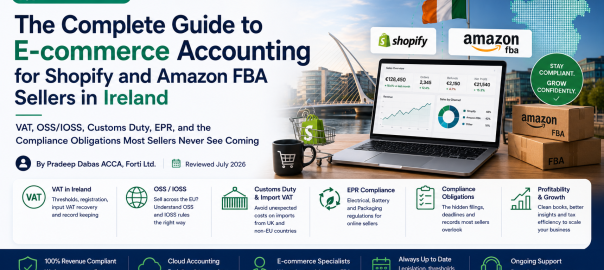
The Complete Guide to E-commerce Accounting for Shopify and Amazon FBA Sellers in Ireland

QUICK ANSWER
E-commerce accounting differs from standard Irish SME accounting because several distinct compliance regimes apply from the first sale, with no minimum threshold. The biggest blind spots are: VAT registration is required in every country where Amazon physically stores your stock (OSS does not cover this); the EU’s low-value customs duty exemption ended 1 July 2026; and packaging, electronics, or battery sellers may owe Extended Producer Responsibility (EPR) registration in Ireland regardless of where the business is based.

Running an e-commerce business looks deceptively simple from the outside: list a product, make a sale, ship it out. In reality, the moment a business starts selling across borders — which almost every Shopify or Amazon seller does within their first year — it inherits a compliance footprint that looks nothing like a typical Irish SME’s. A standard bookkeeping model built around one VAT number, one set of accounts, and domestic sales simply doesn’t hold up.

This guide walks through what actually makes e-commerce accounting different, covering the areas that most catch sellers out: VAT and OSS/IOSS, the specific VAT trap hidden inside Amazon’s Pan-European FBA programme, the customs duty change that took effect in July 2026, an environmental compliance obligation most sellers have never heard of, and how to actually reconcile the mess of data a marketplace generates every month.

The Irish E-commerce Market at a Glance

E-commerce isn’t a side channel in Ireland any more — it’s mainstream. Retail e-commerce in Ireland reached an estimated €8.8 billion in 2025, up around 6% year-on-year, and roughly 37.5% of Irish businesses now report having e-commerce sales. Amazon remains the single largest online retailer serving the Irish market by a wide margin. Growth of this scale is exactly why compliance gaps that were once minor — a missed VAT registration, an overlooked packaging obligation — now carry real financial exposure for sellers who are scaling faster than their back-office setup can keep up with.

Why E-commerce Accounting Doesn’t Fit a Standard Bookkeeping Model

A typical Irish limited company sells to Irish customers, charges Irish VAT, and files one VAT3 return covering one jurisdiction. An e-commerce business rarely works that way for long. Within months of scaling past a modest turnover, a Shopify or Amazon seller is likely to be:

  • Selling to customers in multiple EU countries, each with its own VAT rate
  • Holding stock in fulfilment centres outside Ireland, which changes where VAT is actually owed
  • Generating hundreds or thousands of small transactions a month, each bundled with marketplace fees, refunds, and currency conversions
  • Subject to environmental and product compliance obligations that have nothing to do with tax at all

None of this is optional or something that can be addressed “later, once the business is bigger.” Several of these obligations apply from the very first sale, with no minimum threshold. Getting the structure right early avoids a much more expensive clean-up exercise down the line.

VAT and OSS/IOSS Registration for Cross-Border Sellers

The starting point for any Irish e-commerce business is Irish VAT registration. As of May 2026, the Irish VAT registration thresholds are €85,000 for goods and €42,500 for services. Below these thresholds, registration is optional; above them, it’s mandatory.

But for a business selling into other EU countries, Irish registration is only the beginning. The One Stop Shop (OSS) scheme lets a business report VAT on cross-border B2C sales to other EU countries through a single return filed in Ireland, rather than registering separately in every country it sells into. The OSS threshold remains €10,000 — combined across all cross-border EU sales, not per country — above which OSS (or individual country registration) becomes necessary.

For non-EU sellers shipping low-value goods directly to EU consumers, the Import One Stop Shop (IOSS) serves a similar purpose for import VAT, allowing VAT to be collected at the point of sale rather than at the border.

A caution on registering below the threshold: sellers below the €85,000/€42,500 thresholds can register for VAT voluntarily, which is often worthwhile if there are significant VAT-bearing costs to reclaim. But Revenue does scrutinise voluntary applications from pre-trading or pre-revenue businesses more closely than standard registrations. Be ready to show concrete evidence of an intention to trade — supplier contracts, a live Shopify store, or inventory invoices — as applications lacking this can be queried or rejected outright.

Importing Stock Into Ireland? Don’t Overlook PVA and Your EORI Number

Many Irish e-commerce sellers import stock from Great Britain (now treated as a non-EU import post-Brexit) or from Asia before listing it on Shopify or Amazon. Two additional pieces of the compliance picture come into play the moment goods are imported from outside the EU:

  • An EORI number (Economic Operators Registration and Identification) is required to clear customs, and needs to be linked to the business’s Revenue VAT registration.
  • Postponed VAT Accounting (PVA) lets a VAT-registered, Customs & Excise-registered importer account for import VAT directly on their VAT3 return — declaring and reclaiming it in the same return — rather than paying it in cash at the point of entry. This is a genuine cash-flow advantage for any business importing stock regularly, and Revenue’s own guidance confirms it removes the need to pay VAT at the point of importation, subject to the usual deductibility rules.

Businesses that were both VAT- and Customs & Excise-registered before PVA’s introduction received automatic entitlement to use it; anyone registering for VAT and Customs & Excise since then should confirm their postponed accounting position is properly set up — including the correct PA1 entries on the VAT3 — before their first import lands.

Comparing OSS, IOSS, and Local VAT Registration

These three mechanisms are frequently confused, and mixing them up is the single most common VAT mistake among growing e-commerce sellers.

OSS IOSS Local VAT Registration
What it covers Cross-border B2C sales to other EU countries, from stock held in one EU country Import VAT on low-value goods (≤€150) shipped directly to EU consumers from outside the EU VAT on sales and stock held physically within that specific country
Threshold €10,000 combined cross-border EU sales No threshold — per consignment≤€150 No threshold — triggered by holding stock in-country≤€150
Common mistake Assuming it covers Pan-EU FBA stock-holding — it doesn’t Assuming it still means duty-free after 1 July 2026 — it doesn’t Assuming Amazon handles this automatically — it doesn’t

The crucial limitation to understand: OSS only covers where VAT is owed on the sale, not where a business is required to hold a full local VAT registration. That distinction becomes critical the moment stock is physically stored outside Ireland — which is exactly what happens with Amazon’s Pan-European FBA programme.

Pan-EU FBA: The VAT Obligation Most Sellers Don’t See Coming

This is the single most common compliance gap among growing Amazon sellers, and it catches out businesses that are otherwise fully VAT compliant in Ireland.

Amazon’s Pan-European FBA programme distributes a seller’s inventory automatically across its European fulfilment network to speed up delivery and reduce shipping costs. It’s a genuinely useful feature — but it comes with a rule that has nothing to do with sales thresholds: the moment inventory is physically held in a country, VAT registration is required in that country, from the very first unit stored. OSS does not cover this. There is no minimum threshold and no grace period.

In practice, this means a seller enrolled in Pan-EU FBA can find their stock automatically moved into Germany, France, Italy, Spain, Poland, and the Czech Republic — sometimes more — without VAT registration in any of them. Amazon has tightened this further: as of January 2026, sellers must hold VAT registrations in a minimum of five EU countries just to remain eligible for the Pan-EU programme at all. Fall short, and Amazon can restrict or block inventory transfers, which quietly removes the delivery-speed and fee advantages the programme exists to provide in the first place.

Sellers who want to avoid this exposure without giving up FBA altogether typically use the European Fulfilment Network (EFN) instead — storing stock in a single country and shipping cross-border from there — which limits the VAT footprint to that one country plus OSS for cross-border sales, at the cost of slightly slower delivery in some markets.

Illustrative Example: How a Growing Seller’s VAT Footprint Changes

This is a composite scenario based on patterns we see repeatedly across e-commerce clients — not a specific named business.

A Shopify and Amazon seller starts out shipping only from Ireland. In year one, all stock sits in a single Irish warehouse , one VAT registration, one VAT3 return, straightforward. As EU sales grow past €10,000, the seller registers for OSS, which now handles the cross-border VAT on those sales through a single Irish filing ; still manageable.

In year two, the seller opts into Amazon’s Pan-EU FBA programme to speed up delivery across Europe. Overnight, Amazon begins distributing stock into Germany, France, Italy, Spain, and Poland. OSS does not cover any of this stock-holding — the seller now needs five separate local VAT registrations, five sets of local filing obligations, and (per Amazon’s current rules) must have all five in place simply to stay eligible for the programme. A seller who enrolled without anticipating this can find inventory transfers frozen mid-flow while registrations are sorted out — often the first sign something has gone wrong, and a costly one during a peak sales period.

The practical takeaway: before opting into Pan-EU FBA, know exactly which countries your stock will land in and have VAT registrations in place before it arrives, not after. Amazon’s Inventory Event Detail Report is the standard way to track where stock is actually being held.

Unsure where your stock is currently being stored?

Amazon FBA inventory transfers happen automatically behind the scenes, which is exactly how sellers end up with an unregistered VAT obligation without realising it.
Request a free e-commerce VAT & EPR review → forti.ie

The 2026 Customs Duty Change: What It Means for Low-Value Consignments

Until recently, the EU allowed goods valued at €150 or less to enter the bloc free of customs duty. That exemption ended on 1 July 2026. In its place, a temporary flat customs duty of approximately €3 per HS-code line item now applies to consignments of €150 or less, regardless of whether the Import One Stop Shop is used. This interim measure is expected to run until 1 July 2028, ahead of a broader EU customs reform.

The detail that trips people up: IOSS still simplifies how VAT is collected at checkout, but it no longer means duty-free. These are two separate things that used to align neatly and no longer do. A seller who assumes their IOSS registration still covers “no extra charges at the border” for small parcels is working from an outdated assumption that changed only recently — worth flagging explicitly to customers and factoring into landed-cost pricing for low-value items shipped directly from outside the EU.

A Compliance Obligation Most Sellers Have Never Heard Of: Extended Producer Responsibility (EPR)

This is the area most e-commerce guides skip entirely, and it’s a genuine blind spot for sellers focused only on VAT.

Extended Producer Responsibility is an environmental compliance regime that makes anyone placing packaged goods, electrical equipment, or batteries on the Irish market financially responsible for that product’s end-of-life collection and recycling. In Ireland, packaging EPR is administered through Repak, the country’s approved compliance body, with separate schemes covering WEEE (waste electrical and electronic equipment) and batteries.

The important point for e-commerce sellers: this obligation applies to distance sellers, not just Irish-based manufacturers. A business based outside Ireland — including a non-resident seller — that supplies packaged goods directly to Irish consumers is treated as a “producer” under Irish packaging regulations and carries the same registration and reporting obligation as a local manufacturer would. The same logic applies to anyone selling electronics or battery-powered products to Irish buyers via Amazon.ie or a Shopify store shipping into Ireland.

  • Businesses placing packaging on the Irish market above certain thresholds (broadly, larger volumes and turnover) are classed as “major producers” and must join Repak, reporting packaging weights and paying a fee based on volume
  • Smaller producers typically have a simplified registration route with a fixed annual fee rather than the full major-producer reporting burden
  • Sellers of electrical or battery-powered goods have a parallel obligation through the National WEEE Register

This is easy to overlook because it isn’t a tax and doesn’t show up on a VAT return — but it’s a genuine legal obligation with financial penalties for non-compliance, and it’s one that grows more relevant every year as EU packaging waste rules tighten. Any e-commerce business shipping packaged goods into Ireland at meaningful volume should have this checked, not assumed away.

Reconciling Amazon and Shopify Settlements With A2X or Link My Books

Beyond registration and compliance, the day-to-day bookkeeping challenge for e-commerce sellers is different in kind from a typical business. A single Amazon settlement report can bundle together gross sales, referral fees, FBA fees, storage fees, refunds, promotional discounts, and VAT — all in different currencies if selling across multiple marketplaces — and dumping that raw data into a general ledger produces a mess that no accountant can make sense of, let alone use for accurate VAT filings.

This is where reconciliation tools like A2X and Link My Books earn their keep. Both integrate directly with Amazon, Shopify, and other marketplaces, breaking down each settlement into its individual components and posting a clean, correctly categorised summary into Xero or QuickBooks — with VAT correctly split by jurisdiction, which matters enormously once a seller has multiple VAT registrations in play. Attempting to reconcile marketplace settlements manually, without one of these tools, is one of the most common causes of inaccurate VAT filings among growing e-commerce sellers.

Corporation Tax and Multi-Marketplace Bookkeeping Considerations

Once the VAT and reconciliation side is under control, standard Irish company obligations still apply on top: Corporation Tax (CT1) on annual profits, CRO annual returns, and — where turnover and other thresholds are exceeded — statutory audit requirements. The complexity multiplies with the number of marketplaces and currencies involved: a seller running Shopify, Amazon, and perhaps eBay simultaneously needs bookkeeping that consolidates all three cleanly into one set of management accounts, ideally on a monthly cycle rather than being reconstructed at year-end.

What to Look for in an E-commerce Accountant

Given everything above, a generalist accountant without e-commerce experience will typically miss at least one of these areas — most often the Pan-EU FBA VAT trap or the EPR obligation, since neither shows up unless someone is specifically looking for it. When choosing who handles your accounts, look for:

  • Direct, practical experience with Amazon and Shopify settlement reconciliation, not just general bookkeeping
  • Familiarity with OSS/IOSS registration and the distinction between cross-border sales VAT and local stock-holding VAT
  • Awareness of EPR/Repak obligations for physical goods sellers — not every accountant will think to raise this
  • Comfort working with tools like A2X or Link My Books as standard practice, not an unfamiliar add-on

Frequently Asked Questions

Do I need to register for VAT in every country where Amazon stores my stock?

Yes. The moment Amazon physically holds your inventory in a country under Pan-EU FBA, you need a local VAT registration there — there’s no threshold and no grace period. OSS does not cover this; it only applies to cross-border sales, not stock-holding.

What’s the difference between OSS and IOSS?

OSS covers cross-border B2C sales of goods and services to other EU countries where you hold stock in one EU country. IOSS covers import VAT on low-value consignments (€150 or less) shipped directly to EU consumers from outside the EU. They serve different situations and aren’t interchangeable.

Does OSS cover Pan-EU FBA VAT registration?

No. This is the most common misunderstanding among growing sellers. OSS handles VAT on the sale itself; it does not replace the local VAT registration required wherever your stock is physically held.

Is IOSS still duty-free for orders under €150?

No, not since 1 July 2026. The EU’s duty-free exemption for consignments of €150 or less ended on that date. A flat customs duty of roughly €3 per HS-code line item now applies regardless of whether IOSS is used, as an interim measure expected to run until 1 July 2028.

Do I need to register for EPR/Repak if I only sell through Amazon FBA?

Potentially, yes. If you supply packaged goods, electronics, or batteries directly to Irish consumers — including via Amazon.ie — you may be classed as a “producer” under Irish packaging regulations regardless of where your business is based, and carry a Repak (or WEEE Register) registration obligation.

How many EU VAT registrations do I need for Amazon Pan-EU FBA in 2026?

As of January 2026, Amazon requires a minimum of five EU VAT registrations to remain eligible for the Pan-EU FBA programme. The exact countries depend on where your stock is distributed — commonly Germany, France, Italy, Spain, and Poland.

What tools help reconcile Amazon and Shopify settlements for VAT?

A2X and Link My Books are the two most widely used tools. Both break marketplace settlement reports into their individual components (sales, fees, refunds, VAT) and post a clean summary into Xero or QuickBooks, split correctly by jurisdiction.

How does Postponed VAT Accounting (PVA) help Irish e-commerce importers?

PVA lets a VAT-registered, Customs & Excise-registered business account for import VAT on its VAT3 return instead of paying it in cash at the point of import. It preserves working capital on imported stock, but requires an active EORI number and correct PA1 reporting on the VAT3.

E-commerce accounting isn’t harder than standard SME accounting because the numbers are more complicated — it’s harder because there are simply more distinct compliance regimes running in parallel, several of which apply from the first sale with no threshold to build up to. Getting the structure right from the outset is considerably cheaper than untangling it after a few years of growth.

Get Your E-commerce VAT and Compliance Position Reviewed

If you’re selling on Shopify or Amazon — or planning to opt into Pan-EU FBA — it’s worth having your VAT registrations, OSS/IOSS setup, and EPR obligations checked by someone who works with e-commerce sellers day to day, before a gap like the ones above turns into a frozen inventory transfer or a backdated liability.

Forti works with Shopify and Amazon FBA sellers on VAT registration, OSS/IOSS compliance, and monthly bookkeeping using A2X and Link My Books — from €195/month.

Talk to Forti about your e-commerce accounts → forti.ie

Monthly Financial Review

The 15-Minute Monthly Money Check Every Founder Should Do

A simple habit that keeps your business steady, confident, and in control

Most founders don’t avoid their numbers because they don’t care — they avoid them because they feel overwhelming, unclear, or always slightly out of date. And by the time you do look, it’s usually because something feels off.

The truth is, you don’t need hours of reports to stay on top of your finances. You just need a simple rhythm. A short monthly check-in with your bookkeeper can give you a clear picture of where you stand, what needs attention, and what you can confidently ignore.

This 15-minute ritual isn’t about accounting — it’s about peace of mind. It’s about replacing guesswork with clarity and making sure there are no surprises waiting around the corner.

Why This Matters More Than You Think

Running a business is busy, and finance often slips down the priority list until a deadline or cash worry pushes it back up. But the businesses that feel calm around money aren’t necessarily the most profitable — they’re the ones with visibility.

A short monthly conversation keeps you connected to the reality of the business. It helps you spot small issues early, make decisions with confidence, and sleep a little better knowing there’s nothing lurking in the background. Over time, this habit builds trust in your numbers and confidence in your direction.

When to Do It — Before the 10th Each Month

There’s something powerful about having a fixed point in the month when you pause and look at the financial picture. Doing this before the 10th works well because most of the previous month’s activity is settled, but you still have time to act if something needs attention.

Once it becomes routine, it stops feeling like a meeting and starts feeling like a reset. You know it’s coming, your bookkeeper knows it’s coming, and the conversation becomes easier every month. That consistency is what turns finance from reactive to proactive.

Phase 1: A Quick Reality Check (3 Minutes)

Before diving into performance, it’s worth making sure the numbers you’re looking at actually reflect reality. There’s no value in analysing reports if the basics aren’t right.

This quick check builds trust. When you know the data is clean and complete, the rest of the conversation becomes far more useful. It removes doubt and allows you to focus on what matters — understanding the story behind the numbers rather than questioning them.

Are All Accounts Reconciled?

This simply means every transaction showing in the bank is recorded correctly in your accounts. It sounds small, but it’s the difference between clarity and confusion.

When payment platforms like Stripe or Revolut are included, you get a full picture of your cash rather than just part of it. Keeping this tidy each month prevents bigger tidy-ups later and ensures you’re always looking at a reliable position.

Is Anything Sitting in “Uncategorised”?

Every business ends up with a few transactions that don’t quite have a home yet. Left alone, they quietly build up and make reports harder to trust.

Clearing them monthly keeps things clean and often highlights where processes could be smoother — maybe receipts aren’t being uploaded quickly, or suppliers need clearer references. It’s a small step that keeps everything running more smoothly.

Are Any Important Invoices Missing?

This is mostly about making sure you’re not leaving money behind, especially when it comes to VAT reclaims. If a high-value purchase isn’t documented properly, it can delay claims and create unnecessary back-and-forth later.

Checking this regularly encourages good habits across the business. Documentation becomes part of the process rather than an afterthought, and year-end becomes far less stressful.

Here is the quick checklist: 

Bank Reconciliation

Ask: Are all accounts reconciled to month-end?

This includes:

  • Current accounts
  • Savings accounts
  • Stripe / PayPal
  • Revolut or payment processors

If accounts aren’t reconciled, the rest of the discussion is guesswork.

The “Suspense” or Uncategorised Review

Ask: Is anything sitting in Suspense or Uncategorised?

These usually indicate:

  • Missing receipts
  • Unknown transactions
  • Incorrect postings

Clearing them ensures your reports reflect reality, not placeholders.

The Receipt Gap Check

Ask: Are any high-value purchase invoices missing?

Why this matters:

  • Protects VAT reclaims
  • Keeps audit trails clean
  • Prevents last-minute scrambles

Outcome of Phase 1:
You now know the numbers are reliable.

Phase 2: The Numbers That Actually Matter (7 Minutes)

You don’t need to review dozens of reports to understand your business — just a handful of meaningful numbers. These metrics give you a quick snapshot of health, momentum, and risk.

Over time, you start to develop an instinct for them. You’ll notice trends sooner, ask better questions, and feel far more connected to how the business is performing beyond just “busy” or “quiet.”

What’s Your Real Cash Position?

Your bank balance alone doesn’t tell the full story because some of that money already belongs to Revenue. When you subtract upcoming tax liabilities, you see what’s truly available.

This number removes false comfort and replaces it with clarity. It helps you make confident decisions about spending, investing, or holding back — all based on reality rather than assumptions.

Who Still Owes You Money?

Late payments are one of the biggest sources of unnecessary stress in any business. A quick look at who’s overdue keeps collections proactive rather than awkward or last-minute.

When customers know you review this regularly, payment behaviour naturally improves. It’s less about chasing and more about keeping expectations clear.

Has Your Margin Shifted?

Margins tell you how efficiently your business is operating. A small movement can signal supplier changes, pricing issues, or shifts in what you’re selling.

Spotting these early gives you options — renegotiate, adjust pricing, or rethink discounts. It’s far easier to correct course now than months down the line.

How Long Would Cash Last?

This is one of the most reassuring numbers you can know. Instead of worrying vaguely about the future, you have a clear timeline.

Knowing your runway helps you plan with confidence — whether that’s hiring, investing, or simply deciding to hold steady. It replaces uncertainty with perspective.

Are You Growing, Flat, or Slowing?

Looking at revenue compared to last month keeps you grounded in trajectory rather than isolated results. Even small changes can tell you a lot about demand or momentum.

It’s not about reacting emotionally to every fluctuation, but about staying aware of direction so you can respond thoughtfully.

Are Costs Quietly Creeping Up?

Subscriptions, small tools, and operational tweaks can gradually increase your monthly spend without you noticing. A quick scan keeps this in check.

This habit encourages intentional spending and makes it easier to decide what’s genuinely adding value and what might be trimmed.

Profit vs Cash — Do They Tell the Same Story?

Sometimes the business looks profitable but still feels tight on cash. Understanding why helps avoid confusion and unnecessary worry.

This perspective ensures you’re balancing growth with liquidity and not mistaking accounting profit for available funds.

Here is the quick checklist:

This is where insight happens. These are the seven numbers every founder should understand — not just accountants.

True Cash Position

Formula:
Bank balance − real-time tax liabilities (VAT, PAYE, CT accrual)

Why it matters:
Your bank balance is not your spending power. This figure shows what you actually have available.

Debtors Deep Dive

Ask: Who are the top 3 customers over 60 days?

Then decide:

  • Who calls them
  • When payment is expected

Cash flow problems are often collection problems in disguise.

Gross Margin Health

Ask: Did margin move by more than 2%?

If yes, investigate:

  • Supplier price increases
  • Discounting
  • Product mix changes

Margins rarely collapse overnight — but they erode quietly.

Cash Runway

Ask: If we make no new sales, what exact date does cash run out?

This single metric reduces anxiety and improves planning.
It turns vague worry into a clear timeline.

Revenue Trend vs Last Month

Is revenue:

  • Growing
  • Flat
  • Declining

Even a quick comparison highlights momentum early.

Cost Creep Check

Have any recurring costs increased?
Software subscriptions and small expenses quietly add up.

Profit vs Cash Reality

Are you profitable but still cash-tight?
That’s usually due to debtors, stock, or tax timing.

Outcome of Phase 2:
You understand performance, risk, and momentum.

Phase 3: Staying on the Right Side of Compliance (5 Minutes)

Compliance doesn’t need to feel heavy or intimidating when it’s handled little and often. A quick monthly check keeps everything visible and manageable.

Rather than scrambling at year-end, you’re simply confirming that things are ticking along as they should. It’s a calm, steady approach that reduces risk without adding stress.

Have Expenses and Benefits Been Reported?

With real-time reporting becoming more common, it’s helpful to confirm everything has been logged correctly before payments go through.

This keeps you aligned with Revenue expectations and ensures there’s no backlog building quietly in the background.

Is the Director’s Loan Moving?

Director’s loans can creep up without much notice, so a quick monthly glance keeps things transparent.

It’s less about restriction and more about awareness — making sure personal and business finances stay balanced and predictable.

Is Payroll Fully Up to Date?

Payroll touches both compliance and team trust, so it’s worth confirming everything is accurate.

A regular check reduces the risk of surprises and reassures you that contributions and filings are exactly where they should be.

Here is the quick checklist:

Compliance isn’t just about avoiding penalties — it’s about protecting the business and the directors.

Enhanced Reporting Requirements (ERR)

Confirm: Have vouchers, small benefits, and expenses been reported before payment?

Irish Revenue now expects real-time reporting, not year-end adjustments.

Director’s Loan Position

Ask: Has the director’s loan increased?

Watchpoints:

  • Potential 25% surcharge
  • Personal tax implications
  • Cash extraction planning

Monitoring monthly prevents surprises at year-end.

Payroll & Auto-Enrolment

Confirm: Are pension contributions and payroll compliance up to date?

With auto-enrolment changes, monthly checks reduce risk significantly.

Outcome of Phase 3:
Your compliance risk is under control.

Ending With Three Clear Actions

The real value of this ritual is what you do afterwards. Agreeing on just three actions keeps things focused and manageable.

It ensures the conversation leads to progress rather than simply awareness. Small, consistent actions each month create momentum and prevent issues from lingering.

When Numbers Aren’t Ready — It’s Usually a Process Issue

If the data isn’t ready by the time you meet, it’s rarely because reporting is slow. More often, it’s because receipts, invoices, or systems aren’t flowing smoothly.

Fixing how information is captured — through automation or clearer processes — transforms the whole experience. The conversation shifts from searching for documents to making decisions.

What Changes When This Becomes a Habit

Founders who adopt this ritual often describe a noticeable shift — less anxiety, clearer thinking, and more confidence in planning.

It doesn’t change the business overnight, but it changes how you feel running it. And that clarity compounds over time, making growth feel far more manageable.

The Implementation Tool: The RAG Action List

The ritual only works if it leads to action.

At the end of the 15 minutes, agree on exactly three actions using a traffic-light system.

🔴 RED — Immediate Action

Examples:

  • Chase overdue debtors
  • Pause spending
  • Review cash urgently

Owner: Founder

🟡 AMBER — Investigate

Examples:

  • Margin drop analysis
  • Supplier renegotiation
  • Cost review

Owner: Bookkeeper / Finance lead

🟢 GREEN — Optimise

Examples:

  • Move excess cash to savings
  • Increase pension contributions
  • Invest in growth

Owner: Founder

This keeps the meeting focused and prevents “analysis paralysis.”

Real-World Scenario: How a 15-Minute Ritual Changed a Founder’s Cash Flow

The Situation
A Dublin-based service business with a team of six was growing steadily, but the founder constantly felt short on cash. Sales were strong, yet there was always pressure before VAT deadlines. The feeling was familiar — “We’re busy, so why does it always feel tight?”

What We Found
After introducing the monthly 15-minute check-in, two patterns became obvious within the first month:

  • Over €38,000 sitting in invoices older than 60 days
  • A VAT liability that wasn’t being factored into “available cash”

The business wasn’t struggling — it simply didn’t have visibility.

The Actions Taken

  • Implemented a weekly debtor follow-up process
  • Started reviewing true cash (after taxes) monthly
  • Reduced non-essential subscriptions

The Result After 3 Months

  • Cash buffer increased by 42%
  • No more last-minute stress before VAT
  • Founder reported feeling “back in control” of decisions

The key takeaway: nothing dramatic changed operationally — just awareness and timing.

Quick Summary: The 15-Minute Ritual in Plain English

If you remember nothing else, remember this:

1️⃣ Make sure the numbers are accurate
2️⃣ Check the few metrics that really matter
3️⃣ Confirm nothing risky is slipping through compliance
4️⃣ Leave with three clear actions

That’s it. No complicated dashboards. No finance jargon. Just a simple monthly reset that keeps your business grounded.

Frequently Asked Questions

Reports are useful, but conversations create clarity. This ritual turns information into decisions.

1. Is 15 minutes really enough?

Yes — the goal isn’t deep analysis, it’s awareness. If something needs more time, it becomes an action item rather than dragging out the meeting.

2. Do I need accounting software for this?

You don’t need anything fancy, but cloud software makes the process faster and more accurate.

3. What if my business is very small?

This ritual is arguably even more valuable for small businesses because cash visibility is critical.

4. Should this replace management accounts?

No — think of it as a monthly pulse check, while management accounts provide deeper quarterly insight.

5. What if my bookkeeper already sends reports?

Reports are useful, but conversations create clarity. This ritual turns information into decisions.

6. How does this help with cash flow?

It highlights overdue invoices, upcoming taxes, and spending trends early — before they become pressure points.

7. Who should attend the meeting?

Usually just the founder and bookkeeper. It works best when it stays simple and focused.

8. Can this help with growth planning?

Absolutely — knowing your runway and margins gives you confidence to invest at the right time.

9. What’s the biggest mistake founders make?

Looking at their bank balance without considering tax liabilities.

10. How long before I see results?

Most businesses feel the difference within 1–2 months because visibility improves immediately.
If you’re running a business and your finances only get attention at year-end or tax deadlines, this small monthly habit can genuinely change how in control you feel.
Start simple:
📅 Book a 15-minute check-in before the 10th of next month
📊 Review the key metrics
✅ Agree on three actions
Consistency beats complexity every time.
👉 If you’d like a simple checklist or want help setting up a monthly financial rhythm, our team is always happy to point you in the right direction.

Best Accountant For Small Businesses In Ireland How To Choose In 2026

Best Accountant For Small Businesses In Ireland: How To Choose In 2026

If you run a small business in Ireland, your accountant is not just there for year-end accounts. A good one keeps you compliant, helps you avoid nasty surprises, and gives you clearer numbers so you can make better decisions. Payroll, pensions, VAT, and CRO filing expectations keep getting more digital and more deadline-driven. There’s lots at stake.

Ireland is an SME economy. SMEs make up 99.8% of enterprises and employ about 67.9% of people in the business economy (CSO “Business in Ireland”). That means the “right accountant for small businesses” is not a niche problem. It is a big one.

Why Choosing The Right Accountant Matters More In 2026

A few regulatory changes and realities make 2026 a year where “good enough” accounting can cost you time and money:

  • Auto-enrolment pensions are live: Ireland’s auto-enrolment retirement savings system, MyFutureFund, commenced on 1 January 2026, bringing new employer responsibilities for eligible employees.
  • Payroll reporting stays real-time: PAYE Modernisation is built around employers reporting pay and statutory deductions with up-to-date information every pay period. Your payroll processes and controls need to be working smoothly.
  • CRO filing pressure: The CRO has highlighted processing backlogs for annual returns in peak periods, and professional bodies have advised filing early to reduce risk.
  • VAT is still a common pain point: Sure, Revenue’s VAT thresholds (for example, €42,500 for services and €85,000 for goods) are simple on paper. But when you factor in turnover timing, mixed supplies, and cross-border selling, things start to get tricky.

So the best accountant in 2026 is the one who helps you build a system that works throughout the year, not someone who only appears at filing time.

Start With The Basics: Qualifications, Regulation, And Accountability

In Ireland, anyone can call themselves an “accountant”. What you want is a properly qualified professional who is accountable to a recognised body and keeps up with CPD.

Here are practical ways to verify credentials:

If your business needs an audit, do not assume every accountant can do it. You can also check the CRO Register of Auditors.

Tip: Ask directly, “What is your professional qualification, and can I verify your membership online?” A credible firm expects this question.

Match The Accountant To Your Business Model

A great accountant for your friend’s café might be the wrong fit for your online store or consultancy. Start by getting clear about what you actually need.

Sole Trader Vs Limited Company Support

If you are a sole trader, you usually need strong support with bookkeeping quality, tax compliance, and cashflow habits. If you run a limited company, you also need help with the extra layer of company compliance, director responsibilities, and smoother year-end preparation.

Either way, ask what they do monthly or quarterly, not just annually.

E-commerce, Retail, And Multi-Channel Selling

E-commerce accounting is its own world: payment processors, refunds, fees, VAT complexity, and sometimes inventory. If you sell across Shopify, Amazon, Etsy, or even just Stripe and PayPal, you want an accountant who can explain how they handle:

  • Payment gateway reconciliation
  • Fees, chargebacks, and refunds
  • Stock and cost of sales (if relevant)
  • VAT treatment for your selling setup

Get them to explain their process in simple, clear language.

Employers And Growing Teams

If you have employees (or plan to hire), your accountant should be comfortable with payroll controls and the new pension landscape. Auto-enrolment has started in 2026, so you want someone who can help you understand what changes for your payroll workflow.

Check Their Systems: Tools, Security, And How Work Gets Done

The best accountant is not the one with the fanciest software. It is the one with a clear, reliable process.

Here is what to look for:

Clear Digital Workflow

Ask how you will share documents and data. For example:

  • Do they use a client portal for uploads and approvals?
  • Do they have a standard monthly checklist?
  • Do they reconcile bank accounts regularly, not just at year-end?

Comfort With Revenue Online Services

Most Irish businesses end up relying on Revenue’s online channels in some way. Revenue’s online services include ROS for business customers and practitioners.

You do not need to be a ROS expert. You want an accountant who is.

Data Protection And Security

You are handing over sensitive information: payroll data, bank details, supplier invoices. Ask what they do to keep it secure (access controls, secure document sharing, and who in their team can see what).

Make Sure They Cover The Compliance That Can Hurt You

A good accountant reduces risk. The easiest way to test that is to ask about compliance, deadlines, and what happens if something goes wrong.

CRO Annual Returns

For companies, the CRO annual return is not optional. Companies file a B1 annual return, and in many cases financial statements must be attached, depending on the filing.

Ask your accountant:

  • Who owns the deadline tracking?
  • How early do they start preparing the annual return?
  • What is their plan during peak CRO season?

VAT Registration And VAT Returns

VAT is one of the fastest ways to get into a mess if you are not tracking turnover correctly. Revenue sets thresholds and explains who should register.

Ask:

  • How will you track turnover against thresholds?
  • If you are close to the threshold, what is the plan?
  • If you sell online, how do they handle VAT complexity?

Payroll Reporting

Revenue’s PAYE Modernisation is designed to keep employer and employee payroll information accurate and up to date.

Ask:

  • How do they reduce payroll errors?
  • What payroll checks happen each run?
  • Who helps when something does not reconcile?

AML Onboarding Is Normal

If an accountant or tax adviser is a “designated person” under Irish AML law, they have obligations around customer due diligence and reporting.

So if a firm asks you for ID, proof of address, and business details early on, that is usually a sign they are doing things properly, not “being difficult”.

Look For Communication That Helps You Make Better Decisions

Small business owners do not need more reports. You need clearer answers.

When you speak to an accountant, listen for:

  • Do they explain things in a way you understand?
  • Do they tell you what to do next, not just what happened?
  • Do they offer simple management numbers during the year?

You can even test this with a question like: “What are the three numbers you would track monthly for my kind of business, and why?”

If they cannot answer without jargon, you may struggle later.

Fees In 2026: What “Good Value” Actually Looks Like

Price matters, but it is not just the monthly fee. It is what is included and what you avoid.

When comparing quotes, get clarity on:

  • Bookkeeping support vs bookkeeping only
  • VAT returns included or charged separately
  • Payroll included or charged per employee
  • Year-end accounts and tax returns included or separate
  • Advisory time included (and what counts as advisory)

Also ask for an engagement letter or terms that spell out responsibilities. If it is vague, that vagueness can come back to bite you.

Red Flags That Should Make You Walk Away

Some warning signs are universal, but here are ones that matter a lot in Ireland:

  • They will not tell you their qualification or registration body.
  • You cannot verify them in a professional directory.
  • They push you to “wait and see” on obvious compliance issues.
  • They minimise AML checks or suggest skipping them.
  • They are hard to reach before you sign up.

Getting an accountant today is really about choosing a partner for clarity and compliance.

Verify qualifications, match expertise to your business model, ask about systems, and make sure you understand exactly what you are paying for.

accounting plans

How Irish Businesses Can Save Thousands By Optimising VAT And Bookkeeping Together

How Irish Businesses Can Save Thousands By Optimising VAT And Bookkeeping Together

If you are running a small business in Ireland, chances are VAT and bookkeeping are tasks you keep pushing aside. Keeping a mental pile of tasks for later? You are definitely not the only one.

 An SME Business Sentiment Survey showed that costs had risen for almost 80% of small Irish businesses in the six months preceding April 2025, with many owners saying regulatory and compliance demands are a real strain.

When margins are tight, every euro matters. The good news is that VAT and bookkeeping do not have to be two separate headaches. When you manage them together, using one clean set of numbers, you can reclaim more input VAT, avoid penalties, improve cash flow and make better decisions. Over a year or two, that can easily add up to thousands of euro in savings for an Irish SME.

In this guide, we will walk through how VAT actually works in Ireland right now, the hidden ways disorganised books cost you money, and practical steps to join everything up.

Why VAT And Bookkeeping Matter For Irish SMEs

Small and medium enterprises are the backbone of the Irish economy. The Central Statistics Office reports that SMEs make up 99.8% of all enterprises in Ireland and employ about two-thirds of workers. They also account for just over 43 percent of total business turnover.

With so many jobs and livelihoods tied up in small businesses, getting the basics right really matters. Two of the most important building blocks are:

  • VAT – the tax you collect and pay on most goods and services
  • Bookkeeping – the day to day recording of money coming in and going out

On paper, they look like separate jobs. In reality, they rely on exactly the same information. If your records are patchy, your VAT will be wrong. If your VAT filings are rushed, your books will never fully match reality.

Quick Refresher On Irish VAT In 2025

Here is where things stand today for most Irish businesses:

  • Standard VAT rate
    Revenue’s current VAT rates show that the standard rate is 23%, with a reduced rate of 13.5 percent and a second reduced rate of 9 percent for specific goods and services.
  • VAT registration thresholds
    As of 1 January 2025, you must register for VAT if your annual turnover is above:
  • €42,500 if you supply services only
  • €85,000 if you supply goods, or mainly goods

These increased thresholds are designed to ease the compliance burden on smaller traders, while still bringing growing businesses into the VAT net. 

See Revenue’s VAT thresholds page for full details.

  • How often you file VAT returns
    Most Irish businesses file VAT returns every two months, with returns due by the 19th day of the following month, or the 23rd for ROS filers. More frequencies and deadlines are on Revenue’s tax calendar.
  • Record-keeping rules
    Revenue expects businesses to keep “full and true records” of all VAT-related transactions, including sales, purchases, imports and exports. Poor records can affect both your VAT bill and how much VAT you are allowed to reclaim. These VAT records should be kept for at least six years.

All of this hangs on one thing: accurate, up-to-date bookkeeping.

How Disconnected VAT And Bookkeeping Cost You Money

When VAT and bookkeeping are handled separately, small errors creep in and quietly nibble away at your profit. Here are some of the most common problem areas we see with Irish SMEs.

1. Missed input VAT on expenses

If your receipts and purchase invoices are not captured properly, you simply cannot reclaim the VAT you are entitled to. Accurate records are essential for claiming input VAT and correcting mistakes.

2. Penalties and interest for late or incorrect returns

Many businesses still scramble to pull figures together just before a VAT deadline. That is when mistakes happen. Dealing with Irish businesses every da, we see the same issues again and again – late filings, using the wrong VAT rate, or forgetting reverse charge on certain cross-border purchases.

These errors can trigger interest and penalties, not to mention the stress of Revenue queries.

3. Compliance costs eating into profit

Regulatory and compliance costs are one of the top financial challenges for small firms, alongside staff costs and other overheads.

If your VAT and bookkeeping are disjointed, each return takes more time to prepare and check. That means more billable hours from professionals, or more unpaid late nights for you.

4. Poor visibility on real profit

Some owners only look at sales dashboards from Shopify, their card provider or their bank. These show revenue, not profit. Without joined up bookkeeping and VAT reporting, it is hard to see what is actually left after VAT, supplier costs, wages and tax. That makes pricing, hiring and investment decisions riskier than they need to be.

5. A Simple Example Of Hidden VAT Leakage

Say a small service business in Dublin turning over €120,000 a year, comfortably above the VAT threshold for services.

  • It spends around €40,000 a year on VATable costs such as software, fuel and subcontractors. At 23%, the VAT on those costs is roughly €7,480.
  • Because receipts are lost in cars and drawers, only about 70% of those expenses ever reach the books. That means only around €5,200 of VAT is reclaimed.

That is a shortfall of over €2,000 a year in missed VAT alone, before you factor in any penalties or interest for late or inaccurate filings. Over a few years, that adds up to money that could have funded staff training, a marketing push, or a badly needed equipment upgrade.

Benefits Of Aligning VAT And Bookkeeping

When you treat VAT and bookkeeping as one process instead of two separate chores, things start to work in your favour.

1. You reclaim more of the VAT you are entitled to

Regular bookkeeping, with every purchase properly recorded and coded, makes it far easier to claim all legitimate input VAT. Detailed purchase records are the key to getting VAT back on your costs.

2. You avoid nasty VAT surprises

If your accounts are updated weekly or monthly, you always have a rough idea of what the next VAT bill will look like. That gives you time to plan cash flow, instead of finding out on the 18th that a large payment is due on the 19th or 23rd. Late filings can trigger interest and penalties, so staying ahead of the calendar is vital.

3. You make better decisions with cleaner numbers

Good records do more than keep Revenue happy. They help you spot unprofitable lines, see where cash is leaking and decide when it might be time to move from sole trader to limited company. See more on Why Good Bookkeeping Saves You Time and Money

4. You are ready if Revenue ever asks questions

Under Irish VAT law, you are expected to keep full, true records that support the figures on your VAT returns, and to hold onto those documents for at least six years.

When VAT and bookkeeping are joined up, you do not have to dig through old boxes if Revenue sends a letter. Your invoices, bank statements and VAT reports will already tie together.

5. You reduce the overall cost of compliance

When your books are tidy, your accountant spends less time untangling them and more time on useful advice, like tax planning or funding options. That is a much better way to use professional fees.

How To Connect VAT And Bookkeeping

You do not have to fix everything at once. Here is what you can do over the next few weeks to get VAT and bookkeeping working together.

Choose Software That Makes VAT Easy

If you still rely on spreadsheets, now is the time to move to cloud accounting. Tools such as Xero or similar platforms let you:

  • Connect bank feeds and payment platforms
  • Code transactions with the correct VAT rate
  • Run VAT reports and submit figures based on live data

Forti’s VAT return service uses market-leading software such as Xero and Hubdoc to automate invoice capture and VAT coding, then ties that into ongoing bookkeeping. Because Revenue accepts electronic records, this also supports your obligation to keep full VAT records.

Align Your Bookkeeping Routine With VAT Deadlines

Look at your VAT filing frequency and work backwards. If you file every two months: 

  • Reconcile bank accounts at least weekly
  • Make sure all invoices for the period are entered at least one week before the VAT deadline
  • Compare your bookkeeping VAT control account with the draft VAT return from ROS before filing

This workflow means your VAT return becomes a by-product of regular bookkeeping, not a separate panic job.

Standardise How You Capture Invoices And Receipts

Pick one simple system for capturing paperwork and make it non-negotiable for everyone in the business. For example:

  • Email all supplier invoices to a single dedicated address
  • Use a scanning app to snap fuel receipts, parking tickets and small purchases
  • Ask staff not to pay cash for business expenses unless there is no card option

Forti’s ecommerce accounting packages already build in tools such as Hubdoc and integrations with platforms like Shopify and Amazon, so that sales and costs flow straight into the books without manual data entry.

Agree Clear Roles For VAT And Bookkeeping

Decide who is responsible for what. In many Irish SMEs:

  • Someone in house gathers paperwork and approves payments
  • A bookkeeper keeps the day to day records tidy
  • An accountant reviews, files VAT returns and advises on tax planning

Since 57 percent of SMEs say compliance is their biggest pressure point, it makes sense that so many choose to work with a professional partner like Forti. We step in so you do not have to manage every detail alone.

How Forti Accountants Helps You Optimise VAT And Bookkeeping

At Forti, we work with Irish SMEs and online sellers every day. We see firsthand how VAT and bookkeeping together smoothens out company operations. Our services include: 

  • Online bookkeeping tailored to your business structure, whether you are a sole trader or a limited company
  • VAT return preparation and filing through ROS, using clean data from your books
  • Bank and payment platform reconciliation, so card machines, Stripe, PayPal and bank statements all match your accounts
  • Management reports that show profit after VAT, not just top line sales
  • Support with Revenue queries, backed by proper digital records

If you want to stop juggling spreadsheets and guessing your VAT bill, you can explore our bookkeeping services or VAT return service and let our team handle the details while you focus on growing the business.

What Happens When You Tidy Up VAT and Bookkeeping Together

Here is a typical story we see:

A small Dublin hair and beauty salon grows quickly, turning over around, say…€250,000 a year. They are registered for VAT, but:

  • Card takings from the terminal, online bookings and cash sales were recorded separately
  • Staff bought supplies ad hoc and often forgot to hand in receipts
  • VAT returns were based on rough summaries from the bank account

When they move their bookkeeping and VAT to Forti:

  • We connect their bank and card machine to cloud software
  • Set up a simple process for capturing supplier invoices and receipts
  • Clean up their chart of accounts so VAT rates are applied correctly

Within the first year, the salon:

  • Reclaims several thousand euro in input VAT that had previously been missed
  • Stops paying late filing charges
  • Gains a clear picture of which services were actually profitable after VAT and product costs

That is the power of treating VAT and bookkeeping as one joint system rather than two separate chores.

VAT And Bookkeeping FAQs For Irish Small Businesses

Do I need to register for VAT if my turnover is under the threshold?

If your taxable turnover is below the current thresholds (€42,500 for services, €85,000 for goods), you are not required to register for VAT.

However, voluntary registration can sometimes make sense, especially if:
-Most of your customers are VAT-registered businesses
-You have significant VAT on your own costs and want to reclaim it

Before you register, weigh up the extra administration and cash flow impact. A chat with a VAT accountant in Dublin can help you decide what is best for your situation.

How long should I keep VAT records in Ireland?

You should keep VAT-related records such as invoices, receipts, credit notes and relevant contracts for at least six years.
Revenue’s guidance on keeping VAT records is clear that records must be “full and true”, and they can be stored electronically as long as they are legible and accessible.

How often will I file VAT returns?

For most Irish SMEs, the standard filing pattern is bi-monthly. You file a VAT 3 return every two months, with payment due by the 19th of the following month, or the 23rd if you file and pay through ROS.
If your annual VAT liability is low, you may qualify to file less often, such as every four months or once a year. Your accountant can help you check your current status and whether a change would suit your cash flow.

What is the current VAT rate in Ireland?

As of 2025, the standard VAT rate stands at 23%.
There are reduced rates of 13.5% and 9% for certain activities such as some construction services, energy, and specific tourism or hospitality categories.

Take the Chaos Out of Your Accounts

Ready to stop stressing about VAT and bookkeeping? Deadlines, receipts, and returns shouldn’t keep weighing you down. It’s time to finally get it all under controlTalk to Forti Accountants and stop wrestling with paperwork. Let us connect your VAT and books so you stay organised, accurate, and focused on growing your business.

Manage your

Written by the Forti Accountants team – helping Irish businesses stay compliant and confident since 2017.

What Makes an Accountant Good for E-Commerce-A Complete Guide

What Makes an Accountant Good for E-Commerce-A Complete Guide

Running an online shop sounds simple enough, doesn’t it? You set up a Shopify or WooCommerce store, list your products, and the orders start rolling in. But anyone who’s been in the game knows it’s not that straightforward. Between juggling Amazon fees, PayPal payouts, VAT returns, and stock that disappears faster than you can count it, things get messy – very quickly.

That’s where a good accountant comes in. But not just any accountant. You need someone who understands how e-commerce works – the platforms, the fees, the cross-border sales, and the headaches that come with them.

In this post, I’ll walk you through what makes an accountant good for e-commerce, with real examples and simple checklists you can use when picking the right partner.

In this article, we’ll explore:

  • The features that make an accountant good for e-commerce.
  • Real-life examples of what happens if these areas are ignored.
  • Checklists and FAQs to help you choose the right accountant.
  • Practical tips for Irish online businesses selling at home and abroad.

Why E-Commerce Needs Specialist Accounting

If you’ve ever run a traditional bricks-and-mortar shop, you’ll know the setup:

  • Sales are made face-to-face.
  • Stock is kept in one place.
  • VAT is charged at the local rate.
  • You can usually track your takings by looking at the till at the end of the day.

Now compare that with e-commerce. On the surface it looks simple – customers order online and you ship – but behind the scenes, the financial side is far more complex.

Here’s why:

Sales Channels Are Multi-Layered

In a local shop, sales come from one till. In e-commerce, you might have:

  • Shopify for direct-to-consumer sales.
  • Amazon FBA handling storage, packing, and shipping.
  • Etsy or eBay for niche markets.
  • Facebook or Instagram shops generating social sales.

Each platform takes its own cut, applies its own rules, and pays out on its own schedule. If these aren’t tracked properly, your accounts will never balance.

Example: An Irish skincare brand selling on Shopify and Amazon found that their accountant only recorded Shopify payouts. Amazon sales were showing in the bank later, with storage and fulfilment fees deducted – so the accounts didn’t reflect the true profit.

VAT Is a Moving Target

In a traditional business, VAT is fairly straightforward: you charge the Irish rate and file bi-monthly returns. But in e-commerce:

  • Selling €12,000 of goods to EU customers means you need to register for the One Stop Shop (OSS) scheme.
  • Selling to UK customers requires UK VAT registration once you pass £85,000.
  • Different products may even have different VAT rates (e.g. children’s clothing vs adult clothing).

Startups often overlook this, only realising when Revenue queries their returns or when Amazon asks for proof of VAT compliance.

Payments and Currencies Complicate the Picture

A café deals in cash and card. An e-commerce store deals in:

  • Stripe, PayPal, Klarna, Apple Pay.
  • Payouts arriving days later, minus hidden fees.
  • Orders from Ireland, the UK, Europe, or the US – often in different currencies.

This means €10,000 in sales on your platform might only equal €9,500 in your bank account after fees and conversions. Unless these differences are reconciled properly, you’re either overstating revenue or underestimating expenses.

Inventory Moves Faster and Costs More to Manage

A shopkeeper can walk into their stockroom and count what’s left. E-commerce businesses might have:

  • A warehouse in Ireland.
  • Stock stored at Amazon FBA in the UK or Germany.
  • Dropshipping arrangements with suppliers in Asia.

You also need to account for delivery, packaging, customs charges, and returns. Without accurate tracking of these costs, your “best seller” might actually be losing money.

The Pace of Growth Is Faster

A local shop might grow steadily year on year. E-commerce can grow overnight. One viral TikTok post and your orders triple in a week. But with fast growth comes new challenges:

  • Cash flow strains from reordering stock.
  • Higher VAT and tax obligations.
  • Hiring staff to help with fulfilment.

Without financial systems that scale, you could burn out or run out of cash even while sales look great.

🔑 In short: E-commerce isn’t just retail online – it’s a completely different beast. From VAT rules to multi-currency payments, from inventory spread across borders to growth that can outpace your systems, it takes an accountant who understands these unique pressures to keep your business safe, compliant, and profitable.

Knows the Platforms You Sell On

When you’re running an online shop, your sales don’t just come from one till or one card machine. Instead, you might be selling through:

  • Shopify for your main website.
  • WooCommerce if you’re on WordPress.
  • Amazon FBA for Prime customers.
  • Etsy or eBay for niche or handmade products.
  • Even Instagram and Facebook shops, where people buy directly through social media.

Each of these platforms has its own way of recording sales, charging fees, handling refunds, and paying you. And unless your accountant understands them – and can integrate them into your accounts – your numbers will never tell the full story.

Why It Matters

A sale isn’t always a sale. Here’s why:

  • A Shopify sale might look like €50 in revenue, but after Stripe fees you only receive €48.50.
  • An Amazon FBA sale might show as €30, but after storage, fulfilment, and referral fees, only €22.40 actually hits your account.
  • An Etsy order could be €40, but when paid in dollars, converted back to euro, and fees deducted, the final figure might be €36.

If your accountant just records the payouts from your bank, they’re missing the full picture: how much the platform charged, what VAT was applied, and whether that sale was profitable at all.

Example from Ireland

An Irish jewellery seller was recording only Shopify payouts in their accounts. They didn’t realise that PayPal fees were never deducted in the bookkeeping. At year-end, their accounts showed €120,000 in sales. In reality, after platform charges, their turnover was closer to €110,000. This not only overstated revenue but also created a higher VAT and tax bill than necessary.

What a Good E-Commerce Accountant Does

  • Integrates your platforms with accounting software.
    Tools like A2X, Dext, or Link My Books automatically pull Shopify, Amazon, and PayPal data into Xero or QuickBooks.
  • Records fees properly.
    Instead of just looking at the bank balance, they’ll show you exactly how much Amazon or Stripe took in fees.
  • Tracks refunds and chargebacks.
    These often slip through the cracks. Without recording them, you’re overstating income.
  • Separates VAT from sales.
    Platforms don’t always display VAT clearly, so your accountant needs to untangle it.

What Startups Should Ask

If you’re just starting out, here are three questions to ask before hiring an accountant:

  • “Can you connect my Shopify/Amazon/WooCommerce store directly into Xero or QuickBooks?”
  • “How do you make sure platform fees and VAT are recorded properly?”
  • “Do you work with other e-commerce clients, and can you share examples?”

If they can’t answer confidently, they’re not the right fit for an online business.

Practical Tip for Startups

Even if you’re only making a handful of sales per week, set up your integrations early. Automating Shopify or Amazon into your accounts from day one means:

  • You don’t waste weekends manually entering sales.
  • You won’t get a shock at year-end when fees suddenly appear.
  • You’ll see the real profit per sale, not just the top-line number.

🔑 In short: A good accountant knows that Shopify, Amazon, and PayPal aren’t just sales channels – they’re complex systems with fees, VAT, and hidden costs. By integrating them properly, you’ll always know where your money’s going and whether your store is truly profitable.

Gets Inventory and Stock Right

If you’re running an e-commerce business, your stock is your lifeline. Without it, you’ve no sales. But inventory isn’t just about counting boxes in a warehouse – it’s about understanding the true cost of getting products to customers and making sure every sale actually turns a profit.

This is one of the biggest areas where e-commerce businesses trip up, especially startups. It’s easy to look at your Shopify dashboard, see “€10,000 in sales this month,” and think things are going well. But if you’re not factoring in packaging, shipping, storage fees, and returns, you might be losing money without even realising it.

Why Inventory Accounting Matters

Here’s what makes e-commerce stock so tricky compared to a normal retail shop:

  • Multiple Locations: You might have stock in your spare bedroom, with Amazon FBA in the UK, and maybe even a dropshipping supplier in Asia.
  • Extra Costs: It’s not just the product cost. Think customs charges, packaging, couriers, warehousing, and even promotional freebies.
  • Returns: Fashion and consumer goods can have return rates of 10–30%. If you don’t record these properly, your sales look better than reality.
  • Dead Stock: Products that don’t sell tie up cash. If your accountant isn’t helping you track turnover, you could be sitting on shelves of wasted money.

Real Example from Ireland

A small Galway-based fashion brand thought they were making €20 profit per hoodie. The numbers looked fine in Shopify, but once their accountant dug deeper, here’s what was actually happening:

  • Hoodie cost from supplier: €25
  • Amazon FBA fulfilment fee: €6
  • Amazon referral fee: €5
  • Packaging and branding: €2
  • Delivery costs on returns (20% of orders): €3

👉 Net profit per hoodie = €-1 (a loss)

On paper, the shop looked successful. In reality, they were slowly bleeding cash. A proper e-commerce accountant would have flagged this early and suggested adjusting prices or reducing fees.

What a Good Accountant Will Do

A specialist e-commerce accountant won’t just tick off invoices – they’ll:

  • Record Cost of Goods Sold (COGS) correctly, including shipping, packaging, customs, and storage.
  • Track gross margin per SKU so you know which products are profitable.
  • Monitor inventory turnover (how quickly stock is selling) to avoid cash tied up in slow movers.
  • Help with stock forecasting – essential if one viral Instagram post doubles your sales overnight.
Turn your e-commerce numbers into insights

Startup Advice: Don’t Wait Until Year-End

Many new sellers think: “I’ll just focus on sales now and sort the accounts later.” That’s a dangerous mindset. If you don’t build proper inventory tracking into your accounts from the start, you’ll struggle to:

  • Price products correctly.
  • Understand which items make or lose money.
  • Raise finance or funding (investors want accurate COGS and margins).

Even simple spreadsheets, backed by proper guidance from your accountant, can make a massive difference in the early days.

Practical Steps for E-Commerce Sellers

  • Record the real cost per product. Don’t just include what you pay your supplier – add shipping, packaging, and customs.
  • Track returns separately. If 20% of your products are coming back, you need to know the impact on profit.
  • Review stock regularly. Products gathering dust = money tied up. Consider promotions to clear them.
  • Use accounting software with inventory features. Xero and QuickBooks both have options, and you can link Shopify or Amazon for live updates.
  • Ask your accountant for gross margin reports. This will quickly show which products keep your business alive and which are dragging it down.

🔑 In short: Inventory isn’t just boxes in storage – it’s your cash flow, your profit, and your future growth. A good e-commerce accountant will help you understand the real cost per product, stop you underpricing, and give you the clarity to scale with confidence.

VAT & Sales Tax Compliance Across Jurisdictions

Ask any online seller what keeps them up at night, and chances are VAT will come up. When you’re just starting, it seems simple: you charge VAT if you’re over the Irish threshold, and file returns every two months. But once you start selling across borders — UK, Europe, or further afield — VAT becomes a maze.

Why VAT is Trickier for E-Commerce

  • Different Thresholds: In Ireland, you must register once turnover hits €40,000 (services) or €75,000 (goods). In the UK, it’s £85,000. In the EU, once you pass €10,000 in cross-border sales, you must register for OSS (One Stop Shop).
  • Different Rates: Kids’ clothes, food, and digital products can all have different VAT rates.
  • Marketplaces & VAT: Platforms like Amazon and Etsy sometimes collect VAT at source, sometimes they don’t — leaving you responsible.
  • Imports & Brexit: Since Brexit, shipping goods to or from the UK can mean customs declarations and import VAT, even for Irish businesses.

Real Example from Ireland

A Cork-based home décor business expanded into Europe through Etsy. They hit €15,000 in EU sales but didn’t register for the OSS scheme. Six months later, Revenue queried their returns, pointing out that they owed VAT not just in Ireland but across multiple EU countries. The business ended up paying penalties — all because they didn’t know about the €10,000 threshold.

What a Good Accountant Will Do

A specialist e-commerce accountant will:

  • Monitor thresholds: Keep track of your Irish, UK, and EU sales to know exactly when you need to register.
  • Register for OSS or UK VAT: Handle the paperwork so you don’t miss deadlines.
  • File returns correctly: Whether it’s bi-monthly Irish VAT, UK VAT, or OSS, they’ll make sure each sale is reported to the right authority.
  • Advise on marketplace VAT rules: Amazon, for example, may collect VAT on some transactions, but not all — your accountant should know the difference.

Why Startups Trip Up

When you’re new to selling online, VAT doesn’t seem urgent. Many startups think:

  • “I’ll worry about VAT once I’m bigger.”
  • “Amazon handles it, so I don’t have to.”
  • “It’s just a few sales abroad — Revenue won’t notice.”

But VAT rules don’t wait until you’re ready. Once you cross a threshold, you’re responsible — whether you knew it or not. Missing this can lead to backdated bills and penalties.

Practical Steps for Online Sellers

  • Know your thresholds: Keep an eye on €40k/€75k in Ireland, £85k in the UK, and €10k in EU cross-border sales.
  • Keep sales reports by region: Most platforms let you export by country — check monthly.
  • Ask about OSS early: If you’re selling to Europe, register before you hit €10k, not after.
  • Don’t assume marketplaces handle VAT: Double-check how Amazon, Etsy, or eBay collect tax.
  • Work with an accountant who knows e-commerce: VAT for online sellers is too complex to DIY once sales start growing.

Extra Tip for Irish Startups

Even if you’re under the Irish VAT threshold, consider voluntary VAT registration if:

  • You’re buying stock from VAT-registered suppliers.
  • You expect to cross the threshold soon.
  • You want to reclaim VAT on startup costs.

For some businesses, registering early makes financial sense.

🔑 In short: VAT for e-commerce isn’t just a formality — it’s a moving target across Ireland, the UK, and the EU. The sooner you understand your obligations (and get help tracking them), the less chance you’ll face penalties or cash flow surprises.

Currency & Payment Gateway Handling

One of the most overlooked parts of running an online shop is how you actually get paid. Unlike a local shop, where money goes straight into the till, e-commerce businesses deal with payment gateways — Stripe, PayPal, Klarna, Revolut, Apple Pay, or direct bank transfers. Add in multiple currencies, and things get messy quickly.

Why It Matters

At first glance, it seems simple: you sell something for €50, and the customer pays. But behind the scenes:

  • Payment gateway fees are deducted before the money hits your account.
  • Currency conversions can eat into profits if you’re selling in sterling or dollars.
  • Settlement timings vary — Stripe might pay in 3 days, PayPal in 7, Amazon in 14.
  • Refunds and chargebacks reduce your balance, often weeks after the original sale.

If you’re not tracking these, your Shopify “sales report” will never match your bank statement.

Real Example from Ireland

A Dublin-based Etsy seller listed prices in dollars to appeal to US customers. They assumed €1,000 in dollar sales equalled €1,000 in their bank. In reality, by the time PayPal took fees and applied currency conversion, the payout was €930. Over the year, that missing €70 per €1,000 added up to over €7,000 in lost profit they hadn’t accounted for.

Another Amazon FBA seller in Cork thought their €50,000 in sales meant €50,000 revenue. After Amazon’s 15% referral fee, fulfilment charges, and bank conversion costs, their true net revenue was closer to €40,000.

What a Good E-Commerce Accountant Does

  • Reconciles gateways automatically. Instead of manually matching Stripe or PayPal payouts, they use tools like A2X or Dext to import transactions into Xero or QuickBooks.
  • Accounts for fees correctly. Every €0.30 Stripe fee, every PayPal commission, every Klarna deduction is recorded.
  • Tracks multi-currency sales. They ensure sales in GBP or USD are reported in euro correctly, with fees and FX rates included.
  • Flags hidden costs. For example, they’ll show you how much Amazon fees are eating into your margins — something sellers often miss.

Why Startups Struggle

Most startups look only at their Shopify dashboard or PayPal balance. The problem? Those figures show gross sales, not what you actually receive. This creates three common pitfalls:

  • Overstated turnover. You think you sold €50k, but after fees, it’s really €45k. That can mean overpaying VAT or corporation tax.
  • Cash flow confusion. A big sales week doesn’t always mean cash in the bank if Amazon holds funds for 14 days.
  • Ignored chargebacks. A refund or chargeback can hit weeks later, leaving you out of pocket if it’s not tracked.

Practical Steps for Online Sellers

  • Know your fee structures. Stripe typically charges 1.4% + €0.25 per transaction in the EU. PayPal can be up to 3.4% + €0.35. Amazon takes 15%+ depending on category.
  • Check settlement timing. Don’t assume today’s sales equal today’s cash. Plan your cash flow around payout cycles.
  • Record gross vs net. Keep track of both — gross sales for VAT, net for actual income.
  • Monitor currency exposure. If you’re selling heavily in GBP or USD, consider a multi-currency account (e.g. Wise, Revolut Business) to avoid conversion losses.
  • Ask your accountant for fee reports. A good accountant will show you exactly how much gateways are costing you each month.

Extra Tip for Startups

When margins are tight, even a 2–3% fee difference can make or break profitability. If you’re scaling fast, review your payment processors regularly. Sometimes moving from PayPal to Stripe, or setting up a multi-currency account, can save thousands per year.

🔑 In short: Getting paid in e-commerce isn’t as simple as “sale = income.” Between fees, conversions, and delays, your true revenue can be 10–20% lower than your dashboard suggests. A good accountant will make sure you see the real numbers so you can make smarter decisions.

Financial Reporting, Metrics & KPI Building

Running an online store isn’t just about how many orders came in this week. To really know if your e-commerce business is working, you need to look beyond sales and focus on profitability, cash flow, and growth trends.

That’s where financial reporting and KPIs (Key Performance Indicators) come in. A good e-commerce accountant doesn’t just file tax returns — they turn your numbers into insights you can act on.

Why This Matters

E-commerce can be deceptive. A Shopify dashboard might proudly flash “€50,000 in sales this month”, but:

  • After returns, it could drop to €45,000.
  • After Amazon/PayPal fees, you might only get €42,000.
  • After cost of stock, packaging, and delivery, your gross profit could be just €18,000.
  • And after ads, staff, and overheads, your net profit may be closer to €5,000.

Without proper reports, you won’t see where the money is going — or which products are actually making you money.

What Metrics Really Matter in E-Commerce

A specialist accountant will help you track the numbers that count, including:

  • Gross Margin per Product (SKU): Shows how much profit each item brings after costs. Example: One T-shirt might have a 60% margin, another just 20%. Without this, you might keep pushing the wrong product.
  • Cash Flow Forecasting: Essential for startups. You might have big sales today but no cash for stock next month if payouts are delayed. A forecast keeps you from running out of money when demand spikes.
  • Customer Acquisition Cost (CAC): How much does it cost in ads and promotions to get one new customer?
  • Customer Lifetime Value (LTV): How much revenue does one customer generate over time? If your LTV is €200 but CAC is €150, you’re in trouble.
  • Channel Profitability: Are you making more on Shopify, Amazon, Etsy, or social media? Sometimes one channel looks busy but barely breaks even once fees are added.
  • Return Rates & Refund Impact: Especially in fashion and consumer goods. A product with a 25% return rate might not be worth keeping.

Example from an Irish Startup

A Cork-based health supplements brand thought Facebook ads were “working” because sales were increasing. But when their accountant ran proper reports, it turned out the Customer Acquisition Cost (CAC) was €35 and the average order value was only €30. They were losing €5 on every new customer.

By tracking LTV, the accountant showed that customers who subscribed stayed for six months, making them profitable in the long run. That insight gave the business confidence to keep investing — but with smarter targeting.

What a Good Accountant Will Do

  • Build clear reports: Monthly P&L, balance sheet, and cash flow that actually make sense.
  • Custom dashboards: Some accountants provide real-time dashboards linked to Shopify or Xero.
  • Highlight trends: Not just numbers, but insights — “Product A is 3x more profitable than Product B.”
  • Guide decisions: Show whether to raise prices, cut low-margin products, or invest in ads.

Startup Advice: Keep It Simple at First

In your first year, you don’t need a 50-page report. Focus on three basics:

  • Cash flow forecast (do I have enough to pay suppliers and taxes?).
  • Gross margin per product (which items keep me profitable?).
  • Monthly P&L (am I making money or losing it?).

As you grow, layer in CAC, LTV, and channel profitability.

Practical Steps for E-Commerce Sellers

  • Don’t rely only on platform dashboards. Shopify shows revenue, not profit. Amazon reports can be confusing.
  • Ask your accountant for margin analysis. Even a simple report on top 5 products can be a game-changer.
  • Check cash flow weekly. Growth without cash is a killer — many e-commerce businesses fail not from lack of sales, but from lack of liquidity.
  • Review ad spend vs return. If ads are eating your margins, it’s time to pause and reassess.
  • Keep an eye on refunds. A high return rate might mean a pricing or quality issue you need to fix.

🔑 In short: Sales numbers look nice on Shopify, but they don’t tell you if you’re making money. The right accountant helps you focus on the real KPIs — margins, cash flow, and profitability — so you can grow with confidence instead of flying blind.

Scale & Growth Advisory

Every online seller dreams of growth. More orders, more customers, more sales — that’s the goal. But here’s the part people don’t always talk about: growth can be just as stressful as it is exciting.

When sales pick up, so do your costs. You need more stock, more staff, and suddenly your VAT bill doubles. If you’re not prepared, you can find yourself flat out busy — but short of cash.

That’s why the best e-commerce accountants don’t just file your VAT return and disappear. They act as advisors, helping you plan ahead so growth doesn’t trip you up.

Turn your e-commerce numbers into insights

Why Growth Can Be Risky

  • Cash runs out faster. A viral TikTok might double your orders, but if suppliers want payment up front, you’ll need serious cash flow to keep up.
  • Tax bills get bigger. Hitting new VAT thresholds in Ireland, the UK, or Europe can be a shock if you weren’t watching.
  • Expansion brings red tape. Selling in Germany or France isn’t just about translating your website — you’ll need VAT compliance and may face customs issues.
  • People costs creep in. Hiring even one person for fulfilment or customer service means payroll, PRSI, and pensions.

A Real Story from Dublin

One fitness brand in Dublin exploded during lockdown. They jumped from €30k to €150k in sales per month practically overnight. Sounds like a dream, right? But within weeks they were in trouble:

  • Suppliers demanded bigger, faster payments.
  • Revenue was looking for VAT on the higher turnover.
  • They had to take on staff but didn’t have payroll in place.

Their accountant helped them build a cash flow forecast, secure a short-term loan, and set up payroll properly. Without that, the business could have collapsed — not because of lack of sales, but because of poor planning.

How an Accountant Helps You Grow Safely

A good e-commerce accountant will:

  • Map out cash flow so you can see when money will be tight.
  • Prepare for funding by pulling together proper accounts for banks or investors.
  • Guide market expansion — explaining VAT rules for the UK, EU OSS, or even US sales tax.
  • Handle payroll when you take on your first employee, making sure you’re compliant with Revenue.
  • Be a sounding board — giving you the numbers you need to decide if it’s worth adding new products or channels.

Advice for Startups

Don’t wait until you’re “big enough” to think about growth planning. Even if you’re only selling a few dozen orders a week, planning ahead saves headaches later. For example:

  • If you know you’ll hit the €10k EU sales threshold this year, register for OSS early.
  • If you’re testing ads, check that your customer acquisition cost isn’t higher than your profit per sale.
  • If you’re about to hire your first employee, ask your accountant to set up payroll before you start paying them.

Simple Steps to Get Started

  • Sit down with your accountant and build a 12-month forecast — sales, costs, VAT, everything.
  • Ask about funding options now, not when you’re desperate.
  • Check your profit margins before expanding into new markets.
  • Review growth monthly — compare what actually happened against your forecast.
  • Don’t be afraid to ask “dumb” questions. Good accountants want you to understand, not just nod along.

🔑 In plain terms: Sales growth is brilliant, but only if it’s sustainable. A great e-commerce accountant makes sure you don’t run out of money, fall foul of VAT rules, or hire staff before you’re ready. They help you grow steadily — without losing sleep.

Knowledge of Software & Tech Stack

If there’s one thing that separates traditional accountants from e-commerce specialists, it’s how they use technology. Running an online shop means you’re already dealing with apps, dashboards, and platforms every day. Your accountant should be the same — using the right tools to make your life easier, not harder.

Why Software Matters

Gone are the days of shoeboxes full of receipts and Excel spreadsheets that never balance. A good e-commerce accountant uses cloud-based software to:

  • Pull your Shopify, WooCommerce, Amazon, Etsy, Stripe, and PayPal data directly into your accounts.
  • Reconcile transactions automatically, so you don’t spend Sundays matching numbers.
  • Give you real-time reports instead of waiting months to see if you’re making a profit.

This isn’t just about saving time — it’s about making sure your accounts are accurate and always up to date.

Tools That Make a Difference

Here are some of the tools many Irish e-commerce businesses use:

  • Xero or QuickBooks Online: Cloud accounting software that connects directly to your bank and sales platforms.
  • A2X or Link My Books: Automates Shopify and Amazon data, breaking out fees, VAT, and refunds properly.
  • Dext or Hubdoc: Snap a photo of a supplier invoice and it’s uploaded straight into your accounts.
  • Wise or Revolut Business: Multi-currency accounts that save you money on FX fees.
  • Shopify Analytics + Xero Reporting: Together, these show you not just sales, but true profitability.

Real Example from Galway

A Galway-based e-commerce startup selling handmade cosmetics used to spend hours every week copying numbers from Shopify into Excel. They constantly felt behind and never really knew their margins.

When their accountant introduced Xero + A2X, everything changed. Shopify and PayPal transactions synced automatically, fees were recorded, and monthly reports were ready in minutes. Suddenly, the founder had clarity on which products made the most money — and could finally focus on growing the business instead of chasing spreadsheets.

What Startups Should Do Early

Even if you’re only doing a handful of orders per week, set up the right systems early. Here’s why:

  • You’ll save hours of admin as you grow.
  • You’ll avoid costly mistakes like missed VAT or unrecorded fees.
  • You’ll always know your cash flow and profit per product.

Think of it like building your shop on a strong foundation — the sooner you set it up, the easier scaling becomes.

Practical Steps for Online Sellers

  • Choose cloud software. Avoid desktop tools or Excel — they don’t scale.
  • Connect your sales channels. Link Shopify, WooCommerce, Amazon, and payment gateways to your accounting software.
  • Automate what you can. Use A2X or Dext to cut down on manual data entry.
  • Ask your accountant to train you. Even basic knowledge of Xero or QuickBooks helps you keep on top of things.
  • Review your tech stack once a year. As you grow, new tools may save you money and time.

🔑 In short: A good e-commerce accountant doesn’t drown you in spreadsheets. They use tools like Xero, A2X, and Dext to automate the boring bits, keep your accounts accurate, and give you real-time insights into how your business is really performing.

Final Thoughts: Why Choosing the Right Accountant Matters

Running an e-commerce business in Ireland can be exciting — the sales notifications, the thrill of shipping orders worldwide, the chance to grow faster than a traditional shop ever could. But behind the scenes, the numbers can quickly get overwhelming.

From VAT deadlines to Stripe fees, from stock sitting in Amazon warehouses to refund rates climbing higher than expected — the financial side of e-commerce is not something to leave to chance.

A good e-commerce accountant isn’t just someone who files your tax return. They’re your financial partner:

  • Helping you understand your numbers.
  • Keeping you compliant with Revenue, HMRC, and EU VAT rules.
  • Saving you time with the right software and integrations.
  • Giving you clarity so you can make smarter decisions about growth.

In short — they make sure your business is not only selling, but profitable.

Quick Checklist: Choosing the Right E-Commerce Accountant

Here’s a step-by-step guide you can use when speaking to potential accountants:

✅ Do they understand e-commerce platforms? (Shopify, WooCommerce, Amazon, Etsy)

✅ Can they integrate payment gateways? (Stripe, PayPal, Klarna)

✅ Do they know VAT rules for Ireland, the UK, and EU OSS?

✅ Will they track true product costs (COGS)? Not just sales, but packaging, delivery, returns.

✅ Do they offer real-time reporting? Not just once a year.

✅ Have they worked with online sellers before? Ask for examples or references.

✅ Will they help with growth planning? Funding, payroll, expansion into new markets.

If they can’t tick most of these boxes, keep looking.

FAQs: Common Questions Irish E-Commerce Owners Ask

Q1: Do I really need a specialist accountant if I’m only starting out?

Yes. Even small online sellers face VAT thresholds, payment fees, and returns. Setting things up properly from day one avoids messy (and costly) corrections later.

Q2: Can’t I just rely on Shopify or Amazon reports?

No. Shopify shows sales, not profit. Amazon reports are complicated and often exclude VAT or fees. An accountant translates platform data into proper accounts that Revenue and banks recognise.

Q3: What’s the difference between a bookkeeper and an accountant for e-commerce?

A bookkeeper records sales and expenses. An accountant for e-commerce goes further — managing VAT across borders, reconciling payment gateways, advising on pricing and margins, and helping you scale.

Q4: I sell on Amazon FBA — do I need a UK accountant as well?

Not necessarily. An Irish accountant with FBA experience can handle UK VAT registration and returns for you. Just make sure they understand cross-border compliance.

Q5: What software should I start with?

Most Irish e-commerce sellers use Xero or QuickBooks Online. Pair this with A2X (for Shopify/Amazon) and Dext (for receipts/invoices) to keep things automated and accurate.

Q6: How much does an e-commerce accountant cost in Ireland?

It depends on transaction volume and services. Expect to pay a monthly package (often €150–€500+) that covers bookkeeping, VAT returns, and advice. Think of it as an investment — the right accountant often saves you more in tax and errors than they cost.

Q7: Should I register for VAT voluntarily as a startup?

In some cases, yes. If you’re buying from VAT-registered suppliers, registering early can save you money. An accountant can tell you if this makes sense for your business.

Final Word

E-commerce is one of the most exciting ways to build a business today — but only if your finances are under control. By working with an accountant who understands Shopify, Amazon, VAT, payment gateways, and growth challenges, you give yourself the best chance of building something sustainable.

So, whether you’re just starting out on Etsy or running a six-figure Shopify store, don’t settle for a “traditional” accountant who doesn’t get e-commerce. Find one who speaks your language — and your numbers will finally make sense.

Ready to Take the Next Step?

If you’re running an online business, you already know how quickly the numbers can get complicated. The good news is you don’t have to figure it all out alone.

At Forti Accountants, we specialise in working with Irish e-commerce businesses — from ambitious startups to established online retailers. Our team understands Shopify, Amazon FBA, WooCommerce, Stripe, and PayPal inside out, and we’ll help you with:

  • VAT & cross-border compliance (Ireland, UK, EU OSS)
  • Bookkeeping & accounts that reflect the real cost of selling online
  • Smart reporting so you can see margins, cash flow, and profitability at a glance
  • Growth planning to scale your business with confidence

With local expertise, absolute price transparency, and a focus on great customer service, we’re here to take the stress out of your finances so you can focus on growing your store.

Turn your e-commerce numbers into insights
Mastering Bookkeeping for Irish E-Commerce Businesses A Complete Guide

Mastering Bookkeeping for Irish E-Commerce Businesses: A Complete Guide

Running an online shop in Ireland is exciting. Sales are coming in from Shopify, WooCommerce, or maybe even Amazon. Orders are shipped, customers are happy, and business feels good.

But behind every successful e-commerce business is one thing most people don’t talk about enough: bookkeeping.

For many business owners, bookkeeping feels like a chore—something you leave until tax time. But in reality, it’s the backbone of your business. Done properly, it keeps you on the right side of Revenue, helps you understand whether you’re really making money, and gives you the confidence to grow.

At Forti, we’ve worked with dozens of Irish online retailers and seen the difference that good bookkeeping makes. In this guide, we’ll walk you through the essentials of bookkeeping for Irish e-commerce businesses. We’ll keep it simple, practical, and relevant to what you’re facing day to day.

Why Bookkeeping Matters More for E-Commerce

Every business needs bookkeeping, but e-commerce brings extra complications. A shop selling locally might only deal with cash, card, and a till. Online sellers face:

  • Multiple sales channels – Shopify, Amazon, Etsy, eBay… each with different reporting systems.
  • Payment gateways – PayPal, Stripe, Revolut, Klarna… all deduct fees before they pay you.
  • Cross-border sales – Selling to EU customers brings extra VAT rules.
  • Returns and chargebacks – A natural part of online sales, but a headache to record properly.
  • Inventory costs – Stock sitting in a warehouse or your spare room still needs to be tracked.

Without proper bookkeeping, these details pile up into confusion. You might think your sales are up, but once you deduct fees, refunds, and VAT, the real picture could be very different.

Getting Started: The Basics You Can’t Skip

Open a Separate Business Bank Account

If you’re running your online shop through your personal account, stop now. Mixing personal and business money makes reconciliation a nightmare and can even cause legal issues.

With a dedicated Irish business account:

  • You’ll see exactly what belongs to the business.
  • Reconciling transactions becomes faster.
  • Your accountant (or Revenue) won’t be digging through your personal coffee receipts.

It’s a small step, but it makes everything cleaner.

Choose the Right Software

Good software is like having an extra pair of hands. For Irish e-commerce, these are the most common options:

  • Xero – A favourite for online retailers here. It integrates with Shopify, Amazon, and banks, and handles Irish VAT well.
  • QuickBooks Online – Strong reporting but can be less flexible with EU VAT.
  • Surf Accounts – Irish-made software with excellent compliance tools, though less focused on e-commerce.
  • A2X – A lifesaver if you sell on Amazon, Shopify, or eBay. It syncs your sales data into Xero or QuickBooks automatically.

When choosing software, look for:

  • Bank feeds from Irish accounts
  • Sales syncing from your platforms
  • Multi-currency handling (vital if you sell outside Ireland)
  • Solid VAT reporting tools

Think of software as an investment. It saves time, reduces mistakes, and makes scaling possible.

Automate What You Can

Manual data entry isn’t just boring—it’s dangerous. Mistakes creep in easily. Automation reduces that risk.

Here’s what you can automate:

  • Receipts – Use apps to scan and save them instantly.
  • Bank feeds – Connect your account so transactions flow straight into your software.
  • Sales – Integrate platforms so your daily sales appear automatically.
  • Invoices – Set up recurring invoices and payment reminders.

You’ll still need to review everything, but automation cuts hours off your workload.

Daily, Weekly, and Monthly Routines That Work

One of the biggest mistakes we see is business owners leaving bookkeeping until the end of the year. That’s when panic sets in.

Instead, stick to a simple routine:

Daily:

  • Record sales and refunds with VAT included.
  • Save any receipts from purchases.

Weekly:

  • Reconcile your bank account against the books.
  • Log expenses and supplier payments.
  • Review your cash flow.

Monthly:

  • Check profit and loss reports.
  • Review inventory levels and costs.
  • Prepare VAT returns if they’re due.
  • A little and often is far easier than one big stressful job.

Handling Multi-Channel Sales

Irish online businesses rarely sell on just one platform. You might be on Shopify and Amazon, with PayPal and Stripe handling payments. That’s where things get tricky.

Let’s say you sell a €50 product on Shopify. Stripe processes the payment, takes a €1.50 fee, and transfers €48.50 to your bank. If you only record what lands in your account, you’ll miss the sale figure, the fee, and the VAT.

The right way is to record:

  • Gross sale: €50
  • Stripe fee: €1.50
  • Net deposit: €48.50

It takes a bit of discipline, but this is how you’ll know your true turnover and keep VAT filings accurate.

Inventory and Cost of Goods Sold (COGS)

Inventory is one of the trickiest areas in e-commerce bookkeeping. Why? Because your stock is both an asset and an expense.

Here’s how it works:

  • When you buy stock, it sits as an asset (inventory).
  • When you sell it, part of that cost becomes an expense (COGS).

Keeping this accurate matters because it shows your real profit. If you don’t track stock properly, your accounts might look better (or worse) than they are.

Practical tips:

  • Do regular stocktakes.
  • Track supplier costs carefully.
  • Use software that links inventory with bookkeeping.

VAT: The Big One

If you’re running an e-commerce business in Ireland, VAT is probably the part that worries you most—and for good reason.

Key things to know:

  • The VAT registration threshold is €75,000 for goods.
  • Once registered, you must charge VAT on sales and file returns.
  • You need to keep proper VAT invoices for every transaction.
  • If you sell to customers across the EU, the OSS (One-Stop Shop) scheme can simplify things by letting you file one return for all EU sales.

Many Irish e-commerce businesses run into trouble here because of poor record-keeping. Errors in VAT reporting can lead to penalties, and Revenue audits are no joke.

Case Study: A Dublin Shopify Store

One of our clients, a Dublin-based Shopify store selling fitness accessories, was in real trouble. Sales were booming, but behind the scenes it was chaos:

  • PayPal and Stripe payouts didn’t match sales records.
  • VAT returns kept being filed late and with errors.
  • The owner didn’t know how much profit they were actually making.
  • Overstocking meant thousands of euro were tied up in unused stock.

What we did:

  • Set them up on Xero with A2X integration.
  • Automated the reconciliation of sales, fees, and refunds.
  • Put a proper VAT system in place.
  • Introduced weekly bank reconciliations.
  • Helped them monitor COGS and stock levels properly.

The result?

  • 10+ hours a week saved on admin.
  • VAT errors reduced to zero.
  • Over-ordering dropped by 15%.
  • Clean books that allowed them to secure a bank loan to expand.

It’s a clear example of how better bookkeeping isn’t just about compliance—it directly supports growth.

Should You Outsource?

For small e-commerce businesses, DIY bookkeeping can work at first. But as sales grow, so does the workload. That’s when outsourcing makes sense.

Outsourcing to a professional means:

  • Your records are accurate and Revenue-compliant.
  • VAT returns are filed correctly and on time.
  • You get reports that actually help you run your business.
  • You have more time to focus on sales and customers.

At Forti Accountants, we specialise in working with Irish e-commerce businesses. We understand the challenges of multi-channel sales, payment gateways, and VAT, and we make sure your books don’t hold your business back.

Conclusion

Bookkeeping may not be the part of running an e-commerce business that excites you, but it’s the part that holds everything together. For Irish online sellers, proper bookkeeping isn’t just about ticking boxes for Revenue — it’s about knowing whether your business is truly profitable, staying on top of VAT, and having the confidence to plan for growth.

The good news is, you don’t have to figure it all out alone. With the right systems, regular routines, and professional support when needed, bookkeeping can become a strength rather than a struggle.

At Forti Accountants, we specialise in helping Irish e-commerce businesses bring order to their books, streamline VAT compliance, and get a clear picture of their finances. Whether you’re starting out or scaling fast, we can help you set up the systems, routines, and reports that make running your business easier.

Still have questions? You’re not alone. Here are some of the most common queries Irish e-commerce sellers ask us about bookkeeping — and how we can help.

Stop stressing over spreadsheets — let’s make your books work for you.

Frequently Asked Questions (FAQs)

Why does bookkeeping feel harder for e-commerce businesses?

Because there are simply more moving parts. If you run a shop on the high street, most of your sales are straightforward. But online, you’re dealing with Shopify, Amazon, PayPal, Stripe, and maybe even selling to customers in different countries. Each platform has its own fees and payout schedules, which makes the numbers messy. That’s why e-commerce bookkeeping needs a bit more structure — and why many sellers in Ireland turn to us at Forti Accountants, since we know the common pitfalls and how to keep everything tidy.

Do I really need to register for VAT as a small online seller?

That depends on your turnover. In Ireland, if your sales of goods go over €75,000 in a 12-month period, you must register for VAT. But even if you’re under the threshold, it can sometimes make sense to register earlier — for example, if you import stock and want to claim back the VAT you pay. Every case is a little different, and at Forti we regularly guide e-commerce sellers through this decision and the paperwork that follows.

What’s the best bookkeeping software if I sell online?

There’s no one-size-fits-all answer. Here’s how most Irish sellers decide:

Xero is excellent if you want easy integrations with Shopify, WooCommerce, and Amazon.
QuickBooks Online is strong on reporting, though VAT for EU sales can take more work.
Surf Accounts is Irish-made and very reliable for compliance, but doesn’t always connect smoothly with e-commerce platforms.
A2X is brilliant if you’re on Amazon, Shopify, or eBay — it pulls all your sales data neatly into Xero or QuickBooks.

We often help clients set up the right mix, so their sales, bank, and VAT all link together without endless manual entry.

How do I handle PayPal and Stripe sales in my books?

This is where lots of people slip up. If you just record what lands in your bank, you’ll miss the full picture. Let’s say you sell something for €50. Stripe takes a €1.50 fee and pays you €48.50. If you only record the €48.50, your sales will look lower than they are, and your VAT return could be wrong. The proper way is to record the €50 sale, note the €1.50 as a fee, and match the €48.50 deposit. At Forti Accountants, we set this up so it runs smoothly without you needing to worry about every single transaction.

Is outsourcing bookkeeping really worth it for online shops?

For many small sellers, it makes sense to keep it in-house at the start. But once you grow, the time you spend trying to reconcile Shopify payouts with PayPal and Stripe fees could be better spent finding new customers. Outsourcing means:

-VAT returns are correct and on time.
-Your books are always up to date.
-You get clear reports to actually see your profits.
-You can focus on sales instead of spreadsheets.

Plenty of Irish e-commerce businesses come to Forti when they hit that tipping point — it saves them stress and, in the long run, money.

Are Forti Accountants actually experienced with e-commerce businesses?

Yes, absolutely. We’re not just general accountants who happen to work with an online shop now and again. E-commerce is a big part of what we do. We work with Irish businesses selling on Shopify, WooCommerce, Amazon, eBay, and Etsy. We know the ins and outs of payment gateways, multi-currency sales, VAT rules, and stock management. In short — we speak your language, and we know the challenges of selling online.

What happens if I don’t keep proper books?

To put it simply: headaches. You could end up with VAT filings that don’t match Revenue’s records, surprise tax bills, or accounts that don’t show your true profit. It also makes it harder to get a loan or investment if your books are messy. The good news is that once your system is set up properly, bookkeeping becomes much easier. That’s why we always tell clients — don’t leave it until year-end, and don’t wait until there’s a problem. Start right, and your business will run smoother.

Why Good Bookkeeping Saves You Time and Money

Why Good Bookkeeping Saves You Time and Money

If you’re running a business in Ireland – whether you’re a sole trader, a freelancer, or managing a small company – you’ll know that keeping on top of the paperwork can be a bit of a chore. Bookkeeping often ends up at the bottom of the list, squeezed between client work, staff, and family.

But here’s the thing: good bookkeeping isn’t just about ticking Revenue’s boxes. Done right, it actually saves you time, keeps you out of trouble, and – most importantly – saves you money.

At FORTI LTD, we’ve sat with countless business owners who’ve admitted, “I just shoved everything in a drawer and hoped for the best.” And that’s fair enough – you didn’t go into business to become an accountant. But with a few small changes (and the right support), bookkeeping can go from a dreaded task to something that quietly keeps your business healthy and your mind at ease.

Let’s walk through why it matters, what goes wrong when it’s ignored, and how to do it the smart way.

What Bookkeeping Really Means (and Why It Matters)

When people hear the word bookkeeping, they often think of endless spreadsheets and a shoebox of receipts. In reality, it’s much simpler: bookkeeping is just keeping an accurate record of every euro that comes in and out of your business.

It matters because:

  • It shows you if you’re actually making money (profit, not just sales).
  • It makes tax season painless, instead of panic stations.
  • It protects you if Revenue ever calls for an audit.
  • It helps you sleep at night, knowing you’re on top of things.

Example: You might feel like business is booming because the shop is busy, but without clear records you don’t know if the margin on your products is enough to cover your bills. Bookkeeping shines a light on what’s really happening – no guesswork, just facts.

What Happens When It’s Ignored

We’ve seen it all: plastic bags of receipts, half-finished Excel sheets, and “I’ll do it later” turning into a mountain of admin. And the results are always the same: stress, wasted time, and lost money.

The big risks are:

  • Lost receipts → means lost expenses → higher tax bills.
  • Missed deadlines → CRO fines, Revenue interest, and late payment charges.
  • Wrong numbers → you could be overcharging VAT or under-declaring income.
  • Cash flow surprises → you don’t know what’s in the bank versus what’s owed.

And the worst part? It’s avoidable.

Real story: A tradesman client of ours kept no mileage log for three years. When we fixed his books, we discovered he had missed out on €7,500 worth of legitimate mileage claims. That’s money that should have been back in his pocket.

How Good Bookkeeping Saves You Time

Time is precious, and poor bookkeeping eats it up. Here’s how tidy books give you your time back:

  • No year-end chaos – You don’t need to spend weekends digging through old bank statements.
  • Tax done quickly – When records are in order, your accountant can file with minimal back-and-forth.
  • Invoicing made simple – Proper systems send and chase invoices automatically.
  • Peace of mind – You’re not worrying about “what if Revenue comes knocking.”

Example: One of our clients, a salon owner in Cork, used to dread Sundays because she spent them updating spreadsheets. We moved her to a cloud system where she takes a photo of each receipt. Her bookkeeping now takes 10 minutes a week – and she gets her Sundays back.

How Good Bookkeeping Saves You Money

This is where most business owners have their “lightbulb moment.”

  • Avoiding fines: Late CRO filings = €1,200 penalty. Late tax returns = interest and surcharges. Good records mean nothing slips through.
  • Claiming every cent: From software subscriptions to petrol, every expense matters. Without records, you can’t claim them back.
  • Better decisions: When you know your numbers, you don’t overspend, overstock, or undercharge.
  • Cash flow control: Knowing what’s owed to you and what you owe stops you from dipping into overdrafts.

Example: A shopkeeper in Limerick thought she was breaking even. Once we cleaned up her books, it turned out she was overspending €800/month on wasted stock. Fixing it not only saved money but turned her into profit.

Practical Tips You Can Start Today

You don’t need to overhaul your whole system overnight. Small changes make a big difference.

  • Open a separate bank account for your business.
  • Keep it digital – snap receipts with your phone.
  • Update little and often – 15 minutes a week beats a week in October.
  • Use software like Xero or QuickBooks if you’ve more than a few invoices.
  • Ask for help – a bookkeeper or accountant can keep you right.

Case Studies – Good vs Bad Bookkeeping

The Shoebox Electrician

Mark from Galway used to hand over a box of receipts once a year. His accountant charged more for sorting the mess, and he lost out on hundreds in VAT refunds. After moving to monthly bookkeeping, he saved €2,400/year and cut his accountancy bill.

The Expanding Retailer

A shop in Limerick with five staff couldn’t keep track of payroll or supplier payments. Cash flow was always a guess. We introduced proper bookkeeping and monthly management accounts. Within six months, the owner secured a loan to expand because the bank finally trusted the numbers.

The Freelance Designer

Siobhan in Dublin thought she was organised with her spreadsheets. But she missed small subscriptions and home office costs every year, overpaying Revenue by €3,000 over three years. Once her records were managed properly, she claimed everything and kept more of her hard-earned income.

What’s the Difference Between Bookkeeping for a Sole Trader and a Limited Company?

Bookkeeping is essential no matter what structure you choose, but the way it’s handled differs between sole traders and limited companies. Understanding these differences helps you stay compliant and avoid surprises.

Sole Trader Bookkeeping

As a sole trader, the bookkeeping is usually simpler:

  • Income & Expenses: You track your business income and allowable expenses.
  • Personal vs Business: There’s no legal separation between you and the business, so profits are taxed as personal income.
  • Tax Returns: You file an annual Form 11 Income Tax Return through Revenue.
  • VAT (if registered): You’ll need to file VAT returns, usually every 2 months.
  • Records: While less complex, you still need to keep receipts, invoices, and bank records for 6 years.

Example: A freelance copywriter earning €40,000/year as a sole trader just needs to track client invoices, software subscriptions, mileage, and phone bills. At year-end, their accountant prepares the accounts and files a Form 11.

Limited Company Bookkeeping

For limited companies, the responsibilities are heavier:

  • Separate Entity: The company is a legal entity, separate from the directors. Its finances must be kept separate.
  • Statutory Accounts: You must prepare and file full company accounts every year.
  • Corporation Tax (CT1): The company pays corporation tax on profits.
  • Annual CRO Return (B1): You must file with the Companies Registration Office. Missing deadlines = €1,200 penalty + possible loss of audit exemption.
  • Payroll: If you or anyone else takes a salary, payroll must be processed through Revenue.
  • Dividends: Must be tracked separately from wages.
  • VAT: Still applies if you’re registered.

Example: A small marketing agency in Dublin with 2 directors and 3 staff needs to track payroll, VAT, client invoices, staff expenses, corporation tax, and CRO filings. It’s more complex than a sole trader, and bookkeeping must be airtight.

In short:

  • Sole traders have simpler bookkeeping but pay personal tax on profits.
  • Limited companies face stricter compliance, more filings, and heavier penalties if records aren’t in order.

FORTI Accountants Tip: If you’re unsure which route is right for you, good bookkeeping not only keeps you compliant but also helps you and your accountant decide whether staying a sole trader or moving to a limited company makes financial sense.

FAQs – Straight Answers

FAQs – Bookkeeping for Sole Traders & Limited Companies in Ireland

Q1. Do sole traders need bookkeeping if their income is small?

Yes. Even if you only earn €10,000, you still need to file a tax return. Proper bookkeeping ensures you claim expenses and don’t overpay Revenue.

Q2. Can a sole trader use their personal bank account for business?

It’s allowed, but not recommended. Mixing personal and business finances makes bookkeeping messy and can cause problems during an audit.

Q3. How long do I need to keep my records?

Both sole traders and limited companies must keep financial records for 6 years, including invoices, receipts, and bank statements.

Q4. Do limited companies need to hire a bookkeeper?

Not legally, but in practice, yes. The requirements (CRO, CT1, payroll, VAT) are too complex for most directors to manage themselves without risk.

Q5. Are bookkeeping costs tax-deductible?

Yes. For both sole traders and companies, accountancy and bookkeeping fees are an allowable business expense.

Q6. What’s the biggest bookkeeping mistake sole traders make?

Mixing personal and business finances. This leads to lost expenses and confusion about what’s truly business-related

Q7. What’s the biggest mistake limited companies make?

Missing CRO filing deadlines. This triggers an immediate €1,200 penalty and may force you into a costly audit.

Q8. Do I need to use accounting software?

Sole traders with very low transactions may manage with spreadsheets. Limited companies should use proper software like Xero or QuickBooks to handle VAT, payroll, and compliance.

Q9. How often should bookkeeping be updated?

Weekly is best, monthly at a minimum. Leaving it until year-end is risky and often more expensive.

Q10. Should I switch from sole trader to limited company for tax reasons?

It depends. Companies can be more tax-efficient at higher profits, but compliance costs are higher. Proper bookkeeping gives your accountant the data to advise if switching makes sense.

Wrapping Up

Whether you’re a sole trader keeping things lean or a limited company juggling payroll, VAT, and CRO filings, good bookkeeping is the backbone of your business. It saves you time, keeps you compliant, and ensures you never pay more tax than you need to.

At FORTI Accountants, we tailor bookkeeping to your structure — simple and affordable for sole traders, thorough and compliant for limited companies. With our support, you’ll have tidy books, peace of mind, and more time to focus on your business.

Ready to take control of your bookkeeping? Talk to FORTI Accountants today.

How FORTI Accountants Can Help

We know most business owners don’t love bookkeeping – and that’s where we step in.

At FORTI Accountants, our job is to keep things simple, transparent, and calm. We’ll:

  • Set up easy systems that fit how you already work.
  • Handle VAT, payroll, and CRO filings so deadlines never slip.
  • Give you management reports so you know your numbers every month.
  • Keep pricing clear, with no hidden extras.

Most importantly, we’ll free you up to focus on what you do best, while we quietly keep the books in order.

Final Word

Good bookkeeping is like brushing your teeth. Ignore it and problems build up. Stay on top of it and everything runs smoother, cheaper, and healthier.

It saves you time. It saves you money. And it saves you from unnecessary stress.

At FORTI Accountants, we’re here to take the weight off your shoulders. With us, you get more than compliance – you get peace of mind and a clear path for your business.

Ready to take the hassle out of bookkeeping? Talk to Forti.ie today.

Ready to take the hassle out of Bookkeeping
The End of the Shoebox Your Ultimate Guide to AI-Powered Bookkeeping in Ireland

The End of the Shoebox: Your Ultimate Guide to AI-Powered Bookkeeping in Ireland

Let’s have an honest chat, business owner to business owner. What’s the one task that consistently falls to the bottom of your to-do list? The one that lurks in the back of your mind on a Sunday evening?

For so many, it’s the bookkeeping.

It’s the faded mountain of receipts in a shoebox. It’s the chaotic Excel spreadsheet that was a good idea in January but is now a monster you’re afraid to open. It’s that sinking feeling when you get the email reminder that the VAT return is due, and you have no earthly idea where to start.

For decades, this administrative headache was simply the price of admission for being your own boss in Ireland. But I’m here to tell you, in 2025, that is no longer the case. Clinging to these old methods isn’t just inefficient; it’s actively holding your business back.

The future of bookkeeping is already here. It’s driven by the cloud, powered by Artificial Intelligence (AI), and it’s about to give you back your most valuable assets: your time, your peace of mind, and a crystal-clear view of your finances.

Part 1: The Foundation – What is Online (Cloud) Accounting?

Before we get to the fancy stuff, let’s get the basics right. Cloud accounting is the bedrock of this entire revolution.

  • The Old Way: You had accounting software installed on one computer in the office. All your data lived there. If you wanted your accountant to see it, you had to export a file and email it, or worse, drop off a USB stick. It was siloed, dated, and a pain in the neck.
  • The New Way (Cloud Accounting): Your financial data lives securely “in the cloud” – on highly protected remote servers. You use world-class platforms like Xero, QuickBooks, or the Irish-born Surf Accounts to access it through a web browser or a phone app, anytime, anywhere.

Think of it as the difference between a DVD collection and Netflix. One is a static library in your house; the other is a live, accessible-anywhere universe of content. Your accounting should be the same.

Part 2: The Game-Changers – Your New Digital Toolbelt

This is where the magic happens. Cloud accounting platforms are the hub, but it’s the connected apps and tools that automate the grunt work.

This is the end of manual data entry. Apps like Dext Commerce (formerly Receipt Bank) and Hubdoc (which is included with many Xero subscriptions) are your new digital filing cabinet. Here’s how they work:

Let’s say you’re a builder and you’ve just been to Chadwicks for materials. You have a long, flimsy receipt.

  • The Old Agony: You shove the receipt in your van’s glovebox. It gets crumpled, coffee-stained, and forgotten. Months later, you find it and have to manually type the details into your spreadsheet, trying to remember what it was for.
  • The New Magic: You take your phone out, open the Dext or Hubdoc app, and snap a photo of the receipt. That’s it. You’re done.

Behind the scenes, the app uses Optical Character Recognition (OCR), a form of AI, to read the paper receipt like a human would. It instantly extracts the supplier (Chadwicks), the date, the total amount, and the VAT. It then automatically publishes this data into your Xero or QuickBooks, often pre-categorised as ‘Cost of Materials’. The digital copy of the receipt is attached, making you fully compliant with Revenue.

This is non-negotiable in modern accounting. We connect your business bank account directly and securely to your cloud accounting software.

Every morning, all transactions from the previous day—money in from customers, money out to suppliers—appear automatically in your books. Your job transforms from tedious typing to a simple, satisfying task of reviewing and confirming. “Yes, that payment from ‘Smith Ltd’ was for Invoice 123.” Click. “Yes, that direct debit was for the van insurance.” Click.

You have a live, real-time view of your cash flow, every single day.

Part 3: The Brain – How AI is Quietly Running the Show

“AI” is a buzzword, but in bookkeeping, it has tangible, practical applications that are working for businesses right now.

  • Intelligent Categorisation: The first time you tell your software that a payment to “Circle K” is ‘Motor Expenses’, the AI takes note. The next time a Circle K transaction appears on your bank feed, it will automatically suggest the same category. Over months, it learns the unique patterns of your business, automating 80-90% of your transaction coding.
  • Anomaly Detection: AI is brilliant at spotting things that don’t look right. For example, it can flag a potential duplicate invoice from a supplier who has accidentally billed you twice. It can highlight if a recurring bill, like your phone bill, is suddenly 50% higher than normal, prompting you to investigate. This acts as a financial watchdog, catching costly errors a tired human might miss.
  • Predictive Cash Flow Forecasting: This is where it gets seriously powerful. By analysing your past income patterns, your scheduled supplier payments, and your upcoming VAT liability, AI-driven tools can create surprisingly accurate cash flow forecasts. They can answer the question, “If I continue as I am, what will my bank balance be in 30, 60, or 90 days?” This moves you from reactive panic to proactive planning.

Part 4: The Proof – Online Bookkeeping in the Real World

This all sounds great in theory, but what does it look like for an actual Irish business? Let’s look at a few examples.

  • The Problem: Ciara is a brilliant carpenter but her admin was a disaster. Invoices were written by hand at the end of the week. Receipts for timber and tools were lost in a chaotic van. She had no real idea if she was making a decent profit on each job and was constantly chasing payments.
  • The Solution: We set Ciara up with Xero and the Dext app on her phone.
  • The Transformation:
    • Now, when she buys materials, she snaps the receipt before leaving the car park. (Time Saved: 2-3 hours/month)
    • As soon as a job is finished, she creates and emails a professional-looking invoice directly from the Xero app on her phone before she even drives away. The invoice includes a ‘Pay Now’ button linked to Stripe. (Result: Gets paid 15 days faster on average)
    • Her bank feed shows her exactly who has paid. She has a live view of her cash flow and can see which types of jobs are most profitable. (Result: Increased her net profit by 12% in the first year by focusing on higher-margin work)
  • The Problem: Brendan’s restaurant was busy, but the margins were razor-thin. Supplier invoices from his butcher, baker, and veg supplier were piling up in a folder. He was struggling to track his food costs against his daily takings and was worried about his VAT liability.
  • The Solution: We implemented QuickBooks Online and Hubdoc.
  • The Transformation:
    • All supplier invoices are now emailed directly to a unique Hubdoc email address. They are automatically read, coded, and filed. (Time Saved: 5-6 hours/month of painful admin)
    • His daily sales from his till system are automatically synced to QuickBooks each night.
    • His bank feed reconciles all card payments and supplier direct debits.
    • The live dashboard in QuickBooks shows him his precise food costs as a percentage of his sales. He spotted his meat costs were creeping up and was able to renegotiate with his supplier, saving him over €400 a month. (Result: Tighter cost control and protected profits)
    • His VAT return is now a 20-minute job, not a 2-day nightmare.

Part 5: Your Accountant’s New Role – From Calculator to Coach

So, is the goal of all this tech to make your accountant redundant?

Absolutely not. It’s to make them infinitely more valuable.

When we, as your accountants, are freed from the drudgery of data entry, our role evolves. We stop being historians looking backwards and become navigators looking forward. We can spend our time with you discussing:

  • “Your cash flow forecast shows a tight spot in two months. Let’s make a plan.”
  • “Your gross profit margin has slipped. Let’s investigate why.”
  • “You have enough retained profit to invest in that new equipment tax-efficiently.”

This is the advisory relationship that truly helps you grow. We use the data provided by the technology to give you the strategic insights that make a real difference.

It’s Time to Join the Revolution

Running a business in Ireland is challenging enough without battling a bookkeeping system that works against you. The tools, the technology, and the expertise are all here, waiting to lift that administrative burden from your shoulders for good.

Embracing this modern approach will give you back your time, provide you with the clarity you crave, and empower you to take control of your financial destiny.

Ready to Make the Switch? Here’s the Forti Difference.

Understanding the power of modern bookkeeping is the first step. The second is choosing the right partner to guide you. In a sea of options, you need a firm that doesn’t just offer a service, but a genuine solution built on trust and modern expertise.

At Forti, we’ve built our online bookkeeping service around four core principles that we know matter most to Irish business owners.

1. Expertise You Can Actually Rely On

At the end of the day, technology is just a tool. Its real power is unlocked when wielded by an expert. Our team aren’t just tech enthusiasts; we are qualified, experienced accounting professionals who understand the nuances of Irish tax and CRO compliance. We set up the systems, but we also provide the strategic oversight that helps you grow.

2. AI-Powered Efficiency is Our Standard

We don’t just write blogs about AI and smart apps – we live and breathe them every single day. We use cutting-edge tools like Dext, Hubdoc, and intelligent automation within Xero and QuickBooks to streamline your finances. This means maximum efficiency for you, fewer errors, and more time for us to focus on high-value strategic advice for your business.

3. Prompt Support from Real People

There is nothing more frustrating than having an urgent question and getting radio silence. That’s not how we operate. When you work with Forti, you’re not just another client on a list. You get prompt, clear communication from a team that knows your business. We pride ourselves on being accessible and responsive because your peace of mind is our priority.

4. Absolute Price Transparency

Let’s tackle the elephant in the room: the fear of surprise bills from your accountant. We believe that’s an outdated model. We provide clear, upfront pricing with fixed monthly fees. You’ll know exactly what you’re paying for and what’s included, with no hidden charges for phone calls or emails. It’s professional service, built on clarity and trust.

Your Journey to Stress-Free Finances Starts Here

You’ve seen the power of modern bookkeeping. You’ve seen how it can transform a business from chaotic and stressful to streamlined and in control. Now, it’s your turn to experience it.

Stop letting bookkeeping be the task you dread. Let’s turn it into one of your business’s greatest strengths.

Explore our Online Bookkeeping packages today. See our transparent pricing and book your free, no-obligation consultation to discover how we can tailor a perfect, AI-powered solution for your Irish business.

AI-Powered Bookkeeping

A Start-Up's Guide to Annual Compliance in Ireland

A Start-Up’s Guide to Annual Compliance in Ireland

Everything You Need to Know to Stay Legally Compliant and Financially Fit

Starting a limited company in Ireland? Then annual compliance is a term you’ll be hearing a lot. Whether you’re a first-time entrepreneur or scaling up your venture, understanding your compliance responsibilities is essential to avoid penalties and ensure smooth business operations. In this guide, we break down annual compliance in simple terms — including key filings, deadlines, and costs — and how they apply to different industries.

What Is Annual Compliance?

Annual compliance means staying legally up to date with the CRO and Revenue.

If that sounds a bit vague (or a bit scary), don’t worry — you’re not alone. As a qualified accountant who works with start-ups every day, I can tell you this: annual compliance isn’t as complicated as it sounds — but it is important.

Every limited company in Ireland must file certain returns and financial documents each year to remain in good standing. This includes confirming company details, submitting accounts, and paying any taxes due. Think of it as the legal health check for your business.

Annual Compliance Checklist for Irish Limited Companies

Here’s what your accountant or finance team should be handling every year:

Task Authority Deadline
Annual Return (Form B1) CRO Every year on your ARD
Abridged Accounts CRO With second return onwards
Full Year-End Accounts Revenue & CRO 9 months after year-end
Corporation Tax Return (CT1) Revenue Same as above
Director’s Income Tax (Form 11) Revenue 31st October each year
VAT Returns (if registered) Revenue Usually every 2 months
Payroll Returns (if employing) Revenue Monthly
Maintain Company Registers Internal/CRO Ongoing

What Does Annual Compliance Include?

It’s more than just ticking boxes — it’s a full-circle legal and tax package.

Most annual compliance packages in Ireland will include:

  • Annual Return (Form B1) filing
  • Preparation and filing of abridged financial statements
  • Full year-end accounts for Revenue
  • Corporation Tax Return (CT1)
  • Revenue reminders & support
  • Sometimes: Director’s Income Tax Return (Form 11)

Depending on your accountant, VAT returns, payroll, and secretary services may be included or offered separately.

What Does It Cost?

Your compliance cost depends on your setup and service level.

As a rule of thumb, our estimated fee ranges between 1–2% of your annual turnover, depending on your industry, volume of transactions, and services required.

Company Type Typical Cost (Ex. VAT)
Simple Ltd Co. (no VAT, no payroll) €750 – €1,200
VAT-registered, 1–2 employees €1,500 – €2,500
With regular bookkeeping €2,500 – €4,000+
Complex or growing company €5,000+

Breakdown of Typical Fees:

Service Range (Ex. VAT)
Annual Return (Form B1) Filing €150 – €250
Abridged Accounts €250 – €400
Corporation Tax Return (CT1) €400 – €600
Director’s Income Tax (Form 11) €150 – €250
VAT Returns €50 – €150/return
Payroll Processing €40 – €80/month
Registered Office / Secretary €450 – €800/year

Annual Return vs Year-End Accounts

These are two different filings, often confused.

Feature Annual Return (Form B1) Year-End Accounts
Filed With CRO Revenue & CRO (abridged only)
Purpose Legal & structural info Financial performance & tax
Includes Accounts? From second return onward Always
Deadline ARD + 56 days 9 months post year-end
Penalties €100 + €3/day + audit loss Interest + audit risk

Case Studies

What annual compliance and bookkeeping typically look like across industries:

1. Marketing Agency – Turnover €200k

  • Two directors, 50–60 transactions per month (sales, purchases, bank)
  • Needs: Annual Return, CT1, year-end accounts, basic bookkeeping
  • Expected Cost: Annual compliance €1,200–€1,500, Bookkeeping €120–€150/month

2. Tradesman – Turnover €500k

  • Up to 100 transactions/month
  • Needs: Full bookkeeping, VAT returns, annual compliance, tax planning
  • Expected Cost: Compliance €1,500–€2,000, Bookkeeping €150–€250/month

3. Business Consultant – Turnover €100k

  • 30–50 transactions, payroll for 1, VAT registered
  • Needs: Payroll, VAT returns, annual accounts, CT1, B1, and Form 11
  • Expected Cost: Compliance €1,200–€1,500, Bookkeeping & payroll €150–€200/month

4. Health & Fitness Startup – Turnover < €50k

  • No VAT, limited activity, sole director
  • Needs: Basic annual compliance (B1, CT1, abridged accounts)
  • Expected Cost: €750–€950/year all-in

5. E-Commerce Retailer – Turnover €1M

  • Trading on Shopify, Etsy, Amazon; 500+ transactions/month
  • Needs: Monthly bookkeeping, VAT, payroll, CT1, Form 11s, multi-channel reporting
  • Expected Cost: Compliance €2,000+, Bookkeeping & all services €400–€700/month

Frequently Asked Questions (FAQs)

Q1. What happens if I miss my Annual Return deadline?

You’ll face late filing penalties (€100 plus €3 per day) and may lose audit exemption for two years.

Q2. Do I need to file a tax return if my company made no profit?

Yes. Even dormant or zero-profit companies must file a CT1 and B1 annually.

Q3. Can I do my own annual compliance?

Technically yes, but it’s risky. Errors or missed filings can lead to penalties. It’s best to use a qualified accountant.

Q4: What’s the difference between CRO and Revenue filings?

CRO is for your company’s legal standing; Revenue is for taxes. Both are legally required.

Q5: How long does company registration take?

Typically 5–10 working days, but it can vary depending on CRO processing times.

Q6: Is bookkeeping included in annual compliance packages?

Not always. Many accountants offer it as a separate service unless bundled.

Q7: What’s the typical accounting year-end in Ireland?

Most companies choose 31st December, but it can be any date.

Q8: When do I need to register for VAT?

When your turnover exceeds €37,500 (services) or €75,000 (goods) in a 12-month period.

Q9: Are directors personally liable for company taxes?

No, but they are responsible for ensuring the company meets its obligations.

Q10: Can Forti handle everything for me?

Yes! We offer full-service compliance, bookkeeping, payroll, and CRO support tailored to your business.

Final Word

Annual compliance might not be glamorous, but it’s essential. Whether you’re applying for funding, trying to stay off Revenue’s radar, or just want peace of mind — investing in proper compliance is the best place to start.

If you’re unsure about your current setup or want a second opinion, talk to a qualified accountant. One good conversation could save you thousands.

forti-final-logo

Let Forti Take Care of It

At Forti, we specialise in helping Irish start-ups and growing businesses stay fully compliant, without the hassle. From company formation to bookkeeping, VAT, payroll, and all Revenue and CRO filings — we offer flexible, fixed-fee support tailored to your needs.

The Journey of a Sole Trader in Ireland – From Set-Up to Staying Compliant

The Journey of a Sole Trader in Ireland – From Set-Up to Staying Compliant

Setting up as a sole trader in Ireland is one of the easiest ways to get your business off the ground. Registering as a sole trader is quick and cost-effective, whether you’re a freelancer, a tradesperson, or running a side hustle.

That said, while there’s less paperwork than running a limited company, there are still a few key steps to follow—and a few pitfalls to avoid. In this guide, we’ll walk you through everything from registering with Revenue to tax returns, to the tools that can save you hours of admin each week.

Key Steps To Follow

Step 1: Registering as a Sole Trader

Unlike a limited company, you don’t need to go through the Companies Registration Office (CRO). But you must register with Revenue once you start trading — ideally within 30 days.

Here’s what you’ll need to do:

  • Register for Income Tax (self-assessed) using Form TR1 (or TR1(FT) for foreign nationals)
  • Choose your trading name (if not using your own name, register it with the CRO via RBN1)
  • Set up a business bank account to separate personal and business finances
  • Get insurance if needed (e.g., public liability or professional indemnity)

Do:

  • Register with Revenue early — don’t wait until your first tax return.
  • Keep your receipts and records from day one — even small ones.

Don’t:

  • Use your personal name for business unless you’re happy with it being public.
  • Mix business and personal transactions — it’ll cause confusion later.

Step 2: Running the Day-to-Day

Managing a business as a sole trader requires multitasking, including marketing, sales, service delivery, and administrative tasks. Staying on top of your finances throughout the year will save you from last-minute panic come October.

Here’s what you’ll be doing:

  • Issue invoices for your services or sales
  • Track your income and expenses monthly
  • If applicable, register for VAT and file returns
  • Pay yourself directly (as it’s not a separate legal entity)

Do:

  • Set aside 20–30% of your income for tax — trust us, you’ll need it.
  • Consider using a simple app or spreadsheet to track your expenses.

Don’t:

  • Avoid waiting until tax season to compile all your expenses as it can become a daunting task.
  • Forget about PRSI and USC – they’re part of your tax bill too.

Step 3: Annual Compliance – Your Tax Return

As a sole trader, your biggest yearly obligation is your self-assessed Income Tax Return, also known as Form 11.

Important Dates:

  • 31st October – Deadline for submitting and paying via post
  • Mid-November – Extended deadline if you file online via ROS

You’ll declare:

  • Total income from your business
  • Any allowable expenses (e.g. phone, mileage, software, insurance)
  • Any PAYE income (if you have another job)
  • Pension contributions, medical expenses, etc.

If your income is above certain thresholds, you may also need to make preliminary tax payments for the following year.

Do:

  • File on time to avoid late penalties and interest charges.
  • Use a qualified accountant to help you claim every expense you’re entitled to.

Don’t:

  • Underestimate your income — Revenue cross-checks against bank and card processors.
  • Miss your deadlines — it affects your credit and could cause Revenue audits.

Optional (But Smart) Services for Sole Traders

Sole traders don’t have to hire a company secretary or file annual returns like limited companies — but there are still services that make life a lot easier.

Hiring a Bookkeeper

  • Keeps your records up to date
  • Saves you hours come tax season

Getting Tax Advice

  • Helps reduce your tax bill through proper planning (e.g. capital allowances, pensions)

Registering for VAT

Do:

  • Get advice early — even one meeting a year with an accountant can save you money.
  • Keep mileage logs and expense receipts properly stored.

Don’t:

  • Leave taxes to chance. The self-assessment system in Ireland relies on your honesty and accuracy — Revenue takes errors seriously.
Take control of your finances — explore Forti’s smart services for
sole traders.

The Role of Software – Making Life Easier for Sole Traders

Thankfully, software has made the admin side of things easier than ever for sole traders in Ireland. You don’t need a big accounting team — just a few clever tools:

Top Picks:

  • Xero or QuickBooks Simple Start – For basic invoicing, income tracking, and expense management
  • Revolut Business / AIB Business – Great for separating personal and business transactions
  • AutoEntry or Dext – Snap your receipts and log them instantly
  • Google Sheets – Still a solid option if you’re just starting out

With these tools, many sole traders can now:

  • Send and track invoices in minutes
  • Automatically categorise expenses
  • See a running tally of how much tax they owe
  • Hand off clean, ready-to-file reports to their accountant

“I used to spend hours each week chasing invoices and sorting receipts. Now it’s all done through my phone. I wish I’d done this sooner.”
– Claire, Sole Trader – Graphic Designer, Galway

Top 10 FAQs About Being a Sole Trader in Ireland

Q1: Do I need to register a company?

No — you just register with Revenue as a sole trader using Form TR1.

Q2: How much tax do sole traders pay in Ireland?

You’ll pay Income Tax, USC, and PRSI on your profits. Rates depend on your income level.

Q3: Can I claim expenses?

Absolutely — things like phone, travel, insurance, subscriptions, and home office costs (if applicable).

Q4: Do I need a separate bank account?

Not legally, but it’s strongly advised — it makes tax time far easier.

Q5: Do I have to register a business name?

Only if you’re trading under a name other than your own.

Q6: When do I file my tax return?

By 31st October each year (or mid-November if filing online via ROS).

Q7: Can I hire someone as a sole trader?

Yes, but you’ll need to register for PAYE and file payroll returns.

Q8: What if I make a loss?

Losses can be carried forward to offset future profits (or possibly against PAYE income).

Q9: Do I need to charge VAT?

Only if your turnover exceeds €37,500 (services) or €75,000 (goods).

Q10: Can Forti help with this?

Yes! We work with sole traders across Ireland to handle tax returns, bookkeeping, VAT, and more.

Wrapping Up

In Ireland, operating as a sole trader offers a simplified approach to managing a small business with minimal bureaucratic burdens. But that doesn’t mean there’s no responsibility. The key to success is staying organised, filing your tax return on time, and closely monitoring your numbers.

At Forti Ltd, we assist sole traders throughout Ireland with the following services:

  • Registration & tax setup
  • Bookkeeping
  • Annual returns
  • VAT & payroll (if needed)
  • Cloud accounting setup & training

Whether you’re just starting out or growing fast, we’re here to make things easier.

Take control of your finances — explore Forti’s smart services for
sole traders.