Without Small and Medium Enterprises (SMEs), Ireland’s economy would collapse.These businesses fuel major sectors like construction, retail, services, and manufacturing. As of 2021, CSO statistical data showed they were 99.8% of all enterprises and contributed 41.5% of total turnover in the country.
However, while multinational corporations have entire teams to manage their finances, SMEs rely on small, often overwhelmed teams—or just one person trying to do it all.
These obstacles hurt growth and productivity. Access to funding, compliance with stringent regulations, and resource constraints end up taking a straight.
Why Irish SMEs Struggle with Financial Management
For one, they are stretched too thin. Without enough cash on hand, it’s hard to pay suppliers, invest in equipment, or even meet payroll.
38% of SMEs are experiencing short to medium-term cashflow challenges.
28% are “firefighting” to manage their business finances. This is a reactive approach of dealing with immediate, urgent financial issues or crises, like scrambling to pay bills or suppliers and constantly managing overdue invoices or debts rather than addressing underlying causes or planning ahead.
Tax compliance can be tricky. Ireland’s VAT rules, corporate tax requirements, and payroll regulations are detailed and strict. If you miss a deadline or make a mistake, you risk hefty fines—and many SMEs in Ireland have paid the price.
Then there’s technology. With accounting software do you use? If you’re relying on manual processes, you’re more likely to make errors, waste time, and feel overwhelmed.
Expertise is another issue. Without a full-time financial pro, it’s easy to slip up. Underpaying taxes or missing out on deductions might seem minor, but these mistakes can cost you big.
All these challenges add up. They drain your time, money, and energy, holding your business back from growing.
Custom Accounting Services for SMEs
Generic accounting services don’t cut it for SMEs. You’re not running a multinational corporation, and your needs are different. That’s why you need accounting services are designed specifically for businesses like yours.
Save Your Time: Outsourcing your accounts frees up hours every week. No more late nights staring at spreadsheets. Focus on growing your business instead.
Stay Compliant: Irish tax laws are complex, but accountants are already well versed with them.. They handle VAT returns, payroll, and audits, so you can avoid fines and penalties.
Get Insights: This includes financial reports that show you exactly how your business is performing and, where leaks are, and how you can optimize cash flow.
Reduce Costs: Hiring an in-house team is expensive. Outsourcing gives you expert help at a fraction of the cost.
Scale with Ease: As your business grows, your accounting needs will evolve. Tailored services adapt with you, ensuring you’re never left behind.
Choosing the Right Accounting Partner for Your Business
Here’s how to choose one:
Understand your needs: Are taxes your biggest challenge? Is cash flow your priority? Define what you need help with.
Check expertise: Find a provider who specialises in Irish SMEs. You’ll benefit from their local knowledge.
Look for technology: A good accounting partner should use cloud tools and automation.
Read reviews: Client testimonials and case studies will give you a sense of their reliability.
You didn’t start your SME to get buried in numbers. Accounting services from Forti help you focus on what matters: growing your business. Email us at info@forti.ie or call us at 01-9065862 to get started.
Running an e-commerce business in Ireland provides exciting opportunities, but it also presents distinct bookkeeping challenges. For financial clarity and compliance, it is imperative to maintain effective bookkeeping in light of online sales, inventory management, and fluctuating cash flow. In this guide we will go over the basics of e commerce business bookkeeping, discussing procedures, typical mistakes, and recommended strategies. Additionally, discover how FORTI can assist with your e-commerce bookkeeping needs, allowing you to concentrate on expansion as we handle the details.
Why Bookkeeping Matters for E-Commerce Businesses
Bookkeeping is not merely a compliance obligation for e-commerce enterprises; it is a strategic asset. Here’s why it’s important:
1. Inventory Management
Accurate inventory tracking is essential for comprehending profit margins, guaranteeing appropriate stock levels, and preventing costly write-offs.
2. VAT Compliance
VAT on sales must be collected by Irish e-commerce companies. Maintaining accurate records helps you avoid fines by making sure you report and pay VAT accurately.
3. Cash Flow Management
Maintaining a healthy cash flow and reinvesting in growth requires accurate tracking of income and expenses when transaction volumes are high.
4. Financial Clarity for Decision-Making
Strategic decisions are aided by the insights that detailed records offer into profitable products, seasonal trends, and consumer purchasing patterns.
Key Bookkeeping Steps for E-Commerce Businesses
Here’s how to simplify your e-commerce bookkeeping step-by-step:
1. Set Up a Dedicated Business Bank Account
It’s essential to have a dedicated business bank account for all your e-commerce transactions to maintain a distinction between your business finances and make tracking easier while also complying with Irish tax laws.
2. Track All Sales and Income Sources
Ensure to keep track of all earnings received from sources such as sales from your website through third-party marketplaces, as well as other revenue streams. It’s important to monitor not only the income but also consider any fees and shipping costs to better understand the overall profitability of your business. Make sure you don’t just focus on how much you earn but also take into account any charges and shipping expenses to get a picture of how profitable your business is.
3. Record Cost of Goods Sold (COGS)
The expenses linked to creating or acquiring the goods you sell are reflected in your COGS (Cost of Goods Sold). It’s important to keep your COGS up to date to ensure the profitability and inventory valuation are accurate; this includes costs related to manufacturing processes such as shipping and warehousing expenses.
4. Manage Inventory Effectively
In the world of businesses, like e commerce stores and shops selling goods over the internet or other electronic platforms, inventories are a significant asset to manage well and keep track of properly to run a successful operation smoothly and effectively which includes maintaining precise records of available stock levels monitoring expenses and updating data for any inventory losses or reductions due to theft damage or other factors that may affect the overall inventory quantity The use of specialised software for inventory management can make this entire process easier by seamlessly connecting with your accounting system, allowing for better organisation and control over your business operations.
5. Record Expenses and Overheads
Remember to keep track of all your business costs, such as advertising expenses and hosting fees, along with shipping and software subscriptions, in order to maximise your deductions and lower your income effectively.
6. Track VAT on Sales and Purchases
Irish online businesses are required to apply VAT on transactions within the EU and ensure reporting of it by maintaining records of VAT on sales as well as purchases and expenses. Utilise accounting tools to streamline VAT calculations and schedule reminders for submitting VAT returns.
7. Reconcile Payment Gateway Fees
Make sure to factor in the transaction fees charged by payment gateways such as PayPal, Stripe, or credit card processors when reconciling the income with the sales figures.
8. Monitor Accounts Receivable and Payable
It’s crucial, for businesses that offer credit or have vendor accounts to keep an eye, on money owed and money coming due to ensure cash flow and prevent penalties for late payments.
9. Generate Monthly Financial Reports
Regular monthly reports that consist of profit and loss statements along, with balance sheets and cash flow statements offer insights, into the well being of your business entity.Use these reports to assess profitability and make informed business choices.
Common errors in e-commerce bookkeeping
1. Not Tracking Inventory Changes Accurately
Profit calculations may become erroneous if stock level fluctuations are ignored. Utilise software to keep tabs on inventory and make necessary record adjustments.
2. Failing to Reconcile Payment Gateway Fees
Payment gateway fees mount up. Ignoring the need to reconcile these fees may lead to unexpected discrepancies and inaccurate revenue tracking. If you dont record the expenses, you end up paying additional taxes.
3. Overlooking VAT Compliance
Inaccurately recording VAT on both domestic and EU sales can result in expensive fines and problems with Revenue compliance.
4. Not Separating Income Sources
Revenue can be easily misclassified when there are several sales channels. Better financial analysis and tax accuracy are made possible by tracking each source independently.
5. Inconsistent COGS Recording
Inaccurate profit margins and skewed financial statements are the results of inconsistent cost tracking. Update COGS monthly for accuracy on regular basis. Keep your books clean and health.
6. Neglecting to Record Small Expenses
Running a store involves minor costs, like packaging materials and software subscriptions that should be accurately tracked to gauge the actual profitability of the business.
Best Practices for Efficient E-Commerce Bookkeeping
Use E-Commerce Accounting Software
Accounting software tailored for e-commerce businesses, such as QuickBooks Commerce or Xero, allows seamless integration with sales platforms to automate inventory tracking and manage VAT and expenses efficiently without the need for data entry. Reducing errors significantly.
Implement Inventory Management Tools
Tools such as TradeGecko or the inventory management features integrated into Shopify assist in monitoring stock quantities and replenishment requirements while also managing costs of goods sold (COGS). This efficient system saves time. Effectively mitigates problems related to insufficient stock levels.
Schedule Monthly Financial Reviews
Regularly checking your statements every month enables you to identify patterns and manage your funds effectively while also making changes in a timely manner. Moreover, reviewing your finances on a regular basis ensures that you are well prepared for tax season with records that adhere to regulations.
Plan for VAT and Tax Payments
Online retail companies should remember to submit VAT returns on a basis and allocate funds each month to account for VAT and taxes so that they are ready when its time to make payments.
Work with a Bookkeeper Experienced in E-Commerce
Managing finances for e-commerce comes with its own set of hurdles to overcome—an accountant well acquainted with digital enterprises can navigate VAT issues and monitor inventory while assisting in optimising tax benefits.
Monthly Bookkeeping Checklist for E-Commerce Businesses
Your bookkeeping procedure can be streamlined and you can avoid missing any important steps by using a monthly checklist:
Task
Frequency
Completed (Y/N)
Record all sales and income sources
Weekly
Update inventory and COGS
Weekly
Record expenses and overheads
Weekly
Reconcile bank and payment gateway fees
Monthly
Track VAT on sales and purchases
Monthly
Generate profit and loss statement
Monthly
Review cash flow and inventory levels
Monthly
Prepare VAT return (if applicable)
Quarterly
Monthly and Annual Bookkeeping and Tax Compliance Activities
Monthly Bookkeeping Activities:
Sales Invoices and Revenue Recording
Purchase Invoices and Expense Tracking
Bank Account Reconciliation
Creditors Reconciliation (Supplier Balances)
Debtors Reconciliation (Customer Balances)
Payroll and PAYE Reconciliation
Loan Account Reconciliation
Other Reconciliation Tasks (e.g., Petty Cash, Intercompany Accounts)
Bi-Monthly and Year-End Tax & Compliance Activities:
Bi-Monthly VAT Returns (Cash or Accrual Basis Reconciliation)
Payroll Processing and Submissions
Year-End Financial Reconciliations
Preparation of Financial Statements
CT1 Corporate Tax Filing
B1 Annual Return Filing
Personal Income Tax Returns (Self-Assessment)
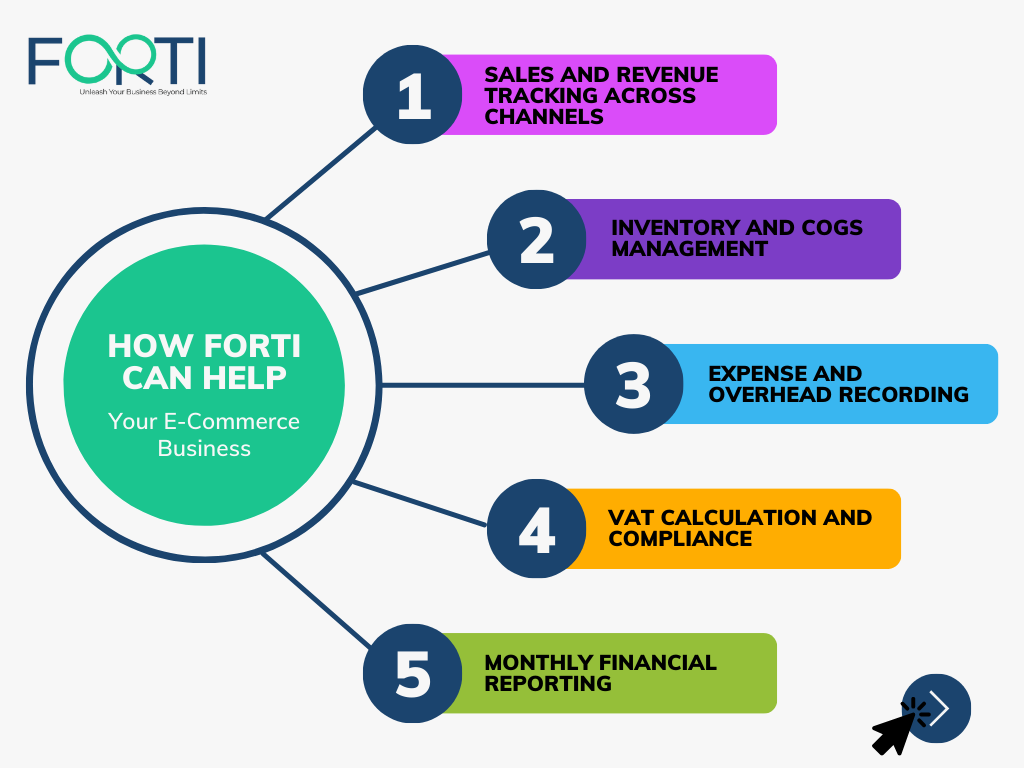
How FORTI Can Help Your E-Commerce Business
We recognise the requirements of online retail companies and offer tailored accounting solutions to simplify your financial processes and ensure precision and transparency for you to concentrate on expanding your enterprise.
Our Bookkeeping Services for E-Commerce Businesses Include:
Sales and Revenue Tracking Across Channels We keep a record of earnings from every sales source. Compare payment gateway charges to guarantee revenue calculations.
Inventory and COGS Management We make sure to keep our inventory records up-to-date and accurately calculate the cost of goods sold (COGS) to reflect our profit margins.
Expense and Overhead Recording We keep a record of every cost related to our business operations. From packaging expenses to marketing expenditures. To make sure that we cover all the expenses incurred.
VAT Calculation and Compliance We handle VAT computations for your sales in Ireland and the EU to guarantee reporting and submission to prevent any penalties.
Monthly Financial Reporting To help you understand the performance of your business, FORTI offers monthly balance sheets, cash flow reports, and profit and loss statements.
Document Management for Tax Compliance We prepare you for audits and tax filings by organising and safely storing all supporting documentation, including invoices and receipts.
Ready to streamline your e-commerce bookkeeping?
FORTI can handle the complexities of your e-commerce accounting. With our tailored bookkeeping solutions, you can maintain VAT compliance, manage inventory, and make data-driven growth decisions.
Limited companies in Ireland must maintain bookkeeping practices not for daily business activities but also to meet legal obligations as mandated by the law. Unlike traders, who have stringent reporting requirements compared to limited companies, such as filing annual financial statements and corporation tax returns along with payroll filings. To ensure accuracy and compliance, it’s essential to establish solid bookkeeping practices from the start. This guide serves as a resource for companies to grasp the significance of bookkeeping practices and lays out steps while pointing out common mistakes and offering best practices. Explore how FORTI can assist your business with customised accounting services, check these bookkeeping tips:
Monthly and Annual Bookkeeping and Tax Compliance Activities
Monthly Bookkeeping Activities:
Sales Invoices and Revenue Recording
Purchase Invoices and Expense Tracking
Bank Account Reconciliation
Creditors Reconciliation (Supplier Balances)
Debtors Reconciliation (Customer Balances)
Payroll and PAYE Reconciliation
Loan Account Reconciliation
Other Reconciliation Tasks (e.g., Petty Cash, Intercompany Accounts)
Bi-Monthly and Year-End Tax & Compliance Activities:
Bi-Monthly VAT Returns (Cash or Accrual Basis Reconciliation)
Payroll Processing and Submissions
Year-End Financial Reconciliations
Preparation of Financial Statements
CT1 Corporate Tax Filing
B1 Annual Return Filing
Personal Income Tax Returns (Self-Assessment)
Why Bookkeeping is Crucial for Limited Companies
Bookkeeping for limited companies in Ireland is more complicated than for sole traders. Here’s why effective bookkeeping is essential:
1. Legal Compliance
Under legislation, it is mandatory for companies to keep precise financial documentation and present yearly reports to both the Companies Registration Office (CRO) and the Revenue authorities.
2. Corporation and VAT tax
Maintaining records is crucial, for filing taxes and complying with Irish Revenue regulations to avoid penalties related to corporation tax and VAT returns.
3. Corporate Tax and VAT
Proper bookkeeping helps ensure accurate tax filings, including corporation tax and VAT returns, to avoid penalties and stay compliant with Irish Revenue requirements.
4. Financial Transparency
Detailed records provide stakeholders, such as shareholders and investors, with an accurate picture of the company’s financial health and performance.
5. Cash Flow Management
Proper bookkeeping ensures that cash flow is closely monitored, allowing your company to meet financial obligations while also planning for growth.
Key Bookkeeping Steps for Limited Companies
Here’s how to build a solid bookkeeping foundation for your limited company:
1. Separate Business and Personal Finances
It’s essential to follow this rule: All business dealings must be conducted using a corporate bank account, as mandated for limited companies. This practice eases accounting tasks. Guarantees transparency in records.
2. Keep track of all the money coming in and going out
Keep track of all transactions related to the business, from sales and expenses to loan repayments and investment income. Ensure that every transaction is categorised correctly to avoid misclassification, which can lead to incorrect tax filings.
3. Track Receivables and Payables
Keep an eye on outstanding invoices (receivables) and upcoming payments (payables). This is crucial for cash flow management and helps you avoid late fees or interest on overdue bills.
4. Manage Payroll Accurately
Limited companies’ payroll includes calculating employee pay, tax deductions, PRSI, and USC. Use a compliant payroll system to manage these tasks accurately, and ensure you file payroll taxes with Revenue on time.
5. Keep Detailed Records for VAT
If your company is registered for VAT, you must accurately track VAT on sales and purchases. Use accounting software to calculate VAT returns and set filing deadline reminders to avoid penalties.
6. Maintain Supporting Documentation
Irish Revenue mandates that you keep all supporting paperwork, such as receipts and contracts, for a period of six years and suggests using a document management system to store and organise these documents.
7. Reconcile Bank Statements Monthly
Reconciling your bank statements with your books every month ensures that your records are accurate and highlights any discrepancies early on. This is essential for maintaining reliable cash flow records.
8. Prepare Financial Statements
Limited companies are required to prepare financial statements, such as profit and loss statements, balance sheets, and cash flow statements. These statements give a snapshot of the company’s financial health and are crucial for decision-making and compliance.
Common Bookkeeping Mistakes to Avoid
1. Failing to Separate Business Transactions
Mixing personal and business finances can lead to serious bookkeeping issues, and it is against Irish accounting regulations for limited companies.
2. Ignoring Regular Reconciliation
Without monthly reconciliation, errors or missing transactions are easily overlooked, resulting in inaccuracies in financial reporting.
3. Misclassifying Expenses and Income
Incorrectly categorising transactions can lead to inaccurate tax filings and financial statements, affecting decision-making and tax liabilities.
4. Overlooking Payroll Compliance
Payroll compliance errors, such as incorrect deductions or late payments, can result in fines and reduce employee trust.
5. Inadequate VAT Tracking
Failure to properly track VAT on sales and expenses can result in errors in VAT returns, penalties, or overpayment/underpayment of VAT.
6. Neglecting Accounts Receivable and Payable Management
Poor receivables and payables management can put a strain on cash flow, making meeting financial obligations difficult.
7. Missing Documentation
Your tax liability may increase if you lose supporting documentation, which may cause problems during audits and result in missed deductions.
Best Practices for Efficient Bookkeeping in Limited Companies
1. Use Accounting Software
Accounting software simplifies bookkeeping tasks, such as invoicing, payroll, VAT calculations, and financial reporting. Popular options include Xero, Sage, and QuickBooks, which are designed to support compliance with Irish accounting standards. These software also uses platforms such as Hubdoc, which simplify your process of expense recording.
2. Schedule Monthly Financial Reviews
Sit down with your bookkeeper and review the monthly transactions. Monthly reviews provide an opportunity to examine your cash flow, track spending patterns, and address issues early. Making informed business decisions is also aided by routine financial reviews.
3. Work with a Professional Bookkeeper or Accountant
Taking the help of an expert means doing things more efficiently and quickly. With complex compliance requirements, many limited companies benefit from working with an experienced bookkeeper or accountant. Professionals can handle regulatory filings, tax compliance, and provide strategic financial advice. It also avoids any type of error that may arise from wrong expense categorisation.
4. Plan for Corporate Tax Payments
As a limited company, you’re required to pay corporation tax. Make smart financial decisions. A portion of income should be set aside for taxes throughout the year to avoid cash flow problems during tax season.
5. Implement a Document Management System
Organise your documents. A secure, organised document management system makes it easier to locate receipts, invoices, and other supporting documents when needed for audits or tax filings.
Monthly Bookkeeping Checklist for Limited Companies
A simple checklist can help ensure you don’t miss any essential bookkeeping tasks:
Task
Frequency
Completed (Y/N)
Record all income and expenses
Weekly
Save and organise receipts and invoices
Ongoing
Reconcile bank statements
Monthly
Track accounts receivable/payable
Weekly
Review payroll and tax deductions
Monthly
Prepare VAT calculations (if applicable)
Monthly
Generate financial statements
Monthly
Review cash flow and profit/loss
Monthly
This checklist can help streamline your bookkeeping, ensuring compliance and accuracy every month.
How FORTI Can Support Your Limited Company’s Bookkeeping
We recognise the challenges that come with managing bookkeeping for companies. Our comprehensive bookkeeping services are designed to handle everything from day-to-day recording to VAT returns and payroll management, ensuring your accounts are compliant and up-to-date.
Our Bookkeeping Services for Limited Companies Include:
Transaction Recording & Expense Tracking: We precisely document every transaction, classifying them to give a transparent financial picture.
Accounts Receivable & Payable Management: Our team monitors receivables and payables to help you manage cash flow and meet deadlines.
Payroll Compliance: We manage payroll, including tax deductions and PRSI, while adhering to Irish payroll regulations.
Monthly Reconciliations: Reconcilliations are the key exercise to keep the records clean and compliant. Regular reconciliations keep your accounts balanced, reducing errors and highlighting discrepancies early.
VAT Filing and Tax Preparation: We handle VAT calculations, track VAT on all relevant transactions, and prepare accurate tax filings to ensure your compliance.
Detailed Financial Reporting: FORTI provides monthly financial reports, such as profit and loss, balance sheets, and cash flow statements, to keep you up to date on your company’s financial health.
Document Management: We maintain a digital system for storing and organising all necessary documents, ensuring that you are ready for audits and tax returns.
Are you prepared to streamline your accounting tasks?
Allow FORTI to handle your documentation while you focus on growing your business effectively! Count on our team to deliver bookkeeping services that align with the needs of Irish businesses.
👋 Reach out to us now for a consultation. Uncover how FORTI can assist you in bookkeeping/annual compliance, impeccable financial records, and enhancing your company’s effectiveness while ensuring adherence to Irish regulations!
Managing your finances well is an important part of running a successful solo entrepreneur business in Ireland. Though it may not be fun, keeping accurate and up-to-date financial records allows you to track your profitability. adhere to the rules governing Irish taxes and make educated choices The importance of proper bookkeeping, the best ways to do it, frequent mistakes to avoid, and ways to make it easier to understand are all covered in depth in this guide for sole proprietors. Whether you’re just starting out or are looking to improve your procedures for bookkeeping jobs, this booklet will guide you to a better understanding of bookkeeping, and you can manage your finances confidently.
Why Bookkeeping Matters for Sole Traders
Maintaining records goes beyond simply documenting transactions—it involves gaining a comprehensive understanding of your business’s financial well-being. For sole traders, in particular, this is crucial since they bear legal responsibility for all facets of their business operations, including financial matters. Here’s why adopting bookkeeping techniques is indispensable:
1. Clear Financial Understanding
By monitoring your earnings and expenditures, you will develop an understanding of the financial health of your business, facilitating smoother strategising and expansion efforts.
2. Ensuring Revenue Compliance
Sole traders, in Ireland need to keep records, for tax purposes as having maintained accounts can make tax returns easier and lower the chances of facing penalties.
3. Making decisions based on information
Keeping records enables you to strategise, determining the ideal timing for investing in new equipment or making pricing adjustments and cost reductions.
4. Keeping track of your expenses
Maintaining records enables you to deduct qualifying expenses from your income tax calculation and consequently lessen your tax obligations in the end.
Essential Bookkeeping Steps for Sole Traders
Here are the key steps to set up a simple yet effective bookkeeping system for your sole trader business:
1. Ensure you keep your business and personal finances separate, from each other
It’s important for solo entrepreneurs to maintain a distinction between their business and personal finances by setting up a business bank account to handle all financial transactions related to the business efficiently and keep an organised record of the company’s financial operations.
2. Monitor Expenditures
Remember to log all transactions from sales to business costs, noting down specifics such, as dates and descriptions along with the amounts and payment methods used in each transaction for record-keeping purposes as per Irish Revenue guidelines that allow claiming of business related expenses.
3. Employ a Basic Accounting System
Utilising accounting tools such as Xero or QuickBooks software or even a simple spreadsheet template can simplify the process of managing your records by providing functions for expense tracking and invoicing along with basic reporting capabilities to maintain organised bookkeeping practices.
4. Remember to hold onto your receipts and invoices.
Remember to keep track of all the receipts and invoices related to your business activities as a sole trader in Ireland; it’s important to hold onto these papers for up to six years to show your costs and earnings clearly when needed in the future. Use a filing system to scan and store your documents for retrieval.
5. Remember to check your bank statements every month
Monthly reconciliations are important for making sure your records align with your bank statement and catching any mistakes or missing transactions to maintain financial records.
6. Make sure to calculate your taxes
Individual business owners must submit their income tax returns every year. Keep a record of their earnings and expenses to determine their tax obligations before the deadlines approach.It’s advisable to set aside money for taxes to prevent financial burdens at the end of the year.
7. Track Cash Flow
Cash flow management is essential for business sustainability. Monitor your income versus expenses regularly to ensure you have enough funds to cover expenses and grow your business.
It’s crucial for businesses to effectively manage their cash flow to sustain operations and growth potential, keeping an eye on their earnings in comparison to expenses to ensure funds for business expansion and covering costs efficiently.
Common Bookkeeping Mistakes to Avoid
Mixing Personal and Business Finances: Never mix the expenses. Always use a separate bank account for business. This prevents confusion and ensures your records are accurate.
Neglecting to Record Small Transactions: We all have tendency to ignore keeping a track of smaller expenses. Small cash expenses add up. Always record them to get a true picture of your spending.
Not Setting Aside Money for Taxes: It’s tempting to reinvest all profits back into the business, but remember to save for taxes to avoid cash flow issues.
Ignoring Regular Reconciliation: Adopt a practice to reconcile your bank monthly. Bank reconciliations catch errors early, reducing the risk of large discrepancies over time.
Skipping Receipt Tracking: Without receipts, you may miss out on expense claims, potentially increasing your tax liability. If you miss the receipts, you wont be able to claim the vat and you pay additional taxes too.
Best Practices for Efficient Bookkeeping Processes
1. Weekly Schedule
Make sure to set aside a time each week to handle your bookkeeping tasks, as it helps in maintaining records and avoids accumulating a pile of tasks to tackle all at once.
2. Accounting Software
Managing your finances is made easier with accounting software that automates tasks and keeps track of expenses while giving you an overview of your situation. Popular software programs such as QuickBooks or Xero come equipped with features like generating invoices and organising expenses efficiently.
3. Collaborate with a bookkeeper or accountant.
If you’re uncertain about handling your bookkeeping or if you find yourself in need of assistance around tax time, it might be an idea to think about bringing onboard a bookkeeper or accountant to assist your efforts.
4. Plan for Taxes
As a sole trader, you’re responsible for filing a self-assessment income tax return. Setting aside funds for taxes throughout the year can prevent cash flow issues when taxes are due.
5. Check your statements consistently
Reviewing documents, like income statements and cash flow statements, is essential for gaining insights into your company’s well-being and enabling you to make informed business choices on a regular basis.
Bookkeeping Checklist for Sole Traders
To keep you on track, here’s a simple monthly checklist for bookkeeping:
Task
Frequency
Completed (Y/N)
Record all income and expenses
Weekly
Save receipts and invoices
Ongoing
Reconcile bank statements
Monthly
Set aside money for taxes
Monthly
Review cash flow and income statement
Monthly
Prepare for self-assessment tax return
Annually
Using this checklist can help you manage your finances efficiently, saving time and ensuring accurate, compliant records.
How FORTI Can Help
We understand that bookkeeping can be difficult, particularly for sole traders who must focus on running their business. Our dedicated bookkeeping services are tailored to help sole traders in Ireland stay organised, compliant, and stress-free.
Our Bookkeeping Services for Sole Traders Include:
Transaction Recording: We meticulously document every source of earnings and all expenditures to classify them. .
Expense Tracking and Tax Preparation: We track every eligible expense, maximising your deductions and ensuring accurate tax filings.
Monthly Reconciliations: Our team makes sure that your records are current and reconciles your accounts to align with your bank statements.
Regular Financial Reporting: We provide monthly financial reports so you always know your business’s financial health, and keep you updated with your finacial situation.
Revenue Compliance and Tax Filing Assistance: Our services help you stay compliant with Irish Revenue, simplifying tax season and ensuring peace of mind.
Are you prepared to streamline your accounting tasks?
Allow FORTI to handle your documentation while you focus on growing your business effectively! Count on our team to deliver bookkeeping services that align with the needs of Irish businesses.
👋 Reach out to us now for a consultation. Uncover how FORTI can assist you in bookkeeping impeccable financial records and enhancing your company’s effectiveness while ensuring adherence to Irish regulations!
Bookkeeping for Irish businesses involves attention to detail and regular maintenance. Depending upon the complexity of the business, we estimate around 8-15 hours per month of bookkeeping required for SMEs. Still, common mistakes keep happening, which can lead to wrong records, problems with the law, and even fines. These errors can cause some serious issues for any business, including cashflow problems, if not looked after carefully.
In this article, 10 common mistakes in Irish accounting are talked about, along with ways to avoid them and the effects they can have on your business. We will also give you a useful checklist template to make keeping your books easier.
10 Common Mistakes in Irish Accounting
1. Misclassifying Transactions
Error
When any kind of expense comes up, it needs to be recorded properly based on the type of transaction. If you put expenses in the wrong category, especially between capital and operational costs, it can mess up your financial statements and make it harder to figure out your taxes.
Solution
A clear understanding, combined with expertise, aids in categorising expenses and Keep your company’s financial records organised using a uniform chart of accounts that is reviewed and updated on a regular basis. Staff should be trained on classification to guarantee uniformity.
Consequences & Impact
Financial decisions and budget allocations may be impacted by inaccurate classification, which can lead to overpayment of taxes, underutilisation of tax deductions, and the creation of false financial statements.
2. Small Cash Transactions
Error
Another common mistake is overlooking the small transactions. A lot of Irish businesses, especially those dealing in cash, may overlook these small transactions, which leads to inaccurate cashflow and reporting issues.
Solution
Strong control over spending management is provided by platforms like as Revolut, which are very practical and user-friendly. Limiting the expenses is another option. Implementing a petty cash log should be taken into consideration in addition to this digital spending tracking. These transactions can be automatically logged and categorised with the use of accounting software.
Impact & Consequences
Over time, little amounts accumulate. Ignoring them can affect overall financial accuracy and planning by distorting financial statements and creating disparities in cash flow.
3. Data Entry Errors
Error
This problem occurs when there is a lot of manual work required. Even in this digital age, people continue to record transactions manually. Manual data entry errors, such as inaccurate dates, amounts, or invoice numbers, can cause considerable discrepancies in Irish company accounting.
Solution
In the current digital era, laborious manual work has been entirely eliminated through the use of OCR technology. This error can now be prevented with the simple snap of a photograph. Similarly, the task that typically requires hours of work can be reduced to mere seconds by emailing the invoice to the software upon its arrival. Utilise accounting software that includes built-in validation tools to mitigate manual entry errors. Implement a system of double-checking, in which a second individual evaluates entries.
Consequences & Impact
Data entry errors cause inaccuracies that affect compliance with Irish regulatory standards, produce reports that are untrustworthy, and waste time tracking and fixing mistakes. Not appropriately recording the expenses or recording them at all can lead to a considerably more serious consequence: incorrectly claiming VAT. An immediate negative effect on VAT returns of about 5,000 euros was caused by the discovery while dealing with one of the new clients that approximately 25,000 euros’ worth of invoices had not been recorded.
4. Monthly Reconciliations
Error
One of the frequent errors that we always notice is either neglecting or failing to reconcile bank and credit card statements with accounts monthly. As we mentioned above, if the work is done manually, this error is common among Irish SMEs. Wrong transactions lead to discrepancies between actual cash flow and reported amounts.
Solution
The only way to deal with this error is to schedule monthly reconciliations as a non-negotiable task. Automated reconciliation features in accounting software can streamline this process and reduce errors.
Consequences & Impact
Businesses run the danger of undetected errors or even fraud if they don’t do frequent reconciliations. This may result in poorly informed financial decision-making and poorly managed cash flow. At the end of the year, business owners typically receive a lengthy list of chores from accountants asking them to justify every transaction. If they are unable to do so, most accountants will tend to make adjustments, which results in inaccurate reporting and the possibility of not being able to make the right tax claims.
5. Ignoring Accruals and Deferrals
Error
Not recording accrued income (income that earned but is not being received yet, eg., accounts payable) or deferral (revenue received but not incurred, eg., deposit) results in misleading monthly statements, especially for companies on accrual accounting.
Solution
Make sure accruals and deferrals are entered on a regular basis by using scheduled reminders. To accurately reflect income and expenses, bookkeepers should be familiar with Irish accrual accounting standards.
Consequences & Impact
If misrepresented profits and expenses are not adequately managed, they may impact tax obligations and financial reporting, leading to problems with Irish Revenue compliance. If someone is charged, they could be fined up to €126,970 or put in jail for up to five years. A convicted individual may also be compelled to fulfil unfinished business regarding documents, returns, etc.; not doing so within 30 days is a crime in and of itself.
6. Depreciation and Amortization
Error
Companies risk misleading lenders and investors by reporting inflated asset values if they don’t factor in depreciation and amortisation.
Solution
Depreciation and amortisation should be consistently accounted for, therefore, make sure to schedule automatic calculations in your accounting software to conform with Irish accounting standards.
Consequences & Impact
Business valuations and financial statements are impacted by exaggerated asset values. Higher liabilities could also arise from erroneous tax computations.
Inflated Business Valuations: Misleads investors, creditors, and prospective buyers; undermines trust and credibility when true values are revealed.
Misleading Financial Statements: distorts the company’s financial health, causing management to make poor decisions based on inaccurate data.
Higher Tax Liabilities: Inaccurate tax calculations may result in higher liabilities; potential penalties and legal consequences if discovered by tax authorities.
Loss of Investor and Stakeholder Confidence: Erodes trust, harms reputation, affects stock prices, and reduces investor interest.
Operational and Budgeting Errors: Leads to overinvestment or underestimating cash needs, causing inefficiencies or financial strain.
8. Accounts Receivable and Payable
Error
Cash flow issues and relationships with stakeholders are negatively affected if there are any errors in managing accounts payables and receivables.
Solution
Promote monthly reconciliations and set reminders to avoid these AP and AR issues.
Consequences & Impact
Maintaining a steady flow of funds is critical to the success of any company. Impacting cash flow, late payments, and collections make it tougher to manage obligations and risk damaging relationships with suppliers, which could lead to unfavourable credit conditions.
8. Payroll Errors
Error
Payroll errors, such as inaccurate tax deductions, late payments, or noncompliance with Irish payroll regulations, can result in fines and employee dissatisfaction.
Solution
Use a payroll management system that calculates taxes and deductions automatically. Regularly review employee data and tax codes to stay up-to-date with Revenue requirements.
Consequences and Impact:
Ensuring payroll accuracy is critical for compliance and employee satisfaction. Some of the consequences are as follows:
Revenue Penalties
Loss of Employee Trust
Legal Risks
Compliance Issues:
Administrative Burden
Employee Satisfaction
9. Documentation
Error
Businesses in Ireland are required to keep records for up to 6 years. In addition to keeping records, not having receipts, invoices, or other supporting papers can make it hard to prove finances during audits or tax inspections by the Irish Revenue.
Solution
A combination of cloud-based backup and digital document management software makes all data readily available by organising and linking documents to accounting processes.
Consequences & Impact
Inadequate documentation can lead to denied deductions during tax audits, resulting in increased tax liabilities and potential penalties.
10. Tax Compliance Deadlines
Error
Take all necessary measures to safeguard your company against noncompliance. Irish businesses risk heavy fines if they fail to file their VAT, PAYE, or corporation taxes by the due dates.
Solution
Create a tax calendar with filing date reminders. Irish-compliant accounting software can help monitor deadlines and streamline tax calculations.
Consequences & Impact
Some of the consequences are as follows:
Fines and Penalties: Late tax filings result in fines and increased financial liabilities for the business.
Interest Charges: Interest on overdue taxes adds to the total tax burden.
Revenue Scrutiny: Consistent noncompliance may result in additional scrutiny from tax authorities, increasing the likelihood of detailed audits.
Audit Risks: The increased likelihood of audits may expose other compliance issues, resulting in additional penalties and corrective actions.
Reputational Damage: Non-compliance impacts the business’s reputation with stakeholders, affecting credibility and trust.
Cash Flow Impact: Penalties and interest charges can disrupt cash flow, limiting the funds available for operations or growth.
Monthly Bookkeeping Checklist Template for Irish Businesses
A Monthly Bookkeeping Checklist can help keep Irish businesses organised and compliant. Use the following template to track monthly tasks:
Task
Frequency
Assigned To
Completed (Y/N)
Notes
Record all transactions, including petty cash
Daily
[Name]
Review and classify transactions
Weekly
[Name]
Reconcile bank statements
Monthly
[Name]
Record accruals and deferrals
Monthly
[Name]
Calculate and record depreciation
Monthly
[Name]
Reconcile accounts receivable/payable
Monthly
[Name]
Review payroll for accuracy
Bi-weekly
[Name]
Update supporting documentation
Ongoing
[Name]
Review tax compliance deadlines
Quarterly
[Name]
Review financial statements
Monthly
[Name]
Conclusion
Good financial management starts with keeping accurate books. If you don’t make these common mistakes, your records will be more likely to be correct, in line with Irish Revenue rules, and legal. For many businesses, doing their own accounting can take a lot of time and lead to mistakes. This is where FORTI is useful.
At FORTI, we offer full bookkeeping services created just for Irish businesses. This way, you can be sure that your accounts are being handled by professionals. We handle all of the documentation so you can focus on what you do best: building your business. Our highly qualified employees, modern technology, and custom solutions make this possible.
Why Opt, for FORTI, for Your Bookkeeping Requirements?
In every stage of our bookkeeping services, at FORTI – accuracy and dependability are guaranteed while ensuring adherence, to regulations.
First. Evaluation of Requirements: Lets begin by grasping the needs of your company and examining your existing bookkeeping methods to provide assistance and pinpoint potential areas for enhancement.
Establishing a Chart of Accounts: We develop a chart of accounts for your business to guarantee consistent classification of all transactions. Our team is responsible for handling the input and sorting of data with the help of error checking tools to prevent mistakes in data entry and maintain precise financial records.
Monthly reconciliation of bank statements and credit card accounts: We meticulously review your accounts each month to align them with bank statements to avoid errors and maintain the accuracy of your cash flow.
Managing Accruals and Depreciation: We manage transactions, like accruals and deferrals, while also handling depreciation to ensure that our financial performance aligns, with Irish Revenue regulations.
Accounts payable and receivable: We keep an eye on your outgoing payments to make sure they are paid and collected on time to keep cash flowing smoothly.
Handling Employee Salaries and Adhering, to Regulations: Our payroll system prioritises precision and adherence to regulations by handling calculations and deductions while ensuring submission of taxes in compliance with laws.
Regular Reporting & Financial Reviews: Each month we provide you with reports that emphasise any concerns or areas of potential growth to assist you in managing your finances effectively and staying on course.
Managing tax compliance and documentation: We keep all the required supporting paperwork in order for audits and to make sure you can take advantage of all deductions.
Ongoing Support & Advisory: Our team of professionals goes beyond managing records; they also offer valuable guidance and strategic perspectives to help you make well informed decisions using reliable and current data.
Are you prepared to streamline your accounting tasks?
Allow FORTI to handle your documentation while you focus on growing your business effectively! Count on our team to deliver bookkeeping services that align with the needs of Irish businesses.
👋 Reach out to us now for a consultation. Uncover how FORTI can assist you in bookkeeping impeccable financial records and enhancing your companys effectiveness while ensuring adherence to Irish regulations!
Structural Changes
If your company structure changes, we handle all required CRO filings and statutory updates. Includes:
Director appointments or resignations
Share transfers or allotments
Company name changes
We ensure your company records remain accurate and legally compliant.
Strike
If you decide to close your company, we manage the full voluntary strike-off process, including compliance review, documentation, and filing with the Companies Registration Office (CRO), ensuring the company is properly and safely dissolved.
Additional CRO Filings
Director changes, share transfers, share allotments, company name changes or other statutory updates.
RBO Filing / Ownership Updates
Required whenever shareholders or beneficial ownership changes (25%+). We prepare and submit the update to the Central Register to keep your company compliant
Registered Office Address
Secure and reliable registered office solution to improve your business reputation. This add-on service provides an official business address for company registration and ensures important business correspondence is handled professionally. Includes:
Official registered business address
Use for company registration
Handling of business correspondence
Professional business presence
Reliable address for official records
Full Company Secretary Service
Our full company secretary service ensures your company adheres to corporate governance standards. This includes maintaining statutory registers, filing annual returns, handling board resolutions, and advising on legal compliance. By outsourcing this service, you can reduce administrative workload and ensure your company avoids compliance-related risks.
Register of Beneficial Owners (RBO) Filing / Update
Every Irish company must file and maintain accurate beneficial ownership details with the Central Register of Beneficial Owners (RBO). Our service includes:
Preparation and electronic filing with the Central RBO
Review of 25%+ ownership or control thresholds
Confirmation of submission for your records
Required within 5 months of incorporation and whenever shareholding changes. Failure to file can result in significant penalties — we ensure your company remains fully compliant.
Strike Off
If you need to close your company — whether within the first year or later — we manage the entire voluntary strike-off process professionally and compliantly. Our team handles:
Director resolutions and required documentation
Pre-strike-off compliance review
Preparation and filing with the Companies Registration Office (CRO)
We ensure your company is properly wound down to avoid delays, penalties, or future compliance issues.
Please note: CRO filing fee and required newspaper advertisement costs are separate.
Digital Marketing Services (Free Consultation)
Reaching your audience effectively is key to growth. This free consultation introduces startups and small businesses to digital marketing strategies, including social media management, search engine optimisation (SEO), and online advertising, tailored to your industry and goals.
Introduction to Website Development Company (Free)
Building a strong online presence is vital for any business. This free service connects you with experienced website development companies, offering startups and small businesses tailored consultations to help establish or upgrade their online platforms.
Modern businesses thrive on effective communication. This service provides VoIP phone solutions and professional call answering with calendar management and call forwarding. It ensures no business opportunities are missed while projecting a professional image to clients and partners.
6-Month Annual Return Filing
Filing the first Annual Return (B1) is an important requirement to keep your company compliant and in good standing. This service includes the preparation, filing, and management of all required documents for the year, such as financial statements, shareholder reports, and any necessary changes to the company structure. It allows you to focus on growing your business while ensuring your obligations are met. Includes:
Preparation and electronic filing
Deadline monitoring
Audit exemption protection
This filing is required even if no financial statements are due.
Annual Return Filing per Year
Annual returns are essential for keeping your company information up-to-date with the Companies Registration Office (CRO). This service ensures that all required information, such as directors, shareholders, and company financials, is filed accurately and on time, avoiding late penalties and maintaining good standing.
Annual Compliance Support
Annual compliance is critical for avoiding fines and maintaining good standing with regulatory authorities. This service includes the preparation, filing, and management of all required documents for the year, such as financial statements, shareholder reports, and any necessary changes to the company structure. It allows you to focus on growing your business while ensuring your obligations are met. Includes:
Annual Return (B1) filing
Statutory register maintenance
Deadline tracking
Audit exemption monitoring
Compliance advisory support
Ideal for directors who want ongoing professional oversight.
Annual Return (B1) Filing
Preparation and filing of yearly CRO Annual Return (after year one).
Helps maintain good standing and avoid late filing penalties.
Full Company Secretary Service
Our full company secretary service ensures your company adheres to corporate governance standards. This includes maintaining statutory registers, filing annual returns, handling board resolutions, and advising on legal compliance. By outsourcing this service, you can reduce administrative workload and ensure your company avoids compliance-related risks.
Historical filing and bookkeeping services are for businesses that have gaps in their financial year filings. We will require this information for compliance and reporting purposes, regardless of the gap duration.
Manage Annual Returns Deadline (Included)
File Annual Return in CORE (Included)
File PDF Financial Statements in CORE File Manager (Included)
Signing Annual Return and Bank Application Documents (Included (Limited)**)
Company Secretarial Paperwork Filing (Included)
Maintaining and Updating Company Registers (Included)
Drafting Minutes for Board Meetings (AGM Included) (Included)
Ongoing Company Secretarial Advice (Annual Limit) (Up to 300 minutes)
Countersignatures for Company Bank Applications/Reports (Not Included)
Traditional phone systems are transformed by VoIP (vocal over Internet Protocol) technology, which facilitates vocal communication over the internet. This technology is extensively employed in cloud-based phone services. The latest technology provides businesses with substantial advantages, such as seamless integration with a variety of digital tools and increased flexibility. Our call answering services ensure that you never miss an important call. We ensure that your business’s communication is both efficient and effective by managing your diary, receiving inquiries, and forwarding them to you.
Our Business Address Service will improve your company’s corporate image by providing a prestigious address for your correspondence. We will forward your business correspondence to an alternative address of your choosing via post for a nominal fee of €55 per month. This service is renewable annually, with an additional fee for forwarding general business correspondence.
If you need cloud based phone services, enquire now.
Company Formation
Includes CRO Filing Fee for Private Limited Company or DAC.
Manage Annual Returns Deadline (Included)
File Annual Return in CORE (Included)
File PDF Financial Statements in CORE File Manager (Included)
Signing Annual Return and Bank Application Documents (Included (Limited)**)
Company Secretarial Paperwork Filing (Included)
Maintaining and Updating Company Registers (Included)
Drafting Minutes for Board Meetings (AGM Included) (Included)
Ongoing Company Secretarial Advice (Annual Limit) (Up to 300 minutes)