Category Archives: Bookkeeping

A Start-Up's Guide to Annual Compliance in Ireland

A Start-Up’s Guide to Annual Compliance in Ireland

Everything You Need to Know to Stay Legally Compliant and Financially Fit

Starting a limited company in Ireland? Then annual compliance is a term you’ll be hearing a lot. Whether you’re a first-time entrepreneur or scaling up your venture, understanding your compliance responsibilities is essential to avoid penalties and ensure smooth business operations. In this guide, we break down annual compliance in simple terms — including key filings, deadlines, and costs — and how they apply to different industries.

What Is Annual Compliance?

Annual compliance means staying legally up to date with the CRO and Revenue.

If that sounds a bit vague (or a bit scary), don’t worry — you’re not alone. As a qualified accountant who works with start-ups every day, I can tell you this: annual compliance isn’t as complicated as it sounds — but it is important.

Every limited company in Ireland must file certain returns and financial documents each year to remain in good standing. This includes confirming company details, submitting accounts, and paying any taxes due. Think of it as the legal health check for your business.

Annual Compliance Checklist for Irish Limited Companies

Here’s what your accountant or finance team should be handling every year:

Task Authority Deadline
Annual Return (Form B1) CRO Every year on your ARD
Abridged Accounts CRO With second return onwards
Full Year-End Accounts Revenue & CRO 9 months after year-end
Corporation Tax Return (CT1) Revenue Same as above
Director’s Income Tax (Form 11) Revenue 31st October each year
VAT Returns (if registered) Revenue Usually every 2 months
Payroll Returns (if employing) Revenue Monthly
Maintain Company Registers Internal/CRO Ongoing

What Does Annual Compliance Include?

It’s more than just ticking boxes — it’s a full-circle legal and tax package.

Most annual compliance packages in Ireland will include:

  • Annual Return (Form B1) filing
  • Preparation and filing of abridged financial statements
  • Full year-end accounts for Revenue
  • Corporation Tax Return (CT1)
  • Revenue reminders & support
  • Sometimes: Director’s Income Tax Return (Form 11)

Depending on your accountant, VAT returns, payroll, and secretary services may be included or offered separately.

What Does It Cost?

Your compliance cost depends on your setup and service level.

As a rule of thumb, our estimated fee ranges between 1–2% of your annual turnover, depending on your industry, volume of transactions, and services required.

Company Type Typical Cost (Ex. VAT)
Simple Ltd Co. (no VAT, no payroll) €750 – €1,200
VAT-registered, 1–2 employees €1,500 – €2,500
With regular bookkeeping €2,500 – €4,000+
Complex or growing company €5,000+

Breakdown of Typical Fees:

Service Range (Ex. VAT)
Annual Return (Form B1) Filing €150 – €250
Abridged Accounts €250 – €400
Corporation Tax Return (CT1) €400 – €600
Director’s Income Tax (Form 11) €150 – €250
VAT Returns €50 – €150/return
Payroll Processing €40 – €80/month
Registered Office / Secretary €450 – €800/year

Annual Return vs Year-End Accounts

These are two different filings, often confused.

Feature Annual Return (Form B1) Year-End Accounts
Filed With CRO Revenue & CRO (abridged only)
Purpose Legal & structural info Financial performance & tax
Includes Accounts? From second return onward Always
Deadline ARD + 56 days 9 months post year-end
Penalties €100 + €3/day + audit loss Interest + audit risk

Case Studies

What annual compliance and bookkeeping typically look like across industries:

1. Marketing Agency – Turnover €200k

  • Two directors, 50–60 transactions per month (sales, purchases, bank)
  • Needs: Annual Return, CT1, year-end accounts, basic bookkeeping
  • Expected Cost: Annual compliance €1,200–€1,500, Bookkeeping €120–€150/month

2. Tradesman – Turnover €500k

  • Up to 100 transactions/month
  • Needs: Full bookkeeping, VAT returns, annual compliance, tax planning
  • Expected Cost: Compliance €1,500–€2,000, Bookkeeping €150–€250/month

3. Business Consultant – Turnover €100k

  • 30–50 transactions, payroll for 1, VAT registered
  • Needs: Payroll, VAT returns, annual accounts, CT1, B1, and Form 11
  • Expected Cost: Compliance €1,200–€1,500, Bookkeeping & payroll €150–€200/month

4. Health & Fitness Startup – Turnover < €50k

  • No VAT, limited activity, sole director
  • Needs: Basic annual compliance (B1, CT1, abridged accounts)
  • Expected Cost: €750–€950/year all-in

5. E-Commerce Retailer – Turnover €1M

  • Trading on Shopify, Etsy, Amazon; 500+ transactions/month
  • Needs: Monthly bookkeeping, VAT, payroll, CT1, Form 11s, multi-channel reporting
  • Expected Cost: Compliance €2,000+, Bookkeeping & all services €400–€700/month

Frequently Asked Questions (FAQs)

Q1. What happens if I miss my Annual Return deadline?

You’ll face late filing penalties (€100 plus €3 per day) and may lose audit exemption for two years.

Q2. Do I need to file a tax return if my company made no profit?

Yes. Even dormant or zero-profit companies must file a CT1 and B1 annually.

Q3. Can I do my own annual compliance?

Technically yes, but it’s risky. Errors or missed filings can lead to penalties. It’s best to use a qualified accountant.

Q4: What’s the difference between CRO and Revenue filings?

CRO is for your company’s legal standing; Revenue is for taxes. Both are legally required.

Q5: How long does company registration take?

Typically 5–10 working days, but it can vary depending on CRO processing times.

Q6: Is bookkeeping included in annual compliance packages?

Not always. Many accountants offer it as a separate service unless bundled.

Q7: What’s the typical accounting year-end in Ireland?

Most companies choose 31st December, but it can be any date.

Q8: When do I need to register for VAT?

When your turnover exceeds €37,500 (services) or €75,000 (goods) in a 12-month period.

Q9: Are directors personally liable for company taxes?

No, but they are responsible for ensuring the company meets its obligations.

Q10: Can Forti handle everything for me?

Yes! We offer full-service compliance, bookkeeping, payroll, and CRO support tailored to your business.

Final Word

Annual compliance might not be glamorous, but it’s essential. Whether you’re applying for funding, trying to stay off Revenue’s radar, or just want peace of mind — investing in proper compliance is the best place to start.

If you’re unsure about your current setup or want a second opinion, talk to a qualified accountant. One good conversation could save you thousands.

forti-final-logo

Let Forti Take Care of It

At Forti, we specialise in helping Irish start-ups and growing businesses stay fully compliant, without the hassle. From company formation to bookkeeping, VAT, payroll, and all Revenue and CRO filings — we offer flexible, fixed-fee support tailored to your needs.


The Journey of a Sole Trader in Ireland – From Set-Up to Staying Compliant

The Journey of a Sole Trader in Ireland – From Set-Up to Staying Compliant

Setting up as a sole trader in Ireland is one of the easiest ways to get your business off the ground. Registering as a sole trader is quick and cost-effective, whether you’re a freelancer, a tradesperson, or running a side hustle.

That said, while there’s less paperwork than running a limited company, there are still a few key steps to follow—and a few pitfalls to avoid. In this guide, we’ll walk you through everything from registering with Revenue to tax returns, to the tools that can save you hours of admin each week.

Key Steps To Follow

Step 1: Registering as a Sole Trader

Unlike a limited company, you don’t need to go through the Companies Registration Office (CRO). But you must register with Revenue once you start trading — ideally within 30 days.

Here’s what you’ll need to do:

  • Register for Income Tax (self-assessed) using Form TR1 (or TR1(FT) for foreign nationals)
  • Choose your trading name (if not using your own name, register it with the CRO via RBN1)
  • Set up a business bank account to separate personal and business finances
  • Get insurance if needed (e.g., public liability or professional indemnity)

Do:

  • Register with Revenue early — don’t wait until your first tax return.
  • Keep your receipts and records from day one — even small ones.

Don’t:

  • Use your personal name for business unless you’re happy with it being public.
  • Mix business and personal transactions — it’ll cause confusion later.

Step 2: Running the Day-to-Day

Managing a business as a sole trader requires multitasking, including marketing, sales, service delivery, and administrative tasks. Staying on top of your finances throughout the year will save you from last-minute panic come October.

Here’s what you’ll be doing:

  • Issue invoices for your services or sales
  • Track your income and expenses monthly
  • If applicable, register for VAT and file returns
  • Pay yourself directly (as it’s not a separate legal entity)

Do:

  • Set aside 20–30% of your income for tax — trust us, you’ll need it.
  • Consider using a simple app or spreadsheet to track your expenses.

Don’t:

  • Avoid waiting until tax season to compile all your expenses as it can become a daunting task.
  • Forget about PRSI and USC – they’re part of your tax bill too.

Step 3: Annual Compliance – Your Tax Return

As a sole trader, your biggest yearly obligation is your self-assessed Income Tax Return, also known as Form 11.

Important Dates:

  • 31st October – Deadline for submitting and paying via post
  • Mid-November – Extended deadline if you file online via ROS

You’ll declare:

  • Total income from your business
  • Any allowable expenses (e.g. phone, mileage, software, insurance)
  • Any PAYE income (if you have another job)
  • Pension contributions, medical expenses, etc.

If your income is above certain thresholds, you may also need to make preliminary tax payments for the following year.

Do:

  • File on time to avoid late penalties and interest charges.
  • Use a qualified accountant to help you claim every expense you’re entitled to.

Don’t:

  • Underestimate your income — Revenue cross-checks against bank and card processors.
  • Miss your deadlines — it affects your credit and could cause Revenue audits.

Optional (But Smart) Services for Sole Traders

Sole traders don’t have to hire a company secretary or file annual returns like limited companies — but there are still services that make life a lot easier.

Hiring a Bookkeeper

  • Keeps your records up to date
  • Saves you hours come tax season

Getting Tax Advice

  • Helps reduce your tax bill through proper planning (e.g. capital allowances, pensions)

Registering for VAT

Do:

  • Get advice early — even one meeting a year with an accountant can save you money.
  • Keep mileage logs and expense receipts properly stored.

Don’t:

  • Leave taxes to chance. The self-assessment system in Ireland relies on your honesty and accuracy — Revenue takes errors seriously.
Take control of your finances — explore Forti’s smart services for
sole traders.

The Role of Software – Making Life Easier for Sole Traders

Thankfully, software has made the admin side of things easier than ever for sole traders in Ireland. You don’t need a big accounting team — just a few clever tools:

Top Picks:

  • Xero or QuickBooks Simple Start – For basic invoicing, income tracking, and expense management
  • Revolut Business / AIB Business – Great for separating personal and business transactions
  • AutoEntry or Dext – Snap your receipts and log them instantly
  • Google Sheets – Still a solid option if you’re just starting out

With these tools, many sole traders can now:

  • Send and track invoices in minutes
  • Automatically categorise expenses
  • See a running tally of how much tax they owe
  • Hand off clean, ready-to-file reports to their accountant

“I used to spend hours each week chasing invoices and sorting receipts. Now it’s all done through my phone. I wish I’d done this sooner.”
– Claire, Sole Trader – Graphic Designer, Galway

Top 10 FAQs About Being a Sole Trader in Ireland

Q1: Do I need to register a company?

No — you just register with Revenue as a sole trader using Form TR1.

Q2: How much tax do sole traders pay in Ireland?

You’ll pay Income Tax, USC, and PRSI on your profits. Rates depend on your income level.

Q3: Can I claim expenses?

Absolutely — things like phone, travel, insurance, subscriptions, and home office costs (if applicable).

Q4: Do I need a separate bank account?

Not legally, but it’s strongly advised — it makes tax time far easier.

Q5: Do I have to register a business name?

Only if you’re trading under a name other than your own.

Q6: When do I file my tax return?

By 31st October each year (or mid-November if filing online via ROS).

Q7: Can I hire someone as a sole trader?

Yes, but you’ll need to register for PAYE and file payroll returns.

Q8: What if I make a loss?

Losses can be carried forward to offset future profits (or possibly against PAYE income).

Q9: Do I need to charge VAT?

Only if your turnover exceeds €37,500 (services) or €75,000 (goods).

Q10: Can Forti help with this?

Yes! We work with sole traders across Ireland to handle tax returns, bookkeeping, VAT, and more.

Wrapping Up

In Ireland, operating as a sole trader offers a simplified approach to managing a small business with minimal bureaucratic burdens. But that doesn’t mean there’s no responsibility. The key to success is staying organised, filing your tax return on time, and closely monitoring your numbers.

At Forti Ltd, we assist sole traders throughout Ireland with the following services:

  • Registration & tax setup
  • Bookkeeping
  • Annual returns
  • VAT & payroll (if needed)
  • Cloud accounting setup & training

Whether you’re just starting out or growing fast, we’re here to make things easier.

Take control of your finances — explore Forti’s smart services for
sole traders.

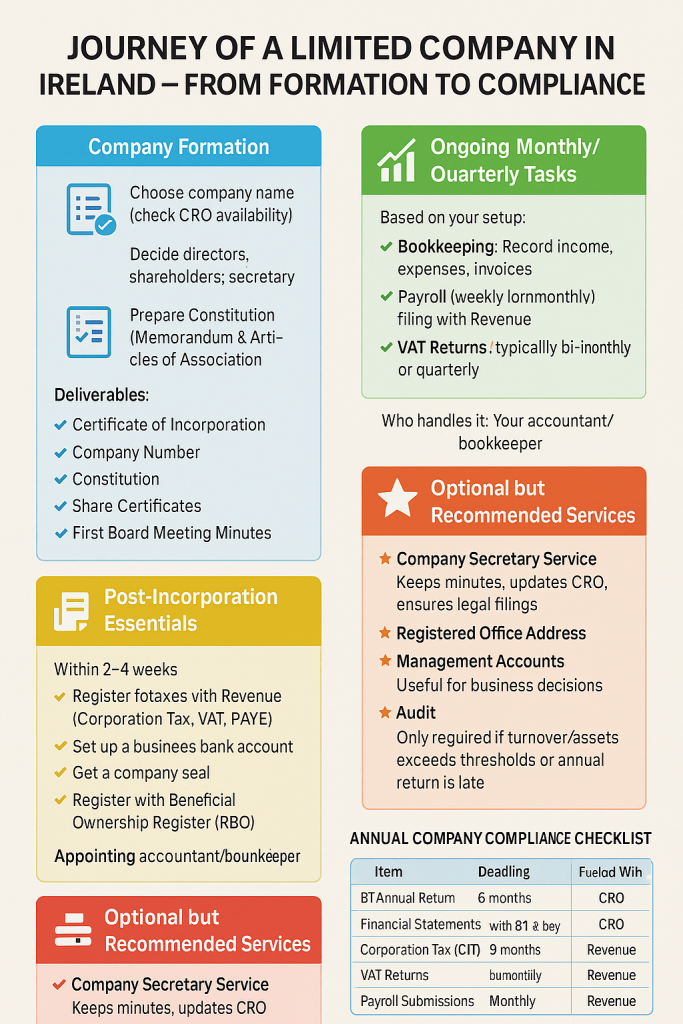
The Journey of a Limited Company in Ireland – From Start-Up to Staying Compliant

The Journey of a Limited Company in Ireland – From Start-Up to Staying Compliant

Are you considering establishing a limited company in Ireland? Discover the full journey – from formation and VAT registration to bookkeeping, annual returns, and corporation tax. This is a practical guide designed specifically for Irish SMEs.

Setting up a limited company in Ireland is a big step – and a very exciting one too. Whether you’re a first-time entrepreneur, moving your freelance business to a more formal structure or expanding from abroad, knowing what happens after incorporation is just as important as getting started.

In this guide, we’ll walk you through the full journey of an Irish limited company – from formation and early steps to ongoing responsibilities and annual compliance. We’ll keep it practical, clear, and honest. After all, no one likes surprises when it comes to Revenue or the CRO!

Step 1: Starting Out – Company Formation in Ireland

Let’s begin with the basics. Setting up a Private Company Limited by Shares (LTD) in Ireland is the most common route. It offers flexibility, limited liability, and is suitable for most businesses.

Here’s what you’ll need:

  • A unique company name (CRO will need to approve it)
    • Search the company name in just a few seconds: Click Here!
  • At least one director (one must be EEA-resident unless bonded)
  • One company secretary (can’t be the same person as the sole director)
  • A registered office address in the Republic of Ireland
  • Shareholders and details of share capital
  • A company constitution (used to be called Memorandum & Articles)

Once you submit the Form A1 and supporting documents to the Companies Registration Office (CRO), you’ll receive:

  • Certificate of Incorporation
  • Company Number
  • Constitution
  • Share Certificates
  • First Board Meeting Minutes

This stage is usually handled by an accountant or a company formation agent, and can be done within 5–10 working days.

✅ Do:

  • Use a professional company formation agent or accountant to get it right first time.
  • Double-check the company name with the CRO before finalising anything.

❌Don’t:

Assume the CRO will approve any name – many are rejected for being too similar to existing names.

Step 2: What Comes Next – Post-Incorporation Essentials

Now that your company is officially registered, there are a few important steps you’ll need to tick off:

  • Register with Revenue – for Corporation Tax, VAT (if applicable), and PAYE (if you’ll have employees)
  • Open a business bank account – make sure it’s in the company’s name
  • Get a company seal – used for official documents
  • Register with the RBO – the Beneficial Ownership Register
  • Find a bookkeeper or accountant – trust us, you’ll thank yourself later

Pro Tip: If you’ve got a good accountant, they’ll guide you through all of this and make sure nothing’s missed.

✅ Do:

  • Register for Corporation Tax within 30 days of trading.
  • Make sure the RBO registration is done within 5 months – it’s mandatory.

❌ Don’t:

  • Use your personal bank account for business – it’s not just unprofessional, it causes accounting headaches.
  • Delay appointing a tax agent – you’ll risk missing deadlines later on.

Step 3: Day-to-Day Running – Bookkeeping, Payroll & VAT

As your business begins trading, there’s regular financial housekeeping to be done.

Here’s what that usually includes:

  • Bookkeeping – tracking income, expenses, invoices, and receipts
  • Payroll – processing salaries and filing with Revenue via ROS
  • VAT Returns – filed bi-monthly or quarterly, depending on your setup

If you’re not comfortable managing all this yourself (and most business owners aren’t), outsourcing to a bookkeeper or accountant is a smart move. It’ll save you hours each month and ensure you stay on the right side of Revenue.

✅ Do:

  • Keep digital copies of receipts – they’ll save your bacon at year-end.
  • Use cloud accounting software (or a reliable bookkeeper) to stay organised.

❌ Don’t:

  • Wait until the end of the year to sort your books – late filing leads to penalties.
  • Miss payroll filings – Revenue are very strict about this.

Step 4: Staying Compliant – Annual Filing & Tax Returns

Once you’ve hit the six-month mark, it’s time to think about annual compliance. Here’s what’s involved:

  1. B1 Annual Return
    • Your first B1 return is due 6 months after incorporation (no accounts required)
    • Every year after, your B1 return must be filed with financial statements
  2. Financial Statements
    • Includes profit & loss, balance sheet, and director’s report
    • Must follow Irish GAAP or IFRS standards
  3. Corporation Tax Return (Form CT1)
    • Due 9 months after your company’s year-end
    • Submitted to Revenue with iXBRL-tagged accounts
  4. Income Tax Return (Form 11) for Directors
    • Required if you’re a director and self-assessed for income tax

Miss a B1 deadline by even a single day and you’ll lose your audit exemption for two years – which means paying for a full audit even if you’re a small business.

✅ Do:

  • Mark deadlines in your calendar and get professional help with returns.
  • File the B1 on time every year to retain audit exemption.

❌ Don’t:

  • Assume your accountant will file unless you ask – follow up regularly.
  • Ignore iXBRL – it’s not optional for most companies.

Optional (But Highly Recommended) Services

Here are a few services that aren’t legally required but make life much easier:

📌 Company Secretary Service

  • Handles statutory registers, board meeting minutes, CRO filings, and ensures you don’t miss key deadlines

📌 Registered Office Address

  • Keeps your home address private
  • Ensures important post from Revenue and CRO is handled properly

📌 Management Accounts

  • Quarterly reports that show how your business is doing – especially useful if you’re applying for a loan or grant

📌 Audit

  • Only required if you lose exemption or grow beyond certain thresholds
  • Even if optional, it can boost credibility with investors or banks

✅ Do:

  • Use a registered office address if you work from home – it looks more professional.
  • Get quarterly management accounts to keep an eye on business health.

❌ Don’t:

  • Rely on memory for deadlines – use a professional or set up reminders.
  • Think audits are only for big companies – one late return and you’re in.

Quick Annual Compliance Checklist (for Irish Limited Companies)

Task Due Who You File With
B1 Annual Return 6 months after incorporation CRO
Financial Statements With second and future B1s CRO
Corporation Tax (CT1) 9 months after financial year-end Revenue
VAT Returns Every 2 or 3 months Revenue
Payroll Submissions (RTD/P30) Monthly Revenue

Smart Software = Less Admin Hassle

Accounting and compliance software significantly alleviates the burden on businesses today. Gone are the days of chasing receipts in shoeboxes or manually filing VAT returns. With the right tools in place, you can cut down your admin time significantly – and reduce the chances of errors.

Here’s what we typically use (or recommend) for Irish limited companies:

  • Xero or QuickBooks Online – Both are cloud-based accounting platforms that make invoicing, bank reconciliation, expense tracking, and VAT reporting a breeze. You can access them anytime, anywhere – and they integrate beautifully with banks and payroll systems.
  • Surf Accounts or Big Red Cloud – Also popular with Irish SMEs, especially for those who prefer a more localised interface or need simple bookkeeping features.
  • BrightPay – Our go-to payroll software. It automates submissions to Revenue (via ROS), calculates tax, USC, and PRSI for each employee, and handles payslips and leave tracking too.
  • Hubdoc AutoEntry or Dext (formerly Receipt Bank) – These tools let you scan receipts with your phone and automatically extract the data into your accounts. No more typing in totals or guessing VAT amounts — it’s all done for you.
  • Google Drive /Dropbox – For securely storing all your company documents — everything from incorporation papers to tax returns.

The Result?

By combining the right software with professional support, we’ve helped clients reduce their manual admin by up to 90%. Things like:

  • Automated bank feeds & reconciliations
  • One-click VAT and payroll filings
  • Real-time dashboards showing how your business is performing
  • Fewer missed deadlines
  • More time to actually run your business

“Since moving to Xero with Forti, I don’t touch the books anymore. I just upload my receipts and check the reports once a week – everything else is handled.”
– Cian, Retail Business Owner, Co. Kildare

FAQs About Running a Limited Company in Ireland

1. How long does it take to register a company in Ireland?

It usually takes around 5 to 10 working days once the documents are submitted to the Companies Registration Office (CRO). If everything’s in order, it can move quite quickly.

2. Do I need an Irish-based director?

Not exactly — but you do need at least one director who is resident in the European Economic Area (EEA). If not, you’ll need to put a Section 137 bond in place to meet the CRO’s requirements.

3. What happens if I miss the B1 deadline?

If you miss the deadline, even by a day, you’ll lose your audit exemption for two years. You might also get hit with late filing penalties — so it’s one to stay on top of.

4. When should I register for VAT?

If your turnover is going to exceed €37,500 for services or €75,000 for goods, you’ll need to register. Even if you’re under the limit, some businesses choose to register early for credibility or to reclaim VAT.

5. Can I handle the bookkeeping myself?

You can, especially if things are simple early on. But unless you’re very confident with numbers, it’s usually best to bring in a professional bookkeeper or accountant. It saves time and reduces the risk of mistakes.

6. Do directors have to file personal tax returns too?

Yes — most directors in Ireland are self-assessed, which means you’ll need to file a Form 11 each year for your personal income.

7. What’s the difference between Corporation Tax and Income Tax?

Corporation Tax is paid by the company on its profits. Income Tax is what you pay personally on any income you take from the business (like salary or dividends).

8. Do I legally need a company secretary?

Yes – if there’s only one director, you must appoint a separate company secretary. They help make sure your company stays compliant with the CRO.

9. How much does it cost to stay compliant each year?

It depends on what services you need, but for most small companies it’s somewhere between €2,500 and €4,000 per year. That would typically cover bookkeeping, tax returns, annual filings, and company secretarial work.

10 Can Forti help with all of this?

Absolutely. We look after everything from company formation and bookkeeping to tax filing, payroll, and compliance. Whether you’re just starting out or running a growing business, we’ll guide you through the whole journey.

Wrapping Up

Setting up a limited company in Ireland is a great way to build something lasting, but there’s more to it than just filling out a few forms. From day one, there are important responsibilities — bookkeeping, tax returns, VAT, payroll, and making sure you don’t miss key deadlines.

The good news? You don’t have to do it alone.

At Forti Ltd, we’ve helped multiple business owners across Ireland set up, stay compliant, and focus on growing their business. Whether you’re a start-up, a sole trader going limited, or expanding into Ireland from abroad — we’re here to help every step of the way.

Your Guide to Bookkeeping & Year-End Compliance for Irish Limited Companies

Your Guide to Bookkeeping & Year-End Compliance for Irish Limited Companies

Running a business in Ireland is no small task, and once you’ve set up a limited company, there’s more to it than just finding customers and doing the work. Keeping your accounts in order and staying compliant with Revenue and the CRO is a must — not just to avoid fines, but to keep your business running smoothly.

Whether you’re a one-person consultancy or a small team managing e-commerce, this guide is here to help you understand how bookkeeping works, how to keep it simple, and what happens at year-end.

1. What Is Bookkeeping & Why Does It Matter?

What Is Bookkeeping & Why Does It Matter

Bookkeeping is just a fancy way of saying keeping track of what comes in and what goes out of your business. It’s not about being a maths whizz — it’s about knowing:

  • What you earned
  • What you spent
  • Who owes you money
  • What you owe to Revenue and others

Done right, bookkeeping helps you stay on top of your cash flow, make smart decisions, and avoid trouble with tax returns or penalties. Done wrong, and you’ll end up handing your accountant a shoebox of receipts — and a bigger bill.

2. How to Keep Your Books – Step by Step

Here’s a simple process any Irish limited company can follow:

Open a Business Bank Account

Keep personal and business money completely separate — this saves hours of confusion later.

Record All Sales

Whenever you invoice a client, log the details: date, customer, amount (including VAT if applicable), and when it’s due. Keep a copy of every invoice.

Track All Purchases and Expenses

Bought a laptop for work? Paying for Canva, QuickBooks, or stock images? Save the receipts and enter them into your system.

Reconcile Bank Statements

Once a month, go through your bank statements and match every transaction with your own records. If something’s missing or looks odd — you’ll spot it quickly.

Keep on Top of VAT (if registered)

  • Record VAT on every sale and purchase
  • File returns every two months (most common)
  • Save all VAT invoices — Revenue can audit at any time

Payroll (if you have staff or pay yourself a salary)

Use payroll software to calculate PAYE, USC, PRSI, and report it to Revenue (ROS) in real-time. If you’re a director, you’re also considered an employee.

Use Simple Tools

Even a basic accounting tool like Xero, QuickBooks, or Surf Accounts can make life a lot easier. Or you can use Excel — just keep it tidy.

3. Smart Tips to Save Time (and Accountant Fees)

Here’s how to keep your books tidy and your accountant happy:

  • Email or scan receipts once a week – don’t let them pile up
  • Use categories like Rent, Advertising, Software, Mileage
  • Use cards or bank transfers – avoid messy cash
  • Store documents by month – easy for referencing
  • Note unusual items (e.g. personal reimbursements or deposits)

The cleaner your books, the cheaper your accountant’s fee — it’s that simple.

Explore Our Accounting Packages

Download a Business_Expense_Tracker

4. What Bookkeeping Might Cost You

Bookkeeping fees depend on the size and complexity of your business. Here’s a rough guide:

Monthly Bookkeeping Costs

Type of Business Monthly Cost (ex. VAT) Notes
Solo Consultant €100 – €150 Low volume, no VAT
Small VAT-Registered €150 – €300 30–100 transactions/month
E-commerce or Services €300 – €600 Stripe, PayPal, VAT, etc.
Larger Company From €600+ Multi-accounts, payroll

Add €25–€40/month per staff member if payroll is needed.

Catch-Up Work (Historical)

Catch-up or historical work refers to the process of rebuilding or cleaning up your accounts when bookkeeping hasn’t been done properly — or at all — for a certain period of time.

This could involve:

  • Sorting through 6–12 months of bank statements, receipts, and invoices
  • Recreating sales and purchase records
  • Filing overdue VAT returns
  • Preparing for late CRO or Revenue submissions

It’s a common need for busy business owners who’ve focused on running their business and let the admin slide — no judgement! But the longer you leave it, the more time and cost it takes to get back on track. Starting early saves stress (and money).

Months Missed Estimated Fee What’s Included
3 Months €250 – €450 Sales, purchases, 1 bank account
6 Months €500 – €900 Adds VAT returns & tidy-up
12 Months €900 – €1,800 Full year, ideal for CRO/Revenue filing
More than 1 Yr From €1,500+ Custom quote after reviewing records

If you’ve left your books untouched, it’s never too late — but catching up will cost more. Best to stay on top of it monthly.

5. What Happens at Year-End – Compliance Made Simple

Here’s what every limited company in Ireland needs to do at the end of their financial year:

Annual Accounts

Prepared by your accountant, these include:

  • Profit & Loss Account
  • Balance Sheet
  • Notes to the Accounts

Even if you’ve made no money — you still need accounts.

Corporation Tax (CT1)

  • Due 9 months after your year-end
  • Must be filed by the 23rd of that month
  • You’ll also pay your tax by this date

CRO Annual Return (Form B1)

  • First one is due 6 months after setup (no accounts)
  • After that, due every year with full accounts
  • Filed on the CORE platform

How to Check if Form B1 Has Been Filed

Option 1: Use the CRO Company Search

  1. Go to: https://core.cro.ie
  2. Click on “Company Search” (top right).
  3. Enter your company name or number.
  4. Click on your company name in the results.
  5. Scroll to see:
    • “Next Annual Return Date” – tells you when the next B1 is due.
    • “Last Annual Return Filed” – shows the date it was submitted.
    • You can also view/download past B1s under the “Submissions” tab.

Option 2: Log into Your CORE Account

If you’re the director, secretary, or agent:

  1. Login to your company’s CORE account at https://core.cro.ie
  2. Go to “My Submissions”
  3. You’ll see the status of each filing – including if the latest B1 has been:
    • Drafted
    • Submitted
    • Received
    • Registered

How to Set Up a CORE Account (for CRO Filings)

Here’s how to set up your own account on the CRO’s CORE system if you want to monitor submissions directly:

Explore Our Accounting Packages

Step-by-Step:

  1. Go to: https://core.cro.ie
  2. Click “Register” at the top right.
  3. Fill in:
    • Your name, email, and phone
    • Choose a username and password
  4. After registering, verify your email.
  5. Log in and click “My Companies”
  6. You can now:
    • File annual returns
    • View submission history
    • Download certificates
    • See deadlines

Handy Tip:

Set calendar reminders for:

  • 6 months after incorporation (for the first B1)
  • Every 12 months after that for your ongoing returns

If you’re unsure or can’t find the info, your accountant or company secretary should be able to check it quickly via CORE or their filing software.

RBO (Register of Beneficial Ownership)

  • Must be filed within 5 months of incorporation
  • Update any time the ownership changes

What Is the RBO?

The RBO is a separate register from the CRO. It records who ultimately owns or controls the company.

“Beneficial Owner” = A person who owns more than 25% of the company’s shares or voting rights, or who otherwise controls it.”

How to File or Update the RBO

  1. Visit: https://rbo.gov.ie
  2. Login or register (you’ll need a MyGovID or ROS certificate)
  3. Provide:
    • Company number
    • Beneficial owner’s full name, PPSN, DOB, residential address
    • % of shares owned or nature of control
    • Date they became a beneficial owner
  4. Submit electronically — no fee for initial or updated filings

Penalties for Non-Compliance

  • Failure to file RBO = criminal offence
  • Fines of up to €500,000
  • Can delay opening a business bank account, applying for funding, or tendering for contracts

Good Practice for Accountants

  • Keep a copy of the internal RBO register with client records
  • Set a review reminder (e.g. annually or at AGM)
  • Re-file if:
    • Shares are transferred
    • New directors gain control
    • Existing beneficial owners resign or reduce shareholding below 25%

6. Deadlines & Penalties – What You Could Face

Missed Task Penalty or Consequence
Late B1 Filing €100 + €3/day (up to €1,200), audit exemption gone
Late CT1 Filing 5% surcharge if <2 months late, 10% if more
Late VAT Return Interest + possible Revenue audit
RBO Not Filed Criminal offence, fines up to €500,000

Missing even one deadline can be costly — not just in money but in admin headaches.

Estimated Fee Structure for CRO Annual Return Submission

Service Type Typical Fee (ex. VAT) Notes
B1 Submission Only (client prepares accounts) €50 – €100 Straightforward, no financial formatting
B1 Submission + Financial Statement Upload €100 – €250 You handle tagging, formatting, digital signatures
B1 + Year-End Accounts Preparation (small co.) €350 – €750+ Includes full accounts prep, director reports, tax calcs
Late B1 Filing Support €100 – €300 extra Handling penalties, loss of audit exemption, backdating

7. Real-Life Example: Graphic Design Studio

Jane runs a graphic design business in Galway. She has one staff member and is VAT registered.

  • 40–60 transactions/month
  • Uses Stripe and bank account
  • Pays herself via payroll

Her setup looks like this:

Task Cost
Monthly Bookkeeping €200
Payroll (1 employee) €20/month
Annual Accounts & CT1 €750
CRO Annual Return (B1) €50
Total Annual Spend ~€3,130/year

Jane keeps her receipts digital, reconciles her bank monthly, and avoids any late fees. Her accountant loves her.

8. In Summary

If you run a limited company in Ireland, bookkeeping and compliance are part of the job. They might not be the flashiest tasks, but they’re essential.

  • Stay organised each month
  • File everything on time
  • Use a decent bookkeeper or accountant

It’ll save you money, reduce stress, and let you focus on growing the business you love.

Frequently Asked Questions (FAQs)

FAQ
1. Do I need an accountant if I already use bookkeeping software?

Not necessarily — bookkeeping software like Xero or QuickBooks can help manage day-to-day records, but an accountant is still needed to prepare and file your year-end accounts, corporation tax (CT1), and ensure you’re compliant with Irish law. Most business owners use both.

2. What happens if I don’t file my B1 annual return on time?

You’ll face an automatic €100 penalty, plus €3 for every additional day late (up to €1,200). You’ll also lose your audit exemption, meaning your next set of accounts must be fully audited — even if you’re a small company. It’s one of the most expensive mistakes Irish companies make.

3. I’ve just set up my company — when do I need to start bookkeeping?

Straight away. From the moment you start trading (or incur expenses), you should begin recording transactions. Your first B1 return is due 6 months after incorporation, so don’t leave it until the last minute.

4. I haven’t done any bookkeeping for the past year. What should I do?

Get help from a bookkeeper or accountant as soon as possible. They can go through your bank statements, invoices, and receipts to rebuild your records. The longer you leave it, the more it can cost — especially if you miss filing deadlines.

5. How much should I budget for bookkeeping each year?

It depends on your business size, but most small Irish companies spend between €1,500–€3,000 a year for full monthly bookkeeping, payroll, and end-of-year compliance. Catch-up or messy accounts may cost more initially.

6. What documents should I keep for Revenue or CRO?

Keep:
-> Invoices issued and received
-> Receipts (physical or scanned)
-> Bank statements
-> VAT returns
-> Payroll reports
-> Annual accounts and CT1 filings
Revenue can audit up to 6 years back, so store documents securely (digital is fine).

7. What’s the difference between bookkeeping and accounting?


Bookkeeping is about keeping records tidy and up to date: invoices, expenses, VAT, payroll.
Accounting is more strategic: preparing accounts, filing taxes, financial planning.

Think of bookkeeping as keeping the house clean, and accounting as managing the whole household.

8. I’m not VAT registered yet — do I need to worry about VAT returns?

Not until your turnover exceeds €37,500 for services or €75,000 for goods. But if you’re nearing those thresholds, it’s wise to register early or at least plan for it. Your bookkeeper can help monitor this

9. Can I file my year end accounts via myaccount?

Yes, you can file your year-end accounts through the Revenue Online Service (ROS), but not via myAccount.

Filing Year-End Accounts in Ireland

If you’re self-employed or a sole trader, you can file your Income Tax Return (Form 11) through myAccount. This allows you to:

  • Declare additional income
  • Claim tax credits and reliefs
  • Get a Statement of Liability
  • Request refunds for any overpaid taxes

However, if you’re filing as a company, you’ll need to submit your year-end accounts in iXBRL format via ROS. This includes:

  • Directors’ report
  • Auditor’s report
  • Statement of profit and loss
  • Balance sheet
  • Statement of cash flows
  • Statement of changes in equity
  • Notes to the accounts
  • Detailed profit and loss account

For more detailed guidance on submitting financial statements in iXBRL, you can check out Revenue’s official page here: Revenue.ie – Submitting Financial Statements.

Steps to File Your Year-End Accounts

  1. Register for ROS: If you haven’t done so already, you’ll need to register for ROS (Revenue Online Service). You’ll also need a digital certificate, which you can get through myAccount. For more details on registering, check out this guide: ROS Registration Instructions.
  2. Prepare Your Financial Statements: Make sure your financial statements are in the correct iXBRL format. You may need accounting software or a professional accountant’s help to generate these.
  3. Sign in to ROS: Once you’re registered, sign in to ROS at revenue.ie – ROS Sign In.
  4. Submit Your Financial Statements: Head to the relevant section on ROS for submitting your financial statements, then follow the instructions to upload your iXBRL files.
  5. Complete the Corporation Tax Return (CT1): Along with your financial statements, you’ll also need to complete and submit your CT1 form, which is also done through ROS.

A Few Important Things to Keep in Mind:

  • myAccount vs. ROS: myAccount is mainly for personal taxes, while ROS is designed for businesses and tax agents, so your company tax filings should go through ROS.
  • Deadlines: Make sure you’re aware of the deadlines for filing your returns to avoid any penalties.
  • Professional Help: If you’re unsure about preparing your iXBRL statements, it might be worth speaking to an accountant or tax professional.

Need Help? Talk to Forti

At Forti, we work with Irish businesses every day — from start-ups to established SMEs. Whether you’re behind on your books or just want someone to take care of it every month, we’re happy to help.

Let’s make bookkeeping simple.

Let Forti simplify your bookkeeping
Cybersecurity in Accounting Why Protecting Your Financial Data Has Never Been More Critical

Cybersecurity in Accounting: Why Protecting Your Financial Data Has Never Been More Critical

With more Irish businesses turning to online tools and cloud-based accounting systems, the importance of keeping your financial data safe has never been greater. Your accounts hold some of the most sensitive information in your business—bank details, payroll figures, invoices, Revenue records—and all of it is a goldmine for cybercriminals.

While digital tools make running your business easier, they also open the door to risks. It’s not just large corporations being targeted—small businesses are increasingly falling victim to scams, hacks, and data breaches.

In this post, we’ll look at why cybersecurity should be a priority in your day-to-day accounting, the types of threats you need to be aware of, and what you—and your accountant—can do to stay protected.

Why Cybersecurity Matters in Accounting

Why Cybersecurity Matters in Accounting

Whether you’re a sole trader, a family-run firm, or a growing SME, your accounting systems are full of information that fraudsters would love to get their hands on. A single security slip could lead to financial losses, damage to your reputation, and serious legal trouble under GDPR.

Many businesses assume that once they move to a cloud platform like Xero or QuickBooks, they’re automatically protected. And while these providers do have strong security measures in place, that’s only half the job. The other half comes down to how you use the system, who has access, and how careful your team is.

Common Cyber Threats in Accounting

1. Phishing Scams

You get an email that looks like it’s from your accountant or bank, asking for login details or payments. One wrong click and your information is gone.

2. Ransomware Attacks

A type of malware that locks you out of your system until you pay a ransom. Your accounts are effectively held hostage.

3. Weak Passwords

If you’re still using “password123”, you’re making it far too easy for someone to break in.

4. Unsecured Devices

Logging into your accounts on a public Wi-Fi network or a shared device puts you at serious risk.

Secure your business finances with expert help—Talk to Forti LTD today.

Real Case: A Costly Mistake in Limerick

A small marketing agency in Limerick was targeted by a phishing scam. An email that appeared to come from their accountant asked them to make a “routine payment” to a new supplier. They didn’t double-check—and €8,000 disappeared into a fake account. The money was never recovered, and the company ended up facing a Revenue audit due to the incident.

This just shows that cyber threats are not a big-company problem—they can affect any of us.

Steps You Can Take to Stay Protected

  • Use Strong Passwords – Avoid using the same password across multiple platforms. Use a mix of letters, numbers, and symbols.
  • Enable Two-Factor Authentication (2FA) – It adds an extra layer of protection when logging in.
  • Keep Software Updated – Don’t ignore update reminders—they often fix security issues.
  • Limit Access – Only give accounting access to people who genuinely need it. Review user permissions regularly.
  • Train Your Staff – Everyone should know how to spot a dodgy email or pop-up.
    Choose Trusted Providers – Stick with accounting software that has a solid reputation for security.

The Responsibility of Accountants and Advisors

Don’t wait for a breach Forti LTD Protects What Matters Most.

Cybersecurity isn’t just the business owner’s job. Accountants and bookkeepers have a duty to protect the data entrusted to them. Whether working in-house or through an external firm, anyone handling financial information needs to:

  • Store client information securely.
  • Avoid sharing passwords or sending sensitive documents by email without encryption.
  • Educate clients on safe practices.
  • Choose software with built-in security tools.
  • Report suspected breaches immediately and support clients in responding to incidents.

At Forti, we take this responsibility seriously. We use secure systems, limit access on a need-to-know basis, and work closely with our clients to ensure they understand how to keep their information safe. We don’t just manage your books—we help protect your business.

Conclusion

In today’s digital world, accounting and cybersecurity go hand in hand. The good news is that protecting your financial data doesn’t have to be complicated—it just takes a bit of care and consistency.

Whether you’re using cloud tools or working with an accountant, make sure your systems and habits are set up to keep your business safe.

If you’d like a hand reviewing your setup or want support moving to a secure online system, get in touch with us at Forti. We’ll guide you every step of the way.

Frequently Asked Questions (FAQs)

Are cloud accounting platforms safe?

Yes—provided you use them correctly. The platforms themselves use secure encryption and data storage, but users must follow good practices too.

What’s the most common risk for small businesses?

Phishing emails are the biggest threat. They rely on human error—clicking a dodgy link or trusting a fake request.

Can Forti help with cybersecurity?

We can. We’ll help you set up secure systems, review your access controls, and give you advice on how to reduce your risk.

What if I think I’ve had a data breach?

Change your passwords straight away, contact your software provider, and speak to your accountant. If personal data is involved, you may need to notify the Data Protection Commission.

Do I still need antivirus software if I use cloud accounting?

Yes—absolutely. Cloud software doesn’t protect your laptop or phone. You still need to guard your own devices.

How often should I check my security settings?

Ideally every few months—or straight away if someone leaves your company or changes role.

Green Accounting Bringing Sustainability into the Books

Green Accounting: Bringing Sustainability into the Books

Sustainability isn’t just a buzzword anymore—it’s become a vital part of how we do business here in Ireland. From climate targets to consumer expectations, businesses are under more pressure than ever to show they’re doing their bit for the environment. But how do you actually measure that? And more importantly, how do you report on it in a way that matters?

That’s where green accounting comes in. Also known as environmental accounting, this approach helps businesses track the environmental impact of their operations and include that information in their financial reporting. It’s about giving a more rounded picture—not just profits and losses, but carbon and waste too.

In this article, we’ll break down what green accounting means, why it matters to Irish businesses, and how to get started in a practical, no-nonsense way.

What is Green Accounting?

What is Green Accounting

Green accounting is the practice of including environmental costs and benefits in your financial reporting. It might sound complicated, but the idea is fairly straightforward: if your business affects the environment, those effects should be reflected in your figures.

That could include:

  • The cost of dealing with waste and emissions
  • Spending on eco-friendly upgrades (like energy-efficient lighting or electric vehicles)
  • Savings from sustainability initiatives

Any taxes, fines, or incentives linked to environmental performance
It’s a way to make your accounts reflect the real impact your business is having—not just financially, but environmentally too.

Why Green Accounting Matters in Ireland

Why Green Accounting Matters in Ireland
  • Legislation is changing – Between EU climate rules and Ireland’s own targets, it’s only a matter of time before more businesses are required to report on their environmental footprint.
  • Investors and customers care – More and more, people want to deal with companies that are honest about sustainability. It’s not just about being ‘green’—it’s about being transparent.
  • Better business decisions – Knowing the environmental cost of your choices helps you manage resources better, avoid waste, and uncover new ways to save money.

Reputation and trust – Clear reporting builds trust. Whether it’s with clients, staff, or stakeholders, people respect a business that’s upfront about both its successes and its challenges.

What Does Green Accounting Actually Measure?

Every business is different, but here are a few things that often show up in environmental reports:

  • Energy and water usage
  • Emissions and carbon footprint
  • Waste and recycling performance
  • Eco-friendly investments and their returns
  • Grants or penalties linked to environmental action (or inaction)

Some businesses go even further, assigning financial values to things like biodiversity or air quality. It depends on your industry and what matters most to your operations.

Case Study: Going Green in Dublin

A medium-sized print and packaging business in Dublin was looking to improve its sustainability credentials. With Forti’s help, they began measuring their electricity and gas use, switched to recycled materials, and installed low-energy equipment in their warehouse.

The upfront cost was offset by grants and long-term savings, and within a year, they’d reduced their energy bills by 18% and secured a new contract with a large retailer focused on sustainable suppliers. More importantly, they were able to show that progress clearly in their accounts.

Case Study: Going Green in Dublin

How to Get Started with Green Accounting

How to Get Started with Green Accounting
  • Pick a starting point – Don’t try to measure everything at once. Start with energy usage or waste management and build from there.
  • Use a framework – Standards like the GRI (Global Reporting Initiative) or EU Taxonomy can help guide what to track and how to report it.
  • Get help – Your accountant or a sustainability advisor can help you set up systems that fit your business.
  • Make it part of your regular reports – Don’t bolt it on as an afterthought. Integrate it into your monthly or quarterly updates.
  • Be honest – It’s okay to have areas that need improvement. What matters is showing you’re tracking progress and making an effort.
How to Get Started with Green Accounting

The Role of Accountants in a Greener Economy

Accountants aren’t just number crunchers—they’re business advisors. And as businesses shift towards greener models, accountants have a key role in helping track, manage, and communicate environmental impact.

They can:

  • Identify environmental costs that often go unrecorded
  • Help create budgets and forecasts that reflect sustainability goals
  • Align your reporting with global sustainability standards
  • Ensure the figures you report are accurate, reliable, and meaningful

At Forti, we work with Irish businesses every day to help them make sense of green accounting. Whether you’re starting from scratch or looking to improve what you already track, we’re here to help.

Frequently Asked Questions (FAQs)

Is green accounting only for large companies?

Not at all. Any business can benefit from tracking its environmental impact—even sole traders. It’s about doing what makes sense for your size and industry.

Do I need special software to do green accounting?

Not necessarily. Many businesses start by using spreadsheets or integrating with their existing accounting software. As your needs grow, you might explore tools that offer more features.

What if I don’t have much environmental impact?

You might be surprised. Energy use, transport, packaging—most businesses affect the environment in some way. Tracking these areas can lead to both savings and opportunities.

Will this affect my tax or compliance requirements?

Currently, it’s more about voluntary reporting, but legislation is changing fast. Green accounting can help you stay ahead of future requirements and benefit from grants or incentives.

Can my accountant handle this or do I need a sustainability expert?

Many accountants (like us at Forti) are already working with clients on green reporting. That said, for detailed environmental assessments, partnering with a sustainability consultant may also help.

How do I show my sustainability progress to customers?

Green accounting gives you real numbers you can use in annual reports, marketing, tenders, or client proposals. It’s a great way to show you’re serious about your environmental impact.

How to Get Started with Green Accounting

Conclusion

Green accounting is about making sustainability part of how you do business—not just something you talk about. By bringing environmental measures into your financial reporting, you show that your business cares not only about profits, but also about its place in the wider world.

Whether you’re taking the first step or already on the journey, there’s never been a better time to make sustainability part of your bottom line.

“Go green with confidence — Get started with Forti’s sustainable accounting services.”

Picking the Right Accounting Software for Your Business in Ireland

Picking the Right Accounting Software for Your Business in Ireland

A comparison of Xero, QuickBooks Online, Sage, and Surf Accounts

When you’re running a business in Ireland, keeping your accounts in good shape is not just about staying compliant — it’s about making life easier. With the right software, you’ll save time, stay on top of your taxes, and get a clearer view of how your business is doing.

At Forti Ltd., we work with businesses of all shapes and sizes, and we’re often asked, “Which accounting software should I use?” To help, we’ve pulled together this guide on four of the most popular platforms used in Ireland: Xero, QuickBooks Online, Sage, and Surf Accounts.

1. Xero

Xero Accounting Software

Best for: Tech-savvy SMEs, creatives, eCommerce

Why people like it:

Xero’s clean, easy-to-use dashboard is a hit with Irish startups and small business owners. You can send invoices, connect to your bank, and keep an eye on your cash flow — all from your phone or laptop.

Key Features:

  • Live bank feeds from Irish banks
  • Easy invoicing and expense tracking
  • Great for working with your accountant in real-time
  • Works well with apps like Shopify, Stripe, HubSpot, and more

Things to watch:

It can take a bit of getting used to at first, and the pricing can climb if you need lots of features or extra users.

2. QuickBooks Online

QuickBooks Online Accounting Software

Best for: Freelancers, service-based businesses, consultants

Why people like it:

QuickBooks is a long-time favourite for its simple layout and handy mobile app. If you’re new to cloud accounting, it’s a good place to start.

Key Features:

  • Track mileage, capture receipts, and send invoices easily
  • Link up with your Irish bank
  • Connect to ROS for VAT returns
  • Good range of financial reports

Things to watch:

Payroll isn’t built-in for Ireland, but it can link up with software like BrightPay.

3. Sage Business Cloud

Sage Business Cloud Accounting Software

Best for: Larger SMEs, retail, or anyone who needs strong reporting

Why people like it:

Sage has been trusted by Irish businesses for years. It’s reliable, especially for companies with stock to manage or lots of users who need different levels of access.

Key Features:

Solid Irish VAT and compliance tools

Advanced reporting and audit trail

Inventory and stock tracking

Secure cloud access with full control

Things to watch:

The interface feels a bit older than Xero or QuickBooks, and it can be tricky to set up without a bit of help.

4. Surf Accounts

Surf Accounts Accounting Software

Best for: Irish SMEs who want a local option with built-in CRM

Why people like it:

Surf Accounts was built with Irish businesses in mind. It’s got all the usual accounting tools but also throws in a built-in CRM, which is great if you’re managing leads and customers.

Key Features:

  • Submit VAT returns straight to ROS
  • Integrated CRM system for sales and marketing
  • Multi-currency support
  • Custom dashboards and reports

Things to watch:

Not as many integrations as the bigger players, and the design isn’t quite as slick.

Quick Comparison

Platform Ideal For Payroll Support Irish VAT Ready Extra Features
Xero SMEs, eCommerce, modern startups Via add-ons 1,000+ app integrations
QuickBooks Online Freelancers, consultants BrightPay (external) Mileage tracker, mobile app
Sage Inventory-heavy businesses Built-in (paid) Strong audit/reporting tools
Surf Accounts Irish businesses & CRM users Included Local support, CRM tools

Hubdoc

hubdoc software

“Snap it, store it, forget it.”

Hubdoc is a handy app that takes the hassle out of paperwork. Instead of stuffing receipts into a drawer or chasing down invoices at the end of the month, you just take a quick photo or forward them by email. Hubdoc reads the details for you — amounts, dates, supplier names — and sends them straight into your accounting software, with the original document saved for your records.

It’s brilliant for VAT returns, keeps things tidy for Revenue audits, and saves hours of manual entry.

Hubdoc Integrations

Works seamlessly with:

Accounting Software Hubdoc Integration Notes
Xero ✅ Full integration Hubdoc is owned by Xero, making it the most seamless option. Data flows directly into Xero as bills, with documents attached.
QuickBooks Online ✅ Partial integration Works well for receipt scanning and document storage, but integration isn’t as tight as with Xero. Requires more manual review.
Sage ❌ No direct Hubdoc support You’ll need to use alternatives like Dext Prepare or manual import methods.
Surf Accounts ❌ No known direct integrations Hubdoc isn’t supported. You may need to use CSV imports or explore local tools for document capture.

Dext Prepare (Alternative to Hubdoc)

Dext Prepare software

Integrates with:

Accounting Software Dext Prepare Integration
Xero ✅ Excellent integration
QuickBooks Online ✅ Excellent integration
Sage (various versions) ✅ Supported (Sage Business Cloud, Sage 50, etc.)
Surf Accounts ❌ Not directly supported

Pleo (Smart company cards)

Pleo software

Pleo helps automate employee expenses and integrates well with:

Accounting Software Pleo Integration Notes
Xero ✅ Seamless Automatically syncs receipts and expenses to Xero accounts.
QuickBooks Online ✅ Supported Supports expense categories and direct syncing.
Sage ✅ Limited versions Mostly with Sage 50 or Business Cloud. May require middleware.
Surf Accounts ❌ Not officially supported Manual data handling required.

Summary: Best Pairings for Automation

  • Xero + Hubdoc/Pleo/Dext → Most automation, perfect for Irish SMEs looking to modernise
  • QuickBooks Online + Dext/Pleo → Very good automation with some manual oversight
  • Sage + Dext → Good for more traditional or enterprise setups
  • Surf Accounts → Best used for simpler setups with internal document handling

Real-Life Case Study: Manual Processes Holding a Business Back

  1. Client: A mid-sized manufacturing company based in Munster
  2. Turnover: ~€1 million annually
  3. Previous system: Manual bookkeeping using Excel and physical paperwork
  4. Team: 10 staff including one part-time admin

The Situation

This manufacturing company came to Forti Ltd. after years of struggling with inefficiencies:

  • Delayed accounts: Often missed VAT and tax return deadlines
  • Frequent errors: Invoices mismatched, spreadsheet formulas broken
  • Paper overload: Boxes of receipts, purchase orders, and handwritten notes
  • No real-time view: They never quite knew how much was in the bank or owed in taxes
  • Audit anxiety: Incomplete records increased the risk of Revenue fines
  • Wasted time: The owner spent weekends catching up on admin tasks instead of growing the business

The Transformation with Digital Tools

The Transformation with Digital Tools

We helped them migrate to Xero and layered in tools that took their admin workload down to a minimum:

Accounting Software + Mobile Apps

  • Xero: Real-time accounting, automated reconciliation, and financial dashboards
  • Hubdoc: Employees snap photos of receipts on their phones; the system extracts the data and uploads it directly into Xero — no more manual entry
  • Dext Prepare (formerly Receipt Bank): For scanning, tagging, and uploading invoices or bills from email or mobile
  • Revolut Business or Pleo (for expense cards): Linked to Xero for automatic expense tracking

Financial Clarity

  • Live dashboards for cash flow and P&L
  • Clean, up-to-date data helped them secure a government grant with confidence
  • No more chasing down receipts or guessing the VAT owed

Document Handling Cut to Near-Zero

  • Receipts and invoices automatically fetched from email (via Hubdoc or Dext)
  • Uploaded documents matched with transactions in real time
  • Revenue-ready records stored securely in the cloud

Benefits of Going Digital

Using the right mix of accounting software and mobile apps, this business:

  • Reduced bookkeeping time by over 60%
  • Filed all returns on time (for the first time in years)
  • Passed a Revenue audit with zero penalties
  • Had confidence to hire more staff and expand operations

What Tools Do You Need?

Here are some apps we often recommend for Irish SMEs:

Tool Purpose Works With
Xero Core accounting platform N/A
Hubdoc Scan/upload receipts & bills Xero, QuickBooks
Dext Prepare Automated data entry & OCR Xero, QuickBooks, Sage
Pleo Smart expense cards Xero, QuickBooks
BrightPay Payroll for Irish businesses Xero, QuickBooks, Sage

How Forti Can Help

Not Sure Which Accounting Software is Right for You Let Forti Help.

We don’t just set you up with the right software. At Forti Ltd., we:

  • Help you choose the right platform for your needs
  • Handle the setup and migration from old systems
  • Automate day-to-day bookkeeping and VAT tasks
  • Train your staff and stay with you as your business grows

Frequently Asked Questions

Which accounting software is best for Irish VAT returns?

All four platforms — Xero, QuickBooks Online, Sage, and Surf Accounts — are fully compliant with Irish VAT rules. Surf and QuickBooks offer direct ROS integration, while Xero handles it smoothly through third-party add-ons.

Can I use these platforms for payroll in Ireland?

Yes, but with a caveat. Only Sage and Surf Accounts offer built-in payroll tools for Irish businesses. For Xero and QuickBooks, you’ll need to link up with payroll providers like BrightPay.

Is it easy to switch from spreadsheets to accounting software?

Absolutely. All of these tools offer simple onboarding and migration. At Forti, we make the switch seamless by importing your old data and setting everything up for you.

Which one is best if I want to grow my business?

That depends. If you’re scaling and need automation, Xero or QuickBooks is a great pick. If you want an all-in-one system with sales tracking and local support, Surf Accounts might suit you best.

What if I need help using the software?

That’s where we come in. Forti Ltd. offers ongoing support, training, and advice so you’re never left wondering what to click next.

Don’t Let Admin Slow You Down

Still relying on spreadsheets, folders, and hand-written notes? It might be costing you more than you think — in lost time, stress, and potential Revenue penalties.

With Forti Ltd., we’ll help you:

  1. Choose the right tools
  2. Set everything up
  3. Automate your admin
  4. Train your staff
  5. Stay compliant, confident, and in control

Let Forti Ltd. help you find the right tools — and use them well.

Why Ireland Should Be Your Go-To Business Hub in 2025

Why Ireland Should Be Your Go-To Business Hub in 2025

Thinking about launching a startup or taking your business global? Ireland might just be the perfect place to make it happen. With a strong economy, investor-friendly tax policies, and a prime location, it’s no surprise that companies—big and small—are choosing to set up here.

And this year, the Emerald Isle is doubling down to incentivise business owners like you.

Key Reasons to Choose Ireland

Key Reasons to Choose Ireland

A Corporate Tax System That Works for Businesses

International companies have been coming in droves due to the 12.5% corporate tax rate. Pretty low compared to the rest of the region. And for startups in tech, biotech, or any R&D-driven sector, you can get generous tax credits and capital allowances.

However, note that going forward, multinational corporations with revenues over €750 million will see a new 15% minimum tax rate. That’s because of OECD tax reforms being done by the government to align with global tax standards.

We Simplify Your Irish Setup

The EU Market—With an English-Speaking Advantage

Post-Brexit, Ireland holds a unique position—it’s now the only English-speaking country in the EU.

If you’re a business trading across Europe, this gives you a major advantage: Access to 450 million consumers while maintaining strong trade links with the UK and US. That’s something you need to scale globally.

A Talent Pool That Fuels Growth

Your business is only as strong as your team. Ireland offers a wealth of skilled, educated professionals in key industries. Our universities focus heavily on STEM education, producing top-tier talent.

From data analysts and software engineers to biotech researchers, you have a vast pool to pick from.

A Government That Supports Entrepreneurs

Enterprise Ireland and Local Enterprise Offices (LEOs) offer startups grants, funding, and mentorship through programmes. The Competitive Start Fund and High Potential Start-Up (HPSU) programme are designed to give early-stage businesses a boost. It’s the right ground to give early-stage businesses a footing.

A Thriving Innovation Ecosystem

There are major tech clusters in Dublin, Cork, and Galway. Global giants such as Google, Meta, and Pfizer have already established their presence in these areas. Why? Because Ireland prioritises collaboration between businesses, universities, and government-backed research programmes. That’s where you want to be for new ideas, R&D, and cutting-edge tech.

Stability For Long-Term Business Growth

Economic and political stability matter more than ever. Ireland offers both.

With strong GDP growth, low unemployment, and a business-friendly government, Ireland gives companies the stability and predictability they need to grow.

Opportunities for Startups and Global Companies in Ireland

Tech and Innovation—A Hub for Startups

The artificial intelligence, fintech, and medtech sectors are booming. You’ll find the funding, talent, and infrastructure here to scale your operations.

Sustainability—Big Opportunities for Green Businesses

There’s solid financial support out there for businesses focusing on renewable energy and eco-friendly tech. Government grants, investment funds, and tax incentives—you name it. Available for companies dealing with the likes of wind and solar energy, sustainable packaging, or carbon reduction solutions.

Pharmaceuticals and Life Sciences—A Global Leader

Ireland is a powerhouse for biotech, pharma, and life sciences. Setting up here means instant access to industry experts, generous funding opportunities, and world-class research facilities. Nine of the world’s top ten pharmaceutical giants have already made this their home.

Ireland in 2025—A Business Destination That Stands Out

If you’re looking for a strategic location to build or grow your business, Ireland ticks all the boxes:

  • Business-friendly tax incentives to keep your company competitive.
  • Full access to the EU market with the advantage of an English-speaking workforce.
  • A highly skilled talent pool ready to drive innovation.
  • Government support through funding, grants, and startup programmes.

Now’s the time to make your move!

Launch in Ireland with Zero Hassle! Visit Forti
The Power of AI in Accounting and Smarter Financial Strategies

The Power of AI in Accounting and Smarter Financial Strategies

The basics of accounting never change. Numbers remain the same. You can’t compromise on precision with the details. But the way you work is changing.

AI is speeding up tasks and changing how financial data is analysed and interpreted. Instead of drowning in spreadsheets, you now have tools that process massive datasets in seconds. Less manual work. More time for strategy.

In Ireland’s fast-moving business world, ignoring AI isn’t an option. Accountants who embrace it will stay ahead. Those who don’t? Risk falling behind.

This guide breaks down how AI is reshaping accounting and how you can use it to make smarter, faster decisions—for yourself and your clients.

The Role of AI in Accounting

The Role of AI in Accounting

1. Automating the Repetitive Tasks

No one enjoys manual data entry, invoice processing, or endless reconciliations. AI takes over these mundane activities. Now you have platforms like Xero and QuickBooks automatically matching transactions. Reconciliation time is cut dramatically. Less manual work means fewer errors and faster results.

2. Spotting Fraud Before It Happens

Fraud isn’t always obvious. Sometimes, the red flags are buried in thousands of transactions.

AI-powered systems scan financial data in real time, flagging anything that looks suspicious. Missing entries, duplicate invoices, unusual spending patterns—AI picks up what humans might miss.

For accountants in Ireland, where compliance is strict, this is essential. AI tools catch risky transactions and highlight potential breaches. That way businesses can remain on the right side of the law.

No more costly mistakes. Visit Fortie.ie for AI-powered accounting

3. Predictive Analytics

Traditional accounting was basically like looking in the rearview mirror. With AI, you get a clearer clear view of what’s ahead.

Spot cash flow patterns, revenue trends, and expense shifts before they impact your business. Predict financial outcomes to make smarter decisions on investments, hiring, and risk management—before problems arise.

4. Natural Language Processing (NLP)

Invoices, contracts, emails—financial data is buried everywhere. Sifting through endless documents? That’s yesterday’s problem.

AI-powered NLP tools scan, interpret, and extract key financial details in seconds. Need to pull payment terms from a contract? Find tax clauses buried in an email thread? NLP does the heavy lifting for you.

It’s faster document analysis, fewer manual errors, and more accurate reporting.

Why AI Should Be Part of Your Accounting Toolkit

Why AI Should Be Part of Your Accounting Toolkit

Bringing AI into your accounting workflow is an upgrade that fundamentally shift in how you work.

Here’s what AI brings to the table:

1. Get More Done, Faster

Time is money, and AI slashes the hours wasted on manual work. Data entry, reconciliations, and transaction matching? AI handles them in seconds. That means you can focus on high-value tasks like financial strategy and business planning.

For clients, that translates to lower costs. For accounting firms, it means higher efficiency, improved profitability, and the ability to take on more work without increasing staff.

2. Make Smarter Financial Decisions

AI isn’t just about automation—it’s about giving you better insights. With real-time analytics and forecasting, you don’t have to rely on gut feeling or outdated reports.

Want to spot cash flow issues before they become a crisis? Need to predict revenue trends for the next quarter? AI crunches the numbers and delivers clear, data-backed answers.

Clients who trust your advice more. Businesses make smarter financial moves.

3. Cut Out Costly Mistakes

Human errors in accounting can lead to serious financial trouble. A mistyped figure, a duplicated entry, or a missing transaction can throw entire reports off balance.

AI takes human error out of the equation. It scans vast amounts of data with laser precision, flagging inconsistencies before they become costly headaches. No more compliance worries, no more frantic last-minute corrections—just accurate, reliable reports you can trust.

4. Grow Without the Growing Pains

Scaling a business isn’t easy. More clients usually mean more workload, more stress, and more room for errors. AI changes that.

With the right tools, you can handle increasing volumes of data without sacrificing quality. Whether you’re managing accounts for 50 clients or 500, AI keeps operations running smoothly, accurately, and efficiently.

5. Stand Out from the Competition

If you just file taxes and prepare reports, there are thousands of you for every client. Business want advisors who use the best tools, the best insights, and the best strategies.

Bring AI into your workflow and up the ante.

AI won’t replace accountants. But accountants who use AI will replace those who don’t.

Challenges with Adopting AI Adoption in Accounting

Challenges with Adopting AI Adoption in Accounting

Despite its benefits, integrating AI into your workflow isn’t a walk in the park. Here’s what might stand in your way—and how to tackle it.

Skills Gap

Many accountants aren’t trained in AI tools, making the transition difficult.

Earning to use AI tools, interpret data insights, and troubleshoot systems takes time. Without the right skills, AI can feel more like a barrier than a boost.

The fix? Upskilling. The more you understand AI solutions,, the better they’ll work for you.

The Price of Progress

AI isn’t exactly budget-friendly. Big firms might have the resources to invest, but for smaller practices, the price tag can be daunting.

Between licensing fees, software integration, and continuous updates, the costs add up fast. However, not investing in AI could be even more expensive in the long run. Falling behind on efficiency and accuracy could eventually eat into your bottom line.

The key is strategic investment. Start small, scale gradually, and choose AI tools that offer real value. The right approach can turn AI from a costly experiment into a long-term asset.

Data Privacy and Security Risks

AI needs data to work. Lots of it.

That means accountants must handle large volumes of sensitive financial information. And anytime data is stored, analysed, or shared, security risks follow.

Cyberattacks, breaches, and regulatory compliance issues are real threats. If AI systems aren’t protected, client data is exposed, and reputations are on the line.

Investing in encrypted systems, strong authentication measures, and regular cybersecurity training is the only way to keep financial data safe.

Resistance to Change

AI brings progress, but not everyone is excited about it.

Some accountants see AI as a threat. They worry about job losses, role changes, and a future where machines take over. Others simply don’t trust AI’s ability to handle financial decision-making.

AI isn’t replacing accountants. It’s replacing manual work, inefficiency, and outdated processes. Those who embrace AI will stay ahead. Those who resist risk getting left behind.

Making AI Work for You—Steps to Overcome the Challenges

Making AI Work for You—Steps to Overcome the Challenges

Get the Skills You Need

AI won’t work for you if you don’t know how to use it.

So invest in training. Online courses, workshops, or certifications…plenty of tools are available. The more you know, the more valuable you become.

Start Small, Then Expand

Jumping in too fast can end up frustrating you. Sure, AI is powerful, but using it to overhaul your entire workflow at once is risky.

Instead, test AI in specific areas. Automate reconciliations, invoice processing, or report generation. See what works, what saves time, and what needs tweaking. Once you’ve mastered the basics, scale up.

Visit Fortie.ie to scale your business

Pick the Right AI Tools for Your Needs

Not every AI system is built for accountants.

Choose tools that match your firm’s size, budget, and client needs. Some AI platforms are best for small firms, while others cater to high-volume corporate accounting.

And don’t just go for flashy features. Reliability matters. Work with trusted software providers that offer strong support and regular updates.

Protect Your Data—Or Risk Everything

AI runs on massive amounts of financial data. If that data isn’t secure, it’s a liability waiting to happen.

Use encrypted systems, restrict access to sensitive data, and follow strict compliance rules. A single breach can wreck client trust—and your reputation.

Adopt a Growth Mindset

If you keep seeing AI as a threat to your jobs, it will hold you back.

AI has not come to replace you. AI eliminates mundane tasks, allowing you to concentrate on providing higher-value services. At the end of the day, your clients want analysis, strategy, and financial guidance.

AI Is Here—The Question Is, Are You Ready?

AI is rewriting how accounting works.

  • Repetitive tasks automated.
  • Financial insights made sharper
  • Faster and smarter decision-making backed by real-time data.

The accountants who embrace AI and upskill will get a competitive edge. Those who ignore it will struggle to keep up.

Which side will you be on?

Smarter insights, better decisions—Explore AI-driven accounting with Forti.ie!
Bookkeeping The Foundation of Financial Management

Bookkeeping: The Foundation of Financial Management

In the dynamic world of business, accurate financial record-keeping is not just a necessity—it’s the bedrock upon which successful enterprises are built. Bookkeeping, often overlooked but critically important, is the systematic recording, organising, and tracking of financial transactions within an organisation. It’s the process that transforms a chaotic stream of financial data into coherent, actionable information. Whether you’re a small business owner, an aspiring entrepreneur, or simply someone looking to understand the financial backbone of business operations, this comprehensive guide will walk you through the intricacies of bookkeeping, from its fundamental principles to the cutting-edge technologies reshaping the field.

Understanding the Basics of Bookkeeping

Understanding the Basics of Bookkeeping

At its core, bookkeeping is about maintaining a clear and accurate record of a company’s financial transactions. This includes sales, purchases, payments, receipts, and any other monetary movement within the business. The primary goal is to create a financial snapshot of the company at any given time, enabling informed decision-making and ensuring compliance with tax and regulatory requirements.

  1. Financial Statements
    • Income Statement (Profit and Loss Statement)
    • Balance Sheet (Statement of Financial Position)
    • Cash Flow Statement
  2. Accounting Principles and Concepts
    • Going concern
    • Accrual basis
    • Materiality
    • Consistency
    • Prudence
    • Duality (dual aspect)
    • Business entity
    • Historical cost
  3. Accounting System Components
    • Economic Activity
    • Bookkeeping
    • Accounting processes
    • Financial Accounting
    • Management Accounting
  4. Accounting Information System (AIS) Elements
    • People
    • Procedures and instructions
    • Data
    • Software
    • Information technology infrastructure
    • Internal controls
  5. Importance of Accounting
    • Financial planning and decision-making
    • Compliance with regulations
    • Performance measurement
    • Investor and stakeholder communication
    • Cash flow management
  6. Generally Accepted Accounting Principles (GAAP)

The Bookkeeping Process: A Step-by-Step Breakdown

The Bookkeeping Process

1. Identifying Transactions

The bookkeeping process begins with the identification of financial transactions. This involves recognising every instance where money enters or leaves the business. Examples include:

  • Sales of goods or services
  • Purchase of inventory or supplies
  • Payment of salaries or wages
  • Receipt of loan funds
  • Payment of rent or utilities

Each transaction must be properly categorised to ensure accurate financial reporting.

2. Recording Transactions

Once identified, transactions are recorded in a journal. Traditionally, this was done in physical ledgers, but modern businesses predominantly use digital systems. The journal entry typically includes:

  • Date of the transaction
  • Description of the transaction
  • Amount involved
  • Accounts affected (debit and credit)

This step adheres to the double-entry bookkeeping system, where each transaction affects at least two accounts, maintaining the balance of the accounting equation: Assets = Liabilities + Equity.

3. Posting to the General Ledger

After recording in the journal, transactions are posted to the general ledger. The general ledger is the master document that organises all financial data into specific accounts. These accounts typically fall into five main categories:

  • Assets (what the company owns)
  • Liabilities (what the company owes)
  • Equity (owner’s stake in the company)
  • Revenue (income generated)
  • Expenses (costs incurred)

The general ledger provides a comprehensive view of the company’s financial position.

Your Trusted Partner For Online Bookkeeping In Ireland

4. Reconciliation

Regular reconciliation is crucial to ensure the accuracy of financial records. This process involves comparing recorded transactions with bank statements, credit card statements, and other external financial documents. Reconciliation helps identify:


  • Discrepancies or errors in recording
  • Unauthorised transactions
  • Timing differences between when transactions are recorded and when they clear the bank

5. Generating Financial Statements
Periodically, usually monthly or quarterly, bookkeepers generate financial statements based on the information in the general ledger. The three primary financial statements are:

  • Balance Sheet: Shows the company’s assets, liabilities, and equity at a specific point in time.
  • Income Statement (Profit & Loss Statement): Summarises revenues, expenses, and profit or loss over a period.
  • Cash Flow Statement: Illustrates how changes in balance sheet accounts and income affect cash and cash equivalents.

These statements provide a comprehensive overview of the company’s financial health and performance.

The Impact of Technology on Bookkeeping

The Impact of Technology on Bookkeeping

The advent of technology has revolutionised the bookkeeping landscape, transforming it from a manual, time-consuming process to a largely automated, efficient system. Here’s how technology is reshaping bookkeeping:

1. Automation

Modern bookkeeping software automates many aspects of data entry and reconciliation. This not only saves time but also significantly reduces the likelihood of human error. Features like automatic bank feed imports, recurring transaction setup, and rule-based categorisation streamline the bookkeeping process.

2. Cloud-Based Systems

Cloud accounting software has made real-time financial data accessible from anywhere with an internet connection. This allows for:

  • Remote work flexibility
  • Collaboration between team members and external accountants
  • Automatic backups and data security
  • Scalability as the business grows

3. Improved Accuracy

Digital systems perform complex calculations instantly and accurately. They also often include built-in checks and balances to flag potential errors or unusual transactions, enhancing the overall accuracy of financial records.

4. Enhanced Analysis and Reporting

Modern bookkeeping software goes beyond basic record-keeping. Advanced analytics tools provide:

  • Customisable reports
  • Visual representations of financial data (charts and graphs)
  • Forecasting capabilities
  • Key performance indicator (KPI) tracking

These features enable businesses to gain deeper insights into their financial health and make data-driven decisions.

Your Trusted Partner For Online Bookkeeping In Ireland

5. Integration with Other Systems

Bookkeeping software can now integrate seamlessly with other business systems, such as:

  • Point of Sale (POS) systems
  • Customer Relationship Management (CRM) software
  • Inventory management tools
  • Payroll systems

This integration creates a cohesive ecosystem of business data, reducing manual data entry and improving overall efficiency.

Essential Bookkeeping Templates

Essential Bookkeeping Templates

While technology has automated much of the bookkeeping process, understanding and using basic templates can still be valuable, especially for small businesses or those just starting out. Here are some essential templates:

1. Cash Book Template

Purpose: To track all cash inflows and outflows.

Columns typically include:

  • Date
  • Description
  • Cash In
  • Cash Out
  • Balance

2. Accounts Payable Template

Purpose: To manage supplier invoices and payments.

Columns typically include:

  • Supplier Name
  • Invoice Number
  • Invoice Date
  • Due Date
  • Amount Due
  • Payment Status

3. Accounts Receivable Template

Purpose: To track customer invoices and payments received.

Columns typically include:

  • Customer Name
  • Invoice Number
  • Invoice Date
  • Due Date
  • Amount Due
  • Payment Status

4. General Ledger Template

Purpose: To record all financial transactions by account.

Columns typically include:

  • Date
  • Description
  • Debit Amount
  • Credit Amount
  • Balance

5. Income Statement Template

Purpose: To summarise revenues and expenses.

Sections typically include:

  • Revenue
  • Cost of Goods Sold
  • Gross Profit
  • Operating Expenses
  • Net Income

The Future of Bookkeeping

The Future of Bookkeeping

As we look to the future, several emerging trends are set to further transform the bookkeeping landscape:

1. Artificial Intelligence (AI) and Machine Learning

AI and machine learning algorithms are becoming increasingly sophisticated in their ability to analyse financial data. We can expect to see:

  • Predictive analytics for cash flow forecasting
  • Automated anomaly detection in financial transactions
  • AI-powered financial advice and decision-making support

2. Blockchain Technology

Blockchain has the potential to revolutionise bookkeeping by providing:

  • Enhanced security and transparency in financial transactions
  • Real-time, verifiable recording of transactions
  • Simplified auditing processes
Your Trusted Partner For Online Bookkeeping In Ireland

3. Increased Automation

As technology continues to advance, we can expect even greater automation of routine bookkeeping tasks. This will likely lead to:

  • More time for bookkeepers to focus on analysis and strategic planning
  • Reduced costs for businesses
  • Faster closing of books and financial reporting

4. Data Analytics and Business Intelligence

The integration of advanced data analytics tools with bookkeeping software will provide:

  • More sophisticated financial modeling capabilities
  • Enhanced ability to identify trends and patterns in financial data
  • Greater insights into business performance and opportunities for growth

5. Mobile-First Solutions

With the increasing use of smartphones and tablets in business, we can expect to see:

  • More robust mobile bookkeeping applications
  • Real-time expense tracking and receipt capture
  • On-the-go financial reporting and decision-making capabilities

Best Practices for Effective Bookkeeping

Best Practices for Effective Bookkeeping

Regardless of the tools and technologies used, certain best practices remain crucial for effective bookkeeping:

1. Maintain Consistency

Use consistent methods for recording transactions and categorizing expenses. This ensures accuracy and makes it easier to compare financial data over time.

2. Keep Personal and Business Finances Separate

For small business owners, it’s crucial to maintain separate bank accounts and credit cards for personal and business use. This simplifies bookkeeping and tax preparation.

3. Stay Organised

Develop a system for organizing receipts, invoices, and other financial documents. Whether physical or digital, a well-organised system saves time and reduces stress during tax season or audits.

4. Reconcile Regularly

Don’t wait until the end of the month or quarter to reconcile accounts. Regular reconciliation helps catch errors early and ensures accurate financial reporting.

5. Understand Basic Accounting Principles

While software can automate many tasks, understanding fundamental accounting concepts helps in interpreting financial data and making informed decisions.

6. Seek Professional Help When Needed

For complex financial matters or as your business grows, don’t hesitate to consult with a professional accountant or bookkeeper. Their expertise can provide valuable insights and ensure compliance with financial regulations.

7. Stay Informed About Tax Obligations

Keep abreast of changes in tax laws and ensure you’re meeting all tax obligations. This includes understanding which expenses are tax-deductible and maintaining proper documentation.

8. Regularly Review Financial Statements

Make it a habit to review your financial statements regularly. This helps you stay informed about your business’s financial health and identify trends or issues early.

9. Invest in Training

If you’re handling bookkeeping yourself, invest time in learning how to use your chosen software effectively. Many providers offer free training resources or webinars.

10. Plan for the Future

Use your financial data to plan for the future. This includes creating budgets, forecasting cash flow, and setting financial goals for your business.

Conclusion

Bookkeeping is more than just a necessary evil in the business world—it’s a powerful tool that, when done correctly, provides invaluable insights into a company’s financial health and future prospects. As technology continues to evolve, the role of bookkeeping is transforming from a purely record-keeping function to a strategic component of business management.

By embracing modern bookkeeping practices and technologies, businesses can streamline their financial processes, gain deeper insights into their operations, and make more informed decisions. However, it’s important to remember that while technology can automate many aspects of bookkeeping, human oversight and understanding remain crucial. The ability to interpret financial data, spot trends, and make strategic recommendations based on financial insights is what truly adds value in the modern business landscape.

Whether you’re a small business owner managing your own books or a financial professional overseeing complex corporate accounts, staying informed about the latest trends and best practices in bookkeeping is essential. By doing so, you’ll be well-equipped to navigate the financial aspects of business management, ensuring your company’s financial foundation is solid and poised for growth in the ever-changing business world