
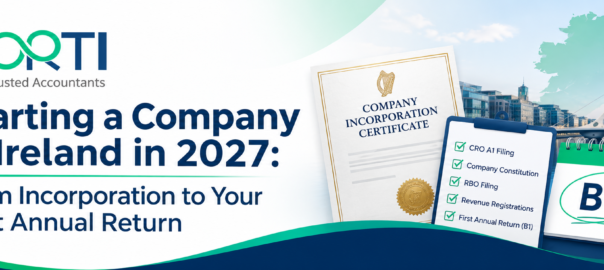
You’ve finally decided to launch your business in the new year. Congratulations!
There are some legal issues that will need to be addressed. One is registering it with the Companies Registration Office (CRO) and then signing it up for tax with Revenue. Then come the nitty-gritties like beneficial ownership filing and a first annual return (with VAT or payroll added once either applies).
Your first-year checklist
- Settle the basics: who holds the shares, who’ll serve as director and secretary, and which address gets the official post.
- Note the day trading starts. Revenue asks for it even when incorporation came earlier.
- Work out who ultimately owns or controls the business, and send those names to the central register.
- Put one person in charge of the first B1, right through to signatures and proof that the CRO received it.
- Keep your invoices, bank statements and payroll records together. Your accountant will need them for your first accounts and tax return.
Sole trader or limited company in Ireland: which suits you?
Who will own the business?
If you’re working on your own and want to try out an idea, starting as a sole trader keeps the paperwork simpler. If you plan to give someone else shares in the business, a limited company gives you a way to agree how much each of you owns.
Who will owe the money?
As a sole trader, you’re personally responsible for business debts. A limited company takes on debts in its own name. Your liability as a shareholder is generally limited to any amount still unpaid on your shares. If you personally guarantee a company loan, you can still be asked to repay it.
How much money will you take home?
As a sole trader, you pay tax on your taxable profits, including money you leave in the business. A company pays Corporation Tax on its taxable profits. Your personal tax then depends on how you pay yourself. When you compare the two, use figures that reflect what you need to live on and what you want to reinvest.
Already working as a sole trader? Pick a handover date. Make a list of unfinished jobs, customer deposits, unpaid invoices and stock. If a customer has paid you a deposit for work the company will finish, agree who will complete the job and issue the final invoice.
If you plan to keep trading in your own name, see what’s involved in registering and managing your accounts as a sole trader.
How do you register a limited company with the CRO?
To register a private company limited by shares (LTD), you’ll need Form A1 and your company constitution. You submit both through CORE, the CRO’s online filing system.
1. Choose your company name
Search the CRO register for names that look or sound like yours. Do this before you pay for signs or tell customers about the launch. If you’ll trade under a different name, make sure your contracts and invoices still show the company’s legal name.
2. Decide who owns which shares
Write down each founding shareholder’s name, how many shares they’ll take and how much they’ll pay. Agree on the voting rights too, so everyone knows how much say they’ll have in company decisions.
3. Choose your director and company secretary
An Irish LTD can have just one director. If you’re the only director, ask someone else to act as company secretary. You’ll also usually need at least one director who lives in the European Economic Area. If none of your directors lives there, check whether you need a Section 137 bond before you file. Our guide for UK founders explains how this works if you live in the UK.
4. Check the names, ID numbers and address
Each director needs to provide their Personal Public Service Number (PPSN). If they don’t have one, they’ll need an Identified Person Number (IPN). Check that each name matches the relevant identity record. You’ll also need a registered office in Ireland. Choose an address where official posts will reach you.
5. File your application and keep the certificate
Check that Form A1 and the constitution agree. Then arrange the signatures and submit both documents through CORE. Once the CRO issues your certificate of incorporation, keep it with your share records. Use the incorporation date on the certificate to work out when your first CRO annual return and beneficial ownership filing are due.
What taxes does a new limited company in Ireland need to register for?
When your company starts trading, register it for Corporation Tax. If you pay yourself a director’s salary, you’ll also need to register for employer PAYE, even if you’re the only person on the payroll. The same applies when you start paying employees.
VAT depends on what you sell and what you buy. For example, buying services from abroad can mean you need to register for VAT even while your Irish sales are low. Our guide to Revenue registrations can help you check which registrations apply to you.
How do you tell Revenue the company has started trading?
Send Revenue a Statement of Particulars within 30 days of starting to trade. You’ll need five details:
- Your company’s CRO number
- Its registered office address
- The address where you do business
- A short description of what your company does
- The date your company started trading
You might register your company in March and start work for your first client in April. Keep a copy of the signed contract and a record of when the work began. That way, you can explain the trading start date you give Revenue.
If you use a tax agent, they’ll register your company through the Revenue Online Service (ROS). If your company is resident in Ireland and you’re handling registration yourself, follow Revenue’s instructions for Form TR2.
Once Revenue gives your company a tax reference number, use it when you contact them about the company. If you previously worked as a sole trader, check whether you still have any personal tax returns to file or tax to pay.
What is the RBO and when do you file?
The Register of Beneficial Ownership (RBO) records the people who ultimately own or control your company. You need to file their details within five months of incorporation. This filing is separate from registering with the CRO and Revenue. You also need to keep a register of beneficial owners within your company.
Start with your shareholders. If another company owns shares in yours, follow the chain of ownership to identify the people behind it.
Owning more than 25% of the shares or voting rights is one sign that someone is a beneficial owner. Check how decisions are made, too. For example, someone who owns exactly 25% may still qualify if a shareholder agreement gives them control over the company.
Do you need to register for VAT straight away in Ireland?
You don’t have to register for VAT just because you’ve set up a company. If your business is based in Ireland, start by checking Revenue’s annual turnover thresholds. The main thresholds are €42,500 for services and €85,000 for goods.
Add up your sales for the calendar year, leaving out VAT. If you sell both goods and services, track them separately. The €85,000 threshold generally applies only if at least 90% of your turnover comes from qualifying goods. Say you supply and fit kitchens. Check how VAT rules treat the units and the fitting work before you count the whole invoice as a sale of goods.
If you’re below your threshold and no other VAT rule requires you to register, you can choose to do so. Think about your customers and your costs. Registration may let you reclaim VAT on eligible purchases. But if you sell to households, what matters to your customers is the final price. If you’ve already agreed a fixed price and have to cover VAT out of it, you’ll earn less on that job.
Before you quote for a large order, check how close it would take you to your threshold. If you’ve already crossed the VAT threshold, work out when your registration should take effect. Then check any invoices you’ve issued since that date. Our Irish VAT registration guide explains how to apply and what evidence Revenue may ask for.
When are your first annual return and tax filings due?
Your first annual return records your company’s details as they stand six months after incorporation. That’s your annual return date. You then have 56 days to file Form B1 with the CRO. You don’t need to attach financial statements to this first return.
Your tax deadlines follow a different timetable. Here’s what to put in your calendar and what to keep for each filing.
| Filing or payment | When to act | What to keep |
|---|---|---|
| Beneficial ownership | Within five months of incorporation. | The register, your ownership checks and the filing confirmation. |
| First CRO annual return (B1) | Return date six months after incorporation, then 56 days to file. | The completed return, signatures and the CRO receipt. |
| Payroll submission | On or before each payday. | The payroll report, the acknowledgement of your submission and payslips. |
| VAT3 return and payment | Usually every two months, due through ROS by the 23rd of the next month. Follow the period Revenue assigns you. | Sales and purchase VAT records that reconcile to the return. |
| Preliminary Corporation Tax | A new company whose first-period Corporation Tax is below €200,000 has no preliminary payment to make for that period. Otherwise, confirm the payment dates ahead of year end. | A profit forecast, the calculation and the funds set aside. |
| CT1 and balance of Corporation Tax | File and pay through ROS within nine months of the period end, and no later than the 23rd of that ninth month. | Final accounts, the tax computation, the return and the receipt. |
What does the calendar look like in practice?
Say you register your company on 10 March 2027 and start trading on 1 April. Your first Corporation Tax accounting period ends on 31 December 2027. Here’s how the dates work out.
- 10 August 2027: File your beneficial ownership details by this date. The five months run from the day you registered the company.
- 10 September 2027: This is your first annual return date. Use the company details that apply on this day to complete your B1.
- 5 November 2027: This is the last day to file your B1.
- 23 September 2028: File your CT1 and pay any Corporation Tax you still owe by this date.
If you qualify to skip the preliminary tax payment, set money aside as you earn profits. Your full Corporation Tax bill will be due with your CT1.
Use our year-end checklist to get your records ready. If your software already sorts your receipts, our guide to how AI is changing accountancy explains which figures still need a human check.
What happens if a B1 is late?
If you miss the deadline, CRO late fees apply, even on your first B1. The legislation excludes your first annual return when counting late filings for audit exemption.
For later returns, the audit exemption rule has applied since 16 July 2025. If you file late more than once in a five-year period, your company can lose its exemption for the next two financial years.
How do you pay yourself and hire your first employee?
Before you move money from the company account to your own, be clear about what it’s for. You might be paying yourself for your work, taking a share of the profits or claiming back a business expense.
- If you take a salary, choose a payday and run your pay through PAYE. Use your Revenue Payroll Notification to work out the deductions. Report your pay to Revenue on or before payday.
- If you take a dividend, check that the company has profits available to pay shareholders. Make sure the payment follows the rights attached to your shares. Get the dividend approved, record it and check whether Dividend Withholding Tax applies.
- If you paid a company expense yourself, keep the receipt. When the company pays you back, record it as an expense repayment.
Our guide to paying yourself as a director explains how each option works.
When you hire your first employee, agree how much you’ll pay them before deductions and how often they’ll get paid. Budget for employer PRSI and any pension contributions on top of their gross pay. Give their start date and pay details to whoever handles your small business payroll before the first payday.
Ireland’s MyFutureFund pension scheme began on 1 January 2026. If your employee is enrolled, their starting contribution is 1.5% of gross pay, and you contribute another 1.5%. Check the enrolment notice for the date contributions start. If you already offer a workplace pension, check whether it meets the scheme’s requirements.
For your own pay as a director, check your employment and PRSI status first. That will help you work out whether to budget for MyFutureFund contributions for yourself.
Can a new Irish company claim start-up tax relief in 2027?
Possibly. If you start trading in 2027, your company could benefit from a proposed extension to Section 486C. The proposal would cover qualifying trades that start by 31 December 2030. Check that the extension has become law before you count on the saving in your cash forecast.
If you already run the business as a sole trader, check whether your trade qualifies as new. Setting up a company to carry on the same work doesn’t automatically make it a new trade.
Under Revenue’s calculation rules, your total Corporation Tax bill determines how much relief you can claim on qualifying trading profits.
- €40,000 or less: You may qualify for full relief on those profits.
- More than €40,000 but less than €60,000: You may qualify for partial relief.
- €60,000 or more: You can’t claim this relief.
Even if you qualify for full relief, your claim is capped by the qualifying PRSI you’ve actually paid. You can count up to €5,000 in employer PRSI per employee, subject to an overall limit of €40,000. A director’s qualifying Class S PRSI can also count, up to €1,000 per director. If you paid no qualifying PRSI for the period, you can’t claim relief for it.
Give your accountant your payroll records and details of any qualifying Class S PRSI you paid. They’ll need those figures to calculate the relief and claim it on your company’s CT1 return.
How much does it cost to set up and run a limited company in Ireland?
If you already have someone to handle your filings, you can pay Forti to register the company. If you’d like help after incorporation, choose a package based on which jobs you want us to take on.
| Forti package | Price before VAT | What you are buying |
|---|---|---|
| Formation Only | €250 | We check your company name, prepare your constitution and share certificates, and file your application. The price includes the CRO incorporation fee. |
| Formation + Compliance | €1,250 | You get company formation, a registered office for 12 months, your RBO filing and your first B1. The package also covers VAT and employer PAYE registration where needed. |
| All-Inclusive Year One | From €3,550 | We set up your company and handle your Revenue registration, RBO filing and first annual return (B1). You also get bookkeeping, annual accounts, your first Corporation Tax return (CT1) and VAT returns if needed. You’ll have a dedicated accountant manager. |
The year-one package covers up to 20 bookkeeping transactions a month. If your sales are seasonal, tell us what a busy month looks like. We can explain what counts as a transaction and quote for any work above the allowance. See our company formation prices for the full list of inclusions.
Frequently asked questions
A. Agree who will check the company details, arrange the signatures and send the B1 to the CRO. Once it’s filed, ask for a copy of the return and the filing receipt. Keep both with your company records.
A. Register your company for Corporation Tax when it starts trading. Your employer handles the tax on your day-job wages. If your company also pays you a salary, you’ll need to register it for employer PAYE. Whether you need VAT registration depends on what your company buys and sells.
A. Your first annual return date is six months after incorporation, even if you haven’t sent an invoice. You then have 56 days to file your B1. Check the return date on your company’s CRO record and set your own reminder, especially if someone else handles your registered office post.
A. No. Having business customers doesn’t automatically mean you need to register. Check what you sell, where your customers are based and which VAT turnover threshold applies. If a client asks for a VAT number, check whether you need one before you agree on the invoice. If registration is optional, you can decide whether it makes sense for your business.
A. You have five months from incorporation to file. If you each directly own half the ordinary shares and hold half the voting rights, you’ll both normally count as beneficial owners. Check both sets of personal details before you file and keep a record of what you submitted.
A. Ask your accountant for a written quote based on the help you expect to need. Then ask what you’d pay if you had more transactions to record, hired someone or needed VAT returns. If most of your sales come in one busy quarter, share those monthly figures. A yearly average can hide how much bookkeeping you’ll need in your busiest months. You can compare the quote with our packages.
Bring your planned trading date and a rough sales estimate to your first meeting. Then ask:
1. Which registrations will I need, and when?
2. Who will track my deadlines and let me know what you need from me?
3. What does your fee cover up to and including my first Corporation Tax return (CT1)?
With Forti’s All-Inclusive Year One package, one team handles the work and you have a dedicated account manager to contact when questions come up.
Tell us when you plan to start trading, who your customers will be and
whether you’ll pay yourself a salary.
We’ll talk through the registrations you’re likely to need and explain
what each package covers.
We look after the CRO, Revenue and RBO filings, and you get on with running the business.