Running a small business in Ireland is exciting, but it also comes with responsibilities — especially when it comes to compliance. Whether you’re a sole trader, freelancer, or managing a limited company, keeping on top of Revenue, CRO, and bookkeeping obligations is non-negotiable.
Yet many small businesses unintentionally make mistakes that can cost them money, time, and peace of mind. From missing deadlines to poor record-keeping, these errors can lead to penalties, audits, and unnecessary stress.
The good news? Most compliance mistakes are avoidable with the right knowledge, organisation, and professional support.
In this guide, we’ll cover
- The most common compliance mistakes small businesses in Ireland make
- Real-world examples of how they happen
- The risks and penalties involved
- Practical tips to avoid them
1. Missing Revenue Deadlines
One of the biggest compliance mistakes is simply missing tax deadlines. Revenue doesn’t send friendly reminders. If you forget, you pay.
Examples:
- Sole traders failing to file their Form 11 Income Tax Return by 31 October (or mid-November for ROS filers).
- Limited companies filing their CT1 Corporation Tax Return late.
- Employers missing PAYE submissions through ROS.
Risks & Penalties:
- Late filing surcharges (up to 10% of your tax bill).
- Interest on overdue tax.
- Risk of being flagged for audit.
How to Avoid:
- Use a compliance calendar with all key dates.
- File early, not at the last minute.
- Work with an accountant who monitors deadlines and submits on your behalf.
💡 Forti LTD Tip: We track deadlines for every client, so nothing slips through the cracks.
2. Filing Incorrect or Incomplete Returns
Another common mistake is submitting incorrect or incomplete returns. This often happens when business owners rush through filings or try to do everything themselves.
Examples:
- Forgetting to declare additional income sources (e.g., rental income alongside business profits).
- Incorrect VAT calculations, especially when dealing with multiple VAT rates.
- Mistakes in payroll submissions, leading to underpaid PRSI or USC.
Risks & Penalties:
- Revenue queries or full audits.
- Interest and penalties for underpayments.
- Damaged credibility with lenders if financial statements don’t match.
How to Avoid:
- Keep accurate, up-to-date records.
- Double-check returns before submission.
- Use professional support for complex filings.
💡 Forti LTD Tip: Our review process ensures all filings are checked thoroughly before submission.
3. Poor Record-Keeping
Good compliance starts with good records. Unfortunately, many small businesses still rely on a shoebox of receipts or unorganised spreadsheets.
Examples:
- Losing VAT invoices needed for reclaim.
- Forgetting mileage logs for business travel claims.
- Mixing personal and business expenses in the same bank account.
Risks & Penalties:
- Inability to claim legitimate expenses.
- Problems during a Revenue audit.
- Overpaying tax because deductions can’t be supported.
How to Avoid:
- Open a dedicated business bank account.
- Use cloud accounting software (Xero, QuickBooks, Sage).
- Store receipts digitally (scanned or photographed).
💡 Forti LTD Tip: We help clients set up simple, digital bookkeeping systems that save time and money.
4. Ignoring CRO Compliance (for Limited Companies)
Limited companies in Ireland have specific obligations with the Companies Registration Office (CRO) — and missing them is one of the most expensive mistakes.
Examples:
- Failing to file the Annual Return (B1).
- Not updating CRO with changes (e.g., directors, address, shareholding).
- Missing Beneficial Ownership Register (RBO) deadlines.
Risks & Penalties:
- Late filing penalty of €100 + €3 per day, capped at €1,200.
- Loss of audit exemption (forcing full audit costs).
- Strike-off proceedings if obligations are repeatedly ignored.
How to Avoid:
- Mark the CRO annual return date on your calendar.
- Update CRO whenever company details change.
- Use an accountant or company secretary to manage filings.
💡 Forti LTD Tip: Our annual compliance package covers CRO filings, so you never face late fees.
5. Not Registering (or Deregistering) for VAT Properly
VAT is an area where many small businesses get tripped up.
Examples:
- Not registering for VAT when turnover passes the threshold (€37,500 for services, €75,000 for goods).
- Staying VAT-registered when no longer required, adding unnecessary admin.
- Failing to apply the correct VAT rate to sales.
Risks & Penalties:
- Backdated VAT liabilities if Revenue discovers late registration.
- Overcharging or undercharging clients.
- Loss of credibility with customers.
How to Avoid:
- Monitor your turnover regularly.
- Speak to your accountant about the benefits/risks of voluntary VAT registration.
- Keep clear VAT records for sales and purchases.
💡 Forti LTD Tip: We advise clients on whether VAT registration is beneficial and handle all returns.
6. Mismanaging Payroll
If you employ staff (or pay yourself as a director), payroll compliance is essential.
Examples:
- Failing to register as an employer with Revenue.
- Missing real-time PAYE submissions.
- Incorrectly calculating USC, PRSI, or pension contributions.
Risks & Penalties:
- Revenue penalties for late submissions.
- Employee dissatisfaction and loss of trust.
- Potential disputes or legal claims over underpaid wages.
How to Avoid:
- Use payroll software that links directly to Revenue.
- Outsource payroll to your accountant.
- Keep employee records up to date.
💡 Forti LTD Tip: Our payroll service ensures wages are accurate and submissions are always on time.
7. Mixing Personal and Business Finances
Many sole traders and even some limited company directors fall into the trap of mixing personal and business money.
Examples:
- Using one bank account for both personal and business expenses.
- Paying for personal holidays or shopping from the business account.
- Taking cash out of the business without proper records.
Risks & Penalties:
- Confused accounts that don’t reflect true profits.
- Problems with Revenue if personal expenses are claimed as business costs.
- Difficulties securing loans or investment.
How to Avoid:
- Keep separate business and personal accounts.
- Document any drawings or director’s loans properly.
- Use bookkeeping software to track transactions clearly.
💡 Forti LTD Tip: We help clients separate finances so accounts are always clear and compliant.
8. Failing to Plan for Tax Liabilities
Many small businesses treat tax as an afterthought — paying whatever is due when the bill arrives. This can lead to cash flow crises.
Examples:
- Spending all profits without setting money aside for tax.
- Forgetting about preliminary tax for sole traders.
- Limited companies failing to budget for corporation tax.
Risks & Penalties:
- Struggling to pay Revenue on time.
- Interest charges on late payments.
- Stress and poor financial planning.
How to Avoid:
- Estimate tax liabilities throughout the year.
- Set aside money monthly into a tax savings account.
- Use management accounts to forecast profits and taxes.
💡 Forti LTD Tip: Our management reports include tax forecasts, so clients aren’t caught by surprise.
9. Not Seeking Professional Advice Early
Many business owners try to do everything themselves — either to save money or because they think compliance is straightforward. Unfortunately, mistakes multiply, and by the time they seek help, it’s more expensive to fix.
Examples:
- A sole trader trying to file their own Form 11 but missing allowable expenses.
- A company director preparing accounts incorrectly, triggering a Revenue query.
- Businesses waiting until after penalties arrive before calling an accountant.
Risks & Penalties:
- Overpaying tax unnecessarily.
- Higher accountancy fees to correct mistakes.
- Lost time and stress.
How to Avoid:
- Seek professional advice early, especially when starting out.
- Build a relationship with an accountant who knows your business.
- View accountancy as an investment, not just a cost.
💡 Forti LTD Tip: We provide free initial consultations to help new businesses start on the right foot.
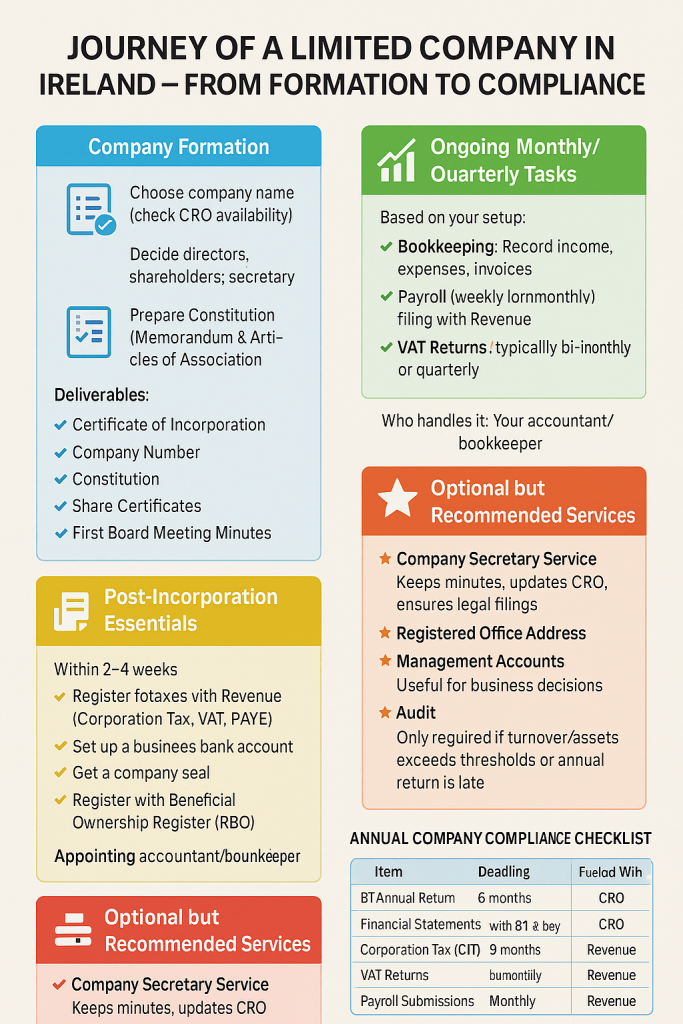
Key Compliance Deadlines for Small Businesses in Ireland
One of the biggest compliance mistakes small businesses make is not knowing their deadlines. Missing even one can lead to fines, penalties, and unnecessary stress. Here’s a clear overview of the most important dates every Irish business owner should mark on their calendar:
Sole Traders & Partnerships
- Income Tax Return (Form 11):
- 31 October each year (paper filing).
- Extended to mid-November if filing and paying online via ROS.
- Preliminary Tax:
- Due on the same date (31 October / mid-November).
Limited Companies
- Corporation Tax Return (CT1):
- Due 9 months after the company’s year-end, and no later than the 23rd of that month if filed online.
- Preliminary Corporation Tax:
- Large companies (tax liability > €200k): 21st of the 11th month of the accounting period.
- Small companies: by the 23rd of the month before year-end.
- Annual Return (CRO B1):
- First return: 6 months after incorporation (no accounts needed).
- Every year after: within 56 days of the company’s annual return date (ARD).
VAT-Registered Businesses
- VAT Returns (VAT3):
- Usually bi-monthly (every 2 months), e.g., Jan–Feb due by 23rd March.
- Some businesses may be on 4-monthly or 6-monthly cycles (depending on turnover).
- Annual Return of Trading Details (RTD):
- Due once a year after the VAT year-end.
Employers (Payroll)
- PAYE Modernisation:
- Real-time reporting required. Payroll submissions must be sent to Revenue on or before each payday.
- P35 End-of-Year Return:
- Replaced by monthly real-time reporting (no longer required separately since 2019).
Other Compliance Deadlines
- RBO (Register of Beneficial Ownership):
- Initial registration within 5 months of incorporation.
- Updates within 14 days of any change.
- Local Property Tax (if applicable):
- Annual payment/return due by 10th January for the year.
FAQs – Compliance for Small Businesses
For sole traders: 31 October (or mid-November via ROS) for the Form 11. For limited companies: CT1 is due 9 months after year-end, CRO annual return within 6 months of incorporation and every year after. Employers must submit payroll to Revenue every pay cycle. VAT returns are usually bi-monthly.
In Ireland, you must keep business records for 6 years. This includes invoices, receipts, bank statements, payroll records, and CRO filings.
Yes. Revenue can disallow expense claims, charge penalties, and even audit your business. Poor record-keeping is one of the fastest ways to trigger an audit.
No. Only if your turnover exceeds €37,500 for services or €75,000 for goods. However, you can register voluntarily if it benefits your business (e.g., reclaiming VAT on expenses).
Yes. A good accountant prevents penalties, saves you tax, and gives you peace of mind. Most clients find the savings more than cover the fee.
Conclusion
Compliance might sound like red tape, but it’s a vital part of running a successful business in Ireland. The most common mistakes — missed deadlines, poor records, incorrect returns, ignoring CRO obligations — are easy to make, but they’re also easy to avoid with the right systems and support.
At Forti LTD, we help small businesses stay compliant with simple, transparent, and professional accountancy services. From annual returns to VAT, payroll, and bookkeeping, we keep everything on track — so you can focus on running your business.
👉 Talk to Forti.ie today about how we can help your business stay compliant and stress-free.