Pradeep Dabas, ACCA, MIoD, MBA
Pradeep Dabas is a Chartered Certified Accountant (ACCA), Member of the Institute of Directors (MIoD), and founder of Forti, a Dublin-based accountancy and advisory firm helping Irish entrepreneurs and SMEs with company formation, bookkeeping, and compliance. He is also the founder of Salt Marketing, a Dublin-based digital marketing agency. Holding an MBA in Marketing and an ACCA qualification — both achieved in Dublin — and with over 20 years of experience in finance and business, Pradeep brings a rare combination of financial rigour and commercial thinking to every client relationship. He is also the creator of The Mentor Academy, an online education platform specialising in finance courses designed to help entrepreneurs and professionals take control of their financial future. Forti is based in Sandyford, Dublin and works with businesses across Ireland.
View all posts by Pradeep Dabas →
Everything You Need to Know to Stay Legally Compliant and Financially Fit
Starting a limited company in Ireland? Then annual compliance is a term you’ll be hearing a lot. Whether you’re a first-time entrepreneur or scaling up your venture, understanding your compliance responsibilities is essential to avoid penalties and ensure smooth business operations. In this guide, we break down annual compliance in simple terms — including key filings, deadlines, and costs — and how they apply to different industries.
What Is Annual Compliance?
Annual compliance means staying legally up to date with the CRO and Revenue.
If that sounds a bit vague (or a bit scary), don’t worry — you’re not alone. As a qualified accountant who works with start-ups every day, I can tell you this: annual compliance isn’t as complicated as it sounds — but it is important.
Every limited company in Ireland must file certain returns and financial documents each year to remain in good standing. This includes confirming company details, submitting accounts, and paying any taxes due. Think of it as the legal health check for your business.
Annual Compliance Checklist for Irish Limited Companies
Here’s what your accountant or finance team should be handling every year:
Task
Authority
Deadline
Annual Return (Form B1)
CRO
Every year on your ARD
Abridged Accounts
CRO
With second return onwards
Full Year-End Accounts
Revenue & CRO
9 months after year-end
Corporation Tax Return (CT1)
Revenue
Same as above
Director’s Income Tax (Form 11)
Revenue
31st October each year
VAT Returns (if registered)
Revenue
Usually every 2 months
Payroll Returns (if employing)
Revenue
Monthly
Maintain Company Registers
Internal/CRO
Ongoing
What Does Annual Compliance Include?
It’s more than just ticking boxes — it’s a full-circle legal and tax package.
Most annual compliance packages in Ireland will include:
Annual Return (Form B1) filing
Preparation and filing of abridged financial statements
Your compliance cost depends on your setup and service level.
As a rule of thumb, our estimated fee ranges between 1–2% of your annual turnover, depending on your industry, volume of transactions, and services required.
Company Type
Typical Cost (Ex. VAT)
Simple Ltd Co. (no VAT, no payroll)
€750 – €1,200
VAT-registered, 1–2 employees
€1,500 – €2,500
With regular bookkeeping
€2,500 – €4,000+
Complex or growing company
€5,000+
Breakdown of Typical Fees:
Service
Range (Ex. VAT)
Annual Return (Form B1) Filing
€150 – €250
Abridged Accounts
€250 – €400
Corporation Tax Return (CT1)
€400 – €600
Director’s Income Tax (Form 11)
€150 – €250
VAT Returns
€50 – €150/return
Payroll Processing
€40 – €80/month
Registered Office / Secretary
€450 – €800/year
Annual Return vs Year-End Accounts
These are two different filings, often confused.
Feature
Annual Return (Form B1)
Year-End Accounts
Filed With
CRO
Revenue & CRO (abridged only)
Purpose
Legal & structural info
Financial performance & tax
Includes Accounts?
From second return onward
Always
Deadline
ARD + 56 days
9 months post year-end
Penalties
€100 + €3/day + audit loss
Interest + audit risk
Case Studies
What annual compliance and bookkeeping typically look like across industries:
1. Marketing Agency – Turnover €200k
Two directors, 50–60 transactions per month (sales, purchases, bank)
Trading on Shopify, Etsy, Amazon; 500+ transactions/month
Needs: Monthly bookkeeping, VAT, payroll, CT1, Form 11s, multi-channel reporting
Expected Cost: Compliance €2,000+, Bookkeeping & all services €400–€700/month
Frequently Asked Questions (FAQs)
Q1. What happens if I miss my Annual Return deadline?
You’ll face late filing penalties (€100 plus €3 per day) and may lose audit exemption for two years.
Q2. Do I need to file a tax return if my company made no profit?
Yes. Even dormant or zero-profit companies must file a CT1 and B1 annually.
Q3. Can I do my own annual compliance?
Technically yes, but it’s risky. Errors or missed filings can lead to penalties. It’s best to use a qualified accountant.
Q4: What’s the difference between CRO and Revenue filings?
CRO is for your company’s legal standing; Revenue is for taxes. Both are legally required.
Q5: How long does company registration take?
Typically 5–10 working days, but it can vary depending on CRO processing times.
Q6: Is bookkeeping included in annual compliance packages?
Not always. Many accountants offer it as a separate service unless bundled.
Q7: What’s the typical accounting year-end in Ireland?
Most companies choose 31st December, but it can be any date.
Q8: When do I need to register for VAT?
When your turnover exceeds €37,500 (services) or €75,000 (goods) in a 12-month period.
Q9: Are directors personally liable for company taxes?
No, but they are responsible for ensuring the company meets its obligations.
Q10: Can Forti handle everything for me?
Yes! We offer full-service compliance, bookkeeping, payroll, and CRO support tailored to your business.
Final Word
Annual compliance might not be glamorous, but it’s essential. Whether you’re applying for funding, trying to stay off Revenue’s radar, or just want peace of mind — investing in proper compliance is the best place to start.
If you’re unsure about your current setup or want a second opinion, talk to a qualified accountant. One good conversation could save you thousands.
Let Forti Take Care of It
At Forti, we specialise in helping Irish start-ups and growing businesses stay fully compliant, without the hassle. From company formation to bookkeeping, VAT, payroll, and all Revenue and CRO filings — we offer flexible, fixed-fee support tailored to your needs.
Setting up as a sole trader in Ireland is one of the easiest ways to get your business off the ground. Registering as a sole trader is quick and cost-effective, whether you’re a freelancer, a tradesperson, or running a side hustle.
That said, while there’s less paperwork than running a limited company, there are still a few key steps to follow—and a few pitfalls to avoid. In this guide, we’ll walk you through everything from registering with Revenue to tax returns, to the tools that can save you hours of admin each week.
Key Steps To Follow
Step 1: Registering as a Sole Trader
Unlike a limited company, you don’t need to go through the Companies Registration Office (CRO). But you must register with Revenue once you start trading — ideally within 30 days.
Here’s what you’ll need to do:
Register for Income Tax (self-assessed) using Form TR1 (or TR1(FT) for foreign nationals)
Choose your trading name (if not using your own name, register it with the CRO via RBN1)
Set up a business bank account to separate personal and business finances
Get insurance if needed (e.g., public liability or professional indemnity)
Do:
Register with Revenue early — don’t wait until your first tax return.
Keep your receipts and records from day one — even small ones.
Don’t:
Use your personal name for business unless you’re happy with it being public.
Mix business and personal transactions — it’ll cause confusion later.
Step 2: Running the Day-to-Day
Managing a business as a sole trader requires multitasking, including marketing, sales, service delivery, and administrative tasks. Staying on top of your finances throughout the year will save you from last-minute panic come October.
Pay yourself directly (as it’s not a separate legal entity)
Do:
Set aside 20–30% of your income for tax — trust us, you’ll need it.
Consider using a simple app or spreadsheet to track your expenses.
Don’t:
Avoid waiting until tax season to compile all your expenses as it can become a daunting task.
Forget about PRSI and USC – they’re part of your tax bill too.
Step 3: Annual Compliance – Your Tax Return
As a sole trader, your biggest yearly obligation is your self-assessed Income Tax Return, also known as Form 11.
Important Dates:
31st October – Deadline for submitting and paying via post
Mid-November – Extended deadline if you file online via ROS
You’ll declare:
Total income from your business
Any allowable expenses (e.g. phone, mileage, software, insurance)
Any PAYE income (if you have another job)
Pension contributions, medical expenses, etc.
If your income is above certain thresholds, you may also need to make preliminary tax payments for the following year.
Do:
File on time to avoid late penalties and interest charges.
Use a qualified accountant to help you claim every expense you’re entitled to.
Don’t:
Underestimate your income — Revenue cross-checks against bank and card processors.
Miss your deadlines — it affects your credit and could cause Revenue audits.
Optional (But Smart) Services for Sole Traders
Sole traders don’t have to hire a company secretary or file annual returns like limited companies — but there are still services that make life a lot easier.
Hiring a Bookkeeper
Keeps your records up to date
Saves you hours come tax season
Getting Tax Advice
Helps reduce your tax bill through proper planning (e.g. capital allowances, pensions)
Registering for VAT
May help if your customers are VAT-registered businesses
Do:
Get advice early — even one meeting a year with an accountant can save you money.
Keep mileage logs and expense receipts properly stored.
Don’t:
Leave taxes to chance. The self-assessment system in Ireland relies on your honesty and accuracy — Revenue takes errors seriously.
The Role of Software – Making Life Easier for Sole Traders
Thankfully, software has made the admin side of things easier than ever for sole traders in Ireland. You don’t need a big accounting team — just a few clever tools:
Top Picks:
Xero or QuickBooks Simple Start – For basic invoicing, income tracking, and expense management
Revolut Business / AIB Business – Great for separating personal and business transactions
AutoEntry or Dext – Snap your receipts and log them instantly
Google Sheets – Still a solid option if you’re just starting out
With these tools, many sole traders can now:
Send and track invoices in minutes
Automatically categorise expenses
See a running tally of how much tax they owe
Hand off clean, ready-to-file reports to their accountant
“I used to spend hours each week chasing invoices and sorting receipts. Now it’s all done through my phone. I wish I’d done this sooner.” – Claire, Sole Trader – Graphic Designer, Galway
Top 10 FAQs About Being a Sole Trader in Ireland
Q1: Do I need to register a company?
No — you just register with Revenue as a sole trader using Form TR1.
Q2: How much tax do sole traders pay in Ireland?
You’ll pay Income Tax, USC, and PRSI on your profits. Rates depend on your income level.
Q3: Can I claim expenses?
Absolutely — things like phone, travel, insurance, subscriptions, and home office costs (if applicable).
Q4: Do I need a separate bank account?
Not legally, but it’s strongly advised — it makes tax time far easier.
Q5: Do I have to register a business name?
Only if you’re trading under a name other than your own.
Q6: When do I file my tax return?
By 31st October each year (or mid-November if filing online via ROS).
Q7: Can I hire someone as a sole trader?
Yes, but you’ll need to register for PAYE and file payroll returns.
Q8: What if I make a loss?
Losses can be carried forward to offset future profits (or possibly against PAYE income).
Q9: Do I need to charge VAT?
Only if your turnover exceeds €37,500 (services) or €75,000 (goods).
Q10: Can Forti help with this?
Yes! We work with sole traders across Ireland to handle tax returns, bookkeeping, VAT, and more.
Wrapping Up
In Ireland, operating as a sole trader offers a simplified approach to managing a small business with minimal bureaucratic burdens. But that doesn’t mean there’s no responsibility. The key to success is staying organised, filing your tax return on time, and closely monitoring your numbers.
At Forti Ltd, we assist sole traders throughout Ireland with the following services:
Registration & tax setup
Bookkeeping
Annual returns
VAT & payroll (if needed)
Cloud accounting setup & training
Whether you’re just starting out or growing fast, we’re here to make things easier.
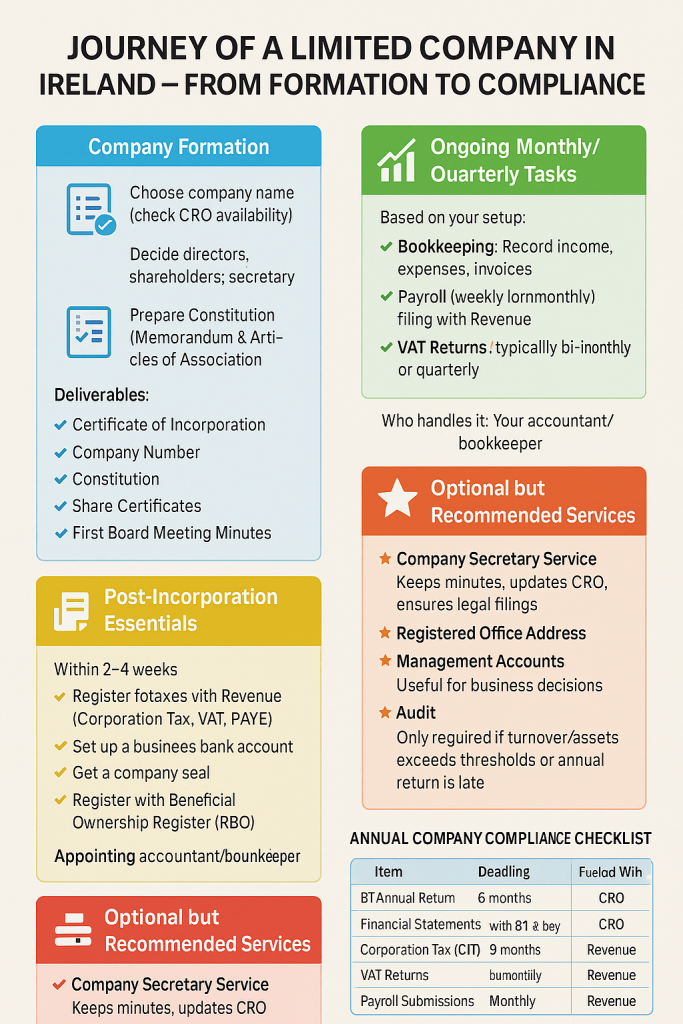
Are you considering establishing a limited company in Ireland? Discover the full journey – from formation and VAT registration to bookkeeping, annual returns, and corporation tax. This is a practical guide designed specifically for Irish SMEs.
Setting up a limited company in Ireland is a big step – and a very exciting one too. Whether you’re a first-time entrepreneur, moving your freelance business to a more formal structure or expanding from abroad, knowing what happens after incorporation is just as important as getting started.
In this guide, we’ll walk you through the full journey of an Irish limited company – from formation and early steps to ongoing responsibilities and annual compliance. We’ll keep it practical, clear, and honest. After all, no one likes surprises when it comes to Revenue or the CRO!
Step 1: Starting Out – Company Formation in Ireland
Let’s begin with the basics. Setting up a Private Company Limited by Shares (LTD) in Ireland is the most common route. It offers flexibility, limited liability, and is suitable for most businesses.
Here’s what you’ll need:
A unique company name (CRO will need to approve it)
Search the company name in just a few seconds: Click Here!
At least one director (one must be EEA-resident unless bonded)
One company secretary (can’t be the same person as the sole director)
A registered office address in the Republic of Ireland
Shareholders and details of share capital
A company constitution (used to be called Memorandum & Articles)
Once you submit the Form A1 and supporting documents to the Companies Registration Office (CRO), you’ll receive:
Certificate of Incorporation
Company Number
Constitution
Share Certificates
First Board Meeting Minutes
This stage is usually handled by an accountant or a company formation agent, and can be done within 5–10 working days.
✅ Do:
Use a professional company formation agent or accountant to get it right first time.
Double-check the company name with the CRO before finalising anything.
❌Don’t:
Assume the CRO will approve any name – many are rejected for being too similar to existing names.
Step 2: What Comes Next – Post-Incorporation Essentials
Now that your company is officially registered, there are a few important steps you’ll need to tick off:
Register with Revenue – for Corporation Tax, VAT (if applicable), and PAYE (if you’ll have employees)
Open a business bank account – make sure it’s in the company’s name
Get a company seal – used for official documents
Register with the RBO – the Beneficial Ownership Register
Find a bookkeeper or accountant – trust us, you’ll thank yourself later
Pro Tip: If you’ve got a good accountant, they’ll guide you through all of this and make sure nothing’s missed.
✅ Do:
Register for Corporation Tax within 30 days of trading.
Make sure the RBO registration is done within 5 months – it’s mandatory.
❌ Don’t:
Use your personal bank account for business – it’s not just unprofessional, it causes accounting headaches.
Delay appointing a tax agent – you’ll risk missing deadlines later on.
As your business begins trading, there’s regular financial housekeeping to be done.
Here’s what that usually includes:
Bookkeeping – tracking income, expenses, invoices, and receipts
Payroll – processing salaries and filing with Revenue via ROS
VAT Returns – filed bi-monthly or quarterly, depending on your setup
If you’re not comfortable managing all this yourself (and most business owners aren’t), outsourcing to a bookkeeper or accountant is a smart move. It’ll save you hours each month and ensure you stay on the right side of Revenue.
✅ Do:
Keep digital copies of receipts – they’ll save your bacon at year-end.
Use cloud accounting software (or a reliable bookkeeper) to stay organised.
❌ Don’t:
Wait until the end of the year to sort your books – late filing leads to penalties.
Miss payroll filings – Revenue are very strict about this.
Once you’ve hit the six-month mark, it’s time to think about annual compliance. Here’s what’s involved:
B1 Annual Return
Your first B1 return is due 6 months after incorporation (no accounts required)
Every year after, your B1 return must be filed with financial statements
Financial Statements
Includes profit & loss, balance sheet, and director’s report
Must follow Irish GAAP or IFRS standards
Corporation Tax Return (Form CT1)
Due 9 months after your company’s year-end
Submitted to Revenue with iXBRL-tagged accounts
Income Tax Return (Form 11) for Directors
Required if you’re a director and self-assessed for income tax
Miss a B1 deadline by even a single day and you’ll lose your audit exemption for two years – which means paying for a full audit even if you’re a small business.
✅ Do:
Mark deadlines in your calendar and get professional help with returns.
File the B1 on time every year to retain audit exemption.
❌ Don’t:
Assume your accountant will file unless you ask – follow up regularly.
Ignore iXBRL – it’s not optional for most companies.
Optional (But Highly Recommended) Services
Here are a few services that aren’t legally required but make life much easier:
📌 Company Secretary Service
Handles statutory registers, board meeting minutes, CRO filings, and ensures you don’t miss key deadlines
📌 Registered Office Address
Keeps your home address private
Ensures important post from Revenue and CRO is handled properly
📌 Management Accounts
Quarterly reports that show how your business is doing – especially useful if you’re applying for a loan or grant
📌 Audit
Only required if you lose exemption or grow beyond certain thresholds
Even if optional, it can boost credibility with investors or banks
✅ Do:
Use a registered office address if you work from home – it looks more professional.
Get quarterly management accounts to keep an eye on business health.
❌ Don’t:
Rely on memory for deadlines – use a professional or set up reminders.
Think audits are only for big companies – one late return and you’re in.
Accounting and compliance software significantly alleviates the burden on businesses today. Gone are the days of chasing receipts in shoeboxes or manually filing VAT returns. With the right tools in place, you can cut down your admin time significantly – and reduce the chances of errors.
Here’s what we typically use (or recommend) for Irish limited companies:
Xero or QuickBooks Online – Both are cloud-based accounting platforms that make invoicing, bank reconciliation, expense tracking, and VAT reporting a breeze. You can access them anytime, anywhere – and they integrate beautifully with banks and payroll systems.
Surf Accounts or Big Red Cloud – Also popular with Irish SMEs, especially for those who prefer a more localised interface or need simple bookkeeping features.
BrightPay – Our go-to payroll software. It automates submissions to Revenue (via ROS), calculates tax, USC, and PRSI for each employee, and handles payslips and leave tracking too.
Hubdoc AutoEntry or Dext (formerly Receipt Bank) – These tools let you scan receipts with your phone and automatically extract the data into your accounts. No more typing in totals or guessing VAT amounts — it’s all done for you.
Google Drive /Dropbox – For securely storing all your company documents — everything from incorporation papers to tax returns.
The Result?
By combining the right software with professional support, we’ve helped clients reduce their manual admin by up to 90%. Things like:
Automated bank feeds & reconciliations
One-click VAT and payroll filings
Real-time dashboards showing how your business is performing
Fewer missed deadlines
More time to actually run your business
“Since moving to Xero with Forti, I don’t touch the books anymore. I just upload my receipts and check the reports once a week – everything else is handled.” – Cian, Retail Business Owner, Co. Kildare
FAQs About Running a Limited Company in Ireland
1. How long does it take to register a company in Ireland?
It usually takes around 5 to 10 working days once the documents are submitted to the Companies Registration Office (CRO). If everything’s in order, it can move quite quickly.
2. Do I need an Irish-based director?
Not exactly — but you do need at least one director who is resident in the European Economic Area (EEA). If not, you’ll need to put a Section 137 bond in place to meet the CRO’s requirements.
3. What happens if I miss the B1 deadline?
If you miss the deadline, even by a day, you’ll lose your audit exemption for two years. You might also get hit with late filing penalties — so it’s one to stay on top of.
4. When should I register for VAT?
If your turnover is going to exceed €37,500 for services or €75,000 for goods, you’ll need to register. Even if you’re under the limit, some businesses choose to register early for credibility or to reclaim VAT.
5. Can I handle the bookkeeping myself?
You can, especially if things are simple early on. But unless you’re very confident with numbers, it’s usually best to bring in a professional bookkeeper or accountant. It saves time and reduces the risk of mistakes.
6. Do directors have to file personal tax returns too?
Yes — most directors in Ireland are self-assessed, which means you’ll need to file a Form 11 each year for your personal income.
7. What’s the difference between Corporation Tax and Income Tax?
Corporation Tax is paid by the company on its profits. Income Tax is what you pay personally on any income you take from the business (like salary or dividends).
8. Do I legally need a company secretary?
Yes – if there’s only one director, you must appoint a separate company secretary. They help make sure your company stays compliant with the CRO.
9. How much does it cost to stay compliant each year?
It depends on what services you need, but for most small companies it’s somewhere between €2,500 and €4,000 per year. That would typically cover bookkeeping, tax returns, annual filings, and company secretarial work.
10 Can Forti help with all of this?
Absolutely. We look after everything from company formation and bookkeeping to tax filing, payroll, and compliance. Whether you’re just starting out or running a growing business, we’ll guide you through the whole journey.
Wrapping Up
Setting up a limited company in Ireland is a great way to build something lasting, but there’s more to it than just filling out a few forms. From day one, there are important responsibilities — bookkeeping, tax returns, VAT, payroll, and making sure you don’t miss key deadlines.
The good news? You don’t have to do it alone.
At Forti Ltd, we’ve helped multiple business owners across Ireland set up, stay compliant, and focus on growing their business. Whether you’re a start-up, a sole trader going limited, or expanding into Ireland from abroad — we’re here to help every step of the way.
An effective accountant is vital for business success in Ireland, regardless of whether you operate as a sole trader or a limited company. Their expertise in areas like tax management and financial planning ensures efficient operations. To clarify the specific support accountants offer each business structure, let’s explore the distinct services they provide to sole traders and limited companies in a straightforward manner.
1. Accountants for Sole Traders: Keeping it Simple and Straightforward
A sole trader is someone who runs their own business as an individual. If you’re a sole trader, you’re the person responsible for everything – from managing the business day-to-day to handling the finances. However, even though it’s a simpler structure, you still need an accountant to help make sure everything is done right, especially when it comes to taxes.
What Does an Accountant Do for Sole Traders?
1. Income Tax and Self-Assessment:
One of the accountant’s main roles is to help with the Income Tax Return (Form 11). This is where you file your self-assessment for the year, based on the income you earned through your business. Your accountant will ensure it’s filed correctly and that you’re not overpaying your taxes.
2. Managing PRSI and USC:
If you’re self-employed, you need to pay PRSI (Pay-Related Social Insurance) and USC (Universal Social Charge). Your accountant will help you calculate these correctly and ensure you’re not missing any payments.
3. Tax Planning:
An accountant will also help with tax planning – for example, by advising on the best ways to claim business expenses, such as office supplies, phone bills, or any other relevant costs that reduce your tax liability.
4. VAT Returns:
If your business’s turnover exceeds the VAT threshold, you’ll need to register for VAT. Your accountant will make sure your VAT returns are filed correctly, and that you’re paying the correct amount of VAT on your services or products.
5. Financial Record Keeping:
While your bookkeeper might handle the day-to-day record-keeping, your accountant ensures that everything adds up properly, helps with year-end accounts, and makes sure you’re on top of any tax filings or legal requirements.
When to Involve an Accountant as a Sole Trader:
When you’re ready to file your Income Tax Return.
If you’re unsure about how to handle VAT registration or returns.
When you want to make sure you’re claiming all the tax reliefs you’re entitled to.
2. Accountants for Limited Companies: More Complex, but Still Essential
Running a limited company brings more complexities, but it also offers benefits such as limited liability, which protects your personal assets from business debts. With this extra complexity comes the need for a more detailed approach to managing your finances. An accountant’s role in a limited company is more extensive compared to a sole trader.
What Does an Accountant Do for Limited Companies?
1. Corporation Tax:
A limited company has to pay Corporation Tax on its profits. Your accountant prepares and files the Corporation Tax Return (Form CT1) for you, making sure all income and expenses are accounted for, and the correct amount of tax is paid.
2. Annual Financial Statements:
Limited companies are required to submit annual accounts, including a balance sheet and profit and loss statement. Your accountant helps prepare these documents and ensures they’re filed with the Companies Registration Office (CRO).
3. PAYE and Payroll:
If you employ staff, or even pay yourself as a director, your accountant will handle PAYE (Pay As You Earn) and ensure that all PRSI and USC contributions are correct. They’ll also manage any employee benefits and deductions.
4. VAT:
Just like sole traders, if your company’s turnover exceeds a certain amount, you’ll need to register for VAT. Your accountant will manage your VAT returns, ensure you’re claiming back VAT on expenses, and that you’re charging VAT correctly on your services or products.
5. Tax Planning and Strategy:
Accountants provide advice on how to structure your business finances in a tax-efficient way. For example, they can help with decisions about whether to pay yourself a salary or take dividends as a director of the company. They may also advise on capital allowances, research and development tax credits, and other ways to minimise your tax burden.
6. Compliance with Company Law:
Limited companies have legal obligations to comply with company law, including filing Annual Returns with the CRO. Your accountant will ensure your company meets all of these requirements and stays compliant.
When to Involve an Accountant for a Limited Company:
When you need to file your Corporation Tax Return and prepare your annual financial statements.
If you have employees and need help with PAYE, PRSI, and USC.
When you’re ready to start tax planning for dividends, capital allowances, and tax-efficient strategies.
Sole Trader vs Limited Company: What’s the Difference in Accountant’s Role?
Feature
Sole Trader Accountant
Limited Company Accountant
Tax Returns
Income Tax Return (Form 11)
Corporation Tax Return (CT1)
Financial Statements
Not typically required
Profit & Loss, Balance Sheet, Cash Flow
Payroll and PAYE
Not applicable
PAYE, PRSI, USC for employees & directors
VAT Returns
File VAT3 if registered
Strategic Advice
Tax credits, expense deductions
Corporate structure, tax planning, dividends
Business Structure
Sole trader, simple structure
Limited company, more complex structure
Compliance
File Income Tax Returns annually
File Annual Returns with CRO, comply with company law
FAQs: Everything You Need to Know
Here are some common questions that can help clear up any confusion:
1. What’s the main difference between an accountant for a sole trader and an accountant for a limited company?
For sole traders, the accountant focuses on Income Tax returns, PRSI, USC, VAT returns, and business expenses. For limited companies, the accountant manages more complex tasks like Corporation Tax returns, payroll, and annual financial statements.
2. Do I need an accountant if I’m a sole trader?
While it’s not required by law, having an accountant can save you time, money, and stress. They’ll ensure you’re filing everything correctly, claiming the right deductions, and staying compliant.
3. How much does it cost to hire an accountant for a limited company?
Fees vary depending on the size and complexity of your business, but typically, accountants for limited companies charge more than for sole traders. Expect to pay anywhere from €500 to €2,000+ per year.
4. When should I switch from being a sole trader to a limited company?
It might be time to switch if your income is growing, you want to limit personal liability, or you want to explore more tax-efficient options. An accountant can help you make the decision.
5. Do I still need a bookkeeper if I have an accountant?
Yes, a bookkeeper handles the daily financial tasks, while the accountant oversees the bigger picture – preparing tax returns, financial statements, and offering strategic advice.
6. Can an accountant help me with tax planning?
Absolutely! An accountant can help you identify tax-saving opportunities, plan for the future, and make your business as tax-efficient as possible.
7. How do I choose the right accountant for my business?
Look for someone who understands your business type (sole trader or limited company), has experience in your industry, and offers a fair fee structure. Most importantly, you should feel comfortable with them and trust their advice.
8. Can an accountant help with business growth strategies?
Yes, an accountant can advise on cash flow forecasting, tax-efficient growth strategies, and ways to fund business expansion, ensuring you’re set up for long-term success.
Conclusion: The Right Accountant Can Make All the Difference
Whether you’re a sole trader or running a limited company, your accountant is an essential part of your financial team. As a sole trader, an accountant helps you manage taxes, file returns, and explore tax reliefs to ensure you don’t pay more than you need to. As a limited company, the accountant’s role becomes more complex, helping you navigate corporate tax, compliance with company law, and long-term financial strategy.
Both accountants for sole traders and limited companies provide valuable insights and peace of mind, ensuring your business is compliant with all tax obligations and helping you make the most of your financial resources.
If you’re unsure which accountant you need, or if you’ve been managing things on your own but want a bit more guidance, it’s never too late to get the right help. A great accountant can free up your time to focus on growing your business, knowing your finances are in safe hands.
Basically, every business in Ireland, big or small, needs to get a handle on corporate taxes. This rundown covers the various types of taxes, why having an accountant is key, ways to cut down on what you owe, tax breaks and credits you can use, and what happens if you don’t follow the rules. Knowing this stuff helps your business stay on the right side of the law and keep your tax bill as low as possible.
Types of Corporate Taxes in Ireland
Ireland offers a competitive corporate tax environment, with some of the lowest rates in Europe. However, it is essential to understand the different types of taxes and how they apply to your business.
1. Corporation Tax on Trading Income
This is the standard tax rate applied to businesses actively trading in Ireland, including those providing services, manufacturing, retailing, and more.
Rate: 12.5% on profits from trading activities.
Who It Applies To: Any business actively selling goods or services.
This low rate makes Ireland an attractive place for businesses to operate, particularly for international companies looking to set up their European headquarters.
2. Corporation Tax on Non-Trading Income
Income from investments, such as dividends, rental income, or interest, is subject to a higher tax rate.
Rate: 25% on non-trading income.
Examples: Rental income from property, dividends from investments, or interest from savings.
While the rate is higher than for trading income, businesses involved in property investment or financial services should plan for this tax appropriately.
3. Capital Gains Tax (CGT)
Capital Gains Tax is charged on the profit made when selling an asset, such as property, shares, or other investments.
Rate: 33% on the gain made from selling assets.
Examples: Selling property, shares, or even cryptocurrencies.
If you sell an asset for more than you bought it, the profit is considered a capital gain, and CGT applies. However, there are exemptions available, such as Principal Private Residence Relief (PPR), which exempts the sale of your main home from CGT.
4. Capital Gains from Property
The sale of property can trigger CGT if it’s not your primary residence.
Rate: 33% on the gain.
Exemptions: If it’s your principal private residence, you can claim exemption from CGT.
For businesses that own commercial or rental property, CGT will be applicable on any gains made from selling such assets. However, businesses can also claim reliefs, such as Entrepreneur Relief, to reduce the CGT rate to 10% on the sale of business assets.
5. Capital Gains from Cryptocurrency
With the rise of digital currencies like Bitcoin and Ethereum, businesses and individuals may now need to consider how profits from cryptocurrency trading are taxed.
Rate: 33% on the profit made from selling cryptocurrency.
Tax Treatment: The Irish tax authority treats cryptocurrency as an asset, so any profits from selling cryptocurrency are subject to CGT.
If you’re holding crypto for investment purposes, the profits will be taxed as a capital gain, but if you’re trading cryptocurrency as part of your business, the profits could be treated as trading income and taxed at 12.5%.
6. Research and Development (R&D) Tax Credit
Ireland incentivises business innovation through its R&D Tax Credit, which provides financial relief to companies investing in eligible research and development activities.
Rate: 25% tax credit on qualifying R&D expenditure.
Eligibility: To qualify, the business must be engaged in technological or scientific research activities.
The Research and Development (R&D) tax credit offers substantial benefits to businesses engaged in innovation. By lowering their total tax liability, this credit serves as a significant incentive for companies in industries such as technology, pharmaceuticals, and engineering to continue their R&D efforts.
7. Knowledge Development Box (KDB)
The Knowledge Development Box (KDB) is designed to reward companies for developing intellectual property (IP) in Ireland.
Rate: 6.25% on profits derived from the use of certain intellectual property.
Eligibility: Companies must conduct qualifying research and development activities and earn income from the exploitation of IP.
For companies with patents or proprietary software, the KDB can offer a reduced tax rate, incentivising the development of intellectual property in Ireland.
The Role of an Accountant in Corporate Taxation
An accountant is essential for ensuring your business stays compliant with Irish tax laws and optimising your tax liabilities. Here’s how an accountant helps:
Tax Compliance and Filing
Accountants handle the preparation and filing of your corporation tax returns, ensuring that all deadlines are met. They also assist with VAT returns and other necessary filings to keep your business in good standing with Revenue.
Tax Planning and Strategy
An accountant helps your business develop tax-efficient strategies. This includes advising on how to structure your business, what reliefs and credits to claim, and how to reduce your tax burden in a legal and compliant way.
Financial Reporting
Accountants prepare financial statements that are required for tax filing, such as profit and loss accounts, balance sheets, and cash flow statements. These documents are crucial for calculating your tax liabilities accurately.
Dealing with Revenue
If there are any issues with your tax filings, an accountant can liaise with Revenue on your behalf. Whether it’s dealing with audits, clarifying tax notices, or managing disputes, having a professional accountant represent you can save time and money.
How to Save Taxes Legally
There are several ways businesses can legally minimise their tax liabilities in Ireland:
1. Claim Tax Credits
The R&D Tax Credit and the Knowledge Development Box are two excellent tax-saving opportunities for businesses. These credits can significantly reduce the amount of tax you owe, but you’ll need an accountant to ensure you meet all the criteria and document the necessary expenses.
2. Maximise Capital Allowances
Capital allowances allow businesses to claim deductions on capital expenditures, such as buying machinery, vehicles, or other assets necessary for the business. By spreading the cost of these assets over several years, businesses reduce their taxable profits.
3. Offsetting Losses
If your business incurs a loss in one year, you can use that loss to offset future profits, reducing your tax liability in the following years. This is a great strategy for businesses in their early years or during tough economic times.
4. Utilise Pension Contributions
Contributions to pensions are tax-deductible, so setting up a pension scheme for yourself or your employees can reduce your taxable income and lower your overall tax burden.
5. Tax-Efficient Corporate Structure
Choosing the right structure for your business (sole trader, partnership, limited company) can have significant tax implications. An accountant can help you decide the best structure for your needs, taking into account taxes on profits, gains, and other considerations.
Important Deadlines for Corporate Tax in Ireland
1. Corporation Tax Return (CT1)
The CT1 is due 9 months after the end of the company’s accounting period. Failure to file on time can result in penalties.
2. VAT Returns
If your business is VAT-registered, VAT returns are generally due quarterly or annually, depending on the turnover. These returns need to be filed on time to avoid penalties.
3. Income Tax Returns (Form 11)
For sole traders and individuals, income tax returns are due by October 31st for the previous tax year.
Penalties for Non-Compliance
Failing to meet tax obligations can result in significant penalties. These include:
Late Filing Penalties: A penalty of €100 is applied for every month a tax return is late, with an additional €100 for each subsequent month.
Interest on Late Payments: Interest at 0.0219% per day is charged on overdue tax payments.
Prosecution: Serious cases of tax evasion can lead to legal action, including hefty fines or even prison sentences.
FAQs: Corporate Taxes in Ireland
1. What is Corporation Tax in Ireland?
Corporation Tax is the tax that companies in Ireland must pay on their profits. The standard rate is 12.5% for trading income, making Ireland one of the most tax-efficient places to do business in Europe. Other types of income, such as investment income, are taxed at a higher rate of 25%.
2. How is Capital Gains Tax (CGT) calculated?
CGT is charged on the profit made from selling assets like property, shares, or cryptocurrency. The tax rate is 33% on the capital gain (the difference between the sale price and the original purchase price). However, reliefs such as Principal Private Residence Relief and Entrepreneur Relief can reduce or eliminate the tax in certain circumstances.
3. Do I have to pay tax on rental income?
Yes, rental income is subject to 25% Corporation Tax, as it is considered non-trading income. However, businesses can deduct certain expenses associated with the property, such as maintenance costs, mortgage interest, and management fees, to reduce the taxable rental income.
4. What reliefs are available to businesses in Ireland to reduce taxes?
There are several reliefs available, including: R&D Tax Credit (25% on qualifying research and development activities) Knowledge Development Box (6.25% on income from intellectual property) Entrepreneur Relief (reduces CGT to 10% on gains from the sale of business assets) Capital Allowances (deductions for capital expenditures such as machinery and equipment) Principal Private Residence Relief (exempts gains from the sale of your main home)
5. Can I save taxes by reinvesting in my business?
Yes, reinvesting profits into your business can help reduce your taxable income. For instance, purchasing capital assets like machinery or vehicles may allow you to claim capital allowances, which reduce the amount of profit that is subject to tax. Additionally, reinvesting in R&D can make you eligible for the R&D tax credit.
6. How do I avoid paying taxes on the sale of my primary residence?
If the property being sold is your Principal Private Residence (PPR), then the gain on the sale is generally exempt from Capital Gains Tax (CGT). However, if the property was not used as your main home for the entire period of ownership, only the portion of the gain relating to the time it was your main residence may be exempt.
7. When are corporate tax returns due in Ireland?
The deadline for filing a Corporation Tax Return (CT1) is 9 months after the end of the company’s accounting period. For example, if your accounting year ends on December 31st, the return is due by September 30th of the following year.
8. What are the penalties for late filing of tax returns?
Failure to file a tax return on time can result in: > A €100 penalty for each month the return is late. > Interest of 0.0219% per day on overdue payments. > Serious cases can lead to prosecution and legal action, including fines and even imprisonment.
9. Is cryptocurrency taxed in Ireland?
Cryptocurrency profits are subject to Capital Gains Tax (CGT) at 33%. However, if cryptocurrency is used within your business, profits might be considered trading income and taxed at the standard corporate rate of 12.5%. Maintaining thorough records of all cryptocurrency transactions is crucial for accurate reporting.
10. What types of income are exempt from tax in Ireland?
Certain types of income may be exempt from tax, including: >Dividends received from Irish subsidiaries are generally exempt from tax. >Interest on certain government bonds or securities may also be exempt. >Capital Gains on the sale of PPR (Principal Private Residence) are exempt under certain conditions.
11. How can I offset losses in my business?
If your business has incurred a loss in one year, you may carry that loss forward to offset against future profits. This helps reduce future taxable income and the taxes you will owe. Losses can also be carried back in certain situations, allowing for a refund of taxes paid in previous years.
Conclusion
Corporate taxes in Ireland are manageable, but navigating them can be complex without the right expertise. An accountant plays a vital role in ensuring compliance, optimising your tax strategy, and helping you take full advantage of the various reliefs and credits available. By understanding the different types of taxes, the role of tax planning, and how to manage gains from assets like property or cryptocurrency, businesses can significantly reduce their tax liabilities and avoid costly mistakes.
If you’re unsure about your tax situation or need help with tax planning, it’s a good idea to speak with a professional accountant. They can help you structure your business tax-efficiently, file your returns on time, and ensure you’re making the most of the tax-saving opportunities available in Ireland.
Need Help with Your Taxes? Let FORTI Ltd. Guide You
We know tax season can be overwhelming, but with the right support, it doesn’t have to be. At FORTI Ltd., we’re here to help make sense of your corporate tax obligations, save you time, and ensure you’re making the most of the tax benefits available to you.
Whether you’re a new business owner or a well-established company, we can provide tailored advice, handle your tax filings, and ensure everything’s done on time and correctly.
Let’s make tax time easier – get in touch with us today!
Call us at: 01-9065862
Email us at: info@forti.ie
We’d love to help you take the stress out of tax season.
Managing taxes doesn’t have to be complicated. In Ireland, Revenue offers three online services
MyAccount
ROS, and
LPT Online
The purpose of ROS and LPT Online is to simplify the process for all individuals in managing their tax obligations. Depending on whether you’re an individual taxpayer, a business owner, or a property owner, there’s a platform that’s perfect for you.
This guide will explain how each platform works, when and why to use them, and give practical examples. Let’s get into it!
1. myAccount: The Easy Way for Individuals to Manage Personal Taxes
If you’re an individual taxpayer (FAQ 6) in Ireland, myAccount is the platform you’ll likely use to handle your personal tax affairs. It’s designed for employees, self-employed individuals, pensioners, and anyone else who needs to file personal tax returns or manage tax credits.
How myAccount Works:
Let’s say Jack is employed full-time in Dublin. He uses myAccount to check his tax credits, file his Income Tax return, and pay his PRSI contributions at the end of the year.
Or maybe Anna, who’s self-employed, uses myAccount to file her Self-Assessment tax return and pay her USC and Income Tax. She can also update her tax credits based on her medical expenses.
What Can You Do on myAccount?
File your Income Tax return if you’re self-employed or need to balance your taxes.
Apply for Tax Credits (like the PAYE credit or medical expenses).
Manage PRSI and USC contributions.
File and pay Local Property Tax (LPT) if you own property.
Request a Tax Refund if you’ve overpaid during the year.
How to Access it:
Simply visit the myAccount Portal and log in with your PPSN. It’s all straightforward once you’re signed up!
2. ROS: The Business Platform for VAT, PAYE, and More
If you’re a business owner, self-employed, or tax agent (an accountant or a tax advisor), then ROS (Revenue Online Service) is the platform you’ll use to handle business-related taxes. Whether you’re filing Corporation Tax, income tax, VAT, PAYE, or other taxes, ROS gives you all the tools you need to stay compliant.
How ROS Works:
Take Ciara, for example. She owns a small retail business in Cork. She uses ROS to file her VAT returns every quarter, pay her PAYE for employees, and submit her Corporation Tax return each year.
Dara, a tax agent, uses ROS to file tax returns for his clients – businesses and self-employed individuals – including VAT and Corporation Tax returns.
What Can You Do on ROS?
Submit Corporation Tax returns (e.g., CT1).
File VAT returns and make payments for VAT due.
Handle PAYE returns for employees (e.g., P30, P35).
Apply for a Tax Clearance Certificate when needed for business dealings.
Make payments for various taxes, including VAT, PAYE, and Corporation Tax.
How to Access it:
To get started with ROS, you’ll need to create a ROS account. Visit ROS Registration to sign up, and make sure to have your ROS Access Number (RAN) and digital certificate ready. Ref: FAQ 7.
3. LPT Online: For Property Owners Managing Local Property Tax
If you’re a property owner, LPT Online is the platform you’ll use to manage your Local Property Tax (LPT). This service allows property owners to file their LPT returns, make payments, and even apply for exemptions or deferrals if needed.
How LPT Online Works:
For example, Tom owns a home in Galway. He uses LPT Online to file his LPT return by declaring the value of his property. He then uses the platform to pay his LPT.
Siobhán, who has a second property, applies for an LPT deferral because of financial hardship. She files her return and claims a deferral through LPT Online.
What Can You Do on LPT Online?
File your LPT Return and declare the value of your property.
Pay your Local Property Tax directly through the platform.
Apply for deferrals or exemptions from LPT if you meet the criteria.
Update your property details (e.g., if you move or sell a property).
Access your payment history and balances.
How to Access it:
To get started with LPT Online, visit the LPT Online Portal. You’ll need your PPSN and property details to register.
Which Service Should You Use?
Choosing between myAccount, ROS, and LPT Online depends on your situation. Here’s a quick guide to help:
Use myAccount if you’re an individual managing personal taxes like Income Tax, PRSI, USC, or LPT (if you own a property).
Use ROS if you’re a business owner, self-employed, or a tax agent managing VAT, Corporation Tax, PAYE, and other business-related tax filings.
Use LPT Online if you’re a property owner managing your Local Property Tax.
File personal tax returns, update credits, manage LPT
File corporate tax returns, manage VAT and PAYE
File and pay LPT, claim deferrals/exemptions
What Tax Types
Income Tax, PRSI, USC, LPT
Corporation Tax, VAT, PAYE, PRSI
Local Property Tax (LPT)
Best For
Employees, pensioners, self-employed
Businesses, professionals, and tax agents
Homeowners and property owners
Access
myAccount
ROS
LPT Online
Additional Guidance for Sole Traders and Limited Companies
Whether you’re just starting out or have been in business for years, understanding your responsibilities is key to staying compliant and avoiding penalties. Here’s a quick guide tailored tosole traders andlimited companies in Ireland:
✅ For Sole Traders:
If you’re self-employed and not trading through a registered company, you’re considered a sole trader.
What You Need to Do:
Register as self-employed with Revenue (if you haven’t already)
Use myAccount to:
File your Form 11 (Income Tax Return) annually
Pay USC and PRSI
Claim business-related expenses and tax credits
If you’re VAT-registered, use ROS to:
File VAT returns (usually bi-monthly or quarterly)
Make tax payments and apply for a Tax Clearance Certificate
If you own property, use LPT Online to manage your Local Property Tax
Top Tip: Even if your income is modest, staying organised with digital records and submitting returns on time builds a strong financial track record — which can help if you apply for loans or grants later.
✅ For Limited Companies:
If your business is a registered company with the Companies Registration Office (CRO), different rules apply.
What You Need to Do:
Use ROS to:
File your CT1 (Corporation Tax Return) annually
Submit VAT and PAYE returns
Handle employer PRSI for any staff
Apply for Tax Clearance and make all business tax payments
File your Annual Return separately through the CRO
Use LPT Online if the company owns any property
Important: You’ll also need a digital certificate for ROS — a secure file that acts like a digital signature. This is essential for submitting returns and managing payments.
Top Tip: Many companies choose to work with accountants or tax advisors to help manage deadlines and compliance. It’s a worthwhile investment, especially during busy financial periods.
How to Access Each Service
Here are the direct links to the three platforms mentioned:
myAccount: https://www.ros.ie/myaccount-web/sign_in.html (For individuals managing personal taxes like Income Tax, PRSI, USC, or tax credits)
ROS (Revenue Online Service): https://www.ros.ie/ (For business owners, self-employed professionals, and tax agents to handle VAT, PAYE, Corporation Tax, and more)
LPT Online (Local Property Tax): https://lpt.revenue.ie/lpt-web/views/login.html (For property owners to file, pay, or defer Local Property Tax)
Additional Guidance for Sole Traders and Limited Companies
✅ For Sole Traders:
Register and manage personal taxes via myAccount
File VAT returns and make payments via ROS (if VAT registered)
Manage Local Property Tax (if applicable) via LPT Online
✅ For Limited Companies:
Submit Corporation Tax, VAT, and PAYE returns via ROS
Apply for a Tax Clearance Certificate via ROS
Manage property-related taxes via LPT Online (if the company owns property)
Frequently Asked Questions (FAQs)
Q1: Can I use more than one platform at the same time?
Yes! For example, if you’re self-employed and own a property, you might use myAccount for your income tax and LPT Online to manage your property tax.
Q2: Do I need a tax agent to use ROS?
Not at all. While tax agents use ROS regularly, any registered business owner can file their own returns through ROS after completing the registration.
Q3: What if I forget my login details?
Each platform has a “Forgot Login” or recovery process. For myAccount, you can reset access using your PPSN and date of birth. For ROS, recovery may require reissuing your digital certificate. LPT Online access can be recovered through your PPSN and property ID.
Q4: Is it safe to make payments on these platforms?
Absolutely. All Revenue portals use secure encryption and authentication processes. Just make sure you’re accessing the official government websites.
Q5: Can I apply for exemptions or refunds online?
Yes, both myAccount and LPT Online allow you to apply for tax credits, exemptions, or refunds if you meet the eligibility criteria.
Q6: Who is an individual taxpayer?
An individual taxpayer in Ireland refers to a person who is personally responsible for paying taxes on their income, rather than doing so through a business entity like a limited company. This includes: ✅ Employees ⏩ People who earn wages or salaries from an employer (PAYE system) ⏩ Taxes are usually deducted at source by the employer ✅ Self-Employed Individuals / Sole Traders ⏩ People who run their own business or freelance ⏩ Responsible for calculating and paying their own taxes through self-assessment ✅ Pensioners ⏩ Retired individuals receiving pensions that may be subject to income tax ✅ People with Additional Income ⏩ For example, someone employed full-time but also earning rental income, investment income, or freelance income on the side ✅ Non-residents with Irish income ⏩ Individuals living abroad but earning income from an Irish source (e.g. rental income from Irish property)
Q7: How to Get Your ROS Access Number (RAN)
1: Go to the ROS Registration Page Visit: https://www.ros.ie 2. Select “ROS for Self-Employed or Business” Choose the option that applies to you: ⏩ Self-Employed / Sole Trader ⏩ Company / Partnership ⏩ Agent (for accountants or tax agents) 3. Enter Your Details You’ll be asked for: ⏩ PPSN or Tax Reference Number ⏩ Name / Business Name ⏩ Address ⏩ Contact details (email and phone) 4. Receive Your RAN by Post Once submitted, Revenue will post the RAN to your registered address (the one they have on file for your tax record). 👉 This usually takes 3–5 working days. 5. Continue ROS Registration Once you have the RAN: ⏩ Return to the ROS login page ⏩ Use the RAN to request your digital certificate ⏩ Download and install your certificate — this is required to securely access ROS services 🔒 Why a RAN and Digital Certificate? ⏩ The RAN confirms your identity and links you to your tax record. ⏩ The digital certificate protects your information and authorises actions like submitting VAT or PAYE returns.
Q8:Can I file my year-end accounts via myaccount?
Yes, you can file your year-end accounts through the Revenue Online Service (ROS), but not via myAccount. Filing Year-End Accounts in Ireland If you’re self-employed or a sole trader, you can file your Income Tax Return (Form 11) through myAccount. This allows you to: ⏩ Declare additional income ⏩ Claim tax credits and reliefs ⏩ Get a Statement of Liability ⏩ Request refunds for any overpaid taxes However, if you’re filing as a company, you’ll need to submit your year-end accounts in iXBRL format via ROS. This includes: ⏩ Directors’ report ⏩ Auditor’s report ⏩ Statement of profit and loss ⏩ Balance sheet ⏩ Statement of cash flows ⏩ Statement of changes in equity ⏩ Notes to the accounts ⏩ Detailed profit and loss account For more detailed guidance on submitting financial statements in iXBRL, you can check out Revenue’s official page here: Revenue.ie – Submitting Financial Statements. Steps to File Your Year-End Accounts 1. Register for ROS: If you haven’t done so already, you’ll need to register for ROS (Revenue Online Service). You’ll also need a digital certificate, which you can get through myAccount. For more details on registering, check out this guide: ROS Registration Instructions. 2. Prepare Your Financial Statements: Make sure your financial statements are in the correct iXBRL format. You may need accounting software or a professional accountant’s help to generate these. 3. Sign in to ROS: Once you’re registered, sign in to ROS at revenue.ie – ROS Sign In. 4. Submit Your Financial Statements: Head to the relevant section on ROS for submitting your financial statements, then follow the instructions to upload your iXBRL files. 5. Complete the Corporation Tax Return (CT1): Along with your financial statements, you’ll also need to complete and submit your CT1 form, which is also done through ROS. A Few Important Things to Keep in Mind: ⏩ myAccount vs. ROS: myAccount is mainly for personal taxes, while ROS is designed for businesses and tax agents, so your company tax filings should go through ROS. ⏩ Deadlines: Make sure you’re aware of the deadlines for filing your returns to avoid any penalties. ⏩ Professional Help: If you’re unsure about preparing your iXBRL statements, it might be worth speaking to an accountant or tax professional.
Conclusion: Making Tax Management Simple
Thanks to myAccount, ROS, and LPT Online, managing your taxes in Ireland has never been easier. Each platform is designed to make tax filings, payments, and updates straightforward, and knowing which service to use will help you stay compliant and avoid any stress come tax season.
Whether you’re an employee trying to sort your Income Tax, a business owner filing VAT, or a property owner managing Local Property Tax, there’s a service for you. If you’re still unsure about which one to use, don’t hesitate to get in touch with Revenue or ask for help.
Running a business in Ireland is no small task, and once you’ve set up a limited company, there’s more to it than just finding customers and doing the work. Keeping your accounts in order and staying compliant with Revenue and the CRO is a must — not just to avoid fines, but to keep your business running smoothly.
Whether you’re a one-person consultancy or a small team managing e-commerce, this guide is here to help you understand how bookkeeping works, how to keep it simple, and what happens at year-end.
1. What Is Bookkeeping & Why Does It Matter?
Bookkeeping is just a fancy way of saying keeping track of what comes in and what goes out of your business. It’s not about being a maths whizz — it’s about knowing:
What you earned
What you spent
Who owes you money
What you owe to Revenue and others
Done right, bookkeeping helps you stay on top of your cash flow, make smart decisions, and avoid trouble with tax returns or penalties. Done wrong, and you’ll end up handing your accountant a shoebox of receipts — and a bigger bill.
2. How to Keep Your Books – Step by Step
Here’s a simple process any Irish limited company can follow:
Open a Business Bank Account
Keep personal and business money completely separate — this saves hours of confusion later.
Record All Sales
Whenever you invoice a client, log the details: date, customer, amount (including VAT if applicable), and when it’s due. Keep a copy of every invoice.
Track All Purchases and Expenses
Bought a laptop for work? Paying for Canva, QuickBooks, or stock images? Save the receipts and enter them into your system.
Reconcile Bank Statements
Once a month, go through your bank statements and match every transaction with your own records. If something’s missing or looks odd — you’ll spot it quickly.
Keep on Top of VAT (if registered)
Record VAT on every sale and purchase
File returns every two months (most common)
Save all VAT invoices — Revenue can audit at any time
Payroll (if you have staff or pay yourself a salary)
Use payroll software to calculate PAYE, USC, PRSI, and report it to Revenue (ROS) in real-time. If you’re a director, you’re also considered an employee.
Use Simple Tools
Even a basic accounting tool like Xero, QuickBooks, or Surf Accounts can make life a lot easier. Or you can use Excel — just keep it tidy.
3. Smart Tips to Save Time (and Accountant Fees)
Here’s how to keep your books tidy and your accountant happy:
Email or scan receipts once a week – don’t let them pile up
Use categories like Rent, Advertising, Software, Mileage
Use cards or bank transfers – avoid messy cash
Store documents by month – easy for referencing
Note unusual items (e.g. personal reimbursements or deposits)
The cleaner your books, the cheaper your accountant’s fee — it’s that simple.
Bookkeeping fees depend on the size and complexity of your business. Here’s a rough guide:
Monthly Bookkeeping Costs
Type of Business
Monthly Cost (ex. VAT)
Notes
Solo Consultant
€100 – €150
Low volume, no VAT
Small VAT-Registered
€150 – €300
30–100 transactions/month
E-commerce or Services
€300 – €600
Stripe, PayPal, VAT, etc.
Larger Company
From €600+
Multi-accounts, payroll
Add €25–€40/month per staff member if payroll is needed.
Catch-Up Work (Historical)
Catch-up or historical work refers to the process of rebuilding or cleaning up your accounts when bookkeeping hasn’t been done properly — or at all — for a certain period of time.
This could involve:
Sorting through 6–12 months of bank statements, receipts, and invoices
Recreating sales and purchase records
Filing overdue VAT returns
Preparing for late CRO or Revenue submissions
It’s a common need for busy business owners who’ve focused on running their business and let the admin slide — no judgement! But the longer you leave it, the more time and cost it takes to get back on track. Starting early saves stress (and money).
Months Missed
Estimated Fee
What’s Included
3 Months
€250 – €450
Sales, purchases, 1 bank account
6 Months
€500 – €900
Adds VAT returns & tidy-up
12 Months
€900 – €1,800
Full year, ideal for CRO/Revenue filing
More than 1 Yr
From €1,500+
Custom quote after reviewing records
If you’ve left your books untouched, it’s never too late — but catching up will cost more. Best to stay on top of it monthly.
5. What Happens at Year-End – Compliance Made Simple
Here’s what every limited company in Ireland needs to do at the end of their financial year:
Annual Accounts
Prepared by your accountant, these include:
Profit & Loss Account
Balance Sheet
Notes to the Accounts
Even if you’ve made no money — you still need accounts.
Corporation Tax (CT1)
Due 9 months after your year-end
Must be filed by the 23rd of that month
You’ll also pay your tax by this date
CRO Annual Return (Form B1)
First one is due 6 months after setup (no accounts)
After that, due every year with full accounts
Filed on the CORE platform
How to Check if Form B1 Has Been Filed
Option 1: Use the CRO Company Search
Go to: https://core.cro.ie
Click on “Company Search” (top right).
Enter your company name or number.
Click on your company name in the results.
Scroll to see:
“Next Annual Return Date” – tells you when the next B1 is due.
“Last Annual Return Filed” – shows the date it was submitted.
You can also view/download past B1s under the “Submissions” tab.
Option 2: Log into Your CORE Account
If you’re the director, secretary, or agent:
Login to your company’s CORE account at https://core.cro.ie
Go to “My Submissions”
You’ll see the status of each filing – including if the latest B1 has been:
Drafted
Submitted
Received
Registered
How to Set Up a CORE Account (for CRO Filings)
Here’s how to set up your own account on the CRO’s CORE system if you want to monitor submissions directly:
Step-by-Step:
Go to: https://core.cro.ie
Click “Register” at the top right.
Fill in:
Your name, email, and phone
Choose a username and password
After registering, verify your email.
Log in and click “My Companies”
You can now:
File annual returns
View submission history
Download certificates
See deadlines
Handy Tip:
Set calendar reminders for:
6 months after incorporation (for the first B1)
Every 12 months after that for your ongoing returns
If you’re unsure or can’t find the info, your accountant or company secretary should be able to check it quickly via CORE or their filing software.
RBO (Register of Beneficial Ownership)
Must be filed within 5 months of incorporation
Update any time the ownership changes
What Is the RBO?
The RBO is a separate register from the CRO. It records who ultimately owns or controls the company.
“Beneficial Owner” = A person who owns more than 25% of the company’s shares or voting rights, or who otherwise controls it.”
How to File or Update the RBO
Visit: https://rbo.gov.ie
Login or register (you’ll need a MyGovID or ROS certificate)
Provide:
Company number
Beneficial owner’s full name, PPSN, DOB, residential address
% of shares owned or nature of control
Date they became a beneficial owner
Submit electronically — no fee for initial or updated filings
Penalties for Non-Compliance
Failure to file RBO = criminal offence
Fines of up to €500,000
Can delay opening a business bank account, applying for funding, or tendering for contracts
Good Practice for Accountants
Keep a copy of the internal RBO register with client records
Set a review reminder (e.g. annually or at AGM)
Re-file if:
Shares are transferred
New directors gain control
Existing beneficial owners resign or reduce shareholding below 25%
6. Deadlines & Penalties – What You Could Face
Missed Task
Penalty or Consequence
Late B1 Filing
€100 + €3/day (up to €1,200), audit exemption gone
Late CT1 Filing
5% surcharge if <2 months late, 10% if more
Late VAT Return
Interest + possible Revenue audit
RBO Not Filed
Criminal offence, fines up to €500,000
Missing even one deadline can be costly — not just in money but in admin headaches.
Estimated Fee Structure for CRO Annual Return Submission
Service Type
Typical Fee (ex. VAT)
Notes
B1 Submission Only (client prepares accounts)
€50 – €100
Straightforward, no financial formatting
B1 Submission + Financial Statement Upload
€100 – €250
You handle tagging, formatting, digital signatures
B1 + Year-End Accounts Preparation (small co.)
€350 – €750+
Includes full accounts prep, director reports, tax calcs
Late B1 Filing Support
€100 – €300 extra
Handling penalties, loss of audit exemption, backdating
7. Real-Life Example: Graphic Design Studio
Jane runs a graphic design business in Galway. She has one staff member and is VAT registered.
40–60 transactions/month
Uses Stripe and bank account
Pays herself via payroll
Her setup looks like this:
Task
Cost
Monthly Bookkeeping
€200
Payroll (1 employee)
€20/month
Annual Accounts & CT1
€750
CRO Annual Return (B1)
€50
Total Annual Spend
~€3,130/year
Jane keeps her receipts digital, reconciles her bank monthly, and avoids any late fees. Her accountant loves her.
8. In Summary
If you run a limited company in Ireland, bookkeeping and compliance are part of the job. They might not be the flashiest tasks, but they’re essential.
Stay organised each month
File everything on time
Use a decent bookkeeper or accountant
It’ll save you money, reduce stress, and let you focus on growing the business you love.
Frequently Asked Questions (FAQs)
1. Do I need an accountant if I already use bookkeeping software?
Not necessarily — bookkeeping software like Xero or QuickBooks can help manage day-to-day records, but an accountant is still needed to prepare and file your year-end accounts, corporation tax (CT1), and ensure you’re compliant with Irish law. Most business owners use both.
2. What happens if I don’t file my B1 annual return on time?
You’ll face an automatic €100 penalty, plus €3 for every additional day late (up to €1,200). You’ll also lose your audit exemption, meaning your next set of accounts must be fully audited — even if you’re a small company. It’s one of the most expensive mistakes Irish companies make.
3. I’ve just set up my company — when do I need to start bookkeeping?
Straight away. From the moment you start trading (or incur expenses), you should begin recording transactions. Your first B1 return is due 6 months after incorporation, so don’t leave it until the last minute.
4. I haven’t done any bookkeeping for the past year. What should I do?
Get help from a bookkeeper or accountant as soon as possible. They can go through your bank statements, invoices, and receipts to rebuild your records. The longer you leave it, the more it can cost — especially if you miss filing deadlines.
5. How much should I budget for bookkeeping each year?
It depends on your business size, but most small Irish companies spend between €1,500–€3,000 a year for full monthly bookkeeping, payroll, and end-of-year compliance. Catch-up or messy accounts may cost more initially.
6. What documents should I keep for Revenue or CRO?
Keep: -> Invoices issued and received -> Receipts (physical or scanned) -> Bank statements -> VAT returns -> Payroll reports -> Annual accounts and CT1 filings Revenue can audit up to 6 years back, so store documents securely (digital is fine).
7. What’s the difference between bookkeeping and accounting?
Bookkeeping is about keeping records tidy and up to date: invoices, expenses, VAT, payroll. Accounting is more strategic: preparing accounts, filing taxes, financial planning.
Think of bookkeeping as keeping the house clean, and accounting as managing the whole household.
8. I’m not VAT registered yet — do I need to worry about VAT returns?
Not until your turnover exceeds €37,500 for services or €75,000 for goods. But if you’re nearing those thresholds, it’s wise to register early or at least plan for it. Your bookkeeper can help monitor this
9. Can I file my year end accounts via myaccount?
Yes, you can file your year-end accounts through the Revenue Online Service (ROS), but not via myAccount.
Filing Year-End Accounts in Ireland
If you’re self-employed or a sole trader, you can file your Income Tax Return (Form 11) through myAccount. This allows you to:
Declare additional income
Claim tax credits and reliefs
Get a Statement of Liability
Request refunds for any overpaid taxes
However, if you’re filing as a company, you’ll need to submit your year-end accounts in iXBRL format via ROS. This includes:
Register for ROS: If you haven’t done so already, you’ll need to register for ROS (Revenue Online Service). You’ll also need a digital certificate, which you can get through myAccount. For more details on registering, check out this guide: ROS Registration Instructions.
Prepare Your Financial Statements: Make sure your financial statements are in the correct iXBRL format. You may need accounting software or a professional accountant’s help to generate these.
Sign in to ROS: Once you’re registered, sign in to ROS at revenue.ie – ROS Sign In.
Submit Your Financial Statements: Head to the relevant section on ROS for submitting your financial statements, then follow the instructions to upload your iXBRL files.
Complete the Corporation Tax Return (CT1): Along with your financial statements, you’ll also need to complete and submit your CT1 form, which is also done through ROS.
A Few Important Things to Keep in Mind:
myAccount vs. ROS: myAccount is mainly for personal taxes, while ROS is designed for businesses and tax agents, so your company tax filings should go through ROS.
Deadlines: Make sure you’re aware of the deadlines for filing your returns to avoid any penalties.
Professional Help: If you’re unsure about preparing your iXBRL statements, it might be worth speaking to an accountant or tax professional.
Need Help? Talk to Forti
At Forti, we work with Irish businesses every day — from start-ups to established SMEs. Whether you’re behind on your books or just want someone to take care of it every month, we’re happy to help.
With more Irish businesses turning to online tools and cloud-based accounting systems, the importance of keeping your financial data safe has never been greater. Your accounts hold some of the most sensitive information in your business—bank details, payroll figures, invoices, Revenue records—and all of it is a goldmine for cybercriminals.
While digital tools make running your business easier, they also open the door to risks. It’s not just large corporations being targeted—small businesses are increasingly falling victim to scams, hacks, and data breaches.
In this post, we’ll look at why cybersecurity should be a priority in your day-to-day accounting, the types of threats you need to be aware of, and what you—and your accountant—can do to stay protected.
Why Cybersecurity Matters in Accounting
Whether you’re a sole trader, a family-run firm, or a growing SME, your accounting systems are full of information that fraudsters would love to get their hands on. A single security slip could lead to financial losses, damage to your reputation, and serious legal trouble under GDPR.
Many businesses assume that once they move to a cloud platform like Xero or QuickBooks, they’re automatically protected. And while these providers do have strong security measures in place, that’s only half the job. The other half comes down to how you use the system, who has access, and how careful your team is.
Common Cyber Threats in Accounting
1. Phishing Scams
You get an email that looks like it’s from your accountant or bank, asking for login details or payments. One wrong click and your information is gone.
2. Ransomware Attacks
A type of malware that locks you out of your system until you pay a ransom. Your accounts are effectively held hostage.
3. Weak Passwords
If you’re still using “password123”, you’re making it far too easy for someone to break in.
4. Unsecured Devices
Logging into your accounts on a public Wi-Fi network or a shared device puts you at serious risk.
Real Case: A Costly Mistake in Limerick
A small marketing agency in Limerick was targeted by a phishing scam. An email that appeared to come from their accountant asked them to make a “routine payment” to a new supplier. They didn’t double-check—and €8,000 disappeared into a fake account. The money was never recovered, and the company ended up facing a Revenue audit due to the incident.
This just shows that cyber threats are not a big-company problem—they can affect any of us.
Steps You Can Take to Stay Protected
Use Strong Passwords – Avoid using the same password across multiple platforms. Use a mix of letters, numbers, and symbols.
Enable Two-Factor Authentication (2FA) – It adds an extra layer of protection when logging in.
Limit Access – Only give accounting access to people who genuinely need it. Review user permissions regularly.
Train Your Staff – Everyone should know how to spot a dodgy email or pop-up. Choose Trusted Providers – Stick with accounting software that has a solid reputation for security.
The Responsibility of Accountants and Advisors
Cybersecurity isn’t just the business owner’s job. Accountants and bookkeepers have a duty to protect the data entrusted to them. Whether working in-house or through an external firm, anyone handling financial information needs to:
Store client information securely.
Avoid sharing passwords or sending sensitive documents by email without encryption.
Educate clients on safe practices.
Choose software with built-in security tools.
Report suspected breaches immediately and support clients in responding to incidents.
At Forti, we take this responsibility seriously. We use secure systems, limit access on a need-to-know basis, and work closely with our clients to ensure they understand how to keep their information safe. We don’t just manage your books—we help protect your business.
Conclusion
In today’s digital world, accounting and cybersecurity go hand in hand. The good news is that protecting your financial data doesn’t have to be complicated—it just takes a bit of care and consistency.
Whether you’re using cloud tools or working with an accountant, make sure your systems and habits are set up to keep your business safe.
If you’d like a hand reviewing your setup or want support moving to a secure online system, get in touch with us at Forti. We’ll guide you every step of the way.
Frequently Asked Questions (FAQs)
Are cloud accounting platforms safe?
Yes—provided you use them correctly. The platforms themselves use secure encryption and data storage, but users must follow good practices too.
What’s the most common risk for small businesses?
Phishing emails are the biggest threat. They rely on human error—clicking a dodgy link or trusting a fake request.
Can Forti help with cybersecurity?
We can. We’ll help you set up secure systems, review your access controls, and give you advice on how to reduce your risk.
What if I think I’ve had a data breach?
Change your passwords straight away, contact your software provider, and speak to your accountant. If personal data is involved, you may need to notify the Data Protection Commission.
Do I still need antivirus software if I use cloud accounting?
Yes—absolutely. Cloud software doesn’t protect your laptop or phone. You still need to guard your own devices.
How often should I check my security settings?
Ideally every few months—or straight away if someone leaves your company or changes role.
Sustainability isn’t just a buzzword anymore—it’s become a vital part of how we do business here in Ireland. From climate targets to consumer expectations, businesses are under more pressure than ever to show they’re doing their bit for the environment. But how do you actually measure that? And more importantly, how do you report on it in a way that matters?
That’s where green accounting comes in. Also known as environmental accounting, this approach helps businesses track the environmental impact of their operations and include that information in their financial reporting. It’s about giving a more rounded picture—not just profits and losses, but carbon and waste too.
In this article, we’ll break down what green accounting means, why it matters to Irish businesses, and how to get started in a practical, no-nonsense way.
What is Green Accounting?
Green accounting is the practice of including environmental costs and benefits in your financial reporting. It might sound complicated, but the idea is fairly straightforward: if your business affects the environment, those effects should be reflected in your figures.
That could include:
The cost of dealing with waste and emissions
Spending on eco-friendly upgrades (like energy-efficient lighting or electric vehicles)
Savings from sustainability initiatives
Any taxes, fines, or incentives linked to environmental performance It’s a way to make your accounts reflect the real impact your business is having—not just financially, but environmentally too.
Why Green Accounting Matters in Ireland
Legislation is changing – Between EU climate rules and Ireland’s own targets, it’s only a matter of time before more businesses are required to report on their environmental footprint.
Investors and customers care – More and more, people want to deal with companies that are honest about sustainability. It’s not just about being ‘green’—it’s about being transparent.
Better business decisions – Knowing the environmental cost of your choices helps you manage resources better, avoid waste, and uncover new ways to save money.
Reputation and trust – Clear reporting builds trust. Whether it’s with clients, staff, or stakeholders, people respect a business that’s upfront about both its successes and its challenges.
What Does Green Accounting Actually Measure?
Every business is different, but here are a few things that often show up in environmental reports:
Energy and water usage
Emissions and carbon footprint
Waste and recycling performance
Eco-friendly investments and their returns
Grants or penalties linked to environmental action (or inaction)
Some businesses go even further, assigning financial values to things like biodiversity or air quality. It depends on your industry and what matters most to your operations.
Case Study: Going Green in Dublin
A medium-sized print and packaging business in Dublin was looking to improve its sustainability credentials. With Forti’s help, they began measuring their electricity and gas use, switched to recycled materials, and installed low-energy equipment in their warehouse.
The upfront cost was offset by grants and long-term savings, and within a year, they’d reduced their energy bills by 18% and secured a new contract with a large retailer focused on sustainable suppliers. More importantly, they were able to show that progress clearly in their accounts.
How to Get Started with Green Accounting
Pick a starting point – Don’t try to measure everything at once. Start with energy usage or waste management and build from there.
Use a framework – Standards like the GRI (Global Reporting Initiative) or EU Taxonomy can help guide what to track and how to report it.
Get help – Your accountant or a sustainability advisor can help you set up systems that fit your business.
Make it part of your regular reports – Don’t bolt it on as an afterthought. Integrate it into your monthly or quarterly updates.
Be honest – It’s okay to have areas that need improvement. What matters is showing you’re tracking progress and making an effort.
The Role of Accountants in a Greener Economy
Accountants aren’t just number crunchers—they’re business advisors. And as businesses shift towards greener models, accountants have a key role in helping track, manage, and communicate environmental impact.
They can:
Identify environmental costs that often go unrecorded
Help create budgets and forecasts that reflect sustainability goals
Align your reporting with global sustainability standards
Ensure the figures you report are accurate, reliable, and meaningful
At Forti, we work with Irish businesses every day to help them make sense of green accounting. Whether you’re starting from scratch or looking to improve what you already track, we’re here to help.
Frequently Asked Questions (FAQs)
Is green accounting only for large companies?
Not at all. Any business can benefit from tracking its environmental impact—even sole traders. It’s about doing what makes sense for your size and industry.
Do I need special software to do green accounting?
Not necessarily. Many businesses start by using spreadsheets or integrating with their existing accounting software. As your needs grow, you might explore tools that offer more features.
What if I don’t have much environmental impact?
You might be surprised. Energy use, transport, packaging—most businesses affect the environment in some way. Tracking these areas can lead to both savings and opportunities.
Will this affect my tax or compliance requirements?
Currently, it’s more about voluntary reporting, but legislation is changing fast. Green accounting can help you stay ahead of future requirements and benefit from grants or incentives.
Can my accountant handle this or do I need a sustainability expert?
Many accountants (like us at Forti) are already working with clients on green reporting. That said, for detailed environmental assessments, partnering with a sustainability consultant may also help.
How do I show my sustainability progress to customers?
Green accounting gives you real numbers you can use in annual reports, marketing, tenders, or client proposals. It’s a great way to show you’re serious about your environmental impact.
Conclusion
Green accounting is about making sustainability part of how you do business—not just something you talk about. By bringing environmental measures into your financial reporting, you show that your business cares not only about profits, but also about its place in the wider world.
Whether you’re taking the first step or already on the journey, there’s never been a better time to make sustainability part of your bottom line.
“Go green with confidence — Get started with Forti’s sustainable accounting services.”
A comparison of Xero, QuickBooks Online, Sage, and Surf Accounts
When you’re running a business in Ireland, keeping your accounts in good shape is not just about staying compliant — it’s about making life easier. With the right software, you’ll save time, stay on top of your taxes, and get a clearer view of how your business is doing.
At Forti Ltd., we work with businesses of all shapes and sizes, and we’re often asked, “Which accounting software should I use?” To help, we’ve pulled together this guide on four of the most popular platforms used in Ireland:Xero, QuickBooks Online, Sage, and Surf Accounts.
1. Xero
Best for: Tech-savvy SMEs, creatives, eCommerce
Why people like it:
Xero’s clean, easy-to-use dashboard is a hit with Irish startups and small business owners. You can send invoices, connect to your bank, and keep an eye on your cash flow — all from your phone or laptop.
Key Features:
Live bank feeds from Irish banks
Easy invoicing and expense tracking
Great for working with your accountant in real-time
Works well with apps like Shopify, Stripe, HubSpot, and more
Things to watch:
It can take a bit of getting used to at first, and the pricing can climb if you need lots of features or extra users.
2. QuickBooks Online
Best for: Freelancers, service-based businesses, consultants
Why people like it:
QuickBooks is a long-time favourite for its simple layout and handy mobile app. If you’re new to cloud accounting, it’s a good place to start.
Key Features:
Track mileage, capture receipts, and send invoices easily
Link up with your Irish bank
Connect to ROS for VAT returns
Good range of financial reports
Things to watch:
Payroll isn’t built-in for Ireland, but it can link up with software like BrightPay.
3. Sage Business Cloud
Best for: Larger SMEs, retail, or anyone who needs strong reporting
Why people like it:
Sage has been trusted by Irish businesses for years. It’s reliable, especially for companies with stock to manage or lots of users who need different levels of access.
Key Features:
Solid Irish VAT and compliance tools
Advanced reporting and audit trail
Inventory and stock tracking
Secure cloud access with full control
Things to watch:
The interface feels a bit older than Xero or QuickBooks, and it can be tricky to set up without a bit of help.
4. Surf Accounts
Best for: Irish SMEs who want a local option with built-in CRM
Why people like it:
Surf Accounts was built with Irish businesses in mind. It’s got all the usual accounting tools but also throws in a built-in CRM, which is great if you’re managing leads and customers.
Key Features:
Submit VAT returns straight to ROS
Integrated CRM system for sales and marketing
Multi-currency support
Custom dashboards and reports
Things to watch:
Not as many integrations as the bigger players, and the design isn’t quite as slick.
Quick Comparison
Platform
Ideal For
Payroll Support
Irish VAT Ready
Extra Features
Xero
SMEs, eCommerce, modern startups
Via add-ons
✅
1,000+ app integrations
QuickBooks Online
Freelancers, consultants
BrightPay (external)
✅
Mileage tracker, mobile app
Sage
Inventory-heavy businesses
Built-in (paid)
✅
Strong audit/reporting tools
Surf Accounts
Irish businesses & CRM users
Included
✅
Local support, CRM tools
Hubdoc
“Snap it, store it, forget it.”
Hubdoc is a handy app that takes the hassle out of paperwork. Instead of stuffing receipts into a drawer or chasing down invoices at the end of the month, you just take a quick photo or forward them by email. Hubdoc reads the details for you — amounts, dates, supplier names — and sends them straight into your accounting software, with the original document saved for your records.
It’s brilliant for VAT returns, keeps things tidy for Revenue audits, and saves hours of manual entry.
Hubdoc Integrations
Works seamlessly with:
Accounting Software
Hubdoc Integration
Notes
Xero
✅ Full integration
Hubdoc is owned by Xero, making it the most seamless option. Data flows directly into Xero as bills, with documents attached.
QuickBooks Online
✅ Partial integration
Works well for receipt scanning and document storage, but integration isn’t as tight as with Xero. Requires more manual review.
Sage
❌ No direct Hubdoc support
You’ll need to use alternatives like Dext Prepare or manual import methods.
Surf Accounts
❌ No known direct integrations
Hubdoc isn’t supported. You may need to use CSV imports or explore local tools for document capture.
Dext Prepare (Alternative to Hubdoc)
Integrates with:
Accounting Software
Dext Prepare Integration
Xero
✅ Excellent integration
QuickBooks Online
✅ Excellent integration
Sage (various versions)
✅ Supported (Sage Business Cloud, Sage 50, etc.)
Surf Accounts
❌ Not directly supported
Pleo (Smart company cards)
Pleo helps automate employee expenses and integrates well with:
Accounting Software
Pleo Integration
Notes
Xero
✅ Seamless
Automatically syncs receipts and expenses to Xero accounts.
QuickBooks Online
✅ Supported
Supports expense categories and direct syncing.
Sage
✅ Limited versions
Mostly with Sage 50 or Business Cloud. May require middleware.
Surf Accounts
❌ Not officially supported
Manual data handling required.
Summary: Best Pairings for Automation
Xero + Hubdoc/Pleo/Dext → Most automation, perfect for Irish SMEs looking to modernise
QuickBooks Online + Dext/Pleo → Very good automation with some manual oversight
Sage + Dext → Good for more traditional or enterprise setups
Surf Accounts → Best used for simpler setups with internal document handling
Real-Life Case Study: Manual Processes Holding a Business Back
Client: A mid-sized manufacturing company based in Munster
Turnover: ~€1 million annually
Previous system: Manual bookkeeping using Excel and physical paperwork
Team: 10 staff including one part-time admin
The Situation
This manufacturing company came to Forti Ltd. after years of struggling with inefficiencies:
Delayed accounts: Often missed VAT and tax return deadlines
Paper overload: Boxes of receipts, purchase orders, and handwritten notes
No real-time view: They never quite knew how much was in the bank or owed in taxes
Audit anxiety: Incomplete records increased the risk of Revenue fines
Wasted time: The owner spent weekends catching up on admin tasks instead of growing the business
The Transformation with Digital Tools
We helped them migrate to Xero and layered in tools that took their admin workload down to a minimum:
Accounting Software + Mobile Apps
Xero: Real-time accounting, automated reconciliation, and financial dashboards
Hubdoc: Employees snap photos of receipts on their phones; the system extracts the data and uploads it directly into Xero — no more manual entry
Dext Prepare (formerly Receipt Bank): For scanning, tagging, and uploading invoices or bills from email or mobile
Revolut Business or Pleo (for expense cards): Linked to Xero for automatic expense tracking
Financial Clarity
Live dashboards for cash flow and P&L
Clean, up-to-date data helped them secure a government grant with confidence
No more chasing down receipts or guessing the VAT owed
Document Handling Cut to Near-Zero
Receipts and invoices automatically fetched from email (via Hubdoc or Dext)
Uploaded documents matched with transactions in real time
Revenue-ready records stored securely in the cloud
Benefits of Going Digital
Using the right mix of accounting software and mobile apps, this business:
Reduced bookkeeping time by over 60%
Filed all returns on time (for the first time in years)
Passed a Revenue audit with zero penalties
Had confidence to hire more staff and expand operations
What Tools Do You Need?
Here are some apps we often recommend for Irish SMEs:
Tool
Purpose
Works With
Xero
Core accounting platform
N/A
Hubdoc
Scan/upload receipts & bills
Xero, QuickBooks
Dext Prepare
Automated data entry & OCR
Xero, QuickBooks, Sage
Pleo
Smart expense cards
Xero, QuickBooks
BrightPay
Payroll for Irish businesses
Xero, QuickBooks, Sage
How Forti Can Help
We don’t just set you up with the right software. At Forti Ltd., we:
Help you choose the right platform for your needs
Handle the setup and migration from old systems
Automate day-to-day bookkeeping and VAT tasks
Train your staff and stay with you as your business grows
Frequently Asked Questions
Which accounting software is best for Irish VAT returns?
All four platforms — Xero, QuickBooks Online, Sage, and Surf Accounts — are fully compliant with Irish VAT rules. Surf and QuickBooks offer direct ROS integration, while Xero handles it smoothly through third-party add-ons.
Can I use these platforms for payroll in Ireland?
Yes, but with a caveat. Only Sage and Surf Accounts offer built-in payroll tools for Irish businesses. For Xero and QuickBooks, you’ll need to link up with payroll providers like BrightPay.
Is it easy to switch from spreadsheets to accounting software?
Absolutely. All of these tools offer simple onboarding and migration. At Forti, we make the switch seamless by importing your old data and setting everything up for you.
Which one is best if I want to grow my business?
That depends. If you’re scaling and need automation, Xero or QuickBooks is a great pick. If you want an all-in-one system with sales tracking and local support, Surf Accounts might suit you best.
What if I need help using the software?
That’s where we come in. Forti Ltd. offers ongoing support, training, and advice so you’re never left wondering what to click next.
Don’t Let Admin Slow You Down
Still relying on spreadsheets, folders, and hand-written notes? It might be costing you more than you think — in lost time, stress, and potential Revenue penalties.
Let Forti Ltd. help you find the right tools — and use them well.
Structural Changes
If your company structure changes, we handle all required CRO filings and statutory updates. Includes:
Director appointments or resignations
Share transfers or allotments
Company name changes
We ensure your company records remain accurate and legally compliant.
Strike
If you decide to close your company, we manage the full voluntary strike-off process, including compliance review, documentation, and filing with the Companies Registration Office (CRO), ensuring the company is properly and safely dissolved.
Additional CRO Filings
Director changes, share transfers, share allotments, company name changes or other statutory updates.
RBO Filing / Ownership Updates
Required whenever shareholders or beneficial ownership changes (25%+). We prepare and submit the update to the Central Register to keep your company compliant
Registered Office Address
Secure and reliable registered office solution to improve your business reputation. This add-on service provides an official business address for company registration and ensures important business correspondence is handled professionally. Includes:
Official registered business address
Use for company registration
Handling of business correspondence
Professional business presence
Reliable address for official records
Full Company Secretary Service
Our full company secretary service ensures your company adheres to corporate governance standards. This includes maintaining statutory registers, filing annual returns, handling board resolutions, and advising on legal compliance. By outsourcing this service, you can reduce administrative workload and ensure your company avoids compliance-related risks.
Register of Beneficial Owners (RBO) Filing / Update
Every Irish company must file and maintain accurate beneficial ownership details with the Central Register of Beneficial Owners (RBO). Our service includes:
Preparation and electronic filing with the Central RBO
Review of 25%+ ownership or control thresholds
Confirmation of submission for your records
Required within 5 months of incorporation and whenever shareholding changes. Failure to file can result in significant penalties — we ensure your company remains fully compliant.
Strike Off
If you need to close your company — whether within the first year or later — we manage the entire voluntary strike-off process professionally and compliantly. Our team handles:
Director resolutions and required documentation
Pre-strike-off compliance review
Preparation and filing with the Companies Registration Office (CRO)
We ensure your company is properly wound down to avoid delays, penalties, or future compliance issues.
Please note: CRO filing fee and required newspaper advertisement costs are separate.
Digital Marketing Services (Free Consultation)
Reaching your audience effectively is key to growth. This free consultation introduces startups and small businesses to digital marketing strategies, including social media management, search engine optimisation (SEO), and online advertising, tailored to your industry and goals.
Introduction to Website Development Company (Free)
Building a strong online presence is vital for any business. This free service connects you with experienced website development companies, offering startups and small businesses tailored consultations to help establish or upgrade their online platforms.
Modern businesses thrive on effective communication. This service provides VoIP phone solutions and professional call answering with calendar management and call forwarding. It ensures no business opportunities are missed while projecting a professional image to clients and partners.
6-Month Annual Return Filing
Filing the first Annual Return (B1) is an important requirement to keep your company compliant and in good standing. This service includes the preparation, filing, and management of all required documents for the year, such as financial statements, shareholder reports, and any necessary changes to the company structure. It allows you to focus on growing your business while ensuring your obligations are met. Includes:
Preparation and electronic filing
Deadline monitoring
Audit exemption protection
This filing is required even if no financial statements are due.
Annual Return Filing per Year
Annual returns are essential for keeping your company information up-to-date with the Companies Registration Office (CRO). This service ensures that all required information, such as directors, shareholders, and company financials, is filed accurately and on time, avoiding late penalties and maintaining good standing.
Annual Compliance Support
Annual compliance is critical for avoiding fines and maintaining good standing with regulatory authorities. This service includes the preparation, filing, and management of all required documents for the year, such as financial statements, shareholder reports, and any necessary changes to the company structure. It allows you to focus on growing your business while ensuring your obligations are met. Includes:
Annual Return (B1) filing
Statutory register maintenance
Deadline tracking
Audit exemption monitoring
Compliance advisory support
Ideal for directors who want ongoing professional oversight.
Annual Return (B1) Filing
Preparation and filing of yearly CRO Annual Return (after year one).
Helps maintain good standing and avoid late filing penalties.
Full Company Secretary Service
Our full company secretary service ensures your company adheres to corporate governance standards. This includes maintaining statutory registers, filing annual returns, handling board resolutions, and advising on legal compliance. By outsourcing this service, you can reduce administrative workload and ensure your company avoids compliance-related risks.
Historical filing and bookkeeping services are for businesses that have gaps in their financial year filings. We will require this information for compliance and reporting purposes, regardless of the gap duration.
Manage Annual Returns Deadline (Included)
File Annual Return in CORE (Included)
File PDF Financial Statements in CORE File Manager (Included)
Signing Annual Return and Bank Application Documents (Included (Limited)**)
Company Secretarial Paperwork Filing (Included)
Maintaining and Updating Company Registers (Included)
Drafting Minutes for Board Meetings (AGM Included) (Included)
Ongoing Company Secretarial Advice (Annual Limit) (Up to 300 minutes)
Countersignatures for Company Bank Applications/Reports (Not Included)
Traditional phone systems are transformed by VoIP (vocal over Internet Protocol) technology, which facilitates vocal communication over the internet. This technology is extensively employed in cloud-based phone services. The latest technology provides businesses with substantial advantages, such as seamless integration with a variety of digital tools and increased flexibility. Our call answering services ensure that you never miss an important call. We ensure that your business’s communication is both efficient and effective by managing your diary, receiving inquiries, and forwarding them to you.
Our Business Address Service will improve your company’s corporate image by providing a prestigious address for your correspondence. We will forward your business correspondence to an alternative address of your choosing via post for a nominal fee of €55 per month. This service is renewable annually, with an additional fee for forwarding general business correspondence.
If you need cloud based phone services, enquire now.
Company Formation
Includes CRO Filing Fee for Private Limited Company or DAC.
Manage Annual Returns Deadline (Included)
File Annual Return in CORE (Included)
File PDF Financial Statements in CORE File Manager (Included)
Signing Annual Return and Bank Application Documents (Included (Limited)**)
Company Secretarial Paperwork Filing (Included)
Maintaining and Updating Company Registers (Included)
Drafting Minutes for Board Meetings (AGM Included) (Included)
Ongoing Company Secretarial Advice (Annual Limit) (Up to 300 minutes)